
Coffee Market By Product Form (Whole Bean Coffee, Ground Coffee, Single Serve Coffee, Soluble Coffee, RTD Coffee, and Other Coffee Products), By Bean Type (Arabica, Robusta, Blend, and Other Bean Types), By Roast Level (Light, Medium, Dark, and Other Roast Levels), By Caffeine Type (Regular, Decaf, and Other Caffeine Types), By Price Tier (Economy, Mid-Range, Premium, and Specialty), By Distribution Channel (Supermarkets, and Others), and Others – Global Analysis & Forecast, 2025–2035
Industry: Retail and Consumer | Publishing Date: April 17, 2026 | Last Updated: September 30, 2026 | No of Pages: N/A | No. of Tables: N/A | No. of Figures: N/A | Format: PDF | Report Code: RC4511
Industry Outlook
The global Coffee Market size was valued at USD 211.33 Billion in 2025, and is expected to be valued at USD 222.62 Billion by the end of 2026. The industry is projected to grow, hitting USD 355.55 Billion by 2035, with a CAGR of 5.34% between 2026 and 2035.
Coffee Market Size & Forecast
|
Parameters |
Details |
|
Market Size in 2026 |
USD 222.62 Billion |
|
Revenue Forecast in 2035 |
USD 355.55 Billion |
|
Growth Rate |
CAGR of 5.34% from 2026 to 2035 |
|
Analysis Period |
2025–2035 |
|
Base Year Considered |
2025 |
|
Forecast Period |
2026–2035 |
|
Market Size Estimation |
Billion (USD) |
|
Companies Profiled |
20 |
|
Countries Covered |
33 |
|
Market Share |
Available for 10 companies |
Based on NMSC’s primary research, the global coffee market is witnessing steady growth, driven by rising daily consumption, expanding café culture, and increasing demand for premium and specialty coffee products. Consumers across urban regions are shifting toward high-quality roasted coffee, single-origin beans, and ready-to-drink coffee beverages, encouraging manufacturers and roasters to diversify product portfolios. Our field assessments and interviews with coffee retailers and café operators show that product differentiation, sustainable sourcing, and advanced roasting technologies significantly influence purchasing decisions. Supermarkets and specialty coffee stores continue to dominate retail sales, while café chains and foodservice outlets drive on-premise consumption. Moreover, Asia-Pacific is emerging as a key growth region, supported by rapid urbanization, growing middle-class populations, and expanding international café brands that are strengthening coffee consumption habits across developing economies.
Furthermore, through direct evaluation of supply chain operations across major coffee-producing and consuming regions, we observed that market expansion is strongly shaped by agricultural production capacity, global trade networks, and consumer preference for ethically sourced coffee. Latin America and Africa are the critical suppliers of Arabica and Robusta coffee beans, while North America and Europe represent mature consumption markets with strong demand for specialty and organic coffee products. Our analysis shows that sustainability certifications, traceability initiatives, and digital procurement platforms are increasingly influencing procurement strategies among coffee roasters and retailers. Key industry participants, including multinational coffee brands and specialty roasters, compete through premium product innovation, café expansion, and direct-to-consumer sales channels. In addition, investments in sustainable farming practices and supply chain transparency continue to strengthen long-term industry credibility and resilience.

The chart shows the composition of global green coffee exports by species, with Arabica consistently accounting for over 60% of exports. Robusta maintains a stable share between 33% and 39%, supporting instant coffee and blended products. Together, both species sustain global coffee supply and meet diverse consumption preferences.
What Are the Key Trends in the Coffee Industry?
How Is Ready-to-Drink Coffee Innovation Transforming Retail Beverage Markets?
Ready-to-drink coffee products are increasingly transforming retail coffee consumption by introducing convenient and diversified beverage formats. Coffee brands actively introduce canned cold brew, flavored iced coffee, and functional coffee beverages designed for on-the-go consumption. Further, our assessment of retail channel performance indicates that supermarkets and convenience retailers increasingly allocate greater shelf space to ready-to-drink coffee products as consumer demand expands across younger demographics. Companies leverage premium ingredients, functional formulations, innovative packaging, and differentiated flavor profiles to strengthen brand appeal. Additionally, partnerships with retail chains expand product visibility and improve distribution reach across high-traffic retail environments. As a result, ready-to-drink coffee innovation continues expanding consumption occasions while strengthening the coffee market’s presence within the broader global beverage industry.
How Are Sustainability and Traceable Sourcing Initiatives Influencing Coffee Market Development?
From our market assessments, we determined that sustainability initiatives and traceable sourcing practices increasingly influence purchasing decisions and brand positioning across the coffee market. Our interactions with coffee roasting companies indicate that consumers show growing interest in responsibly sourced coffee beans and transparent supply chains linking coffee farms to final retail products. Further, coffee brands actively invest in ethical sourcing partnerships, environmentally responsible packaging, and farmer support initiatives to strengthen long-term supply security. In addition, companies highlight origin transparency and sustainability certifications to enhance consumer trust and reinforce premium brand positioning. From our analysis of retail marketing strategies, we found that sustainability narratives increasingly shape product differentiation across both packaged coffee and café offerings. Consequently, sustainable sourcing initiatives continue strengthening supply chain resilience while enhancing long-term brand credibility and competitive advantage.
How Are Home Brewing Systems and Capsule-Based Coffee Solutions Reshaping Coffee Consumption Patterns?
Based on our evaluation of evolving coffee consumption patterns and retail coffee sales data, we observed that the rapid growth of home brewing and capsule-based coffee systems significantly transforms consumer behavior. Moreover, product portfolios and recent launches from major coffee brands influence rising demand for convenient, café-quality coffee experiences within households. Our analysis of retail distribution trends indicates that capsule systems, single-serve brewing machines, and premium ground coffee formats increasingly allow consumers to replicate specialty café beverages at home. Furthermore, coffee brands continue expanding capsule compatibility, flavor variety, and premium blend offerings to strengthen product differentiation. Supermarkets and online retail platforms increasingly position home brewing products as premium coffee solutions for at-home consumption. Consequently, the expansion of home brewing ecosystems continues creating new consumption occasions while reinforcing sustained growth across the global coffee market.
Ecosystem Analysis of Coffee Industry
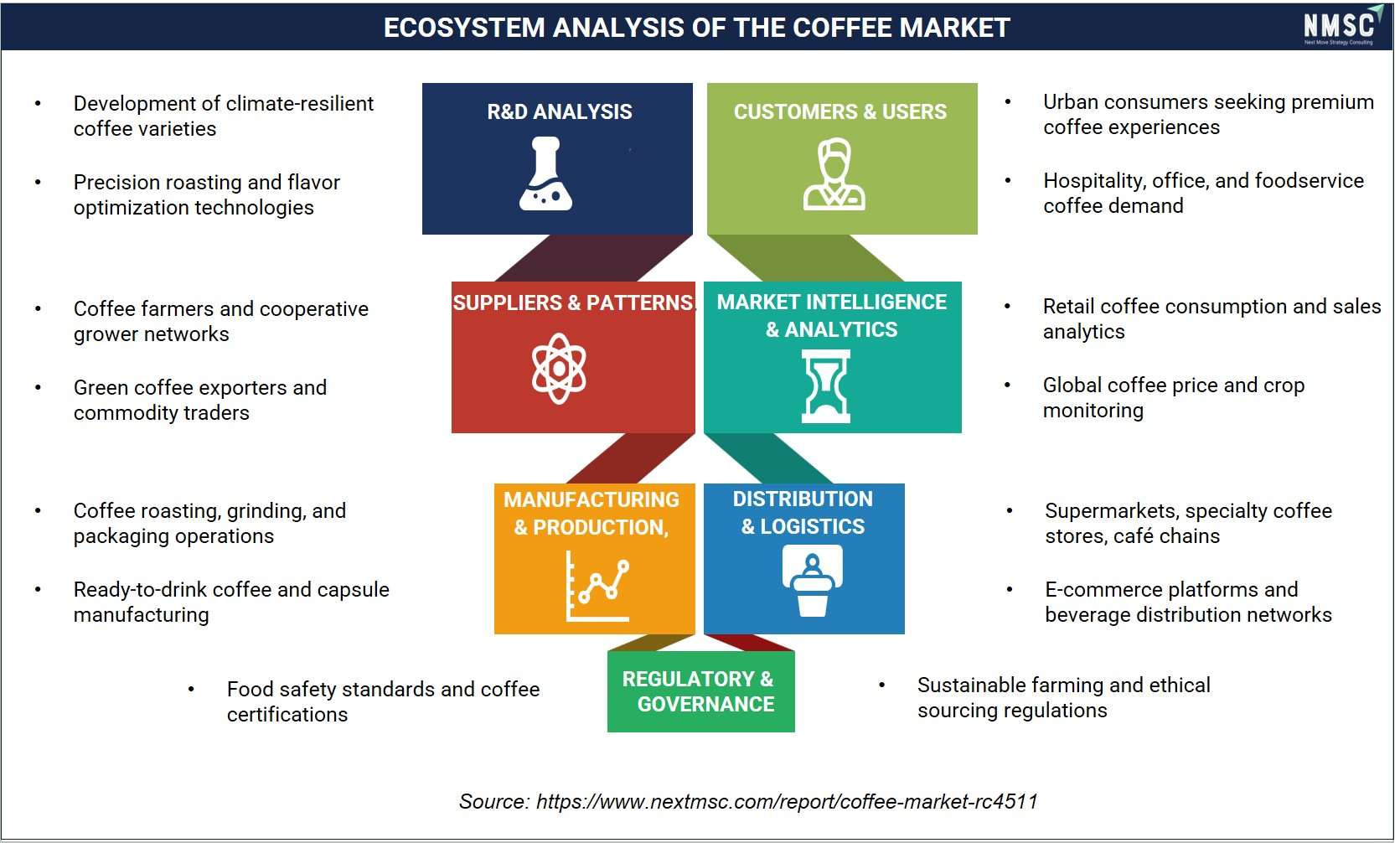
Based on our evaluation of the global coffee value chain, the coffee ecosystem reflects a coordinated structure connecting innovation, supply, production, and consumption. R&D activities support advancements in coffee cultivation and roasting technologies, while evolving consumer demand across cafés, households, and foodservice channels drives product innovation. At the same time, suppliers, manufacturers, and distributors ensure efficient processing and market availability. Consequently, regulatory frameworks and sustainability initiatives reinforce quality standards, supply transparency, and long-term market stability.
What Are the Key Market Drivers, Breakthroughs, And Investment Opportunities That Will Shape the Coffee Industry in the Next Decade?
Growth Catalyst & Risk Assessment Matrix
|
DRIVERS / TRENDS / RESTRAINTS |
(+/–) % IMPACT ON CAGR FORECAST |
GEOGRAPHIC RELEVANCE |
IMPACT TIMELINE |
|
Expanding global coffee consumption and rapid growth of café culture across urban markets |
+1.2% |
North America & Europe mature; fastest growth in Asia-Pacific |
Short to medium term (1–3 years) |
|
Premiumization and rising demand for specialty coffee, single-origin beans, and artisanal roasting |
+0.9% |
North America, Europe, Japan, South Korea; expanding in emerging markets |
Medium term (2–4 years) |
|
Growth of ready-to-drink coffee and convenient beverage formats across retail and e-commerce channels |
+0.8% |
Asia-Pacific and North America leading; strong uptake in urban markets globally |
Short to medium term (1–3 years) |
|
Expansion of café networks and specialty coffee retail ecosystems |
+0.7% |
Asia-Pacific and Middle East emerging; strong presence in Europe & North America |
Medium term (2–4 years) |
|
Coffee price volatility and fragmented supply chains affecting procurement stability |
-0.6% |
Global; strongest impact in producing regions in Latin America and Africa |
Medium term (2–4 years) |
Based on our comprehensive evaluation of global coffee consumption trends, we observed that the market continues to expand steadily, supported by rising daily consumption, growing café culture, and increasing demand for premium and specialty coffee products. Our interactions with coffee roasters, café operators, and beverage distributors indicate that coffee increasingly functions as a lifestyle beverage across both on-premise and at-home consumption occasions. Additionally, product innovation across ready-to-drink coffee, specialty roasting, and capsule-based brewing systems continues expanding consumption formats and improving consumer accessibility. At the same time, evolving consumer preferences for sustainable sourcing, traceable supply chains, and high-quality beans further strengthen brand differentiation across the market. Consequently, the combination of expanding café ecosystems, premiumization trends, and diversified retail distribution continues reinforcing long-term growth across the global coffee market.
Growth Drivers:
How Is Rising Global Coffee Consumption and Expanding Café Culture Driving Coffee Market Growth?
Based on our interactions with coffee roasters, café operators, and retail beverage distributors, we observed that rising global coffee consumption and expanding café culture significantly drive growth across the market. Through discussions with foodservice operators and retail category managers, respondents consistently highlight that coffee increasingly functions as a daily lifestyle beverage across workplaces, social gatherings, and on-the-go consumption occasions. Our evaluation of café network expansion and retail coffee sales indicates that specialty coffeehouses, independent cafés, and premium roasting brands continue scaling their presence across major urban markets. Furthermore, beverage innovation across cold brew, specialty espresso beverages, and ready-to-drink coffee products strengthens consumer engagement, particularly among younger demographics. Coffee beans companies therefore invest in experiential café environments, digital ordering platforms, and diversified beverage portfolios to capture evolving consumption preferences. Consequently, expanding café ecosystems and evolving urban consumption habits continue reinforcing sustained growth across the global coffee market.
How Are Premiumization and Specialty Coffee Trends Accelerating Coffee Market Expansion?
Based on our evaluation of retail product launches and café menu innovation, we observed that premiumization and specialty coffee trends accelerate expansion across the global coffee market. Through engagement with roasting companies, specialty cafés, and beverage retailers, respondents emphasize growing consumer demand for artisanal roasting profiles, single-origin beans, and differentiated flavor experiences. Our assessment of retail positioning strategies indicates that coffee brands increasingly expand premium product lines including specialty capsules, small-batch roasted beans, and high-quality ready-to-drink beverages. In addition, sustainable sourcing initiatives and transparent farmer partnerships strengthen brand credibility and consumer trust across premium coffee segments. Brewed coffee companies also highlight origin storytelling and roasting craftsmanship to differentiate products within competitive retail environments. As a result, premiumization elevates average product value while strengthening long-term consumer engagement. These dynamics support sustained market expansion as consumers increasingly prioritize quality, authenticity, and specialty coffee experiences.
Growth Inhibitor:
How Do Coffee Price Volatility and Supply Chain Fragmentation Limit Coffee Market Stability?
Based on our assessment of global coffee supply chains, we observed that price volatility and supply chain fragmentation act as structural restraints influencing coffee market stability. Through discussions with coffee exporters, roasting companies, and beverage distributors, respondents highlight that coffee prices frequently fluctuate due to weather variability, harvest cycles, and commodity market dynamics. As a result, unpredictable raw bean prices create cost pressures for roasting companies and packaged premium coffee manufacturers, particularly when procurement contracts are tied to international commodity exchanges. In addition, the coffee supply chain remains highly fragmented, involving numerous smallholder farmers, intermediaries, and exporters, which complicates sourcing transparency and procurement efficiency. Consequently, price instability and supply chain fragmentation continue to pose significant challenges for market participants, affecting procurement strategies, operational planning, and overall profitability across the global coffee industry.
Growth Opportunity:
How Is the Expansion of Ready-to-Drink Coffee and Retail Innovation Creating Market Opportunities?
From our evaluation of emerging beverage consumption patterns, we identified ready-to-drink coffee and retail innovation as significant opportunities within the coffee market. Our review of product launches and beverage portfolio expansion indicates that ready-to-drink coffee beverages increasingly attract consumers seeking convenient and on-the-go coffee options across supermarkets, convenience stores, and digital retail platforms. Based on our analysis of beverage innovation strategies, we observed that coffee companies actively introduce flavored cold brew drinks, functional coffee beverages, and premium canned coffee products targeting younger urban consumers. In addition, partnerships between coffee brands and retail chains expand product visibility and strengthen distribution across high-traffic retail channels. Brands also leverage e-commerce platforms, subscription services, and direct-to-consumer sales models to deepen consumer engagement. As a result, innovation in beverage formats and retail distribution models unlocks new consumption occasions and strengthens long-term growth opportunities across the global coffee market.
Consumer Behavour Analysis Impacting the Coffee Industry
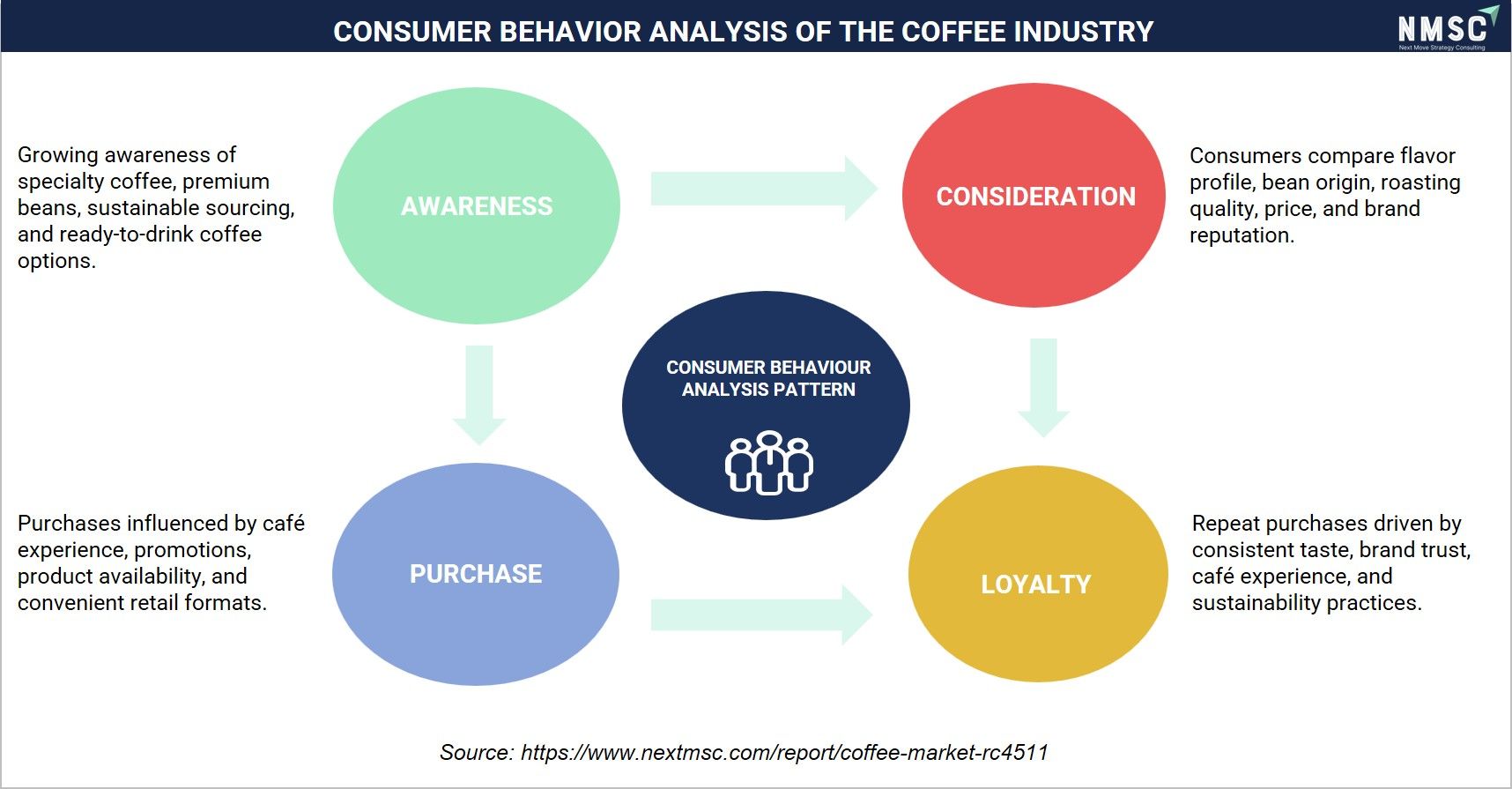
Based on our analysis of consumer purchasing patterns in the coffee industry, we learned that the consumer journey progresses through four key stages: awareness, consideration, purchase, and loyalty. Consumers initially develop awareness through growing interest in specialty coffee, premium beans, and sustainable sourcing practices. They then evaluate options by comparing flavor profiles, bean origin, roasting quality, and brand reputation. Purchasing decisions are further influenced by café experiences, promotional offers, and convenient retail availability. Consequently, consistent product quality, brand trust, and sustainable practices strengthen customer loyalty and encourage repeat coffee consumption.
How Is the Coffee Market Segmented in This Report, And What Are the Key Insights from the Segmentation Analysis?
Market Highlights & Strategic Insights – Coffee Market:
|
Segments |
Key Takeaways |
|
Product Form |
Ground Coffee dominates the market, as industry analysis indicates strong household consumption and widespread retail availability. Whole Bean Coffee gains traction among specialty coffee consumers seeking freshness and flavor control. Soluble Coffee maintains steady demand due to convenience, while Coffee Pods & Capsules and Ready-to-Drink Coffee expand rapidly with the growth of single-serve and on-the-go consumption trends. |
|
Bean Type |
Arabica dominates the market, as market evidence suggests strong consumer preference for its smoother taste and premium positioning. Robusta remains widely used in instant coffee and blended products due to higher caffeine content and lower production cost. Meanwhile, Blends continue gaining popularity as brands balance flavor profile, supply stability, and pricing. |
|
Roast Level |
Medium Roast dominates the market, as industry trends indicate broad consumer preference for balanced flavor and aroma across retail and foodservice channels. Dark Roast remains prominent in espresso-based beverages, while Light Roast gains traction within specialty coffee segments focused on origin-specific flavor profiles. |
|
Caffeine Type |
Regular Coffee dominates the market, as industry data indicates strong demand for caffeinated beverages supporting daily energy consumption. Decaffeinated Coffee represents a smaller but steadily expanding segment, supported by health-conscious consumers seeking reduced caffeine intake. |
|
Flavour |
Unflavoured Coffee dominates the market, reflecting traditional consumption patterns and preference for natural coffee taste. However, Flavoured Coffee continues expanding as market intelligence suggests rising demand for vanilla, caramel, hazelnut, and chocolate variants, particularly among younger consumers and specialty beverage segments. |
|
Packaging Type |
Pouches dominate the market, as procurement trends suggest strong preference for lightweight, cost-efficient packaging suitable for large retail distribution. Glass Jars and Cans remain common for instant coffee packaging, while Stick Packs and Bottles expand with the growth of convenient and ready-to-drink coffee formats. |
|
Price Tier |
Mid-Range Coffee dominates the market, as industry patterns indicate strong demand from mainstream consumers seeking balanced price and quality. Economy Coffee maintains steady demand in price-sensitive regions, while Premium and Specialty Coffee expand rapidly as consumers increasingly prioritize origin transparency, quality beans, and artisanal roasting. |
|
End User |
Household Consumers dominate the market, as market indicators show widespread daily coffee consumption across residential settings. Commercial Establishments, including cafes, restaurants, hotels, and offices, contribute significantly to demand driven by out-of-home consumption. Institutional Consumers and Travel & Leisure venues further support market growth across hospitals, educational institutions, airports, and other transit environments. |
By Product Form Insights
Which Product Forms Drive Demand in the Coffee Market?
Based on current market analysis of global coffee consumption patterns, the market is segmented by product form into whole bean coffee, ground coffee, soluble coffee, coffee pods and capsules, and ready-to-drink coffee.
Industry analysis indicates that ground coffee accounts for a significant share of consumption due to its widespread availability across retail channels and ease of preparation in households and foodservice environments. At the same time, soluble coffee maintains strong demand in convenience-driven markets where instant preparation remains a key purchasing factor. Meanwhile, coffee pods and capsules gain steady traction as single-serve brewing systems expand in households and offices. As consumer lifestyles increasingly favor convenience and consistency, product form continues to play a critical role in shaping coffee consumption preferences globally.

By Bean Type Insights
How Does Bean Type Influence Demand in the Coffee Market?
Based on industry evaluation of coffee production and consumption trends, the coffee market is segmented by bean type into Arabica, Robusta, blends, and other varieties.
Market evidence suggests that Arabica beans dominate global consumption due to their smoother flavor profile, lower bitterness, and strong positioning within premium and specialty coffee segments. In contrast, Robusta beans remain widely used in instant coffee and commercial blends because of their higher caffeine content, stronger taste, and cost efficiency in large-scale production. Meanwhile, blended coffee varieties continue gaining traction as producers combine Arabica and Robusta to balance flavor complexity, supply stability, and pricing. As consumer preferences evolve toward quality and origin transparency, bean selection increasingly influences product positioning across coffee categories.

By Distribution Channel Insights
How Do Distribution Channels Shape the Coffee Market?
Based on current analysis of coffee retail dynamics, the market is segmented by distribution channel into offline and online.
Industry data indicates that supermarkets and hypermarkets account for a major share of global coffee sales, supported by wide product assortments, competitive pricing, and strong consumer footfall. Convenience stores contribute significantly to on-the-go purchases, particularly for ready-to-drink and instant coffee formats. Meanwhile, specialty stores gain traction among consumers seeking premium, artisanal, and specialty coffee products. Online retail continues to expand rapidly, driven by the growth of e-commerce marketplaces and brand-owned websites offering product variety, subscription models, and direct-to-consumer engagement. As purchasing behavior increasingly shifts toward convenience and digital platforms, distribution channels play a critical role in shaping market accessibility and growth.
Regional Outlook:
Geographic Performance Snapshot:
|
Geography |
Key Takeaways |
|
North America |
A mature and high-consumption market supported by strong café culture, specialty coffee adoption, and growing demand for premium packaged and ready-to-drink coffee products. |
|
Europe |
One of the most established coffee markets globally, characterized by high per-capita consumption, strong espresso traditions, and increasing demand for specialty and sustainably sourced coffee. |
|
Asia Pacific |
The fastest-growing region, driven by urbanization, expanding café networks, rising disposable incomes, and growing popularity of specialty and ready-to-drink coffee beverages. |
|
Latin America |
A major global coffee production hub with expanding domestic consumption, supported by strong coffee heritage, growing urban café culture, and rising specialty coffee demand. |
|
Middle East & Africa |
An emerging coffee consumption market where premium café expansion, specialty coffee experiences, and rising urban demand gradually strengthen regional market growth. |
The coffee market is geographically studied across North America, Europe, Asia Pacific, Latin America and Middle East & Africa and each region is further studied across countries.
Coffee Market in North America
North America represents a mature and consumption-driven coffee ecosystem, supported by strong café culture, premium beverage innovation, and well-established retail distribution networks. From our regional assessments, we estimated that North America accounts for a substantial share of global coffee consumption, supported by high per-capita intake and widespread availability across retail and foodservice channels. The United States leads regional demand through large coffeehouse chains, specialty roasters, and ready-to-drink beverage manufacturers, while Canada contributes steady growth through urban café expansion and premium packaged coffee sales. Additionally, strong purchasing power and lifestyle-driven beverage habits reinforce daily consumption across households and workplaces. As a result, beverage brands, roasters, and café operators increasingly invest in specialty blends, single-origin offerings, and sustainable sourcing programs, which gradually raise product value and strengthen long-term market expansion.
Coffee Market in the United States
The United States coffee market stands as the largest contributor to regional consumption, supported by deeply embedded coffee drinking habits and a highly developed café industry. Based on our engagements with specialty roasters and beverage retailers, we observed that daily coffee consumption remains strongly integrated into both workplace routines and social lifestyles. Major coffeehouse chains, independent cafés, and convenience retailers continue expanding beverage menus, introducing cold brew, flavored lattes, and functional coffee drinks. At the same time, grocery retailers and e-commerce platforms strengthen packaged coffee sales, particularly premium ground coffee and single-serve capsules. Furthermore, rising interest in ethically sourced and traceable beans encourages roasters to highlight origin transparency and sustainable farming partnerships. These dynamics support product innovation, brand differentiation, and premium positioning, reinforcing the United States as the most dynamic coffee consumption market in North America.
Coffee Market in Canada
In our discussions with beverage distributors and café operators, we found that Canadian consumers increasingly prefer higher-quality beans, specialty roasting profiles, and café-style beverages across both foodservice and retail channels. This shift toward premium coffee experiences strengthens demand in metropolitan areas such as Toronto, Vancouver, and Montreal, where independent cafés and established coffee chains expand their beverage offerings. Additionally, supermarkets and online grocery platforms increase shelf space for specialty blends, organic coffee, and ethically sourced products, allowing roasters to highlight origin transparency and sustainability credentials. Compared with the United States, Canadian consumers purchase slightly lower volumes per occasion; however, they consistently demonstrate stronger interest in premium packaged coffee and artisanal roasting styles. As a result, coffee brands, roasters, and retail distributors continue investing in quality differentiation, reinforcing stable and long-term growth across the Canadian coffee market.
Coffee Market in Europe
Industry analysis indicates that Europe maintains one of the most mature and culturally embedded coffee markets globally, supported by strong daily consumption habits and a well-established café ecosystem. The region demonstrates consistently high per-capita coffee intake across both household and foodservice channels, with supermarkets, specialty roasters, and coffeehouse chains forming a dense distribution network. Consumption patterns vary across the continent; Northern Europe records some of the highest daily coffee intake globally, while Western Europe strengthens specialty café culture and premium beverage experiences. Meanwhile, Southern European countries sustain strong espresso-based traditions anchored in neighborhood cafés and social consumption rituals. Additionally, sustainability certifications and traceable sourcing programs increasingly influence purchasing decisions across retail and café environments. Consequently, coffee roasters, beverage brands, and café operators continue investing in specialty blends and premium beans, reinforcing Europe’s position as a globally influential coffee consumption region.
Coffee Market in the United Kingdom
Based on our engagement with coffee roasters and café operators, we observed that consumer preferences in the United Kingdom increasingly shift toward artisanal roasting profiles, single-origin beans, and specialty espresso beverages. The country’s rapidly expanding café landscape continues shaping urban consumption habits, particularly across cities such as London, Manchester, and Birmingham. Large coffeehouse chains maintain strong national presence, while independent cafés actively introduce innovative brewing techniques and premium beverage formats. At the same time, supermarkets and online grocery platforms strengthen packaged coffee sales, particularly capsules, premium ground coffee, and ready-to-drink beverages. Sustainability credentials and origin transparency also gain importance among younger consumers. As a result, continuous innovation in beverage menus, roasting techniques, and retail offerings steadily reinforces the United Kingdom’s role as one of Europe’s most dynamic coffee markets.
Coffee Market in Germany
Industry insights indicate that Germany’s market remains strongly anchored in packaged retail consumption, where ground coffee and whole beans dominate supermarket and discount retail shelves. Household coffee drinking habits remain deeply integrated into daily routines, sustaining stable demand across retail distribution channels. Large supermarket chains and discount retailers play a central role in product accessibility, enabling coffee brands and roasting companies to maintain strong nationwide penetration. Meanwhile, specialty cafés and boutique roasters continue expanding across major cities such as Berlin and Hamburg, introducing consumers to premium single-origin beans and alternative brewing methods. Office coffee services also contribute meaningfully to national consumption, supporting daily beverage demand in workplace environments. Consequently, strong retail infrastructure, combined with evolving specialty coffee culture, continues reinforcing Germany as one of Europe’s most stable and high-volume coffee markets.
Coffee Market in France
Coffee distributors and café operators report that French consumers increasingly balance traditional café rituals with growing interest in premium coffee experiences. Espresso-based drinks remain central to everyday consumption across cafés, restaurants, and neighborhood coffee bars, particularly in urban centers such as Paris and Lyon. At the same time, specialty cafés and boutique roasters gradually introduce single-origin beans, cold brew beverages, and lighter roasting styles, attracting younger consumers seeking differentiated coffee flavors. Retail channels also expand premium packaged coffee selections, including organic beans and ethically sourced blends. Sustainability awareness and origin transparency increasingly influence purchasing decisions across both cafés and supermarkets. Accordingly, the combination of strong café culture and emerging specialty coffee trends continues supporting steady development across the French market.
Coffee Market in Italy
Italy demonstrates one of the most culturally influential coffee markets worldwide, where espresso traditions remain deeply integrated into everyday consumer routines. Data analysis reveals that neighborhood coffee bars continue serving as the primary point of consumption across cities and towns, reinforcing coffee’s role as a social and cultural ritual. Espresso dominates beverage menus, while cappuccino and other milk-based drinks maintain strong morning demand in cafés and bakeries. Domestic roasting companies maintain strong market presence and supply espresso blends both locally and internationally. Meanwhile, retail channels demonstrate stable demand for moka-pot coffee, ground espresso blends, and capsule systems used in households. Italian consumers consistently prioritize roasting heritage, flavor balance, and brand familiarity. Therefore, enduring café traditions and strong brand loyalty continue reinforcing Italy’s leadership in global coffee culture.
Coffee Market in Spain
Industry insights indicate that Spain’s coffee consumption is increasingly evolving in parallel with the expansion of café culture and the growing demand for beverages across the hospitality sector. . Cafés, restaurants, and hotel chains remain central to consumption across major urban centers such as Madrid and Barcelona, where coffee accompanies both dining and social gatherings. Espresso-based beverages dominate menus, while iced coffee drinks and specialty beverages gradually gain traction among younger consumers. Meanwhile, supermarkets and convenience retailers steadily expand packaged coffee offerings, particularly capsule systems and ready-to-drink beverages suited for on-the-go consumption. Tourism activity further strengthens coffee demand across hospitality venues, reinforcing consistent beverage consumption throughout the year. As a result, café expansion, hospitality sector growth, and evolving beverage innovation continue supporting long-term development across the Spanish coffee market.
Coffee Market in the Nordics
Industry insights indicate that the Nordic countries, particularly Sweden, Finland, and Norway, represent some of the highest per-capita coffee consuming markets globally. Daily coffee drinking remains deeply embedded in social routines and workplace culture, where filter coffee and light-roast profiles dominate household and office consumption. Supermarkets and specialty roasters maintain strong product availability, while cafés increasingly introduce single-origin beans and artisanal roasting techniques to meet evolving consumer preferences. Additionally, sustainability credentials and ethical sourcing play a decisive role in purchasing decisions, as Nordic consumers demonstrate strong environmental awareness. Coffee brands and roasting companies therefore emphasize organic certification, transparent sourcing, and eco-friendly packaging across product portfolios. Consequently, strong consumption traditions, combined with premium and sustainability-focused product positioning, continue reinforcing the Nordic region as a stable and high-value market in Europe.
Coffee Market in the Asia-Pacific
Market indicators show that the Asia-Pacific market evolves rapidly as urbanization, rising disposable incomes, and expanding café culture reshape beverage consumption patterns across major economies. The region combines mature coffee markets such as Japan and Australia with rapidly expanding consumption hubs including China, South Korea, and Southeast Asia. Growing middle-class populations increasingly adopt coffee as part of modern urban lifestyles, particularly through specialty cafés, ready-to-drink beverages, and premium packaged coffee products. In addition, international coffeehouse chains and regional café operators continue expanding store networks across metropolitan areas, strengthening consumer exposure to specialty coffee experiences. Retail channels also broaden product availability through instant coffee, capsules, and premium ground blends. As a result, expanding café ecosystems and evolving consumer preferences continue positioning Asia-Pacific as the fastest-growing coffee consumption region globally.
Coffee Market in China
China’s coffee market demonstrates one of the fastest consumption growth trajectories globally, supported by rapid urban lifestyle shifts and expanding specialty café networks. Based on our interactions with beverage distributors and café operators, we observed that younger consumers increasingly adopt coffee as a daily lifestyle beverage, particularly across major cities such as Shanghai, Beijing, and Shenzhen. International coffeehouse brands and domestic café chains continue opening new outlets, strengthening consumer familiarity with espresso-based drinks and specialty beverages. Meanwhile, ready-to-drink coffee and instant coffee products maintain strong retail presence through supermarkets and e-commerce platforms. Domestic beverage companies actively innovate with flavored coffee drinks and convenient packaged formats suited for on-the-go consumption. Consequently, expanding café infrastructure, digital retail channels, and evolving consumer habits continue reinforcing China’s rapidly developing market.
Coffee Market in Japan
Japan represents one of the most mature and technologically sophisticated coffee markets in Asia, characterized by strong retail penetration and diverse consumption formats. Data analysis reveals that canned coffee and ready-to-drink beverages maintain exceptional popularity through vending machines, convenience stores, and supermarkets across the country. At the same time, specialty cafés and premium roasting companies steadily expand in urban centers such as Tokyo and Osaka, introducing artisanal brewing techniques and high-quality single-origin beans. Japanese consumers consistently prioritize product quality, flavor consistency, and precise preparation methods, encouraging beverage brands to maintain rigorous roasting standards and product innovation. Convenience retailers also play a central role in daily coffee consumption by offering freshly brewed coffee through in-store machines. Accordingly, Japan’s combination of convenience-driven retail channels and premium café experiences continues sustaining a stable and high-value market.
Coffee Market in India
India’s coffee market demonstrates one of the fastest evolving consumption landscapes in Asia, supported by urban lifestyle shifts, expanding café culture, and rising middle-class purchasing power. Based on our interactions with beverage distributors and café operators, we found that coffee consumption increasingly expands beyond traditional southern markets into major metropolitan areas such as Delhi, Mumbai, and Bengaluru. Domestic café chains and international coffeehouse brands continue expanding store networks, introducing espresso-based drinks, cold brews, and specialty beverages to younger consumers. Meanwhile, instant coffee and ready-to-drink products maintain strong retail presence through supermarkets and e-commerce platforms. Local coffee producers and roasting companies also highlight Indian-origin beans from regions such as Karnataka and Kerala, strengthening domestic brand identity. Therefore, growing café penetration, premium beverage experimentation, and evolving urban consumption habits continue reinforcing India’s rapidly expanding market.
Coffee Market in South Korea
South Korea represents one of Asia’s most sophisticated café-driven markets, where urban consumers demonstrate strong affinity for premium beverages and specialty coffee experiences. Coffee consumption remains deeply integrated into social and workplace routines, particularly across metropolitan centers such as Seoul and Busan. Large café chains and boutique coffee shops maintain dense store networks, offering specialty brews, artisanal roasting profiles, and innovative seasonal beverages. At the same time, convenience stores and supermarkets expand ready-to-drink coffee offerings, supporting on-the-go consumption among young professionals. Beverage brands also experiment with premium beans and unique roasting techniques to differentiate products within a highly competitive café environment. In response, strong café density, product innovation, and evolving consumer preferences continue reinforcing South Korea’s position as a high-value market in Asia.
Coffee Market in Taiwan
Industry analysis indicates that Taiwan maintains a highly quality-focused coffee market, supported by strong consumer appreciation for specialty beans and artisanal brewing techniques. Independent cafés and specialty roasters play a significant role in shaping consumption trends, particularly in urban centers such as Taipei and Taichung. Consumers demonstrate growing interest in single-origin beans, manual brewing methods, and premium roasting profiles that emphasize flavor clarity and origin characteristics. Retail channels also expand offerings of specialty ground coffee, capsules, and premium packaged beans, allowing consumers to replicate café-style experiences at home. Local roasters increasingly collaborate with international coffee producers to introduce diverse flavor profiles into the market. As a result, Taiwan’s emphasis on craftsmanship, quality differentiation, and specialty café culture continues strengthening its reputation as a premium market in Asia.
Coffee Market in Indonesia
Based on NMSC analysis Indonesia’s coffee market evolves through a combination of strong domestic coffee production and rapidly expanding urban consumption. Traditional coffee drinking habits remain widespread, while younger consumers increasingly explore specialty cafés and modern coffee beverages across major cities such as Jakarta and Surabaya. Domestic café chains and independent coffee shops continue expanding networks, introducing espresso-based drinks, cold brews, and specialty blends. At the same time, supermarkets and convenience stores strengthen distribution of instant coffee and ready-to-drink products, which remain highly popular among everyday consumers. Local roasting companies actively highlight Indonesian-origin beans such as Sumatra and Java, strengthening national coffee identity. Therefore, the combination of rich coffee heritage and expanding urban café culture continues supporting sustained growth across Indonesia’s market.
Coffee Market in Australia
Australia demonstrates one of the most sophisticated specialty coffee cultures globally, where café-driven consumption and artisanal roasting traditions shape everyday beverage preferences. Data analysis reveals that independent cafés and boutique roasters play a central role in the national coffee ecosystem, particularly across cities such as Melbourne and Sydney. Consumers consistently favor high-quality espresso beverages, flat whites, and specialty blends prepared by skilled baristas. Meanwhile, supermarkets expand premium packaged coffee offerings, including whole beans and specialty ground coffee sourced from leading roasting companies. Sustainability, traceable sourcing, and ethical bean procurement increasingly influence purchasing behavior among Australian consumers. In turn, the combination of strong café expertise, premium product positioning, and innovation in roasting techniques continues reinforcing Australia’s leadership in global specialty coffee culture.
Coffee Market in Latin America
Latin America represents one of the world’s most influential coffee regions, serving both as a major production hub and a steadily expanding consumption market. Industry analysis indicates that countries such as Brazil, Colombia, and Mexico drive regional coffee activity through strong domestic production and growing urban consumption. While traditional coffee drinking habits remain deeply rooted across households, urban café culture increasingly shapes demand in major cities. Independent cafés, local roasting companies, and international coffeehouse brands continue expanding their presence, introducing specialty blends and premium brewing formats to younger consumers. At the same time, supermarkets and convenience retailers strengthen packaged coffee distribution, particularly ground coffee and instant formats suited for everyday consumption. Consequently, the combination of strong coffee heritage, expanding café ecosystems, and evolving consumer preferences continues reinforcing Latin America’s dynamic coffee market.
Coffee Market in the Middle East & Africa
According to analysis conducted by NMSC coffee consumption across the Middle East and Africa evolves through two distinct patterns shaped by premium café expansion in Gulf economies and emerging urban demand across African markets. Gulf countries demonstrate rapidly growing specialty coffee markets supported by high purchasing power, strong café density, and premium beverage experimentation across cities such as Dubai and Riyadh. International coffeehouse chains and boutique specialty cafés continue expanding networks, introducing artisanal roasting styles and single-origin beans to increasingly sophisticated consumers. In contrast, several African markets demonstrate early-stage but steadily rising urban coffee consumption supported by expanding retail distribution and café culture in major metropolitan areas. Meanwhile, instant coffee and packaged formats maintain strong presence across supermarkets and convenience stores. As a result, expanding café ecosystems and evolving consumer preferences continue supporting long-term growth across the Middle East and African market.
Competitive Landscape
Competitive Dynamics & M&A Landscape:
|
Key Takeaways |
|
The global coffee market is shaped by large multinational beverage companies alongside established specialty roasting brands. Nestlé S.A., Starbucks Corporation, Keurig Dr Pepper Inc., The J. M. Smucker Company, Luigi Lavazza S.p.A., Tchibo GmbH, UCC Ueshima Coffee Co., Ltd.,, Melitta Group Management GmbH & Co. KG, Tata Consumer Products Limited, Paulig Ltd, Strauss Group Ltd., Massimo Zanetti Beverage Group S.p.A., The Kraft Heinz Company, illycaffè S.p.A., Alois Dallmayr KG, Löfbergs AB, DELTA SERVIÇOS – CONSULTORIA E SERVIÇOS, UNIPESSOAL LDA, Caffè Vergnano S.p.A., SUPPLY UNIQUE S.A., and Café Britt S.A. leverage global distribution networks, diversified product portfolios, and strong brand recognition to maintain market leadership. Meanwhile, heritage roasters including Illycaffè, Melitta Group, Tchibo, Strauss Group, Massimo Zanetti Beverage Group, Delta Cafés, Dallmayr, Löfbergs, Café Britt, Caffè Vergnano, and Paulig Group strengthen competition through premium roasting expertise and differentiated specialty coffee offerings. |
|
From our assessment of competitive strategies, companies increasingly prioritize premiumization, specialty roasting innovation, and omnichannel retail expansion. Additionally, sustainable sourcing, traceable supply chains, and ready-to-drink coffee innovations continue shaping product development and consumer engagement across global markets. |
|
Recent consolidation also reflects efforts to strengthen distribution capabilities and expand foodservice presence across the market. Strategic partnerships and portfolio expansion initiatives allow companies to improve supply chain efficiency, broaden hospitality channel offerings, and strengthen competitive positioning across both retail and café segments. |
Which Companies Dominate the Coffee Industry and How Do They Compete?
Based on our analysis, we noticed that the coffee market is dominated by a mix of global beverage conglomerates, established specialty coffee brands, and vertically integrated roasting companies that compete across retail, foodservice, and packaged coffee channels. Nestlé, JDE Peet’s, Keurig Dr Pepper, The J. M. Smucker Company, and The Kraft Heinz Company consistently maintain strong market presence through extensive retail distribution networks, diversified product portfolios, and large-scale manufacturing capabilities. In addition, these companies leverage global sourcing networks, advanced roasting operations, and strong brand portfolios spanning instant coffee, premium ground coffee, capsules, and ready-to-drink beverages. From our evaluation of retail and foodservice channels, we observed that these firms strengthen coffee market share through omnichannel distribution, long-standing retail partnerships, and continuous product innovation. As a result, their scale advantages, brand visibility, and distribution strength allow them to maintain leadership across multiple coffee consumption segments.
Market Dominated by Coffee Giants and Specialists
Industry insights indicate that the competitive landscape is further shaped by renowned roasting companies and specialty coffee brands including Lavazza, Illycaffè, Melitta Group, Tchibo, Strauss Group, Massimo Zanetti Beverage Group, UCC Holdings, Delta Cafés, Dallmayr, and Löfbergs. These companies differentiate primarily through premium roasting expertise, strong brand heritage, and a focus on high-quality beans sourced from established coffee-growing regions. Furthermore, regional leaders such as Tata Consumer Products, Café Britt, Paulig Group, and Caffè Vergnano strengthen market reach through localized distribution strategies and expanding café networks. From our channel assessments, we identified that specialty-focused brands gain traction by emphasizing single-origin beans, artisanal roasting techniques, and sustainable sourcing initiatives. Consequently, while multinational beverage companies dominate global volume, heritage roasters and specialty coffee brands increasingly drive premiumization and product differentiation within the coffee market.
Innovation and Adaptability Drive Market Success
Innovation continues to serve as a critical determinant of competitive advantage in the coffee market as companies expand premium offerings and diversified beverage formats. Market evidence suggests that leading players such as Nestlé, JDE Peet’s, Lavazza, Illycaffè, and Keurig Dr Pepper actively invest in product development across specialty coffee, capsule systems, and ready-to-drink beverages to capture evolving consumer preferences. Moreover, roasting companies including Tchibo, Melitta Group, and Paulig Group continue strengthening premium packaged coffee portfolios and sustainability initiatives to reinforce brand credibility among environmentally conscious consumers. From our evaluation of product launches and retail positioning strategies, we observed that companies integrating traceable sourcing programs, advanced roasting technology, and differentiated beverage experiences consistently enhance consumer loyalty. Therefore, innovation in product formats, roasting expertise, and sustainability credentials continues strengthening long-term competitive positioning across the coffee market.
Market Players to Opt for Merger & Acquisition Strategies to Expand Their Presence
Based on our research, mergers and acquisitions increasingly serve as a strategic growth lever within the coffee market as companies seek to strengthen distribution capabilities and expand their product portfolios. In particular, consolidation enables companies to scale roasting capacity, broaden foodservice offerings, and enhance supply chain efficiencies. In March 2026, Farmer Brothers entered into a definitive agreement to be acquired by Royal Cup Coffee & Tea for USD 1.29 per share in an all-cash transaction. From our assessment of the transaction, we identified that this merger combines two long-established names in the U.S. coffee industry to create a more integrated beverage solutions platform focused on hospitality and foodservice sectors. Consequently, such consolidation strengthens operational scale, enhances service capabilities for restaurant and hospitality clients, and improves competitive positioning. As competition intensifies across both retail and café channels, strategic acquisitions continue reshaping the competitive landscape while enabling companies to expand capabilities and accelerate long-term growth across the coffee market..
Pain Point Analysis of the Coffee Market
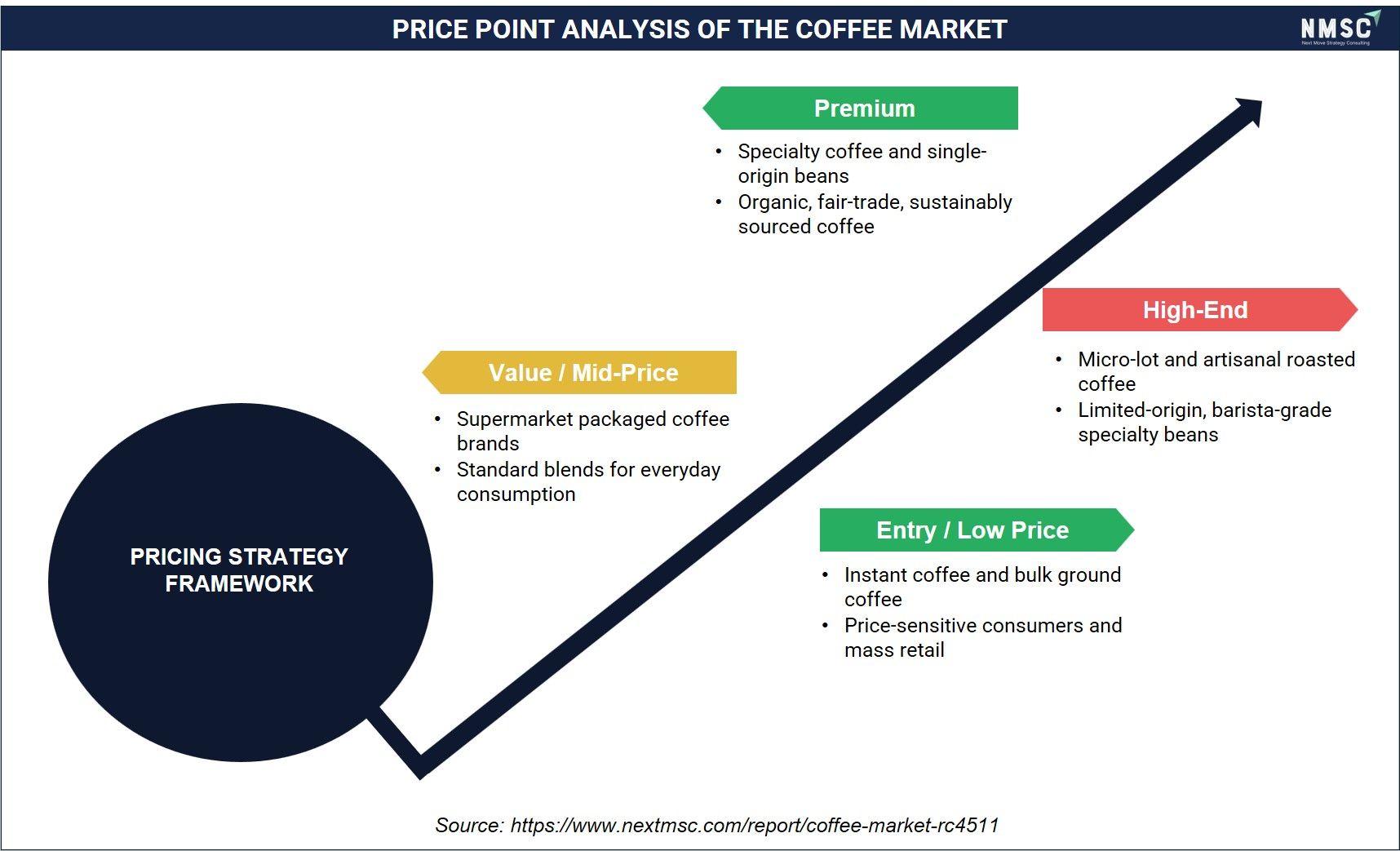
Based on our analysis of coffee pricing dynamics,we noticed that the market follows a tiered structure ranging from entry-level instant and bulk coffee to premium and high-end specialty offerings. While value and mid-price segments dominate everyday consumption through packaged retail brands, demand increasingly shifts toward specialty, single-origin, and sustainably sourced coffee. Consequently, premium and high-end segments gain traction as consumers prioritize quality, origin transparency, and differentiated coffee experiences.
List of Key Coffee Companies
-
Nestlé S.A.
-
Starbucks Corporation
-
Keurig Dr Pepper Inc.
-
The J. M. Smucker Company
-
Luigi Lavazza S.p.A.
-
Tchibo GmbH
-
UCC Ueshima Coffee Co., Ltd.
-
Melitta Group Management GmbH & Co. KG
-
Tata Consumer Products Limited
-
Paulig Ltd
-
Strauss Group Ltd.
-
Massimo Zanetti Beverage Group S.p.A.
-
The Kraft Heinz Company
-
illycaffè S.p.A.
-
Alois Dallmayr KG
-
Löfbergs AB
-
DELTA SERVIÇOS – CONSULTORIA E SERVIÇOS, UNIPESSOAL LDA
-
Caffè Vergnano S.p.A.
-
SUPPLY UNIQUE S.A.
-
Café Britt S.A.
What Are The Latest Key Industry Developments?
-
June 2026 – Starbucks Corporation expanded its ready-to-drink beverage portfolio with the retail launch of a bottled Strawberry Açaí Lemonade Refresher, one of the brand’s most popular café beverages. The product was introduced across grocery and national retail channels to strengthen Starbucks’ presence in the at-home beverage category and capitalize on growing demand for convenient premium beverages outside traditional coffee shops.
-
March 2026 – Luigi Lavazza S.p.A. reported consolidated revenues of approximately €3.9 billion for fiscal year 2025, reflecting strong growth despite record-high green coffee prices and challenging global market conditions. The company attributed its performance to continued expansion in international markets, particularly North America, premium portfolio growth, and strategic investments in branded coffee products. Lavazza also highlighted its commitment to innovation, sustainability, and supply-chain resilience as key pillars supporting long-term growth in the increasingly competitive global coffee market.
-
November 2025 – Löfbergs AB launched one of Europe's first commercially available Regenerative Organic Certified (ROC) coffee products. The launch represented a significant milestone in the coffee industry's sustainability journey, moving beyond conventional certification schemes toward regenerative agricultural practices that prioritize soil health, biodiversity, carbon sequestration, and ecosystem restoration. The initiative further strengthened Löfbergs’ position as a sustainability-focused coffee producer while responding to growing consumer demand for ethically sourced and environmentally responsible coffee products.
What Are The Key Factors Influencing Investment Analysis & Opportunities In The Coffee Market?
Investment activity in the coffee market increasingly reflects a shift toward brand-led, premiumization-driven, and vertically integrated business models, rather than purely commodity-based coffee trading. Based on our evaluation of recent funding activity, strategic acquisitions, and brand expansion initiatives, we observed that investors favour companies demonstrating strong consumer brand equity, scalable retail distribution, and differentiated product portfolios across specialty coffee, ready-to-drink beverages, and premium packaged formats. Coffee brands with direct-to-consumer capabilities, omnichannel retail presence, and strong supply chain traceability consistently attract higher investment interest, particularly when supported by sustainable sourcing programs and transparent farmer partnerships.
We also identified growing investment concentration around specialty roasting, ready-to-drink coffee innovation, and digital café expansion models, particularly in markets experiencing rapid urban consumption growth. Strategic investments increasingly originate from beverage conglomerates, foodservice operators, and retail groups seeking portfolio diversification and stronger positioning within premium beverage categories. Additionally, investors show strong interest in companies integrating advanced roasting technology, sustainable packaging, and traceable sourcing platforms that enhance brand credibility and consumer trust. For investors, the most attractive opportunities emerge in coffee companies combining strong brand differentiation, scalable distribution networks, and consistent premium product innovation capable of sustaining long-term growth.
Key Benefits for Stakeholders:
Next Move Strategy Consulting (NMSC) presents a comprehensive analysis of the Coffee market trends, covering historical developments from 2020 to 2025 and providing forward-looking forecasts through 2035. The study evaluates the coffee market at global, regional, and country levels, providing quantitative outlooks alongside qualitative insights into key consumption drivers, supply dynamics, product innovation, and investment trends across major coffee segments. The analysis examines developments across retail, foodservice, and packaged coffee channels, while also assessing evolving consumer preferences toward specialty coffee, ready-to-drink beverages, and premium roasted products. In addition, the study highlights the influence of sustainability initiatives, traceable sourcing practices, and café culture expansion in shaping demand patterns across mature and emerging coffee markets.
From our observation, the coffee industry delivers measurable value to a diverse industry ecosystem. Investors benefit from growth opportunities driven by premium coffee brands, expanding café networks, and scalable retail distribution platforms. Coffee roasters and beverage companies gain stronger brand differentiation and higher margins through specialty roasting, product innovation, and premium packaging formats. Retailers, café operators, and foodservice chains benefit from steady consumer demand and diversified beverage offerings that strengthen customer engagement. Meanwhile, coffee producers and supply chain partners benefit from expanding global consumption and growing demand for traceable, sustainably sourced beans. By aligning premium product innovation with expanding café ecosystems and evolving consumer lifestyles, the coffee market continues creating long-term value across the global beverage industry.
|
Parameters |
Details |
|
Customization Scope |
Free customization (equivalent to up to 80 analyst-working hours) after purchase. Addition or alteration to country, regional & segment scope. |
|
Pricing and Purchase Options |
Avail customized purchase options to meet your exact research needs. |
|
Approach |
In-depth primary and secondary research; proprietary databases; rigorous quality control and validation measures. |
|
Analytical Tools |
Porter's Five Forces, SWOT, value chain, and Harvey ball analysis to assess competitive intensity, stakeholder roles, and relative impact of key factors. |
Coffee Market Key Segments
By Product Form
-
Whole Bean Coffee
-
Single Origin
-
Blended
-
-
Ground Coffee
-
Fine Grind
-
Medium Grind
-
Coarse Grind
-
-
Single Serve Coffee
-
Pods
-
Capsules
-
Other Single Serve Formats
-
-
Soluble Coffee
-
Spray Dried
-
Freeze Dried
-
Agglomerated
-
Instant Mixes
-
-
RTD Coffee
-
Black RTD
-
Milk Based RTD
-
-
Other Coffee Products
By Bean Type
-
Arabica
-
Robusta
-
Blend
-
Other Bean
By Roast Level
-
Light
-
Medium
-
Dark
-
Other Roast
By Caffeine Type
-
Regular
-
Decaf
-
Other Caffeine
By Price Tier
-
Economy
-
Mid Range
-
Premium
-
Specialty
By Distribution Channel
-
Supermarkets
-
Convenience
-
Specialty Retail
-
E-commerce
-
Other Off Trade
By End User
-
Household Consumers
-
Commercial Establishments
-
Cafes & Coffee Shops
-
Restaurants
-
Hotels
-
Offices
-
-
Institutional Consumers
-
Hospitals
-
Educational Institutions
-
Government Facilities
-
-
Travel & Leisure Venues
-
Airports
-
Railway Stations
-
Airlines
-
Cruise Lines
-
-
Others
Geographical Breakdown
-
North America: U.S., Canada, and Mexico.
-
Europe: UK, Germany, France, Italy, Spain, Sweden, Denmark, Finland, the Netherlands, and the Rest of Europe.
-
Asia Pacific: China, India, Japan, South Korea, Taiwan, Indonesia, Vietnam, Australia, Philippines, Malaysia and the rest of APAC.
-
Middle East & Africa (MEA): Saudi Arabia, UAE, Egypt, Israel, Turkey, Nigeria, South Africa, and the rest of MEA.
-
Latin America: Brazil, Argentina, Chile, Colombia, and the rest of LATAM.
Conclusion & Recommendations
This report equips stakeholders, industry participants, investors, and consultants with actionable intelligence to capitalize on the structural transformation underway in the Coffee market. By combining rigorous data-driven analysis with proven strategic frameworks, NMSC’s Coffee Market Report serves as a critical decision-support resource for navigating an increasingly dynamic global beverage landscape. The coffee market remains positioned for sustained expansion, supported by rising global consumption, premiumization trends, and the continued growth of café culture across both mature and emerging economies. Key strategic insights highlight the growing importance of specialty roasting, brand differentiation, and omnichannel distribution strategies as companies seek to capture higher-value consumer segments. Additionally, innovations in ready-to-drink coffee, single-origin offerings, and sustainable sourcing practices strengthen product appeal and long-term brand loyalty.
For executives and investors, capturing value increasingly requires focusing on high-growth segments such as specialty coffee, premium packaged products, and ready-to-drink beverages, while continuing investments in brand development, supply chain traceability, and sustainable sourcing initiatives. Expanding presence in fast-growing markets, particularly across Asia-Pacific and urbanizing economies, unlocks new demand pools and strengthens global market reach. Strong retail partnerships, café network expansion, and consistent product innovation further enhance brand credibility and consumer engagement, creating durable value across the global coffee ecosystem.
Expert Insights
 “Globally, coffee is a growing business, tea is a flat business and those trends are now coming to India. Whether it is out-of-home coffee or in-home coffee, it is growing very fast”.
- Sunil D’Souza, CEO & Managing Director, Tata Consumer
Statement made during an interview discussing shifting beverage consumption patterns and the accelerating growth of coffee consumption compared with tea.
Market Interpretation
The statement highlights a structural shift in global beverage consumption, where coffee continues to gain momentum while tea demand remains relatively stagnant in several markets. Rising urbanization, evolving consumer lifestyles, and the rapid expansion of out-of-home coffee consumption through cafés and specialty coffee outlets are accelerating this trend. At the same time, the growth of in-home brewing formats, including instant coffee, capsules, and ready-to-drink products, is expanding accessibility and convenience for consumers. As a result, major beverage companies are increasingly investing in premium coffee offerings, specialty blends, and branded coffee portfolios to capitalize on the strong growth trajectory of the global coffee market.


About the Author
 Saista Faiyaz
— Saista Faiyaz is Research Associate at Next Move Strategy Consulting, where she has covered consumer markets and healthcare technologies for 3 years. Her work includes primary interview review, secondary-source validation, market sizing, and structured analysis of company and industry data. She supports research by comparing evidence across sources, organizing findings into market narratives, and documenting assumptions used in analysis. Her scope includes cross-market benchmarking, and reports.
Saista Faiyaz
— Saista Faiyaz is Research Associate at Next Move Strategy Consulting, where she has covered consumer markets and healthcare technologies for 3 years. Her work includes primary interview review, secondary-source validation, market sizing, and structured analysis of company and industry data. She supports research by comparing evidence across sources, organizing findings into market narratives, and documenting assumptions used in analysis. Her scope includes cross-market benchmarking, and reports.
About the Reviewer
 Supradip Baul
— Supradip Baul is an accomplished business consultant and strategist with over a decade of rich experience in market intelligence, strategy, technology, and business transformation. His work has included rigorous qualitative and quantitative analysis across multiple industries, helping clients shape investment decisions and long-term roadmaps. Earlier in his career, he was associated with Gartner, where he contributed to industry-leading reports and market share analyses. He has worked with leading global companies and holds an MBA with a dual specialization in Marketing and Finance.
Supradip Baul
— Supradip Baul is an accomplished business consultant and strategist with over a decade of rich experience in market intelligence, strategy, technology, and business transformation. His work has included rigorous qualitative and quantitative analysis across multiple industries, helping clients shape investment decisions and long-term roadmaps. Earlier in his career, he was associated with Gartner, where he contributed to industry-leading reports and market share analyses. He has worked with leading global companies and holds an MBA with a dual specialization in Marketing and Finance.
At Next Move Strategy Consulting, we understand that insightful market research is the cornerstone of successful business decisions. That's why we employ a robust and multifaceted approach, combining various methodologies to deliver the most accurate and actionable data for our clients.

Research Landscape
We navigate the world of research with two primary approaches:
Qualitative Approach
Our qualitative research methodologies involve immersive techniques such as in-depth interviews, focus groups, and observational studies. By engaging directly with individuals and stakeholders, we uncover valuable insights that quantitative data alone may overlook.

Quantitative Research
In tandem with qualitative methodologies, NMSC leverages the power of Quantitative Research to provide a robust foundation of numerical insights. Through systematic data collection and analysis, we quantify patterns, preferences, and market trends, offering a comprehensive view of the business landscape.
Our quantitative research approach employs diverse tools, including surveys, experiments, and statistical modelling. These methodologies enable us to gather data from a large and representative sample, ensuring the statistical significance of our findings. By employing structured questionnaires and standardized data collection methods, we guarantee the reliability and validity of the information we present to our clients.
Quantitative research is particularly effective in measuring the prevalence of trends, assessing market size, and gauging the impact of various factors on consumer behavior. The numerical precision attained through this approach equips our clients with actionable insights, facilitating data-driven decision-making and strategy formulation.


Our Specialized Toolbox for Industry-Specific Market Research
We deploy a specialized arsenal of techniques tailored to meet your unique requirements. Here's a glimpse into our comprehensive toolbox:

Information Procurement
The stage entails acquiring market data or relevant information through various sources and methodologies.


Market Research Approach
We utilize both top-down and bottom-up approaches in market research analysis to achieve a comprehensive understanding of the market dynamics, leveraging the broad perspective of industry trends and macroeconomic factors alongside detailed insights from specific segments and individual companies.

Porters Five Forces Analysis
We conduct Porter's Five Forces analysis to evaluate the competitive landscape of an industry, providing us with insights into factors that affect profitability and strategic positioning.

SWOT Analysis

Forecasting
We utilize a forecasting model to predict future consumption by considering parameters like population, economics, regulations, market competition, drivers, constraints, technology, and pricing. We also employ statistical techniques such as multilinear regression, exponential smoothing, moving average, ARIMA, and Monte Carlo simulations for accurate predictions. In econometric forecasting, we analyzed short-term and long-term event impacts, attributing values based on regulatory frameworks, economic factors, and market events.





 Speak to Our Analyst