How Advanced AI Technologies are Shaping Tomorrow’s World

Artificial intelligence is moving beyond isolated automation and conversational tools into a broader enterprise infrastructure layer. The latest phase of development is being shaped by agentic systems that can execute multi-step tasks, increasingly capable multimodal models, computer-use technologies, growing investment in AI computing, and stronger requirements for governance and security.
For businesses, this shift changes the AI investment question. The issue is no longer simply whether organizations should adopt AI, but where AI can create measurable operational value, which infrastructure is required to support it, and how companies can deploy increasingly autonomous systems responsibly.
The Artificial Intelligence (AI) Market reflects this expansion across hardware, software and services, with applications spanning healthcare, finance, manufacturing, retail, transportation and enterprise operations. Next Move Strategy Consulting estimates that the global market is projected to reach USD 1,236.47 billion by 2030, representing a 32.9% CAGR from 2025 to 2030.
The Artificial Intelligence (AI) Market Is Shifting Toward Agentic Systems
The most important change in the current AI landscape is the movement from systems that answer questions to systems that can perform work.
OpenAI's updated Agents SDK, introduced April 15, 2026, gives developers a model-native harness and native sandbox execution so agents can inspect files, run commands, edit code and complete long-horizon tasks in controlled environments. OpenAI has also reported a significant internal shift toward agentic workflows: by mid-2026, the average engineer at the company generated roughly 99% of output tokens through Codex rather than ChatGPT, while Legal and Recruiting had each crossed 85% Codex usage.
Microsoft is advancing a related direction through computer-use agents. Its Fara1.5 family (built on the earlier Fara-7B) includes browser-oriented models for computer-use tasks, with weights made publicly available under the MIT license in July 2026.
The implications for the AI market are significant. As AI systems become capable of planning, tool use and execution, value can shift from standalone model access toward orchestration platforms, enterprise software integration, security controls, workflow management and infrastructure.
Section summary
The next stage of AI adoption is increasingly centered on action rather than conversation.
-
Agentic AI is expanding from experimentation into workflow execution.
-
Computer-use capabilities are broadening the range of tasks AI can perform.
-
Enterprise value is shifting toward integrated AI systems rather than isolated models.
-
Governance and monitoring become more important as autonomy increases.
Infrastructure Is Becoming a Core Growth Engine of the Artificial Intelligence (AI) Market
AI expansion is creating a substantial infrastructure requirement across chips, cloud systems, networking, data centers and electricity supply.
The IEA's Key Questions on Energy and AI (April 16, 2026) found that capital expenditure by five large technology companies exceeded USD 400 billion in 2025 and was set to increase by a further 75% in 2026. The same report found electricity demand from data centers rose 17% in 2025, well outpacing global electricity demand growth of 3%. Power consumption per AI task is falling as models and hardware improve, but rising usage including AI agents is offsetting those efficiency gains; the IEA expects global data-center electricity consumption to roughly double by 2030, with AI-focused data-center consumption growing faster still.
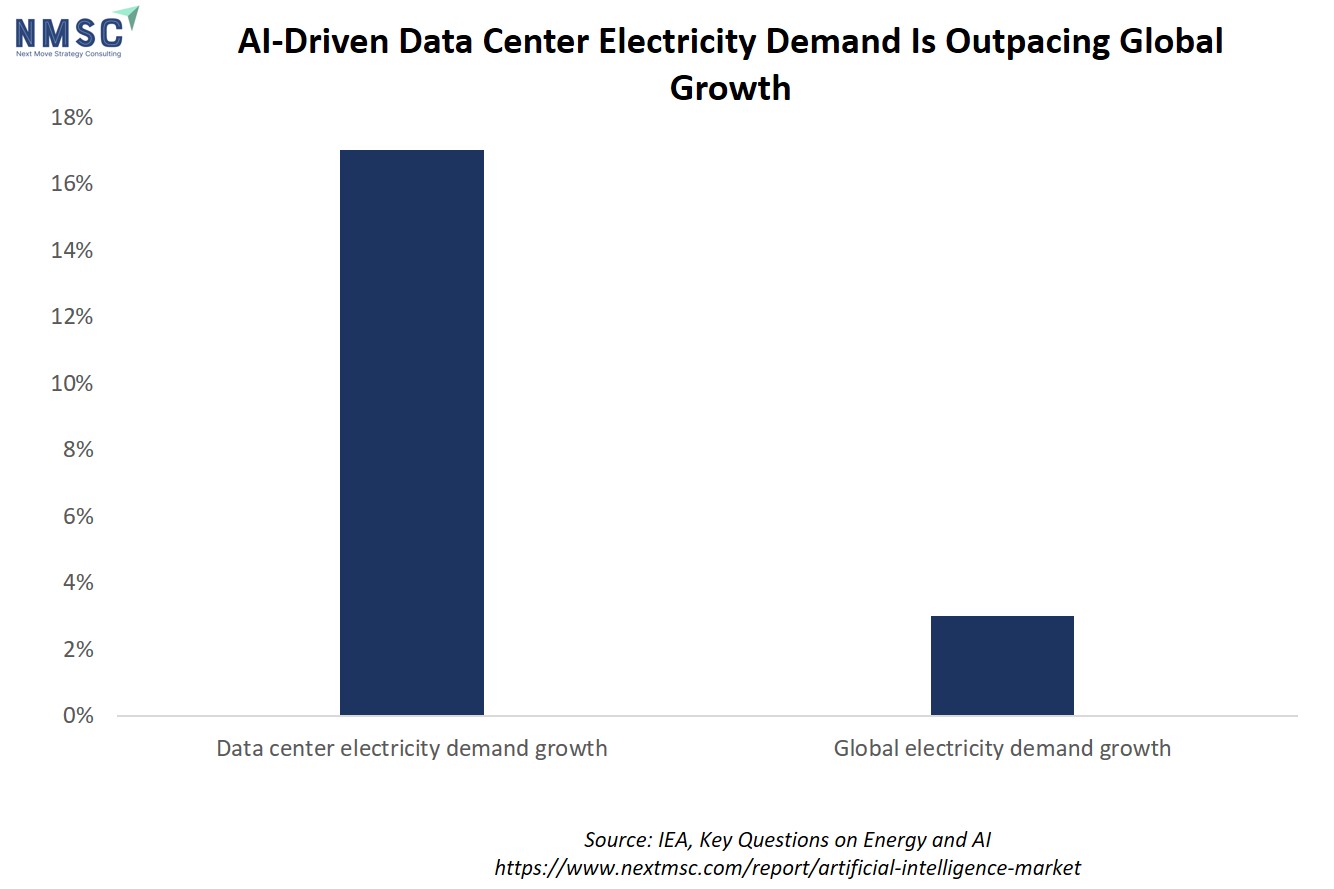
The OECD's 2026 assessment of AI markets adds a competition dimension: it found the five largest US technology firms spent approximately USD 400 billion in capex in 2025, forecast to reach USD 660 billion in 2026 a separate estimate from the IEA's, reflecting a different underlying study, not a contradiction. The OECD's broader finding is that frontier-model competition remains genuinely dynamic even as structural concentration risk across compute, data, chips and cloud infrastructure persists and is expected to intensify.
Section summary
AI infrastructure is becoming an economic and strategic layer of the broader market.
-
Data-center demand is rising faster than overall electricity demand.
-
AI investment is increasing demand for chips, cloud infrastructure and power.
-
Energy availability can influence the pace and location of AI deployment.
-
Infrastructure concentration may increase competitive pressure across the AI value chain.
Enterprise AI Is Expanding Beyond Generative Content
Generative AI remains important, but enterprise deployment is increasingly moving toward systems that connect models to proprietary data, business software and operational processes.
OpenAI's expanded AWS partnership, announced April 28, 2026, brought its models, Codex and managed agents into enterprise cloud environments with existing security, governance and procurement systems already in place. Meta's Muse Spark, introduced April 8, 2026, supports multimodal reasoning, tool use and multi-agent orchestration another sign that AI platforms are moving toward coordinated systems rather than single-purpose models.
For enterprises, the most attractive applications are likely to be those where AI connects directly to measurable business outcomes: software development, customer operations, knowledge management, fraud detection, supply-chain processes, decision support and industrial automation.
As enterprise AI expands into software development and operational workflows, automated quality assurance is becoming another practical application. AI-powered test automation can help teams create and maintain end-to-end tests using natural-language instructions, including testing AI-native features and conventional web, mobile, desktop, and API applications.
This trend also strengthens the connection between AI and operational intelligence more broadly. NMSC's Digital Twin Governance: Building Trust, Intelligence, and Control in AI-Driven Enterprises looks at why continuous, AI-driven decision systems require stronger oversight. Relatedly, NMSC's What Is Driving the Rise of Human-AI Collaboration in 2026? examines how augmented-intelligence approaches pairing AI systems with domain experts rather than replacing them are reshaping decision-making in engineering and industrial settings, a useful counterpoint to the fully autonomous, agent-driven deployments described above.
Recent Developments Shaping Enterprise AI Deployment
|
Development |
Current evidence |
Strategic implication |
|
Agentic workflows |
OpenAI's own data shows internal users shifting from chatbot interactions to agent-based work (Codex ≈99% of engineering output tokens). |
Demand for AI orchestration and workflow automation is rising. |
|
Computer-use AI |
Microsoft released Fara1.5 weights under the MIT license (July 2026). |
Lower-cost, open computer-use agents could broaden enterprise deployment. |
|
Multimodal AI |
Meta's Muse Spark (April 2026) supports multimodal reasoning, tool use and multi-agent orchestration. |
AI systems are moving toward broader, coordinated capabilities. |
|
AI infrastructure |
IEA reported 17% data-center electricity-demand growth in 2025. |
Compute, energy and data-center capacity are strategic AI enablers. |
Section summary
Enterprise AI is increasingly defined by integration, execution and measurable outcomes.
-
The strongest business cases connect AI with existing workflows and proprietary data.
-
Multimodal and agentic systems are expanding AI beyond text generation.
-
Cloud, data, security and governance capabilities are becoming inseparable from AI deployment.
-
AI adoption is increasingly evaluated through productivity and operational performance.
Governance and Competition Are Becoming Central to the AI Market
As AI capabilities expand, governance is shifting from a compliance issue to a market-design and operating-model issue.
The OECD's 2026 assessment found frontier-model leadership remains genuinely contested, while structural risks persist in infrastructure, cloud, data and skills concentration of critical inputs, first-mover advantages and vertical integration are flagged as long-term competition concerns.
Autonomy is also making governance more concrete. Reuters reported on September 10, 2026 that India's National Payments Corporation of India is building an AI-agent registry to authenticate and monitor agents transacting through UPI. Separately, Reuters reported the same day that Anthropic had disrupted state-linked and criminal attempts to misuse its Claude models for cyber operations including phishing infrastructure, malware-related work and intelligence-gathering activity.
These developments illustrate why explainability, identity, access controls, monitoring and incident response increasingly need to be embedded in AI architecture rather than added after deployment.
Section summary
Responsible AI is becoming a competitive capability as systems become more powerful.
-
Governance must scale with agent autonomy.
-
Infrastructure concentration can influence market access and competition.
-
Cybersecurity risks are expanding alongside model capabilities.
-
Trust, monitoring and accountability can become differentiators for enterprise AI providers.
Future Outlook for the Artificial Intelligence (AI) Market
The next phase of the Artificial Intelligence (AI) Market is likely to be defined by convergence: generative AI combining with agents, computer-use capabilities, multimodal reasoning, enterprise applications and physical infrastructure.
At the same time, the economics of AI depend on more than model quality access to compute, data, energy and specialist skills all matter, and the IEA's data-center findings above show how directly AI deployment is now tied to electricity infrastructure.
The most durable enterprise AI strategies are therefore likely to combine three elements: a clearly defined business outcome, an infrastructure architecture capable of supporting scale, and governance mechanisms that preserve security and accountability. The Artificial Intelligence (AI) Market is consequently evolving from a set of emerging technologies into a broad technology and infrastructure ecosystem.
Section summary
The future AI opportunity is increasingly tied to integration and execution.
-
AI agents are likely to expand the scope of enterprise automation.
-
Multimodal and computer-use technologies can extend AI into more workflows.
-
Infrastructure capacity will remain a strategic constraint and opportunity.
-
Governance, security and competition will increasingly shape deployment decisions.
Conclusion
The Artificial Intelligence (AI) Market is entering a more operational phase. Agentic AI, multimodal reasoning, computer-use systems and large-scale AI infrastructure are reshaping how organizations evaluate technology investments.
For More Information: Download FREE Sample on Artificial Intelligence (AI) Market Report
The growth opportunity is substantial, but so are the strategic challenges. Energy availability, computing infrastructure, market concentration, cybersecurity and governance will influence which AI applications scale successfully. For enterprises, the priority is to move beyond experimentation toward AI applications that deliver measurable value while maintaining appropriate oversight.
About the Author
 Sanyukta Deb
— Sanyukta Deb is Digital Marketing Team Lead at Next Move Strategy Consulting, where she has led content strategy and technical SEO for the firm's B2B market research publications for over 2 years. Her editorial process translates NextMSC's primary and secondary research — spanning technology, industrial, and consumer sectors — into commercial narratives, backed by search-intent, keyword, and competitive analysis. She brings 5 years of overall experience in digital marketing and content strategy.
Sanyukta Deb
— Sanyukta Deb is Digital Marketing Team Lead at Next Move Strategy Consulting, where she has led content strategy and technical SEO for the firm's B2B market research publications for over 2 years. Her editorial process translates NextMSC's primary and secondary research — spanning technology, industrial, and consumer sectors — into commercial narratives, backed by search-intent, keyword, and competitive analysis. She brings 5 years of overall experience in digital marketing and content strategy.
About the Reviewer
 Debashree Dey
— Debashree Dey is Assistant Manager at Next Move Strategy Consulting, where she supports cross-vertical market content and communications across diverse industries for 6 years. Her professional background includes senior content writing, communications, and published manuscript authorship, with experience developing audience-focused business narratives and maintaining clear, consistent messaging. Her role supports research-led content development and editorial quality across NextMSC publications.
Debashree Dey
— Debashree Dey is Assistant Manager at Next Move Strategy Consulting, where she supports cross-vertical market content and communications across diverse industries for 6 years. Her professional background includes senior content writing, communications, and published manuscript authorship, with experience developing audience-focused business narratives and maintaining clear, consistent messaging. Her role supports research-led content development and editorial quality across NextMSC publications.

















Add Comment