How Are AI-Powered Autonomy, Swarm Intelligence, and Next-Generation Sensors Redefining the Global Military Robots Market?

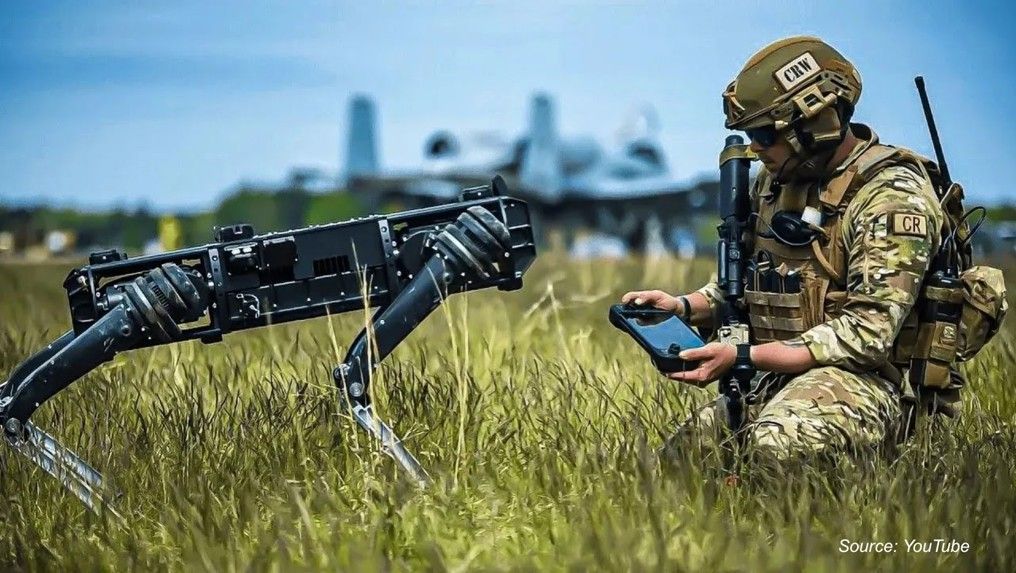
The global military robots’ market is undergoing one of the most consequential technological transformations in modern defense history. What began as remotely piloted platforms and rudimentary unmanned systems has evolved into a highly sophisticated ecosystem of autonomous ground vehicles, aerial drones, underwater robots, and AI-driven battlefield decision systems. Military robots today no longer function merely as force multipliers or surveillance tools. Instead, they increasingly operate as integrated nodes within networked defense architectures, capable of real-time intelligence sharing, collaborative mission execution, and semi-autonomous threat assessment. Our analysis indicates that the convergence of artificial intelligence, edge computing, advanced sensor fusion, and 5G connectivity is fundamentally restructuring how militaries conceptualize, plan, and execute modern operations.
According to Next Move Strategy Consulting, the global Military Robots Market was valued at USD 26.2 billion in 2025 and is expected to reach USD 36.9 billion in 2026, with forecasts estimating the market is projected to reach USD 83.8 billion by 2035, advancing at a CAGR of 9.53% from 2026 to 2035. In volume terms, the market was estimated at 626 thousand units in 2025 and is projected to increase from 883 thousand units in 2026 to 2024 thousand units by 2035, registering a CAGR of 9.65% during the forecast period. This growth trajectory reflects deepening investments by governments worldwide in autonomous defense systems, combined with accelerating technological breakthroughs that are making military robots faster, smarter, and more operationally resilient than at any point in history.
Artificial Intelligence and Machine Learning: The Cognitive Engine Powering Military Autonomy
Artificial intelligence has become the most disruptive force reshaping military robotics, transforming passive unmanned systems into active decision-making platforms. AI-driven algorithms now enable military robots to process real-time battlefield data, identify targets, classify threats, navigate complex terrain, and optimize mission paths without requiring continuous human intervention. Machine learning models, trained on vast operational datasets, allow autonomous systems to improve performance over successive deployments, adapting their behavioral patterns to evolving threat environments. Our assessment indicates that AI integration is no longer an experimental feature in military robotics it is becoming a baseline operational requirement across leading defense programs globally.
For example, in April 2026, AeroVironment launched the MAYHEM 10, an autonomous multi-role launched effects system designed to perform intelligence, surveillance, reconnaissance (ISR), electronic warfare, and precision strike missions within a single platform. The development demonstrates how AI-enabled autonomy is expanding the operational capabilities of military robotic systems, allowing them to execute complex missions with reduced human intervention and greater adaptability in dynamic battlefield environments. Industry developments indicate that artificial intelligence is increasingly enabling military robots to transition from remotely controlled assets to autonomous systems capable of supporting real-time decision-making, mission execution, and coordinated operations alongside human forces.
Autonomous Navigation and Robotic Mobility: Machines That Understand Their Environment

Autonomous navigation represents one of the most technically demanding challenges in military robotics, requiring systems to operate reliably across GPS-denied environments, complex urban terrain, subterranean corridors, and open ocean surfaces simultaneously. Modern military robots employ multi-modal navigation architectures that combine LiDAR, radar, inertial measurement units, visual odometry, and AI-driven simultaneous localization and mapping (SLAM) algorithms to maintain operational awareness without external positioning infrastructure. This reflects a fundamental shift in how defense planners assess the readiness and deployability of unmanned ground, aerial, and maritime systems across contested operational theaters.
Israel Aerospace Industries (IAI) has been advancing autonomous maritime robotics through its BlueWhale autonomous underwater vehicle (AUV), designed to conduct intelligence gathering, surveillance, and reconnaissance missions in complex underwater environments. The platform incorporates advanced navigation and sensing technologies that enable extended operations in GPS-denied conditions while maintaining situational awareness and mission effectiveness. The company's agreement with the Greek Navy in 2025 further highlights growing defense investment in autonomous maritime systems capable of operating independently across contested maritime domains. This demonstrates how autonomous navigation technologies are expanding beyond land and aerial platforms into underwater environments where environmental awareness and precision mobility are critical operational requirements.
Swarm Robotics and Collaborative Autonomy: Strength Multiplied Through Coordination
Swarm robotics represents one of the most strategically significant emerging capabilities within the military robots market, enabling large numbers of relatively simple autonomous platforms to execute coordinated missions that overwhelm traditional defense systems. Inspired by the collective behaviors observed in biological systems such as insect colonies and bird flocks, military swarm architectures distribute intelligence across multiple networked agents rather than concentrating it in a single high-value platform. Our analysis indicates that swarm systems offer substantial tactical advantages by presenting adversaries with distributed, low-cost threats that are operationally more difficult to counter than conventional high-value platforms.
Leonardo has been advancing unmanned aerial system capabilities through investments in autonomous flight technologies, mission management systems, and network-enabled defense platforms. The company further strengthened its position in the unmanned systems domain through the establishment of LBA Systems, a joint venture with Baykar in 2025 focused on next-generation unmanned aerial systems. The collaboration combines expertise in autonomous aviation technologies and platform development, supporting the broader industry shift toward increasingly coordinated and interconnected robotic operations. This reflects growing defense interest in distributed autonomous architectures capable of enabling collaborative mission execution across multiple unmanned platforms.
Could Sensor Fusion and AI-Powered Vision Make Military Robots Smarter Than Human Observers?
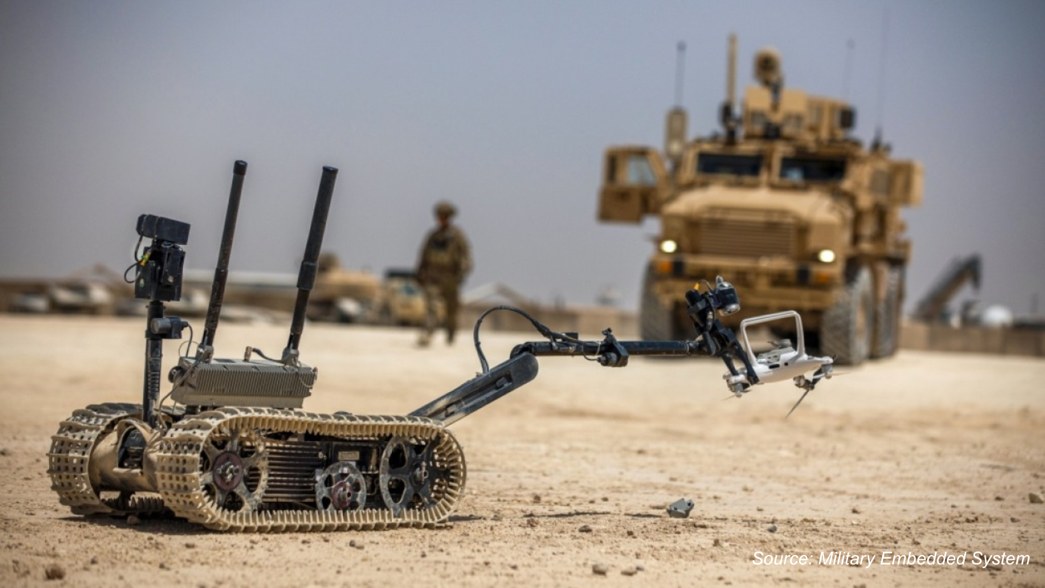
Sensor technology has become the perceptual foundation upon which military robot autonomy depends, enabling platforms to build accurate, real-time models of their operational environments across electromagnetic spectra that exceed human sensory capabilities. Modern military robots integrate electro-optical infrared sensors, synthetic aperture radar, hyperspectral imaging systems, acoustic arrays, and chemical detection modules within unified sensor fusion architectures that generate comprehensive situational awareness from multiple simultaneous data streams. Computer vision algorithms then process this fused sensor data to enable target recognition, scene understanding, threat classification, and autonomous engagement decision support across increasingly challenging operational conditions.
In a complementary development, Elbit Systems Ltd. has continued advancing its multi-sensor payload integration capabilities across its family of Hermes unmanned aerial systems, incorporating AI-enhanced computer vision modules that automate intelligence, surveillance, and reconnaissance data analysis. The company's acquisition of UAV Tactical Systems (UTACS) in 2026 further strengthened its tactical unmanned systems portfolio and advanced sensing capabilities. Industry evidence indicates that automated sensor data exploitation is becoming a critical capability requirement as military organizations seek to manage growing volumes of surveillance and reconnaissance data generated by unmanned platforms.
5G Connectivity and the Internet of Military Things: Building the Networked Battlefield
The integration of 5G communications technology and Internet of Military Things architectures is fundamentally transforming how military robots operate within broader force structures, enabling real-time data sharing, collaborative decision-making, and networked autonomy across increasingly complex operational environments. High-bandwidth, low-latency 5G networks allow military robotic systems to stream high-definition sensor data to command centers, share targeting information across distributed platforms, and receive mission updates in near real time, dramatically reducing the information latency that previously constrained autonomous system performance in dynamic operational scenarios. Our analysis indicates that the convergence of 5G infrastructure and military IoT frameworks is enabling the emergence of genuinely networked battlefields where unmanned systems, crewed platforms, and command nodes form integrated sensor-to-shooter networks.
How Are Edge Computing and Onboard Processing Bringing Intelligence Directly to Military Robots?
Edge computing has emerged as a transformative capability enabler for military robotics, allowing autonomous systems to execute complex AI inference, sensor data processing, and mission decision-making directly onboard the platform rather than depending on connectivity to remote computing infrastructure. This architectural shift is particularly critical in contested operational environments where communications may be degraded, denied, or intermittent, requiring military robots to maintain autonomous operational capability without external data processing support. Our assessment indicates that advances in neuromorphic computing chips, low-power AI accelerators, and field-programmable gate arrays are enabling increasingly sophisticated onboard intelligence within size, weight, and power constraints that military robotic platforms impose.
General Atomics Aeronautical Systems, Inc. has been integrating advanced onboard computing architectures within its MQ-9B SkyGuardian unmanned aerial vehicle, enabling autonomous detect-and-avoid, real-time signals intelligence processing, and onboard mission replanning without requiring continuous satellite link connectivity. The company's USD 25 million expansion of its Mississippi facility in 2026 further reflects growing investment in advanced autonomous systems and the technologies required to support increasingly sophisticated onboard mission capabilities. Industry evidence indicates that edge computing maturity is becoming a key differentiator among military robotic systems as defense organizations prioritize operational resilience in denied or degraded communications environments.
Unmanned Maritime and Underwater Systems: The Silent Expansion into the Blue Domain
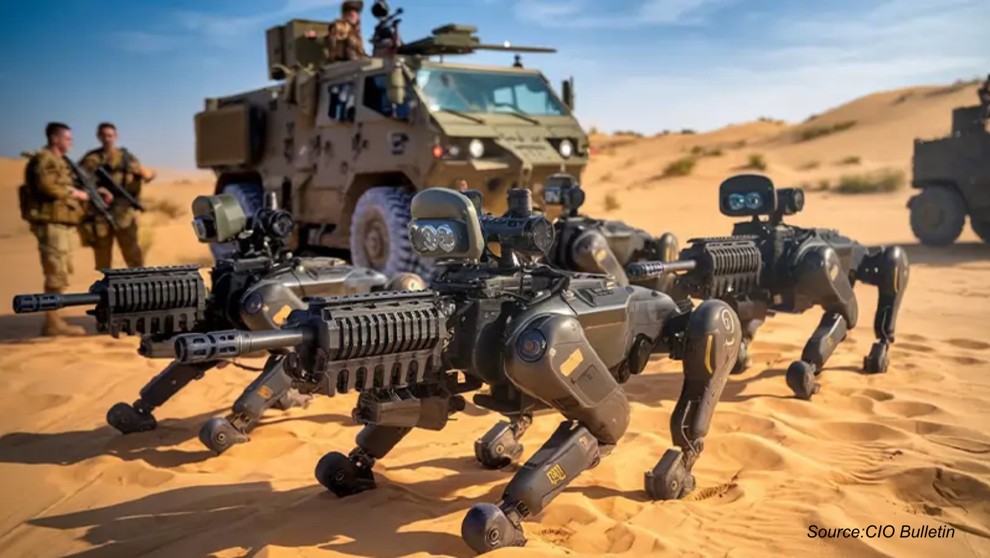
While aerial and ground unmanned systems have historically dominated discussions of military robotics, the maritime and underwater domains are experiencing accelerating development as strategic competition intensifies across ocean environments. Unmanned surface vehicles and autonomous underwater vehicles are increasingly deployed for mine countermeasures, anti-submarine warfare support, harbor protection, and long-endurance maritime surveillance missions that are operationally hazardous or logistically impractical for crewed platforms. Our analysis indicates that underwater robotic systems present unique engineering challenges related to communications, navigation, energy management, and structural integrity that are driving specialized technological innovation distinct from aerial and ground robotic development.
Cybersecurity and Electronic Warfare Resilience: Protecting the Autonomous Systems That Protect Forces
The increasing reliance on networked autonomous military systems creates significant cybersecurity vulnerabilities that adversaries are actively seeking to exploit through electronic warfare, GPS jamming, communications interception, and cyberattacks targeting autonomous platform control systems. Military robots that depend on external communications for navigation, mission updates, or targeting data represent attractive electronic attack targets in contested operational environments, and ensuring their cybersecurity resilience has become a foundational design requirement rather than an afterthought. Our assessment indicates that cybersecurity engineering for military robotic systems encompasses hardware security modules, encrypted communications architectures, cyber-resilient autonomy algorithms, and anti-spoofing navigation systems that maintain operational integrity even under sustained electronic attack.
Rheinmetall AG has been advancing its cyber-protected autonomous ground vehicle architectures, integrating hardware security modules and encrypted communications systems within its Mission Master unmanned ground vehicle family. The company's 2026 agreement with Indra Group to pursue a large-scale Spanish Army vehicle program further highlights growing demand for secure and resilient autonomous platforms capable of operating effectively in electronically contested environments.
What Strategic Forces Are Accelerating the Global Military Robots Market Expansion?
Several interconnected strategic, technological, and geopolitical forces are simultaneously accelerating military robot adoption across defense organizations worldwide:
-
Geopolitical Competition and Defense Modernization: Intensifying great power competition and regional conflicts are compelling governments to accelerate autonomous system procurement as force multiplication and risk reduction tools.
-
Casualty Risk Reduction Imperatives: Military organizations increasingly prioritize autonomous systems for high-risk missions including explosive ordnance disposal, reconnaissance in contested areas, and logistics in fire-affected zones, reducing human exposure to lethal threat environments.
-
Multi-Domain Operations Architecture: Defense doctrines emphasizing integrated land, sea, air, space, and cyber operations are creating demand for unmanned systems capable of operating across multiple domains simultaneously within networked force structures.
-
Defense Budget Expansion: NATO member commitments to reach and exceed 2% GDP defense spending targets, combined with increased defense appropriations in the Indo-Pacific region, are translating directly into expanded autonomous system procurement budgets and development investment.
-
Technology Cost Reduction Curves: Declining costs for AI processors, sensor components, and battery technologies are progressively making sophisticated military robotic capabilities accessible to a wider range of defense customers, expanding the addressable market beyond major military powers.
Based on our assessment, these interconnected drivers are reinforcing each other in a self-amplifying cycle where technological advances reduce costs, cost reductions expand adoption, and broader operational experience generates new requirements that stimulate further technological innovation.
The Future of Military Robotics: Toward Fully Integrated Human-Machine Combat Teams
Our findings indicate that the military robots market is advancing toward a future characterized by deeply integrated human-machine teaming, where autonomous systems and crewed platforms collaborate as genuine operational partners rather than tools subordinate to human control. AI systems capable of understanding mission intent, managing tactical uncertainty, and communicating decisions transparently to human commanders are emerging as the next frontier of military robotic development, moving beyond current teleoperated and semi-autonomous systems toward genuinely collaborative battlefield agents. Based on our assessment, advances in explainable AI, multi-agent coordination, communications-resilient autonomy, and multi-domain platform integration will define the competitive landscape of the military robots market through the 2035 forecast horizon.
About the Author
 Saista Faiyaz
— Saista Faiyaz is Research Associate at Next Move Strategy Consulting, where she has covered consumer markets and healthcare technologies for 3 years. Her work includes primary interview review, secondary-source validation, market sizing, and structured analysis of company and industry data. She supports research by comparing evidence across sources, organizing findings into market narratives, and documenting assumptions used in analysis. Her scope includes cross-market benchmarking, and reports.
Saista Faiyaz
— Saista Faiyaz is Research Associate at Next Move Strategy Consulting, where she has covered consumer markets and healthcare technologies for 3 years. Her work includes primary interview review, secondary-source validation, market sizing, and structured analysis of company and industry data. She supports research by comparing evidence across sources, organizing findings into market narratives, and documenting assumptions used in analysis. Her scope includes cross-market benchmarking, and reports.
About the Reviewer
 Supradip Baul
— Supradip Baul is an accomplished business consultant and strategist with over a decade of rich experience in market intelligence, strategy, technology, and business transformation. His work has included rigorous qualitative and quantitative analysis across multiple industries, helping clients shape investment decisions and long-term roadmaps. Earlier in his career, he was associated with Gartner, where he contributed to industry-leading reports and market share analyses. He has worked with leading global companies and holds an MBA with a dual specialization in Marketing and Finance.
Supradip Baul
— Supradip Baul is an accomplished business consultant and strategist with over a decade of rich experience in market intelligence, strategy, technology, and business transformation. His work has included rigorous qualitative and quantitative analysis across multiple industries, helping clients shape investment decisions and long-term roadmaps. Earlier in his career, he was associated with Gartner, where he contributed to industry-leading reports and market share analyses. He has worked with leading global companies and holds an MBA with a dual specialization in Marketing and Finance.















Add Comment