Top Companies Driving Innovation and Transforming the Global Military Robots Market
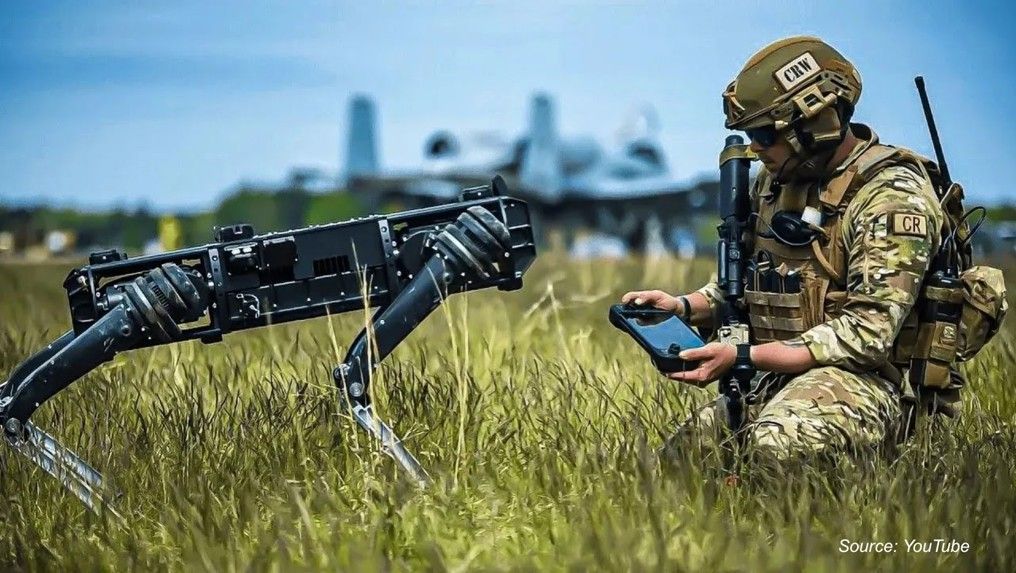
Based on NMSC assessment, we observed that the global Military Robots Market was valued at USD 26.2 billion in 2025 and is expected to reach USD 36.9 billion in 2026, with the market projected to reach USD 83.8 billion by 2035, advancing at a CAGR of 9.53% from 2026 to 2035. In volume terms, the market was estimated at 626 thousand units in 2025 and is projected to increase from 883 thousand units in 2026 to 2024 thousand units by 2035, registering a CAGR of 9.65% during the forecast period.
We observed that the Military Robots Market is undergoing a profound structural transformation, driven by rapid advancements in artificial intelligence, autonomous navigation, sensor integration, and multi-domain operational frameworks. Based on our evaluation of current developments, the market is shifting decisively from remotely piloted and semi-autonomous platforms toward fully autonomous, AI-enabled systems capable of executing complex missions across aerial, ground, and maritime domains with minimal human intervention. Evolving end-user preferences within defense ministries and armed forces globally increasingly prioritize multi-role platforms, reduced operator exposure, and systems capable of operating effectively in contested electronic warfare environments. Our analysis indicates that regulatory frameworks governing autonomous weapons systems are also maturing in parallel with technological development, shaping procurement strategies and export policies across major defense markets. Key innovations driving this transformation include swarm robotics, collaborative combat aircraft architectures, AI-driven target acquisition systems, and advanced unmanned undersea vehicles, collectively enabling a new era of force multiplication and strategic deterrence.
Military Robots Market Overview
The Military Robots Market is evolving at an unprecedented pace as global defense establishments accelerate the integration of autonomous and semi-autonomous systems across combat, logistics, surveillance, and counter-UAS operations. Based on our assessment, we found that the increasing complexity of modern warfare characterized by multi-domain threat environments, advanced electronic warfare capabilities, and asymmetric conflict scenarios is driving sustained demand for robotic systems that can operate with reduced human risk exposure and enhanced operational precision. Rising defense budgets across North America, Europe, and the Asia-Pacific region are further reinforcing procurement cycles, with governments committing to large-scale autonomy programs as core components of national defense modernization strategies. At the same time, through our analysis of market trends, we noticed that the strategic shift from platform-centric to network-centric military operations is fundamentally redefining how robotic systems are designed, deployed, and integrated within broader command-and-control architectures. Moreover, the convergence of commercial AI capabilities with defense applications is accelerating development timelines and lowering per-unit costs, making advanced military robotics increasingly accessible across both tier-one and emerging defense markets.
Furthermore, technological innovation is reshaping the competitive dynamics of the Military Robots Market, where advances in machine learning, computer vision, edge computing, and advanced materials are significantly expanding the operational envelope of autonomous military platforms. Through our engagement with defense technology developers and system integrators, we found that next-generation military robots are moving beyond single-function roles to become multi-mission, interoperable assets capable of seamless integration within joint-force and coalition operational structures. The adoption of open-architecture design standards, AI-assisted mission planning tools, and real-time data fusion capabilities is enabling commanders to deploy robotic assets with greater tactical flexibility and operational confidence. In addition, developments in propulsion systems, energy storage, and stealth technologies are extending the endurance and survivability of military robots across contested environments. These advancements, combined with growing strategic emphasis on unmanned force multiplication and cost-efficient deterrence, are positioning military robots as indispensable components within the 21st-century defense ecosystem.
Leading companies such as General Atomics Aeronautical Systems, Inc., Israel Aerospace Industries Ltd., Lockheed Martin Corporation, Leonardo S.p.A., and General Dynamics Mission Systems, Inc. are at the forefront of transforming the Military Robots Market through continuous innovation, autonomous systems development, and strategic global expansion. Our analysis indicates that these organizations are increasingly focusing on scaling autonomous platform capabilities, advancing AI integration, and strengthening multi-domain operational frameworks to enhance performance, operational relevance, and cost-efficiency. Moreover, through our interaction with manufacturers and technology providers, we identified that investments in autonomous navigation, counter-drone systems, and collaborative unmanned systems architectures are enabling improved mission effectiveness and faster deployment of next-generation robotic capabilities. These efforts are collectively redefining the competitive landscape, positioning military robots as smart, networked, and strategically indispensable assets within the modern defense ecosystem worldwide.
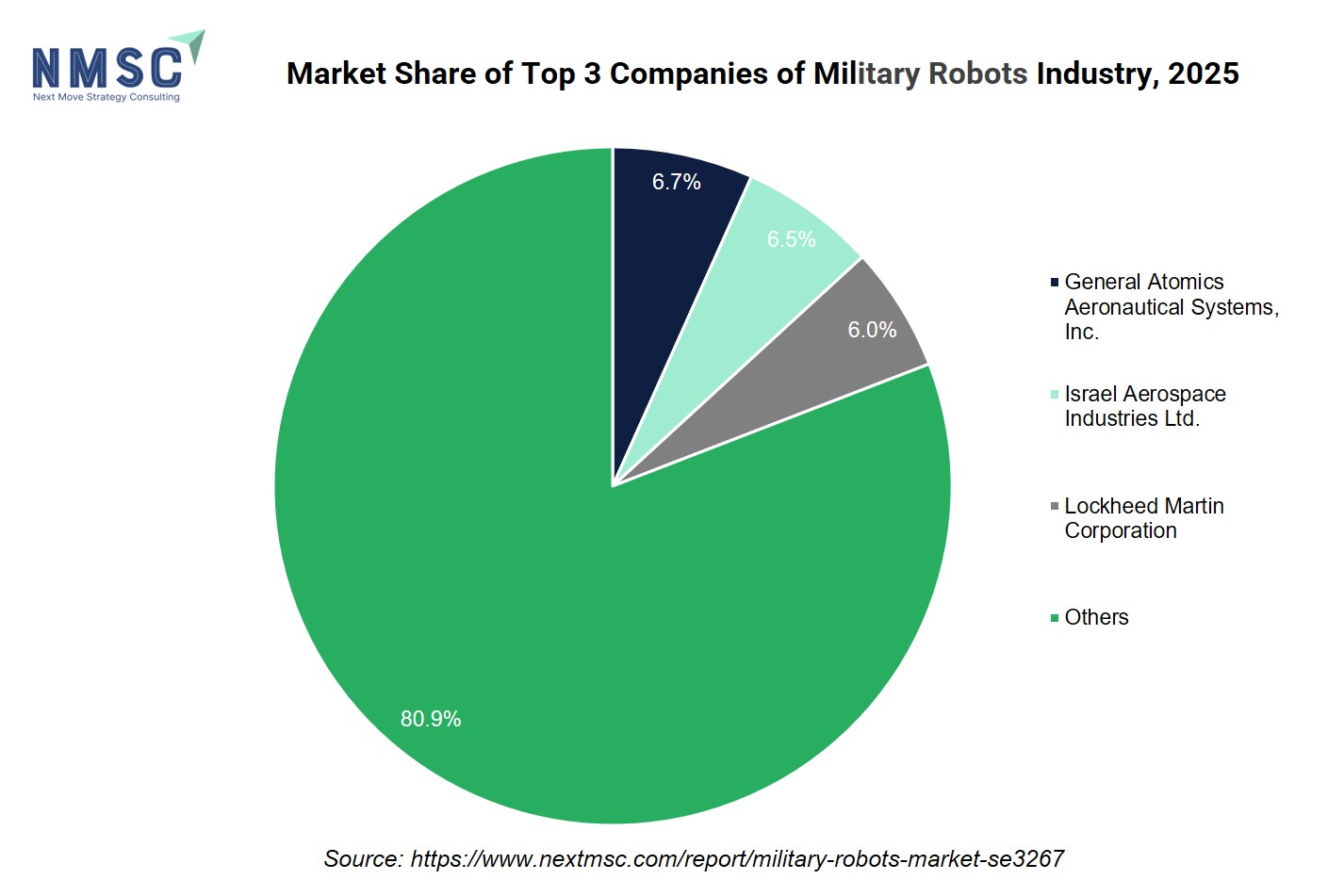
For the latest market share analysis and in-depth report on Military Robots Industry insights, you can buy our latest report: Access the Report
Highlights of General Atomics Aeronautical Systems, Inc.
General Atomics Aeronautical Systems, Inc. (GA-ASI), headquartered in Poway, California, United States, is a global leader in the design, development, and production of remotely piloted aircraft and associated sensor and communication systems for defense applications. The company specializes in unmanned aerial systems (UAS) including the MQ-9 Reaper, MQ-1C Gray Eagle, and next-generation collaborative combat aircraft, along with advanced reconnaissance and surveillance technologies serving air forces and defense agencies across the United States, Europe, and allied nations. GA-ASI's operations are deeply intertwined with the global Military Robots Market, where accelerating demand for AI-enabled, multi-role unmanned aerial platforms and collaborative autonomous combat systems is directly shaping the company's strategic investment priorities, international market engagement, and long-term product development roadmap
Our analysis indicates that in 2025 and 2026, GA-ASI accelerated its position at the forefront of autonomous aerial combat through several significant development milestones. In November 2025, the company successfully flew a second YFQ-42A Collaborative Combat Aircraft (CCA), demonstrating rapid production and testing momentum while simultaneously announcing the Gambit 6 variant a purpose-built air-to-ground autonomous strike platform further expanding its CCA family portfolio. At the 2025 Dubai Airshow, GA-ASI showcased surging global interest in its CCA portfolio and new MQ-9 drone family variants, strengthening its strategic market engagement across the Middle East and Europe. In April 2026, the company unveiled its Mojave STOL concept at the Army Aviation Association of America's 2026 Warfighting Summit, presenting a ruggedized short-takeoff-and-landing drone designed for counter-drone missions, precision strikes, and cargo transport from austere forward operating locations. These developments collectively align with the Military Robots Market's trajectory toward AI-enabled, multi-role unmanned combat systems, reinforcing GA-ASI's competitive positioning as allied demand for collaborative combat capabilities and autonomous strike platforms accelerates.
Highlights of Israel Aerospace Industries Ltd.
Israel Aerospace Industries Ltd. (IAI), headquartered in Lod, Israel, is a state-owned defense and aerospace company recognized as one of the world's most technically advanced defense manufacturers, with a product portfolio spanning unmanned aerial systems, armed ground robots, loitering munitions, air and missile defense, radar systems, precision-guided weapons, and special mission aircraft. IAI serves defense customers across more than 100 countries through a diversified offering that integrates autonomous hardware, advanced sensors, artificial intelligence, and command-and-control architectures. The global Military Robots Market is central to IAI's strategic positioning, as the company's extensive range of combat-proven UAS, autonomous ground vehicles, and loitering munitions platforms directly reflects the market's accelerating shift toward multi-domain, AI-integrated unmanned defense solutions.
Our findings indicate that in May 2025, Israel Aerospace Industries Ltd. (IAI) signed an agreement with the Greek Navy to supply its BlueWhale autonomous underwater vehicle (AUV), enhancing maritime robotic capabilities and supporting industrial collaboration with Hellenic Aerospace Industry (HAI). The agreement strengthens IAI's position in the autonomous maritime systems segment and reflects growing defense demand for underwater robotic platforms capable of intelligence gathering, surveillance, and long-endurance maritime operations.
Highlights of Lockheed Martin Corporation
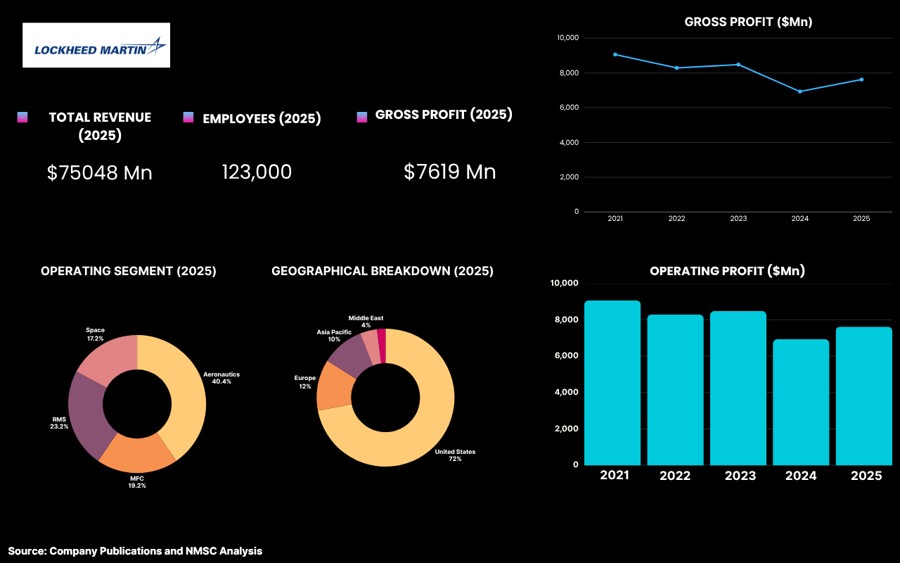
Lockheed Martin Corporation, headquartered in Bethesda, Maryland, United States, is the world's largest defense contractor by revenue, operating across five core business segments encompassing aeronautics, missiles and fire control, rotary and mission systems, space, and Sikorsky aviation. The company delivers advanced aircraft, missile systems, C4ISR technologies, undersea warfare platforms, and increasingly, a comprehensive portfolio of autonomous systems to U.S. and allied defense forces worldwide. Within the global Military Robots Market, Lockheed Martin plays a pivotal and expanding role through its investments in collaborative combat aircraft, autonomous logistics platforms, unmanned maritime vehicles, and AI-integrated command-and-control frameworks that directly align with the market's trajectory toward multi-domain unmanned warfighting operations.
Our analysis indicates that in 2025 and 2026, Lockheed Martin continued expanding its presence across multiple dimensions of the Military Robots Market. In October 2025, the company announced a strategic collaboration with Google Public Sector to integrate advanced generative AI capabilities into its defense systems, enhancing autonomous decision-making frameworks across platforms. In April 2026, Sikorsky, a Lockheed Martin company, secured a USD 15.5 million U.S. Marine Corps contract for the MARV-EL Increment 2 autonomous cargo helicopter program, deploying the R66 TURBINETRUCK platform for frontline expeditionary logistics. Collectively, these initiatives demonstrate Lockheed Martin's intent to establish autonomous multi-domain systems as a core competitive pillar within its defense portfolio.
Highlights of Leonardo S.P.A.
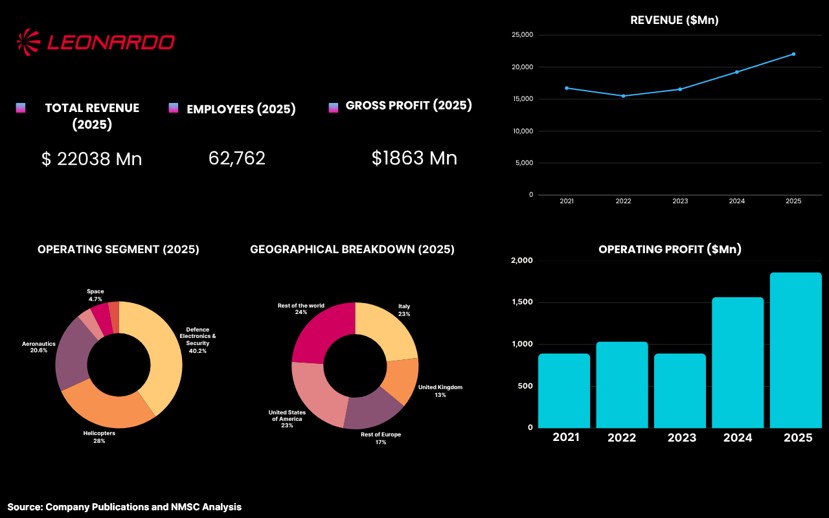
Leonardo S.p.A., headquartered in Rome, Italy, is a global aerospace, defense, and security industrial group with operations spanning fixed-wing aircraft, helicopters, electronics, radar systems, cybersecurity, and space technologies. With approximately 52,000 employees and a multinational operational footprint across Italy, the United Kingdom, the United States, and beyond, Leonardo serves as a trusted technology partner for governments, defense agencies, and NATO member states across multiple continents. The global Military Robots Market directly influences Leonardo's strategic direction, as the company's growing investment in unmanned aerial systems, counter-drone technologies, and autonomous mission systems directly aligns with the market's accelerating demand for AI-integrated, multi-domain robotic defense platforms, particularly within the European defense industrial landscape.
Our assessment indicates that in 2025 and 2026, Leonardo S.p.A. executed several strategically significant initiatives that substantially strengthen its competitive positioning within the Military Robots Market. In March 2025, Leonardo updated its Industrial Plan for 2025–2029, announcing a joint venture with Turkish UAS leader Baykar to create a dedicated global player in the unmanned aerial systems segment leveraging Baykar's operationally proven autonomous UAV platforms alongside Leonardo's mission systems, electronic warfare, and European regulatory expertise with an estimated revenue upside of USD 684 million over the plan period. Leonardo also established a new dedicated Aeronautics Division specifically structured to accelerate strategies across UAS and remotely piloted aircraft systems markets, reflecting a structural organizational commitment to autonomous systems leadership. In January 2026, the Leonardo Proteus VTOL UAS achieved its first flight, marking a significant milestone for the United Kingdom's Royal Navy maritime unmanned rotorcraft capability. These developments align with the Military Robots Market's expansion across counter-UAS, multi-domain autonomous platforms, and European defense industrial sovereignty imperatives.
Highlights of General Dynamics Mission Systems, Inc.
General Dynamics Mission Systems, Inc., headquartered in Fairfax, Virginia, United States, is a leading provider of advanced mission-critical technology solutions for U.S. and allied defense forces, specializing in command, control, communications, computers, intelligence, surveillance, and reconnaissance (C4ISR) systems, cybersecurity architectures, undersea warfare technologies, and autonomous vehicles. Operating as the Mission Systems segment of General Dynamics Corporation a Fortune 100 defense enterprise the division functions as a critical technology integrator across ground, maritime, and aerial defense domains. The global Military Robots Market significantly shapes General Dynamics Mission Systems' strategic roadmap, as the division's sustained investments in autonomous undersea vehicles, unmanned aerial system processing, and AI-driven autonomous ground vehicle integration directly reflect the market's convergence of robotics, artificial intelligence, and multi-domain warfighting requirements.
Our research indicates that in March 2025, General Dynamics Corporation released its 2025 Annual Report, highlighting continued investment in its Bluefin Robotics Unmanned Undersea Vehicle Center of Excellence, which supports the U.S. Navy's Hammerhead and MEDUSA programs through manufacturing, assembly, integration, and testing capabilities for next-generation unmanned undersea vehicle platforms. These investments reinforce the company's position within the Military Robots Market and support growing demand for autonomous maritime and multi-domain defense systems.
Summary of Military Robots Market
The global Military Robots Market is undergoing a fundamental and accelerating transformation, driven by the convergence of artificial intelligence, advanced autonomy architectures, and multi-domain operational requirements that are collectively redefining the nature and conduct of modern warfare. Accelerating defense budgets across the United States, Europe, and the Asia-Pacific region combined with growing strategic demand for unmanned force multiplication, counter-UAS capabilities, collaborative combat systems, and autonomous logistics platforms are sustaining strong market momentum as the sector advances toward the projected USD 83.8 billion valuation by 2035. Companies such as General Atomics Aeronautical Systems, Israel Aerospace Industries, Lockheed Martin, Leonardo S.p.A., and General Dynamics Mission Systems are each advancing distinct but strategically complementary dimensions of this transformation, from collaborative combat aircraft and combat-proven loitering munitions to next-generation autonomous undersea vehicles and AI-driven ground platforms. Strategic investments in platform innovation, industrial partnerships, geographic expansion, and autonomous systems integration are collectively elevating the competitive intensity of the market while establishing unmanned systems as indispensable components of 21st-century defense architecture. As technological maturation, regulatory evolution, and strategic procurement dynamics continue to shape the competitive landscape, organizations that most effectively align autonomous platform development with real-world operational requirements and allied interoperability standards are positioned to emerge as enduring leaders within the global military robotics ecosystem.
About the Author
 Saista Faiyaz
— Saista Faiyaz is Research Associate at Next Move Strategy Consulting, where she has covered consumer markets and healthcare technologies for 3 years. Her work includes primary interview review, secondary-source validation, market sizing, and structured analysis of company and industry data. She supports research by comparing evidence across sources, organizing findings into market narratives, and documenting assumptions used in analysis. Her scope includes cross-market benchmarking, and reports.
Saista Faiyaz
— Saista Faiyaz is Research Associate at Next Move Strategy Consulting, where she has covered consumer markets and healthcare technologies for 3 years. Her work includes primary interview review, secondary-source validation, market sizing, and structured analysis of company and industry data. She supports research by comparing evidence across sources, organizing findings into market narratives, and documenting assumptions used in analysis. Her scope includes cross-market benchmarking, and reports.
About the Reviewer
 Supradip Baul
— Supradip Baul is an accomplished business consultant and strategist with over a decade of rich experience in market intelligence, strategy, technology, and business transformation. His work has included rigorous qualitative and quantitative analysis across multiple industries, helping clients shape investment decisions and long-term roadmaps. Earlier in his career, he was associated with Gartner, where he contributed to industry-leading reports and market share analyses. He has worked with leading global companies and holds an MBA with a dual specialization in Marketing and Finance.
Supradip Baul
— Supradip Baul is an accomplished business consultant and strategist with over a decade of rich experience in market intelligence, strategy, technology, and business transformation. His work has included rigorous qualitative and quantitative analysis across multiple industries, helping clients shape investment decisions and long-term roadmaps. Earlier in his career, he was associated with Gartner, where he contributed to industry-leading reports and market share analyses. He has worked with leading global companies and holds an MBA with a dual specialization in Marketing and Finance.

















Add Comment