How Leading Players are Transforming the Global ERP Software Industry
As per NMSC analysis, the ERP Software Market is set to climb from USD 115.29 billion in 2025 to USD 136.33 billion in 2026, on its way to USD 365.95 billion by 2035 a CAGR of 11.60% across the forecast window. That growth is no longer being driven by simple back-office consolidation. It's being pulled forward by cloud-first deployment, digital transformation budgets, and most visibly in 2026 a wave of agentic AI launches from every major vendor in the category.
ERP Software Market Overview
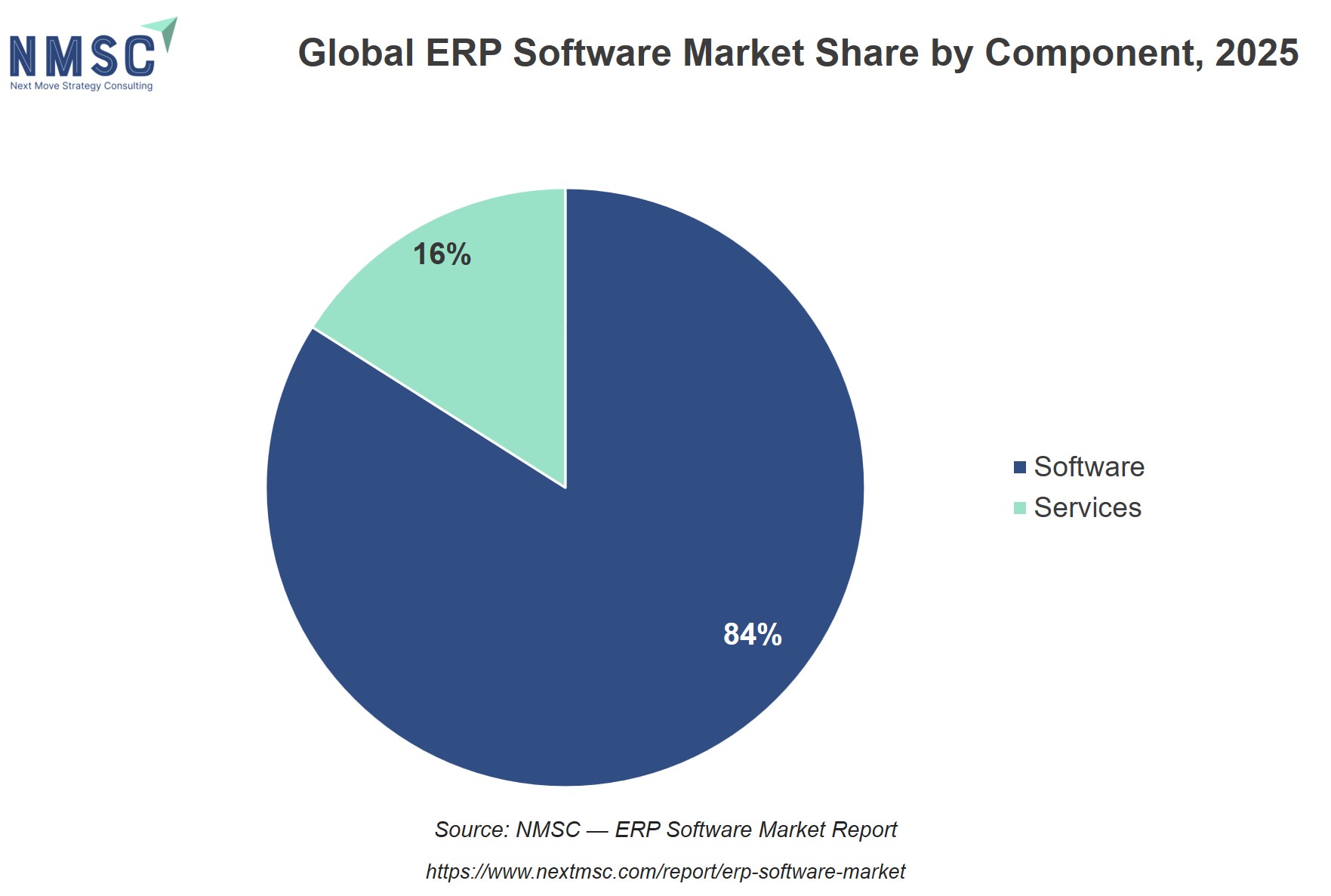
Software still dominates the market's component mix, holding an 84% share in 2025, while services (implementation, customization, managed support) grow at a steadier pace alongside it. Cloud deployment leads globally, though on-premise still accounts for roughly 30% of spend among enterprises with strict data-control or compliance requirements. Small and mid-sized enterprises now represent 54% of end-user demand by volume, even as large enterprises continue to drive the bulk of multi-module, multi-entity revenue.
ERP Software Market Size and Forecast, 2025–2035
|
Parameter |
2025 |
2026 |
2035 |
CAGR (2026–2035) |
|
ERP Software Market Size |
$115.29B |
$136.33B |
$365.95B |
11.60% |
|
Component Split |
Software 84% / Services 16% |
— |
— |
— |
|
End-User Split |
SME 54% / Large Enterprise 46% |
— |
— |
— |
Section takeaway: the market's headline growth number hides a more interesting shift underneath spend is consolidating around cloud-native, AI-embedded platforms rather than simply expanding the old on-premise base.
-
Market nearly triples between 2025 and 2035 at an 11.6% CAGR
-
Software still commands 84% of component spend, but services growth is accelerating
-
SMEs now outnumber large enterprises in adoption volume, though not in per-deployment revenue
What's Driving ERP Software Market Growth?
How Is Cloud and SaaS Adoption Reshaping Deployment Choices?
Cloud deployment's advantage is structural: lower upfront infrastructure cost, faster go-live, and continuous update cycles that suit both multinational rollouts and first-time SME buyers. That dynamic is detailed further in NMSC's dedicated Cloud ERP Suites Market coverage, which tracks the deployment-model shift at a more granular level than the broader ERP category alone.
How Is Agentic AI Changing What "ERP" Means?
2026 has been the year ERP vendors stopped talking about copilots and started shipping agents that execute, not just suggest. That shift and the specific moves behind it is the core of the Industry Leader Moves section below.
Section takeaway: cloud economics and agentic AI are now the two dominant growth levers, replacing the older narrative of ERP as a back-office cost center.
-
Cloud-first deployment remains the primary driver of new ERP spend
-
Agentic AI has moved from pilot to production at several major vendors in 2026
-
Composable, low-code architectures are opening the market to smaller, less IT-heavy buyers
Regional Momentum in the ERP Software Market
North America holds the largest regional share at roughly 37.9%, powered by deep cloud ERP penetration in BFSI, manufacturing, and healthcare. Europe follows at close to 31%, shaped heavily by GDPR-driven hybrid deployments and Industry 4.0 manufacturing integration in Germany. Asia-Pacific, at around 24.1% and growing fastest, is being driven by China's "Made in China 2025" digitalization push, India's SME cloud-first adoption, and government modernization programs across the region. The Middle East & Africa region, valued at roughly USD 4.14 billion in 2025, and Latin America, at about 3.2% share, remain smaller but are both expanding on the back of cloud ERP's lower infrastructure barrier to entry.
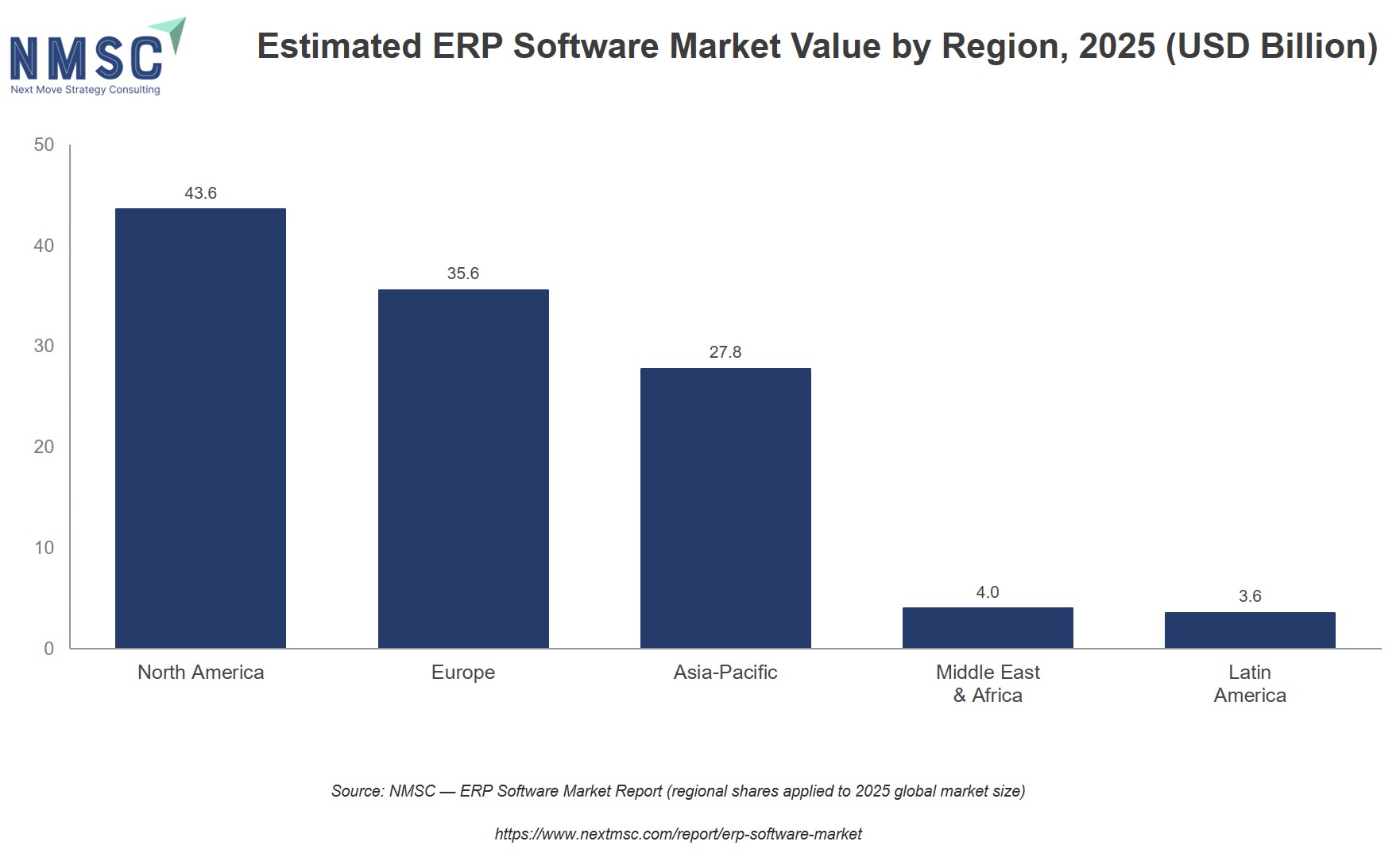
Section takeaway: North America and Europe still anchor the market in absolute dollars, but Asia-Pacific's faster growth rate means the regional mix will keep shifting east through the forecast period.
-
North America remains the largest single region by ERP spend
-
Asia-Pacific is the fastest-growing region, led by China, India, and Japan
-
MEA and Latin America are smaller but benefit disproportionately from cloud ERP's lower entry cost
Industry Leader Moves: How the Top ERP Vendors Are Competing in 2026
This is where 2026 has actually moved the needle. Enterprises weighing a cloud migration are increasingly pairing platform selection with outside cloud application development support to de-risk the transition a pattern reflected in the growth of dedicated cloud migration and modernization practices at firms across the implementation ecosystem.
SAP SE used its Sapphire 2026 conference in Orlando (May 2026) to reposition itself around a three-layer SAP Business AI Platform unifying its Business Technology Platform, Business Data Cloud, and AI Foundation and to launch the SAP Autonomous Suite, which now runs more than 200 specialized agents and over 50 Joule Assistants across finance, HR, procurement, and supply chain. SAP also announced new partnerships with Palantir and Anthropic, expanded existing ties with AWS and Nvidia, and committed a €100 million fund to help partners build and deploy custom agents through Joule Studio. Where SAP's earlier Joule update (January 2025) was about embedding a copilot into S/4HANA Cloud, the 2026 announcements mark a shift toward agents that act on Fusion-style enterprise data with minimal human sign-off.
Oracle matched that pace with its Fusion Agentic Applications, first unveiled at Oracle AI World in London (March 2026) and expanded through the year: 22 agentic applications shipped at launch across ERP, supply chain, HR, and customer experience, bundled into existing Fusion Cloud subscriptions at no added license cost. Oracle extended the lineup to finance and supply chain specifically in April 2026, then in July 2026 introduced an AI-native builder experience inside Oracle AI Agent Studio that lets customers build agents using natural-language, no-code tools or pro-code environments including Codex and Claude Code all running natively against Fusion's existing security, approval, and audit framework. Independent trade coverage now puts Oracle's total embedded-agent count across Fusion Cloud above 600, the largest such deployment among the majors.
Microsoft rolled its Dynamics 365 investments into its broader 2026 Release Wave 1, embedding deeper Copilot and agentic capability across sales, service, finance, supply chain, and HR. Two milestones stand out: general availability of Service Agent (June 2026), which prioritizes and summarizes customer-service cases using Microsoft 365 grounding, and the July 2026 general availability of Microsoft 365 Copilot directly inside Dynamics 365 Sales and Customer Service unifying the CRM and Copilot experience on a shared Model Context Protocol (MCP) foundation rather than bolting AI on as a separate layer.
Workday continues to lean on its Illuminate agent platform for HR and financial process automation, and its numbers back up the strategy: in the fiscal quarter ended July 31, 2026, AI products generated more than $100 million in new annual contract value over 25% of all new ACV booked in the quarter while total revenue rose roughly 13% year-over-year to $2.65 billion. The company also completed a $5 billion share buyback ahead of schedule and approved a new $4 billion program, a signal of confidence in its cloud subscription trajectory even as it keeps expanding Illuminate agents for contract intelligence, workforce planning, and financial close.
Sage has been the most acquisitive of the mid-market leaders in 2026: its half-year results (six months to March 2026) disclosed the acquisitions of Criterion, Akao, and Doyen AI, all folded into the Sage Platform to accelerate Sage Copilot and a growing bench of task-specific agents including an Accounts Payable Agent, Close Agent, and Finance Intelligence Agent now live across Sage Intacct, Sage X3, and Sage Accounting. Sage X3 itself picked up Copilot and agent-based sales monitoring in February 2026, ahead of a broader agent rollout announced at the company's Sage Future event in San Francisco that April.
Infor, backed by Koch Industries, partnered with AWS (announced in Hannover, April 2026) to bring natively built, industry-specific AI agents to manufacturing and distribution customers running on Amazon Bedrock and SageMaker. A real-world case cited by both companies boat manufacturer Xpress Boats used the new CloudSuite Industrial agents to manage purchase orders, general ledger, and accounts payable/receivable, and reported a 98% improvement in identifying process bottlenecks after adopting Infor's process-mining tools. Infor also expanded its Velocity Suite and Agentic Orchestrator later that same month.
Xero, primarily an SME accounting platform but increasingly ERP-adjacent through its Melio acquisition, posted FY2026 revenue up 31% to roughly $2.8 billion (NZD), driven in large part by that ~$2.5 billion U.S. bill-pay acquisition and continued rollout of its JAX ("Just Ask Xero") AI agent. Xero also extended its partnership with Anthropic to integrate Claude more deeply into its platform and began early testing of XeroForce, a natural-language tool for building custom AI agents.
Epicor used its Insights 2026 conference in Nashville (June 2026) to introduce a full agentic AI stack the Epicor Lux design system, a Prism Agent Foundry for building custom agents, and a new wave of Prism vertical agents alongside a "headless ERP" architecture that exposes ERP data to external AI tools like Claude and ChatGPT via the open Model Context Protocol. Epicor Prism reached general availability in the UK and Europe that June with more than 18 pre-built agents, before expanding to Australia and New Zealand in August and Latin America later the same month.
IFS and QAD, by contrast, have taken a narrower path: independent comparative analysis published in mid-2026 found IFS continuing to differentiate through asset-heavy, field-service-intensive verticals, while QAD is concentrating its "Champion" AI agents specifically on adaptive manufacturing workflows rather than a broad horizontal agent suite a reminder that not every vendor's "agentic AI" claims sit at the same stage of production readiness.
Mid-market and niche vendors including Deltek, Odoo, Unit4, Acumatica, SYSPRO, Ramco Systems, Visma, and AFAS round out the competitive field, generally competing on industry-specific workflows, composable architecture, and faster deployment timelines for SMEs rather than on horizontal AI agent breadth.
Section takeaway: the leaders that once competed mainly on functional breadth are now converging on the same battleground how much of the ERP workflow an AI agent can execute without a human in the loop.
-
SAP, Oracle, and Microsoft have all shipped production agentic AI in 2026, not just roadmap announcements
-
Sage and Infor are extending agent capability into mid-market and industry-specific ERP respectively
-
Vendor claims vary widely in how much "agentic AI" is actually live versus still forthcoming
Investment, M&A, and What It Signals
Consolidation in 2025–2026 has centered on buying AI and cloud capability rather than simply adding seats. Acumatica was acquired by Vista Equity Partners to accelerate its cloud and AI product roadmap; Mythics, LLC acquired Smart ERP Solutions to expand Oracle's cloud services ecosystem; and ECI Software Solutions acquired Drypowder in 2026 to add AI-enabled accounts-receivable and embedded payment capability to its platform. On the funding side, AI-native ERP challenger DualEntry drew venture investment aimed specifically at easing migration off legacy systems a sign that investors see an opening for platforms built around AI from the ground up, not retrofitted onto decades-old code.
Notable ERP Software M&A and Funding Activity, 2025–2026
|
Deal |
Type |
Strategic Rationale |
|
Acumatica ← Vista Equity Partners |
Acquisition |
Accelerate cloud and AI product development |
|
Smart ERP Solutions ← Mythics, LLC |
Acquisition |
Expand Oracle cloud services ecosystem |
|
Drypowder ← ECI Software Solutions |
Acquisition (2026) |
Add AI-enabled AR and embedded payments |
|
DualEntry |
Venture funding |
Build AI-native ERP to ease legacy migration |
Future Outlook for the ERP Software Market
NMSC's own assessment points to three structural shifts through 2035: continued acceleration toward cloud and SaaS-first deployment, wider adoption of composable and low-code ERP architecture that reduces dependence on IT teams for customization, and deeper embedding of AI agents into core financial management, human capital management, and supply chain management workflows. Ecosystem integration is following the same path vendors are investing in APIs and standardized connectors so ERP can plug more cleanly into customer relationship management (CRM) systems, e-commerce platforms, and broader enterprise AI tooling rather than sitting as an isolated system of record.
Section takeaway: the vendors best positioned through 2035 are the ones treating ERP less as a static system of record and more as an execution layer that other enterprise systems plug directly into.
-
Composable, low-code ERP is the clearest opportunity for reducing implementation friction
-
AI agents are moving from finance-only pilots into HR, supply chain, and CRM-adjacent workflows
-
Ecosystem interoperability is becoming as important a buying criterion as core module depth
Conclusion
The ERP software market's growth story in 2026 isn't really about a bigger addressable market it’s about vendors racing to put autonomous agents inside workflows that used to require a person at every step. SAP, Oracle, and Microsoft are spending the most visibly on that race; Sage, Infor, Xero, and Epicor are proving the same pattern holds in the mid-market and industry-specific tiers. For enterprises evaluating a platform move now, the practical question is less "which vendor has AI" and more "whose agents are actually shipping in production versus still on a roadmap slide."
Download Free Sample for the full segment-level data, vendor profiles, and country-level forecasts behind this analysis.
About the Author
 Sanyukta Deb
— Sanyukta Deb is Digital Marketing Team Lead at Next Move Strategy Consulting, where she has led content strategy and technical SEO for the firm's B2B market research publications for over 2 years. Her editorial process translates NextMSC's primary and secondary research — spanning technology, industrial, and consumer sectors — into commercial narratives, backed by search-intent, keyword, and competitive analysis. She brings 5 years of overall experience in digital marketing and content strategy.
About the Reviewer
 Debashree Dey
— Debashree Dey is Assistant Manager at Next Move Strategy Consulting, where she supports cross-vertical market content and communications across diverse industries for 6 years. Her professional background includes senior content writing, communications, and published manuscript authorship, with experience developing audience-focused business narratives and maintaining clear, consistent messaging. Her role supports research-led content development and editorial quality across NextMSC publications.















Add Comment