Industrial Robotics Market Size & Share: $88.66Bn, 12.7% CAGR | NextMSC
Introduction
The factory floor has crossed a threshold that no prior automation cycle has reached: as of 2025, five million industrial robots are now operational in manufacturing facilities worldwide — more than double the number recorded just seven years ago, according to the International Federation of Robotics' World Robotics 2026 Report released on September 24, 2026.
This milestone is not a statistical curiosity — it is the clearest signal yet that industrial automation has moved from a competitive advantage to a structural imperative for manufacturers across every major economy.
According to Next Move Strategy Consulting's Industrial Robotics Market report, the global industrial robotics market was valued at USD 48.75 billion in 2025 and is projected to reach USD 88.66 billion by 2030, growing at a CAGR of 12.7% from 2025 to 2030. In volume terms, the market is forecast to expand from 653 thousand units in 2025 to 1,287 thousand units by 2030, reflecting a volume CAGR of 14.5% — a rate that underscores how unit economics are improving even as the addressable market broadens into smaller manufacturers and new industry verticals.
The convergence of embodied AI, Robot-as-a-Service (RaaS) commercial models, and a structural reshoring wave across North America and Europe is rewriting the demand calculus for industrial robots — not just in automotive and electronics, but in logistics, pharmaceuticals, and food processing. This article examines the forces behind that shift, the competitive events reshaping the supply side, and the strategic implications for investors and C-level decision-makers.
For More Information: Download FREE Sample on Industrial Robotics Market Report
From Five Million Units to Physical AI: The Forces Rewriting Industrial Automation
The IFR's Record-Breaking 2025 Installation Data
The IFR's World Robotics 2026 Report, published September 24, 2026, confirmed that global annual installations grew 11% in 2025, with factories worldwide installing more than 600,000 new units over the year. The geographic distribution of that growth is highly concentrated: China alone accounted for 354,000 installations — 59% of global deployments — representing a 20% year-on-year increase. Chinese domestic manufacturers captured a 55% share of their home market, with installations reaching 195,000 units.
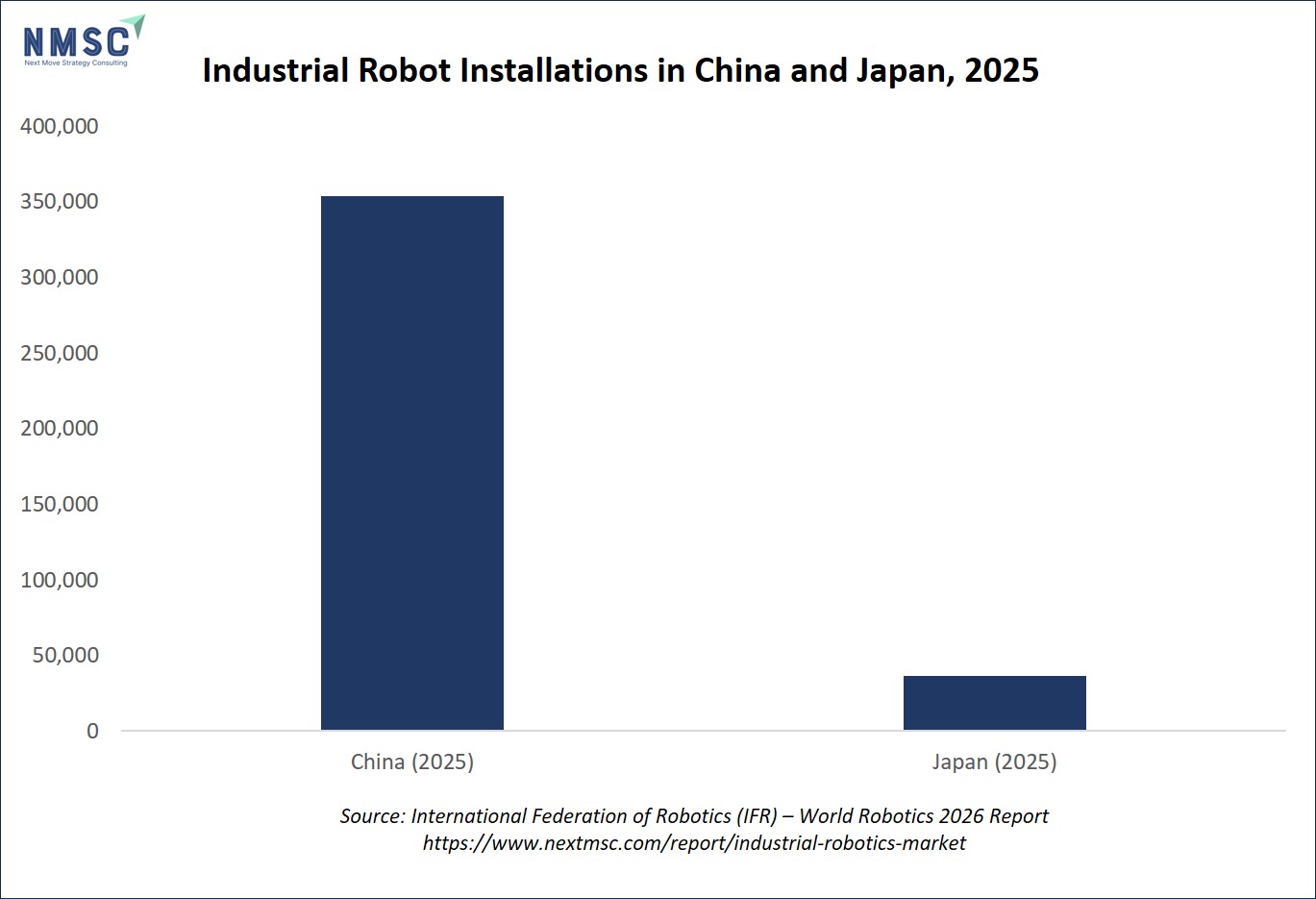
The United States surpassed Japan in 2025 to become the world's second-largest market for industrial robots, with installations growing 12% to nearly 38,500 units — the third-highest figure in the history of U.S. robotics statistics. India installed approximately 10,500 units, up 15%, and has recorded a compound annual growth rate of 27% in new installations between 2020 and 2025.
The IFR also reported that the global market value of industrial robot installations reached an all-time high of USD 16.7 billion, driven by a shift toward higher-value, AI-enabled systems rather than commodity arms.
The ABB-SoftBank Transaction: A $5.375 Billion Bet on Physical AI
The most consequential competitive event in the industrial robotics market in recent months is ABB's decision to divest its Robotics division to SoftBank Group Corp. for an enterprise value of USD 5.375 billion, announced on October 8, 2025. The transaction, expected to close in mid-to-late 2026, ends ABB's earlier plan to spin off the unit as a separately listed company.
ABB Robotics generated 2024 revenues of USD 2.3 billion with an Operational EBITA margin of 12.1%, employing approximately 7,000 people. SoftBank Chairman and CEO Masayoshi Son framed the acquisition explicitly around the convergence of artificial superintelligence and physical robotics: "SoftBank's next frontier is Physical AI. Together with ABB Robotics, we will unite world-class technology and talent under our shared vision to fuse Artificial Super Intelligence and robotics."
This transaction signals that the industrial robotics market's next competitive axis is not mechanical precision — it is AI stack depth. A standalone ABB Robotics entity backed by SoftBank's computing infrastructure and AI investment portfolio will compete differently than a division inside a diversified industrial conglomerate, with implications for pricing, R&D velocity, and go-to-market strategy across the entire sector.
Humanoid Robots Move from Pilot to Production Line
The IFR's Top 5 Global Robotics Trends 2026, published January 8, 2026, identified humanoid robots as a defining trend for the year, noting that companies and researchers are moving beyond prototypes to deploy humanoids in real-world industrial settings, with automotive manufacturers pioneering the transition.
BMW's deployment of Figure AI's humanoid robot at its Spartanburg, South Carolina facility — which supported the production of more than 30,000 BMW X3 vehicles over an 11-month deployment — represents the most operationally validated humanoid use case in mass manufacturing to date. BMW has since established a Center of Competence for Physical AI in Production and is extending humanoid deployment to its Plant Leipzig facility, targeting high-voltage battery assembly.
The significance for the broader industrial robotics market is structural: humanoids do not replace articulated arms in high-throughput, fixed-cell applications. They address the 30–40% of factory tasks that remain unautomated because they require human-environment adaptability — tasks that traditional industrial robots cannot perform without expensive custom fixturing. As humanoids prove reliability and cycle-time parity with human workers, they expand the total addressable market for automation beyond what conventional robot architectures can reach.
ISO 10218:2025 — The Safety Standard That Resets Compliance Timelines
The publication of ISO 10218-1:2025 and ISO 10218-2:2025 — the most significant revision to the global industrial robot safety standard in 13 years — is reshaping procurement and integration timelines across the sector. The updated standard explicitly addresses AI-driven autonomy, human-robot collaboration in shared workspaces, and cybersecurity requirements for cloud-connected robot systems — areas that the 2011 edition did not contemplate.
For manufacturers deploying cobots and AI-enabled systems in Europe, ISO 10218:2025 will become mandatory for CE-marked products, creating a compliance-driven replacement cycle that benefits vendors with pre-certified safety modules and validated human-robot collaboration architectures.
NMSC Strategic Perspective: The Software Layer Is Now the Margin Layer
NextMSC primary research and analysis identifies a structural shift in where value is captured in the industrial robotics supply chain. Hardware — articulated arms, SCARA robots, and mobile platforms — remains the largest revenue segment, but the fastest-growing value layer is software and services: fleet orchestration, vision and perception stacks, predictive maintenance platforms, and Robot-as-a-Service (RaaS) commercial models.
This shift is not incidental. As hardware unit economics improve and Chinese domestic manufacturers capture an increasing share of volume-driven deployments (55% domestic market share in China in 2025, per IFR data), differentiation for international vendors migrates to data, uptime guarantees, and outcome-linked billing. Vendors that can demonstrate measurable SLA performance — not just robot specifications — are converting single-site pilots into multi-site enterprise contracts.
Section Summary: The industrial robotics market is being reshaped by three simultaneous forces: a record installation cycle driven by China and a resurgent U.S. market, a competitive restructuring at the top of the supply chain (ABB-SoftBank), and the emergence of humanoid robots as a commercially validated expansion of the addressable market.
Key Takeaways:
-
The IFR's World Robotics 2026 Report confirmed 5 million robots now operational globally, with 600,000+ new installations in 2025 — an 11% annual increase.
-
China installed 354,000 units in 2025 (59% of global deployments); the U.S. surpassed Japan to become the world's second-largest market.
-
ABB's USD 5.375 billion divestiture to SoftBank signals that AI stack depth — not mechanical precision — is the next competitive axis in industrial robotics.
-
Humanoid robots have crossed from prototype to production, with BMW's Figure AI deployment supporting 30,000+ vehicle builds over 11 months.
Industry Impact Analysis
Automotive: EV Transition Drives High-Payload and Precision Demand Simultaneously
The automotive sector remains the largest adopter of industrial robots globally, but the nature of that demand is changing. Electric vehicle production requires both ultra-high-payload robots for battery module handling — FANUC's M-950iA, launched in November 2024, handles up to 500 kg and was specifically designed for EV battery-tray assembly — and high-precision, force-sensitive robots for cell-level assembly and inspection. This dual requirement is expanding the per-vehicle robot content, even as overall vehicle production volumes face cyclical pressure in Europe.
Brazil's automotive robotics market illustrates the geographic dimension of this shift: installations grew 212% in 2025, driven by Chinese EV manufacturers establishing production capacity in the country. This pattern — Chinese OEMs exporting their automation-intensive production model to new geographies — is a structural demand driver that extends well beyond China's domestic market.
Logistics and E-Commerce: AMR Fleet Orchestration Becomes the Differentiator
Autonomous Mobile Robots (AMRs) and Automated Guided Vehicles (AGVs) are the fastest-growing robot type in logistics and warehousing, driven by e-commerce throughput requirements and persistent labor shortages in fulfillment operations. According to NextMSC primary research and analysis, material handling accounts for approximately 63% of industrial robot applications by market share, with AMRs capturing an increasing proportion of new deployments as fleet orchestration software matures.
The critical competitive dynamic in this segment is no longer robot hardware — it is the software layer that coordinates multi-vendor fleets, integrates with Warehouse Management Systems (WMS) and ERP platforms, and delivers predictive maintenance analytics. Logistics operators are increasingly insisting on open APIs and multi-vendor interoperability to avoid lock-in, which is accelerating the commoditization of AMR hardware and shifting margin to platform providers.
Semiconductor and Electronics: Cleanroom Precision Drives SCARA and Parallel Robot Demand
The semiconductor sector's capital expenditure cycle — driven by government-backed fab construction in the U.S., Europe, Japan, and India — is generating sustained demand for cleanroom-compatible SCARA robots and parallel kinematic systems. These robots perform precision pick-and-place, wafer handling, and dispensing tasks in ISO Class 1–5 environments where contamination control is non-negotiable.
Taiwan's semiconductor-linked robotics demand is particularly notable: the island's trade and industry agencies are actively promoting robotics integration with precision motion controllers and semiconductor-grade cleanroom compatibility, per NextMSC primary research and analysis. As TSMC, Samsung, and Intel expand fab capacity across multiple geographies, the cleanroom robotics segment will benefit from a multi-year capital deployment cycle that is largely insulated from short-term demand fluctuations.
Reshoring and Industrial Policy: A Structural Demand Multiplier
The IFR's World Robotics 2026 Report explicitly identified reshoring and industrial policy as structural demand multipliers: "The need for more resilient supply chains and recent developments of trade and industrial policy in several major economies are resulting in increasing relocation activity in the manufacturing industries. Building manufacturing capacity in high-wage economies and countries facing labor shortages will drive the demand for automation technology."
Yaskawa Electric's June 2025 announcement of a USD 180 million investment to build an 800,000 sq. ft. campus in Franklin, Wisconsin — consolidating U.S. operations, expanding training facilities, and increasing robotics and semiconductor production capacity — is a direct response to this policy environment. The investment creates local manufacturing capacity for a market where "Made in America" provenance is increasingly a procurement criterion for government-adjacent buyers.
Section Summary: The industrial robotics market's demand structure is being reinforced by sector-specific tailwinds — EV production complexity, e-commerce logistics automation, semiconductor fab expansion, and reshoring policy — that operate independently of the broader economic cycle.
Key Takeaways:
-
EV production is expanding per-vehicle robot content, with high-payload and precision robots required simultaneously for battery assembly.
-
AMR fleet orchestration software is becoming the primary margin layer in logistics robotics, as hardware commoditizes.
-
Semiconductor fab expansion across the U.S., Europe, and Asia is generating a multi-year cleanroom robotics demand cycle.
-
Reshoring policy is converting automation from a cost-optimization tool into a strategic manufacturing sovereignty instrument.
Pros and Cons of Recent Market Developments
|
Development |
Pros |
Cons |
|
ABB Robotics divested to SoftBank for USD 5.375B |
Combines ABB's industrial expertise with SoftBank's AI and computing capabilities; accelerates Physical AI roadmap; creates a focused, well-capitalized robotics pure-play |
Integration risk between industrial OT culture and SoftBank's tech-investment model; potential disruption to existing ABB Robotics customer relationships during transition period |
|
IFR confirms 5 million robots operational globally |
Validates long-term demand trajectory; creates a large installed base for software, services, and upgrade revenue; normalizes automation investment across SMEs |
Intensifies price competition in hardware, particularly from Chinese domestic suppliers capturing 55% of China's market; margin pressure on international OEMs in volume segments |
|
ISO 10218:2025 safety standard published |
Creates a clear compliance framework for AI-driven and collaborative robots; reduces liability ambiguity; enables broader human-robot collaboration deployments |
Compliance costs and re-certification timelines create near-term friction for vendors; smaller integrators may lack resources to update system designs rapidly |
|
Humanoid robots entering production (BMW/Figure AI) |
Expands addressable market to unstructured tasks previously inaccessible to traditional robots; reduces dependency on custom fixturing |
Cycle times and energy consumption still lag traditional automation in high-throughput applications; reliability data is limited to narrow task profiles |
|
Yaskawa's USD 180M Wisconsin campus investment |
Strengthens U.S. supply chain resilience; supports reshoring narrative; expands local training capacity for integrators |
Significant capital commitment in a period of uncertain trade policy; construction and ramp-up timelines extend 2–3 years before full capacity is realized |
|
China's 59% share of global robot installations |
Demonstrates scale of global demand; drives component cost reductions that benefit the entire industry |
Concentration risk for global supply chains; Chinese domestic suppliers gaining market share at the expense of international OEMs in the world's largest market |
IFR World Robotics 2026 — Key Regional Installation Data (2025)
|
Country/Region |
2025 Installations (Units) |
YoY Change |
Global Rank |
|
China |
354,000 |
+20% |
1st |
|
United States |
~38,500 |
+12% |
2nd |
|
Japan |
36,219 |
−19% |
3rd |
|
South Korea |
~30,000 |
−1% |
4th |
|
Germany |
<25,000 |
−8% |
5th |
|
India |
~10,500 |
+15% |
6th |
|
Canada |
~4,000 |
+5% |
— |
|
Brazil |
~4,300 |
+38% |
— |
|
Global Total (Operational Stock) |
5,000,000 |
+9% |
— |
|
Global Annual Installations |
>600,000 |
+11% |
— |
Future Outlook & Forecast
NMSC Market Trajectory: USD 88.66 Billion by 2030
According to NextMSC primary research and analysis, the industrial robotics market is on a sustained growth trajectory, with revenue projected to nearly double from USD 48.75 billion in 2025 to USD 88.66 billion by 2030 at a 12.7% CAGR. The volume trajectory is even steeper — from 653 thousand units to 1,287 thousand units — reflecting improving unit economics as AI-enabled systems become more accessible to mid-market manufacturers.
The IFR's own installation forecast supports this trajectory: global annual installations are projected to rise 9% to 655,000 units in 2026 and reach 806,000 units by 2029, with China, the U.S., and India identified as the primary growth markets.
The Five Structural Drivers That Will Sustain Growth Through 2030
1. Embodied AI and On-Device Learning: The IFR's Top 5 Trends 2026 identified Agentic AI — combining analytical AI for structured decision-making with generative AI for adaptability — as the technology that will make robots capable of working independently in complex, real-world environments. As simulation-to-reality pipelines mature, the cost of deploying robots in unstructured environments will fall, expanding the addressable market beyond the fixed-cell applications that have historically dominated.
2. IT/OT Convergence: The merger of Information Technology's data-processing capabilities with Operational Technology's physical control systems is enabling real-time data exchange, advanced analytics, and remote fleet management at scale. This convergence is the technical foundation for cloud robotics, digital twins, and predictive maintenance platforms — the software layer where margin is increasingly concentrated.
3. Demographic Pressure and Labor Scarcity: Aging workforces in Japan, Germany, South Korea, and increasingly China are converting automation from a productivity tool into a workforce continuity instrument. The IFR explicitly identified labor gap mitigation as one of the five defining robotics trends for 2026, noting that employers across all sectors are adopting robotics as a strategic response to unfilled skilled positions.
4. RaaS and Outcome-Based Commercial Models: Robot-as-a-Service is moving from niche trials to mainstream procurement, particularly among SMEs that cannot absorb large capital expenditures. Vendors offering integrated service tiers — deployment, analytics, maintenance — with SLA-backed uptime guarantees are converting hardware sales into recurring revenue streams, improving both vendor economics and buyer adoption rates.
5. Reshoring and Industrial Policy: Government-backed manufacturing capacity expansion in the U.S. (CHIPS Act, Inflation Reduction Act), EU (European Chips Act, Net-Zero Industry Act), India (PLI schemes), and Japan (semiconductor subsidies) is generating a policy-driven automation demand cycle that is structurally less sensitive to short-term economic conditions than traditional capex cycles.
Section Summary: The industrial robotics market's growth through 2030 is underpinned by converging structural forces — AI capability expansion, demographic pressure, policy-driven reshoring, and the commercialization of new robot form factors — that collectively expand both the depth of automation in existing industries and the breadth of industries that can economically deploy robots.
Key Takeaways:
-
NMSC projects the market to reach USD 88.66 billion by 2030 at a 12.7% CAGR, with volume doubling to 1,287 thousand units.
-
IFR forecasts global annual installations to reach 806,000 units by 2029, with China, the U.S., and India as primary growth markets.
-
Agentic AI and IT/OT convergence are the technology foundations for the next wave of automation, expanding deployable use cases beyond fixed-cell applications.
-
RaaS commercial models are lowering the adoption barrier for SMEs, broadening the buyer base beyond large-scale manufacturers.
Next Steps for Stakeholders
For C-Level Executives and Operations Leaders:
-
Audit your automation gap against the new ISO 10218:2025 framework. The updated safety standard is not merely a compliance exercise — it is a blueprint for deploying AI-driven and collaborative robots in shared workspaces. Organizations that align their automation roadmaps with the new standard now will avoid costly retrofits when CE-marking requirements take effect.
-
Evaluate RaaS as a capital-efficient entry point for new automation use cases. For applications where ROI is uncertain or production volumes are variable, outcome-based contracts with SLA-backed uptime guarantees reduce deployment risk while building the internal data and operational capability needed to scale.
-
Prioritize software and integration capability in vendor selection. As hardware commoditizes — particularly in volume segments where Chinese domestic suppliers are gaining share — the differentiating factor in long-term vendor relationships is the quality of fleet orchestration, analytics, and integration support. Vendors that cannot demonstrate open API architectures and multi-vendor interoperability represent a lock-in risk.
-
Assess humanoid robot pilots for unstructured task categories. BMW's 11-month deployment of Figure AI's humanoid supporting 30,000+ vehicle builds provides a validated operational template. Organizations with significant unstructured task content — tasks that require human-environment adaptability — should begin structured pilot evaluations now, before humanoid deployment becomes a competitive necessity.
For Investors and Capital Allocators:
-
The ABB-SoftBank transaction establishes a valuation benchmark. ABB Robotics was valued at USD 5.375 billion on 2024 revenues of USD 2.3 billion — a revenue multiple of approximately 2.3x. This multiple reflects the market's pricing of AI-enabled robotics as a growth asset, not a mature industrial business. Software-first robotics platforms with recurring revenue should command premium multiples relative to hardware-only peers.
-
India and Brazil represent the highest-growth emerging market opportunities. India's 27% CAGR in robot installations from 2020–2025 and Brazil's 38% installation growth in 2025 (driven by Chinese EV manufacturer investments) signal that the next phase of global robotics adoption is broadening geographically. Vendors with low-CAPEX deployment models and local service networks are best positioned to capture this growth.
-
Monitor the SoftBank-ABB Robotics integration for competitive displacement signals. A well-capitalized, AI-focused ABB Robotics entity will compete more aggressively in software and AI-enabled systems. Competitors that have not yet built comparable AI stacks face a narrowing window to close the capability gap through organic development or acquisition.
Conclusion
The industrial robotics market has entered a phase of structural acceleration that is qualitatively different from prior automation cycles. The IFR's confirmation of five million operational robots globally, combined with record annual installations exceeding 600,000 units in 2025, establishes that automation is no longer a discretionary investment — it is a manufacturing infrastructure requirement.
According to NextMSC primary research and analysis, the market's trajectory from USD 48.75 billion in 2025 to USD 88.66 billion by 2030 at a 12.7% CAGR is supported by converging structural forces: embodied AI expanding the range of automatable tasks, RaaS models broadening the buyer base, reshoring policy creating policy-driven demand, and humanoid robots opening entirely new application categories.
The ABB-SoftBank transaction at USD 5.375 billion is the clearest market signal yet that the industrial robotics sector's next competitive battleground is AI capability, not mechanical engineering. For executives and investors, the strategic imperative is clear: position for the software and AI layer, not just the hardware cycle.
About the Author
 Sanyukta Deb
— Sanyukta Deb is Digital Marketing Team Lead at Next Move Strategy Consulting, where she has led content strategy and technical SEO for the firm's B2B market research publications for over 2 years. Her editorial process translates NextMSC's primary and secondary research — spanning technology, industrial, and consumer sectors — into commercial narratives, backed by search-intent, keyword, and competitive analysis. She brings 5 years of overall experience in digital marketing and content strategy.
Sanyukta Deb
— Sanyukta Deb is Digital Marketing Team Lead at Next Move Strategy Consulting, where she has led content strategy and technical SEO for the firm's B2B market research publications for over 2 years. Her editorial process translates NextMSC's primary and secondary research — spanning technology, industrial, and consumer sectors — into commercial narratives, backed by search-intent, keyword, and competitive analysis. She brings 5 years of overall experience in digital marketing and content strategy.
About the Reviewer
 Debashree Dey
— Debashree Dey is Assistant Manager at Next Move Strategy Consulting, where she supports cross-vertical market content and communications across diverse industries for 6 years. Her professional background includes senior content writing, communications, and published manuscript authorship, with experience developing audience-focused business narratives and maintaining clear, consistent messaging. Her role supports research-led content development and editorial quality across NextMSC publications.
Debashree Dey
— Debashree Dey is Assistant Manager at Next Move Strategy Consulting, where she supports cross-vertical market content and communications across diverse industries for 6 years. Her professional background includes senior content writing, communications, and published manuscript authorship, with experience developing audience-focused business narratives and maintaining clear, consistent messaging. Her role supports research-led content development and editorial quality across NextMSC publications.
















Add Comment