Is 2026 PFAS Ban Transforming the Global Food Packaging Market?

Introduction
The Food Packaging Market has entered a transformative period in 2026, defined by an unprecedented convergence of sustainability regulation, industry consolidation, and material innovation. No longer a passive cost center, food packaging has become a frontline strategic variable shaping brand equity, supply chain resilience, and regulatory compliance across global food value chains.
For C-level executives, institutional investors, and packaging strategists, understanding the Food Packaging Market today requires looking beyond unit volumes toward sustainable food packaging mandates, flexible food packaging trends, smart packaging technologies, and the accelerating shift toward eco-friendly packaging materials. This guide synthesizes verified primary-source intelligence from leading institutions and global packaging companies with proprietary forecasting from Next Move Strategy Consulting (NMSC) to deliver an institutional-grade view of where the market stands and where capital should be directed.
How the EU PFAS Ban Is Redefining Sustainable Food Packaging Trends
The single most globally impactful development reshaping the Food Packaging Market in 2026 is the entry into application of the European Union's Packaging and Packaging Waste Regulation (PPWR). The Packaging and Packaging Waste Regulation 2025/40 entered into force on 11 February 2025 and will generally apply from 12 August 2026, covering all packaging and packaging waste regardless of material or origin.
The regulation carries direct and material consequences for food contact packaging. From 12 August 2026, the PPWR will minimise substances of concern, including restrictions on per- and polyfluoroalkyl substances (PFAS) in food contact packaging where they exceed certain thresholds, alongside restrictions on certain single-use plastics such as individual portions or sachets of condiments and sauces. The Regulation further aims to make all packaging on the EU market recyclable in an economically viable way by 2030, safely increase the use of recycled plastics, and decrease the use of virgin materials.
The scale of the underlying challenge is substantial. According to the European Commission, 40% of plastics used in the EU are in packaging, half of all marine litter originates from packaging, and 186.5 kg of packaging waste was generated per person in the EU in 2022. To support compliance, the Commission published implementation guidelines and a Frequently Asked Questions document in March 2026, addressing practical issues raised by stakeholders since the regulation's adoption.
This regulatory acceleration is unfolding alongside profound industry consolidation. Amcor completed its all-stock combination with Berry Global on April 30, 2025, creating a global leader in consumer and healthcare packaging, while Sealed Air entered into a definitive agreement on November 17, 2025 to be acquired by funds affiliated with CD&R in an all-cash transaction with an enterprise value of $10.3 billion.
NMSC Strategic Perspective on the Regulatory Shift
From NMSC's analytical vantage point, the PPWR represents a structural repricing of packaging materials rather than an incremental compliance burden. The economics of the modern food packaging market are increasingly anchored in recyclability, recycled content mandates, and the elimination of substances of concern, fundamentally reshaping material selection, supplier relationships, and capital allocation across the value chain.
NMSC anticipates three structural shifts. First, the PFAS restriction and recyclability mandates will accelerate substitution toward fiber-based, mono-material, and bio-based solutions, compressing demand for legacy multi-laminate structures. Second, the regulatory burden will reinforce consolidation, as scale becomes essential to absorb compliance costs and fund material innovation—evidenced by the Amcor–Berry combination and the Sealed Air acquisition. Third, modified atmosphere packaging (MAP) and intelligent packaging technologies will gain share as brands seek to extend shelf life and reduce food waste within increasingly constrained material parameters. For investors, the signal is clear: value in the Food Packaging Market is migrating decisively toward sustainable, compliant, and technology-enabled solutions.
Section Summary: The Food Packaging Market is being structurally redefined by the EU PPWR, which from August 2026 restricts PFAS in food contact packaging and mandates recyclability, while industry consolidation intensifies in parallel.
The PPWR (Regulation 2025/40) entered into force on 11 February 2025 and applies from 12 August 2026.
From August 2026, PFAS in food contact packaging will be restricted above defined thresholds.
The regulation targets economically viable recyclability for all EU packaging by 2030.
Consolidation is accelerating, including the Amcor–Berry combination and Sealed Air's $10.3 billion acquisition by CD&R.
Industry Impact Analysis
The regulatory and consolidation dynamics are unfolding against a backdrop of fundamental shifts in material demand and end-user behavior. The most powerful driver is the decisive pivot toward sustainable and recyclable materials, which is reshaping both product portfolios and capital expenditure priorities across the sector. NMSC's analysis confirms that increasing consumer awareness of environmental issues is compelling companies to develop eco-friendly packaging materials such as biodegradable plastics, compostable packaging, and recyclable materials.
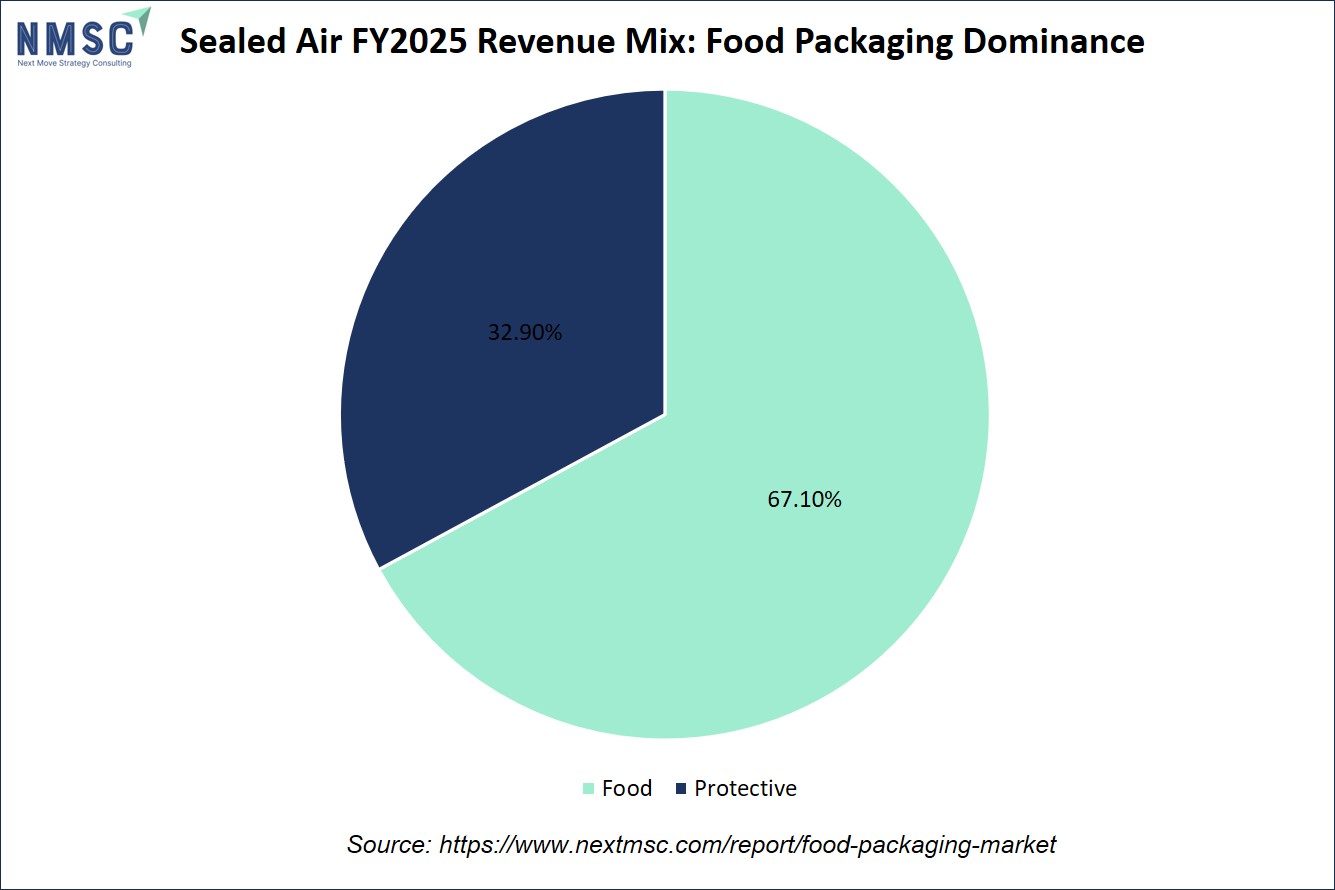
The financial evidence of this shift is visible in segment performance at leading manufacturers. Sealed Air's Food segment generated full-year 2025 net sales of $3,594.7 million, representing 67.1% of total company net sales of $5,359.8 billion, with Food segment Adjusted EBITDA of $829.1 million at a margin of 23.1%. This demonstrates the resilience and margin strength of food packaging relative to protective packaging, even amid volume pressure.
The most powerful demand driver remains technology-driven preservation. NMSC identifies the increasing preference for hygiene and sterile packaging solutions, coupled with efforts to preserve food quality through technology-driven methods including modified atmosphere packaging (MAP) and vacuum atmospheric packaging, as the primary force propelling market growth. The rise of e-commerce and online grocery platforms is creating additional demand for packaging tailored to fulfillment requirements, with the global e-commerce industry projected to reach significant scale.
However, structural headwinds persist. NMSC notes that stringent regulations governing food safety, labeling, and packaging materials pose challenges for manufacturers, requiring costly compliance measures and limiting flexibility in packaging design and materials. This regulatory burden is precisely what is driving consolidation, as scale becomes essential to absorb compliance and innovation costs.
Section Summary: The Food Packaging Market's growth is anchored in sustainable material transition, technology-driven preservation, and e-commerce demand, while regulatory compliance costs remain the principal structural restraint.
-
Sealed Air's Food segment delivered $3,594.7 million in FY2025 sales at a 23.1% Adjusted EBITDA margin.
-
MAP and vacuum packaging technologies are the primary growth drivers for food preservation.
-
E-commerce and online grocery are creating new tailored packaging demand.
-
Stringent food-safety and material regulations raise compliance costs and accelerate consolidation.
Pros and Cons of Recent Market Developments
The regulatory and sustainability dynamics reshaping the Food Packaging Market carry distinct advantages and risks for stakeholders.
|
Pros |
Cons |
|
Sustainability mandates drive innovation in recyclable and bio-based materials |
PFAS restrictions and recyclability rules raise near-term compliance costs |
|
Modified atmosphere packaging (MAP) extends shelf life and reduces food waste |
Material substitution requires significant capital reinvestment |
|
Consolidation builds scale to absorb compliance and innovation costs |
Reduced design flexibility under stricter material parameters |
|
Smart packaging technologies enhance traceability and brand engagement |
Single-use plastic restrictions disrupt established product formats |
|
Food packaging delivers resilient, high-margin demand versus other segments |
Regulatory fragmentation across regions complicates global supply chains |
Key Data & Statistics
The following tables draw exclusively on verified primary-source disclosures from leading packaging companies' financial filings and from the European Commission.
Leading Food Packaging Players
|
Company |
Reported Period |
Key Metric |
Result |
|
Amcor (incl. Berry) |
Q3 FY2026 |
Net sales |
$5,914 million (+77% YoY) |
|
Amcor (incl. Berry) |
H1 FY2026 |
Net sales |
$11,194 million (+70%) |
|
Sealed Air |
FY2025 |
Food segment net sales |
$3,594.7 million (67.1% of total) |
|
Sealed Air |
FY2025 |
Total net sales |
$5,359.8 million |
Amcor reported third-quarter fiscal 2026 net sales of $5,914 million, up 77% year over year, driven largely by the Berry acquisition, while first-half fiscal 2026 net sales reached $11,194 million, up 70%. Sealed Air reported full-year 2025 total net sales of $5,359.8 million.
Sealed Air FY2025 Net Sales by Segment
|
Segment |
FY2025 Net Sales (USD M) |
Share of Total |
Adjusted EBITDA Margin |
|
Food |
3,594.7 |
67.1% |
23.1% |
|
Protective |
1,765.1 |
32.9% |
17.6% |
|
Total |
5,359.8 |
100.0% |
21.2% |
The segment breakdown confirms the structural dominance and superior margin profile of food packaging within a diversified packaging portfolio.
Future Outlook & Forecast for the Food Packaging Market
The forward trajectory of the Food Packaging Market is defined by the sustained convergence of sustainability regulation, material innovation, and smart packaging technologies. Anchoring the long-term market sizing, Next Move Strategy Consulting values the global Food Packaging Market with a projected rise to USD 565.13 billion, registering a CAGR of 5.3% by 2030.
Regionally, the Asia-Pacific region holds the predominating share in food packaging at present and is expected to continue dominating the market during the forecast period, supported by the rising use of recycled materials and increasing consumer demand for sustainable products. The North American market, meanwhile, is experiencing consistent growth driven by increasing demand for processed food products and the introduction of recyclable packaging by regional companies.
NMSC's outlook holds that eco-friendly packaging materials—including biodegradable plastics, compostable packaging, and recyclable materials—represent the principal growth opportunity, as increasing consumer awareness and regulatory initiatives compel companies to innovate. This thesis is strongly corroborated by the EU PPWR's binding recyclability target for 2030 and the resilient margin performance of food packaging segments at leading manufacturers, positioning the sector for durable, defensible growth.
Section Summary: The Food Packaging Market outlook is anchored by NMSC's USD 565.13 billion forecast by 2030 at a 5.3% CAGR, with sustainability, MAP, and smart packaging technologies as the principal value drivers.
-
NMSC projects the market to grow from USD 392.93 billion in 2023 to USD 565.13 billion by 2030.
-
Asia-Pacific remains the dominant regional market through the forecast period.
-
The EU PPWR's 2030 recyclability mandate reinforces the eco-friendly material transition.
-
Food packaging segments demonstrate resilient, high-margin demand at leading manufacturers.
Next Steps for Stakeholders
For C-level executives and institutional investors positioning within the Food Packaging Market, the strategic priorities are increasingly defined and actionable:
-
Accelerate PFAS-free and recyclable material transition. Prioritize investment in fiber-based, mono-material, and bio-based solutions ahead of the August 2026 PPWR application date.
-
Evaluate consolidation and scale opportunities. The Amcor–Berry combination and Sealed Air's acquisition signal that scale is essential to absorb compliance and innovation costs.
-
Invest in MAP and smart packaging technologies. These solutions extend shelf life, reduce food waste, and enhance traceability within tightening material constraints.
-
Target high-growth geographies. Asia-Pacific offers the most attractive blend of structural growth and recycled-material adoption momentum.
-
Stress-test supply chains against regulatory fragmentation. Divergent regional rules require flexible, compliance-ready material strategies.
Conclusion
The Food Packaging Market in 2026 is being reshaped by a rare convergence of forces: the EU PPWR's landmark PFAS restrictions and recyclability mandates taking effect from August 2026; accelerating industry consolidation exemplified by the Amcor–Berry combination and Sealed Air's $10.3 billion acquisition; and the rapid maturation of sustainable materials and smart packaging technologies. Against this backdrop, NMSC's forecast of a USD 565.13 billion market by 2030 at a 5.3% CAGR provides a credible long-term anchor for capital allocation. The decisive strategic insight is unambiguous—value in food packaging now resides in sustainable, compliant, and technology-enabled solutions, and the stakeholders who align their portfolios accordingly will be best positioned to capture the next phase of growth.
About the Author
 Sanyukta Deb
— Sanyukta Deb is Digital Marketing Team Lead at Next Move Strategy Consulting, where she has led content strategy and technical SEO for the firm's B2B market research publications for over 2 years. Her editorial process translates NextMSC's primary and secondary research — spanning technology, industrial, and consumer sectors — into commercial narratives, backed by search-intent, keyword, and competitive analysis. She brings 5 years of overall experience in digital marketing and content strategy.
Sanyukta Deb
— Sanyukta Deb is Digital Marketing Team Lead at Next Move Strategy Consulting, where she has led content strategy and technical SEO for the firm's B2B market research publications for over 2 years. Her editorial process translates NextMSC's primary and secondary research — spanning technology, industrial, and consumer sectors — into commercial narratives, backed by search-intent, keyword, and competitive analysis. She brings 5 years of overall experience in digital marketing and content strategy.
About the Reviewer
 Debashree Dey
— Debashree Dey is Assistant Manager at Next Move Strategy Consulting, where she supports cross-vertical market content and communications across diverse industries for 6 years. Her professional background includes senior content writing, communications, and published manuscript authorship, with experience developing audience-focused business narratives and maintaining clear, consistent messaging. Her role supports research-led content development and editorial quality across NextMSC publications.
Debashree Dey
— Debashree Dey is Assistant Manager at Next Move Strategy Consulting, where she supports cross-vertical market content and communications across diverse industries for 6 years. Her professional background includes senior content writing, communications, and published manuscript authorship, with experience developing audience-focused business narratives and maintaining clear, consistent messaging. Her role supports research-led content development and editorial quality across NextMSC publications.
















Add Comment