Is Cloud Sustainability the Next Frontier in Green Tech?

Imagine powering your business's digital backbone without leaving a massive carbon footprint. In an era where environmental accountability meets technological innovation, the cloud sustainability market is emerging as a pivotal force. As enterprises grapple with escalating cloud costs and regulatory pressures, solutions that blend efficiency with eco-responsibility are not just desirable—they are essential.
This blog delves into recent advancements shaping this space, drawing from credible industry insights to uncover how the cloud can truly go green.
As per the market study by Next Move Strategy Consulting, the global Cloud Sustainability Market size is predicted to reach USD 84.29 billion by 2030 with a CAGR of 19%. we track these shifts to guide clients toward sustainable digital transformations. With global cloud spending projected to surge, integrating sustainability ensures long-term resilience and compliance.
What Defines Cloud Sustainability in Today's Market?
Cloud sustainability refers to practices and technologies that minimize the environmental impact of cloud computing, from data center energy use to emissions tracking. It encompasses carbon footprint monitoring, resource optimization, and alignment with frameworks like the Greenhouse Gas Protocol.
Key elements include:
-
Energy-efficient infrastructure: Leveraging renewable sources and elastic scaling to avoid waste.
-
Data-driven governance: Tools for measuring emissions, water usage, and waste across hybrid clouds.
-
Regulatory compliance: Adhering to ESG standards such as the Corporate Sustainability Reporting Directive (CSRD).
Recent developments highlight a market maturing beyond buzzwords. According to Flexera, 36% of organizations currently track their cloud carbon footprint, and an additional 35% plan to implement monitoring within the next two years. This gradual adoption signals a market ripe for innovation, where sustainability intersects with FinOps (Financial Operations) to deliver dual benefits in cost and environmental savings.
In summary, cloud sustainability is the strategic fusion of technology and ecology, enabling businesses to scale digitally while stewarding the planet. Bullet-point takeaways:
-
Focus on measurable metrics like CO2e (carbon dioxide equivalent) for transparency.
-
Adopt hybrid cloud models that provide both regulatory compliance through data sovereignty and scalable resource optimization.
-
Treat sustainability as a core compliance requirement rather than an optional initiative.
How Are Leading Providers Innovating in Cloud Sustainability?
What Role Does Flexera's New Add-On Play in Greener Clouds?
Flexera recently launched its Cloud Sustainability Add-on, a tool designed to integrate environmental metrics directly into cloud cost management. This add-on, announced in early 2024, enriches billing data with sustainability indicators such as location-specific Power Usage Effectiveness (PUE), chipset power consumption, and hourly carbon intensity.
The platform provides:
-
Visibility into total carbon emissions, water, and electricity usage, broken down by region, provider, and resource type.
-
Actionable recommendations for rightsizing instances, scheduling workloads, and optimal placement to cut both costs and emissions.
-
Custom reports compliant with ESG frameworks, leveraging ISO 14064-certified data from partner Greenpixie.
This solution addresses key challenges, including the difficulty of obtaining reliable environmental data to inform cloud workload decisions. By combining it with Flexera One Cloud Cost Optimization, organizations gain a unified view across multi-cloud environments.
Flexera’s Cloud Sustainability Add-On, scheduled for launch on April 22, 2025, introduces unified dashboards for carbon monitoring, cloud optimization, and sustainability insights.
In short:
-
It elevates FinOps maturity by linking cost to carbon tradeoffs.
-
Enables auditable reporting for regulations like CSRD.
Why Is Sovereign Cloud Gaining Traction for Sustainable Operations?
Tata Consultancy Services (TCS) emphasizes sovereign cloud as a cornerstone for sustainability in its 2024 white paper. Sovereign cloud ensures data and operations remain within jurisdictional borders, fostering control, compliance, and long-term environmental efficiency.
Core principles include:
-
Data sovereignty: Local storage and processing to meet laws like India's Digital Personal Data Protection Act.
-
Operational sovereignty: Independence from foreign dependencies, reducing geopolitical risks.
-
Digital sovereignty: Indigenous infrastructure that supports net-zero visions through optimized, adaptable architectures.
TCS highlights hybrid models that integrate on-premises systems with cloud-native capabilities, minimizing disruptions and enabling AI-driven efficiencies. This approach indirectly bolsters sustainability by promoting resource optimization and resilience.
To wrap up, sovereign cloud frameworks provide a secure and sustainable approach to computing, aligning local data control with energy-efficient operations. Key points:
-
It aligns with national digital agendas for innovation without environmental compromise.
-
Facilitates perpetual adaptability in volatile markets.
Analysis of Key Companies
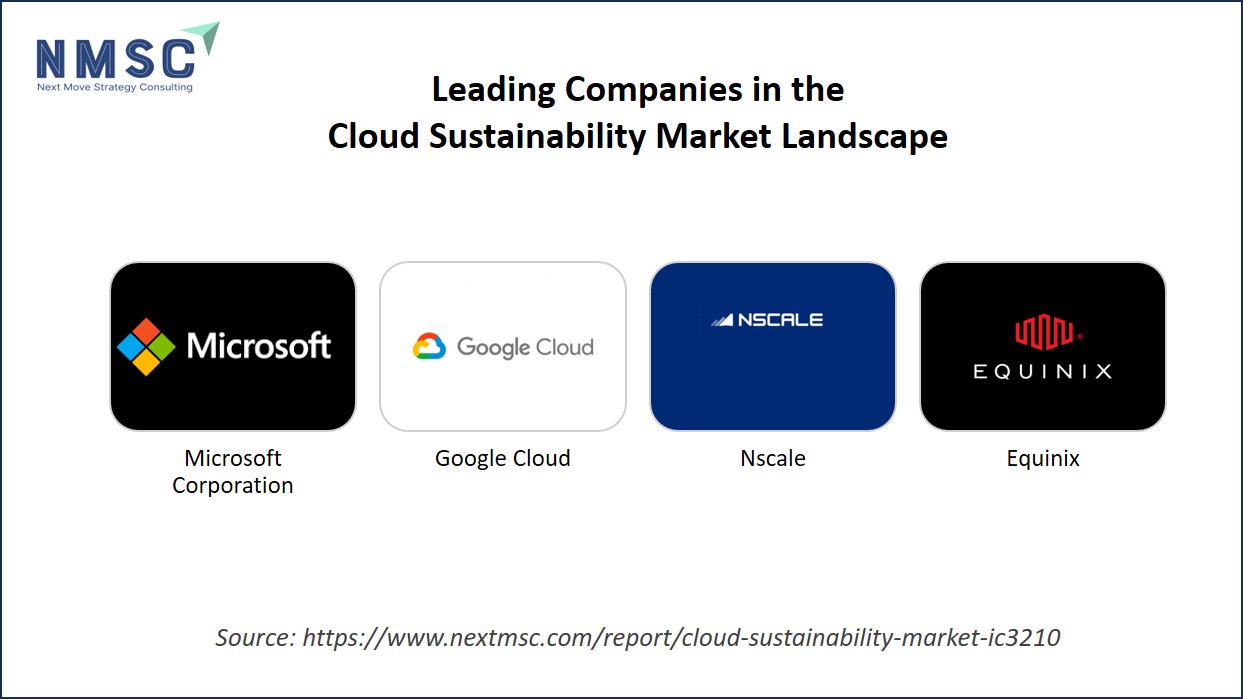
Key players in the global cloud sustainability industry, including Microsoft Corporation, Amazon Web Services (AWS), Google Cloud, Nscale, Equinix, and others, are actively pursuing strategies focused on enhancing energy efficiency, scalability, and environmental impact of cloud services to capture a larger market share and address significant growth potential in this sector.
Future innovations are also focusing on developing cost-effective, scalable green cloud solutions suitable for widespread adoption and adapting infrastructure to regional energy grids, which could further shape market trends and industry.
How is Oracle Leveraging Tech for ESG-Driven Cloud Sustainability?
Oracle is at the forefront of embedding sustainability into cloud operations, as detailed in a 2024 analysis of its initiatives. Oracle reports that consolidating systems on its Cloud Infrastructure reduced hardware requirements by 50%, while over 99% of retired equipment is either reused or recycled, supporting its net-zero by 2050 goal.
These steps support Oracle's net-zero by 2050 goal, using AI for facilities management and spend-based analytics for supplier engagement. Ranked 38th in Sustainability Magazine’s Top 250 World’s Most Sustainable Companies 2025, Oracle exemplifies circular IT principles.
In essence, Oracle's strategy turns data into actionable sustainability. Highlights:
-
Using elastic cloud models helps reduce idle capacity, improving both cost efficiency and energy usage.
-
Partnerships ensure certified recycling under ISO 14001.
What Impact are these Developments Having on the Cloud Sustainability Market?
As a market research firm at Next Move Strategy Consulting, we analyze how such announcements ripple through the cloud sustainability sector. Flexera's add-on, for example, accelerates FinOps adoption by quantifying carbon-cost intersections, potentially boosting market growth as 31% of organizations now weigh both factors in decisions—up from cost-only priorities. This tool empowers enterprises to meet internal emission goals and external regulations, fostering a 10-15% efficiency gain in resource allocation based on integrated metrics.
TCS's sovereign cloud framework addresses a critical gap in emerging markets like India, where data localization mandates intersect with net-zero pledges. By enabling hybrid adaptability, it reduces migration disruptions, indirectly lowering energy-intensive rebuilds and supporting AI scalability without sovereignty tradeoffs. This positions the market for a surge in region-specific solutions, enhancing global compliance while curbing cross-border data flows' environmental toll.
Oracle's ESG tools, meanwhile, democratize sustainability data governance, allowing mid-sized firms to benchmark against giants. With OCI's renewable push, it sets a benchmark for hyperscalers, pressuring competitors to match 100% renewable targets by 2025. Collectively, these innovations could expand the market by emphasizing auditable, scalable green tech—driving a projected shift where sustainability influences 50%+ of cloud procurement by late 2025.
Our analysis adds value: Pair these tools with scenario modeling to predict ROI on green migrations, ensuring investments yield measurable ESG returns. This not only mitigates risks but unlocks stakeholder trust in an era of heightened scrutiny.
Next Steps: Actionable Takeaways for Your Cloud Strategy
Ready to green your cloud? Here are 3-5 practical steps:
-
Assess your footprint: Start with a baseline audit using tools like Flexera's add-on to track CO2e across providers—aim for implementation within six months.
-
Adopt hybrid sovereignty: Evaluate TCS-inspired models for compliance-heavy sectors; pilot a sovereign zone to balance security and sustainability.
-
Integrate ESG analytics: Leverage Oracle Fusion for supplier emissions tracking; set quarterly reviews to align with net-zero goals.
-
Prioritize renewables: Negotiate contracts with 100% renewable providers like OCI; monitor progress against 2025 benchmarks.
-
Build cross-functional teams: Combine FinOps and sustainability experts for holistic decision-making, targeting 20% emission reductions annually.
Organizations that adopt cloud sustainability strategies early can gain a competitive advantage while meeting environmental and regulatory goals.
About the Author
 Sanyukta Deb
— Sanyukta Deb is Digital Marketing Team Lead at Next Move Strategy Consulting, where she has led content strategy and technical SEO for the firm's B2B market research publications for over 2 years. Her editorial process translates NextMSC's primary and secondary research — spanning technology, industrial, and consumer sectors — into commercial narratives, backed by search-intent, keyword, and competitive analysis. She brings 5 years of overall experience in digital marketing and content strategy.
Sanyukta Deb
— Sanyukta Deb is Digital Marketing Team Lead at Next Move Strategy Consulting, where she has led content strategy and technical SEO for the firm's B2B market research publications for over 2 years. Her editorial process translates NextMSC's primary and secondary research — spanning technology, industrial, and consumer sectors — into commercial narratives, backed by search-intent, keyword, and competitive analysis. She brings 5 years of overall experience in digital marketing and content strategy.
About the Reviewer
 Debashree Dey
— Debashree Dey is Assistant Manager at Next Move Strategy Consulting, where she supports cross-vertical market content and communications across diverse industries for 6 years. Her professional background includes senior content writing, communications, and published manuscript authorship, with experience developing audience-focused business narratives and maintaining clear, consistent messaging. Her role supports research-led content development and editorial quality across NextMSC publications.
Debashree Dey
— Debashree Dey is Assistant Manager at Next Move Strategy Consulting, where she supports cross-vertical market content and communications across diverse industries for 6 years. Her professional background includes senior content writing, communications, and published manuscript authorship, with experience developing audience-focused business narratives and maintaining clear, consistent messaging. Her role supports research-led content development and editorial quality across NextMSC publications.


















Add Comment