How Are Cloud AI Developer Services Redefining Enterprise Transformation in 2026?
The Cloud AI Developer Services Market is undergoing a major transformation as enterprises increasingly view artificial intelligence infrastructure as a core component of long-term business strategy rather than an experimental technology investment. Cloud AI developer services including scalable AI platforms, development tools, and enterprise deployment ecosystems are rapidly becoming essential for organizations seeking to build, deploy, and manage artificial intelligence applications at scale.
Two major developments announced in April 2026 clearly highlight this industry shift. Accenture and Google Cloud introduced the Gemini Enterprise Acceleration Program to help organizations accelerate the transition from AI experimentation to enterprise-wide implementation. At the same time, Stellantis and Microsoft announced a five-year strategic collaboration focused on developing more than 100 artificial intelligence initiatives across the automotive value chain.
How Are Major Trends Shaping the Present?
From AI Tools to AI Agents: The Defining Shift
The most consequential trend in cloud AI developer services today is the transition from AI as a tool to AI as an autonomous teammate.
Julie Sweet, Chair and CEO of Accenture, captured the moment precisely: "AI is simple to try and hard to scale and that's the moment leaders are in right now. The real shift is moving from using AI as a tool to deploying agents that can take on meaningful work across the enterprise."
This distinction matters enormously for enterprise decision-making. AI tools respond to queries. AI agents, by contrast, proactively orchestrate workflows, make recommendations, and operate continuously across functions what Accenture describes as systems that are "always on, always listening, and always learning."
Thomas Kurian, CEO of Google Cloud, reinforced this framing: "The true potential of AI is unlocked when it moves from being a tool to a teammate creating a new generation of enterprise solutions that don't just answer queries, but proactively solve complex business challenges."
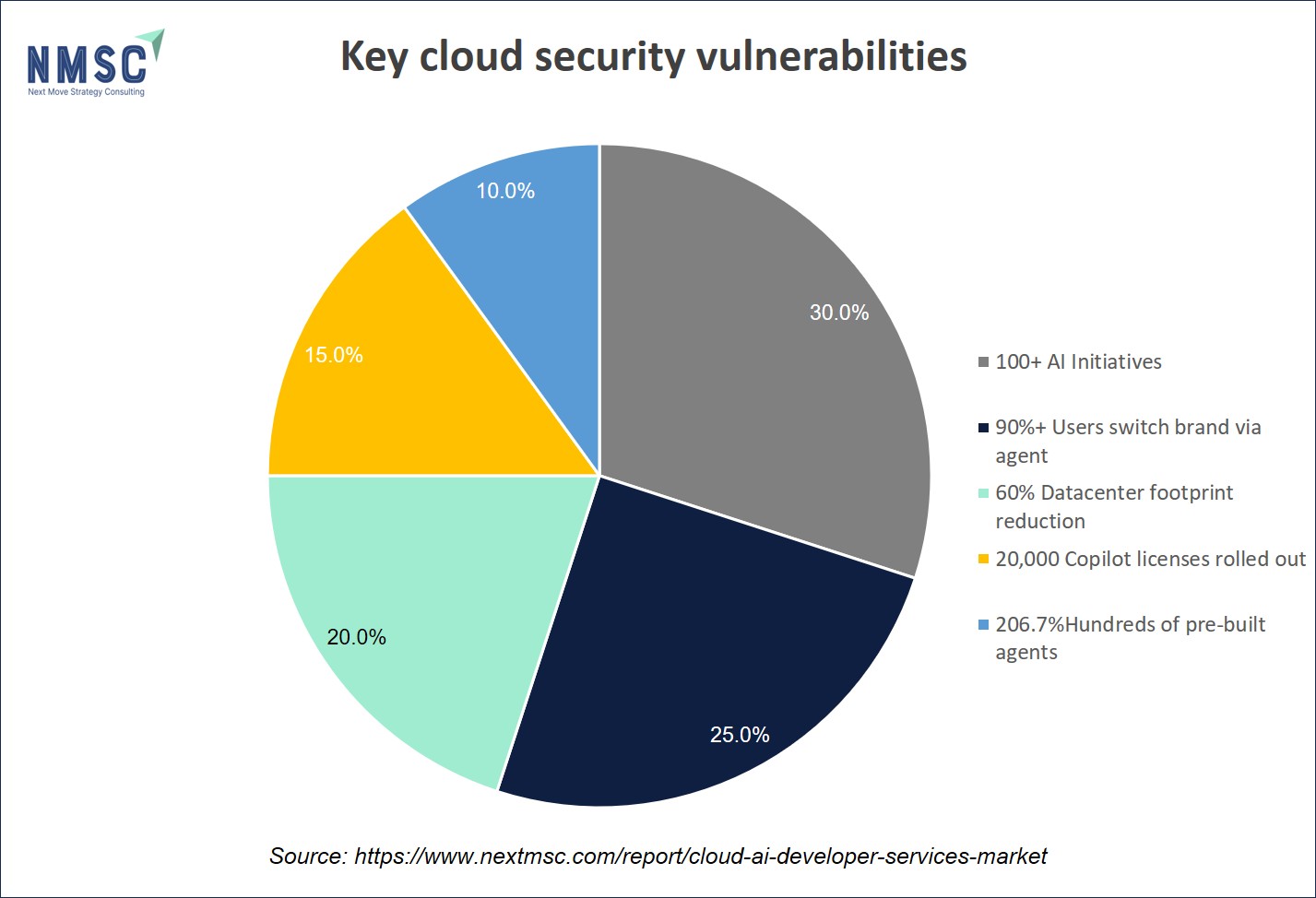
Here is a pie chart visualizing the five key quantitative metrics:
-
100+ AI initiatives - the scope of Stellantis and Microsoft's co-development program
-
90%+ brand-switching - Accenture research on how AI agents influence purchasing decisions
-
60% data center reduction - Stellantis's cloud modernization target by 2029 via Microsoft Azure
-
20,000 Copilot licenses - the initial Microsoft 365 Copilot rollout across Stellantis's global workforce
-
Hundreds of pre-built agents - the catalog available on Google Cloud Marketplace through the Accenture-Google Cloud program
Hover over any segment to see the full detail. The segment sizes are scaled proportionally to the numerical values cited in each metric.
How Is Ecosystem Partnership Changing the Developer Services Landscape?
A second major trend is the rise of tightly integrated ecosystem partnerships that combine cloud infrastructure, frontier AI models, and industry-specific implementation expertise under a single program structure.
The Gemini Enterprise Acceleration Program, announced at Google Cloud Next '26, is a prime example. The program delivers dedicated engineering power through Google and Accenture forward deployed engineers (FDEs) who partner on the most challenging customer use cases to prototype and deliver scaled, industry-specific AI solutions and agents that transform workflows across customer engagements and entire value chains.
The program also includes early access to frontier models from Google DeepMind, including the Gemini family of models, with Accenture's feedback helping to refine these models to ensure they are equipped to deliver benefits for clients.
Notably, organizations gain access to a catalog of hundreds of industry-specific agents built by Accenture and available on the Google Cloud Marketplace, enabling faster value realization.
This is not a traditional vendor-client relationship. It is a co-development model where cloud providers, implementation partners, and research labs converge around specific enterprise outcomes.
On the automotive side, Stellantis and Microsoft announced a five-year strategic collaboration aimed at accelerating Stellantis' digital transformation through the co-development of advanced AI, cybersecurity and engineering capabilities. The collaboration brings together Stellantis' automotive engineering expertise with Microsoft's cloud, AI, and security capabilities a model that mirrors the Accenture-Google Cloud structure in its emphasis on joint execution rather than simple licensing.
Commerce and Retail: Agentic Commerce at Enterprise Scale
The Accenture-Google Cloud program introduces what may be the most consequential commercial implication of AI agents: their role in purchase decisions.
According to Accenture research, as AI agents increasingly make online purchases, over 90% of frequent AI users say they would switch brands based on an agent's recommendation.
This finding has profound implications for brand strategy, procurement, and supply chain positioning. If AI agents become primary purchasing intermediaries, then enterprise visibility to those agents through data quality, API integration, and agent-readable product information becomes a strategic priority.
The companies are creating an enterprise workbench to enable faster decisions, more responsive operations, and unlock new growth opportunities built using Gemini Enterprise for Customer Experience and Google AI Studio, along with Accenture's Agentic Commerce OS and industry-specific AI agents.
-
AI is becoming infrastructure embedded in vehicles, manufacturing lines, and logistics networks.
-
Agentic commerce is reshaping purchasing behavior; enterprises must optimize for agent-readable data.
-
Cybersecurity and AI must be planned together, not sequentially.
-
Cloud modernization (datacenter consolidation, Azure migration) is a prerequisite for AI-at-scale.
Competitive Landscape of the Cloud AI Developer Services Market
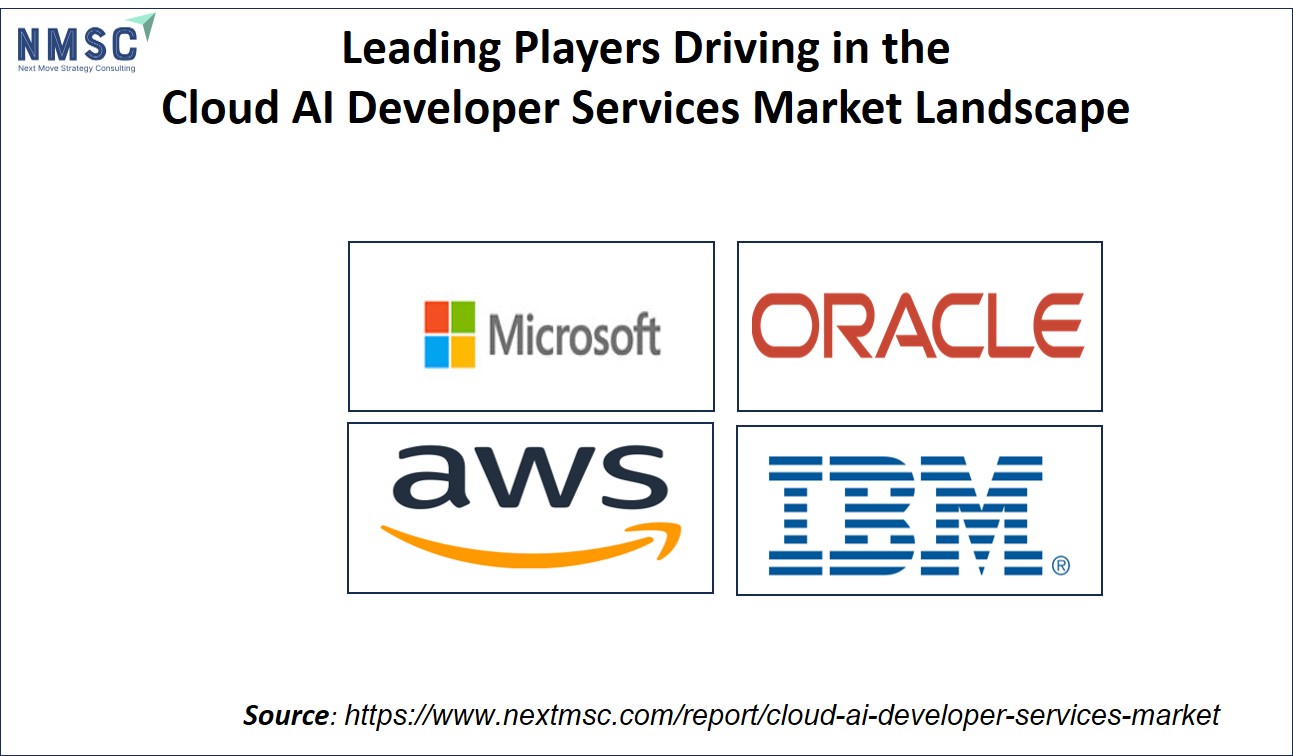
The cloud AI developer services market comprises several major technology companies, including Amazon Web Services (AWS) Inc., Microsoft Azure, Google LLC, IBM Corporation, Oracle Corporation, Salesforce Einstein, SAP SE, Intel Corporation, Cloudera Inc., and Baidu Inc., among others. These companies are actively implementing strategies such as product innovations, strategic partnerships, service expansions, and technology integrations to strengthen their competitive position and sustain leadership within the global cloud AI developer services market.
Future Outlook: Where Are Cloud AI Developer Services Headed?
The trajectory is clear from the evidence available: cloud AI developer services are moving from optional investment to foundational enterprise infrastructure. Several forward-looking patterns emerge from the 2026 announcements.
Agentic commerce will reshape procurement and supply chains. As Accenture research indicates, AI agents are already influencing purchase decisions at scale. Enterprises that structure their data, APIs, and partner ecosystems to be agent-compatible will gain preferential positioning in AI-mediated commerce. Those that do not may find themselves invisible to an increasingly automated purchasing layer.
Sovereign AI will become a compliance requirement, not an edge case. Google Cloud and Accenture are already addressing the unique needs of sovereign AI data centers and data sovereignty needs, delivering pre-built agents for sovereign deployment. As governments tighten data localization requirements, sovereign AI capabilities will shift from a differentiator to a baseline expectation for enterprise cloud deployments.
Key Takeaways:
-
Agent-readable enterprise data and APIs will become a strategic competitive asset.
-
Sovereign AI deployment capabilities are transitioning from optional to regulatory baseline.
-
Workforce AI enablement programs are essential for realizing the productivity gains promised by cloud AI developer services.
-
Unified cybersecurity and AI strategy is no longer a luxury it is an operational requirement.
Next Steps: What Should Leaders Do Now?
For C-level executives, institutional investors, and senior operations leaders evaluating cloud AI developer services, the evidence from these 2026 announcements points to several concrete priorities:
1. Audit your current AI architecture for scalability. Experimentation-phase AI deployments are not designed for enterprise scale. Evaluate whether your current infrastructure can support agentic workflows across multiple functions.
2. Assess ecosystem partnership depth, not just platform capability. The most effective deployments combine cloud infrastructure with forward deployed engineering expertise and industry-specific agents. A platform license alone is insufficient.
3. Map your data environment for agent readiness. Given that over 90% of frequent AI users may switch brands based on agent recommendations, understanding how your products and services appear in AI-mediated contexts is a strategic priority.
4. Build sovereign AI and cybersecurity into your AI roadmap from the start. Do not treat data sovereignty or AI-driven security as afterthoughts. These considerations are being baked into enterprise programs at the architectural level.
5. Invest in workforce enablement in parallel with technology deployment. AI tools without trained users deliver a fraction of their potential value. Dedicated training programs and change management are required components of enterprise AI strategy.
Conclusion
Cloud AI developer services have reached an inflection point. The scale, structure, and ambition of the partnerships announced in April 2026 Accenture and Google Cloud's Gemini Enterprise Acceleration Program, and Stellantis and Microsoft's five-year strategic collaboration confirm that the era of AI experimentation is giving way to the era of AI as operating infrastructure.
For enterprise decision-makers, the strategic imperative is not to debate whether cloud AI developer services are transformative. The evidence is conclusive. The imperative is to move decisively: to build the ecosystem partnerships, workforce capabilities, data architecture, and governance frameworks that allow AI agents to deliver measurable, sustained value at enterprise scale.
The enterprises that navigate this transition well will not simply be more efficient. They will be structurally better positioned to compete in markets where AI agents increasingly mediate decisions, purchases, and customer relationships.
About the Author
 Sanyukta Deb
— Sanyukta Deb is Digital Marketing Team Lead at Next Move Strategy Consulting, where she has led content strategy and technical SEO for the firm's B2B market research publications for over 2 years. Her editorial process translates NextMSC's primary and secondary research — spanning technology, industrial, and consumer sectors — into commercial narratives, backed by search-intent, keyword, and competitive analysis. She brings 5 years of overall experience in digital marketing and content strategy.
Sanyukta Deb
— Sanyukta Deb is Digital Marketing Team Lead at Next Move Strategy Consulting, where she has led content strategy and technical SEO for the firm's B2B market research publications for over 2 years. Her editorial process translates NextMSC's primary and secondary research — spanning technology, industrial, and consumer sectors — into commercial narratives, backed by search-intent, keyword, and competitive analysis. She brings 5 years of overall experience in digital marketing and content strategy.
About the Reviewer
 Debashree Dey
— Debashree Dey is Assistant Manager at Next Move Strategy Consulting, where she supports cross-vertical market content and communications across diverse industries for 6 years. Her professional background includes senior content writing, communications, and published manuscript authorship, with experience developing audience-focused business narratives and maintaining clear, consistent messaging. Her role supports research-led content development and editorial quality across NextMSC publications.
Debashree Dey
— Debashree Dey is Assistant Manager at Next Move Strategy Consulting, where she supports cross-vertical market content and communications across diverse industries for 6 years. Her professional background includes senior content writing, communications, and published manuscript authorship, with experience developing audience-focused business narratives and maintaining clear, consistent messaging. Her role supports research-led content development and editorial quality across NextMSC publications.


















Add Comment