Is the Military Robots Entering a New Amphibious and Autonomous Era?
The Military Robots Market is undergoing visible transformation in 2025. Recent demonstrations in Europe and China show that military robotics is no longer confined to experimental platforms. Instead, systems are now being tested in multinational exercises and showcased in high-profile national events.
Military Robots Market: Amphibious UGVs Move From Land to Sea
Rheinmetall Canada tested the latest version of its Mission Master series during NATO’s Robotic Experimentation and Prototyping using Unmanned Systems exercise in Portugal. The system was dropped from a warship into challenging Atlantic waters using a crane and autonomously returned to a sandy beach near the testing site. The version displayed, referred to as Mission Master 2.0, included upgrades focused on increased robustness and stability. It was equipped with an internally developed mast, a tethered drone from Elistair, a radar from Echodyne, and electro-sensors. The system was shown alongside the Hero-120 loitering munition. During an exercise scenario, a representative stated that the system launched within two minutes of receiving target coordinates. The report further noted that global militaries are increasingly looking to unmanned robots for amphibious operations, including scouting, terrain intelligence collection, and logistical support during water-to-land transitions. Additionally, in April 2025, the Ukrainian Ministry of Defense approved deployment of the Ukrainian-made UNEX amphibious UGV to the front lines.
Mobility and Direct Engagement Systems
Humanoid military robots as specialized units designed to mimic human movement, making them particularly effective for complex urban operations. In terms of high-intensity conflict, Armed robots are utilized to detect, track, and engage specific targets using integrated weaponry. Similarly, Remote-controlled tanks allow for direct engagement in combat scenarios while ensuring that soldiers remain out of harm's way.
Support, Intelligence, and Safety Systems
For logistics and reconnaissance, the Robot mule serves as a vital support asset, engineered to transport heavy equipment across rugged and difficult terrain. Surveillance is handled by Reconnaissance drones, which gather and transmit real-time data to provide commanders with essential situational awareness. Finally, the chart identifies Bomb disposal robots as critical safety tools, specifically designed to neutralize explosive threats without risking human life.

Military Robots Market: China’s Robot Wolves Highlight Armed Autonomy
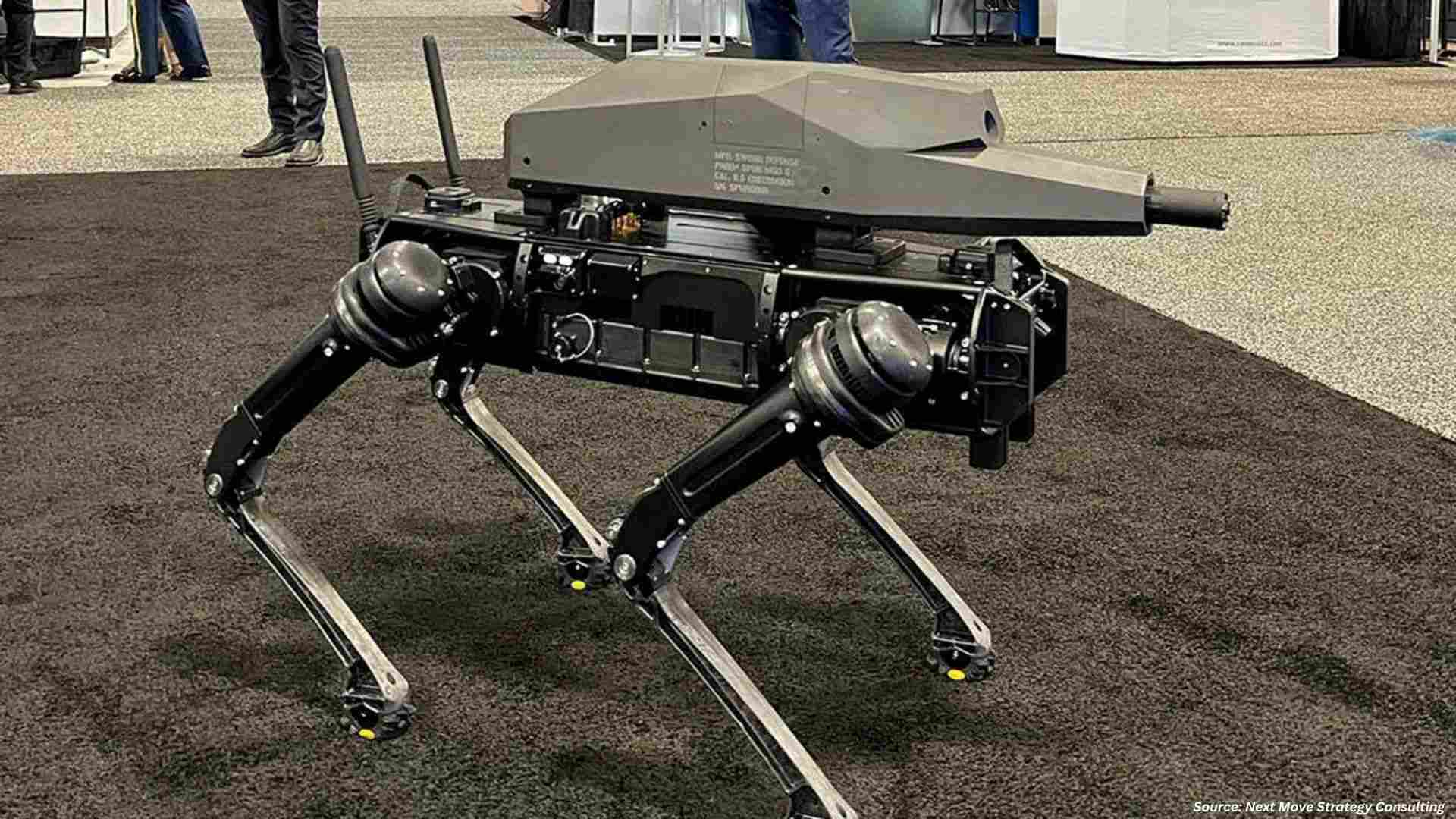
China displayed upgraded four-legged robotic systems, described as “robot wolves,” during a military parade in Beijing. The event was attended by leaders including Vladimir Putin, Shehbaz Sharif, and Kim Jong Un. According to Chinese state media cited in the report, these upgraded robots are designed to stealthily approach enemies, fire precise shots, and operate in rough terrain. They can carry rifles on their backs, climb stairs, carry heavy backpacks, and launch attacks. State television reported that the robots can conduct precision strikes from up to 100 meters (328 feet) away. The systems are also designed to function as coordinated units, dividing tasks among members. A “pack leader” gathers target information and transmits imagery, while other robots execute attacks. The parade marked the 80th anniversary of China’s victory over Japanese forces in World War 2 and served as a platform to showcase defense innovation. An associate professor from the National University of Singapore told AFP that such systems could signal a future battlefield that is “more automated and deadly.”
Vision and Sensing Suite
The robot is equipped with a sophisticated array of sensors located primarily at the front and top of the unit to ensure situational awareness and precise navigation. At the end of the mechanical arm, a cluster of stereo cameras and foveal/peripheral cameras provide high-fidelity visual data, while a SICK LADAR (Laser Detection and Ranging) sensor provides critical depth perception and obstacle detection capabilities. Additionally, a dedicated RSTA (Reconnaissance, Surveillance, and Target Acquisition) camera system is mounted atop the central turret, allowing for broad environmental monitoring.
Mechanical Interaction and Logistics
A significant portion of the robot's utility comes from its articulated arm, which houses specialized tools for physical tasks. This arm is fitted with a gripper for manipulation and a chain saw for cutting through obstacles or materials. The main body of the robot includes a rotating turret for directional flexibility and a bin for combustibles to manage hazardous materials. Furthermore, the rear of the vehicle features a ramp for PackBots, indicating that this larger unit acts as a mobile carrier or "mother ship" for smaller, deployable robotic systems.

The Spectrum of Control and Ethics
Moving into Semi-autonomous systems, the chart describes a middle ground where the machine can perform certain tasks independently while still operating under human supervision. This configuration seeks to strike a balance, utilizing the efficiency of automation while retaining a "human-in-the-loop" to mitigate risks, though some ethical concerns begin to emerge as the machine gains agency. As we transition toward higher complexity, Advanced AI systems are highlighted as tools that offer high levels of independence. These systems are designed with "managed ethical considerations," suggesting that while they operate with significant freedom, they incorporate programmed safeguards or frameworks to ensure their decision-making remains aligned with human values.

Comparative View: 2025 Military Robotics Developments
|
Feature |
Mission Master 2.0 |
Robot Wolves |
|
Platform Type |
Unmanned Ground Vehicle |
Armed Quadruped Robot |
|
Amphibious Capability |
Demonstrated sea-to-shore |
Not reported |
|
Strike Capability |
Integrated loitering |
Precision strikes up to 100 meters |
|
Coordination |
Sensor and drone integration |
Pack-based task division |
|
Deployment Context |
NATO REPMUS |
Beijing Parade |
Leading Companies Driving the Military Robots Industry
The global military robots industry is characterized by the presence of major defense and aerospace corporations that are actively advancing unmanned systems, autonomous technologies, and next-generation battlefield solutions. Key companies operating in this sector include Lockheed Martin Corporation, Northrop Grumman Corporation, BAE Systems plc, General Dynamics Corporation, Thales Group, Elbit Systems Ltd., Israel Aerospace Industries (IAI), AeroVironment, Inc., and Teledyne Technologies Inc., all of which play significant roles in strengthening innovation and competitive dynamics within the evolving defense robotics landscape.

Next Move Strategy Consulting’s View
From a strategic consulting perspective, 2025 developments suggest that the Military Robots Market is entering a phase defined by operational validation rather than experimental trials. Multinational testing involving 24 countries and 276 unmanned systems demonstrates integration at scale within alliance structures. Second, the emergence of coordinated robotic “pack” behavior signals progress toward semi-autonomous combat group functionality. Third, the use of national parades and multinational exercises as platforms for demonstration indicates that robotics capability is also serving as a geopolitical signal.
Conclusion
Recent 2025 developments confirm measurable progress:
-
Amphibious UGVs successfully transitioned from warship deployment to autonomous beach landing.
-
Armed quadruped robots demonstrated precision strike capability up to 100 meters.
-
NATO’s REPMUS exercise tested 276 unmanned systems across 24 countries.
The Military Robots Market is no longer defined solely by research and development. It is being shaped by operational demonstrations, alliance-level experimentation, and visible global signaling.
Next Steps
-
Invest in amphibious and multi-terrain robotic capabilities to align with emerging operational requirements.
-
Prioritize sensor, radar, and drone integration for enhanced battlefield intelligence.
-
Develop coordinated multi-robot communication systems to enable task division and semi-autonomous group behavior.
-
Monitor multinational exercises and public defense showcases for early indicators of adoption trends.
About the Author
 Tania Dey is a content writer specializing in transformation-led, insight-driven storytelling. She develops research-backed, high-impact content aligned with evolving business priorities, digital behavior, and audience expectations. Her work helps organizations sharpen value propositions, strengthen visibility, and communicate strategic intent with clarity and precision. Grounded in data-informed storytelling, she brings a strong focus on relevance, consistency, and measurable digital impact across platforms.
About the Reviewer
 Debashree Dey is a senior content writer and communications specialist known for crafting audience-focused narratives and insight-driven content strategies. As a published manuscript author, she combines creative storytelling with strategic thinking to strengthen brand messaging, enhance visibility, and drive meaningful audience engagement across digital platforms. With a collaborative leadership approach, she contributes to high-impact communication initiatives that ensure consistency, clarity, and long-term brand value. Outside of work, she finds inspiration in creative projects, design exploration, and storytelling-driven ideas.











Add Comment