Sustainable Computing Market: Powering AI with Responsibility

The Sustainable Computing Market is rapidly evolving as the world confronts the environmental cost of digital growth. With artificial intelligence (AI), cloud computing, and high-performance computing expanding at an unprecedented pace, energy consumption has become a critical concern. In 2026, industry leaders and academic innovators are actively reshaping computing architectures to reduce power usage while maintaining performance.
Sustainable Computing Market Trends: Energy Efficiency Takes Center Stage
One of the most defining trends in the sustainable computing market is the push toward energy-efficient hardware and system design. Professor Pekka Jääskeläinen from Tampere University is developing computing solutions that aim to significantly reduce the energy consumption of modern processors. His research focuses on designing customizable processor architectures that can optimize performance while minimizing unnecessary power usage.
Traditional computing systems often consume excessive energy due to general-purpose designs. In contrast, specialized architectures tailored for specific workloads—such as AI or data analytics—can deliver higher efficiency. This shift is essential as computing demand continues to grow.
-
Custom processors reduce redundant computations
-
Energy-aware design improves system-level efficiency
-
Optimization focuses on workload-specific performance
Analysis from Next Move Strategy Consulting indicates that the transition toward workload-specific computing architectures reflects a structural shift in the sustainable computing market, where the focus is moving away from increasing energy consumption alongside performance and toward maximizing efficiency per computation to define competitive differentiation in the coming decade.
AI Infrastructure and Sustainable Computing Market Growth
The expansion of AI infrastructure is a major driver of the sustainable computing market. CoreWeave’s announcement of a $1.5 billion commitment to support AI innovation in the United Kingdom highlights the scale of investment in sustainable computing ecosystems.
This initiative focuses on building high-performance computing infrastructure while integrating sustainability into operations. The goal is to balance AI-driven growth with environmental responsibility, particularly as AI workloads are known to be energy-intensive.
Key highlights of the investment include:
|
Component |
Focus Area |
|
Infrastructure Investment |
$1.5 billion commitment |
|
Objective |
Support AI innovation in the UK |
|
Sustainability Goal |
Reduce environmental impact of AI workloads |
Insights from Next Move Strategy Consulting indicate that large-scale investments in sustainable AI infrastructure show environmental considerations are becoming integral to digital transformation strategies, with companies shifting from treating sustainability as a compliance requirement to making it a core operational priority.
Sustainable Computing Market Drivers: Balancing Performance and Power
The need to balance computational performance with energy efficiency is driving innovation across the sustainable computing market. As AI models grow more complex, the computational requirements increase exponentially, leading to higher energy consumption.
Professor Jääskeläinen’s work emphasizes that improving energy efficiency is not only about hardware but also about software optimization. By aligning software design with hardware capabilities, systems can achieve better performance without additional energy costs.
Key drivers include:
-
Rising energy costs associated with data centers
-
Increased demand for AI and machine learning workloads
-
Need for environmentally responsible computing practices
-
Regulatory and institutional pressure for sustainability
Our observations at Next Move Strategy Consulting indicate that the convergence of hardware innovation and software optimization is reshaping the value chain in the sustainable computing market, enabling organizations that integrate both layers effectively to achieve superior efficiency and long-term cost advantages.
Challenges in the Sustainable Computing Market
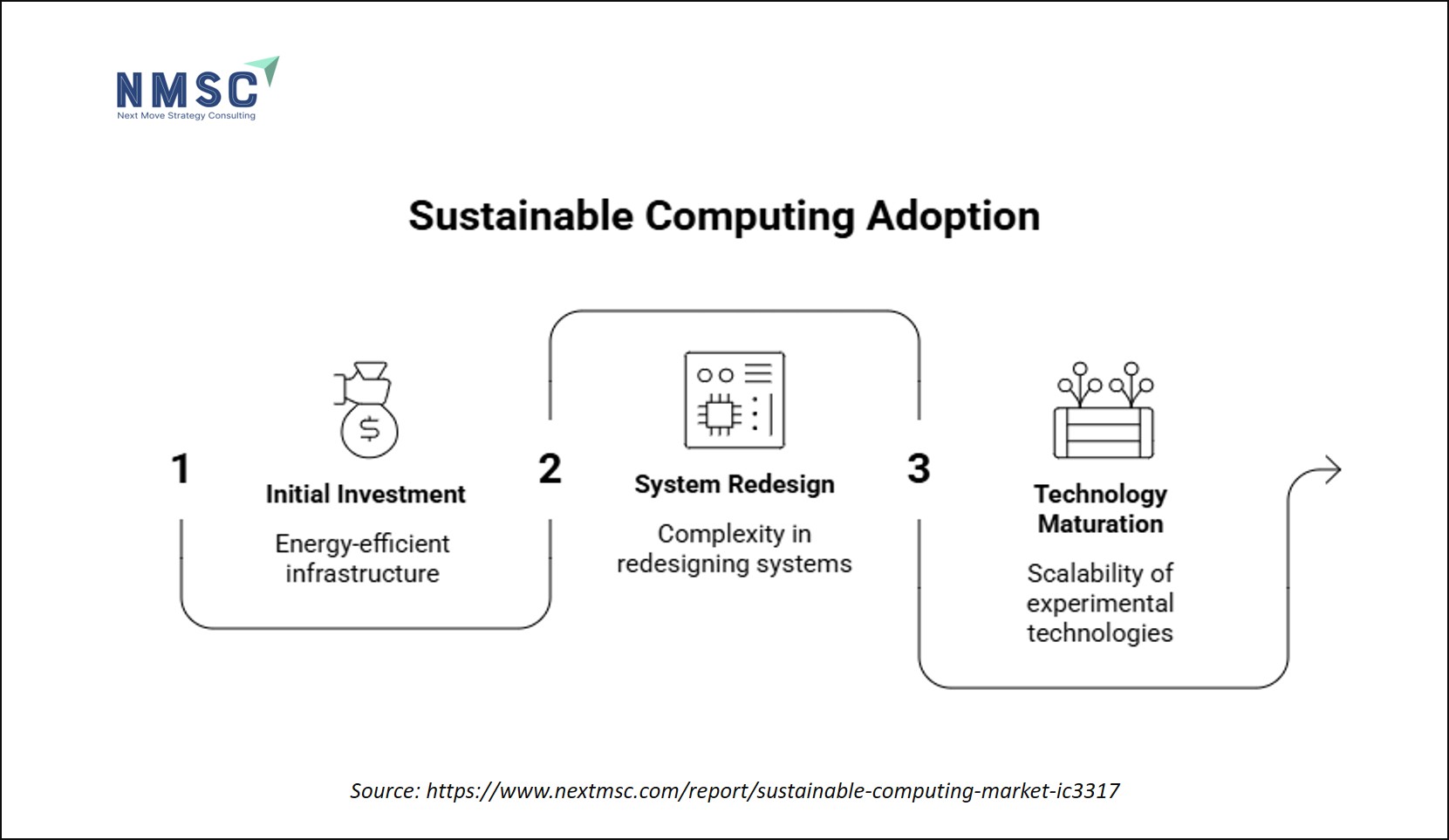
Despite strong momentum, the sustainable computing market faces several challenges:
-
High initial investment in energy-efficient infrastructure
-
Complexity in redesigning existing computing systems
-
Trade-offs between performance and sustainability in some use cases
-
Limited scalability of experimental technologies
Additionally, transitioning from traditional computing systems to sustainable alternatives requires significant organizational and technical changes.
Analysis from Next Move Strategy Consulting indicates that the primary barrier to adoption lies in the capital intensity and complexity of transformation, while the maturation of sustainable computing technologies is expected to drive economies of scale that reduce costs and accelerate adoption across industries.
According to Next Move Strategy Consulting: Industry Impact
The recent developments in sustainable computing signal a long-term transformation in the global technology landscape.
-
AI infrastructure investments are redefining energy consumption patterns
-
Sustainable computing is becoming a key differentiator for tech companies
-
Innovation in processor design is reducing dependency on energy-intensive systems
-
Governments and enterprises are aligning digital growth with sustainability goals
These shifts are expected to influence not only the computing sector but also industries reliant on digital infrastructure, including healthcare, finance, and manufacturing.
Future Outlook of the Sustainable Computing Market
The sustainable computing market is expected to evolve through continued innovation in processor design, AI infrastructure, and energy management systems. The integration of sustainability into computing is no longer optional—it is becoming a necessity for long-term scalability.
Emerging trends include:
-
Development of ultra-low-power processors
-
Increased use of renewable energy in data centers
-
Expansion of green AI initiatives
-
Collaboration between academia and industry
Next Steps: Actionable Takeaways
1. Invest in energy-efficient infrastructure: Organizations should prioritize hardware and systems designed for low power consumption.
2. Adopt workload-specific computing solutions: Tailored architectures can significantly improve efficiency and performance.
3. Integrate sustainability into AI strategies: AI development should include energy optimization from the design stage.
4. Collaborate with research institutions: Partnerships can accelerate innovation in sustainable computing technologies.
5. Monitor regulatory and environmental standards: Staying aligned with global sustainability goals will ensure long-term competitiveness.
This evolving landscape highlights that sustainable computing is not just a technological upgrade—it is a strategic necessity shaping the future of digital transformation.
About the Author
 Sanyukta Deb
— Sanyukta Deb is Digital Marketing Team Lead at Next Move Strategy Consulting, where she has led content strategy and technical SEO for the firm's B2B market research publications for over 2 years. Her editorial process translates NextMSC's primary and secondary research — spanning technology, industrial, and consumer sectors — into commercial narratives, backed by search-intent, keyword, and competitive analysis. She brings 5 years of overall experience in digital marketing and content strategy.
Sanyukta Deb
— Sanyukta Deb is Digital Marketing Team Lead at Next Move Strategy Consulting, where she has led content strategy and technical SEO for the firm's B2B market research publications for over 2 years. Her editorial process translates NextMSC's primary and secondary research — spanning technology, industrial, and consumer sectors — into commercial narratives, backed by search-intent, keyword, and competitive analysis. She brings 5 years of overall experience in digital marketing and content strategy.
About the Reviewer
 Debashree Dey
— Debashree Dey is Assistant Manager at Next Move Strategy Consulting, where she supports cross-vertical market content and communications across diverse industries for 6 years. Her professional background includes senior content writing, communications, and published manuscript authorship, with experience developing audience-focused business narratives and maintaining clear, consistent messaging. Her role supports research-led content development and editorial quality across NextMSC publications.
Debashree Dey
— Debashree Dey is Assistant Manager at Next Move Strategy Consulting, where she supports cross-vertical market content and communications across diverse industries for 6 years. Her professional background includes senior content writing, communications, and published manuscript authorship, with experience developing audience-focused business narratives and maintaining clear, consistent messaging. Her role supports research-led content development and editorial quality across NextMSC publications.


















Add Comment