Synthetic Leather Market: Bio-Based Innovation, Auto Adoption & Manufacturing Shift

Introduction
The synthetic leather market is entering a new phase of transformation, driven by sustainability goals, automotive innovation, and global manufacturing expansion. Recent developments—such as Japanese firms planning new synthetic leather units near Noida Airport, automakers exploring bio-based alternatives, and Nissan’s premium seating innovations—highlight how material science is evolving to balance performance, cost, and environmental responsibility.
Manufacturing Expansion Strengthens Supply Chains
A significant development in 2026 is the planned investment by Japanese firms to establish synthetic leather manufacturing units near Noida International Airport. This move reflects a strategic shift toward localized production, aiming to strengthen supply chains and reduce dependency on imports.
The expansion is expected to:
-
Enhance domestic production capacity
-
Improve logistics efficiency due to proximity to a major airport
-
Support India’s growing demand from automotive and industrial sectors
Such investments indicate increasing confidence in India as a manufacturing hub for advanced materials.
Next Move Strategy Consulting highlights that this manufacturing shift reflects a broader trend of regional supply chain optimization, where localized production helps reduce cost pressures while enabling faster responses to evolving demand patterns, particularly in automotive and consumer goods industries.
Bio-Based Synthetic Leather Gains Momentum
Automotive leaders such as Hyundai and Jaguar Land Rover are actively exploring bio-based faux leather for future vehicle models. These materials are designed to reduce reliance on petroleum-based inputs while maintaining durability and aesthetics.
Key advantages of bio-based synthetic leather include:
-
Lower environmental impact compared to conventional synthetic materials
-
Alignment with sustainability goals in automotive manufacturing
-
Potential for innovation in texture, breathability, and comfort
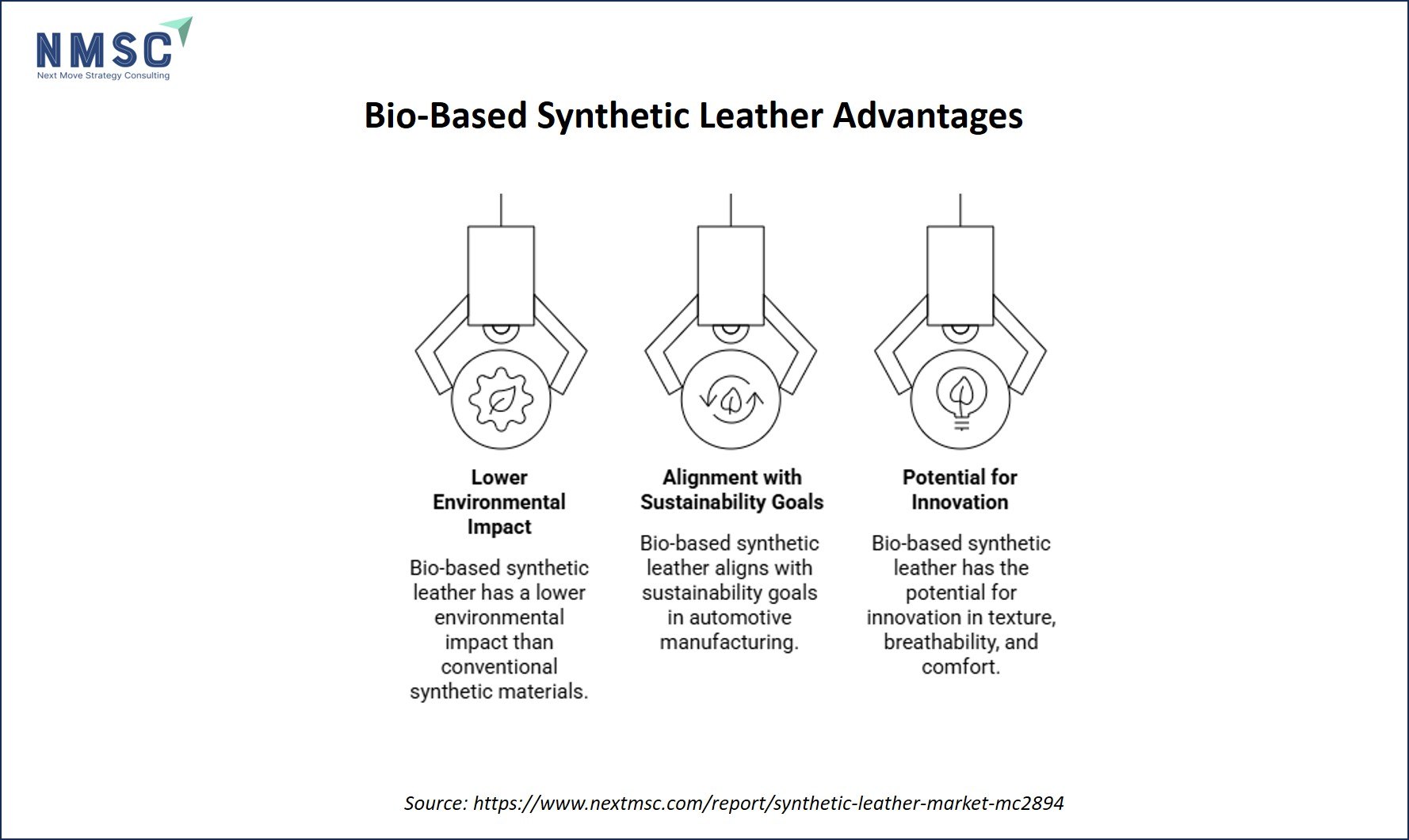
This shift signals a move toward circular material ecosystems in the automotive sector.
Next Move Strategy Consulting observes that the shift toward bio-based alternatives marks a pivotal turning point, as sustainability increasingly influences purchasing decisions and material innovation emerges as a key differentiator among automotive brands.
Automotive Applications Drive Premiumization
Nissan has introduced “TailorFit,” a premium seating solution designed to replicate the look and feel of genuine leather while offering improved durability and comfort. This innovation demonstrates how synthetic leather is no longer viewed as a low-cost substitute but as a high-performance material.
Key features highlighted include:
-
Enhanced tactile experience similar to natural leather
-
Improved resistance to wear and tear
-
Customization options for modern vehicle interiors
This reflects a broader trend where synthetic materials are engineered for premium segments rather than just affordability.
Next Move Strategy Consulting notes that the premiumization of synthetic leather is reshaping consumer perception, and as performance parity with genuine leather improves, adoption is expected to expand across both mid-range and luxury vehicle segments.
Key Trends Shaping the Synthetic Leather Market
|
Trend |
Description |
Industry Impact |
|
Localization of Production |
New manufacturing units in emerging markets |
Stronger supply chains and cost efficiency |
|
Bio-Based Materials |
Shift toward plant-based and sustainable inputs |
Reduced environmental footprint |
|
Automotive Innovation |
Advanced seating and interior materials |
Increased demand for premium synthetic leather |
|
Performance Enhancement |
Improved durability and comfort features |
Broader acceptance across industries |
These trends collectively highlight a transition from cost-driven adoption to value-driven innovation. The market is evolving toward higher-quality, sustainable, and application-specific solutions.
According to Next Move Strategy Consulting: Industry Impact
According to Next Move Strategy Consulting, the recent developments in synthetic leather indicate a structural transformation rather than incremental growth.
-
Manufacturing investments in India are expected to reposition Asia as a dominant production hub
-
Automotive adoption of bio-based materials will accelerate sustainability-led innovation cycles
-
Premium synthetic leather solutions will narrow the gap between artificial and natural materials

This convergence of sustainability, performance, and scalability is expected to redefine competitive dynamics across the synthetic materials industry.
Next Steps: What Industry Stakeholders Should Do
-
Invest in bio-based R&D: Focus on sustainable alternatives to meet evolving regulatory and consumer expectations
-
Strengthen local manufacturing: Reduce supply chain risks through regional production hubs
-
Collaborate with automakers: Align product innovation with automotive design and performance needs
-
Focus on premiumization: Develop high-quality materials to capture higher-margin segments
Conclusion
The synthetic leather market in 2026 is being shaped by a combination of industrial expansion, sustainability innovation, and automotive transformation. From new manufacturing hubs in India to bio-based material exploration and premium automotive applications, the industry is clearly moving toward a more advanced and responsible future.
As companies continue to innovate and scale, synthetic leather is expected to transition from an alternative material to a preferred choice across multiple industries.
About the Author
 Sanyukta Deb
— Sanyukta Deb is Digital Marketing Team Lead at Next Move Strategy Consulting, where she has led content strategy and technical SEO for the firm's B2B market research publications for over 2 years. Her editorial process translates NextMSC's primary and secondary research — spanning technology, industrial, and consumer sectors — into commercial narratives, backed by search-intent, keyword, and competitive analysis. She brings 5 years of overall experience in digital marketing and content strategy.
Sanyukta Deb
— Sanyukta Deb is Digital Marketing Team Lead at Next Move Strategy Consulting, where she has led content strategy and technical SEO for the firm's B2B market research publications for over 2 years. Her editorial process translates NextMSC's primary and secondary research — spanning technology, industrial, and consumer sectors — into commercial narratives, backed by search-intent, keyword, and competitive analysis. She brings 5 years of overall experience in digital marketing and content strategy.
About the Reviewer
 Debashree Dey
— Debashree Dey is Assistant Manager at Next Move Strategy Consulting, where she supports cross-vertical market content and communications across diverse industries for 6 years. Her professional background includes senior content writing, communications, and published manuscript authorship, with experience developing audience-focused business narratives and maintaining clear, consistent messaging. Her role supports research-led content development and editorial quality across NextMSC publications.
Debashree Dey
— Debashree Dey is Assistant Manager at Next Move Strategy Consulting, where she supports cross-vertical market content and communications across diverse industries for 6 years. Her professional background includes senior content writing, communications, and published manuscript authorship, with experience developing audience-focused business narratives and maintaining clear, consistent messaging. Her role supports research-led content development and editorial quality across NextMSC publications.

















Add Comment