Synthetic Leather Market by Material Type (Polyurethane (PU) Leather, Polyvinyl Chloride (PVC) Leather, Bio-based and Circular Leather, Composite and Specialty Leather, and Other Materials), by Product Form (Rolls and Bolts, Sheets and Panels, Cut Parts and Components, and Finished Goods), by Performance Grade (General Purpose, and Others), and Others – Global Opportunity Analysis and Industry Forecast, 2024–2030
Industry: Materials and Chemical | Publishing Date: August 20, 2025 | Last Updated: September 30, 2026 | No of Pages: N/A | No. of Tables: N/A | No. of Figures: N/A | Format: PDF | Report Code: MC2894
Synthetic Leather Market Overview
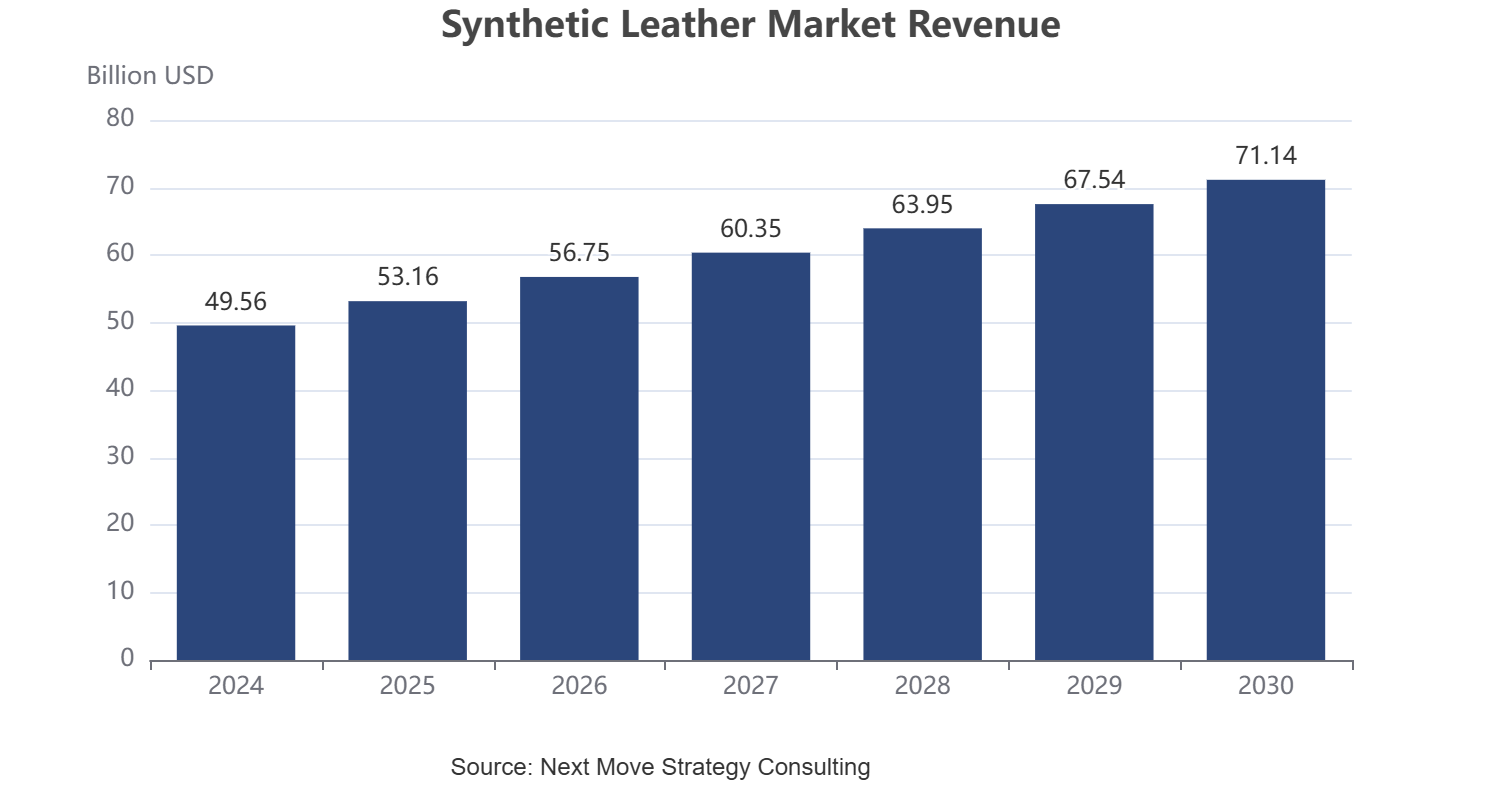
The global Synthetic Leather Market size was valued at USD 49.56 billion in 2024 and is predicted to reach USD 71.14 billion by 2030 with a CAGR of 6.2% from 2025-2030.
The synthetic leather market, also known as or imitation leather or artificial leather refers to the global industry involved in the production and sale of leather materials made from plastics and other non-animal sources. This market encompasses various types of artificial leather, including polyurethane, and polyvinyl chloride that are used as alternatives to genuine leather in numerous applications.
Its ability to match the texture and appearance of real leather at a lower cost makes it an attractive option for consumers and businesses alike. Furthermore, its eco-friendly attributes, including reduced environmental impact and consideration for animal welfare, are in line with the growing sustainability trends observed in today's market.
Market Dynamics and Trends
The significant growth of automotive industry across the world attributes to the growth of imitation leather market as these leather offers a practical and affordable alternative to genuine leather, making it suitable for automotive interiors, while its alignment with environmental and ethical considerations meets the growing synthetic leather market demand for sustainable products. As per the Association of European Automobile Manufacturers, in 2022 the motor vehicle production across the globe reached 85.4 million units, indicating a 5.7% increase from 2021.
Such significant growth of the automotive industry worldwide not only drives the demand for artificial leather as a practical and sustainable alternative but also highlights its pivotal role in enhancing vehicle interiors with cost-effective solutions.
Moreover, stringent regulations worldwide aimed at protecting exotic animals are significantly boosting the synthetic leather industry, as the prohibition of animal-derived leather in various sectors drives the demand for artificial leather as a popular and effective alternative. For instance, the U.S. Congress passed a legislation on banning the import and sale of various animal skins, aiming to prevent major clothing and shoes brands from using animal leather in their products. Additionally, the European Union also passed a regulation on March 2022, on banning fur farming and the sale of farmed animal fur. As animal welfare initiatives continues to rise, the demand for artificial leathers continues to increase, boosting the market expansion.
Furthermore, the global expansion of the furnishing industry is accelerating the growth of the market, as increased furniture production drives demand for affordable and durable materials such as artificial leather to enhance design versatility and product longevity. According to Business and Institutional Furniture Manufacturer's Association, office and institutional furniture market size of U.S. rated 16.429 billion in 2022. Similarly, in UK the furniture manufacturing totalled USD 12.11 billion in 2022. Such expansion of the furnishing industry, driven by increased furniture production, is a significant factor accelerating of the artificial synthetic leather market growth.
However, the harmful effects of PU and PVC based synthetic leather such as environmental pollution, health risks, and non-renewable sourcing, restrain the growth of the artificial leather sector.
On the contrary, the emergence of bio-based faux leather is anticipated to create ample growth opportunity in the forthcoming years. These renewable sources present a compelling alternative to traditional synthetic leather made from petrochemicals by addressing consumer demand for eco-friendly products while meeting stringent regulatory sustainability standards, thereby reducing environmental impact across various industries.
Market Segmentations and Scope of the Study
The synthetic leather market report is segmented on the basis of material type, product form, performance grade, price tier, sales channel, end use industry, and geography. On the basis of material type, the market is segmented into polyurethane (PU) leather, polyvinyl chloride (PVC) leather, bio-based & circular leather, composite & specialty leather, and other materials. Polyurethane (PU) leather is further segmented into standard PU, microfiber PU, water-based PU, solvent-based PU, and thermoplastic PU. Polyvinyl chloride (PVC) leather is divided into calendered PVC, coated PVC, and plasticized PVC. Bio-based & circular leather includes bio-polyurethane leather, plant-based polymer leather, and recycled polymer leather. Composite & specialty leather includes PU PVC blends, acrylic-based leather, silicone-based leather, and other polymer blends. Other materials include coated fabrics and novel material films.
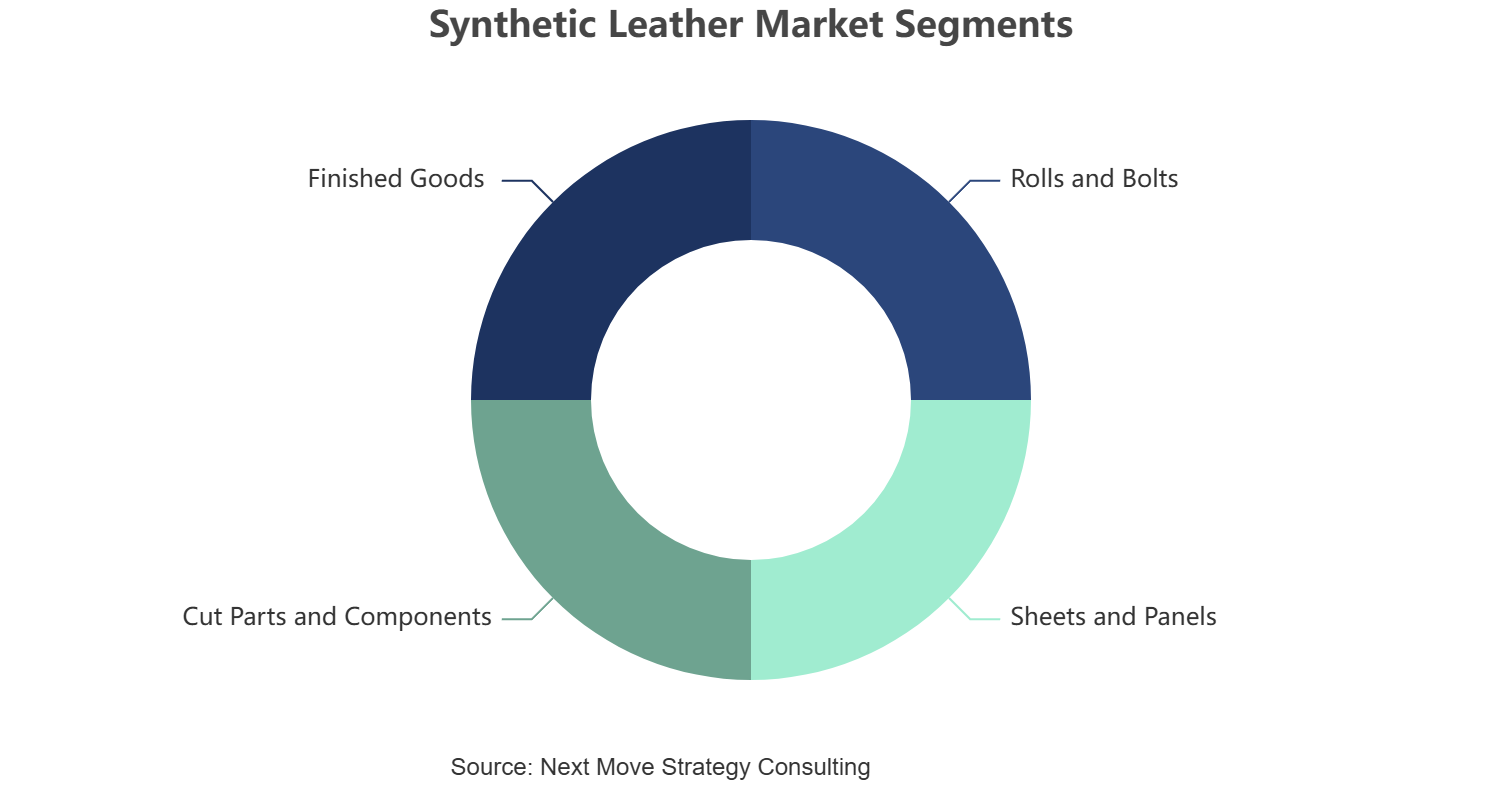
On the basis of product form, the market is segmented into rolls & bolts, sheets & panels, cut parts & components, and finished goods. On the basis of performance grade, the market is categorized into general purpose, automotive OEM grade, high durability & abrasion resistant, flame retardant, anti-microbial, and certified sustainable products. On the basis of price tier, the market is divided into premium, mid-market, and economy segments.
On the basis of sales channel, the market is segmented into B2B supply, B2C retail, aftermarket & bulk supply, and institutional & government procurement. B2B supply is further segmented into OEM direct supply, distributors & converters, and contract manufacturers. B2C retail includes brand-owned retail, online direct-to-consumer, and mass market & department stores. Aftermarket & bulk supply includes replacement & refurbishment channels and wholesale & bulk traders.
On the basis of end use industry, the market is segmented into footwear, automotive interiors, furniture & upholstery, fashion accessories, apparel, consumer goods, sports & leisure goods, industrial & technical applications, medical & healthcare applications, and other applications. Footwear includes athletic & sports footwear, casual & fashion footwear, and safety & work footwear. Automotive interiors include passenger vehicle seating, commercial vehicle seating, door panels & trims, dashboards & consoles, and steering wheels & gear covers. Furniture & upholstery include residential furniture, contract & office furniture, aviation seating, marine seating, and mass transit seating. Fashion accessories include handbags & purses, luggage & travel bags, and wallets & small leather goods. Industrial & technical applications include conveyor belt coverings, protective covers & gaskets, and filtration & technical substrates. Medical & healthcare applications include medical device coverings, hospital furniture upholstery, and orthopedic supports. Other applications include architectural & interior panels, bookbinding & stationery, and defense & special applications. Regional breakdown and analysis of each of the aforesaid segments includes North America, Europe, Asia-Pacific, and RoW.
Geographical Analysis
Asia-Pacific region holds the dominant in synthetic leather market share during the forecast period. The rapid expansion of the automotive sector in this region particularly in countries such as China and India drive growth in adoption of artificial leather an effective alternative to genuine leather for vehicle interiors. According to International Trade Administration report of 2023, China is the world’s largest automotive market, with domestic production expected to reach 35 million units by 2025. Such expanding automotive sector accelerates the demand for imitation leather for maintaining versatility in vehicle interiors.
Moreover, the presence of major key players in the region such as Daikin Industries, Ltd., Toray Industries, Inc., Indofil Industries Limited, Filwel Co. Ltd., and R. Polycoats Pvt. Ltd. drive market growth through continuous innovation, launching new products to meet evolving consumer demands. For instance, in October 2022, Toray Industries Inc. launched Ultrasuede a 100% plant-based polyester for ANA Green Jet headrest covers. The product features eco-friendly materials with around 30% plant-based polyurethane incorporated into the non-woven structure and an additional 30% plant-based polyester in the reinforcement fabric.
On the other hand, North America is expected to show a steady rise in the synthetic leather market during the forecast period due to rise in demand of footwear in the region. Imitation leather emerged as a favoured choice for footwear manufacturers in the U.S., offering an economical and adaptable substitute to genuine leather. As per Footwear Distributors and Retailers of America, Americans spent USD 112.7 billion on shoes in 2023. Based on such significant demand and the expanding footwear industry in region, the imitation leather industry is poised for further acceleration.
Moreover, the expansion of the fashion industry in the region is driving the growth of the synthetic leather market, as these materials provide designers and consumers with a versatile, cost-effective, and sustainable alternative to genuine animal-based leather. According to Global Council for Promotion of International Trade, the U.S. fashion industry is one of the largest industries in this region, with the industry valued at over USD 400 billion in 2023. Such expansion in the sector signifies the growth of fashion industry, thereby surging the growth of the imitation leather market.
Competitive Landscape
Various key players operating in the synthetic leather industry includes Huafon Microfibre Co., Ltd., Continental AG, Anhui Anli Material Technology Co., Ltd., San Fang Chemical Industry Co., Ltd., Nan Ya Plastics Corporation, Kuraray Co., Ltd., Alcantara S.p.A., Mayur Uniquoters Limited, Kyowa Leather Cloth Co., Ltd., Teijin Cordley Limited, Zhejiang Hexin Industry Group Co., Ltd., Ultrafabrics Holdings Co., Ltd., Kolon Industries, Inc., Wuxi Double Elephant Micro-Nanon Material, Asahi Kasei Corporation, Seiren Co., Ltd., Duksung Co., Ltd., Achilles Corporation, Spradling International, Inc., Wanhua Chemical Group and others. These companiesare adopting various strategies such as partnership and product launches to remain dominant in the market.
For instance, in February 2026, Huafon Microfibre Co., Ltd. expanded its microfiber synthetic leather production capabilities through investments in high-performance automotive and footwear materials designed to improve durability, abrasion resistance, and sustainability performance. The company also strengthened its eco-friendly material portfolio through the development of low-VOC and water-based synthetic leather solutions aimed at reducing environmental impact in large-scale manufacturing operations.
Moreover, in January 2026, Continental AG enhanced its sustainable automotive interior materials portfolio through the development of advanced synthetic leather surfaces and recyclable cabin materials designed for electric and autonomous vehicles. The company focused on lightweight interior technologies and environmentally friendly upholstery solutions aimed at improving vehicle sustainability and passenger comfort.
Additionally, in December 2025, Anhui Anli Material Technology Co., Ltd. strengthened its bio-based polyurethane leather solutions business through the launch of eco-friendly synthetic leather materials targeting footwear, sports goods, and automotive applications. The company expanded production of solvent-free and recyclable synthetic leather products to support increasing demand for sustainable alternatives to traditional leather.
Key Benefits
-
The report provides quantitative analysis and estimations of the synthetic leather market from 2024 to 2030, which assists in identifying the prevailing market opportunities.
-
The study comprises a deep-dive analysis of the current and future synthetic leather market trends to depict prevalent investment pockets in the industry.
-
Information related to key drivers, restraints, and opportunities and their impact on the synthetic leather market is provided in the report.
-
Competitive analysis of the players, along with their market share is provided in the report.
-
SWOT analysis and Porters Five Forces model is elaborated in the study.
-
Value chain analysis in the market study provides a clear picture of roles of stakeholders.
Synthetic Leather Market Key Segments
By Material Type
-
Polyurethane (PU) Leather
-
Standard Polyurethane (PU)
-
Microfiber Polyurethane (PU)
-
Water-based Polyurethane (PU)
-
Solvent-based Polyurethane (PU)
-
Thermoplastic Polyurethane (PU)
-
-
Polyvinyl Chloride (PVC) Leather
-
Calendered Polyvinyl Chloride (PVC)
-
Coated Polyvinyl Chloride (PVC)
-
Plasticized Polyvinyl Chloride (PVC)
-
-
Bio-based and Circular Leather
-
Bio-polyurethane Leather
-
Plant-based Polymer Leather
-
Recycled Polymer Leather
-
-
Composite and Specialty Leather
-
PU PVC Blend
-
Acrylic-based Leather
-
Silicone-based Leather
-
Other Polymer Blends
-
-
Other Materials
-
Coated Fabrics
-
Novel Material Films
-
By Product Form
-
Rolls and Bolts
-
Sheets and Panels
-
Cut Parts and Components
-
Finished Goods
By Performance Grade
-
General Purpose
-
Automotive OEM Grade
-
High Durability and Abrasion Resistant
-
Flame Retardant
-
Anti-microbial
-
Certified Sustainable
By Price Tier
-
Premium
-
Mid-market
-
Economy
By Sales Channel
-
B2B Supply
-
OEM Direct Supply
-
Distributors and Converters
-
Contract Manufacturers
-
-
B2C Retail
-
Brand-owned Retail
-
Online Direct-to-Consumer
-
Mass Market and Department Stores
-
-
Aftermarket and Bulk Supply
-
Replacement and Refurbishment Channels
-
Wholesale and Bulk Traders
-
-
Institutional and Government Procurement
By End Use Industry
-
Footwear
-
Athletic and Sports Footwear
-
Casual and Fashion Footwear
-
Safety and Work Footwear
-
-
Automotive Interiors
-
Passenger Vehicle Seating
-
Commercial Vehicle Seating
-
Door Panels and Trims
-
Dashboards and Consoles
-
Steering Wheels and Gear Covers
-
-
Furniture and Upholstery
-
Residential Furniture
-
Contract and Office Furniture
-
Aviation Seating
-
Marine Seating
-
Mass Transit Seating
-
-
Fashion Accessories
-
Handbags and Purses
-
Luggage and Travel Bags
-
Wallets and Small Leather Goods
-
-
Apparel
-
Outerwear and Jackets
-
Fashion Garments and Trims
-
-
Consumer Goods
-
Electronics Cases and Covers
-
Wearable Device Straps
-
Appliance Panels
-
-
Sports and Leisure Goods
-
Sporting Equipment Covers
-
Travel Accessories
-
-
Industrial and Technical Applications
-
Conveyor Belt Coverings
-
Protective Covers and Gaskets
-
Filtration and Technical Substrates
-
-
Medical and Healthcare Applications
-
Medical Device Coverings
-
Hospital Furniture Upholstery
-
Orthopedic Supports
-
-
Other Applications
-
Architectural and Interior Panels
-
Bookbinding and Stationery
-
Defense and Special Applications
-
By Region
-
North America
-
The U.S.
-
Canada
-
Mexico
-
-
Europe
-
The U.K.
-
Germany
-
France
-
Italy
-
Spain
-
Denmark
-
Netherlands
-
Finland
-
Sweden
-
Norway
-
Russia
-
Rest of Europe
-
-
Asia-Pacific
-
China
-
Japan
-
India
-
South Korea
-
Australia
-
Indonesia
-
Singapore
-
Taiwan
-
Thailand
-
Rest of Asia-Pacific
-
-
Rest of the World (RoW)
-
Latin America
-
Middle East
-
Africa
-
Key Players
-
Huafon Microfibre Co., Ltd.
-
Continental AG
-
Anhui Anli Material Technology Co., Ltd.
-
San Fang Chemical Industry Co., Ltd.
-
Nan Ya Plastics Corporation
-
Kuraray Co., Ltd.
-
Alcantara S.p.A.
-
Mayur Uniquoters Limited
-
Kyowa Leather Cloth Co., Ltd.
-
Teijin Cordley Limited
-
Zhejiang Hexin Industry Group Co., Ltd.
-
Ultrafabrics Holdings Co., Ltd.
-
Kolon Industries, Inc.
-
Wuxi Double Elephant Micro-Nanon Material
-
Asahi Kasei Corporation
-
Seiren Co., Ltd.
-
Duksung Co., Ltd.
-
Achilles Corporation
-
Spradling International, Inc.
-
Wanhua Chemical Group
Report Scope and Segmentation:
|
Parameters |
Details |
|
Market Size in 2023 |
USD 49.56 Billion |
|
Revenue Forecast in 2030 |
USD 71.14 Billion |
|
Growth Rate |
CAGR of 6.2% 2025 to 2030 |
|
Analysis Period |
2024–2030 |
|
Base Year Considered |
2024 |
|
Forecast Period |
2025–2030 |
|
Market Size Estimation |
Billion (USD) |
|
Growth Factors |
|
|
Countries Covered |
28 |
|
Companies Profiled |
10 |
|
Market Share |
Available for 10 companies |
|
Customization Scope |
Free customization (equivalent to up to 80 working hours of analysts) after purchase. Addition or alteration to country, regional, and segment scope. |
|
Pricing and Purchase Options |
Avail customized purchase options to meet your exact research needs. |
About the Author
 Jayanta Das
— Jayanta Das is Senior Analyst at Next Move Strategy Consulting, where he has spent 4.5 years covering the firm's full industry taxonomy — spanning aerospace and defense, healthcare, BFSI, energy and power, semiconductors, and beyond — rather than one specialization. His work follows NextMSC's research model, combining data mining, analytics, and secondary research to build market sizing and forecasts behind NextMSC's 2,000-plus research reports, trusted by more than 3,000 organizations globally.
Jayanta Das
— Jayanta Das is Senior Analyst at Next Move Strategy Consulting, where he has spent 4.5 years covering the firm's full industry taxonomy — spanning aerospace and defense, healthcare, BFSI, energy and power, semiconductors, and beyond — rather than one specialization. His work follows NextMSC's research model, combining data mining, analytics, and secondary research to build market sizing and forecasts behind NextMSC's 2,000-plus research reports, trusted by more than 3,000 organizations globally.
About the Reviewer
 Supradip Baul
— Supradip Baul is an accomplished business consultant and strategist with over a decade of rich experience in market intelligence, strategy, technology, and business transformation. His work has included rigorous qualitative and quantitative analysis across multiple industries, helping clients shape investment decisions and long-term roadmaps. Earlier in his career, he was associated with Gartner, where he contributed to industry-leading reports and market share analyses. He has worked with leading global companies and holds an MBA with a dual specialization in Marketing and Finance.
Supradip Baul
— Supradip Baul is an accomplished business consultant and strategist with over a decade of rich experience in market intelligence, strategy, technology, and business transformation. His work has included rigorous qualitative and quantitative analysis across multiple industries, helping clients shape investment decisions and long-term roadmaps. Earlier in his career, he was associated with Gartner, where he contributed to industry-leading reports and market share analyses. He has worked with leading global companies and holds an MBA with a dual specialization in Marketing and Finance.
At Next Move Strategy Consulting, we understand that insightful market research is the cornerstone of successful business decisions. That's why we employ a robust and multifaceted approach, combining various methodologies to deliver the most accurate and actionable data for our clients.

Research Landscape
We navigate the world of research with two primary approaches:
Qualitative Approach
Our qualitative research methodologies involve immersive techniques such as in-depth interviews, focus groups, and observational studies. By engaging directly with individuals and stakeholders, we uncover valuable insights that quantitative data alone may overlook.

Quantitative Research
In tandem with qualitative methodologies, NMSC leverages the power of Quantitative Research to provide a robust foundation of numerical insights. Through systematic data collection and analysis, we quantify patterns, preferences, and market trends, offering a comprehensive view of the business landscape.
Our quantitative research approach employs diverse tools, including surveys, experiments, and statistical modelling. These methodologies enable us to gather data from a large and representative sample, ensuring the statistical significance of our findings. By employing structured questionnaires and standardized data collection methods, we guarantee the reliability and validity of the information we present to our clients.
Quantitative research is particularly effective in measuring the prevalence of trends, assessing market size, and gauging the impact of various factors on consumer behavior. The numerical precision attained through this approach equips our clients with actionable insights, facilitating data-driven decision-making and strategy formulation.


Our Specialized Toolbox for Industry-Specific Market Research
We deploy a specialized arsenal of techniques tailored to meet your unique requirements. Here's a glimpse into our comprehensive toolbox:

Information Procurement
The stage entails acquiring market data or relevant information through various sources and methodologies.


Market Research Approach
We utilize both top-down and bottom-up approaches in market research analysis to achieve a comprehensive understanding of the market dynamics, leveraging the broad perspective of industry trends and macroeconomic factors alongside detailed insights from specific segments and individual companies.

Porters Five Forces Analysis
We conduct Porter's Five Forces analysis to evaluate the competitive landscape of an industry, providing us with insights into factors that affect profitability and strategic positioning.

SWOT Analysis

Forecasting
We utilize a forecasting model to predict future consumption by considering parameters like population, economics, regulations, market competition, drivers, constraints, technology, and pricing. We also employ statistical techniques such as multilinear regression, exponential smoothing, moving average, ARIMA, and Monte Carlo simulations for accurate predictions. In econometric forecasting, we analyzed short-term and long-term event impacts, attributing values based on regulatory frameworks, economic factors, and market events.





 Speak to Our Analyst