The Artificial Intelligence Bots Market: Innovation vs. Surveillance

The Artificial Intelligence (AI) Bot Market is currently at a critical inflection point. As we move through 2026, the industry is balancing a "Product Revolution"-characterized by high-performance automated systems-with intense debates regarding ethics, workplace surveillance, and the definition of "service quality."
Why Is the Shift Toward "AI-Native" Architectures Significant?
The market is moving away from AI as an "add-on" and toward "AI-native" ecosystems. This approach embeds intelligent systems directly into the core infrastructure of digital services. Organizations are now deploying models that favor "Human + AI Collaboration," allowing users to utilize complex quantitative strategies and real-time operational insights that were previously too slow or cumbersome to manage manually.
-
Operational Resilience: Modern bots are engineered with "risk-aware intelligence" to adjust parameters dynamically based on data inputs.
-
Structural Integration: Intelligence is now a foundational element of product architecture, spanning from inventory management to customer interaction analysis.
-
Infrastructure Maturity: Systems are no longer just tools for efficiency; they are now embedded "coaches" that influence operational behavior in real-time.
The Market Research View: The "Human Cost" and Ethical Backlash
As a market research company, we observe that the introduction of tools like Burger King’s "Patty" marks a significant evolution: AI is moving from back-end analytics to real-time behavioral oversight.
While critics have raised alarms about surveillance, Burger King has explicitly stated that the BK Assistant is not designed to record personal conversations or evaluate individual employees. Instead, the firm uses aggregated keywords to understand the overall service culture, a distinction that is crucial for brands attempting to balance efficiency with employee privacy. topOur analysis indicates that the market faces three primary challenges as it matures:
-
Trust as a Competitive Advantage: High-performance bots now require a delicate balance. If a tool is perceived as a "surveillance" mechanism rather than a "support" mechanism, adoption rates among staff—and brand perception among consumers—will suffer.
-
The Accuracy/Ethics Gap: As seen in the debate surrounding these new headsets, there is skepticism regarding the AI's ability to interpret human nuance. Using an algorithm to score "friendliness" raises questions about whether the AI is measuring genuine service or simply forcing employees to "game the system" by reciting specific keywords.
-
Regulatory Sensitivity: The growing scrutiny over how AI monitors human behavior suggests that the next phase of market growth will depend on transparency. Companies that prioritize ethical "human-in-the-loop" systems will likely outperform those that use AI primarily for rigid oversight.
How Are Trading and Service Bots Leading the Innovation Wave?
Two distinct segments are currently defining the AI bot market: high-finance automation and frontline service augmentation.
1. High-Performance Trading (Financial Bots)
In February 2026, the cryptocurrency exchange Phemex unveiled an AI Bot to automate quantitative strategies like Futures Grid and Martingale systems. This tool enables users to maintain a competitive edge by systematically adjusting to market volatility, significantly reducing the impact of emotional, manual decision-making.
2. Frontline Service Augmentation (Operational Bots)
In the fast-food sector, Burger King has launched its "BK Assistant" platform, which is currently being piloted in 500 U.S. restaurants. The platform features an OpenAI-powered chatbot dubbed "Patty."
-
Operational Utility: Patty assists staff with inventory alerts (e.g., notifying managers when the soda machine is low) and provides instant access to recipe instructions.
-
Behavioral Monitoring: The system also monitors drive-thru interactions to track the frequency of specific phrases such as "welcome to Burger King," "please," and "thank you," generating aggregate "friendliness scores" for restaurant teams.
|
Bot Type |
Core Function |
Primary Benefit |
|
Financial Bots |
Quantitative Strategy Automation |
Capital preservation and risk management. |
|
Service Bots |
Operational & Behavioral Coaching |
Process streamlining and service consistency. |
Leading Players of the Industry
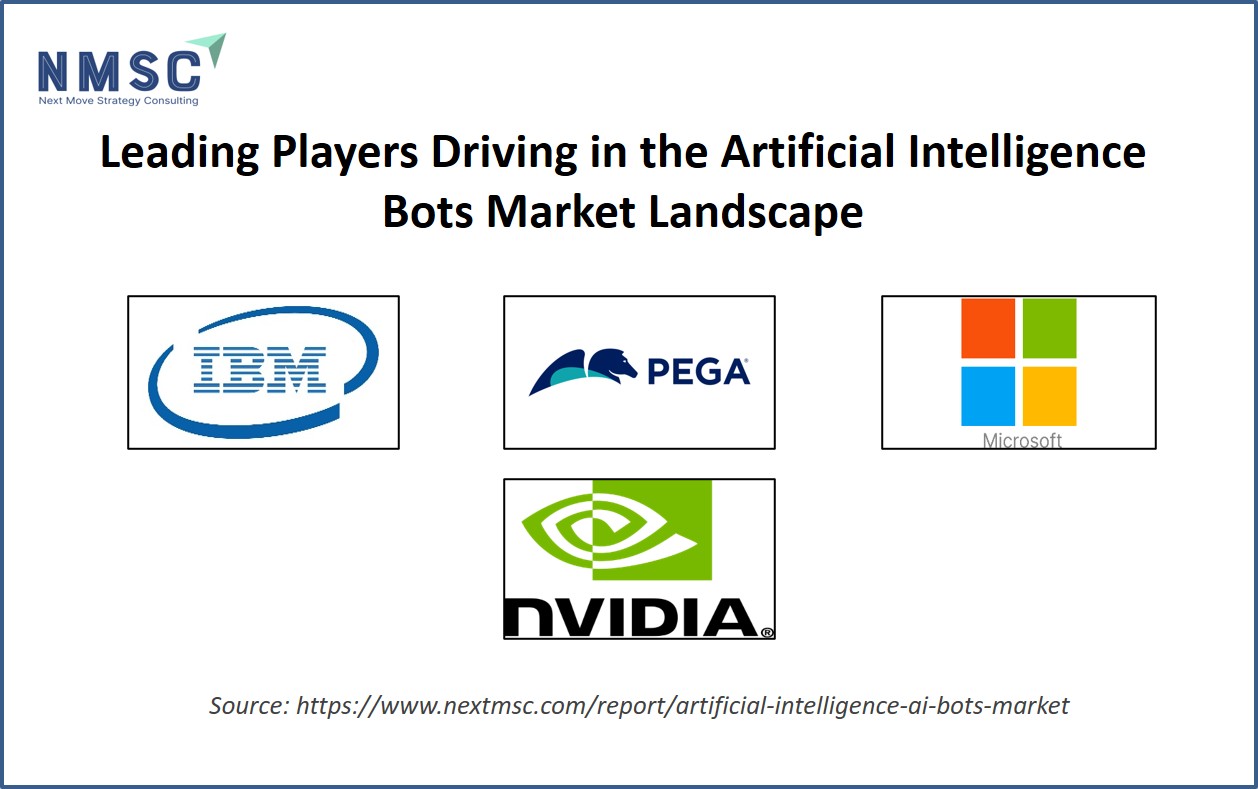
The global artificial intelligence bot market is highly competitive, with leading companies focusing on mergers and acquisitions, joint ventures, partnerships, and continuous technological innovation to maintain long-term growth. Key players currently operating in this space include Alphabet Inc., Apple Inc., Amazon Web Services, Salesforce, IBM Corporation, HP Inc., Oracle Corporation, SAP SE, Nvidia Corporation, Microsoft Corporation, and Intel Corporation.
In June 2020, Conversica Inc. expanded its partnership with AutoAlert, a major automotive software provider. The collaboration aimed to enhance Conversica’s Automotive AI Sales and Service Assistants, helping accelerate revenue across sales and after-sales services while delivering a more integrated customer experience platform.
The Next Move Strategy Consulting Perspective
As the Artificial Intelligence Bots Market matures, we at Next Move Strategy Consulting observe a fundamental decoupling of two industry trajectories. On one hand, the Financial Automation segment is proving that high-stakes, data-intensive tasks are increasingly reliant on "risk-aware" autonomous systems. On the other, the Frontline Service segment is entering a period of social friction, where the definition of "service quality" is being challenged by the very tools meant to improve it.
Our research suggests that the companies most likely to capture long-term market share will not be those that simply deploy the most sophisticated algorithms, but those that master "Human-Centric AI Deployment." This strategy requires three specific pillars:
-
Transparency by Design: Moving beyond simple privacy policies to proactive, clear communication regarding how AI is utilized for employee support versus oversight.
-
Ethical Verification: Developing supply chain transparency for data labeling, ensuring that the "human cost" of training intelligent systems meets modern labor standards.
-
Collaborative Intelligence: Prioritizing tools that assist, augment, and elevate human decision-making rather than those designed primarily for behavioral monitoring.
In the fast-paced landscape of 2026, the competitive advantage will shift from raw technological capability to the trust and social license a brand maintains with its stakeholders and its workforce. The "AI-Native" revolution is not merely a transition of infrastructure; it is a transition of responsibility.
Next Steps for Stakeholders
As the AI bots market evolves in 2026, stakeholders should consider the following actionable takeaways:
-
Audit Your AI Purpose: Differentiate clearly between "operational support" (e.g., inventory management) and "behavioral evaluation." Mixing the two can lead to significant reputational backlash.
-
Focus on "Coaching," Not "Scoring": If implementing AI in customer-facing roles, ensure the tool provides feedback that empowers employees rather than acting as a digital overseer.
-
Prioritize Transparency: Be upfront with staff and consumers about what data is being collected and, crucially, how it is not being used.
-
Monitor Ethical Sentiment: As "Ethically Sourced AI" becomes a competitive advantage, companies must document the safeguards they have in place to prevent biased or intrusive monitoring.
About the Author
 Sanyukta Deb
— Sanyukta Deb is Digital Marketing Team Lead at Next Move Strategy Consulting, where she has led content strategy and technical SEO for the firm's B2B market research publications for over 2 years. Her editorial process translates NextMSC's primary and secondary research — spanning technology, industrial, and consumer sectors — into commercial narratives, backed by search-intent, keyword, and competitive analysis. She brings 5 years of overall experience in digital marketing and content strategy.
Sanyukta Deb
— Sanyukta Deb is Digital Marketing Team Lead at Next Move Strategy Consulting, where she has led content strategy and technical SEO for the firm's B2B market research publications for over 2 years. Her editorial process translates NextMSC's primary and secondary research — spanning technology, industrial, and consumer sectors — into commercial narratives, backed by search-intent, keyword, and competitive analysis. She brings 5 years of overall experience in digital marketing and content strategy.
About the Reviewer
 Debashree Dey
— Debashree Dey is Assistant Manager at Next Move Strategy Consulting, where she supports cross-vertical market content and communications across diverse industries for 6 years. Her professional background includes senior content writing, communications, and published manuscript authorship, with experience developing audience-focused business narratives and maintaining clear, consistent messaging. Her role supports research-led content development and editorial quality across NextMSC publications.
Debashree Dey
— Debashree Dey is Assistant Manager at Next Move Strategy Consulting, where she supports cross-vertical market content and communications across diverse industries for 6 years. Her professional background includes senior content writing, communications, and published manuscript authorship, with experience developing audience-focused business narratives and maintaining clear, consistent messaging. Her role supports research-led content development and editorial quality across NextMSC publications.

















Add Comment