What is Driving the Bluetooth 5 Market in 2025?
Introduction
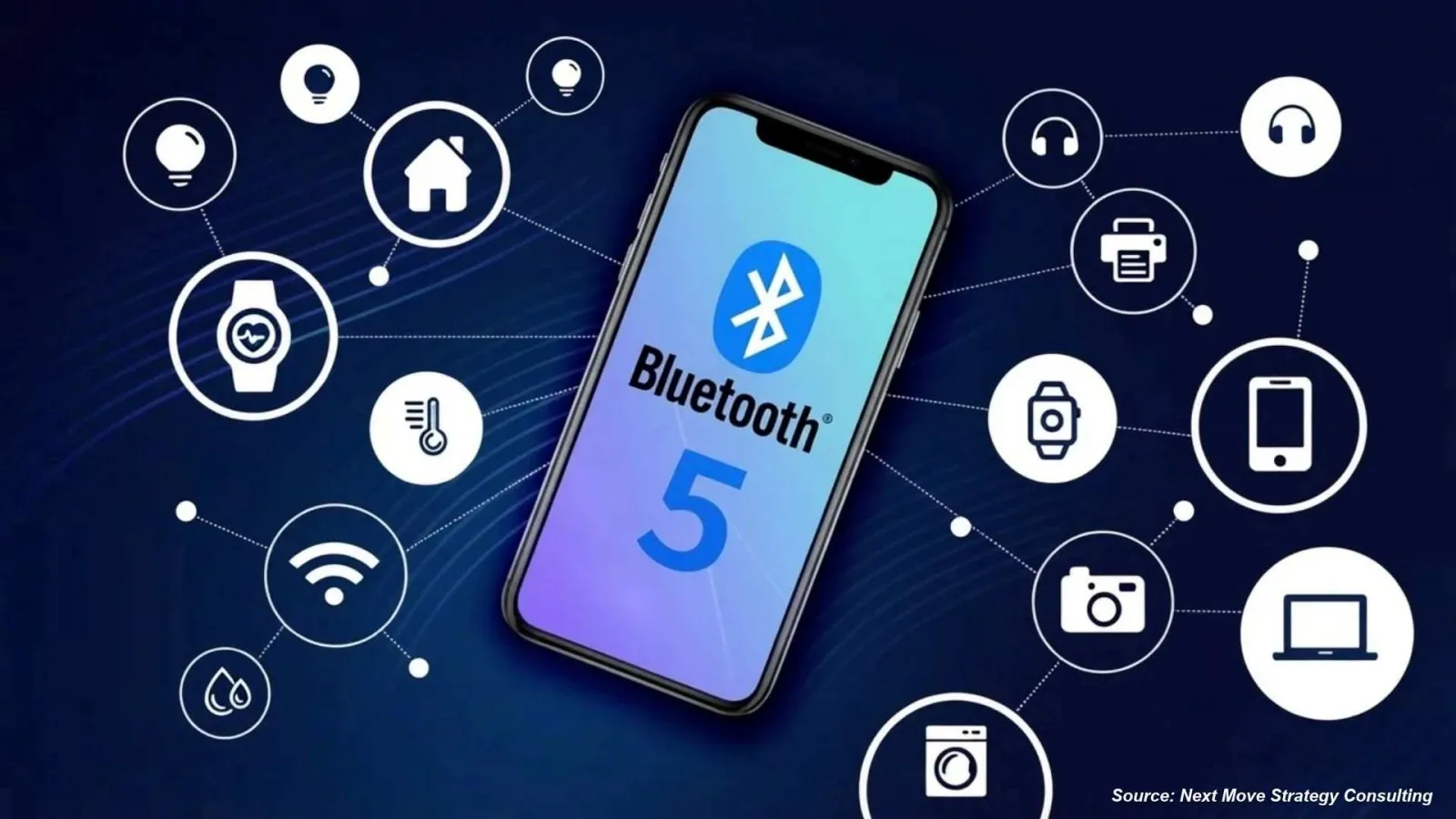
Wireless connectivity has long been a commodity feature in consumer electronics, but Bluetooth 5.0 is undergoing a structural transformation — from a simple audio and data transport layer into the foundational nervous system of edge-intelligent devices across healthcare, industrial automation, retail, and automotive sectors. The technology's combination of four-times the range, two-times the speed, and eight-times the broadcast message capacity relative to Bluetooth 4.2 has made it the default short-range wireless standard for an expanding universe of connected applications.
According to Next Move Strategy Consulting's Bluetooth 5.0 Market report, the global Bluetooth 5.0 Market was valued at USD 7.8 billion in 2025 and is projected to reach USD 22.6 billion by 2035, growing at a CAGR of 11.2% from 2026 to 2035. This trajectory is not driven by incremental device volume alone — it reflects a fundamental expansion of the technology's value proposition, as Bluetooth 5.0 SoCs increasingly incorporate AI inference engines, direction-finding capabilities, and LE Audio support that command premium pricing across healthcare, industrial, and automotive segments.
For More Information: Download FREE Sample on Bluetooth 5.0 Market Report
From Connectivity Standard to Edge Intelligence Platform: The Defining Shift of 2026
Bluetooth Channel Sounding and the Industrial Precision Revolution
The most consequential near-term development reshaping the Bluetooth 5.0 ecosystem is the commercial momentum behind Bluetooth Channel Sounding — a secure, fine-ranging feature that delivers centimeter-level distance measurement across connected devices. Published in January 2026, the Bluetooth Special Interest Group's (SIG) industry outlook confirmed that Channel Sounding has already received widespread interest for industrial asset tracking and automotive digital key applications within just one year of its adoption.
Øyvind Strøm, EVP of the Short-Range Business Unit at Nordic Semiconductor, stated in January 2026: "In 2026, we expect to see Bluetooth Channel Sounding enabling sub-meter asset tracking and guaranteeing worker safety through geofencing and safety zone functionalities. Industrial innovation is entering a new phase of intelligence and precision, and Bluetooth is right at the center of it."
Parker Dorris, Staff Product Manager at Silicon Labs, reinforced this assessment: "We're beginning to see how Bluetooth Location Services solutions are driving new levels of productivity in industrial applications, particularly in asset tracking. The latest wave of innovation is being powered by Bluetooth Channel Sounding, which enables highly precise location capabilities."
This is not a marginal feature upgrade. Channel Sounding transforms Bluetooth 5.0 infrastructure from a communication medium into a spatial intelligence layer — enabling logistics operators, hospital systems, and manufacturing plants to track assets, personnel, and equipment with sub-meter accuracy without deploying separate UWB or GPS infrastructure. According to NMSC's primary research and analysis, the Location-based Services application segment is the fastest-growing in the Bluetooth 5.0 Market at a CAGR of 14.8% from 2026 to 2035, directly reflecting this capability expansion.
NXP's i.MX 93W: Multi-Protocol AI Integration Redefines the SoC Landscape
In March 2026, NXP Semiconductors launched the i.MX 93W applications processor at Embedded World 2026, integrating Edge AI with Wi-Fi 6, Bluetooth LE, and IEEE 802.15.4 connectivity in a single system-in-package (SiP) designed for industrial IoT and smart-edge applications. The device replaces up to 60 discrete components in physical AI designs, directly reducing bill-of-material costs and board footprint for industrial IoT device manufacturers.
This launch exemplifies the most significant structural shift in the Bluetooth 5.0 component market: the migration from single-protocol Bluetooth chips toward multi-protocol combo SoCs that integrate Bluetooth LE alongside Wi-Fi 6, UWB, and Thread on a single die. For enterprise IoT buyers, this consolidation reduces integration complexity and total cost of ownership. For semiconductor vendors, it raises the competitive bar — favoring large conglomerates with multi-protocol design capability over single-protocol specialists.
STMicroelectronics Enters Mass Production of Bluetooth LE 5.4 Module
In June 2025, STMicroelectronics entered mass production of the ST67W611M1 — a combined Wi-Fi 6 and Bluetooth Low Energy 5.4 module developed in collaboration with Qualcomm Technologies, designed for STM32-based IoT systems. The module delivers certified Wi-Fi 6 and Bluetooth LE connectivity in a compact LGA form factor, enabling IoT device manufacturers to accelerate time-to-market with a pre-certified, integration-ready platform.
The ST67W611M1's entry into mass production signals that Bluetooth 5.4 — which introduced Periodic Advertising with Responses (PAwR) for scalable bidirectional communication with large device populations — is transitioning from specification to volume deployment. This is particularly consequential for Electronic Shelf Label (ESL) and smart label applications, where PAwR enables a single access point to communicate with thousands of shelf labels simultaneously.
Nordic Semiconductor Acquires Memfault for USD 120 Million
In June 2025, Nordic Semiconductor acquired Memfault, a U.S.-based cloud platform startup, for approximately USD 120 million, creating the first complete chip-to-cloud platform for lifecycle management, OTA updates, diagnostics, and large-scale IoT deployments. The integration, completed in September 2025, brought Memfault's proven observability and OTA infrastructure directly into Nordic's nRF Cloud platform, enabling developers building with Nordic's Bluetooth LE-enabled chipsets to access device reliability engineering tools at scale.
This acquisition reflects a broader competitive dynamic in the Bluetooth 5.0 Market: the battle for developer platform loyalty is shifting from hardware specifications to software ecosystem depth. Vendors that can offer seamless chip-to-cloud workflows — covering device provisioning, firmware updates, diagnostics, and fleet management — are capturing design wins that pure hardware vendors cannot.
NMSC Strategic Perspective: The Convergence of Edge AI and Bluetooth 5.0
NMSC's primary research and analysis identifies the convergence of on-device AI inference with Bluetooth 5.0 connectivity as the defining structural shift of the current market phase. Wearable manufacturers including Samsung and Apple are integrating neural processing units directly into Bluetooth SoCs, enabling real-time health metric analysis, gesture recognition, and contextual audio processing without cloud dependency. This transforms Bluetooth 5.0 from a data transport layer into an intelligent sensing and decision platform.
Shantanu Bhalerao, VP of Wireless Products at Infineon Technologies, articulated this shift in January 2026: "Bluetooth connectivity is at the heart of enabling edge AI and will help lead the next set of intelligent, power-efficient edge solutions. Edge AI has unlocked a whole new potential of what Bluetooth-enabled products can do."
According to NMSC's analysis, this AI-native differentiation is becoming the primary competitive battleground in the Bluetooth 5.0 SoC market. Vendors that successfully embed machine learning inference engines alongside Bluetooth 5.0 radios are capturing design wins in premium wearable, healthcare, and smart home platforms — segments that carry significantly higher average selling prices than commodity consumer electronics applications.
Section Summary: The Bluetooth 5.0 Market is undergoing a platform-level transformation in 2026, driven by Channel Sounding's industrial precision capabilities, multi-protocol AI-integrated SoC launches, and the emergence of chip-to-cloud software ecosystems.
Key Takeaways:
-
Bluetooth Channel Sounding is enabling sub-meter indoor positioning in industrial, healthcare, and retail environments without additional GPS or UWB infrastructure investment.
-
NXP's i.MX 93W and STMicroelectronics' ST67W611M1 mass production signal the industry's decisive shift toward multi-protocol, AI-integrated Bluetooth SoCs.
-
Nordic Semiconductor's USD 120 million acquisition of Memfault demonstrates that software ecosystem depth — not hardware specifications alone — is the new competitive differentiator.
-
NMSC's analysis identifies AI-native Bluetooth SoC integration as the highest-value design win opportunity through 2035, particularly in healthcare monitoring and industrial automation.
Industry Impact Analysis
Healthcare BLE: The Fastest-Growing Vertical Reshapes Device Economics
The healthcare end-user segment is the fastest-growing in the Bluetooth 5.0 Market at a CAGR of 15.2% from 2026 to 2035, advancing from USD 0.7 billion in 2025 to USD 2.8 billion by 2035, according to NMSC's primary research and analysis. This growth is not driven by incremental device adoption — it reflects a structural shift in how healthcare is delivered, with Bluetooth LE becoming the connectivity standard for continuous monitoring outside clinical settings.
ABI Research, in a May 2026 analysis published on the Bluetooth SIG's platform, projected that annual Bluetooth-enabled continuous glucose monitor (CGM) shipments alone will reach 115 million units by 2030, nearly double from 62.1 million units in 2025. Bluetooth-enabled healthcare device shipments overall are forecast to increase 27% annually between 2025 and 2030.
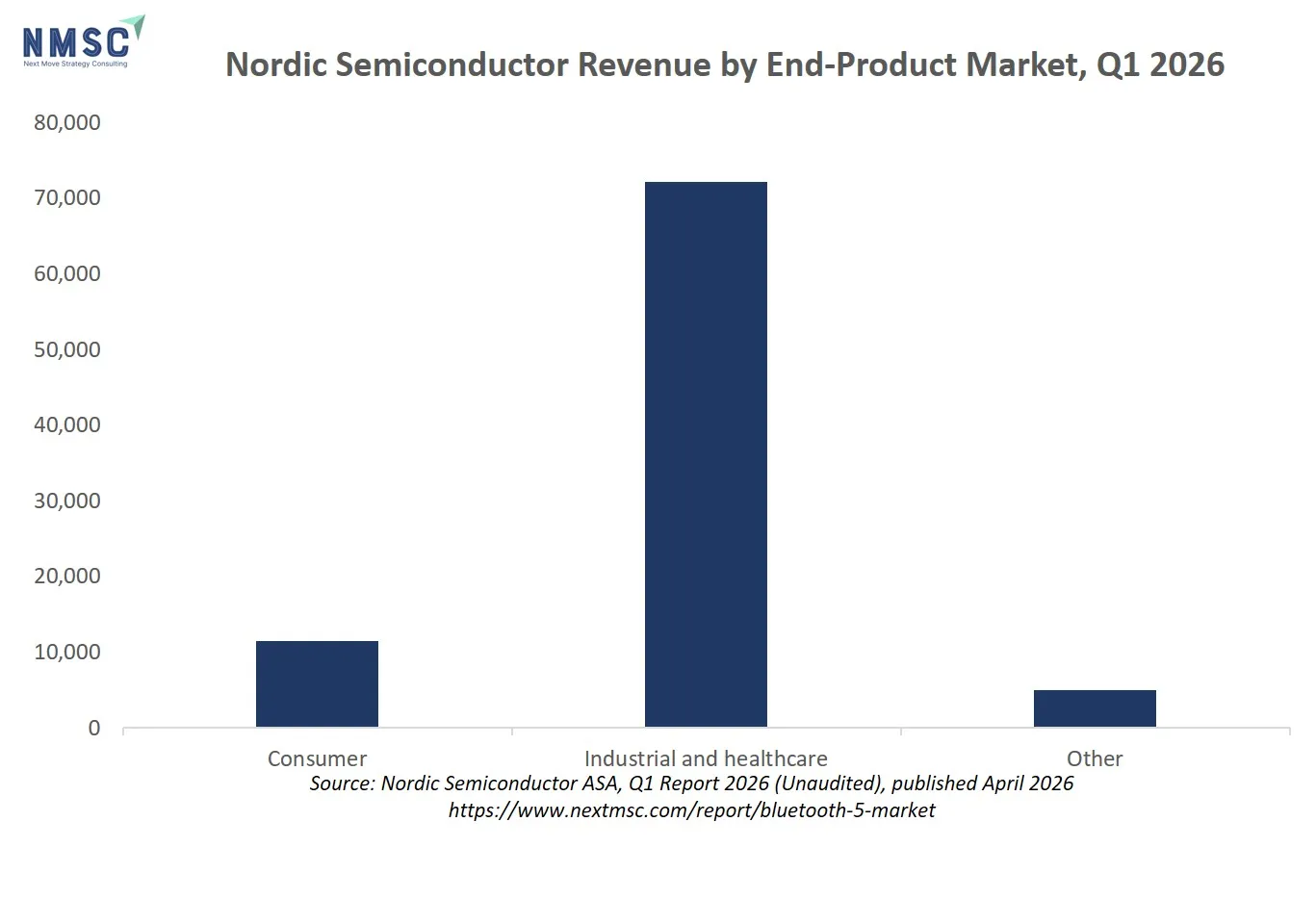
The U.S. Food and Drug Administration's Digital Health Center of Excellence has cleared multiple Bluetooth-enabled devices including continuous glucose monitors, cardiac rhythm monitors, and remote patient monitoring kits that rely on BLE protocols compliant with Bluetooth 5.0. These FDA clearance pathways create a structured, compliance-driven demand channel that reinforces long-term procurement of certified Bluetooth 5.0 components and integration services.
Electronic Shelf Labels: A 40% CAGR Opportunity Reshaping Retail Infrastructure
Bluetooth Electronic Shelf Labels (ESLs) represent one of the most structurally compelling near-term growth vectors in the Bluetooth 5.0 ecosystem. ABI Research, in its May 2026 analysis, projected that annual shipments of Bluetooth ESLs will reach nearly 176 million units by 2030, achieving a 40% CAGR — positioning Bluetooth ESLs as one of the fastest-scaling hardware opportunities in the entire wireless connectivity market.
The Bluetooth ESL standard, introduced in 2023, enables a single Bluetooth 5.4 access point to update thousands of shelf labels simultaneously using Periodic Advertising with Responses — a capability that was not available in earlier Bluetooth versions. This technical differentiation is driving large-scale retail and warehousing deployments that generate high-unit-volume hardware procurement for SoC and module suppliers.
Auracast Broadcast Audio: Transforming Public Space Accessibility
Auracast broadcast audio — a Bluetooth LE Audio capability built on Bluetooth 5.2 and backward-compatible with many Bluetooth 5.0 hardware platforms — is expanding the addressable market for Bluetooth-enabled audio infrastructure in public venues. The Bluetooth SIG confirmed in January 2026 that Auracast has been deployed across live theatres, music venues, houses of worship, and conference facilities globally, with universities and hospitals emerging as the next major adoption wave.
Chuck Sabin, VP of Technology and Market Development at the Bluetooth SIG, stated in January 2026: "Auracast broadcast audio is the best thing that has happened for assistive listening and audio accessibility in a long time. There is no question the impact Auracast broadcast audio is having on the ecosystem and raising awareness for assistive listening, in general."
Regulatory Frameworks Reinforce Long-Term Demand
Regulatory environments across major markets are actively reinforcing Bluetooth 5.0 adoption. The U.S. FCC's Part 15 certification framework provides stable domestic market access. The EU's Radio Equipment Directive (RED) harmonizes certification across European markets, enabling manufacturers to access multiple national markets through a single certification process. The EU's Ecodesign Regulation for electronics creates regulatory incentives favoring low-power wireless standards such as Bluetooth LE over higher-power alternatives — directly benefiting Bluetooth 5.0's BLE profile, which operates at sub-milliwatt power consumption levels.
In automotive, UNECE Regulation No. 155 on cybersecurity is reinforcing demand for certified, security-compliant Bluetooth 5.0 solutions in vehicle digital key and infotainment applications. Medical-grade Bluetooth deployments are subject to FDA clearance pathways in the United States and CE marking under the EU Medical Devices Regulation, raising the compliance bar for component manufacturers while reinforcing long-term demand for certified solutions.
Section Summary: Healthcare BLE, Bluetooth ESL, and Auracast broadcast audio are the three highest-impact application vectors reshaping the Bluetooth 5.0 Market's revenue composition, supported by regulatory frameworks that create durable, compliance-driven procurement demand.
Key Takeaways:
-
Healthcare BLE device shipments are growing at 27% annually through 2030, with CGM shipments alone projected to reach 115 million units by 2030, according to ABI Research.
-
Bluetooth ESLs are scaling at a 40% CAGR, with 176 million annual unit shipments projected by 2030 — creating a high-volume hardware procurement opportunity for SoC and module suppliers.
-
Auracast broadcast audio is expanding Bluetooth 5.0's addressable market into public venue audio infrastructure, a segment previously served by proprietary assistive listening systems.
-
EU Ecodesign Regulation and FDA digital health clearance pathways are creating compliance-driven demand channels that reinforce long-term Bluetooth 5.0 component procurement.
Pros and Cons of Recent Market Developments
|
Recent Development |
Pros |
Cons |
|
NXP i.MX 93W Multi-Protocol SoC Launch (March 2026) |
Reduces up to 60 discrete components; lowers BOM cost and board footprint for industrial IoT OEMs; accelerates time-to-market for AI-enabled edge devices |
Sampling begins H2 2026, limiting near-term design win conversion; favors large OEMs with resources to redesign around new SiP architecture |
|
Nordic Semiconductor Acquires Memfault (June 2025, USD 120M) |
Creates first chip-to-cloud lifecycle management platform; strengthens developer ecosystem loyalty; enables OTA updates and diagnostics at fleet scale |
Raises competitive pressure on pure-hardware Bluetooth SoC vendors lacking equivalent software platforms; integration complexity may delay full platform availability |
|
STMicroelectronics ST67W611M1 Mass Production (June 2025) |
Pre-certified Wi-Fi 6 + Bluetooth LE 5.4 module accelerates customer time-to-market; Bluetooth 5.4 PAwR enables scalable ESL and smart label deployments |
Module-level integration limits customization for advanced OEM applications; Qualcomm QCC743 dependency creates supply chain concentration risk |
|
Bluetooth Channel Sounding Commercial Adoption (2026) |
Enables sub-meter indoor positioning without additional UWB infrastructure; opens high-value RTLS revenue streams in healthcare, logistics, and retail |
Requires anchor infrastructure investment; performance degrades in high-density RF environments; regulatory approval timelines vary across emerging markets |
|
Auracast Broadcast Audio Expansion |
Expands Bluetooth 5.0 addressable market into public venue audio infrastructure; creates BYOD-driven hardware refresh cycles in assistive listening |
Consumer device Auracast support remains uneven; venue operators face upfront infrastructure investment before BYOD benefits materialize |
|
Bluetooth High Data Throughput (8 Mbps PHY, in development) |
Unlocks high-fidelity wireless audio, AR/VR, and large media transfer applications without proprietary dongles |
Specification still under development; backward compatibility with existing Bluetooth 5.0 hardware not guaranteed for all use cases |
Key Data & Statistics
|
Date |
Company |
Event |
Market Significance |
|
March 2026 |
NXP Semiconductors |
Launched i.MX 93W — Edge AI + Wi-Fi 6 + Bluetooth LE + 802.15.4 SiP |
Replaces up to 60 discrete components; accelerates physical AI in industrial IoT |
|
March 2026 |
Arduino / Qualcomm |
Announced Arduino VENTUNO Q powered by Qualcomm Dragonwing IQ8 |
Targets AI, robotics, and industrial IoT connected device development |
|
January 2026 |
Qualcomm |
Completed Industrial & Embedded IoT expansion strategy (Arduino, Edge Impulse, Foundries.io, Focus.AI, Augentix) |
Consolidates AI-enabled IoT connectivity ecosystem under single platform |
|
September 2025 |
Nordic Semiconductor |
Integrated Memfault into nRF Cloud — full chip-to-cloud OTA and observability platform |
First complete lifecycle management platform for Bluetooth LE IoT fleets |
|
June 2025 |
Nordic Semiconductor |
Acquired Memfault for USD 120 million |
Establishes software ecosystem leadership in Bluetooth LE IoT management |
|
June 2025 |
STMicroelectronics |
Entered mass production of ST67W611M1 Wi-Fi 6 + Bluetooth LE 5.4 module |
Enables scalable ESL and smart label deployments using Bluetooth 5.4 PAwR |
Future Outlook & Forecast
The Path to USD 22.6 Billion: Three Structural Growth Horizons
According to NMSC's primary research and analysis, the Bluetooth 5.0 Market is forecast to grow from USD 8.7 billion in 2026 to USD 22.6 billion by 2035 at a CAGR of 11.2%. This trajectory reflects three distinct structural growth horizons, each driven by a different combination of technology maturation and application expansion.
Near-Term (2026–2028): LE Audio, Channel Sounding, and ESL Volume Ramp
The near-term growth phase is defined by the commercial scaling of Bluetooth LE Audio across premium TWS earphones and hearing aids, the deployment of Channel Sounding-enabled RTLS infrastructure in healthcare and logistics, and the volume ramp of Bluetooth ESL deployments in retail and warehousing. ABI Research's May 2026 analysis confirmed that Bluetooth ESL shipments are growing at a 40% CAGR, with the Bluetooth ESL standard introduced in 2023 already driving large-scale deployments across retail and warehousing industries.
Mid-Term (2028–2031): AI-Native SoC Proliferation and Healthcare Device Scaling
The mid-term phase is characterized by the proliferation of AI-native Bluetooth SoCs across wearables, smart home, and industrial monitoring applications. ABI Research's May 2026 analysis projected that Bluetooth-enabled device shipments will reach over 8.1 billion units annually by 2030, up from 5.4 billion units in 2025, driven by advances in edge AI and the shift toward connected MCUs and ultra-low-power architectures. Healthcare BLE device adoption — advancing at a 15.2% CAGR through 2035 per NMSC's analysis — will be the highest-value revenue contributor in this phase.
Long-Term (2031–2035): Ambient IoT, Smart Labels, and Ubiquitous Positioning Infrastructure
The long-term phase is defined by the emergence of ambient IoT — energy-harvesting Bluetooth devices that operate without batteries, enabling a new class of disposable sensors, smart packaging, and supply chain tracking labels. ABI Research projected in May 2026 that Bluetooth smart label shipments will grow at a 30% CAGR over the next five years, with battery suppliers and label vendors already increasing production capacity in anticipation of large-scale deployments.
High Data Throughput and Ultra-Low Latency HID: The Next Specification Wave
The Bluetooth SIG confirmed in January 2026 that two of its most anticipated specification development projects — High Data Throughput (targeting 8 Mbps PHY) and Ultra-Low Latency HID (targeting 1000 Hz polling rates) — are progressing toward release. High Data Throughput will unlock high-fidelity wireless audio, AR/VR headset connectivity, and large media transfer applications. Ultra-Low Latency HID will enable Bluetooth gaming controllers and AR/VR peripherals to match the responsiveness of USB-wired connections — eliminating the proprietary wireless dongle that has historically been required for competitive gaming peripherals.
Øyvind Strøm of Nordic Semiconductor stated: "The convergence of the ultra-low latency HID project, the high data throughput project, and the higher bands project is setting the stage for a new generation of Bluetooth-enabled experiences. These advancements are not just incremental; they are foundational to the next wave of immersive and intelligent low-latency wireless products."
Asia-Pacific: The Fastest-Growing Region Through 2035
Asia-Pacific is the fastest-growing major region in the Bluetooth 5.0 Market at a CAGR of 12.9% from 2026 to 2035, advancing from USD 2.0 billion in 2025 to USD 6.7 billion by 2035, according to NMSC's primary research and analysis. China's domestic SoC vendors — including Realtek, MediaTek, and Goodix — produce high-volume Bluetooth 5.0 chipsets for consumer electronics export, while India's Production-Linked Incentive scheme for electronics manufacturing is enhancing domestic Bluetooth 5.0 ecosystem development. South Korea's Samsung and LG Electronics continue to drive global TWS earphone and smartwatch Bluetooth 5.0 adoption at scale.
Section Summary: The Bluetooth 5.0 Market's path to USD 22.6 billion by 2035 is structured across three distinct growth horizons — ESL and LE Audio volume ramp, AI-native SoC proliferation, and ambient IoT scaling — each supported by specific technology milestones and application expansions.
Key Takeaways:
-
Bluetooth-enabled device shipments are projected to exceed 8.1 billion units annually by 2030, up from 5.4 billion in 2025, per ABI Research's May 2026 analysis.
-
Bluetooth smart label shipments are growing at a 30% CAGR, with ambient IoT positioning Bluetooth as the de facto standard for supply chain visibility.
-
High Data Throughput (8 Mbps) and Ultra-Low Latency HID specifications under development by the Bluetooth SIG will unlock AR/VR and gaming peripheral markets currently served by proprietary wireless solutions.
-
Asia-Pacific's 12.9% CAGR through 2035 is underpinned by China's SoC manufacturing dominance, India's PLI-driven electronics expansion, and South Korea's consumer electronics leadership.
Next Steps for Stakeholders
For SoC Vendors and Semiconductor Manufacturers:
Prioritize multi-protocol integration combining Bluetooth 5.0 with Wi-Fi 6E and UWB to capture premium smart home, automotive, and enterprise IoT design wins. Healthcare-grade BLE certification — covering FDA clearance pathways and EU Medical Devices Regulation CE marking — is non-negotiable for vendors targeting the fastest-growing end-user segment through 2035. Invest in SDK and developer ecosystem quality, as platform-level competition is intensifying across Zephyr RTOS, Mbed OS, and proprietary development environments. The Nordic Semiconductor-Memfault integration demonstrates that chip-to-cloud software capability is now a primary design win criterion.
For Enterprise IoT Buyers and Device Manufacturers:
Evaluate multi-protocol SoC platforms — particularly NXP's i.MX 93W and STMicroelectronics' ST67W611M1 — for new industrial IoT and smart building designs that require co-existence management across Bluetooth LE, Wi-Fi 6, and Thread. For healthcare device programs, engage FDA's Digital Health Center of Excellence early in the design process to align BLE protocol stack implementation with applicable clearance pathways. For retail and logistics applications, prioritize Bluetooth 5.4 PAwR-capable infrastructure to support ESL and smart label deployments at scale.
For Investors and Financial Analysts:
The highest-conviction investment themes within the Bluetooth 5.0 Market through 2035 are healthcare BLE device connectivity at a 15.2% CAGR, location-based services at 14.8% CAGR, and Bluetooth ESL at a 40% CAGR per ABI Research. Monitor Nordic Semiconductor and Silicon Laboratories for premium specialty wireless positioning, and Qualcomm and Broadcom for large-scale multi-protocol integration plays. The Bluetooth smart label and ambient IoT segment — growing at a 30% CAGR — represents a structurally attractive early-stage investment opportunity for venture and growth equity investors.
For Government Agencies and Standards Bodies:
Accelerate harmonization of radio equipment certification frameworks in emerging markets — particularly in Southeast Asia, Africa, and Latin America — where regulatory fragmentation is extending product launch cycles by six to eighteen months and discouraging investment in market customization. The Bluetooth SIG's Qualification Program and the EU Radio Equipment Directive's harmonized standards provide proven models for reducing certification complexity without compromising spectrum management objectives.
Conclusion
The Bluetooth 5.0 Market is not simply growing — it is diversifying into a multi-vertical, multi-application platform that is increasingly difficult to categorize as a single market. The same underlying technology that powers a consumer TWS earphone is now enabling sub-meter indoor positioning in hospital wards, bidirectional communication with 10,000 electronic shelf labels from a single access point, and real-time health metric analysis on a wearable without cloud connectivity.
According to NMSC's primary research and analysis, the global Bluetooth 5.0 Market will advance from USD 7.8 billion in 2025 to USD 22.6 billion by 2035 at a CAGR of 11.2%. The developments of 2025 and 2026 — NXP's multi-protocol AI SoC, Nordic's chip-to-cloud platform, STMicroelectronics' Bluetooth 5.4 mass production, and the Bluetooth SIG's Channel Sounding and High Data Throughput roadmap — collectively confirm that this market is entering its highest-value growth phase. For C-level executives, investors, and technology strategists, the strategic imperative is clear: Bluetooth 5.0 is no longer a connectivity feature to be specified — it is a platform to be invested in.
About the Author
 Sanyukta Deb
— Sanyukta Deb is Digital Marketing Team Lead at Next Move Strategy Consulting, where she has led content strategy and technical SEO for the firm's B2B market research publications for over 2 years. Her editorial process translates NextMSC's primary and secondary research — spanning technology, industrial, and consumer sectors — into commercial narratives, backed by search-intent, keyword, and competitive analysis. She brings 5 years of overall experience in digital marketing and content strategy.
About the Reviewer
 Debashree Dey
— Debashree Dey is Assistant Manager at Next Move Strategy Consulting, where she supports cross-vertical market content and communications across diverse industries for 6 years. Her professional background includes senior content writing, communications, and published manuscript authorship, with experience developing audience-focused business narratives and maintaining clear, consistent messaging. Her role supports research-led content development and editorial quality across NextMSC publications.
















Add Comment