What Is Driving the Rise of Autonomous UGVs in 2026?
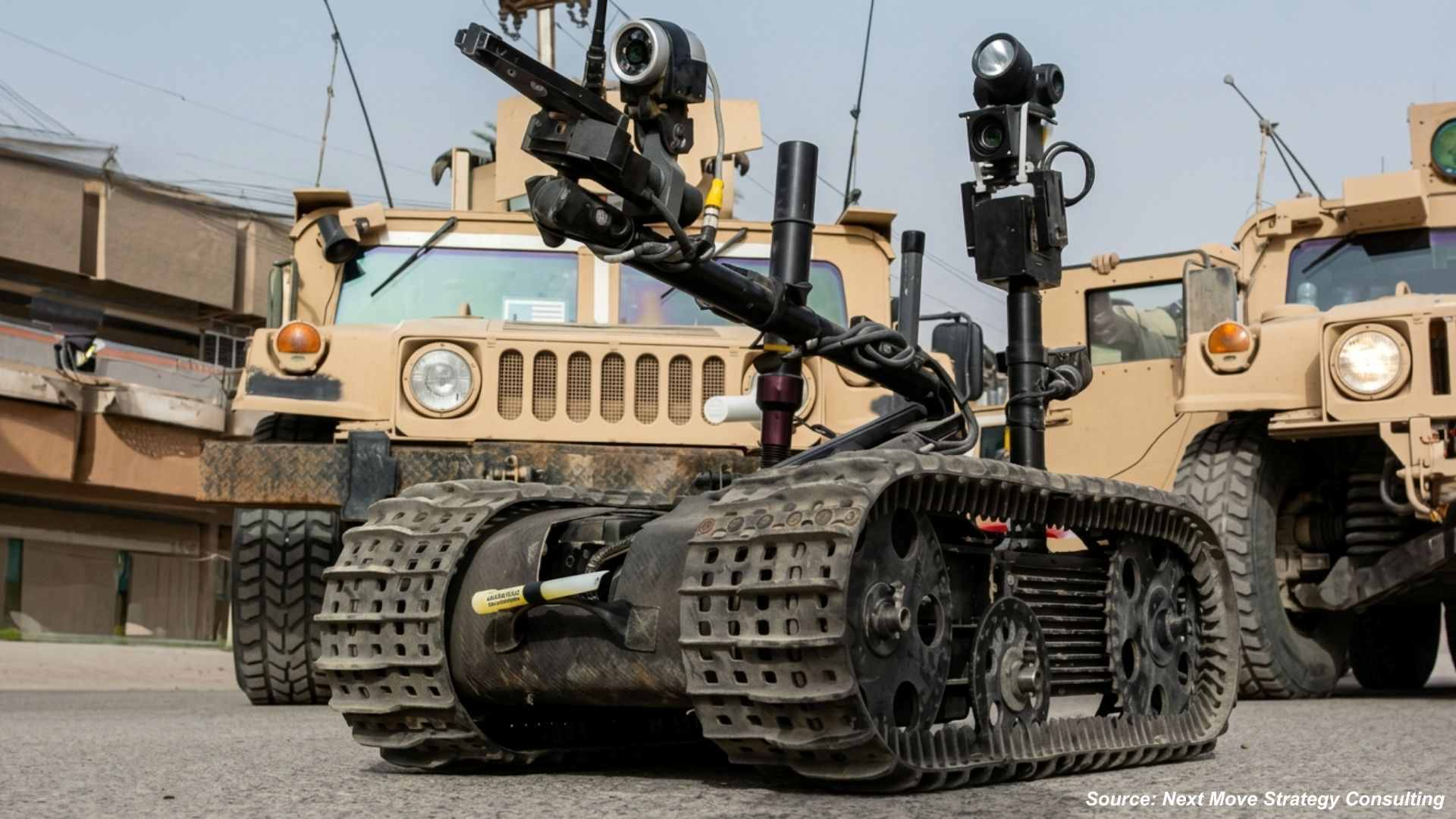
Autonomous UGV Market is rapidly moving beyond pilot programs and entering real-world deployment across agriculture, logistics, security, and defense environments. As organizations confront labor shortages, rising operational costs, and increasing pressure to improve efficiency, autonomous ground platforms are emerging as a practical automation solution rather than a future concept.
Recent developments from Voltrac and ePropelled demonstrate how innovation is accelerating across both vehicle platforms and propulsion technologies. In 2025, Voltrac secured €7 million in seed funding to expand production of its Thor autonomous UGV platform, while ePropelled introduced new additions to its GPM Series of intelligent propulsion systems designed specifically for autonomous ground vehicles.
For investors, procurement leaders, and corporate strategists, these developments highlight a broader shift toward scalable, commercially viable autonomous mobility solutions capable of supporting demanding operational environments.
How Is Agricultural Automation Shaping Autonomous UGV Development?
Agriculture has emerged as one of the most compelling use cases for autonomous UGV deployment. Labor shortages continue to affect farming operations globally, creating demand for technologies that can improve productivity while reducing reliance on manual labor. Voltrac was established specifically to address these challenges, developing autonomous systems that can support both agricultural and front-line logistics operations.
Its flagship platform, Thor, was designed and built in less than a year and has already been tested across vineyards, olive groves, and citrus farms. Unlike traditional agricultural machinery that is later upgraded with automation capabilities, Thor was engineered from the ground up as an autonomous platform. This purpose-built approach allows the company to optimize performance, simplify system architecture, and improve operational efficiency.
The vehicle incorporates 70% fewer components than conventional alternatives and features fully swappable batteries. Equally important, it remains compatible with existing farming implements, allowing operators to adopt automation without replacing established equipment fleets. Thor can autonomously haul loads of up to four tonnes across rugged terrain while enabling a single operator to supervise multiple vehicles simultaneously.

Why Does Compatibility Matter?
One of the primary barriers to agricultural technology adoption is the cost associated with replacing existing equipment. By maintaining compatibility with standard farming implements, autonomous UGV platforms can significantly reduce capital investment requirements while accelerating deployment. This strategy allows operators to integrate automation into existing workflows rather than redesigning their entire operating model.
How Are Intelligent Drive Systems Improving Autonomous UGV Performance?
While autonomous vehicle platforms often receive the most attention, propulsion technology plays a critical role in determining vehicle performance, reliability, and operational efficiency. Recognizing this requirement, ePropelled expanded its GPM Series in 2025 with the introduction of the GPM35, GPM50, and GPM70 integrated propulsion systems.
These systems combine motors, controllers, and optional planetary gearboxes into compact, ruggedized units designed specifically for autonomous mobility platforms. By integrating multiple functions into a single solution, the company aims to simplify vehicle design while improving power delivery and operational reliability.
The GPM35 delivers 4 kW of continuous power and 35 Nm of torque, while the GPM50 increases output to 6 kW continuous power and 52 Nm of torque. For heavy-duty applications, the flagship GPM70 provides 70 Nm of base torque and can reach up to 560 Nm when paired with its optional gearbox configuration.
Why Is Precision Control Becoming Essential?
Autonomous UGVs operate in complex environments where stability, traction, and maneuverability directly influence mission success. To address these requirements, the GPM Series incorporates encoder-based closed-loop speed and position control, high-resolution feedback systems, predictive diagnostics, and over-the-air software update capabilities.
These technologies enable vehicles to respond more accurately to changing terrain conditions while supporting predictive maintenance strategies that reduce downtime. The result is a propulsion architecture designed not only for performance but also for long-term operational sustainability.

What Major Trends Are Shaping the Present Autonomous UGV Landscape?
Several themes are emerging across the autonomous UGV ecosystem. First, manufacturers are increasingly moving away from retrofitting conventional vehicles and instead developing platforms designed specifically for autonomous operation. This approach allows companies to optimize system architecture, improve efficiency, and reduce mechanical complexity.
Second, deployment opportunities are expanding beyond traditional defense applications. Agricultural operations, front-line logistics, perimeter security, and industrial mobility applications are all emerging as viable markets for autonomous ground vehicles. This diversification is broadening the commercial potential of the technology.
Another notable trend is the growing importance of connected intelligence. Features such as real-time monitoring, predictive diagnostics, analytics platforms, and remote software updates are becoming standard expectations rather than premium capabilities. As autonomous systems become more sophisticated, software-driven performance optimization is increasingly influencing purchasing decisions.
Finally, commercialization efforts are accelerating. Voltrac's plan to scale production capacity to 100 units annually by 2026 reflects growing confidence that autonomous UGVs are moving beyond demonstration projects and into practical deployment scenarios.

Competitive Landscape of the Autonomous UGV Industry
The autonomous UGV industry features a diverse group of established defense contractors, robotics innovators, and advanced mobility technology providers, including Otokar Ltd, Nexter Systems, Lockheed Martin Corporation, Oshkosh Defense LLC, General Dynamics Corporation, Robotics Plus, Harris Corporation, BAE Systems, Northrop Grumman Corporation, and Milrem Robotics Inc. To strengthen their market positions and expand their technological capabilities, these companies are actively pursuing strategic initiatives such as new product launches, enabling them to address evolving operational requirements and maintain a competitive edge within the rapidly advancing autonomous UGV landscape.

Future Outlook
The autonomous UGV sector is entering a stage where commercial scalability is becoming just as important as technological innovation. Industry participants are increasingly focused on demonstrating operational value, deployment readiness, and long-term reliability rather than simply showcasing technical capabilities.
Future growth is likely to be influenced by expanding production capacity, broader adoption within logistics operations, increased integration of intelligent propulsion systems, and continued advancements in autonomous navigation technologies. The convergence of these developments could strengthen the role of autonomous ground platforms across multiple industries.
The initiatives announced by both Voltrac and ePropelled suggest that the industry is progressing toward practical deployment models that prioritize efficiency, flexibility, and operational performance. For investors, procurement leaders, and strategic decision-makers, this transition may represent one of the most important indicators of the sector's maturity heading into 2026.
Next Steps
Organizations evaluating autonomous UGV opportunities should:
-
Assess labor and operational challenges that automation could address.
-
Evaluate compatibility with existing equipment and workflows.
-
Review propulsion and power system requirements carefully.
-
Conduct pilot deployments before large-scale implementation.
-
Monitor emerging suppliers and technology partnerships.
A structured evaluation process can help decision-makers identify where autonomous ground platforms deliver the greatest operational value.
About the Author
 Tania Dey is a content writer specializing in transformation-led, insight-driven storytelling. She develops research-backed, high-impact content aligned with evolving business priorities, digital behavior, and audience expectations. Her work helps organizations sharpen value propositions, strengthen visibility, and communicate strategic intent with clarity and precision. Grounded in data-informed storytelling, she brings a strong focus on relevance, consistency, and measurable digital impact across platforms.
About the Reviewer
 Debashree Dey is a senior content writer and communications specialist known for crafting audience-focused narratives and insight-driven content strategies. As a published manuscript author, she combines creative storytelling with strategic thinking to strengthen brand messaging, enhance visibility, and drive meaningful audience engagement across digital platforms. With a collaborative leadership approach, she contributes to high-impact communication initiatives that ensure consistency, clarity, and long-term brand value. Outside of work, she finds inspiration in creative projects, design exploration, and storytelling-driven ideas.
















Add Comment