What Is the Advanced Virtual Assistant Market and Why Does It Matter in 2025?

The Advanced Virtual Assistant Market is emerging as one of the most influential segments within the artificial intelligence ecosystem, driven by growing enterprise demand for intelligent automation and personalized digital experiences. Artificial intelligence is no longer a back office experiment. It has become the front line of how enterprises engage customers, manage operations, and deliver services at scale.
The commercial momentum behind the advanced virtual assistant market is exceptional. According to Next Move Strategy Consulting (NMSC), the global market was valued at USD 8.94 billion in 2023 and is projected to reach USD 78.61 billion by 2030, growing at a CAGR of 36.5% from 2024 to 2030. For C-level executives, institutional investors, and senior procurement leaders, this trajectory is not a forecast to monitor, it is a strategic imperative to act on.
Key Trends Reshaping the Advanced Virtual Assistant Market in 2025
1. Banking Leads Enterprise Adoption and the Numbers Prove It
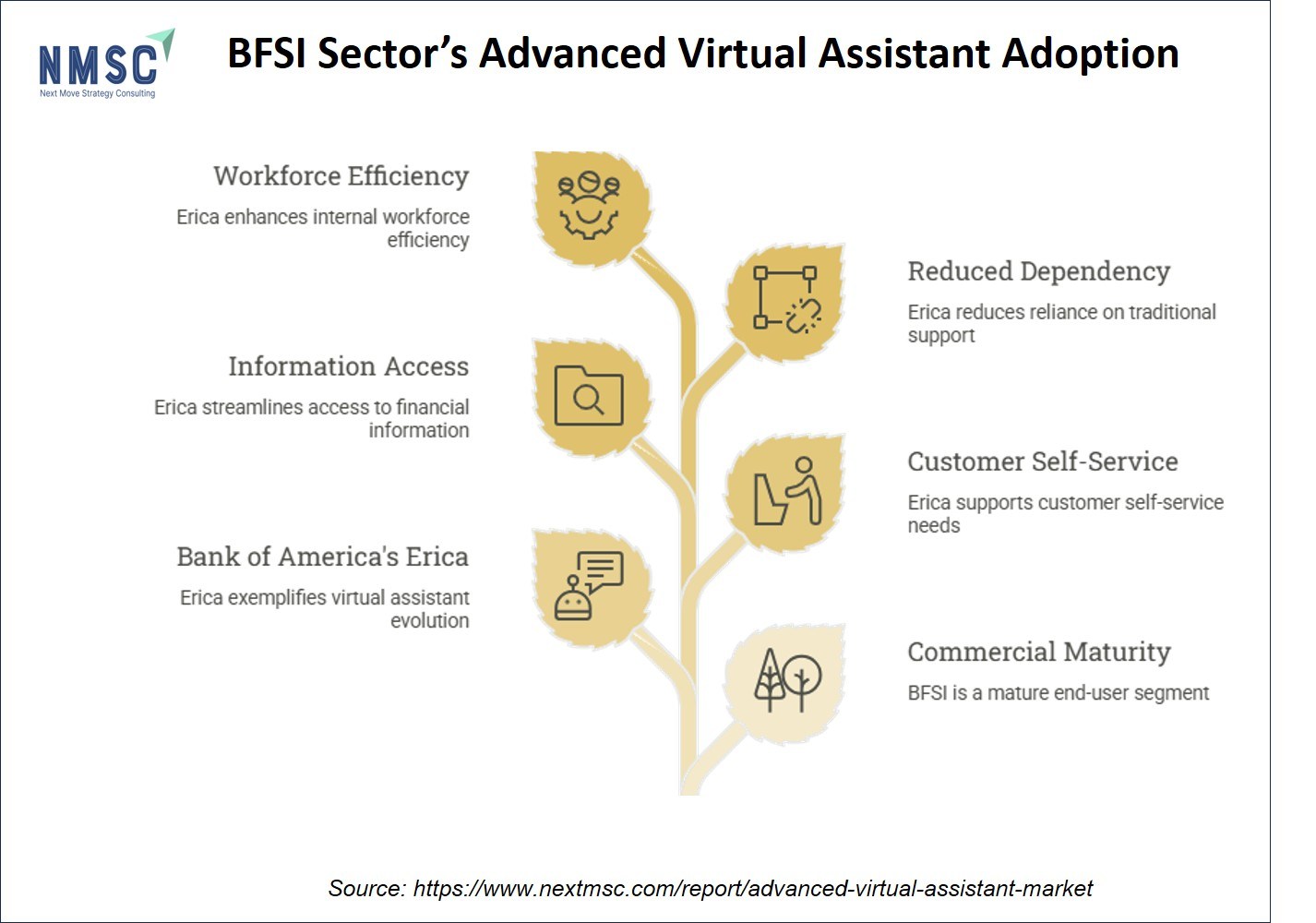
The BFSI (Banking, Financial Services and Insurance) sector has emerged as one of the most commercially mature end user segments within the advanced virtual assistant market. A strong example of this evolution is Bank of America’s virtual financial assistant, Erica.
Bank of America reported continued expansion in Erica’s adoption and engagement across both customer and employee use cases, demonstrating the growing role of AI driven assistants in large scale financial operations. The platform has supported customer self service, streamlined access to information, reduced dependency on traditional support channels, and enhanced internal workforce efficiency.
2. Healthcare Deploys AVAs at Population Scale
Healthcare is rapidly emerging as the second most strategically significant end-user segment in the advanced virtual assistant market. On December, Elevance Health announced the expansion of its Virtual Assistant to approximately 22 million commercial health plan members, available through the Sydney Health app and affiliated health plan websites. Early pilot results indicated that nearly 9 out of 10 users were able to leverage the Virtual Assistant to find answers to their healthcare questions. Expansion to Medicare members is planned for 2026.
This deployment is significant for two reasons. First, it demonstrates that AVAs are now operating at population scale in healthcare a sector historically resistant to rapid technology adoption due to regulatory complexity and patient safety requirements. Second, it validates the advanced virtual assistant market's capacity to deliver measurable outcomes in high-stakes, high-complexity service environments.
3. Enterprise AI Platforms: Microsoft Copilot and the Agentic Shift
One of the most transformative developments shaping the advanced virtual assistant market in 2025 is the shift from standalone conversational tools to integrated, enterprise grade AI assistant platforms. A notable example is Microsoft’s continued expansion of Microsoft 365 Copilot, reflecting broader enterprise adoption of AI powered workplace assistants.
The company introduced new capabilities designed to make virtual assistants more context aware and operationally embedded within business environments. These enhancements focus on enabling AI systems to better understand user context, workflows, and organizational knowledge while supporting centralized deployment, governance, and security of AI agents across enterprise environments.
4. Asia-Pacific: Smartphone Penetration Fuels the Fastest-Growing Region
Asia Pacific represents the fastest growing regional market within the advanced virtual assistant industry, supported by expanding smartphone adoption, improving digital connectivity, and increasing investment by device manufacturers in AI enabled assistant capabilities. The region’s mobile ecosystem continues to strengthen its contribution to economic growth while creating a favorable environment for the deployment of intelligent virtual technologies.
The continued expansion of next generation mobile networks is expected to accelerate access to advanced digital services and support wider integration of virtual assistants across consumer and enterprise applications. Enhanced connectivity infrastructure is enabling organizations to scale AI powered interactions, automate service delivery, and improve user engagement across multiple industries.
Industry Impact Analysis
The convergence of enterprise AI investment, sector-specific deployments, and connectivity infrastructure is producing measurable structural changes across the advanced virtual assistant market.
Cost Reduction as a Primary ROI Driver: Bank of America's Erica demonstrates that AVAs can directly reduce operational costs at scale with IT service desk calls reduced by 50% through internal deployment alone. For organizations evaluating AVA investment, this represents a quantifiable, near-term return that justifies capital allocation.
High Development Costs as a Market Restraint: Despite the market's growth trajectory, NMSC identifies the increasing costs of developing AVAs as a primary restraint, noting that small businesses and startups face significant financial barriers to adoption. This creates a bifurcated market where large enterprises capture disproportionate early-mover advantages, while SMB adoption lags a gap that Microsoft's $21/user/month Copilot Business offering is now beginning to address.
IoT Integration as a Future Growth Catalyst: NMSC identifies the integration of AVAs with Internet of Things (IoT) devices in smart homes enabling voice commands to control appliances and systems as a significant future growth opportunity. This integration enhances convenience, enables automation, and introduces personalized experiences, expanding the advanced virtual assistant market well beyond enterprise applications into consumer and residential segments.
Regulatory and Trust Considerations: As AVAs handle increasingly sensitive financial, health, and personal data, regulatory oversight is intensifying. Organizations deploying AVAs must navigate data privacy regulations, accessibility requirements, and sector-specific compliance frameworksparticularly in healthcare and financial services, where regulatory standards are most stringent.
Pros and Cons of Recent Market Developments
|
Development |
Pros |
Cons |
|
Bank of America Erica (3B+ Interactions, Aug 2025) |
Proven ROI at institutional scale; 50% IT service desk call reduction; 98%+ user resolution rate |
High upfront development investment; requires continuous model training (75,000+ updates since launch) |
|
Elevance Health 22-Million-Member AVA Rollout (Dec 2025) |
Population-scale healthcare navigation; 9/10 pilot users resolved queries; supports Spanish translation |
Subject to state-specific regulatory approvals; Medicare expansion still pending for 2026 |
Competitive Landscape
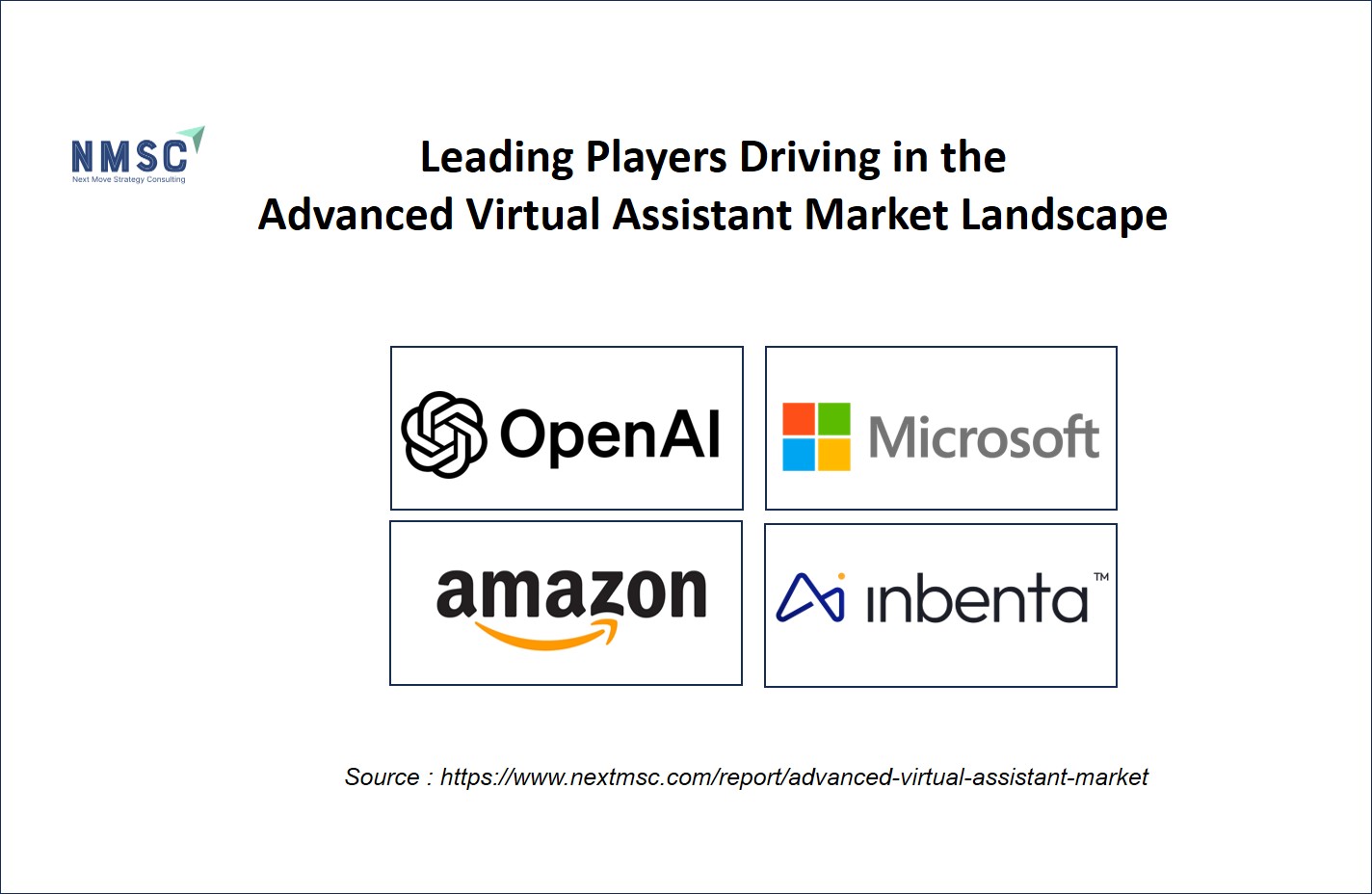
The advanced virtual assistant market is characterized by the presence of several established technology providers and AI solution developers, including Microsoft Corporation, IBM Corporation, Alphabet Inc., Apple Inc., Amazon.com, Inc., OpenAI, Creative Virtual Ltd, Nuance Communications, Inbenta Technologies, and [24]7.ai, Inc., among others. These companies are actively strengthening their market position through strategic initiatives such as continuous investment in research and development, expansion of AI capabilities, product innovation, technology enhancements, partnerships, and new solution launches. Such initiatives are contributing to increased competition and accelerating innovation across the global advanced virtual assistant market.
Next Steps for Stakeholders
For C-level executives, institutional investors, and senior procurement leaders evaluating the advanced virtual assistant market, the following actions are strategically material in 2025:
-
Conduct an AVA Readiness Assessment: Before committing to enterprise AVA deployment, audit existing data infrastructure, API integration capabilities, and NLP model compatibility. The complexity of integrating AVAs with legacy systems is a primary implementation risk that must be assessed upfront.
-
Prioritize BFSI and Healthcare Use Cases for Immediate ROI: Bank of America's 50% IT service desk call reduction and Elevance Health's 9-in-10 pilot user resolution rate provide benchmarks for near-term ROI. Organizations in these sectors should treat AVA deployment as a priority investment, not a discretionary technology upgrade.
-
Evaluate Microsoft 365 Copilot for Enterprise-Wide Deployment: With more than 90% of the Fortune 500 already using the platform, Microsoft 365 Copilot represents the lowest-friction path to enterprise AVA adoption for organizations within the Microsoft ecosystem. The $21/user/month SMB tier also makes it accessible for mid-market organizations.
Conclusion
The advanced virtual assistant market in 2025 is not a market in transition, it is a market in acceleration. The convergence of enterprise-grade AI platforms, population-scale healthcare deployments, institutional BFSI adoption, and Asia-Pacific's expanding mobile infrastructure is driving a growth trajectory that NMSC projects will take the market from USD 8.94 billion in 2023 to USD 78.61 billion by 2030. For rigorous, data-driven market intelligence, Next Move Strategy Consulting's Advanced Virtual Assistant Market report provides comprehensive market sizing, CAGR analysis, segment-level forecasts, and competitive intelligence across 28 countries and 10 leading players.
About the Author
 Sanyukta Deb
— Sanyukta Deb is Digital Marketing Team Lead at Next Move Strategy Consulting, where she has led content strategy and technical SEO for the firm's B2B market research publications for over 2 years. Her editorial process translates NextMSC's primary and secondary research — spanning technology, industrial, and consumer sectors — into commercial narratives, backed by search-intent, keyword, and competitive analysis. She brings 5 years of overall experience in digital marketing and content strategy.
Sanyukta Deb
— Sanyukta Deb is Digital Marketing Team Lead at Next Move Strategy Consulting, where she has led content strategy and technical SEO for the firm's B2B market research publications for over 2 years. Her editorial process translates NextMSC's primary and secondary research — spanning technology, industrial, and consumer sectors — into commercial narratives, backed by search-intent, keyword, and competitive analysis. She brings 5 years of overall experience in digital marketing and content strategy.
About the Reviewer
 Debashree Dey
— Debashree Dey is Assistant Manager at Next Move Strategy Consulting, where she supports cross-vertical market content and communications across diverse industries for 6 years. Her professional background includes senior content writing, communications, and published manuscript authorship, with experience developing audience-focused business narratives and maintaining clear, consistent messaging. Her role supports research-led content development and editorial quality across NextMSC publications.
Debashree Dey
— Debashree Dey is Assistant Manager at Next Move Strategy Consulting, where she supports cross-vertical market content and communications across diverse industries for 6 years. Her professional background includes senior content writing, communications, and published manuscript authorship, with experience developing audience-focused business narratives and maintaining clear, consistent messaging. Her role supports research-led content development and editorial quality across NextMSC publications.


















Add Comment