How AI Chatbots Are Transforming Customer Service

The chatbot market keeps compounding faster than almost any other corner of enterprise software, and 2026 has offered the clearest picture yet of who is actually winning the race to put AI in front of customers. According to Next Move Strategy Consulting's Chatbot Market research, global chatbot market revenue was valued at USD 4.93 billion in 2023 and is projected to reach USD 21.68 billion by 2030, growing at a CAGR of 23.2%. Increasingly, that growth runs through a small group of companies OpenAI, Alphabet, Microsoft, Meta, and Baidu chief among them whose 2026 product launches, funding rounds, and enterprise rollouts are reshaping what “AI-powered customer service” actually means for the businesses buying it.
This review updates our earlier look at how AI chatbots are transforming customer service with verified 2026 adoption data and a detailed look at what the market's largest players have actually shipped this year not just announced.
What Is an AI Chatbot?
An AI chatbot is software that uses artificial intelligence to communicate with people in natural language. Unlike the rule-based bots of a decade ago, today's chatbots can interpret intent, hold multi-turn conversations, search company documentation, and complete tasks such as checking an order or booking an appointment escalating to a human agent when needed. Most current-generation chatbots are built on large language models, which is why they read as more conversational than the keyword-matching systems they replaced.
Why Businesses Are Adopting AI Chatbots
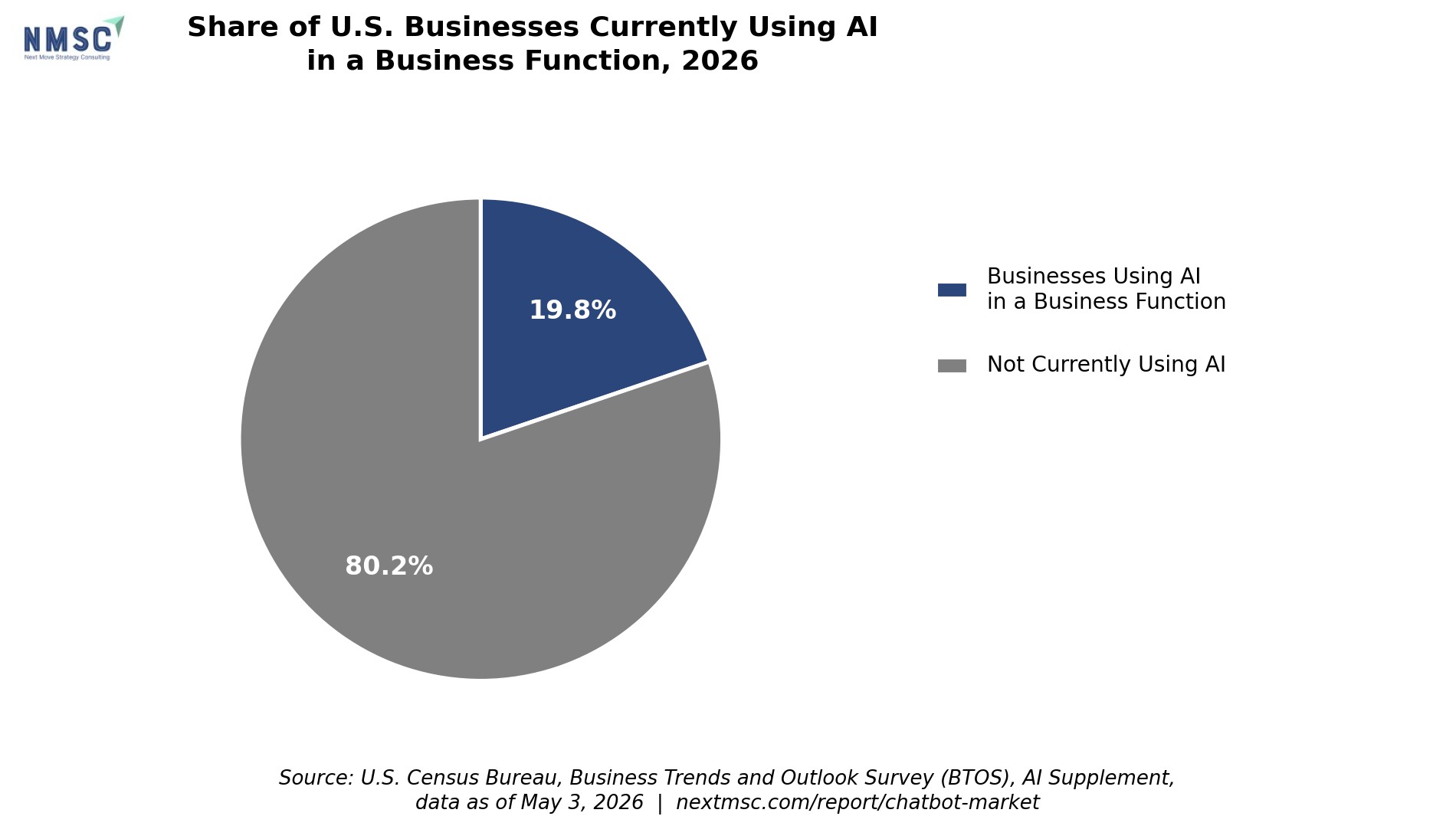
Customer expectations keep rising, and staffing a support desk around the clock isn't practical for most growing businesses. AI chatbots absorb the routine, repetitive share of that workload so human agents can focus on complex or sensitive cases. Adoption is real but still uneven: as of May 2026, 19.8% of U.S. businesses reported using AI in a business function in the prior two weeks, according to the U.S. Census Bureau's Business Trends and Outlook Survey one of 15 business functions the survey tracks, customer service among them.
Section summary
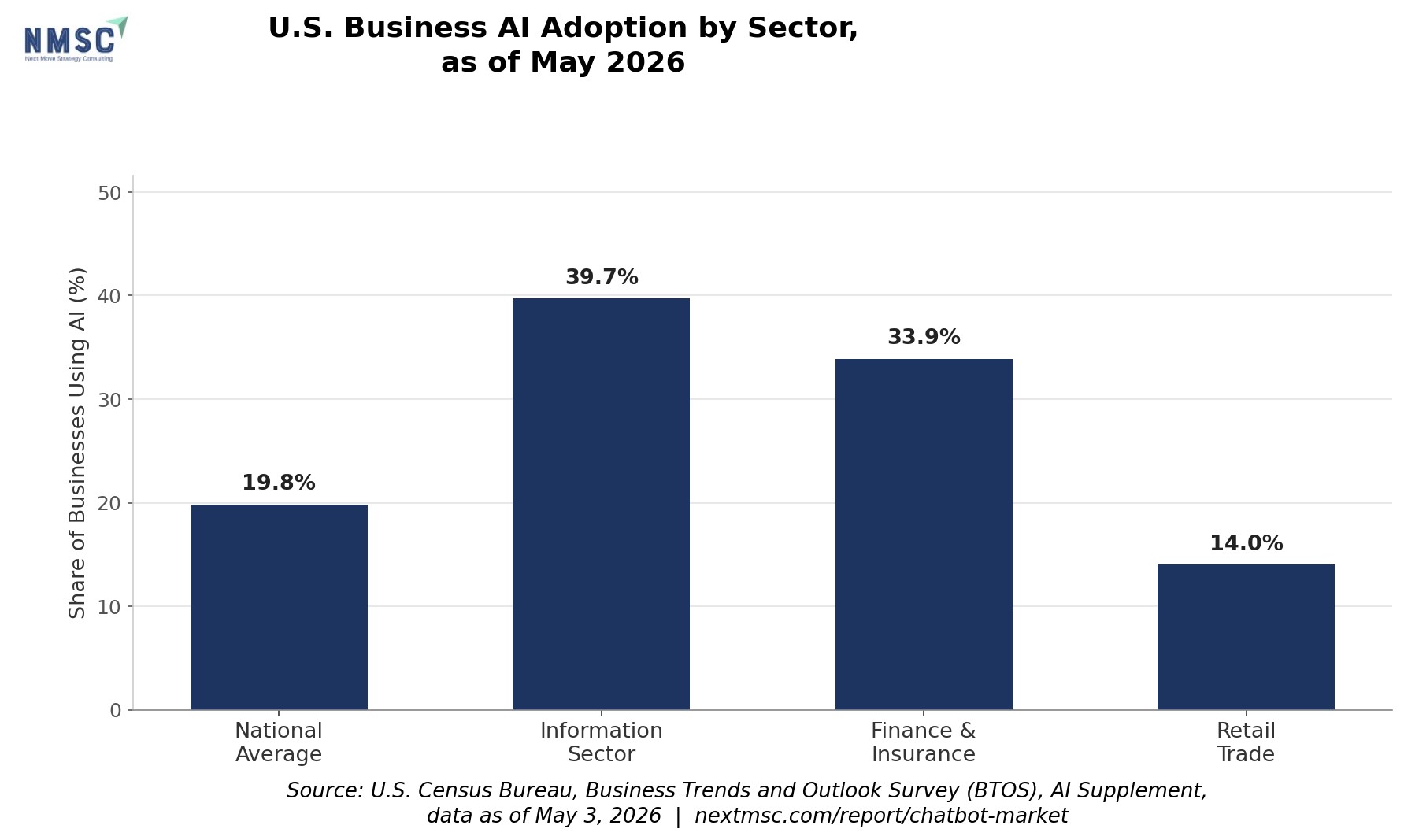
Adoption of AI in day-to-day business operations is still a minority practice nationally, but it is concentrated in exactly the sectors information and financial services where chatbot deployment is most mature.
-
19.8% of U.S. businesses reported using AI in a business function as of May 2026 (Census Bureau BTOS).
-
Adoption runs roughly double the national rate in the Information sector (39.7%) and Finance & Insurance (33.9%).
-
Between 20% and 23% of U.S. businesses expected to adopt AI within six months of the survey period.
How AI Chatbots Are Transforming Customer Service
Six changes stand out in how chatbots now operate inside support organizations:
-
Instant support for routine requests order tracking, password resets, billing questions without a queue.
-
24/7 coverage across time zones, particularly valuable for businesses serving international customers.
-
Reduced repetitive load on human agents, who are freed for escalations, technical issues, and account-specific problems.
-
More personalized conversations, since modern chatbots can reference purchase history and prior support requests instead of asking customers to repeat themselves.
-
Consistent support across channels websites, apps, WhatsApp, Messenger, and voice so the experience doesn't depend on where a customer starts.
-
Closer collaboration with human agents: summarizing conversations, suggesting responses, and routing conversations to the right department.
None of this replaces a support team; it changes what the team spends its time on.
Industry Leader Moves: Who's Actually Shipping in the Chatbot Market
The chatbot industry's competitive landscape includes Baidu, OpenAI, Alphabet, Microsoft, Meta, Kore.ai, Artificial Solutions, IBM, BotsCrew, and Haptik. Several of the largest have had a genuinely eventful year and their moves are not evenly weighted, so the largest disclosures get the most space here.
OpenAI disclosed that ChatGPT reached 900 million weekly active users on February 27, 2026 more than doubling the 400 million reported a year earlier alongside a $110 billion funding round backed by Amazon, Nvidia, and SoftBank. In March 2026, OpenAI closed an additional round totaling $122 billion in committed capital at a $852 billion post-money valuation, and on June 8, 2026, the company confidentially filed paperwork for an IPO targeting a valuation near $1 trillion.
Alphabet Inc. (Google) said its Gemini app crossed 1 billion monthly active users in August 2026, according to the company's own product update. That followed Google I/O in May 2026, where the company launched the Gemini 3.5 model family, and an April 22, 2026 launch of the Gemini Enterprise Agent Platform as the successor to Vertex AI a direct push into the enterprise agent category where chatbot vendors increasingly compete.
Microsoft Corporation reported that Microsoft 365 Copilot surpassed 30 million paid seats in its fiscal fourth quarter, disclosed July 29, 2026 up from 20 million the prior quarter, the fastest quarterly seat addition since Copilot launched in November 2023.
Meta launched Muse Spark in April 2026, the first proprietary model from its newly formed Meta Superintelligence Labs, moving its consumer Meta AI assistant away from the open-weight Llama models it had used since 2024, while keeping existing Llama releases open source. Meta guided full-year 2026 AI infrastructure capital expenditure to $125–145 billion.
Baidu reported that daily active users of its ERNIE Assistant grew 83% year-over-year in June 2026, even as the company said it was deliberately delaying monetization of AI search to prioritize user experience. AI Cloud infrastructure revenue grew roughly 50% year-over-year in the second quarter of 2026, following 184% growth in GPU cloud revenue in the first quarter, as ERNIE 5.1 took the top spot among Chinese models on the LMArena leaderboard.
IBM Corporation moved watsonx Orchestrate, its agentic AI platform, to general availability at its Think 2026 conference on May 5, 2026, shipping with a catalog of more than 150 pre-built agents and connectors, then added a centralized “Agentic Control Plane” for governing agents at scale in June 2026.
Kore.ai secured an undisclosed strategic growth investment led by AllianceBernstein Private Credit Investors on January 27, 2026, taking its total disclosed funding to roughly $223 million, to expand its agent-first enterprise platform. Jio Haptik, the Reliance-owned conversational AI provider, expanded its autonomous agent lineup to six products in 2026, adding an Insights agent, while continuing to serve more than 500 enterprise customers, primarily across South and Southeast Asia. Artificial Solutions and BotsCrew continued serving their established enterprise and SMB conversational-AI niches respectively, without a comparably sized disclosed move in the period reviewed.
2026 Industry Leader Moves in the Chatbot Market
|
Company |
Move |
Date |
Disclosed metric |
|
OpenAI |
ChatGPT reached 900 million weekly active users |
Feb 27, 2026 |
900M WAU |
|
Alphabet Inc. (Google) |
Gemini app crossed 1 billion monthly active users |
Aug 2026 |
1B+ MAU |
|
Microsoft Corporation |
Microsoft 365 Copilot surpassed 30 million paid seats |
Jul 29, 2026 |
30M paid seats |
|
Meta |
Launched Muse Spark, first proprietary Meta AI model |
Apr 2026 |
Not disclosed |
|
Baidu |
ERNIE Assistant daily active users grew year-over-year |
Jun 2026 |
+83% YoY DAU |
|
IBM Corporation |
watsonx Orchestrate reached general availability |
May 5, 2026 |
150+ agent catalog |
|
Kore.ai |
Strategic growth investment led by AllianceBernstein |
Jan 27, 2026 |
Undisclosed |
|
Jio Haptik |
Expanded to six autonomous agents (added Insights agent) |
2026 |
500+ enterprise clients |
Section summary
Where several years of chatbot development were shaped mainly by model quality, 2026's moves are increasingly about scale user counts, paid seats, and agent catalogs and about who controls the agentic layer sitting on top of the chatbot itself.
-
OpenAI and Google both crossed roughly 1 billion monthly/weekly users in 2026, a scale previously reached only by the largest consumer apps in history.
-
Microsoft and IBM are both racing to own enterprise agent orchestration, not just conversational chat.
-
Capital intensity keeps rising: Meta alone guided $125–145 billion in 2026 AI infrastructure spend.
Industries Benefiting From AI Chatbots
Adoption spans far beyond tech. E-commerce platforms use chatbots for product recommendations, delivery tracking, and returns processing. SaaS companies lean on them for onboarding and troubleshooting. Healthcare providers use them for appointment scheduling and routine patient questions, with privacy and regulatory compliance as a standing requirement. Banking and financial services remain one of the most active adopters NMSC tracks this vertical in more depth in its Chatbot Market in BFSI report, and adoption in the sector has been consistently ahead of the broader economy: Census Bureau data puts Finance & Insurance sector AI use at 33.9%, nearly double the national average.
Key Considerations Before Adopting an AI Chatbot
-
Knowledge quality matters. A chatbot is only as useful as the documentation and knowledge base it can search.
-
Human support should stay reachable. Not every issue should or can be resolved by AI alone.
-
Monitoring is not optional. Businesses should regularly review chatbot conversations to catch missing answers, incorrect responses, and new customer needs.
-
Platform selection should weigh more than chat. Beyond natural language understanding, look for CRM integration, workflow automation, analytics, and genuine multichannel support voice included, where tools such as Murf.ai's conversational AI extend chatbot experiences into spoken interactions.
U.S. Business AI Adoption by Firm Size, 2026
|
Segment |
Share using AI in a business function |
|
National average (all U.S. businesses) |
19.8% |
|
Firms with 250+ employees |
37% |
|
Firms with 100–249 employees |
32% |
|
National, expected use within 6 months |
20–23% |
Best Practices for Successful Adoption
Start with the highest-volume, lowest-complexity questions before automating anything sensitive. Keep the underlying knowledge base current a chatbot repeats whatever it's given, including outdated answers. Track resolution rate, customer satisfaction, and escalation rate rather than deployment alone, and treat automation and human support as complementary rather than competing. Businesses weighing a build-versus-buy decision often start with platforms like Chatbase, which let teams build AI agents from existing documentation and deploy them across channels while keeping a human handoff available.
Future Outlook for the Chatbot Market
NMSC's 23.2% CAGR forecast through 2030 assumes continued generative AI investment, and 2026's spending data supports that: combined AI infrastructure capex commitments from just Meta and Microsoft are running well past $150 billion annualized. The more interesting shift is structural chatbots are increasingly one interface inside a broader “agent” layer (Google's Gemini Enterprise Agent Platform, IBM's watsonx Orchestrate, Kore.ai's agent-first platform) that can execute multi-step tasks rather than just answer questions. Expect the “chatbot” label itself to keep blurring into “AI agent” over the next few years, even as the underlying market NMSC tracks keeps growing.
Section summary
Forecast growth in the chatbot market looks conservative next to 2026's actual spending and usage figures, and the product category is visibly shifting from answering questions to completing tasks.
-
NMSC's 23.2% CAGR (2024–2030) forecast is being tested by capex commitments already exceeding $150 billion annually from just two vendors.
-
Agentic platforms from Google, IBM, and Kore.ai signal the category is moving beyond simple Q&A chat.
-
North America's continued dominance in chatbot market share is reinforced by the concentration of the largest vendors' headquarters and earliest enterprise adoption there.
|
Segment-level forecasts, regional data, and full competitive benchmarking sit behind the figures cited in this review. |
Conclusion
AI chatbots have moved from a novelty to standard infrastructure for a meaningful share of businesses, even if national adoption 19.8% as of May 2026 is earlier-stage than the headlines around OpenAI, Google, and Meta might suggest. The companies actually shipping in this space in 2026 are investing at a scale that outpaces even NMSC's own growth forecast, and the category is visibly evolving from conversational chat toward task-completing agents. For businesses evaluating a chatbot deployment, the fundamentals from our original review still hold: reliable knowledge, human support that stays reachable, and continuous monitoring now alongside a clearer-eyed view of which vendors are actually delivering at scale.
About the Author
 Sanyukta Deb
— Sanyukta Deb is Digital Marketing Team Lead at Next Move Strategy Consulting, where she has led content strategy and technical SEO for the firm's B2B market research publications for over 2 years. Her editorial process translates NextMSC's primary and secondary research — spanning technology, industrial, and consumer sectors — into commercial narratives, backed by search-intent, keyword, and competitive analysis. She brings 5 years of overall experience in digital marketing and content strategy.
Sanyukta Deb
— Sanyukta Deb is Digital Marketing Team Lead at Next Move Strategy Consulting, where she has led content strategy and technical SEO for the firm's B2B market research publications for over 2 years. Her editorial process translates NextMSC's primary and secondary research — spanning technology, industrial, and consumer sectors — into commercial narratives, backed by search-intent, keyword, and competitive analysis. She brings 5 years of overall experience in digital marketing and content strategy.
About the Reviewer
 Debashree Dey
— Debashree Dey is Assistant Manager at Next Move Strategy Consulting, where she supports cross-vertical market content and communications across diverse industries for 6 years. Her professional background includes senior content writing, communications, and published manuscript authorship, with experience developing audience-focused business narratives and maintaining clear, consistent messaging. Her role supports research-led content development and editorial quality across NextMSC publications.
Debashree Dey
— Debashree Dey is Assistant Manager at Next Move Strategy Consulting, where she supports cross-vertical market content and communications across diverse industries for 6 years. Her professional background includes senior content writing, communications, and published manuscript authorship, with experience developing audience-focused business narratives and maintaining clear, consistent messaging. Her role supports research-led content development and editorial quality across NextMSC publications.

















Add Comment