6 Things You Can Do If Your Business Has Idle Capital

Banking used to be a slow-moving business. It no longer is. Over the past year, tokenized deposits have settled their first live interbank transaction, three of the world’s largest asset managers have folded private markets into everyday brokerage accounts, and a seven-year regulatory restriction on one of America’s biggest lenders has finally come off. The general banking and financial services market the broad web of savings, lending, investment, and insurance activity that keeps money moving through an economy is being rebuilt in public, one earnings call and press release at a time.
This piece walks through what's actually changed: the technology forcing banks to modernize, the specific moves the industry's leading players have made in 2026, where account ownership still lags globally, and the risks chiefly cybersecurity that come with moving faster. It also revisits a practical question every business with cash sitting in the bank should be asking: what should you actually do with it?
Market Overview: Why Banking Is Being Rebuilt From the Inside Out
The general banking and financial services market covers three broad areas of activity. Personal banking serves individual customers, high-net-worth individuals, and younger savers just starting to build credit. Business banking serves small and medium enterprises, larger corporate clients, and startups. And a third category specialized services covers insurance, retirement planning, and the online and mobile banking infrastructure that now underpins almost everything else. Geographically, Asia-Pacific holds the largest share of this market, a position tied to the sheer scale of the region's banking, financial services, and insurance (BFSI) sector and its expanding middle class.
General Banking and Financial Services Market Segmentation
|
Segment category |
Sub-segments |
|
Personal banking |
Individual customers · High-net-worth individuals · Students & young adults |
|
Business banking |
Small & medium enterprises · Corporate clients · Startups & entrepreneurial ventures |
|
Specialized services |
Insurance · Retirement planning · Online & mobile banking |
|
Regional coverage |
North America · Europe · Asia-Pacific · Rest of World |
Three forces are doing most of the work behind current growth. The first is the continued expansion of insurance as a category a trend already visible in regulatory data: the OECD recorded a 6.2% rise in non-life gross premiums written and a 6.3% rise in gross claims paid in 2023, and the broadening of coverage keeps generating cross-selling opportunities for banks that also distribute insurance products. The second is the deepening adoption of digital banking software and fintech tooling, which is reshaping operational efficiency and customer experience across nearly every institution profiled in this piece. The third discussed in more depth below is the accelerating build-out of blockchain-based settlement and AI infrastructure, which is opening entirely new product categories rather than just digitizing old ones. Working against that growth is a steady rise in cyber risk, covered later in this article.
Section summary: the market is anchored in personal banking, business banking, and specialized services, with Asia-Pacific in the lead on scale.
-
Insurance-sector growth remains a durable structural driver of cross-selling within banking groups.
-
Digital banking software and fintech adoption are the connective tissue across nearly every strategic move covered in this piece.
-
Asia-Pacific's scale advantage is reinforced by continued GDP growth and a fast-growing middle class.
Business Banking in Focus: Turning Idle Capital Into Growth
For small and medium enterprises specifically one of the core segments of the business banking category above the practical question is rarely about market forecasts. It's about what to do with cash that's just sitting there. Idle capital, meaning funds not actively supporting daily operations or funding growth, tends to build up naturally during steady revenue periods. Left untouched, it quietly limits a company's ability to invest, adapt, or respond to opportunity. A few approaches consistently hold up:
-
Keep it safe while it earns. Business deposit accounts including digital options such as Maya's business deposit accounts typically pay more than personal savings accounts while adding features like automated payments and real-time transaction tracking. Government-backed instruments such as treasury bills offer a similarly low-risk home for capital that needs to stay liquid.
-
Reinvest in the business. Upgrading equipment, funding a marketing push, or training staff all compound directly into the operations that already work.
-
Pay down high-interest debt. Reducing liabilities improves creditworthiness and frees up flexibility for the next unexpected expense.
-
Make targeted strategic investments. Diversified equity or fund exposure evaluated against the business's actual risk tolerance can turn idle cash into a longer-term growth engine.
-
Build a cash reserve. A buffer against slow periods reduces reliance on costly short-term credit when it matters most.
-
Consider partnerships or acquisitions. Buying into complementary capabilities or customer bases can be faster than building them from scratch.
None of these strategies are new, but the tools available to execute them have changed considerably which is exactly where the rest of this market picture picks up.
Digital Transformation and Emerging Technology Trends
Three technology shifts are doing more to reshape general banking and financial services right now than any single regulatory change: generative AI moving from pilot to production, deposits and other assets moving on-chain, and banks quietly replacing decades-old core banking software with cloud-native platforms.
AI moves from experiment to earnings line
Bank of America's second-quarter 2026 results gave one of the clearest pictures yet of what production-scale artificial intelligence looks like inside a large bank: employees are generating more than 400,000 AI prompts a day, the bank has approved over 300 AI use cases, and 114 generative AI applications are already live. Management tied the buildout directly to a roughly 360-basis-point improvement in its efficiency ratio, to 59%. Citigroup, meanwhile, is pursuing efficiency from a different angle continuing a multiyear plan to cut its headcount toward 20,000 fewer roles by the end of 2026, with technology-driven productivity cited as a direct factor.
Deposits go on-chain
Tokenization moved from theory to live infrastructure this year. On August 19, 2026, HSBC and Standard Chartered completed the first live interbank transaction exchanging tokenized deposit obligations between their respective platforms. A month earlier, the Bank for International Settlements published real-value testing results from Project Agorá, in which 28 financial institutions and central banks settled transactions across 17 scenarios in an average of roughly 80 seconds. Separately, more than 140 companies including Visa, Mastercard, Stripe, BlackRock, Coinbase, and Shopify have backed Open USD, a consortium-governed stablecoin structure. Within banks themselves, JPMorgan's Kinexys blockchain unit is now processing more than $1 billion in transactions daily, and CEO Jamie Dimon told analysts in May 2026 that the bank could deploy $10 billion to $20 billion on the right acquisition in the coming years, though he was careful to frame dealmaking as a last resort rather than a strategy. Europe's own settlement infrastructure is close behind: the Eurosystem's Pontes platform is scheduled to launch in September 2026. Together, this activity is what's fueling renewed interest in tokenization as a category and in the underlying blockchain infrastructure that supports it.
Core systems get replaced, not patched
Perhaps the least flashy but most consequential shift is happening underneath the surface. As part of a strategic cycle running through 2028, Deutsche Bank's Private Bank division announced in August 2026 that it has selected Thought Machine's cloud-native Vault Core platform to serve as the core banking engine for personal banking and wealth management in Germany, with technology firm GFT brought on as delivery partner. The move is part of a plan to cut the bank's core banking systems from 15 down to two. It's a clear signal that the growth in digital banking software and cloud computing adoption is no longer just about customer-facing apps it now extends to the ledgers underneath them.
Global Industry Leader Moves
The general banking and financial services market's largest players have not been standing still. Below is where fifteen of the sector's most closely watched companies stand as of 2026, weighted toward the moves with the widest industry impact.
The US “big six” are moving on very different timelines
Wells Fargo is arguably the standout turnaround story of the year. After operating under a Federal Reserve-imposed $1.95 trillion asset cap since 2018, the restriction was lifted in June 2025, and by its Q1 2026 earnings call the bank reported 10% year-over-year asset growth, with management targeting roughly $50 billion in full-year net interest income and a medium-term return-on-tangible-common-equity goal of 17–18%. JPMorgan Chase spent early 2026 expanding its consumer footprint becoming the new issuer of the Apple Card in a deal announced January 7, 2026, and closing its acquisition of wealth-management platform WealthOS the same month while also weighing a much larger move: Dimon's May 2026 comments about a possible $10–20 billion acquisition. Citigroup continued a multiyear simplification under CEO Jane Fraser, selling its Russia-based banking unit to Renaissance Capital in December 2025, divesting a stake in Banamex ahead of a panned Mexico consumer-banking IPO, and posting 22% year-over-year growth in wealth management revenue alongside 13% growth in investment banking in the first half of 2025.
Goldman Sachs has been the most acquisitive of the group, closing its purchase of venture capital platform Industry Ventures in January 2026, completing the acquisition of defined-outcome ETF specialist Innovator Capital Management in April, agreeing to buy income-ETF provider NEOS Investments mid-year, and announcing an agreement in August to acquire real estate investment manager LCN Capital Partners for up to $410 million together pushing its active ETF platform toward roughly $80 billion within a combined $130 billion ETF business. Morgan Stanley took a different route to growth, expanding access to its Private Markets and Alternatives Fund in June 2026 by removing the accredited-investor requirement and lowering minimum investment thresholds, positioning itself for a private-markets industry expected to grow past $30 trillion in assets under management by 2030. Bank of America's year was defined by scale: alongside its AI rollout, the bank opened digital-asset allocation to Merrill and Private Bank advisors in January 2026, letting them proactively recommend 1–4% bitcoin ETF exposure for eligible clients a shift from the previous client-request-only model.
Europe's giants are finishing, not starting, their transformations
UBS passed a major milestone in March 2026, completing the migration of roughly 1.2 million former Credit Suisse clients onto its own infrastructure one of the most complex bank integrations in history while payment volumes on the combined platform rose 25% to nearly 3.1 million transactions a day; UBS is now targeting $13.5 billion in cumulative cost savings from the merger by the end of 2026. Barclays pursued growth through acquisition on two fronts: completing its roughly $800 million purchase of US personal-loan platform Best Egg around May 2026, and agreeing in June to acquire UK youth-banking app GoHenry, which has helped more than two million children build money skills since 2012. Deutsche Bank's core-banking overhaul (detailed above) sits alongside continued cost-saving efforts under its 2025–2028 strategic cycle. BNP Paribas was active across insurance, technology, and leasing: it completed a long-term bancassurance partnership with Ageas in April 2026 selling a 25% stake in AG Insurance for roughly €1.9 billion while raising its own stake in Ageas to 22.5% extended its generative AI partnership with Mistral AI for three more years in May, and completed its Arval unit's acquisition of Athlon, Mercedes-Benz's former leasing arm, in July, creating a combined fleet of 2.3 million vehicles.
Asia's state-linked giants are exporting their currencies, not just their capital
Industrial and Commercial Bank of China (ICBC), the world's largest bank by assets, was named China's Africa Renminbi Joint Clearing Bank by the People's Bank of China in June 2026 and began paying interest on digital-yuan wallet balances at the start of the year; its Shanghai and Singapore branches also completed the first China–Singapore cross-border digital yuan payment over an upgraded settlement platform in July. State Bank of India posted record profit in its quarter ended June 2026 and continues to invest in digital infrastructure, including its upcoming YONO 2.0 platform and a new “CHAKRA” center of excellence focused on financing data centers, GPUs, and renewable-energy infrastructure building on a record ₹25,000 crore ($2.9 billion-scale) qualified institutional placement, India's largest ever share sale of its kind.
The technology vendors behind the banks
Sapiens International, the insurance-software provider, completed its roughly $2.5 billion take-private acquisition by Advent International in early 2026 and went on to win a new life-insurance advisor-journey contract with Canada's Co-operators in February. MongoDB launched an invite-only Asia-Pacific partner program in March 2026 aimed squarely at helping banks and insurers in markets like Singapore, India, and Indonesia modernize legacy systems for AI workloads. Xaver, the smallest of the group, has continued expanding its AI-driven advisory platform for banks, insurers, and brokers, positioning itself around the wave of pension reform underway across Europe.
Global Banking Industry Leader Moves Tracker, 2025–2026
|
Company |
Recent move |
Date |
Scale / value |
|
JPMorgan Chase |
New issuer of Apple Card; closed WealthOS acquisition |
Jan 2026 |
Not fully disclosed |
|
Bank of America |
Opened proactive digital-asset (BTC ETF) allocation for advisors |
Jan 2026 |
1–4% of eligible portfolios |
|
Citigroup |
Sold Russia banking unit to Renaissance Capital |
Dec 2025 |
Part of a 20,000-role, multi-year restructuring |
|
Wells Fargo |
Asset cap lifted; balance sheet growth resumed |
Lifted Jun 2025; 11% growth reported Q1 2026 |
$1.95T cap removed |
|
Goldman Sachs |
Agreed to acquire LCN Capital Partners |
Aug 2026 |
Up to $410M; ~$3B AUS acquired |
|
Morgan Stanley |
Expanded PMAX private-markets fund access |
Jun 2026 |
Lowered investor minimums, added daily subscriptions |
|
Barclays |
Agreed to acquire GoHenry (youth banking) |
Jun 2026 (Q4 2026 close expected) |
Not disclosed |
|
Deutsche Bank |
Selected Thought Machine's Vault Core for core banking |
Aug 2026 |
Cutting core platforms from 15 to 2 |
|
UBS |
Completed Credit Suisse client migration |
Mar 2026 |
~1.2M clients migrated |
|
BNP Paribas |
Completed Ageas bancassurance partnership |
Apr 2026 |
~€1.9B stake sale |
|
ICBC |
Named Africa Renminbi Joint Clearing Bank |
Jun 2026 |
Assets exceed 50 trillion yuan (2025) |
|
State Bank of India |
Record quarterly profit; CHAKRA center launched |
Q1 FY2026-27 (reported Aug 2026) |
Record ₹25,000cr QIP (July 2025) |
|
Sapiens International |
Advent International take-private acquisition completed |
Early 2026 |
~$2.5B |
|
MongoDB |
Launched APAC financial-services partner program |
Mar 2026 |
Not disclosed |
|
Xaver |
Continued AI advisory platform expansion in Europe |
Ongoing, 2026 |
Up to 65% cited efficiency gain for partners |
Industry impact: the direction of travel is consistent even where the tactics differ.
-
US banks freed from post-crisis restrictions (Wells Fargo) or flush with capital (JPMorgan, Goldman, Citi) are moving into wealth management, alternatives, and consumer credit simultaneously.
-
European giants (UBS, Deutsche Bank, BNP Paribas, Barclays) are largely finishing multi-year integration and modernization programs rather than starting new ones.
-
State-linked Asian institutions (ICBC, SBI) are using their scale to export currency infrastructure and fund next-generation compute and energy assets.
Regional Analysis: Where Account Ownership Still Lags
Asia-Pacific's dominance in overall market size doesn't mean access is evenly distributed. The World Bank's Global Findex Database 2025 its most recent edition, based on surveys of roughly 145,000 adults across 141 economies in 2024 found that 79% of adults worldwide now have a financial account, up from just 51% in 2011. But the regional spread remains wide.
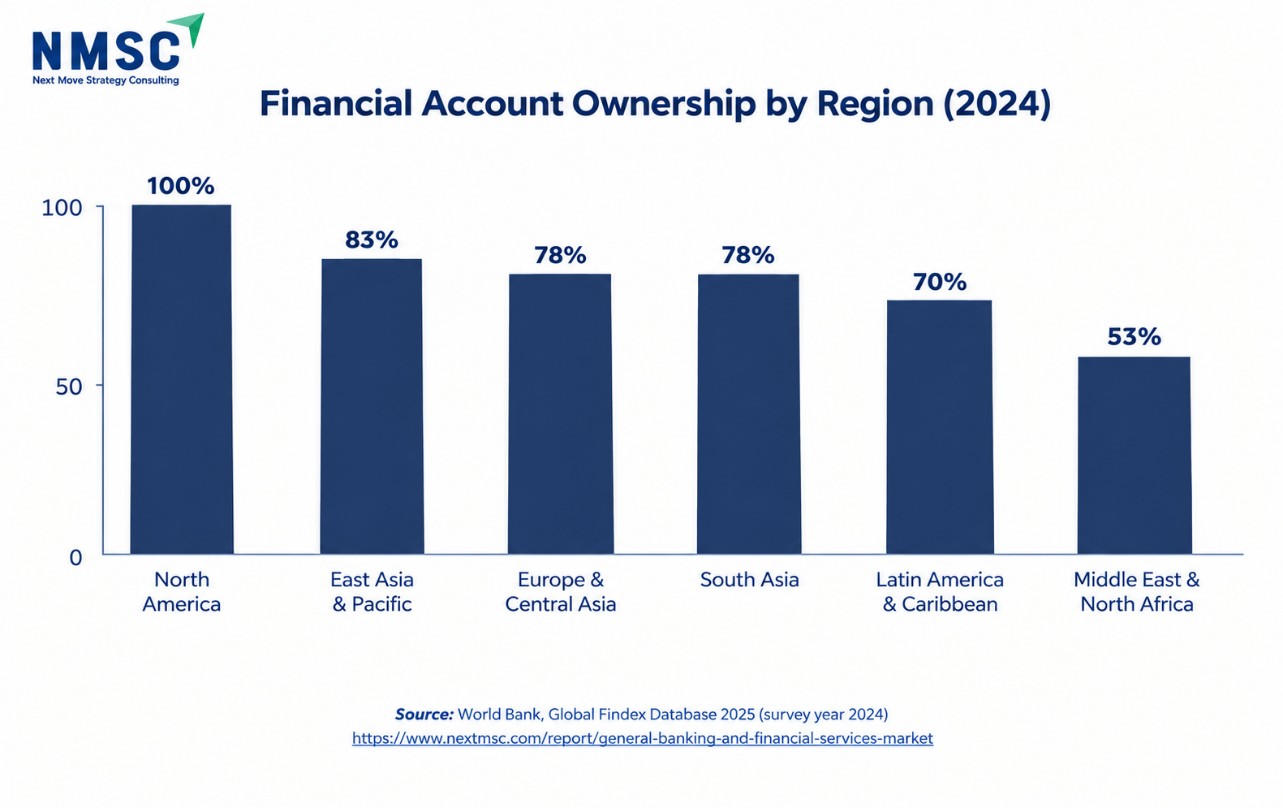
North America figure reflects near-universal ownership in high-income economies; all other regional figures exclude high-income economies within each region, per World Bank methodology. Source: World Bank, Global Findex Database 2025 (survey year 2024) worldbank.org/en/publication/globalfindex.
Asia-Pacific's leadership position is therefore a story of scale more than uniform access: East Asia and the Pacific lead developing regions at 83% account ownership, but South Asia home to some of the region's largest unbanked populations sits at 78%, still short of universal coverage. In Europe, ongoing core-system replacement work at institutions like Deutsche Bank suggests the next phase of growth there will come from modernizing existing relationships rather than adding new account holders. The Middle East and North Africa, at 53%, represents the widest remaining gap and, not coincidentally, the region where mobile-money and digital-wallet products are growing fastest as newer entrants leapfrog traditional branch banking.
Market Challenges: The Cost of Moving Fast
Faster digital adoption comes with a cost, and that cost is concentrated in cybersecurity. According to IBM's 2026 Cost of a Data Breach Report, the global average cost of a data breach climbed to a record $4.99 million, up 12% year over year and financial services breaches specifically rose 13% to $6.29 million, among the highest of any sector. The report also found that AI-driven attacks disproportionately targeted critical infrastructure sectors, including financial services and energy, accounting for 62% of such attacks. The average time to identify and contain a breach also lengthened, to 247 days.
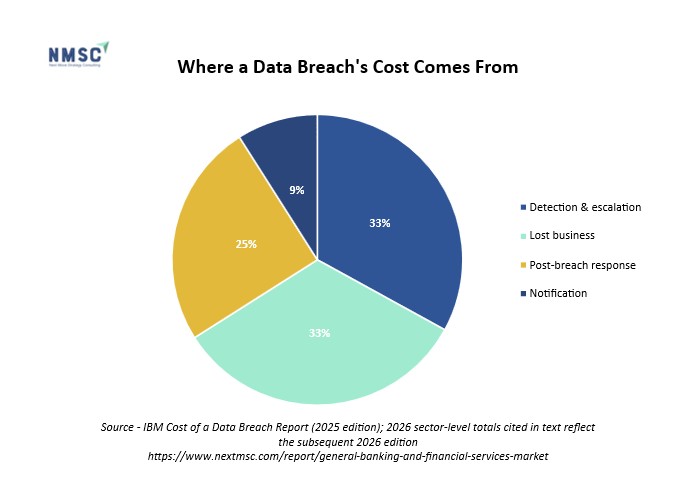
Detection, escalation, and lost business together make up the majority of what a breach actually costs a bank well before regulatory fines or ransom payments enter the picture. That's part of why fraud detection and prevention tooling has become a priority investment area across the institutions covered above, alongside the broader modernization efforts already underway at Deutsche Bank and UBS. Legacy-system complexity compounds the problem: banks running older core platforms typically take longer to detect intrusions simply because monitoring is fragmented across more systems one more reason core-banking replacement projects are being treated as a security investment, not just an efficiency one.
Market Opportunities and Future Outlook
Three areas look set to define the next phase of growth. The first is insurance distribution technology: as digitalization continues to reshape how policies are sold and serviced, the insurtech category is positioned to keep benefiting from the same insurance-sector growth driving the broader banking and financial services market. The second is embedded, life-stage-specific credit and savings products Barclays' move into youth banking through GoHenry is a clear signal that buy now, pay later and other flexible, embedded-finance formats will keep expanding into demographics that traditional banking products have historically underserved.
The third is sustainable finance. BNP Paribas' equity investment in battery-storage developer Eclipse part of a broader push to finance Europe's energy transition is one example of banks treating climate infrastructure as a core lending category rather than a side initiative, a trend reflected in the continued growth of the green finance market. On the regulatory side, central bank digital currencies remain a slower-moving but structurally important trend: the Atlantic Council's CBDC tracker counted 146 countries and currency unions representing over 98% of global GDP exploring a CBDC as of mid-2026, with 41 in active pilot phases and three (the Bahamas, Jamaica, and Nigeria) already fully launched. Whether tokenized deposits, stablecoins, or CBDCs end up as the dominant form of digital money, banks that have already begun building settlement infrastructure as HSBC, Standard Chartered, and JPMorgan have will be better positioned than those waiting for the picture to fully clarify.
Future outlook: the next 12–24 months will likely reward institutions that have already started building, rather than those still evaluating.
-
Insurtech and embedded finance are extending banking products into segments younger savers, gig workers, underserved regions that legacy products didn't reach well.
-
Sustainable and green finance are shifting from ESG reporting exercises into core lending strategy.
-
Digital-money infrastructure (tokenized deposits, stablecoins, CBDCs) is consolidating around a handful of interoperable standards rather than one winner-take-all format.
Conclusion
The general banking and financial services market isn't being disrupted by a single new entrant the way earlier fintech waves threatened to disrupt it it's being rebuilt from within by the same institutions that have always run it, just moving at a pace few would have predicted even two years ago. For businesses managing their own idle capital, and for anyone trying to make sense of where an entire industry is headed, the throughline is the same: the tools for moving money, storing it safely, and putting it to work are changing faster than the habits built around them. Institutions and individuals that update both together will be the ones best positioned for what comes next.
|
Get the full market picture Full market sizing, forecast data, and segment-level detail for the general banking and financial services market are available in NMSC's complete syndicated report. |
About the Author
 Sanyukta Deb
— Sanyukta Deb is Digital Marketing Team Lead at Next Move Strategy Consulting, where she has led content strategy and technical SEO for the firm's B2B market research publications for over 2 years. Her editorial process translates NextMSC's primary and secondary research — spanning technology, industrial, and consumer sectors — into commercial narratives, backed by search-intent, keyword, and competitive analysis. She brings 5 years of overall experience in digital marketing and content strategy.
Sanyukta Deb
— Sanyukta Deb is Digital Marketing Team Lead at Next Move Strategy Consulting, where she has led content strategy and technical SEO for the firm's B2B market research publications for over 2 years. Her editorial process translates NextMSC's primary and secondary research — spanning technology, industrial, and consumer sectors — into commercial narratives, backed by search-intent, keyword, and competitive analysis. She brings 5 years of overall experience in digital marketing and content strategy.
About the Reviewer
 Debashree Dey
— Debashree Dey is Assistant Manager at Next Move Strategy Consulting, where she supports cross-vertical market content and communications across diverse industries for 6 years. Her professional background includes senior content writing, communications, and published manuscript authorship, with experience developing audience-focused business narratives and maintaining clear, consistent messaging. Her role supports research-led content development and editorial quality across NextMSC publications.
Debashree Dey
— Debashree Dey is Assistant Manager at Next Move Strategy Consulting, where she supports cross-vertical market content and communications across diverse industries for 6 years. Her professional background includes senior content writing, communications, and published manuscript authorship, with experience developing audience-focused business narratives and maintaining clear, consistent messaging. Her role supports research-led content development and editorial quality across NextMSC publications.


















Add Comment