Why Is South Korea’s Skin Care Product Market Booming in 2024-2025?
Introduction
The global skin care products market is undergoing one of the most consequential structural transformations in its modern history — simultaneously expanding its consumer base, elevating its scientific foundations, and rewriting the rules of product discovery and distribution. According to Next Move Strategy Consulting's Skin Care Products Market report, the global skin care products market was valued at USD 148.6 billion in 2025 and is projected to reach USD 246.8 billion by 2035, advancing at a CAGR of 5.2% from 2026 to 2035. The market reached USD 156.3 billion in 2026, reflecting sustained momentum across face care, sun care, body care, and premium formulation categories.
This growth is not driven by a single catalyst. It reflects the convergence of three structurally durable forces: the World Health Assembly's formal recognition of skin diseases as a global public health priority in May 2025, which is accelerating dermatologist-endorsed product adoption across both prescription and OTC channels; the migration of beauty discovery from physical retail to social commerce platforms, where TikTok's U.S. beauty sales are on track to reach USD 4 billion in 2026 according to McKinsey & Company's State of Beauty report (June 2026); and the deployment of AI-powered molecular simulation by leading manufacturers to compress formulation development timelines from years to weeks. For C-level executives and institutional investors, the skin care products market now represents a long-duration, multi-segment growth opportunity with clearly defined premiumization pathways across every major geography.
For More Information: Download FREE Sample on Skin Care Products Market Report
When Atomic-Scale AI Meets the Formulation Lab: The Innovation Inflection Point
L'Oréal and NVIDIA Redefine the Speed of Skincare Science
On March 17, 2026, L'Oréal announced the expansion of its AI partnership with NVIDIA at the NVIDIA GTC AI Conference in San Jose, integrating NVIDIA's ALCHEMI machine learning framework directly into its Research and Innovation ecosystem. The partnership enables L'Oréal scientists to simulate ingredient performance and molecular interactions at an atomic scale, testing thousands of formulation variables simultaneously in a virtual environment — a process the company states is 100 times faster than traditional laboratory methods.
The initiative is currently focused on two of the highest-growth functional categories within the skin care products market: photoprotection and skin tone management — precisely the segments where NMSC's proprietary research identifies the most structurally significant consumer demand expansion.
"By applying AI-powered molecular simulation to our most proprietary actives, we are bridging atomic-scale discovery with real-world consumer benefit — accelerating the development of more effective, more sensorial and accessible products for consumers around the world," said Barbara Lavernos, Deputy Chief Executive Officer in charge of Research, Innovation and Technology, L'Oréal, in the company's official press release dated March 17, 2026.
This development carries direct commercial implications for the skin care products market's competitive structure. Brands capable of deploying AI-driven formulation science can bring clinically differentiated products to market faster, at lower R&D cost, and with greater ingredient precision — compressing the innovation cycle that previously gave large conglomerates a structural advantage over emerging brands. The addressable market for AI-powered skincare formulation tools is expanding beyond L'Oréal's proprietary ecosystem, with ingredient suppliers, contract manufacturers, and independent brands beginning to integrate computational chemistry into their own development pipelines.
NMSC Strategic Perspective: AI Formulation Science as a Market Restructuring Force
NMSC's proprietary research and analysis identifies the L'Oréal-NVIDIA partnership as a leading indicator of a broader structural shift in how the skin care products market's competitive hierarchy will be determined over the 2026–2035 forecast period. Historically, formulation differentiation required multi-year clinical trial programs and substantial laboratory infrastructure — barriers that concentrated innovation capacity among the largest global beauty conglomerates. AI-powered molecular simulation dissolves this barrier by enabling rapid, low-cost in-silico testing of novel active ingredient combinations before any physical synthesis occurs.
The commercial consequence is a bifurcation of the competitive landscape: brands that invest in AI formulation capabilities will accelerate their premium ingredient pipeline and reduce time-to-market for clinically validated products, while brands that rely on conventional formulation processes will face growing speed-to-market disadvantages. NMSC's analysis indicates that this dynamic will be most consequential in the anti-aging functional segment — the fastest-growing category in the skin care products market at a CAGR of 7.4% from 2026 to 2035 — where the ability to identify and validate novel peptide, retinoid, and growth factor combinations at molecular scale will directly determine which brands capture the premium pricing power that this segment commands.
Section Summary: The L'Oréal-NVIDIA ALCHEMI partnership represents a structural inflection point in skin care formulation science, with AI-driven molecular simulation enabling 100x faster ingredient discovery and directly expanding the competitive addressable market for premium, clinically validated skincare formulations.
Key Takeaways:
-
L'Oréal's NVIDIA ALCHEMI integration enables atomic-scale simulation of ingredient performance, reducing formulation development timelines by a factor of 100 compared to traditional laboratory methods.
-
The partnership's initial focus on photoprotection and skin tone management aligns with the two fastest-growing functional demand areas in the skin care products market.
-
AI formulation science is transitioning from a proprietary advantage of global conglomerates to a broadly accessible capability, restructuring the competitive barriers to premium skincare innovation.
-
NMSC's analysis identifies anti-aging (7.4% CAGR) and sun care (6.6% CAGR) as the functional segments most directly benefiting from accelerated AI-driven formulation pipelines.
Industry Impact Analysis
The WHO Resolution: Skin Disease Recognition Reshapes Clinical Skincare Demand
On May 24, 2025, the World Health Assembly adopted resolution WHA78.15, formally recognizing skin diseases as a global public health priority — a landmark decision that is reshaping how governments, healthcare systems, and consumer brands position dermatological skincare products. Skin diseases affect an estimated 4.69 billion people globally, making them one of the top ten causes of disability worldwide.
The resolution's practical impact on the skin care products market operates through two distinct channels. First, it elevates the institutional credibility of dermatologist-recommended skincare products, reinforcing consumer trust in clinically validated formulations and accelerating the migration of consumers from cosmetic-only products toward functional, barrier-repair, and therapeutic-adjacent skincare. Second, it creates a policy mandate for national health systems to invest in skin disease prevention and treatment infrastructure — a development that directly expands the professional and clinical distribution channel, which NMSC's proprietary research identifies as growing at a CAGR of 6.9% from 2026 to 2035, the second-fastest offline channel in the market.
MoCRA's 2026 Compliance Milestone: Regulatory Pressure as a Competitive Filter
The U.S. Modernization of Cosmetics Regulation Act of 2022 (MoCRA) entered a critical enforcement phase in 2026, with the FDA advancing Good Manufacturing Practice (GMP) regulations for cosmetic facilities, mandatory product listing requirements, and safety substantiation documentation standards. According to legal analysis published by Foley & Lardner LLP in March 2026, as of January 2026 the FDA had not yet issued final GMP regulations, but draft guidance was anticipated — creating a compliance preparation imperative for all cosmetic manufacturers operating in the U.S. market.
For the skin care products market, MoCRA functions as a competitive filter: brands with established safety substantiation programs, robust adverse event reporting systems, and compliant facility registration are positioned to accelerate market share gains as smaller, non-compliant competitors face enforcement risk. This dynamic is particularly consequential in the masstige and premium segments, where clinical credibility is a primary consumer purchase driver.
Estée Lauder's Forest Essentials Acquisition: India's Premiumization Moment
On March 5, 2026, The Estée Lauder Companies announced an agreement to acquire the remaining interests in Forest Essentials, the Indian luxury Ayurvedic skincare brand, completing an 18-year partnership that began with a minority investment in 2008 and increased to 49% in 2020. The transaction, subject to regulatory approvals, is expected to close in the second half of 2026. Forest Essentials is the top-ranked brand in prestige skin care in India and is forecast to grow net sales at a low double-digit rate.
"This next phase of partnership reflects our long-term commitment to India — one of our largest and most significant emerging markets — and our conviction in the global resonance of this remarkable brand," said Stéphane de La Faverie, President and Chief Executive Officer, The Estée Lauder Companies, in the company's official press release dated March 5, 2026.
This acquisition is a direct commercial expression of the structural opportunity NMSC's proprietary research identifies in India: the fastest-growing national skin care market in Asia-Pacific at a CAGR of 9.2% from 2026 to 2035, driven by a 1.4 billion-person consumer base with rapidly rising aspirational spending power and expanding e-commerce infrastructure through platforms including Nykaa, Amazon India, and Flipkart.
Social Commerce Rewriting the Distribution Equation
McKinsey & Company's State of Beauty report, published June 18, 2026, identifies social commerce as the fastest-growing beauty distribution channel globally, with U.S. beauty sales on TikTok on track to reach USD 4 billion in 2026 — representing approximately 260% annual growth since 2023. Skin care has led TikTok's beauty category growth, expanding nearly 300% over the same period. This channel shift directly validates NMSC's proprietary forecast that online brand-direct sites will be the fastest-growing distribution channel in the skin care products market at a CAGR of 9.4% from 2026 to 2035.
Section Summary: Four concurrent developments — the WHO's WHA78.15 resolution, MoCRA's 2026 compliance enforcement, Estée Lauder's Forest Essentials acquisition, and social commerce's structural displacement of traditional beauty retail — are collectively reshaping the skin care products market's demand architecture, competitive hierarchy, and distribution economics.
Key Takeaways:
-
The WHO's formal recognition of skin diseases as a global public health priority (WHA78.15, May 2025) is accelerating institutional demand for clinically validated skincare, directly expanding the professional and clinical distribution channel (6.9% CAGR).
-
MoCRA's 2026 enforcement phase is functioning as a competitive filter, advantaging brands with established safety substantiation programs over non-compliant smaller competitors.
-
Estée Lauder's full acquisition of Forest Essentials positions India — the fastest-growing national skin care market at 9.2% CAGR — as the company's largest emerging market.
-
TikTok's U.S. beauty sales trajectory (USD 4 billion in 2026, per McKinsey) confirms social commerce as the primary channel disruption force in the skin care products market's distribution landscape.
Pros and Cons of Recent Market Developments
|
Development |
Pros |
Cons |
|
L'Oréal-NVIDIA ALCHEMI AI Partnership |
Compresses formulation development timelines by 100x; enables rapid identification of novel active ingredient combinations for photoprotection and anti-aging |
Concentrates early-mover AI formulation advantage among large conglomerates; smaller brands face growing speed-to-market disadvantage without equivalent AI infrastructure |
|
WHO WHA78.15 Skin Disease Resolution (May 2025) |
Elevates institutional credibility of dermatologist-endorsed skincare; expands clinical distribution channel; accelerates government investment in skin health infrastructure |
Increases regulatory scrutiny of cosmetic efficacy claims; brands with unsubstantiated clinical positioning face growing consumer and regulatory challenge |
|
FDA MoCRA 2026 Compliance Enforcement |
Raises ingredient safety and transparency standards; builds long-term consumer trust in U.S. market; creates competitive moat for compliant brands |
Increases compliance cost burden for smaller brands; GMP facility registration and safety substantiation requirements may constrain new market entrants |
|
Estée Lauder Full Acquisition of Forest Essentials |
Validates India's 9.2% CAGR growth trajectory; brings Ayurvedic luxury skincare to global distribution; strengthens ELC's emerging market portfolio |
Integration risk in preserving Forest Essentials' artisanal brand DNA within a global corporate structure; regulatory approval timeline uncertainty |
|
Social Commerce Acceleration (TikTok, Douyin) |
Democratizes brand discovery; enables emerging brands to achieve rapid scale without traditional retail infrastructure; compresses consumer trial-to-purchase cycle |
Platform economics remain volatile; high affiliate commission and promotional costs compress margins; algorithm dependency creates brand visibility risk |
|
EU Cosmetics Regulation Ingredient Restrictions |
Drives clean formulation innovation; builds consumer trust in European market; creates premium pricing opportunity for compliant brands |
Restricts ingredient innovation available in less regulated markets; increases reformulation cost for global brands; creates product fragmentation across jurisdictions |
Future Outlook & Forecast
Longevity Beauty, Biotech Ingredients, and the Decade Ahead
The skin care products market's trajectory through 2035 is defined by three converging megatrends that NMSC's proprietary research identifies as structurally durable rather than cyclical. The first is the longevity beauty movement — a fundamental reorientation of anti-aging skincare from cosmetic concealment toward biological optimization. As Forbes reported in April 2026, longevity beauty is reshaping the skincare category in 2026, with brands investing in evidence-based, biology-optimizing formulations supported by customizable at-home diagnostic tools. This shift moves the anti-aging segment — already the fastest-growing functional category at 7.4% CAGR per NMSC's analysis — from a reactive treatment paradigm to a preventive science paradigm, expanding the addressable consumer base to include millennials and Gen Z consumers adopting retinoids, peptides, and growth factor formulations in their mid-20s.
The second megatrend is biotechnology-derived ingredient manufacturing. Lab-grown retinol, bio-fermented hyaluronic acid, and biosynthetic peptides are reducing the supply chain concentration risk associated with plant-derived actives while enabling more consistent ingredient potency and purity. This development directly supports the luxury price tier's 7.6% CAGR trajectory, as biotech-derived actives command premium pricing and create formulation differentiation that mass-market competitors cannot replicate at equivalent cost structures.
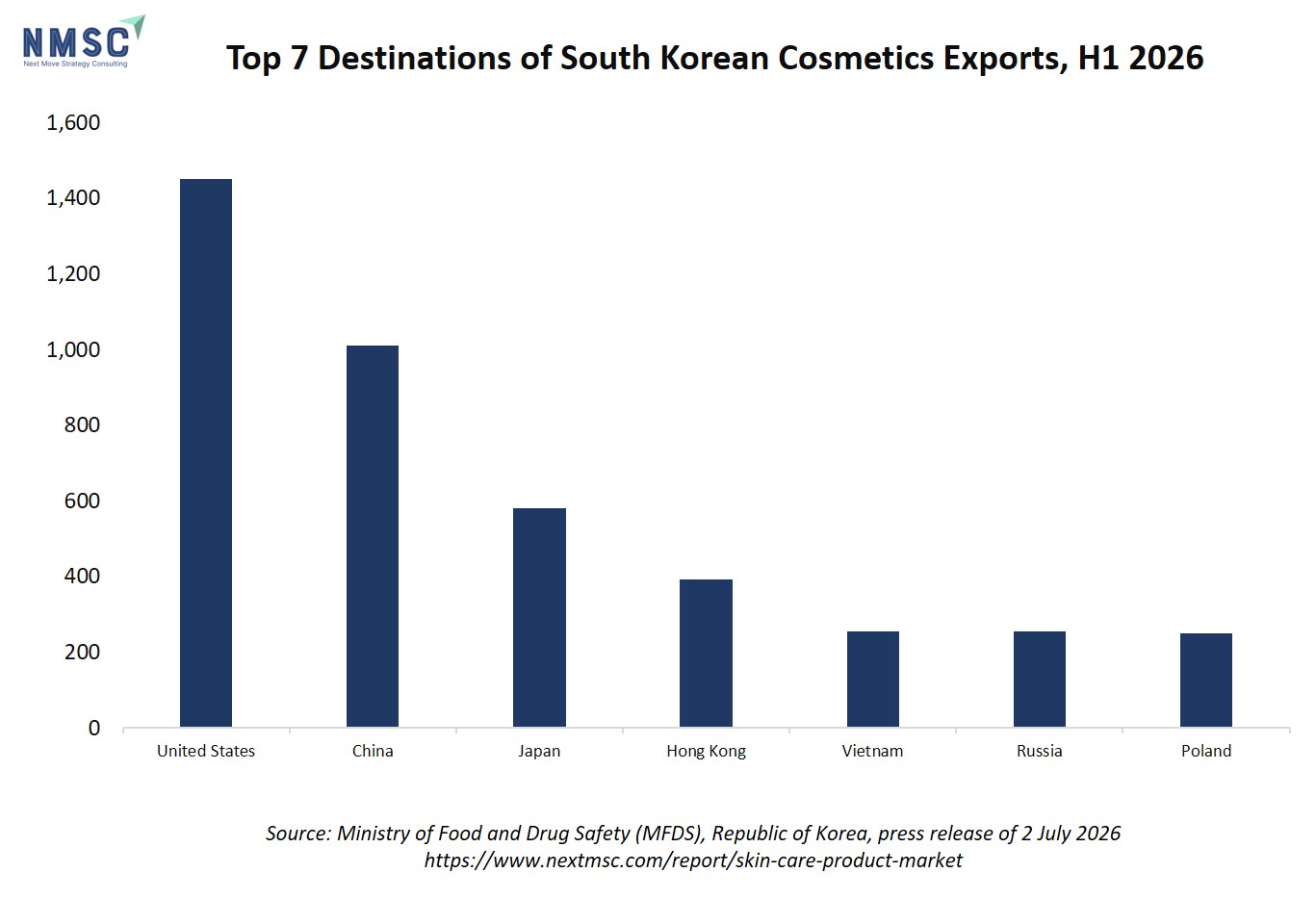
The third megatrend is the structural expansion of the men's skincare segment. NMSC's proprietary research identifies men's skincare advancing at a CAGR of 6.3% from 2026 to 2035 globally — the fastest-growing consumer gender segment in the market. South Korea, Japan, and China lead global male skincare adoption rates, while North America and Europe are witnessing accelerating growth in men's facial moisturizer, cleanser, and serum consumption driven by shifting gender norms and rising awareness of skin cancer prevention.
McKinsey & Company's State of Beauty report (June 2026) projects the global beauty market will reach USD 590 billion by 2030, growing at 5% annually — a trajectory consistent with NMSC's proprietary skin care products market forecast. McKinsey further identifies e-commerce as accounting for the greatest share of beauty market sales by channel globally at 28%, with social commerce growing faster than any other channel. This channel evolution directly supports NMSC's forecast that online brand-direct sites will register a 9.4% CAGR — the highest of any distribution channel in the skin care products market — as brands invest in proprietary DTC platforms that enable AI-personalized recommendations, subscription models, and first-party consumer data capture.
Section Summary: The skin care products market's 2026–2035 growth trajectory is anchored by three structurally durable megatrends — longevity beauty science, biotechnology-derived ingredient manufacturing, and men's skincare expansion — supported by social commerce's structural displacement of traditional retail and the continued premiumization of emerging markets in MEA and Latin America.
Key Takeaways:
-
Anti-aging (7.4% CAGR) and luxury price tier (7.6% CAGR) represent the highest-conviction growth themes within the skin care products market through 2035, per NMSC proprietary research and analysis.
-
Online brand-direct sites (9.4% CAGR) will be the fastest-growing distribution channel, driven by DTC subscription models, AI personalization, and first-party consumer data advantages.
-
MEA and Latin America (both 7.2% CAGR) represent the highest-growth regional opportunities, with India (9.2% CAGR) the fastest-growing national market globally.
-
McKinsey's June 2026 analysis confirms social commerce as the fastest-growing beauty channel, with TikTok U.S. beauty sales on track for USD 4 billion in 2026 — validating NMSC's digital channel growth projections.
Next Steps for Stakeholders
For Brand Owners and Consumer Products Companies:
Prioritize clinical substantiation as a non-negotiable brand positioning investment. The WHO's WHA78.15 resolution and MoCRA's 2026 enforcement phase are jointly elevating the institutional credibility threshold that consumers and regulators apply to skincare efficacy claims. Brands without dermatologist partnerships, clinical trial data, or ingredient transparency programs face growing consumer trust deficits that cannot be resolved through marketing spend alone. Sun care represents the highest-return adjacent category expansion opportunity for brands currently concentrated in facial skincare, given its 6.6% CAGR trajectory and regulatory tailwinds across Europe, North America, and MEA. Invest in AI-powered formulation capabilities — either through proprietary development or ingredient supplier partnerships — to compress the innovation cycle for premium active ingredient products.
For Investors and Financial Analysts:
The highest-conviction investment themes within the skin care products market through 2035, per NMSC's proprietary research and analysis, are: anti-aging functional products (7.4% CAGR), luxury price tier (7.6% CAGR), men's skincare (6.3% CAGR), online brand-direct distribution (9.4% CAGR), and MEA and Latin America regional expansion (7.2% CAGR each). M&A targets with the strongest risk-adjusted return profiles are clean beauty platforms with verifiable ESG credentials, clinical skincare brands with DTC subscription economics, and AI-personalization technology companies with demonstrable consumer data moats. The Estée Lauder-Forest Essentials transaction structure — an 18-year minority investment culminating in full acquisition — provides a replicable template for patient capital deployment in high-growth emerging market prestige skincare assets.
For Retailers and Distributors:
The McKinsey State of Beauty (June 2026) finding that Amazon and TikTok's combined U.S. beauty sales could surpass the combined sales of Sephora and Ulta Beauty in 2026 is a direct signal that specialty beauty retail's discovery-channel advantage is eroding. Retailers must invest in curated assortments, expert-guided in-store discovery, and exclusive product architectures that social commerce platforms cannot replicate. Private label development in the masstige segment — where CeraVe, Neutrogena, and Olay demonstrate that clinical positioning at accessible price points commands strong consumer loyalty — represents the most defensible margin opportunity for mass retail operators.
For Regulatory and Policy Stakeholders:
The WHO's WHA78.15 resolution creates a policy mandate for national health systems to develop skin disease prevention frameworks that intersect with consumer skincare product standards. Regulatory bodies should prioritize harmonization of ingredient safety standards across jurisdictions — the current divergence between EU Cosmetics Regulation, FDA MoCRA, China NMPA, and equivalent national frameworks creates formulation fragmentation costs that constrain global brand innovation investment and impede the development of universally accessible, clinically validated skincare products.
Conclusion
The global skin care products market is entering its most consequential decade of structural transformation. NMSC's proprietary research and analysis projects the market will advance from USD 156.3 billion in 2026 to USD 246.8 billion by 2035 at a CAGR of 5.2% — a trajectory underpinned by the convergence of AI-driven formulation science, the WHO's formal elevation of skin health as a global public health priority, MoCRA's regulatory maturation of the U.S. market, and social commerce's structural displacement of traditional beauty retail.
The competitive landscape is being redrawn by brands that invest in clinical substantiation, AI personalization, and direct-to-consumer digital infrastructure — not by those that rely on distribution scale or legacy brand awareness alone. For investors, the anti-aging functional segment (7.4% CAGR), luxury price tier (7.6% CAGR), and online brand-direct channel (9.4% CAGR) represent the highest-conviction growth themes. For brand owners, the imperative is clear: science-backed positioning, sustainable formulation credentials, and digital commerce capability are no longer differentiators — they are the baseline requirements for sustained competitive relevance in the skin care products market through 2035.
About the Author
 Sanyukta Deb
— Sanyukta Deb is Digital Marketing Team Lead at Next Move Strategy Consulting, where she has led content strategy and technical SEO for the firm's B2B market research publications for over 2 years. Her editorial process translates NextMSC's primary and secondary research — spanning technology, industrial, and consumer sectors — into commercial narratives, backed by search-intent, keyword, and competitive analysis. She brings 5 years of overall experience in digital marketing and content strategy.
About the Reviewer
 Debashree Dey
— Debashree Dey is Assistant Manager at Next Move Strategy Consulting, where she supports cross-vertical market content and communications across diverse industries for 6 years. Her professional background includes senior content writing, communications, and published manuscript authorship, with experience developing audience-focused business narratives and maintaining clear, consistent messaging. Her role supports research-led content development and editorial quality across NextMSC publications.
















Add Comment