Arkema’s €150 Million Carling Unit Raises the Carbon Bar in Acrylic Supply
Arkema’s Carling Inauguration, Nippon Shokubai’s Excess-Capacity Warning and Brussels’ Critical Chemicals Push Redraw the Economics of Acrylic Supply
On 8 October 2026, Arkema inaugurated a next-generation acrylic acid purification unit at its Carling site in France, a project of nearly €150 million that the company says improves the energy efficiency of the purification step by 25% and reduces the site’s carbon intensity by 20%. According to the Arkema Carling press release of 8 October 2026, the ceremony was attended by Thierry Le Hénaff, Chairman and Chief Executive Officer of Arkema, and Stéphane Séjourné, Executive Vice-President of the European Commission for Prosperity and Industrial Strategy, and was held on the same day as the General Assembly of the Critical Chemicals Alliance, a European Commission initiative that supports a chemical industry the Commission treats as strategic. A single acrylics plant therefore sits at the point where three pressures now meet: the cost of energy, the carbon content of monomers, and how much base chemistry Europe keeps.
According to Next Move Strategy Consulting’s Acrylic Resins Market report, the global acrylic resins market was valued at USD 16.85 billion in 2025 and is projected to reach USD 26.40 billion by 2035, growing at a CAGR of 4.6% from 2026 to 2035. NextMSC primary research and analysis places the 2026 value at USD 17.62 billion and attributes the largest regional share, approximately 48% of 2025 revenue, to Asia-Pacific. The Carling inauguration bears on that outlook because acrylic acid and its esters are the monomer base for acrylic emulsions, solvent-borne resins and UV-curable systems, so a change in the cost and carbon profile of monomer supply reaches the resin producers and the coatings, adhesives and construction chemical customers they serve.
For More Information: Download FREE Sample on Acrylic Resins Market Report
The Financial Logic: A Feedstock Shock Meets Weak Construction Demand
The cost backdrop explains why producers are spending on efficiency rather than volume. In its FY2025 results presentation of 14 May 2026, covering the fiscal year ended 31 March 2026, Nippon Shokubai reported naphtha prices of JPY 65,700 per kilolitre in January to March 2026 and a forecast of JPY 120,000 to 140,000 per kilolitre for April to June 2026, amid heightened tensions in the Middle East. The company said price pass-through to customers was under way and declined to set a consolidated forecast for the fiscal year ending 31 March 2027, stating that the impact of the Middle East situation was extremely difficult to estimate. Group revenue fell 2.3% to JPY 399.9 billion and operating profit fell 8.0% to JPY 17.5 billion, while revenue in the acrylic acid and superabsorbent polymer domain declined 1.7% to JPY 218.4 billion. Nippon Shokubai also described declining domestic construction demand in Japan and said excess production capacity in China keeps the recovery of the acrylic acid and acrylate supply-demand balance difficult in the near term.
The same cost shock appears in the Arkema Second-Quarter 2026 Results release of 30 July 2026. Arkema reported a 5.1% price effect at group level, reflecting pricing adjustments to offset raw material inflation and tighter market conditions in upstream acrylics, while volumes fell 1.8%. In Primary Materials, the segment in which the company reports its acrylic monomer activity, sales rose 5.6% to €389.3 million on a 16.0% price effect tied to higher acrylic monomer prices after the start of the Middle East conflict, while volumes fell 9.7% on weak acrylic monomer demand, notably in Europe. Segment EBITDA reached €57.7 million against €44.3 million a year earlier, although Arkema noted that acrylic spreads had returned to low levels in Asia since May.
Coating Solutions, the Arkema segment that sells waterborne resins for decorative paints and UV-curing resins, recovered more sharply. Sales rose 4.9% to €422.4 million, EBITDA climbed to €78.2 million from €51.1 million, and the EBITDA margin widened to 18.5% from 12.7%. Excluding a mechanical effect from the move of certain activities to manufacturing agreements, prices rose 8.2% as the segment passed through input cost inflation, notably in acrylics, and Arkema cited a positive dynamic in waterborne resins for decorative paints in North America.
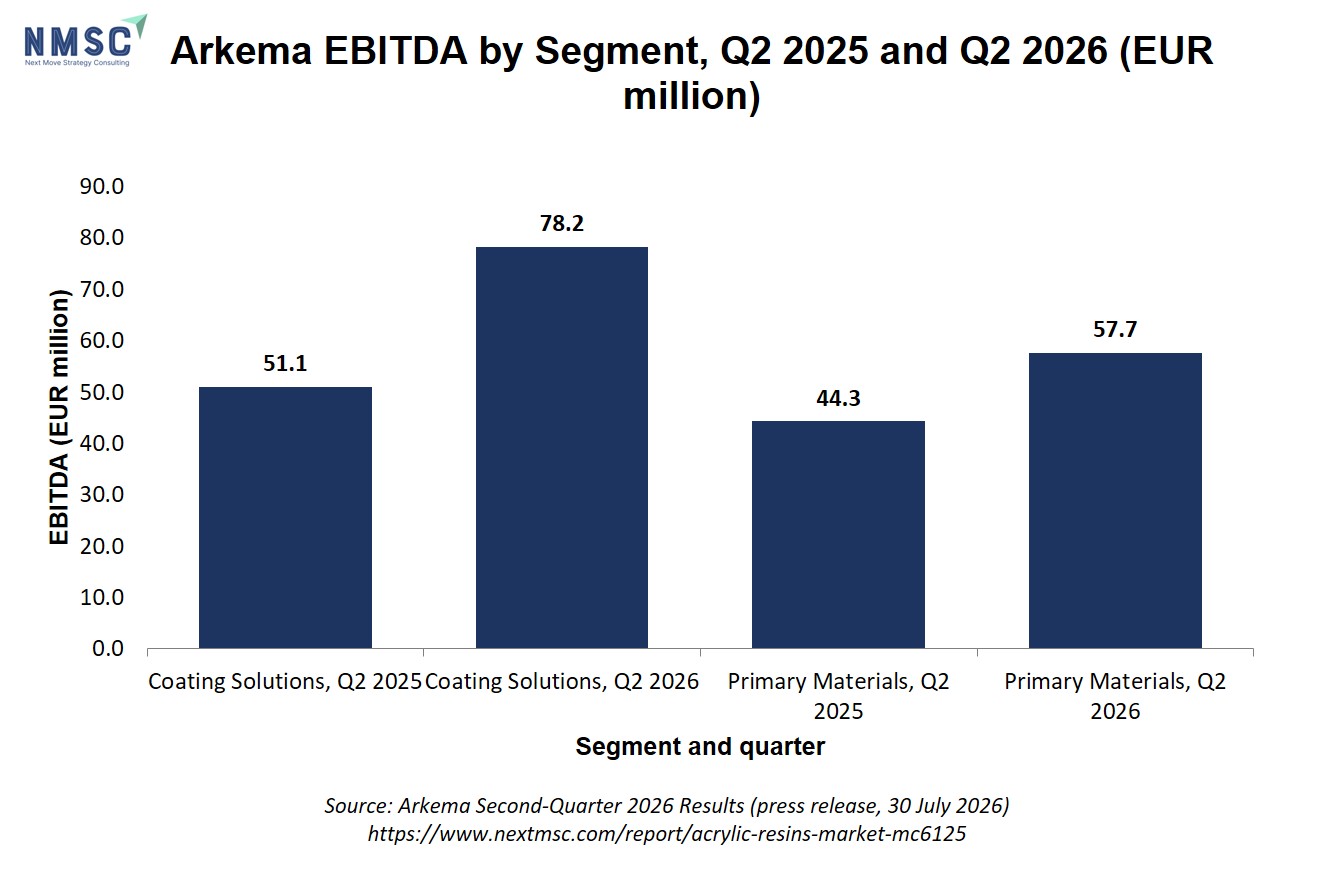
In the Arkema Second-Quarter 2026 Results release, Arkema reported Coating Solutions EBITDA of €78.2 million for the second quarter of 2026 against €51.1 million a year earlier, and Primary Materials EBITDA of €57.7 million against €44.3 million.
Nippon Shokubai’s presentation also frames the supply side. The company put global acrylic acid demand at about 7.8 million tons for 2026, with medium-term growth of about 3% a year, and reported planned worldwide expansion and shutdown of annual production capacity of about 1,000,000 tons in 2025, about 600,000 tons in 2026 and about 250,000 tons from 2027 onward.
Global Acrylic Acid Supply and Demand Reported by Nippon Shokubai
|
Indicator |
Value reported by Nippon Shokubai |
|
Global acrylic acid demand, 2026 |
About 7.8 million tons |
|
Medium-term annual demand growth |
3% (growth of about 5% assumed in emerging countries) |
|
Planned expansion and shutdown of annual capacity worldwide, 2025 |
About 1,000,000 tons |
|
Planned expansion and shutdown of annual capacity worldwide, 2026 |
About 600,000 tons |
|
Planned expansion and shutdown of annual capacity worldwide, 2027 onward |
About 250,000 tons |
Key Industry Developments: Three Producer Moves Reshaping Acrylic Supply
The Carling unit was decided in 2023 and was partly funded by the French State under the France 2030 programme, operated by ADEME, and by the European Union through NextGenerationEU, according to the Arkema Carling press release. The release adds that the process reduces solvent consumption significantly and that the project belongs to a decarbonization investment programme that could reach €400 million cumulatively over 2022 to 2030. Carling supplies acrylic monomers used in performance coatings, adhesives and water treatment, and AFP reported that the plant produces several hundred thousand tonnes of acrylic products a year.
“Europe must keep its chemical industry.”
- Stéphane Séjourné, Executive Vice-President for Prosperity and Industrial Strategy, European Commission, Arkema Carling press release, 8 October 2026.
In North America, BASF Corporation launched Butyl acrylate RE and 2-Ethylhexyl acrylate RE on 31 March 2026. The two acrylic esters are made at the Freeport, Texas site, where renewable electricity from wind and solar sources in Texas is attributed to the products to replace 100% of their consumption at the site under BASF’s product carbon footprint methodology. The BASF Corporation release describes the grades as equivalent to conventional esters in quality and performance, aimed first at coatings and adhesives, and states that Avery Dennison pioneered their commercialization in the adhesives and sealants value chain.
In Asia, Nippon Shokubai said it will build its acrylic acid and acrylate production and shipment structure around Japan and Indonesia, and that it is adding 50,000 tons a year of superabsorbent polymer capacity in Indonesia, with commercial operation scheduled for July 2027. In the same presentation it reported that special ester volumes declined on weak demand and aggressive low pricing of Chinese products.
Three Acrylic Value-Chain Moves Disclosed by Producers
|
Company and site |
Date |
Development |
Disclosed scale |
|
Arkema, Carling, France |
8 October 2026 |
Next-generation acrylic acid purification unit inaugurated |
Investment of nearly €150 million; purification energy efficiency up 25%; site carbon intensity down 20% |
|
BASF Corporation, Freeport, Texas |
31 March 2026 |
Butyl acrylate RE and 2-Ethylhexyl acrylate RE launched with attributed renewable electricity |
Two acrylic ester grades; renewable electricity attributed to replace 100% of their consumption at the site |
|
Nippon Shokubai, Indonesia |
14 May 2026 |
Superabsorbent polymer expansion and a production and shipment structure centred on Japan and Indonesia |
50,000 tons per year; commercial operation scheduled for July 2027 |
Regional Outlook: Europe Seeks a Cost and Carbon Position While Asia Adds Capacity
AFP reported on 8 October 2026 that the Critical Chemicals Alliance brings together at least 12 member states and 20 regions with industry and other stakeholders. Its working list of particularly critical molecules holds about fifty entries, which the Commission wants to reduce to about ten by the end of the year, and the alliance is also meant to contribute to targeted actions to modernise steam crackers and ammonia units by the end of 2026. The Commission presented its chemicals industry action plan on 8 July 2025, aimed at high energy costs, international competition and the risk of capacity closures. AFP added that Sylvie Lemoine, Deputy Director General of Cefic, said implementation is what counts now, that EuroCommerce warned against passing support costs on to downstream buyers, and that the European Environmental Bureau left the alliance in early October over hazardous substances in the initial list. According to AFP, the sector described the meeting as setting a methodology for identifying critical molecules and sites rather than a final list.
Cefic’s Iris monthly report for April 2026, published on 2 July 2026 from Eurostat data, shows why cost is the central issue. EU27 chemical output stood at 81.2 on an index of 2021=100, down 1.6% year on year and 16% below the 2014 to 2019 benchmark, while producer prices rose 6.7% to 127.1. Cefic reads the price rise as cost pass-through rather than demand, because volumes were still falling, and reported that EU industrial gas prices ran at about 3.4 times delivered US levels in the second half of 2025.
EU27 Chemical Industry Indicators Reported by Cefic
|
Indicator |
Latest reading |
Comparison |
|
Chemical output index (2021=100), April 2026 |
81.2 |
Down 1.6% year on year; 16% below the 2014 to 2019 benchmark |
|
Chemical producer price index (2021=100), April 2026 |
127.1 |
Up 6.7% from 119.1 in April 2025 |
|
Extra-EU27 chemical trade balance, April 2026 |
EUR 1.28 billion |
Down EUR 0.49 billion year on year |
|
Industrial gas price, EU, second half of 2025 |
EUR 48.3 per MWh |
EUR 14.0 per MWh in the United States, a ratio of about 3.4 times |
NextMSC primary research and analysis sizes the European acrylic resins market at USD 3.37 billion in 2025 with a CAGR of 4.0% through 2035, and identifies REACH-driven compliance as the factor steering European formulators toward bio-based and low-VOC chemistries. Asia-Pacific stood at USD 8.09 billion in 2025 and is forecast to grow at 5.8%, with China at roughly USD 3.72 billion and India the fastest-growing covered country at 6.8%. North America stood at USD 3.71 billion in 2025 with a CAGR of 4.4%.
Segment Dynamics: Waterborne, UV-Curable and Electronics Applications Lead
NextMSC primary research and analysis shows acrylic emulsions holding the largest product share, approximately 42% or USD 7.08 billion in 2025, while UV-curable acrylic resins are the fastest-growing product type at a 7.4% CAGR from 2026 to 2035. By application, paints and coatings accounted for approximately 38% (USD 6.40 billion) in 2025 and construction chemicals are the fastest-growing application at 5.9%, while electronics is the fastest-growing end-use industry at 6.8%.
Producer disclosures point the same way. In the Arkema Second-Quarter 2026 Results release, Arkema reported significant growth at Sartomer, its photocure resins business, in all three regions, notably in electronics, 3D printing and industrial coatings, better market conditions for UV curing resins in the United States, and a sales increase of about 15% across batteries, electronics and 3D printing. Nippon Shokubai reported that revenue in its Electronics domain rose 19.0% to JPY 24.9 billion on display-related materials sold to China, and cited continued growth in its ACRYVIEWA acrylic resins for optical films as LCD panels grow larger and higher in definition.
Growth Drivers and Restraints: Evidence from Producer Disclosures
The disclosures reviewed for this article separate into three supports and three constraints for acrylic supply and demand.
-
Price pass-through: Arkema’s Coating Solutions prices rose 8.2% excluding a mechanical effect as input cost inflation, notably in acrylics, was passed on (Arkema Second-Quarter 2026 Results, 30 July 2026).
-
Low-carbon differentiation: BASF Corporation commercialised renewable-electricity acrylic esters with Avery Dennison, and Arkema’s Carling unit cuts site carbon intensity by 20% (BASF Corporation, 31 March 2026; Arkema Carling press release, 8 October 2026).
-
Electronics and photocure demand: Nippon Shokubai’s Electronics revenue rose 19.0% and Arkema’s batteries, electronics and 3D printing markets grew about 15% (Nippon Shokubai, 14 May 2026; Arkema Second-Quarter 2026 Results, 30 July 2026).
-
Volume weakness: Arkema’s Primary Materials volumes fell 9.7%, with weak acrylic monomer demand notably in Europe (Arkema Second-Quarter 2026 Results, 30 July 2026).
-
Chinese overcapacity: Nippon Shokubai said excess production capacity in China keeps the near-term supply-demand recovery difficult, and Arkema said acrylic spreads in Asia were back at low levels from May (Nippon Shokubai, 14 May 2026; Arkema Second-Quarter 2026 Results, 30 July 2026).
-
European energy cost gap: Cefic reported EU industrial gas prices at about 3.4 times US levels in the second half of 2025 (Cefic, 2 July 2026).
NMSC Strategic Perspective: Carbon and Cost Position Now Decide Who Holds Acrylic Volume
NextMSC primary research and analysis reads the Carling inauguration as evidence that European producers are competing on cost to serve and carbon intensity rather than on nameplate volume. The mechanism is visible in the disclosed figures: a 25% gain in purification energy efficiency cuts the energy needed for the purification step in a region where, according to Cefic, industrial gas cost about 3.4 times the US level, and a 20% reduction in site carbon intensity supports supply to coatings and adhesive formulators working under the REACH-driven compliance requirements that NextMSC research identifies as the factor steering European demand toward bio-based and low-VOC chemistries.
NextMSC primary research and analysis also finds that Chinese producers are adding integrated acrylic acid and ester capacity faster than global demand growth, a shift that favours downstream formulators able to secure stable, cost-competitive monomer supply. Nippon Shokubai’s statement that excess capacity in China keeps the near-term balance difficult, and Arkema’s report that acrylic spreads in Asia returned to low levels from May, are consistent with that finding. The implication for resin makers is a split market: commodity emulsion volume stays exposed to Asian cost pressure, while UV-curable acrylic resins (7.4% CAGR) and electronics applications (6.8% CAGR), as projected by NextMSC research through 2035, carry the margin that justifies low-carbon monomer sourcing.
Against the USD 17.62 billion 2026 base, NextMSC research projects an absolute dollar opportunity of USD 8.78 billion between 2026 and 2035. The evidence in this article indicates that the share of that increment captured by European monomer producers depends on whether Carling-type efficiency gains are repeated at other sites and recognised by customers in pricing, and on how the Critical Chemicals Alliance process, still at the methodology stage according to AFP, translates into support.
Competitive Landscape: Three Producers, Three Strategic Responses
Arkema’s sales mix shows how much of the group sits in acrylic-linked segments. In the Arkema Second-Quarter 2026 Results release, Adhesive Solutions represented 30.5% of group sales, Advanced Materials 36%, Coating Solutions 17.5% and Primary Materials 16%, so the two segments in which Arkema reports acrylic resin and acrylic monomer activity together account for 33.5% of sales.

The Arkema Second-Quarter 2026 Results release publishes segment shares of total group sales of 30.5% for Adhesive Solutions, 36% for Advanced Materials, 17.5% for Coating Solutions and 16% for Primary Materials.
The three producers examined here are responding differently. Arkema is investing in a lower-energy, lower-carbon European acrylic acid plant, BASF Corporation is certifying lower-carbon acrylic ester grades at its Texas site with a named adhesives customer, and Nippon Shokubai is concentrating production and shipment on Japan and Indonesia while growing electronics and superabsorbent polymer volumes. NextMSC primary research and analysis profiles 20 companies in its acrylic resins report, among them BASF SE, Dow Inc., Arkema S.A., Mitsubishi Chemical Group Corporation and Wanhua Chemical Group Co., Ltd., and describes the market as moderately consolidated, with competition centred on feedstock integration, formulation breadth and regional distribution scale.
Bottom Line
Arkema’s 8 October 2026 inauguration of its €150 million Carling unit shows European acrylic producers answering energy and carbon pressure with efficiency capital rather than added volume. Disclosures from Arkema, BASF Corporation and Nippon Shokubai describe monomer prices lifted by Middle East feedstock costs, weaker volumes, Chinese capacity holding Asian spreads low, and growth concentrated in coatings, electronics and UV-curable applications. Cefic’s April 2026 data, with EU27 chemical output 16% below its benchmark and gas at about 3.4 times US levels, explains why Brussels is defining critical molecules. NextMSC primary research and analysis values the global acrylic resins market at USD 16.85 billion in 2025 and projects USD 26.40 billion by 2035 at a 4.6% CAGR. Buyers and investors should track acrylic spreads in Asia, follow-on low-carbon investments at other producer sites, and the Commission’s narrowing of its critical molecules list by the end of 2026.
About Next Move Strategy Consulting
Next Move Strategy Consulting is a premier market research and management consulting firm that has been committed to provide strategically analysed well documented latest research reports to its clients. The research industry is flooded with many firms to choose from, what makes NMSC different from the rest is its top-quality research and the obsession of turning data into knowledge by dissecting every bit of it and providing fact-based research recommendation that is supported by information collected from over 500 million websites, paid databases, industry journals and one on one consultations with industry experts across a diverse range of industry sectors. The high-quality customized research reports with actionable insights and excellent end-to-end customer service help our clients to take critical business decisions that enables them to move beyond time and have competitive edge in the industry.
We have been servicing over 1000 customers globally that includes 90% of the Fortune 500 companies over a decade. Our analysts are constantly tracking various high growth markets and identifying hidden opportunities in each sector or the industry. We provide one of the industry’s best quality syndicate as well as custom research reports across 10 different industry verticals. We are committed to deliver high quality research solutions in accordance to your business needs. Our industry standard delivery solutions that ranges from the pre consultation to after-sales services, provide an excellent client experience and ensure right strategic decision making for businesses.
For more information, please contact:
Next Move Strategy Consulting
5th Floor 867 Boylston St, STE 500,
Boston, MA 02116, U.S.
E-Mail: [email protected]
Direct: +1-217-650-7991
Website: www.nextmsc.com
About the Author
 Sanyukta Deb
— Sanyukta Deb is Digital Marketing Team Lead at Next Move Strategy Consulting, where she has led content strategy and technical SEO for the firm's B2B market research publications for over 2 years. Her editorial process translates NextMSC's primary and secondary research — spanning technology, industrial, and consumer sectors — into commercial narratives, backed by search-intent, keyword, and competitive analysis. She brings 5 years of overall experience in digital marketing and content strategy.
About the Reviewer
 Debashree Dey
— Debashree Dey is Assistant Manager at Next Move Strategy Consulting, where she supports cross-vertical market content and communications across diverse industries for 6 years. Her professional background includes senior content writing, communications, and published manuscript authorship, with experience developing audience-focused business narratives and maintaining clear, consistent messaging. Her role supports research-led content development and editorial quality across NextMSC publications.













Add Comment