Baykar’s K2 Kamikaze Drone Signals Strategic Shift in Drone Market
Industry Insights from Next Move Strategy Consulting
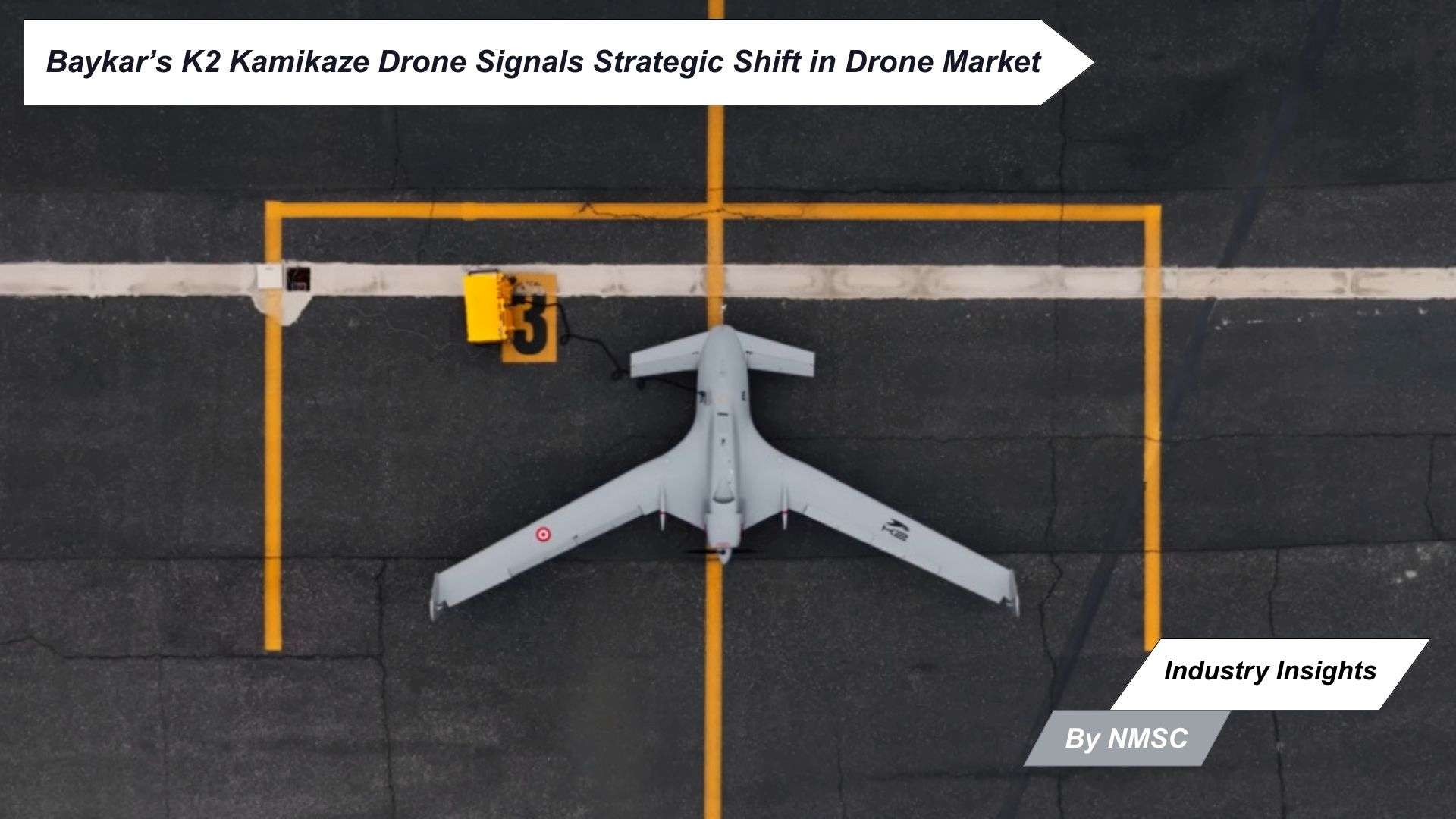
As the global Drone Market continues to evolve with advancements in autonomy and defense applications, Baykar’s debut of the K2 Kamikaze unmanned aerial vehicle (UAV) represents a notable development in next-generation aerial warfare systems. Designed as a one-way attack platform with coordinated operational capabilities, the K2 introduces a new dimension to how drones are deployed in modern combat environments.
Advancing Beyond Conventional UAV Architectures
Baykar has positioned the K2 Kamikaze UAV as a high-performance, expendable platform equipped with advanced artificial intelligence and autonomy algorithms. The system recently completed formation flight tests involving five aircraft, demonstrating its ability to operate in coordinated configurations such as “right echelon,” “line,” and “V” formations.
Unlike traditional UAVs designed for repeated missions, the K2 is primarily intended as a low-cost, mass-producible loitering munition. However, Baykar is also exploring the possibility of reusing the platform after payload deployment and return-to-base operations, reflecting a hybrid approach between expendability and operational efficiency.
Key Capabilities at a Glance:
-
Maximum Takeoff Weight of 800 kg, positioning it among the largest platforms in its category
-
Warhead Capacity of 200 kg, enabling high-impact strike potential
-
Extended Range exceeding 2,000 kilometers for long-distance missions
-
Endurance of over 13 hours, supporting prolonged operational presence
-
Speed exceeding 200 km/h for rapid deployment scenarios
-
Short Runway Takeoff and Landing capabilities for flexible deployment
AI-Enabled Coordination: Swarm or Structured Formation?
A defining feature of the K2 Kamikaze UAV is its use of artificial intelligence, sensors, and onboard software to maintain positional awareness within coordinated group operations. Baykar describes this as “AI-assisted swarm synergy,” with test aircraft successfully maintaining formation integrity and completing assigned tasks.
However, the demonstration appears to reflect coordinated group flight rather than a fully autonomous swarm. True swarm systems typically require large numbers of drones operating independently in highly contested environments without centralized control. In contrast, the K2 tests involved a limited number of aircraft and did not simulate complex electronic warfare or kinetic disruptions.
This positions the K2 more accurately as a long-range loitering munition capable of operating in synchronized groups, rather than a fully realized swarm system.
Designed for Contested and Denied Environments
The K2 Kamikaze UAV incorporates a navigation architecture tailored for operations in electronic warfare environments. It is capable of functioning even when GPS or GNSS signals are disrupted, relying instead on terrain-based visual navigation systems, including night-time operation capabilities.
Such features align with broader industry trends where drones are increasingly required to maintain operational effectiveness in denied environments using alternative navigation methods.
A Cruise Missile Alternative in Drone Form
Given its size, payload capacity, and range, the K2 Kamikaze UAV closely resembles a cruise missile substitute rather than a small, agile swarm drone. Its design suggests a focus on long-range strike missions with coordinated deployment, offering a scalable and potentially cost-efficient alternative to traditional missile systems.
While comparisons have been drawn with other long-range loitering munitions, the K2 distinguishes itself through its larger platform size and extended operational reach.
According to Next Move Strategy Consulting
The introduction of platforms like the K2 Kamikaze UAV highlights a significant shift in the drone market toward high-capacity, AI-enabled strike systems capable of coordinated operations. Rather than focusing solely on miniaturized swarm drones, manufacturers are increasingly investing in larger, long-range platforms that combine autonomy, payload strength, and operational flexibility.
This development is expected to influence future market dynamics by accelerating demand for intelligent loitering munitions and hybrid drone systems that bridge the gap between traditional missiles and unmanned aerial vehicles.
Strengthening the Future of Autonomous Aerial Warfare
Baykar’s K2 Kamikaze UAV represents an important step in the evolution of drone technology, showcasing how artificial intelligence and coordinated flight capabilities are being integrated into modern defense strategies. While not yet a fully realized swarm system, the platform reflects ongoing progress toward more sophisticated and autonomous aerial operations.
As the drone market continues to mature, innovations like the K2 are set to redefine how unmanned systems are deployed, emphasizing scalability, resilience, and intelligent coordination in increasingly complex operational environments.
Source: Aerospace Global News
Prepared by: Next Move Strategy Consulting
About the Author
 Sanyukta Deb
— Sanyukta Deb is Digital Marketing Team Lead at Next Move Strategy Consulting, where she has led content strategy and technical SEO for the firm's B2B market research publications for over 2 years. Her editorial process translates NextMSC's primary and secondary research — spanning technology, industrial, and consumer sectors — into commercial narratives, backed by search-intent, keyword, and competitive analysis. She brings 5 years of overall experience in digital marketing and content strategy.
Sanyukta Deb
— Sanyukta Deb is Digital Marketing Team Lead at Next Move Strategy Consulting, where she has led content strategy and technical SEO for the firm's B2B market research publications for over 2 years. Her editorial process translates NextMSC's primary and secondary research — spanning technology, industrial, and consumer sectors — into commercial narratives, backed by search-intent, keyword, and competitive analysis. She brings 5 years of overall experience in digital marketing and content strategy.
About the Reviewer
 Debashree Dey
— Debashree Dey is Assistant Manager at Next Move Strategy Consulting, where she supports cross-vertical market content and communications across diverse industries for 6 years. Her professional background includes senior content writing, communications, and published manuscript authorship, with experience developing audience-focused business narratives and maintaining clear, consistent messaging. Her role supports research-led content development and editorial quality across NextMSC publications.
Debashree Dey
— Debashree Dey is Assistant Manager at Next Move Strategy Consulting, where she supports cross-vertical market content and communications across diverse industries for 6 years. Her professional background includes senior content writing, communications, and published manuscript authorship, with experience developing audience-focused business narratives and maintaining clear, consistent messaging. Her role supports research-led content development and editorial quality across NextMSC publications.















Add Comment