Boston Dynamics' AI-Powered Atlas Ushers New Era for Humanoid Workforce
Industry Insights from Next Move Strategy Consulting
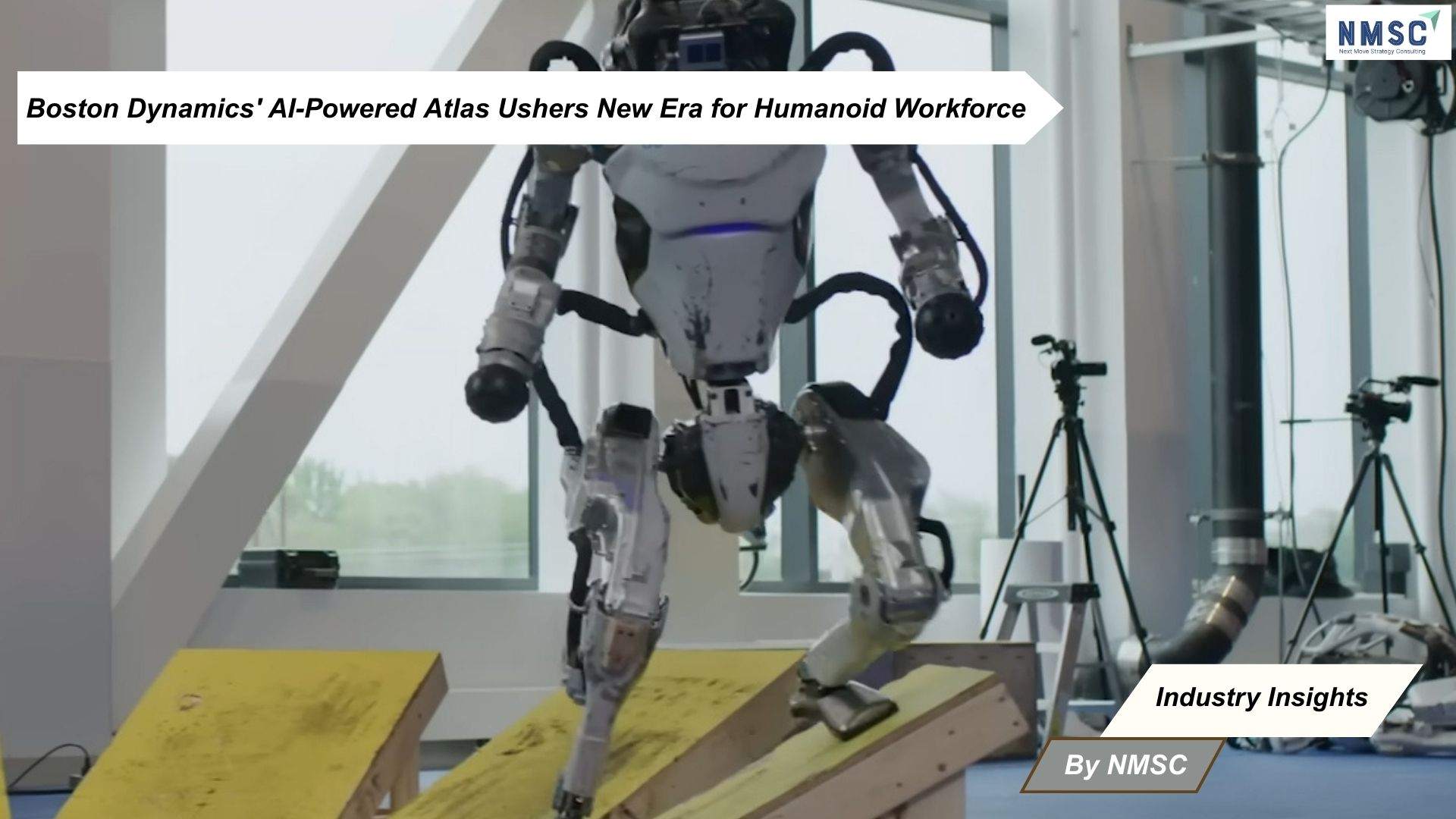
A global race to develop humanoid robots for widespread industrial use is accelerating, led by pioneers like Boston Dynamics. The Massachusetts-based company, with support from its majority owner Hyundai, is now field-testing its new-generation Atlas robot in a real-world factory setting, marking a significant leap from laboratory research to practical application.
From Hydraulic Prototype to AI-Powered Worker
The evolution of Boston Dynamics' flagship humanoid, Atlas, underscores the rapid transformation of the field. In 2021, Atlas was a bulky, hydraulic machine programmed by engineers' algorithms. Today's Atlas is a sleeker, all-electric robot with an AI "brain" powered by Nvidia's advanced microchips. This shift enables a revolutionary training approach. "It's more about teaching, and demonstrations, and machine learning than manual programming," explains Scott Kuindersma, head of robotics research at Boston Dynamics.
The company employs innovative methods to train Atlas. In one technique, a scientist uses a virtual reality headset to directly control the robot's movements, generating data to train its AI models for autonomous task execution. Another method involves a motion capture suit, where human movements—like a correspondent performing jumping jacks—are recorded. Data from the suit is fed into a machine learning process where thousands of digital Atlases practice in simulation, mastering the skill under varied challenging conditions before it is uploaded to every physical robot.
A Pathway to General-Purpose Robots and a Competitive Global Market
This training has endowed Atlas with a growing repertoire of dynamic movements, including running, crawling, skipping, and dancing. While limitations remain for complex daily tasks, the progress is clear. "I think the thing that's really exciting now is we see a pathway to get there," Kuindersma states. Boston Dynamics CEO Robert Playter is spearheading this push toward general-purpose machines. "There's a lot of excitement in the industry right about the potential of building robots that are smart enough to really become general purpose," he says.
The commercial stakes are high. Goldman Sachs predicts the humanoid robot market will reach $38 billion within the decade. Boston Dynamics and other U.S. firms are competing against state-supported Chinese companies in this strategic race. "The Chinese government has a mission to win the robotics race," Playter notes, acknowledging the competitive threat despite his belief in Boston Dynamics' technical lead.
Redefining the Future of Work
The current testing of Atlas at a Hyundai factory in Georgia, where it practices autonomously sorting roof racks, points to a tangible future for humanoids in manufacturing. Playter believes such robots will fundamentally change work, taking over repetitive and physically demanding labor. He emphasizes that this will create new roles in robot management, training, and servicing. Furthermore, robots like Atlas offer "superhuman capabilities," such as operating in dangerous environments or handling extreme conditions, providing clear safety and efficiency benefits.
Addressing common fears, Playter dispels notions of a dystopian future. Observing the immense effort required to train robots for straightforward tasks, he says, "would dispel that worry about sentience and rogue robots."
Industry Response and Strategic Outlook
According to Next Move Strategy Consulting, Boston Dynamics' practical deployment of Atlas represents a critical inflection point for the AI robotics sector. It validates a shift from speculative research to solving tangible industrial labor challenges. This move is expected to catalyze significant investment across manufacturing, logistics, and hazardous work environments, accelerating the timeline for commercial adoption. The focus will increasingly be on developing reliable, general-purpose platforms that can be adapted to diverse tasks, transforming productivity and safety standards globally.
Source: CBS News
Prepared by: Next Move Strategy Consulting
About the Author
 Sanyukta Deb
— Sanyukta Deb is Digital Marketing Team Lead at Next Move Strategy Consulting, where she has led content strategy and technical SEO for the firm's B2B market research publications for over 2 years. Her editorial process translates NextMSC's primary and secondary research — spanning technology, industrial, and consumer sectors — into commercial narratives, backed by search-intent, keyword, and competitive analysis. She brings 5 years of overall experience in digital marketing and content strategy.
Sanyukta Deb
— Sanyukta Deb is Digital Marketing Team Lead at Next Move Strategy Consulting, where she has led content strategy and technical SEO for the firm's B2B market research publications for over 2 years. Her editorial process translates NextMSC's primary and secondary research — spanning technology, industrial, and consumer sectors — into commercial narratives, backed by search-intent, keyword, and competitive analysis. She brings 5 years of overall experience in digital marketing and content strategy.
About the Reviewer
 Debashree Dey
— Debashree Dey is Assistant Manager at Next Move Strategy Consulting, where she supports cross-vertical market content and communications across diverse industries for 6 years. Her professional background includes senior content writing, communications, and published manuscript authorship, with experience developing audience-focused business narratives and maintaining clear, consistent messaging. Her role supports research-led content development and editorial quality across NextMSC publications.
Debashree Dey
— Debashree Dey is Assistant Manager at Next Move Strategy Consulting, where she supports cross-vertical market content and communications across diverse industries for 6 years. Her professional background includes senior content writing, communications, and published manuscript authorship, with experience developing audience-focused business narratives and maintaining clear, consistent messaging. Her role supports research-led content development and editorial quality across NextMSC publications.















Add Comment