Can America Power Its AI Expansion Without China’s Electrical Supply Chain Dependence?
Lede
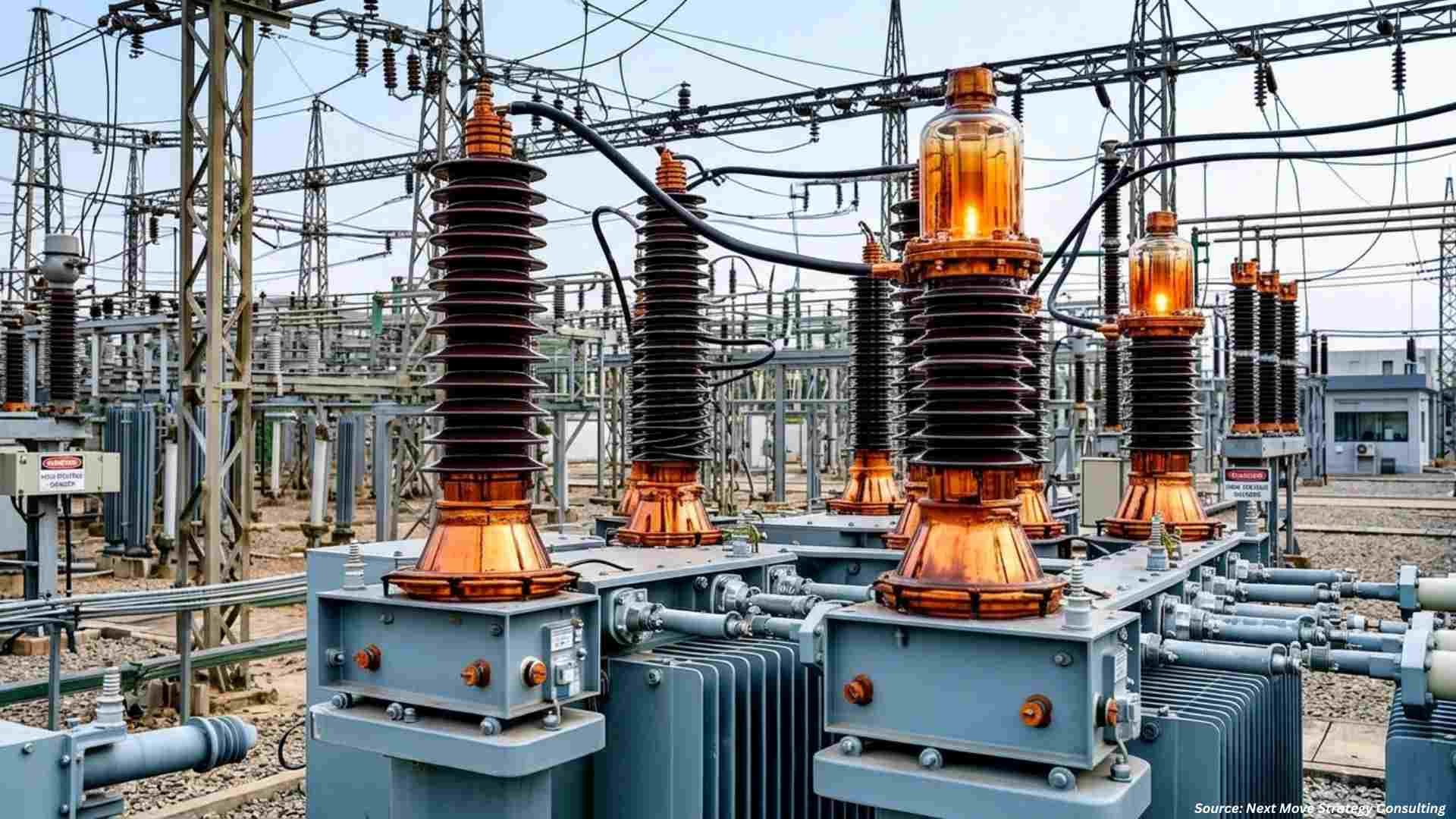
In the red dirt of Abilene, Texas, thousands of workers are racing to complete one of the world’s largest AI data center campuses, even as a critical bottleneck threatens to slow America’s artificial intelligence expansion: a shortage of electrical infrastructure and heavy reliance on Chinese imports for AI Transformer Market.
At the same time, DG Matrix has secured $60 million in Series A funding to scale solid-state transformer technology aimed at reducing these infrastructure delays and accelerating AI-ready power systems.
At Next Move Strategy Consulting, I observe that these two developments reflect a structural shift in the AI era: compute expansion is no longer constrained by chips alone but increasingly by power infrastructure readiness.
US AI Build-Out and Electrical Equipment Bottlenecks
The US is witnessing an unprecedented wave of AI-driven infrastructure expansion, with tech giants such as Alphabet, Amazon, Meta, and Microsoft collectively committing over $650 billion in capital spending in 2026 for data center and AI capacity expansion.
However, nearly half of planned US data center projects are reportedly delayed or cancelled due to shortages of critical grid components such as transformers, switchgear, and batteries.
At Next Move Strategy Consulting, I observe that the constraint is not financial but industrial capital is abundant, but execution depends on long-lead manufacturing components that currently exceed domestic capacity.
At the core of this challenge is a structural dependency on imported electrical infrastructure, particularly from China, which continues to supply a significant share of high-voltage grid equipment used in AI data center construction. This dependency has increased vulnerability in project timelines, especially as lead times for transformers have extended from roughly two years to as much as five years in some cases.

AI Power Bottleneck and Next-Gen Grid Shift
The rapid expansion of AI data centers is creating a structural imbalance between digital compute demand and physical power infrastructure capacity. As AI workloads scale, electricity consumption from hyperscale data centers is rising sharply, while critical grid components such as transformers, switchgear, and battery systems face prolonged supply shortages and extended lead times. This mismatch is increasingly delaying large-scale AI deployments despite strong capital investment from major technology firms.
At the same time, a new wave of energy infrastructure innovation is emerging to address these constraints. Technologies such as solid-state transformers and modular, software-defined power systems are being developed to reduce dependency on traditional grid architectures and significantly shorten deployment timelines. DG Matrix’s Interport™ platform represents this shift, enabling integrated power management across grid, renewable, and storage sources to support high-density AI workloads more efficiently.
At Next Move Strategy Consulting, I observe that this transition marks a critical inflection point where power infrastructure is becoming as strategically important as semiconductor supply chains in determining AI scalability and competitive advantage.

DG Matrix Funding and Infrastructure Innovation
DG Matrix announced the closure of a $60 million Series A funding round led by Engine Ventures, bringing its total funding to over $100 million, to scale next-generation solid-state transformer systems for AI and electrification infrastructure.
The company’s Interport™ platform is designed to reduce “time-to-power” from years to months by integrating grid, solar, battery, and generator inputs into a unified power architecture, specifically targeting AI data center energy constraints.
At Next Move Strategy Consulting, I observe that DG Matrix represents a broader transition toward modular, software-defined energy infrastructure mirroring how cloud computing transformed IT architecture.
The company is positioning itself at the center of a major shift in power system design, where traditional grid hardware is increasingly being replaced by flexible, multi-source, digitally controlled energy platforms capable of supporting high-density AI workloads.
AI Infrastructure Shift from Grid Limits to Smart Power Systems
AI data center expansion is entering a phase where electricity infrastructure is becoming the primary constraint on growth. While hyperscalers continue to scale compute capacity aggressively, the supporting grid ecosystem is struggling to keep pace due to long manufacturing lead times for transformers and switchgear, coupled with rising global demand for electrification. This has created a widening gap between planned AI capacity and actual deployable infrastructure.
In response, the industry is gradually shifting toward next-generation power architectures that emphasize modularity, flexibility, and faster deployment. Solid-state transformer systems, distributed energy integration, and hybrid storage solutions are emerging as alternatives to conventional grid-dependent setups. These technologies aim to reduce installation timelines, improve energy efficiency, and support fluctuating AI workloads more effectively.
At Next Move Strategy Consulting, I observe that this transition reflects a deeper structural evolution in the AI economy where competitive advantage will increasingly depend on how quickly organizations can convert electrical capacity into operational compute, rather than simply expanding physical data center footprints.

AI Power Infrastructure Transition
The convergence of AI compute demand and power infrastructure limitations is reshaping global energy strategy. Data centers are evolving into gigawatt-scale industrial assets, requiring high-voltage transformers capable of supporting continuous AI workloads.
At Next Move Strategy Consulting, I observe three structural shifts.
First, supply chains for electrical equipment are becoming a strategic bottleneck for AI expansion, with lead times for critical components extending far beyond historical norms.
Second, AI workloads are introducing highly variable and intensive power demand patterns, requiring advanced grid stabilization technologies such as battery storage and dynamic load balancing systems.
Third, the industry is gradually shifting toward solid-state and modular power systems, which reduce dependence on traditional transformer-heavy infrastructure and enable faster deployment cycles.
Traditional grid models rely on centralized transformers, long installation timelines, and fixed power routing architectures. In contrast, emerging AI power models prioritize distributed systems, software-controlled energy flow, and rapid deployment capability, fundamentally changing how data center infrastructure is designed and operated.
Long-Term Market Impact & NMSC Perspective
At Next Move Strategy Consulting, I observe that the long-term trajectory of AI infrastructure will be defined by energy system scalability rather than compute availability alone.
Energy infrastructure is emerging as the primary constraint on AI expansion. Even with sufficient capital and semiconductor supply, the inability to rapidly deploy transformers, switchgear, and grid connections will continue to delay large-scale AI projects.
Over time, this is expected to drive a structural shift toward decentralized and modular power architectures, where infrastructure can be deployed closer to demand centers and configured dynamically based on workload requirements.
Companies operating at the intersection of AI and energy infrastructure are likely to benefit the most from this transition, as demand grows for technologies that compress deployment timelines and reduce reliance on traditional grid expansion cycles.
From my analysis at Next Move Strategy Consulting, I conclude that the AI race will ultimately be determined by which economies and companies can scale power infrastructure as efficiently as they scale computational infrastructure.
What to Do Next (Actionable Insights)
Hyperscalers should prioritize long-term procurement agreements for grid equipment to reduce exposure to supply chain delays.
Energy companies should accelerate investment in modular and solid-state transformer technologies that reduce installation complexity and lead times.
Governments should strengthen domestic manufacturing capacity for transformers and critical grid components to reduce strategic dependence on imports.
Investors should focus on startups operating at the intersection of AI infrastructure and energy systems, particularly those enabling faster deployment of high-capacity power solutions.
Data center developers should adopt hybrid sourcing strategies that combine imported equipment with emerging domestic manufacturing partnerships to mitigate risk.
Conclusion
The rapid expansion of AI infrastructure is increasingly constrained not by computing power but by the availability and deployment speed of electrical grid systems. Persistent dependence on imported transformers and switchgear has created structural delays in data center development, even as capital investment accelerates.
At the same time, emerging technologies such as solid-state transformers and modular energy platforms are beginning to redefine how power infrastructure is built and deployed for AI workloads.
At Next Move Strategy Consulting, I conclude that the future of AI leadership will depend on how effectively nations and companies resolve the growing imbalance between digital ambition and physical energy infrastructure readiness.
About Next Move Strategy Consulting:
Next Move Strategy Consulting is a premier market research and management consulting firm that has been committed to provide strategically analysed well documented latest research reports to its clients. The research industry is flooded with many firms to choose from, what makes Next Move different from the rest is its top-quality research and the obsession of turning data into knowledge by dissecting every bit of it and providing fact-based research recommendation that is supported by information collected from over 500 million websites, paid databases, industry journals and one on one consultations with industry experts across a diverse range of industry sectors. The high-quality customized research reports with actionable insights and excellent end-to-end customer service help our clients to take critical business decisions that enables them to move beyond time and have competitive edge in the industry.
We have been servicing over 1000 customers globally that includes 90% of the Fortune 500 companies over a decade. Our analysts are constantly tracking various high growth markets and identifying hidden opportunities in each sector or the industry. We provide one of the industry’s best quality syndicate as well as custom research reports across 10 different industry verticals. We are committed to deliver high quality research solutions in accordance to your business needs. Our industry standard delivery solutions that ranges from the pre consultation to after-sales services, provide an excellent client experience and ensure right strategic decision making for businesses.
For more information, please contact:
Next Move Strategy Consulting
5th Floor 867
Boylston St, STE 500,
Boston, MA 02116, U.S.
E-Mail: [email protected]
Direct: +1-217-650-7991
Website: www.nextmsc.com
About the Author
 Sanyukta Deb
— Sanyukta Deb is Digital Marketing Team Lead at Next Move Strategy Consulting, where she has led content strategy and technical SEO for the firm's B2B market research publications for over 2 years. Her editorial process translates NextMSC's primary and secondary research — spanning technology, industrial, and consumer sectors — into commercial narratives, backed by search-intent, keyword, and competitive analysis. She brings 5 years of overall experience in digital marketing and content strategy.
Sanyukta Deb
— Sanyukta Deb is Digital Marketing Team Lead at Next Move Strategy Consulting, where she has led content strategy and technical SEO for the firm's B2B market research publications for over 2 years. Her editorial process translates NextMSC's primary and secondary research — spanning technology, industrial, and consumer sectors — into commercial narratives, backed by search-intent, keyword, and competitive analysis. She brings 5 years of overall experience in digital marketing and content strategy.
About the Reviewer
 Debashree Dey
— Debashree Dey is Assistant Manager at Next Move Strategy Consulting, where she supports cross-vertical market content and communications across diverse industries for 6 years. Her professional background includes senior content writing, communications, and published manuscript authorship, with experience developing audience-focused business narratives and maintaining clear, consistent messaging. Her role supports research-led content development and editorial quality across NextMSC publications.
Debashree Dey
— Debashree Dey is Assistant Manager at Next Move Strategy Consulting, where she supports cross-vertical market content and communications across diverse industries for 6 years. Her professional background includes senior content writing, communications, and published manuscript authorship, with experience developing audience-focused business narratives and maintaining clear, consistent messaging. Her role supports research-led content development and editorial quality across NextMSC publications.


















Add Comment