Is Telemedicine Entering a New Era of Connected, Real-Time Care?

Lede:
Telemedicine is moving beyond video consultations into a data-driven, always-on model of care. Two recent developments one from Massachusetts-based pet health innovator PetPace and another from World Health Organization Regional Office for Europe (WHO/Europe) in collaboration with the Organisation for Economic Co-operation and Development (OECD) highlight how remote healthcare is evolving from emergency adoption to structured, sustainable integration across health systems. Together, these updates signal a structural shift in the Telemedicine Market, expanding its scope from human care to veterinary innovation while strengthening global policy frameworks.
PetPace V3.0: Expanding Telemedicine into Predictive Pet Care
In a significant development for digital health and veterinary care, PetPace has launched its V3.0 AI-powered smart collar for dogs and cats. Unlike traditional pet wearables that primarily track activity, the new collar integrates clinically validated biometric monitoring capturing vital signs such as heart rate, respiration, temperature trends, posture, sleep quality, and heart rate variability.
What distinguishes this launch is its embedded 24/7 global telehealth and telemedicine access. Pet owners can connect with licensed veterinarians via live chat or video consultations, with real-time biometric data shared directly from the collar during virtual visits. The system allows both instant consultations through PetPace’s network and remote engagement with a pet’s personal veterinarian, provided a valid doctor–patient relationship exists.
Among its most notable features:
-
AI-driven pain scoring using proprietary, clinically validated algorithms
-
Beta-stage epilepsy episode monitoring for dogs
-
Real-time data sharing for remote diagnostics and follow-up care
-
Apple Watch integration for instant alerts and health metrics access
By combining predictive analytics with continuous physiological monitoring, PetPace is positioning telemedicine as proactive rather than reactive. Instead of waiting for visible symptoms, veterinarians can interpret subtle biometric deviations, potentially identifying health concerns earlier.
This model mirrors a broader healthcare shift: integrating remote patient monitoring (RPM) with teleconsultation infrastructure. In effect, veterinary telemedicine is becoming a testing ground for scalable, data-enriched care ecosystems.
Core Functional Areas of AI-Powered Telemedicine
|
Functional Area |
AI Contribution |
Impact on Care Delivery |
|
Diagnostics & Monitoring |
Real-time biometric data analysis |
Early detection and timely action |
|
Virtual Assistance |
AI chatbots and clinical decision tools |
Faster consultations and triage |
|
Automation & Workflow Support |
Task automation and data processing |
Improved efficiency and scalability |
How AI Integration Is Strengthening Telemedicine Systems
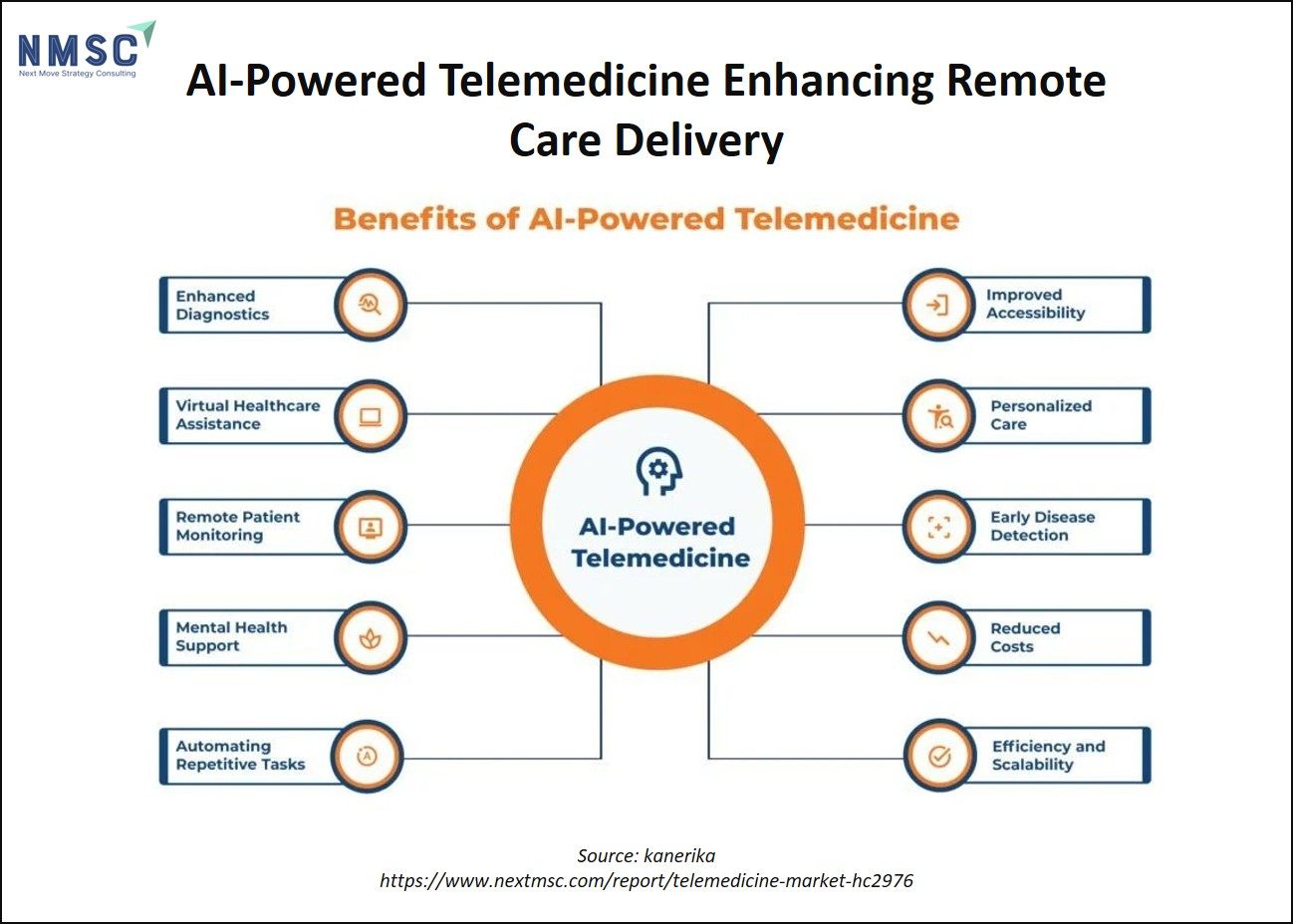
The expanding role of AI-powered telemedicine in transforming remote healthcare delivery. At the center is “AI-Powered Telemedicine,” surrounded by key benefit areas including enhanced diagnostics, virtual healthcare assistance, remote patient monitoring, mental health support, and automation of repetitive tasks. On the outcomes side, it highlights improved accessibility, personalized care, early disease detection, reduced costs, and greater efficiency and scalability. These elements align with recent developments such as PetPace integrating AI-driven real-time biometric monitoring with 24/7 telehealth access, as well as policy discussions led by World Health Organization Regional Office for Europe and Organisation for Economic Co-operation and Development emphasizing structured frameworks for sustainable telemedicine implementation. Together, the visual underscores how AI enhances clinical accuracy, expands access across geographies, and enables scalable, data-driven care ecosystems in both human and veterinary health settings.
WHO/Europe and OECD: Strengthening Telemedicine Frameworks
While innovation advances at the device level, policymakers are focusing on sustainability and governance.
On 26 March 2025, WHO/Europe and OECD co-hosted a webinar under the “Decoding Data and Digital Health” series to address telemedicine implementation frameworks, quality-of-care tools, and strategic pathways for long-term adoption. The discussion emphasized that telemedicine, initially accelerated by the COVID-19 pandemic, must now transition into structured, policy-backed integration within national health systems.
WHO defines telemedicine as remote clinical services delivered when patients and providers are separated by distance, encompassing video consultations, remote diagnostics, monitoring, and therapy. According to WHO’s 2023 digital health assessment, 78 percent of Member States in the European Region now directly reference telehealth in policy or strategic planning.
However, adoption remains uneven. Key challenges include:
-
Lack of standardized clinical guidelines
-
Data governance and interoperability gaps
-
Reimbursement and regulatory inconsistencies
-
Equity concerns for rural and vulnerable populations
The joint WHO–OECD dialogue stressed that telemedicine can advance universal health coverage by expanding access for remote communities, persons with disabilities, and underserved groups. The emphasis has shifted from rapid deployment to quality assurance, digital governance, and measurable outcomes.
Patient-Centric Outcomes Enabled by AI
|
Outcome Area |
Description |
Long-Term Benefit |
|
Accessibility |
Remote consultations across locations |
Wider healthcare coverage |
|
Personalized Care |
Data-driven treatment recommendations |
Better patient engagement |
|
Cost Optimization |
Reduced hospital visits and admin burden |
Lower system-wide healthcare costs |
Long-Term Impact on the Telemedicine Market
These parallel developments device-level AI integration and policy-level standardization are converging in ways that could redefine the Telemedicine Market landscape.
1. Expansion Beyond Human Healthcare
Veterinary telemedicine demonstrates that remote monitoring ecosystems are transferable across care domains. Wearable-driven diagnostics in pets may accelerate similar models in chronic disease management for humans.
2. Shift Toward Predictive Telemedicine
Continuous biometric system combined with AI is transforming telemedicine from episodic consultation into predictive health management. This evolution strengthens demand for interoperable platforms, cloud analytics, and secure health data exchange systems.
3. Institutional Legitimization
WHO and OECD-backed frameworks provide regulatory clarity, encouraging healthcare providers and governments to scale services with confidence. Structured policy reduces uncertainty for technology developers and digital health providers.
4. Equity and Accessibility Priorities
Telemedicine’s growth will increasingly be evaluated not just by adoption rates, but by inclusivity metrics rural access, affordability, disability inclusion, and cross-border licensing harmonization.
NMSC Perspective: Strategic Outlook and Structural Implications
From a Next Move Strategy Consulting perspective, the recent announcements suggest that telemedicine is entering its second maturity phase. During the pandemic, telemedicine expanded rapidly due to necessity. The current phase is characterized by integration, optimization, and value measurement.
NMSC observes three structural signals:
-
Data as the Core Asset: The competitive advantage is shifting from consultation platforms to actionable health intelligence. AI-driven analytics and continuous monitoring will define differentiation.
-
Hybrid Care Models: Telemedicine will increasingly complement, not replace, in-person care. Blended service delivery models are likely to dominate health systems over the next decade.
-
Regulatory Convergence: As organizations like WHO and OECD promote standardized tools and frameworks, cross-border digital care models may expand, especially in regions facing workforce shortages.
NMSC estimates that telemedicine adoption will deepen most rapidly in chronic disease management, post-procedure monitoring, mental health services, and veterinary applications. The integration of wearables with licensed remote practitioners could become a baseline expectation rather than a premium feature.
In the long term, the Telemedicine Market is expected to move toward outcome-driven reimbursement models, where digital care platforms are evaluated based on measurable clinical improvements and cost savings rather than consultation volume alone.
The Road Ahead
Telemedicine is no longer defined solely by video calls. It is increasingly shaped by AI analytics, real-time biometric sharing, structured policy backing, and ecosystem interoperability. The PetPace innovation illustrates how connected devices can transform remote consultations into informed clinical engagements. Meanwhile, WHO and OECD initiatives underscore that sustainable telemedicine requires governance, standards, and equity safeguards. As technology and policy mature in tandem, the Telemedicine Market appears poised not just for expansion, but for structural transformation where continuous care, predictive insights, and global accessibility redefine what remote healthcare truly means.
About Next Move Strategy Consulting:
Next Move Strategy Consulting is a premier market research and management consulting firm that has been committed to providing strategically analysed well documented latest research reports to its clients. The research industry is flooded with many firms to choose from, what makes NMSC different from the rest is its top-quality research and the obsession of turning data into knowledge by dissecting every bit of it and providing fact-based research recommendation that is supported by information collected from over 500 million websites, paid databases, industry journals and one on one consultations with industry experts across a diverse range of industry sectors. The high-quality customized research reports with actionable insights and excellent end-to-end customer service help our clients to take critical business decisions that enables them to move beyond time and have competitive edge in the industry.
We have been servicing over 1000 customers globally that includes 90% of the Fortune 500 companies over a decade. Our analysts are constantly tracking various high growth markets and identifying hidden opportunities in each sector or the industry. We provide one of the industry’s best quality syndicate as well as custom research reports across 10 different industry verticals. We are committed to deliver high quality research solutions in accordance to your business needs. Our industry standard delivery solutions that ranges from the pre consultation to after-sales services, provide an excellent client experience and ensure right strategic decision making for businesses.
For more information, please contact:
Next Move Strategy Consulting
5th Floor 867
Boylston St, STE 500
Boston, MA 02116, U.S.
E-Mail: [email protected]
Direct: +1 857 758 5017
Website: www.nextmsc.com
About the Author
 Sanyukta Deb
— Sanyukta Deb is Digital Marketing Team Lead at Next Move Strategy Consulting, where she has led content strategy and technical SEO for the firm's B2B market research publications for over 2 years. Her editorial process translates NextMSC's primary and secondary research — spanning technology, industrial, and consumer sectors — into commercial narratives, backed by search-intent, keyword, and competitive analysis. She brings 5 years of overall experience in digital marketing and content strategy.
Sanyukta Deb
— Sanyukta Deb is Digital Marketing Team Lead at Next Move Strategy Consulting, where she has led content strategy and technical SEO for the firm's B2B market research publications for over 2 years. Her editorial process translates NextMSC's primary and secondary research — spanning technology, industrial, and consumer sectors — into commercial narratives, backed by search-intent, keyword, and competitive analysis. She brings 5 years of overall experience in digital marketing and content strategy.
About the Reviewer
 Debashree Dey
— Debashree Dey is Assistant Manager at Next Move Strategy Consulting, where she supports cross-vertical market content and communications across diverse industries for 6 years. Her professional background includes senior content writing, communications, and published manuscript authorship, with experience developing audience-focused business narratives and maintaining clear, consistent messaging. Her role supports research-led content development and editorial quality across NextMSC publications.
Debashree Dey
— Debashree Dey is Assistant Manager at Next Move Strategy Consulting, where she supports cross-vertical market content and communications across diverse industries for 6 years. Her professional background includes senior content writing, communications, and published manuscript authorship, with experience developing audience-focused business narratives and maintaining clear, consistent messaging. Her role supports research-led content development and editorial quality across NextMSC publications.

















Add Comment