South Korea Gains Ground in Global Shipbuilding Race
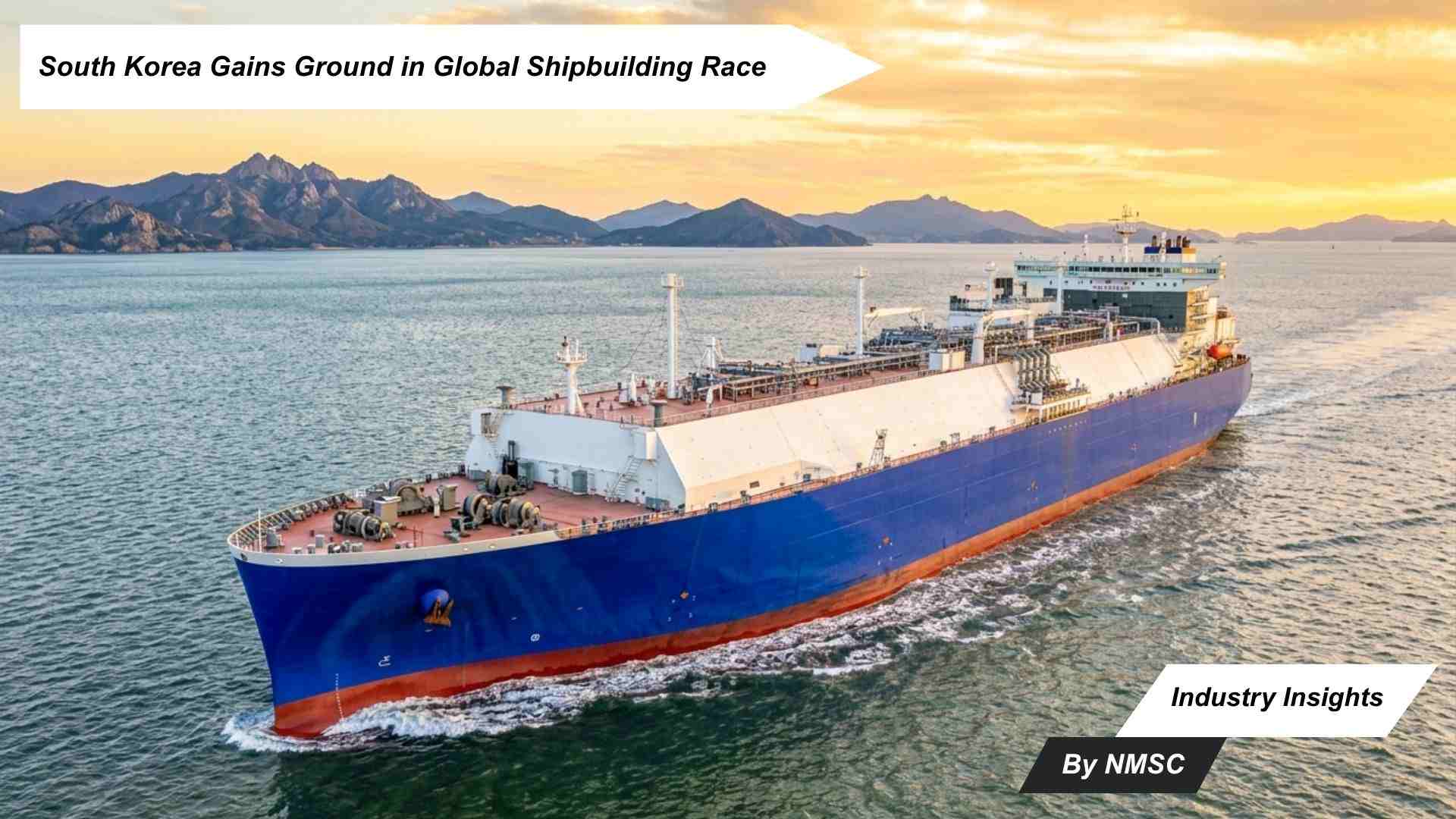
Industry Insights from Next Move Strategy Consulting
Amid a broader slowdown in global shipbuilding activity, South Korea has demonstrated notable resilience by significantly increasing its share of global ship orders, reducing the longstanding lead held by China. The latest data released by Clarkson Research Services highlights a shifting competitive dynamic within the global shipbuilding landscape, signaling renewed momentum for Korean shipbuilders.
A Strong Rebound in Market Share
According to the March data, South Korea secured orders totaling 1.59 million compensated gross tons (CGT) across 38 vessels, capturing approximately 39 percent of the global market. This marks a substantial rise compared to its 11 percent share recorded in February. In contrast, China maintained its leading position with 2.15 million CGT for 84 ships, representing a 53 percent share, though notably down from its dominant 80 percent share in the previous month.
This shift reflects a narrowing gap between the two shipbuilding powerhouses, indicating increased competitiveness and a potential rebalancing of global order distribution.
Global Shipbuilding Activity Sees Mixed Trends
Overall, global ship orders reached 4.06 million CGT for 135 vessels in March. While this represents a 36 percent decline from February’s 6.38 million CGT, it also marks a 31 percent increase compared to the same period last year. The data suggests that although short-term fluctuations persist, the industry continues to show year-on-year growth resilience.
The fluctuations in monthly performance highlight the cyclical nature of shipbuilding demand, influenced by global trade conditions, energy markets, and investment cycles.
Shipbuilding Costs Remain Elevated
Clarkson’s newbuilding price index stood at 182.07 in March, reflecting a marginal decline of 0.07 percentage points from the previous month. Despite this slight dip, the index remains at a historically high level, underscoring sustained cost pressures in ship construction.
Vessel-specific pricing further illustrates the premium nature of modern shipbuilding:
-
Liquefied natural gas (LNG) carriers were priced at $248.5 million
-
Very large crude carriers (VLCCs) stood at $129.5 million
-
Ultra-large container ships reached $260 million
These elevated price levels reflect ongoing demand for technologically advanced and high-capacity vessels, particularly in energy transportation and global logistics.
Strategic Implications for the Shipbuilding Industry
The latest developments indicate a strategic shift in the competitive landscape, with South Korea strengthening its foothold despite an overall contraction in monthly orders. The ability to secure high-value vessel contracts, particularly LNG carriers, appears to be a key driver behind its improved market position.
Meanwhile, China continues to lead in total volume, supported by its large-scale production capabilities and broad vessel portfolio. However, the reduction in its market share suggests increasing competition and evolving buyer preferences.
Next Move Strategy Consulting’s View
According to Next Move Strategy Consulting, the global Shipbuilding Market is undergoing a phase of recalibration characterized by fluctuating order volumes, high construction costs, and intensifying competition among leading nations.
The rise in South Korea’s market share highlights the growing importance of specialization in high-value vessels, such as LNG carriers and advanced container ships. At the same time, sustained high pricing levels indicate strong underlying demand for modern fleets, even amid short-term order volatility.
Looking ahead, the market is expected to remain dynamic, with technological innovation, energy transition requirements, and global trade recovery shaping future order patterns. Shipbuilders that can balance cost efficiency with advanced engineering capabilities are likely to gain a competitive edge.
A Competitive Landscape in Transition
As global shipbuilding navigates a complex economic environment, the narrowing gap between South Korea and China signals a more competitive and diversified market structure. With both nations leveraging their respective strengths, the industry is poised for continued evolution driven by demand for efficiency, sustainability, and scale.
Source: AJP
Prepared by: Next Move Strategy Consulting
About the Author
 Sanyukta Deb
— Sanyukta Deb is Digital Marketing Team Lead at Next Move Strategy Consulting, where she has led content strategy and technical SEO for the firm's B2B market research publications for over 2 years. Her editorial process translates NextMSC's primary and secondary research — spanning technology, industrial, and consumer sectors — into commercial narratives, backed by search-intent, keyword, and competitive analysis. She brings 5 years of overall experience in digital marketing and content strategy.
Sanyukta Deb
— Sanyukta Deb is Digital Marketing Team Lead at Next Move Strategy Consulting, where she has led content strategy and technical SEO for the firm's B2B market research publications for over 2 years. Her editorial process translates NextMSC's primary and secondary research — spanning technology, industrial, and consumer sectors — into commercial narratives, backed by search-intent, keyword, and competitive analysis. She brings 5 years of overall experience in digital marketing and content strategy.
About the Reviewer
 Debashree Dey
— Debashree Dey is Assistant Manager at Next Move Strategy Consulting, where she supports cross-vertical market content and communications across diverse industries for 6 years. Her professional background includes senior content writing, communications, and published manuscript authorship, with experience developing audience-focused business narratives and maintaining clear, consistent messaging. Her role supports research-led content development and editorial quality across NextMSC publications.
Debashree Dey
— Debashree Dey is Assistant Manager at Next Move Strategy Consulting, where she supports cross-vertical market content and communications across diverse industries for 6 years. Her professional background includes senior content writing, communications, and published manuscript authorship, with experience developing audience-focused business narratives and maintaining clear, consistent messaging. Her role supports research-led content development and editorial quality across NextMSC publications.
















Add Comment