Ukraine FP-2 Drone Intensifies February Strike Operations
Industry Insights from Next Move Strategy Consulting
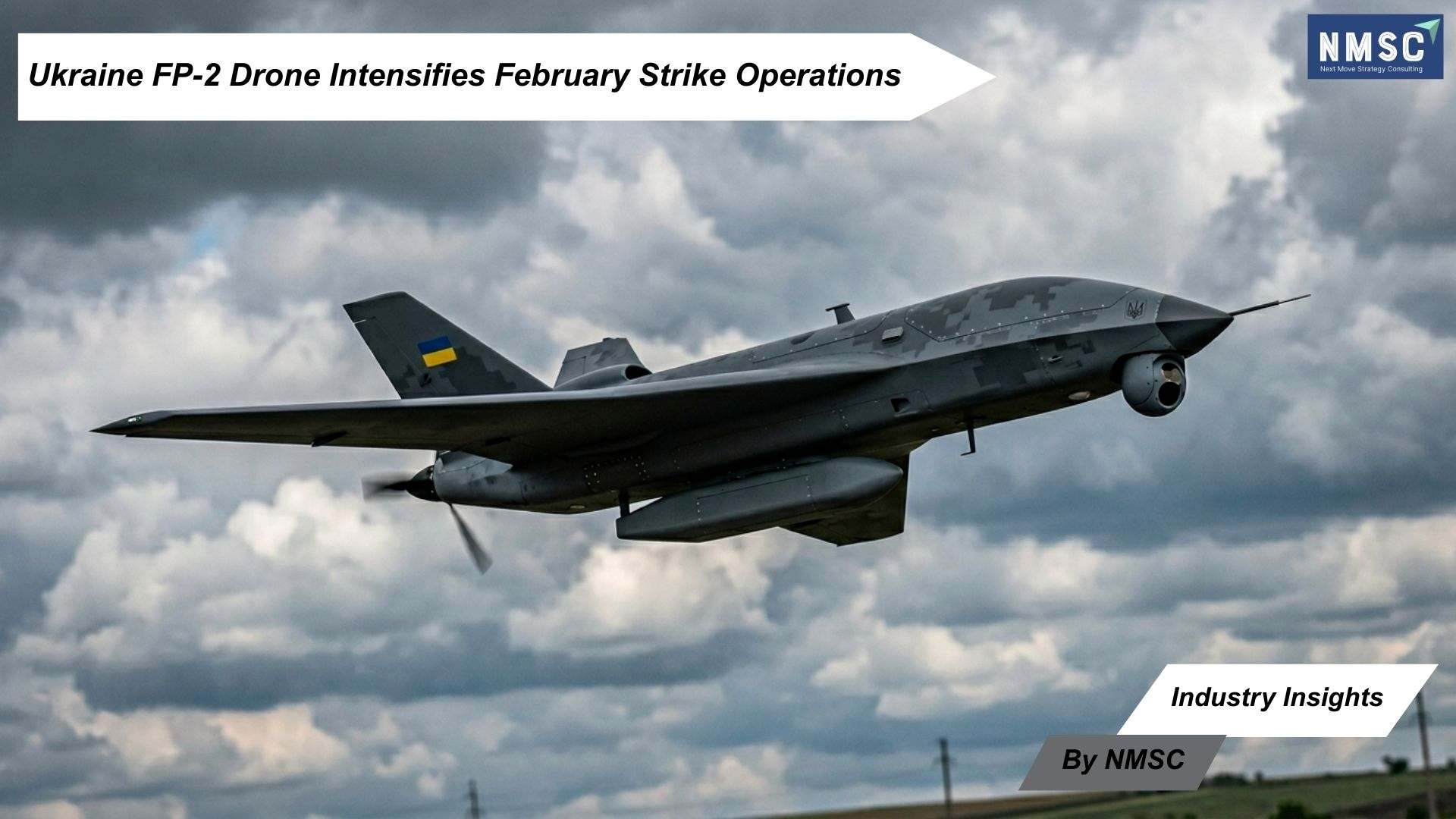
Ukraine’s FP-2 medium-strike drone has significantly intensified operations in February, targeting a range of high-value Russian military assets. The increased tempo of drone strikes indicates a growing role for unmanned systems in modern warfare, demonstrating improved operational efficiency and precision strike capabilities. Recent activity suggests that FP-2 and FP-1-type drones have been deployed extensively, contributing to the destruction of air defence systems, missile launchers, and logistics infrastructure.
Alongside the deployment of the FP-5 Flamingo heavy cruise missile on deep-strike missions, the FP-2 drone appears to have entered a phase of expanded operational use. Over recent weeks, multiple high-value targets have reportedly been neutralized, highlighting the evolving effectiveness of Ukraine’s unmanned strike capabilities.
Medium-Range Strike Platform with Enhanced Payload
Introduced in September 2025, the FP-2 is a medium-range strike drone derived from the earlier FP-1 long-range drone. While the FP-1 has a range of approximately 1,400 kilometres, the FP-2’s range is reduced to around 200 kilometres in order to accommodate a larger payload capacity. The drone is capable of carrying a 100-kilogram warhead, enabling it to deliver more destructive strikes against strategic targets.
The FP-2 is available in configurations that include autonomous guidance for stationary targets and radio-controlled operation for engaging moving targets. This flexibility allows the drone to support a variety of operational missions, ranging from infrastructure disruption to tactical battlefield engagements.
The system has been described as relatively low-cost while maintaining a heavy warhead capability, enabling deployment in large numbers. Low-altitude flight combined with coordinated operations can potentially allow these drones to evade or overwhelm air defence systems, posing threats to logistics hubs, weapon depots, and operational bases.
Increased Strike Tempo in February
February witnessed a noticeable increase in FP-2 strike activity. On 10 February, FP-2 drones reportedly struck a forward drone operator base in Ukraine’s Zaporizhzhia region, demonstrating their capability to target operational infrastructure.
Additional strike footage shared by analysts showed FP-2 and similar unmanned systems hitting multiple Russian military assets, including Pantsir-S1 and S-400 air defence systems, Buk-M1 missile systems, Uragan multiple launch rocket systems, and Malakhit radar installations. Other reported targets included Tor-M1 and S-300VM air defence systems, command posts, warehouses, unmanned aerial vehicle launch points, and additional strategic positions.
One recorded strike showed an FP-2 drone destroying a Russian Smerch multiple launch rocket system. FP-2-type drones may also have been responsible for attacks on two rare Russian Be-12 flying boats reported earlier in the month.
Recent reports also indicated that two Russian helicopters, a Mi-8 and a Ka-52, were destroyed on the ground at Pugachevka Airfield in Russia’s Oryol region using strike-type unmanned aerial vehicles, although it remains unclear whether FP-2 drones were involved.
Potential Technological Improvements
The exact reasons behind the increased operational tempo remain uncertain, but the FP-2 system may be benefiting from technical refinements. Possible improvements in flight stability and the use of mesh networking technology could enable extended operational effectiveness and more synchronized strike missions.
Such advancements could allow drones to coordinate attacks more efficiently while maintaining precision at operational ranges, increasing their effectiveness against defended targets.
Expanding Role of Strike Drones
The growing deployment of FP-2 drones illustrates the expanding importance of medium-range unmanned strike platforms in modern military operations. Their combination of payload capacity, operational flexibility, and relatively low cost makes them suitable for repeated strikes against high-value targets.
The ability to operate autonomously or under manual control further enhances their tactical utility, allowing operators to adapt missions according to battlefield requirements.
Next Move Strategy Consulting’s View
According to Next Move Strategy Consulting, the increasing use of medium-range strike drones such as the FP-2 reflects a broader transformation in the global drone market. Modern unmanned systems are evolving toward higher payload capacities, improved precision, and coordinated operations designed to enhance mission effectiveness.
The rising adoption of autonomous guidance, radio-controlled targeting, and coordinated drone operations demonstrates a shift toward more advanced unmanned warfare capabilities. These developments are expected to accelerate innovation in drone technologies as defense organizations continue investing in scalable and cost-effective strike platforms.
The FP-2’s operational activity highlights how drones are becoming critical assets in modern defense strategies, reinforcing their role as essential tools for precision engagement and strategic targeting.
Source: Aerospace Global News
Prepared by: Next Move Strategy Consulting
About the Author
 Sanyukta Deb
— Sanyukta Deb is Digital Marketing Team Lead at Next Move Strategy Consulting, where she has led content strategy and technical SEO for the firm's B2B market research publications for over 2 years. Her editorial process translates NextMSC's primary and secondary research — spanning technology, industrial, and consumer sectors — into commercial narratives, backed by search-intent, keyword, and competitive analysis. She brings 5 years of overall experience in digital marketing and content strategy.
Sanyukta Deb
— Sanyukta Deb is Digital Marketing Team Lead at Next Move Strategy Consulting, where she has led content strategy and technical SEO for the firm's B2B market research publications for over 2 years. Her editorial process translates NextMSC's primary and secondary research — spanning technology, industrial, and consumer sectors — into commercial narratives, backed by search-intent, keyword, and competitive analysis. She brings 5 years of overall experience in digital marketing and content strategy.
About the Reviewer
 Debashree Dey
— Debashree Dey is Assistant Manager at Next Move Strategy Consulting, where she supports cross-vertical market content and communications across diverse industries for 6 years. Her professional background includes senior content writing, communications, and published manuscript authorship, with experience developing audience-focused business narratives and maintaining clear, consistent messaging. Her role supports research-led content development and editorial quality across NextMSC publications.
Debashree Dey
— Debashree Dey is Assistant Manager at Next Move Strategy Consulting, where she supports cross-vertical market content and communications across diverse industries for 6 years. Her professional background includes senior content writing, communications, and published manuscript authorship, with experience developing audience-focused business narratives and maintaining clear, consistent messaging. Her role supports research-led content development and editorial quality across NextMSC publications.















Add Comment