US Air Force Expands 3D Printing to Sustain Legacy Aircraft
Industry Insights from Next Move Strategy Consulting
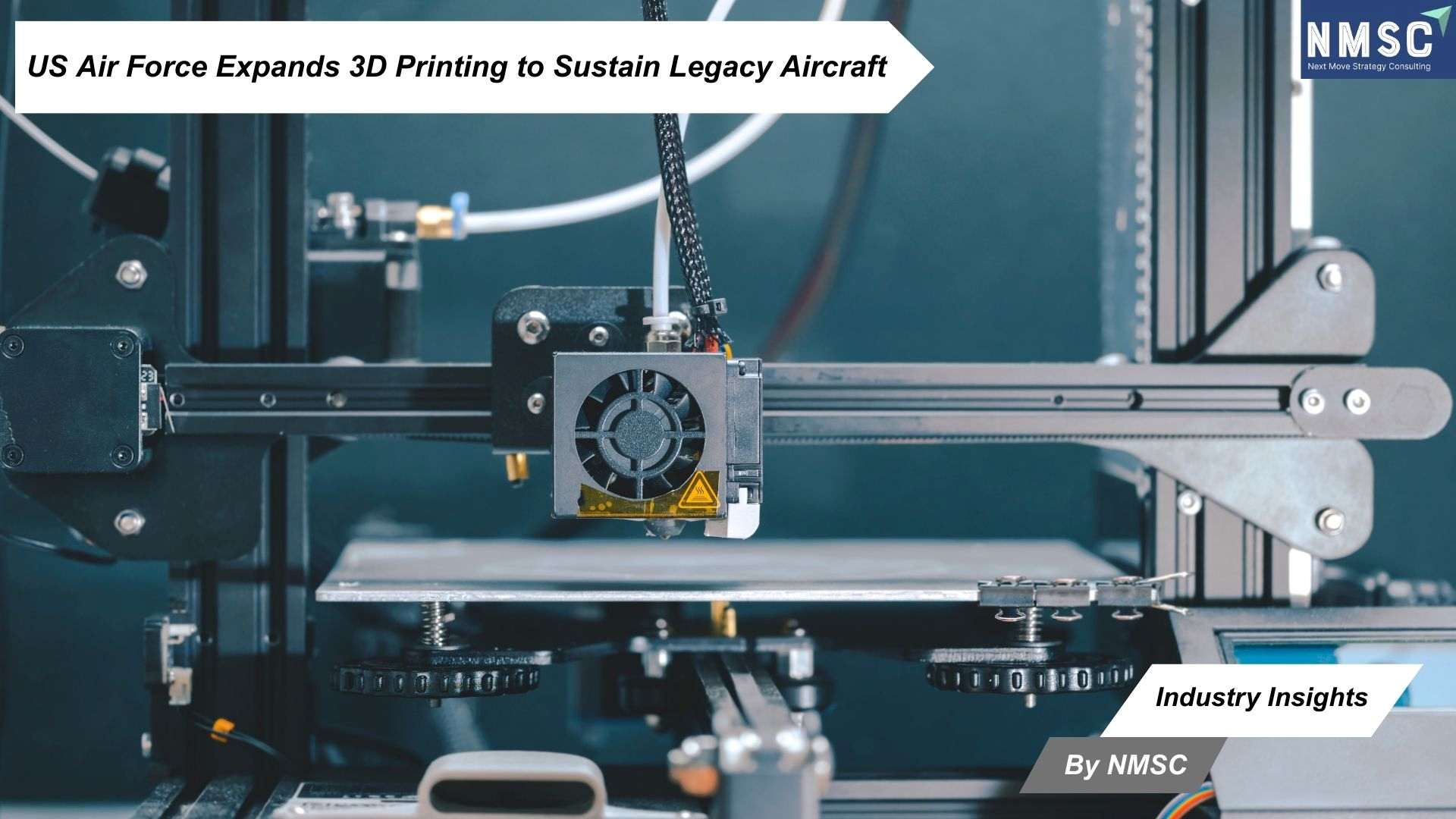
As global defense forces confront aging fleets and increasingly fragile supply chains, the US Air Force is turning to 3D printing to ensure operational readiness and extend the service life of legacy aircraft. By leveraging additive manufacturing, the Air Force is reshaping how critical components are produced, sourced, and sustained across its aviation ecosystem.
A Strategic Shift in Aircraft Maintenance
The US Air Force is using 3D printing also known as additive manufacturing to produce hard-to-source parts for aircraft that are no longer in active production. This approach allows older platforms to remain operational for longer periods while significantly reducing maintenance costs and lead times associated with traditional manufacturing. At the center of this effort is the US Air Force Materiel Command, which operates a specialized additive manufacturing team at Warner Robins Air Logistics Complex at Robins Air Force Base in Georgia. The team focuses on improving aircraft availability and mission readiness by rapidly producing replacement parts that would otherwise be difficult or impossible to procure.
Inside the Additive Manufacturing Mission
According to the Air Force, the 402nd Commodities Maintenance Group (CMXG) Reverse Engineering, Additive, Design and Inspection (READI) Lab uses additive manufacturing, reverse engineering, and specialized engineering services to generate aircraft components. The initiative began roughly a decade ago with polymer-based machines and has expanded in recent years to include metal additive manufacturing systems, enabling broader applications and greater efficiency. Hunter Henry, an additive manufacturing engineer with the 402nd CMXG, highlighted the tangible benefits of the technology, noting that 3D printing enables the rapid creation of prototypes and tools while avoiding complex machining processes. This results in notable savings in both time and cost.
Addressing Supply Chain Gaps Across Legacy Fleets
Additive manufacturing is proving especially valuable in overcoming supply chain challenges associated with legacy aircraft. Platforms supported through this initiative include the C-130 Hercules, C-5M Super Galaxy, C-17 Globemaster III, B-1B Lancer, B-52 Superfortress, KC-135 Stratotanker, and F-15 Eagle. As aircraft programs wind down, subcontractors may exit the market, making replacement parts scarce. Historically, this has forced fleets to rely on cannibalization to remain operational. The 402nd CMXG’s 3D printing lab addresses this issue by providing alternative production solutions that deliver parts within reasonable timeframes and costs. In many cases, metal components can also be substituted with 3D-printed polymer parts.
Beyond Legacy Aircraft: Scaling Additive Manufacturing
While the Air Force’s current focus is on sustaining older aircraft, the use of 3D printing extends well beyond legacy platforms. Additive manufacturing is increasingly influencing drone development and frontline innovation. Observations from recent conflicts highlight how widely 3D printers are used for manufacturing and modifying unmanned aerial systems, often at the unit level. In the United States, additive manufacturing is also supporting the development of advanced, jet-powered combat drones, including the Collaborative Combat Aircraft. Cost control and production speed are critical factors in these programs, making 3D printing a strategic enabler. Beehive Industries, for example, is developing propulsion systems such as the Rampart engine using additive manufacturing. The company cites accelerated production cycles, reduced supplier dependence, elimination of obsolete parts, and localized production as key advantages of this approach.
Next Move Strategy Consulting’s Viewpoint
According to Next Move Strategy Consulting’s view, the US Air Force’s growing reliance on 3D Printing Market reflects a broader shift in defense manufacturing toward agility, resilience, and cost efficiency. Additive manufacturing is no longer a niche capability but a strategic tool that supports fleet sustainment, mitigates supply chain risks, and accelerates innovation across both manned and unmanned platforms.
Redefining the Future of Military Aviation
From sustaining decades-old aircraft to enabling next-generation drones, 3D printing is becoming a cornerstone of modern military aviation. By integrating additive manufacturing into maintenance, logistics, and production strategies, the US Air Force is not only keeping its legacy fleets flying longer but also laying the groundwork for a more adaptable and resilient aerospace future.
Source: Aerospace Global News
Prepared by: Next Move Strategy Consulting
About the Author
 Tania Dey
— Tania Dey is a content writer specializing in transformation-led, insight-driven storytelling. She develops research-backed, high-impact content aligned with evolving business priorities, digital behavior, and audience expectations. Her work helps organizations sharpen value propositions, strengthen visibility, and communicate strategic intent with clarity and precision. Grounded in data-informed storytelling, she brings a strong focus on relevance, consistency, and measurable digital impact across platforms.
Tania Dey
— Tania Dey is a content writer specializing in transformation-led, insight-driven storytelling. She develops research-backed, high-impact content aligned with evolving business priorities, digital behavior, and audience expectations. Her work helps organizations sharpen value propositions, strengthen visibility, and communicate strategic intent with clarity and precision. Grounded in data-informed storytelling, she brings a strong focus on relevance, consistency, and measurable digital impact across platforms.
About the Reviewer
 Sanyukta Deb
— Sanyukta Deb is Digital Marketing Team Lead at Next Move Strategy Consulting, where she has led content strategy and technical SEO for the firm's B2B market research publications for over 2 years. Her editorial process translates NextMSC's primary and secondary research — spanning technology, industrial, and consumer sectors — into commercial narratives, backed by search-intent, keyword, and competitive analysis. She brings 5 years of overall experience in digital marketing and content strategy.
Sanyukta Deb
— Sanyukta Deb is Digital Marketing Team Lead at Next Move Strategy Consulting, where she has led content strategy and technical SEO for the firm's B2B market research publications for over 2 years. Her editorial process translates NextMSC's primary and secondary research — spanning technology, industrial, and consumer sectors — into commercial narratives, backed by search-intent, keyword, and competitive analysis. She brings 5 years of overall experience in digital marketing and content strategy.

















Add Comment