US Tightens Nvidia AI Chip Curbs as Huang Headlines COMPUTEX
US AI Chip Export Crackdown Disrupts Semiconductor Supply Chain Ahead of COMPUTEX Keynote; Market Size Expectations Recalibrated
TAIPEI, Taiwan — June 1, 2026 — On the eve of the highly anticipated COMPUTEX 2026 tech exposition, the global semiconductor landscape faced a major regulatory shockwave. The U.S. Commerce Department's Bureau of Industry and Security (BIS) issued stringent new export guidance targeting the indirect diversion of high-performance Artificial Intelligence Chips to restricted entities.
The immediate market reaction was swift, with Nvidia (NVDA) shares sliding 1.45% in early trading as institutional investors moved to hedge near-term regulatory vulnerabilities across the broader hardware ecosystem.
Washington Ploses the Malaysia Loophole
The regulatory shift directly targets third-country distribution networks, specifically halting advanced Nvidia AI accelerator shipments from reaching Chinese firms via Malaysian subsidiaries. U.S. officials estimate that hundreds of thousands of restricted chips successfully bypassed baseline sanctions through this secondary channel between mid-2025 and mid-2026.
The strict updated mandates create immediate compliance friction for cloud infrastructure operators and tech distributors throughout Southeast Asia. Industry watchdogs warn that further enforcement actions could materialize if Washington identifies additional third-party logistical gateways serving restricted end-users.
Huang Takes the Center Stage Amid Policy Risks
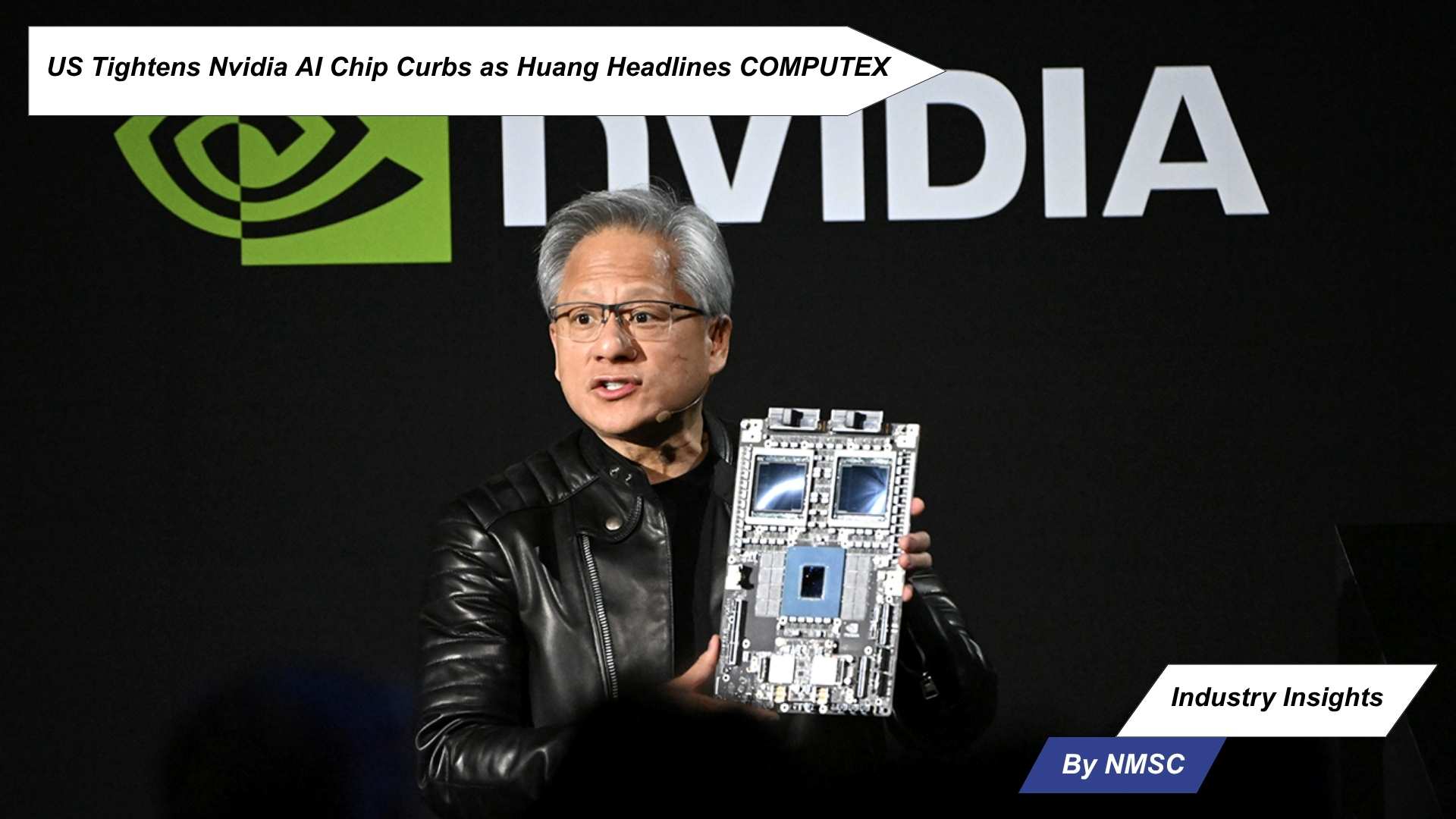
The sudden regulatory tightening landed less than 24 hours before Nvidia CEO Jensen Huang delivered his prominent opening keynote at COMPUTEX 2026 in Taipei. Standing alongside industry titans from Microsoft, Intel, and Samsung, Huang’s presentation arrived as markets aggressively re-evaluated sovereign risk factors alongside raw hardware roadmaps.
Despite the geopolitical headwind, market history suggests structural demand may absorb the shock. During past cycles, stellar product architecture releases frequently offset immediate regulatory anxiety, as seen when Nvidia surged over 10% during previous event windows despite prevailing export constraints.
Structural Market Impact and Competitive Shifts
The regulatory squeeze on Nvidia coincides with aggressive moves from domestic competitors to claim premium market share. Advanced Micro Devices (AMD) recently verified that its Venice EPYC processors have entered high-volume production, representing the industry’s debut high-performance server chip built on Taiwan Semiconductor Manufacturing Company’s (TSMC) ultra-efficient 2nm node.
According to next-generation hardware analysts at Next Move Strategy Consulting, the convergence of tightening regulatory walls and rapid architecture transitions is profoundly reshaping the semiconductor sector.
"The modern AI accelerator domain is transitioning into an era where geographic operational diversity and power-to-performance efficiency override pure raw processing metrics," notes a senior market strategist at Next Move Strategy Consulting. "As Western export frameworks systematically isolate specific regional hubs, major enterprise buyers are reallocating massive capital deployments toward highly diversified, alternative architectural pipelines like TSMC's 2nm node to shield themselves from localized supply chain disruptions."
With high-performance computing demand continuing to scale globally, this multi-front market shift signals a complex era for hardware manufacturers where compliance agility and geographic infrastructure diversity are just as critical as technological supremacy.
Source: Gotrade
Prepared by: Prakhyat Chowdhury
About the Author
 Sanyukta Deb
— Sanyukta Deb is Digital Marketing Team Lead at Next Move Strategy Consulting, where she has led content strategy and technical SEO for the firm's B2B market research publications for over 2 years. Her editorial process translates NextMSC's primary and secondary research — spanning technology, industrial, and consumer sectors — into commercial narratives, backed by search-intent, keyword, and competitive analysis. She brings 5 years of overall experience in digital marketing and content strategy.
Sanyukta Deb
— Sanyukta Deb is Digital Marketing Team Lead at Next Move Strategy Consulting, where she has led content strategy and technical SEO for the firm's B2B market research publications for over 2 years. Her editorial process translates NextMSC's primary and secondary research — spanning technology, industrial, and consumer sectors — into commercial narratives, backed by search-intent, keyword, and competitive analysis. She brings 5 years of overall experience in digital marketing and content strategy.
About the Reviewer
 Debashree Dey
— Debashree Dey is Assistant Manager at Next Move Strategy Consulting, where she supports cross-vertical market content and communications across diverse industries for 6 years. Her professional background includes senior content writing, communications, and published manuscript authorship, with experience developing audience-focused business narratives and maintaining clear, consistent messaging. Her role supports research-led content development and editorial quality across NextMSC publications.
Debashree Dey
— Debashree Dey is Assistant Manager at Next Move Strategy Consulting, where she supports cross-vertical market content and communications across diverse industries for 6 years. Her professional background includes senior content writing, communications, and published manuscript authorship, with experience developing audience-focused business narratives and maintaining clear, consistent messaging. Her role supports research-led content development and editorial quality across NextMSC publications.


















Add Comment