AI in Defense: Dassault, Harmattan Fly NAMIB with Rafale
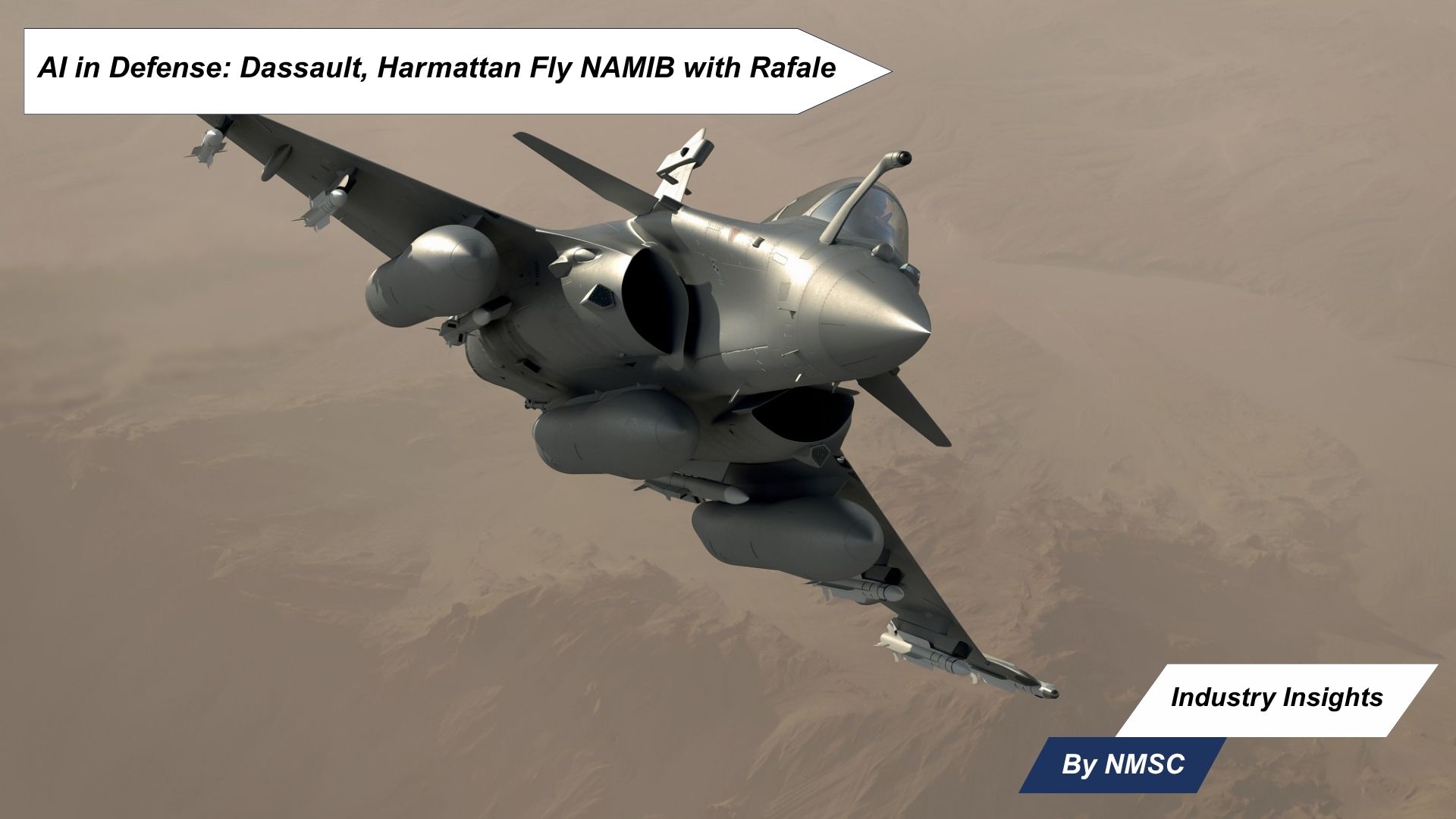
Dassault Aviation, Harmattan AI Complete Rafale Flight With New NAMIB Electronic Warfare AI Payload
SAINT-CLOUD, France — July 13, 2026 — Dassault Aviation and Harmattan AI have completed a collaborative in-flight engagement pairing a Rafale F4 fighter with an unmanned aerial system carrying NAMIB, a newly developed AI in military and defense payload built to detect and geolocate enemy radar emissions. The test, announced Monday, is among the first to demonstrate autonomous drone-fed targeting data flowing directly into a crewed fighter's combat systems, underscoring the deepening integration of artificial intelligence into frontline air combat.
Autonomous Drone Feeds Radar Data Straight to the Rafale
NAMIB is an electronic warfare payload capable of detecting, identifying and geolocating electromagnetic emissions, particularly those from air defense systems. It can be carried by tactical quadcopter drones as well as by longer-endurance, fixed-wing unmanned aircraft. During the flight, NAMIB discreetly detected and precisely geolocated a radar located several dozen kilometers away; the target's location was transmitted to the Rafale, which then simulated a strike.
Development of NAMIB began in January 2026 under a strategic partnership between Dassault Aviation and Harmattan AI aimed at integrating advanced autonomous capabilities into the next generation of air combat systems. “This flight demonstrates the Rafale’s real and tangible multi-domain collaborative combat capabilities,” said Eric Trappier, chairman and CEO of Dassault Aviation, adding that the F4 standard architecture allows the jet to leverage new capabilities such as NAMIB’s detection and geolocation functions as part of a “high-low mix” combining sophisticated crewed systems with autonomous, expendable effectors.
Electronic Warfare Moves to the Edge
“Electronic warfare has become a decisive factor in achieving operational superiority,” said Mouad M’Ghari, co-founder and CEO of Harmattan AI, noting that the demonstration shows such capabilities can now run on lightweight autonomous systems operating close to the threat. Harmattan AI builds mission-ready autonomous systems spanning air defense, intelligence, surveillance and reconnaissance, strike, electronic warfare and command-and-control, and operates across the United States, Europe, the Middle East and Africa.
Key Highlights:
-
NAMIB detected and geolocated a radar several dozen kilometers away, relaying coordinates to a Rafale F4 for a simulated strike
-
The electronic warfare payload can be carried by tactical quadcopters as well as longer-endurance fixed-wing unmanned aircraft
-
Development of NAMIB began in January 2026 under a strategic Dassault Aviation-Harmattan AI partnership
-
The flight demonstrates a “high-low mix” combat concept pairing crewed fighters with autonomous, expendable effectors
Analyst Insight:
According to analysts at Next Move Strategy Consulting, the global AI in military and defense market is projected to reach USD 10.26 billion by the end of 2026, up from USD 9.13 billion in 2025, and is expected to climb to USD 29.39 billion by 2035, reflecting a compound annual growth rate of 12.4% from 2026 to 2035. NMSC analysts note that air systems currently lead AI adoption in defense, driven by demand for persistent intelligence, surveillance and reconnaissance, with electronic warfare and autonomous operations among the fastest-growing application segments as militaries push AI capabilities closer to the point of engagement.
Industry Outlook:
Programs such as NAMIB illustrate a broader shift NMSC has tracked across the sector: air combat AI capabilities are moving from centralized command systems toward lightweight, forward-deployed platforms operating close to the threat. With European and allied forces prioritizing multi-domain collaborative combat architectures, continued investment in autonomous ISR and electronic warfare payloads is expected to support the market's growth through the next decade, even as regulatory scrutiny over autonomous weapons governance remains a moderating factor.
Source: GlobeNewswire (Dassault Aviation)
Prepared By: Rocktim Gogoi
About the Author
 Sanyukta Deb
— Sanyukta Deb is Digital Marketing Team Lead at Next Move Strategy Consulting, where she has led content strategy and technical SEO for the firm's B2B market research publications for over 2 years. Her editorial process translates NextMSC's primary and secondary research — spanning technology, industrial, and consumer sectors — into commercial narratives, backed by search-intent, keyword, and competitive analysis. She brings 5 years of overall experience in digital marketing and content strategy.
Sanyukta Deb
— Sanyukta Deb is Digital Marketing Team Lead at Next Move Strategy Consulting, where she has led content strategy and technical SEO for the firm's B2B market research publications for over 2 years. Her editorial process translates NextMSC's primary and secondary research — spanning technology, industrial, and consumer sectors — into commercial narratives, backed by search-intent, keyword, and competitive analysis. She brings 5 years of overall experience in digital marketing and content strategy.
About the Reviewer
 Debashree Dey
— Debashree Dey is Assistant Manager at Next Move Strategy Consulting, where she supports cross-vertical market content and communications across diverse industries for 6 years. Her professional background includes senior content writing, communications, and published manuscript authorship, with experience developing audience-focused business narratives and maintaining clear, consistent messaging. Her role supports research-led content development and editorial quality across NextMSC publications.
Debashree Dey
— Debashree Dey is Assistant Manager at Next Move Strategy Consulting, where she supports cross-vertical market content and communications across diverse industries for 6 years. Her professional background includes senior content writing, communications, and published manuscript authorship, with experience developing audience-focused business narratives and maintaining clear, consistent messaging. Her role supports research-led content development and editorial quality across NextMSC publications.


















Add Comment