Which Region Dominates the Smart EV Market? Asia-Pacific Holds the Lead
China's NEV Share Hits a Record 61.6% and Exports Pass 4 Million Units as Domestic Demand Softens, Testing Asia-Pacific's 58% Hold on Smart EV Revenue
On 12 October 2026, data from the China Association of Automobile Manufacturers (CAAM), reported by Xinhua and published by China Daily, showed that new energy vehicles accounted for a record 61.6% of China's new car sales in September, the third consecutive month above 60%. Across the first nine months of 2026, NEV sales reached 12.472 million units, a cumulative share of 53.6%, while China exported more than 4 million NEVs, more than double the level of a year earlier, including 571,000 units in September alone. The release gives a current answer to the question that automakers, suppliers and investors in intelligent electric vehicles keep asking: Asia-Pacific, led by China, still dominates, but the basis of that dominance is moving from domestic showrooms toward export markets in Europe, Southeast Asia and Latin America.
According to Next Move Strategy Consulting's Smart EV Market report, the global smart EV market was valued at USD 42.6 billion in 2025 and is projected to reach USD 212.6 billion by 2035, growing at a CAGR of 17.5% from 2026 to 2035. NextMSC primary research and analysis places Asia-Pacific at approximately 58% of 2025 revenue, with China alone accounting for USD 16.80 billion. NMSC's market measures the revenue of the intelligent technology stack inside electric vehicles, including advanced driver-assistance and autonomous driving systems, smart cockpit platforms, connectivity and over-the-air software, so the vehicle-volume data cited in this article from CAAM, the International Energy Agency and the European Automobile Manufacturers' Association serves as the demand base rather than as a substitute for that revenue pool.
For More Information: Download FREE Sample on Smart EV Market Report
Why Asia-Pacific Leads: Production Scale, Price Parity and Policy
The International Energy Agency (IEA) set out the structural case in its Global EV Outlook 2026, released on 20 May 2026. Chinese automakers supplied 60% of the electric cars sold worldwide in 2025, while European and North American automakers were each responsible for about 15%. China built nearly three-quarters of the almost 22 million electric cars produced globally that year and sold more than 13 million at home, an electric share of almost 55% of its new car sales, according to the IEA.
Price is the mechanism behind that volume. The IEA found that nearly 70% of battery electric cars sold in China in 2025 were already cheaper than their conventional equivalents before government incentives, up from around 50% in 2021, and that average battery electric car prices there fell by more than 10% during the year. Policy support is now thinner: from January 2026, China replaced its full purchase tax exemption for new energy vehicles with a 50% reduction and moved its trade-in scheme to price-capped, energy-efficiency-linked incentives, according to the IEA. Global electric car sales of around 3.9 million in the first quarter of 2026 were 8% lower than a year earlier, primarily because of weaker sales in China and the United States, and the IEA recorded that Chinese electric car exports more than doubled over the same quarter, offsetting weaker domestic sales.
Electric Car Sales by Major Market, 2025
|
Market |
2025 electric car sales |
Share of new car sales |
Context |
|
China |
More than 13 million |
Almost 55% |
Six in ten electric cars sold globally |
|
Europe |
4.2 million |
28% |
Sales up more than 30% after tighter EU CO2 standards |
|
United States |
Around 1.5 million |
Just below 10% |
Federal tax credits ended after September 2025; fourth-quarter sales 45% lower year on year |
|
Rest of world (outside the three major markets) |
2 million |
Not reported as a single share |
Up from 1.3 million in 2024 |
Key Industry Developments: Europe, Southeast Asia and Trade Policy
Europe shows how the export engine is landing. The European Automobile Manufacturers' Association (ACEA) reported on 24 September 2026 that battery electric cars accounted for 21.7% of new EU registrations in the first eight months of 2026, level with petrol, and that battery electric registrations rose 62.7% year on year in August, according to Euronews. The South China Morning Post, working from the same ACEA figures against a backdrop of rising petrol prices, calculated that BYD, Chery, Leapmotor and SAIC accounted for about 92% of the net increase in EU registrations in August, with BYD's volume more than doubling to 20,845 units.
Trade policy is adjusting in parallel. On 9 October 2026, after two days of talks in Beijing, the EU and China issued a joint statement reporting an understanding on hybrid vehicle trade in a WTO-compliant manner and agreeing to continue negotiating on tariff reductions and minimum pricing for Chinese electric vehicles, according to EUobserver. EU Trade Commissioner Maroš Šefčovič described the outcome as a first step toward rebalancing trade. China's Ministry of Commerce said on 12 October 2026, citing Eurostat data, that EU imports of hybrid vehicles from China rose from 107,000 in 2024 to 302,000 in 2025, as reported by CGTN.
Outside the three largest markets the pull is stronger still. The IEA reported that electric car sales in Southeast Asia more than doubled in 2025 to more than half a million, close to one in five new cars, and that Chinese-made models made up three-quarters of the Thai market. In Latin America, sales rose 75% to more than 350,000, and just under 85% of the electric cars sold in Brazil were made in China. Across the countries outside China, Europe and the United States, 55% of electric cars sold were imported from China, up from less than 5% five years earlier.
“Electric car sales set new records in close to 100 countries last year.”
- Fatih Birol, Executive Director, International Energy Agency, IEA news release, Close to 30% of cars sold this year are set to be electric as countries and consumers respond to energy crisis, 20 May 2026.
Segment Context: What the Smart Layer Adds
The volume figures above measure electric vehicles, not the intelligent systems inside them. NextMSC primary research and analysis shows that ADAS and Autonomous Driving Systems were the largest technology segment in 2025 at USD 17.89 billion, approximately 42% of the market, while Over-the-Air Software Platforms are the fastest-growing segment at a 24.5% CAGR from 2026 to 2035. By autonomy level, Level 2 Partial Automation held approximately 38% of 2025 revenue, while Level 3 Conditional Automation and Level 4 High Automation are projected to grow at 27.1% and 34.9% CAGR respectively.
Regulation is where regions diverge. China's Ministry of Industry and Information Technology approved its first two Level 3 passenger car models on 15 December 2025, from Changan Automobile and BAIC's Arcfox brand, for limited public deployment, with pilot operations in designated areas of Chongqing and Beijing, according to China Daily's report of 20 January 2026. The IEA counted driverless taxis, all of them electric, operating commercially in more than 20 cities, mainly in China and the United States. NextMSC primary research and analysis finds that fragmented Level 3 and Level 4 approval pathways remain a restraint in North America and Europe.
Regional Outlook: Leadership Today, Faster Growth Elsewhere
NextMSC's regional model confirms Asia-Pacific's lead and shows where the gap is likely to narrow. In 2025, Asia-Pacific generated USD 24.71 billion of the market's USD 42.6 billion, ahead of North America at USD 9.37 billion and Europe at USD 6.39 billion. Asia-Pacific's projected CAGR of 16.8% from 2026 to 2035 sits below the 17.5% market average, while North America is projected to grow at 19.0%, the fastest among the major regions, on robotaxi expansion and over-the-air autonomy monetisation, and Middle East & Africa at 20.9% from a base of USD 1.28 billion. China, the largest single country, is projected to rise from USD 16.80 billion in 2025 to USD 70.16 billion by 2035 at a 15.4% CAGR, while India, at USD 1.48 billion in 2025, is projected to be the fastest-growing country at 24.1%.
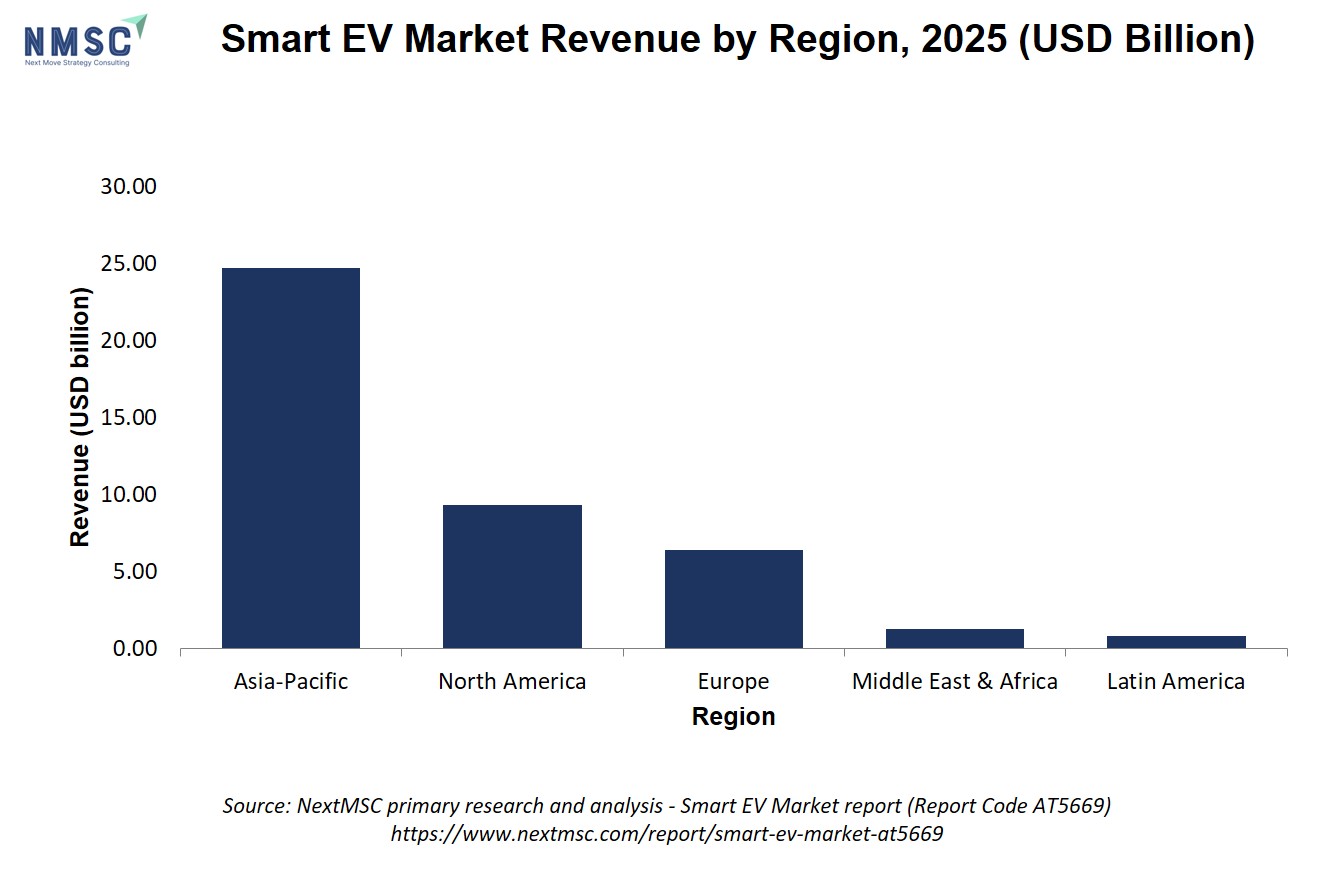
Smart EV Market by Region, 2025 and 2035
|
Region |
2025 (USD billion) |
2035 (USD billion) |
CAGR 2026–2035 |
Key driver |
|
Asia-Pacific |
24.71 |
116.93 |
16.8% |
Intense smart EV competition and rapid ADAS commercialization |
|
North America |
9.37 |
53.15 |
19.0% |
Robotaxi expansion and OTA-driven autonomy monetization |
|
Europe |
6.39 |
29.76 |
16.6% |
OEM software-defined vehicle investment and EV mandates |
|
Middle East & Africa |
1.28 |
8.50 |
20.9% |
Smart city investment and premium smart EV adoption |
|
Latin America |
0.85 |
4.25 |
17.4% |
Rising EV adoption and expanding connected vehicle infrastructure |
|
Total |
42.60 |
212.60 |
17.5% |
— |
Growth Drivers and Restraints
NextMSC primary research and analysis weights the factors shaping the regional split as follows, with the largest single driver concentrated in Asia-Pacific and the largest restraint concentrated in North America and Europe.
Growth Catalyst and Risk Assessment Matrix
|
Factor |
Type |
Impact on CAGR |
Geographic relevance |
Timeline |
|
Rapid Level 2+ and Level 3 ADAS commercialization in China |
Driver |
+5.4% |
Asia-Pacific |
2026–2032 |
|
Rising consumer expectation for continuous OTA software improvement |
Driver |
+3.6% |
Global |
2026–2035 |
|
Expanding smart EV price competition broadening mass-market access |
Driver |
+2.8% |
Asia-Pacific, Latin America |
2026–2033 |
|
Growing robotaxi and autonomous fleet pilot programs |
Driver |
+1.5% |
North America, Asia-Pacific |
2026–2033 |
|
Fragmented Level 3/4 regulatory approval pathways across regions |
Restraint |
−2.1% |
North America, Europe |
2026–2031 |
|
Consumer data privacy and cybersecurity compliance requirements |
Restraint |
−0.8% |
Europe, North America |
2026–2029 |
NMSC Strategic Perspective: Dominance Is Shifting From Showrooms to Supply Chains
NextMSC primary research and analysis reads the CAAM, IEA and ACEA releases as evidence of a change in where regional dominance is earned. Asia-Pacific's share of roughly 58% of 2025 smart EV revenue rests on three linked advantages that the IEA documents: nearly 70% of China's battery electric cars priced below conventional equivalents before incentives, nearly three-quarters of global electric car production, and more than 80% of global battery cell output. Together they give Chinese manufacturers a fleet large enough to spread the cost of advanced driver-assistance hardware and over-the-air platforms across millions of vehicles, which is the economic logic behind the 24.5% CAGR that NMSC projects for Over-the-Air Software Platforms.
The second shift is geographic. With domestic electric car sales softer after the purchase tax change, exports have become the growth channel: more than 4 million NEVs left China in the first nine months of 2026, and Chinese imports accounted for 55% of electric car sales outside the three major markets in 2025. NextMSC primary research and analysis concludes that Asia-Pacific's influence on other regions therefore extends beyond its own revenue share, because intelligent features reach Europe, Southeast Asia and Latin America embedded in Chinese-built platforms.
The third is where the lead is most exposed. In NMSC's model Asia-Pacific grows below the market average while North America and Middle East & Africa grow faster, so the lead narrows even as the region remains the largest in 2035, at USD 116.93 billion against USD 53.15 billion for North America. Three pressures bear on that path: trade measures such as the EU and China talks on hybrid and electric vehicle duties; price competition that NMSC identifies as compressing vehicle-level margins among Chinese smart EV brands; and fragmented Level 3 and Level 4 approvals, which NMSC weights at −2.1% on CAGR in North America and Europe through 2031.
Competitive Landscape: Who Is Gaining Share, and Where
NextMSC primary research and analysis profiles 20 companies in the market, including Tesla, BYD, NIO, XPeng and Li Auto, and describes the structure as moderately fragmented, with Chinese specialists competing on autonomy and update cadence against traditional automakers. The regional evidence from named, traceable sources points the same way. In the Middle East, the IEA reported that BYD, which entered the regional market in 2022, held a 60% share of electric car sales in 2025, while Tesla's share fell to around 15% from about half in 2020. In Africa, BYD accounted for 35% of electric car sales in 2025, up from 4% in 2023, and in Mexico it captured more than 70% of the electric vehicle market. In Europe, ACEA figures reported by the South China Morning Post show BYD, Chery, Leapmotor and SAIC capturing most of the growth in EU registrations in August 2026.
Bottom Line
Asia-Pacific dominates the smart EV market today, and on NextMSC's figures it keeps that position through 2035, with USD 24.71 billion of the USD 42.6 billion market in 2025 and a projected USD 116.93 billion by 2035. The October 2026 CAAM release shows why: a record 61.6% NEV share in China and more than 4 million NEV exports in nine months. The lead is nonetheless changing character. Domestic demand in China is softer after the purchase tax change, Chinese imports accounted for 55% of electric car sales outside the three major markets, and the regions growing fastest in NMSC's model, North America at 19.0% and Middle East & Africa at 20.9%, are doing so from smaller bases. Three variables deserve tracking: how the EU and China settle hybrid and electric vehicle duties, how quickly Level 3 and Level 4 approvals spread beyond China, and whether Chinese brands can sustain pricing against margin pressure. Stakeholders should watch export volumes alongside domestic sales.
About Next Move Strategy Consulting
Next Move Strategy Consulting is a premier market research and management consulting firm that has been committed to provide strategically analysed well documented latest research reports to its clients. The research industry is flooded with many firms to choose from, what makes NMSC different from the rest is its top-quality research and the obsession of turning data into knowledge by dissecting every bit of it and providing fact-based research recommendation that is supported by information collected from over 500 million websites, paid databases, industry journals and one on one consultations with industry experts across a diverse range of industry sectors. The high-quality customized research reports with actionable insights and excellent end-to-end customer service help our clients to take critical business decisions that enables them to move beyond time and have competitive edge in the industry.
We have been servicing over 1000 customers globally that includes 90% of the Fortune 500 companies over a decade. Our analysts are constantly tracking various high growth markets and identifying hidden opportunities in each sector or the industry. We provide one of the industry’s best quality syndicate as well as custom research reports across 10 different industry verticals. We are committed to deliver high quality research solutions in accordance to your business needs. Our industry standard delivery solutions that ranges from the pre consultation to after-sales services, provide an excellent client experience and ensure right strategic decision making for businesses.
For more information, please contact:
Next Move Strategy Consulting
5th Floor 867 Boylston St, STE 500,
Boston, MA 02116, U.S.
E-Mail: [email protected]
Direct: +1-217-650-7991
Website: www.nextmsc.com
About the Author
 Sanyukta Deb
— Sanyukta Deb is Digital Marketing Team Lead at Next Move Strategy Consulting, where she has led content strategy and technical SEO for the firm's B2B market research publications for over 2 years. Her editorial process translates NextMSC's primary and secondary research — spanning technology, industrial, and consumer sectors — into commercial narratives, backed by search-intent, keyword, and competitive analysis. She brings 5 years of overall experience in digital marketing and content strategy.
About the Reviewer
 Debashree Dey
— Debashree Dey is Assistant Manager at Next Move Strategy Consulting, where she supports cross-vertical market content and communications across diverse industries for 6 years. Her professional background includes senior content writing, communications, and published manuscript authorship, with experience developing audience-focused business narratives and maintaining clear, consistent messaging. Her role supports research-led content development and editorial quality across NextMSC publications.














Add Comment