Acetone and Phosphorus Derivative Market By Product Type {Acetone Base and Derivatives (Acetone Solvent, Methyl Methacrylate, & Others) and Phosphorus Derivatives (Phosphoric Acid, Phosphorus Pentoxide, Phosphorus Chlorides, & Others)}, By Grade (Industrial Grade, Specialty Grade), By Application (Fertilizers, Detergents, Food Additives, & Others), and By End User (Agriculture, Automotive, Building and Construction, & Others) – Global Opportunity Analysis and Industry Forecast, 2025–2030
Industry: Materials and Chemical | Publishing Date: June 9, 2026 | Last Updated: October 16, 2026 | No of Pages: N/A | No. of Tables: N/A | No. of Figures: N/A | Format: PDF | Report Code: MC3850
Industry Outlook
The Acetone and Phosphorus Derivative Market size was valued at USD 70.29 billion in 2024 and is expected to reach USD 73.20 billion by 2025. Looking ahead, the industry is projected to expand significantly, reaching USD 89.63 billion by 2030, registering a CAGR of 7.24% from 2025 to 2030.
The acetone and phosphorus derivative market is expanding steadily, driven by growing demand across pharmaceuticals, agrochemicals, electronics, and speciality chemical industries. Acetone serves as a key solvent and chemical intermediate in the production of bisphenol-A, methyl methacrylate, and pharmaceuticals, while phosphorus derivatives are essential for flame retardants, fertilisers, and water treatment chemicals. Rising industrialisation, advancements in materials science, and expanding applications in lithium-ion batteries and semiconductor manufacturing are driving market growth.
Manufacturers are focusing on process optimisation, sustainable production routes, and recycling of by-products to reduce environmental impact. By combining chemical innovation, sustainability, and diversified end-use applications, the acetone and phosphorus derivative market is meeting evolving industrial demands while supporting the transition toward eco-efficient chemical manufacturing.
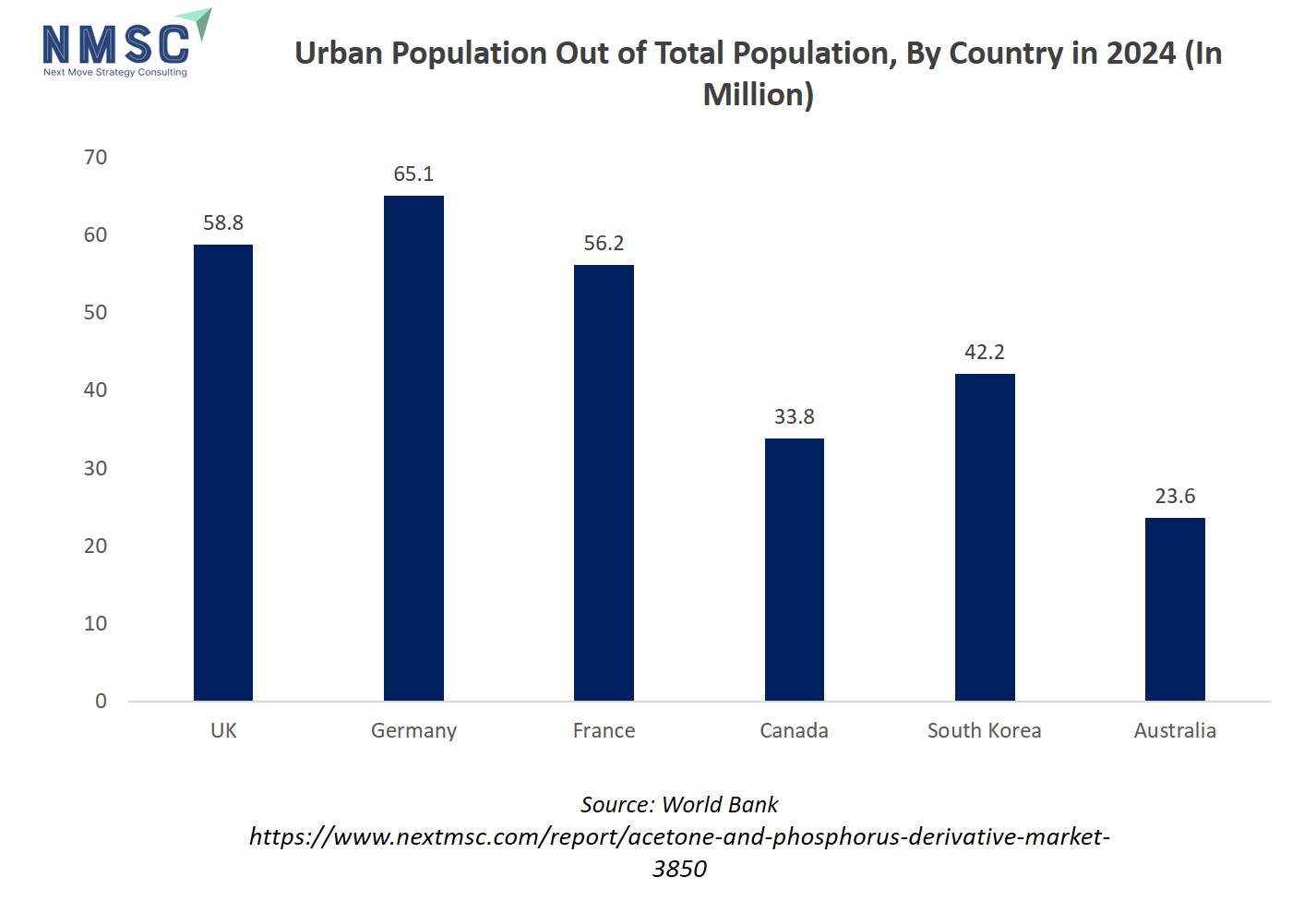
The chart presents the urban population in millions for six countries in 2024, with Germany (65.1 million), the UK (58.8 million), and France (56.2 million) leading, while Australia (23.6 million) and Canada (33.8 million) trail behind. High urbanisation rates correlate with greater demand for infrastructure, chemicals, and modern industrial inputs. This directly impacts the acetone and phosphorus derivative market, as cities require large quantities of these compounds for applications in construction, manufacturing, consumer goods, and water treatment. As urban populations rise, demand for speciality chemicals to support growing industries and urban life accelerates, fostering innovation and expansion within the acetone and phosphorus derivative sectors.
What Are the Key Acetone and Phosphorus Derivative Market Trends?
How Is the Growing Urban Population Reshaping the Acetone and Phosphorus Derivative Market?
Rapid urbanisation is material to demand patterns, 57.7% of the world lived in urban areas in 2024, concentrating consumption, construction and processed-food demand into cities. As more people move to cities, demand for housing, infrastructure and urban consumer goods increases, driving construction activity, durable consumer-packaged goods and higher volumes of processed food that underpin fertiliser demand in surrounding agricultural belts. This creates a compounded pull for acetone solvent. Companies that map urban growth corridors prioritise regional blending hubs, waterborne and low-VOC coating formulations, small-package logistics for retailers, and long-term offtake agreements with polymer and coatings manufacturers serving urban construction projects. A focused action is to allocate commercial resources to fast-growing city-regions, pair capacity investments with last-mile distribution, and certify products for indoor air quality and food-grade use to capture urban premium demand.
How Is Acetone’s Role as a Feedstock for MMA and BPA Affecting the Acetone Market Dynamics?
Acetone remains closely tied to phenol production economics because most industrial acetone is co-generated with phenol, downstream demand for MMA and BPA acetone volumes. Recent company reporting confirms that acetone supply flexibility is limited by phenol plant cycles and maintenance schedules. When demand for acrylics or polycarbonate rises, acetone tightness quickly emerges because standalone acetone capacity additions are rare. For producers, the actionable insight is to develop commercial flexibility, short-term offtake hedges for acetone and upstream feedstock contracting for phenol producers, or to pursue tolling arrangements and joint ventures with MMA and BPA converters to stabilise margins.
How Are Regulatory and Performance Shifts Driving Speciality Phosphorus Products and Flame-Retardant Substitution?
Regulatory pressure on halogenated flame retardants and stricter flammability and safety standards in construction and electronics is accelerating substitution toward phosphorus-based retardants and speciality organophosphates. Industry reporting and capacity plans indicate increasing interest in higher-margin, speciality phosphorus chemistries that meet non-halogen regulatory regimes. Companies that certify product safety and secure supply chains for food and pharma-grade phosphates will capture premiums. An immediate action is to prioritise R&D and regulatory compliance investments for non-halogen flame retardants and to secure feedstock contracts for a reliable supply of purified phosphoric acid.
What Are the Key Market Drivers, Breakthroughs, and Investment Opportunities That Will Shape the Acetone and Phosphorus Derivative Market in the Next Decade?
Global demand for phosphorus derivatives is underpinned by fertiliser needs for food security and by upstream investment in phosphate rock and acid conversion, particularly in APAC and Morocco. Primary organisations tracking production report year-on-year increases in phosphoric acid and MAP/DAP output in 2024 as supply recovers from prior disruptions, which strengthens the base demand for industrial phosphates used beyond fertilisers. Meanwhile, acetone’s market position is shaped by its co-production dynamics with phenol and its feedstock role for key downstream polymers and resins, supply is therefore responsive to phenol economics and plant operations. Collectively, these drivers create differentiated opportunities for speciality grades and higher-purity derivatives, while also exposing participants to feedstock price swings and energy costs.
Growth Drivers:
How Is Agricultural Demand for Fertilisers Driving Phosphorus Derivative Volumes?
Global fertiliser consumption rebounded strongly in 2024, with phosphoric acid and MAP/DAP output estimated to rise by around 4% year-on-year, supported by government-backed agricultural programs and favourable crop economics. This recovery has directly lifted demand for phosphate intermediates, tightening production-to-offtake linkages across the value chain. Producers are increasingly pursuing long-term supply contracts and backward integration to secure feedstock access and stabilise margins. Moreover, investments in acid purification and process efficiency are enabling suppliers to diversify toward higher-value speciality markets, such as food-grade and electronic-grade phosphates, reducing exposure to cyclical bulk fertiliser demand.
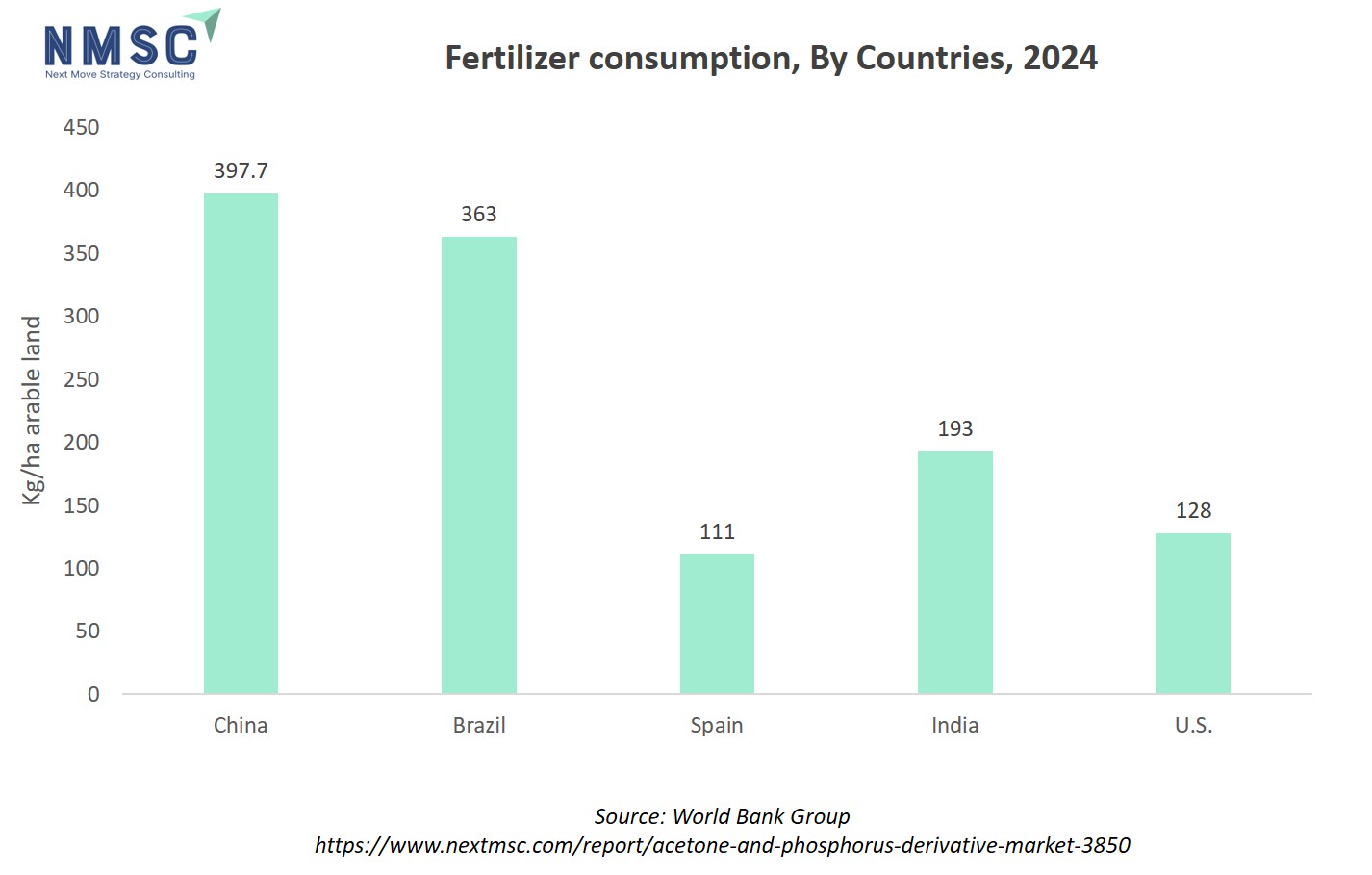
The chart displays fertiliser consumption (kg per hectare of arable land) in 2024, with China leading at 397.7, followed by Brazil (363), India (193), the U.S. (128), and Spain (111). These high consumption rates, especially in China and Brazil, reflect intensive agricultural practices aimed at maximising food production. The extensive use of fertilisers heavily stimulates demand for phosphorus derivatives, a critical component in many fertilisers, driving market growth in regions with large agricultural bases. Additionally, acetone is widely used in the production of agricultural chemicals and solvents, so increased fertiliser application indirectly supports in the acetone and phosphorus derivative market growth for formulation, processing, and support of modern farming practices.
How Is Polymer and Speciality Chemical Demand Sustaining Acetone Volumes?
Global demand for acetone remains underpinned by its essential role in acrylic, polycarbonate, and speciality chemical synthesis. Since acetone is predominantly co-produced with phenol, demand dynamics closely follow phenol-linked markets such as automotive plastics, coatings, and construction materials. The 2024 resurgence in downstream manufacturing activity, particularly in Asia and North America, has strengthened acetone consumption trends. Producers are increasingly aligning with MMA and BPA manufacturers through integrated value-chain partnerships to enhance resilience against cyclical solvent price fluctuations. Additionally, the industry is shifting toward captive conversion and derivative diversification strategies to improve margin stability and reduce exposure to commodity market swings.
Growth Inhibitors:
What Feedstock and Price Volatility Risks Constrain Market Growth?
Feedstock price volatility remains the most significant constraint for both phosphoric acid and acetone markets. For acetone, fluctuations in benzene and cumene prices, driven by energy market uncertainty, rapidly erode profitability. Similarly, phosphate rock price instability, freight cost inflation, and geopolitical supply disruptions continue to pressure phosphoric acid producers. These factors lead to unplanned production curtailments or delays in capacity ramp-ups. To mitigate these risks, leading producers are adopting dynamic hedging strategies, diversifying raw material sourcing, and negotiating flexible, index-linked contracts with buyers. Enhanced operational efficiency and real-time market analytics are also becoming crucial for protecting margins amid volatile feedstock conditions.
Where Can Investors Find Higher Returns in the Value Chain?
Investment opportunities increasingly centre on high-purity phosphoric acid and speciality organophosphate production, targeting high-growth sectors such as electronics, batteries, and pharmaceuticals. These applications command premium pricing and offer insulation from traditional fertiliser cyclicality. Parallel to this, the growing emphasis on circular economy solutions has elevated interest in acetone recycling technologies and bio-based acetone pathways, which align with global decarbonization trends. Investors should prioritise brownfield capacity upgrades and purification technologies that improve process efficiency and output quality. Forming strategic partnerships with downstream speciality manufacturers unlock integrated value, enhancing long-term return potential within the evolving phosphorus and acetone derivative ecosystems.
How Acetone and Phosphorus Derivative Market Segmented in This Report, And What Are the Key Insights from the Segmentation Analysis?
By Product Type Insights
Are Acetone-Based and Derivatives or Phosphorus Derivatives Dominating Market Value and Growth Trajectories?
Based on product type, the market is segmented into acetone-based and derivatives, and phosphorus derivatives. The acetone base and derivatives segment includes acetone solvent, methyl methacrylate, bisphenol A, acetone cyanohydrin, and others. The phosphorus derivatives segment comprises phosphoric acid, phosphorus pentoxide, phosphorus chlorides, ammonium phosphate, and industrial phosphates.
Global value and growth are bifurcated, acetone and its derivatives are driven by solvent markets and polymer feedstock demand (MMA, BPA), whereas phosphorus derivatives are dominated by fertiliser demand and industrial phosphates. In volume terms, fertiliser-linked phosphates command larger tonnage flows, while acetone derivatives capture higher per-tonne value in speciality chemical chains. The strategic insight is that companies focused on phosphorus derivatives must manage commodity cycles and invest in purification for speciality markets, while acetone value capture depends on integration into MMA/BPA supply chains and the ability to monetise high-purity or speciality grades.
By Grade Insights
Is Industrial Grade or Speciality Grade Commanding a Stronger Margin Expansion?
Based on grade, the acetone and phosphorus derivative market is segmented into industrial grade and speciality grade.
The grade split separates bulk industrial grades (large volumes, lower margins) from speciality grades (food, pharma, battery-grade phosphates, high-purity acetone). Demand for speciality grades is expanding due to electronics, battery and pharmaceutical requirements. Investment in purification and quality certification yields margin uplift and reduces exposure to commodity cycles. Capacity additions that produce high-purity streams are strategic priorities for firms seeking asymmetric returns and resilience to bulk fertiliser price cycles.
By Application Insights
Which Applications are Dictating Demand Patterns?
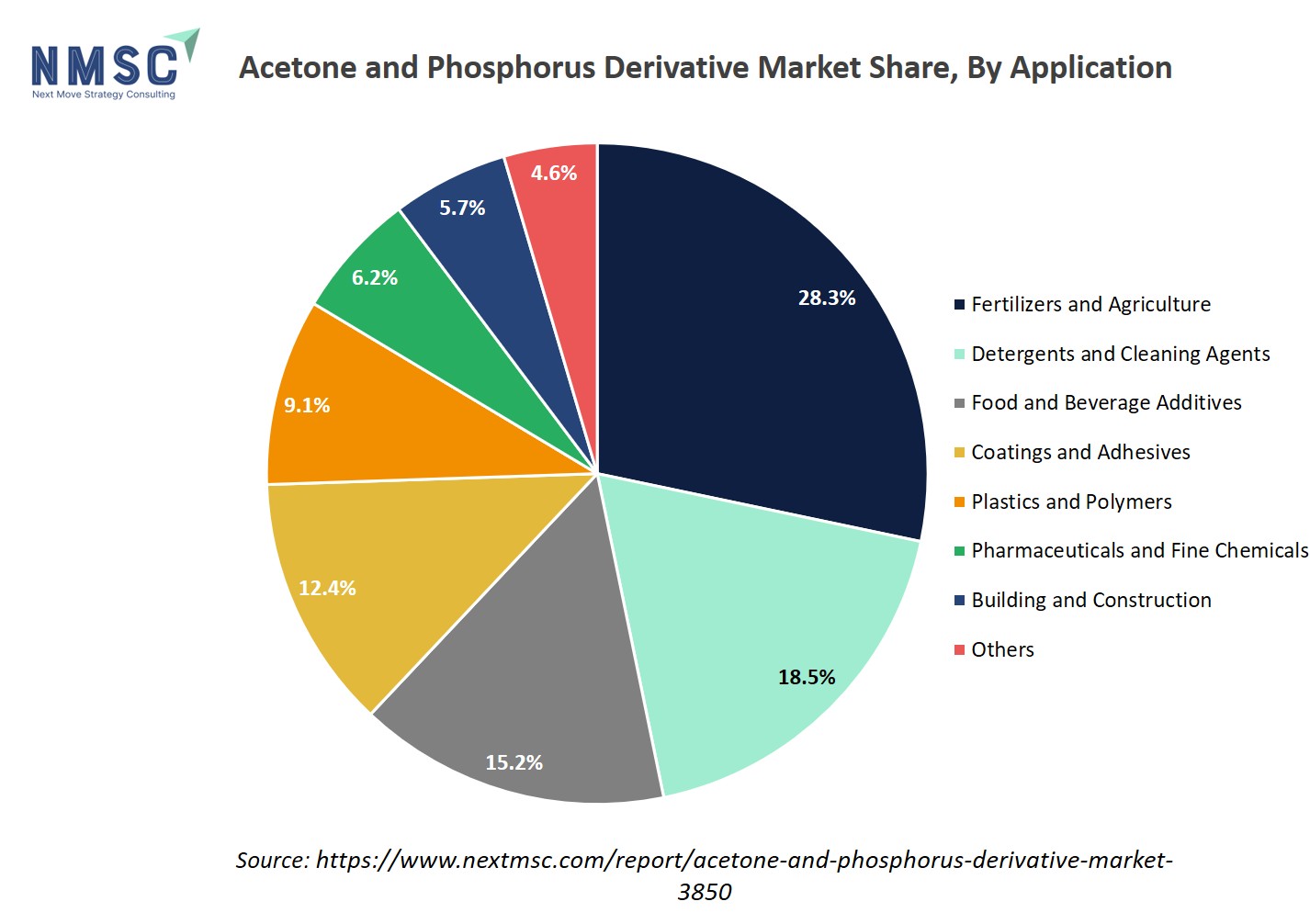
Based on application, the acetone and phosphorus derivative market is segmented into fertilisers and agriculture, detergents and cleaning agents, food and beverage additives, coatings and adhesives, plastics and polymers, pharmaceuticals and fine chemicals, building and construction, and others.
Fertilisers and agriculture dominate phosphorus derivative volumes, while coatings, adhesives, plastics and pharmaceuticals are major acetone end markets. Growth in construction and automotive (polycarbonate and acrylic demand) supports acetone-linked volumes, simultaneous food security measures and fertiliser restocking cycles support phosphorus demand. Firms should align capacity with regional agricultural cycles and seek long-term contracts with polymer and pharma manufacturers to stabilise offtake.
By End User Insights
Are Agriculture or Chemical Manufacturing Driving Purchase Decisions and Investment?
Based on end user, the acetone and phosphorus derivative market is segmented into agriculture, automotive, building and construction, consumer goods and packaging, chemical and material manufacturing, electronics and electrical, and others.
Agriculture drives large tonnage purchases for phosphates and remains the primary end user for phosphorus derivatives, while chemical and material manufacturers (polymers, speciality chemicals, pharma) are the primary end users for acetone derivatives. This split implies differing contract structures, bulk commodity contracts for agriculture, and shorter, quality/grade-sensitive contracts for chemical manufacturers. Strategically, suppliers should offer differentiated commercial models for each end-user cohort.
Regional Outlook
The acetone and phosphorus derivative market is geographically studied across North America, Europe, Asia Pacific, Middle East & Africa, and Latin America and each region is further studied across countries.
Acetone and Phosphorus Derivative Market in North America
North America demonstrates stable industrial demand for acetone derivatives across plastics, coatings, and composites, supported by downstream manufacturing in automotive and construction sectors. Fertiliser consumption remains steady but is tempered by production rationalisation as firms adjust to feedstock availability and global phosphate pricing. U.S. and Canadian producers continue prioritising energy efficiency, margin enhancement, and sustainability-linked capital projects. Increased interest in circular chemistry, feedstock recovery, and renewable acetone pathways reflects long-term decarbonization goals. Supply-chain resilience, particularly in phosphate sourcing and logistics, remains a key regional strategic priority.
Acetone and Phosphorus Derivative Market in the United States
The U.S. market focuses on high-purity chemical manufacturing, emphasising acetone derivatives for advanced materials, automotive coatings, and electronic applications. Acetone demand tracks phenol and MMA cycles, while fertiliser markets continue to adjust to trade dependencies and potash price volatility. Producers are expanding sustainability programs and digitalising operations to optimise plant efficiency and emissions performance. Speciality phosphates and solvent derivatives are gaining importance as downstream industries adopt tighter purity standards and ESG reporting frameworks. Ongoing R&D in circular acetone and bio-feedstock integration underlines the U.S. leadership in speciality and performance chemicals.
Acetone and Phosphorus Derivative Market in Canada
Canada’s market is underpinned by its position as a major fertiliser and nutrient exporter, with strong phosphate and potash linkages to global supply chains. Nutrien and other key players emphasise logistics optimisation, blending services, and sustainability-driven nutrient solutions. Fertiliser demand is supported by agricultural exports and stable domestic consumption, while downstream speciality chemical production remains limited but strategically positioned near logistics hubs. Policy support for clean technology investments and energy transition initiatives offers future potential for value-added phosphate processing and cleaner acetone production pathways in Canada’s industrial corridors.
Acetone and Phosphorus Derivative Market in Europe
Europe’s acetone and phosphorus derivative market is characterised by strong demand for speciality chemicals, polymers, and coatings, alongside a constrained domestic phosphate rock supply. Heavy import dependence on Morocco, Russia, and North Africa has heightened focus on supply diversification and geopolitical risk management. European producers continue to invest in recycling infrastructure, bio-based acetone projects, and purification technologies for high-purity phosphates. Sustainability regulations, particularly under REACH and the Green Deal, are accelerating the shift toward circular production and low-emission chemical processes. Integration of digital monitoring and process automation enhances competitiveness despite high input costs.
Acetone and Phosphorus Derivative Market in the United Kingdom
The U.K. market retains strong specialisation in high-value acetone and phosphate derivatives, leveraging its logistics and distribution hubs to serve Europe and overseas markets. Post-Brexit regulatory realignment and domestic sustainability targets have elevated compliance requirements for chemical producers. Firms are prioritising traceability, green certification, and advanced purification to meet end-user standards in pharmaceuticals and coatings. Investment in low-carbon and circular solutions remains a policy priority, aligning with broader net-zero commitments and green industrial growth strategies. This transition reinforces the U.K.’s position as a niche supplier of premium-grade chemical intermediates.
Acetone and Phosphorus Derivative Market in Germany
Germany’s acetone market is anchored by its robust automotive, construction, and polymer industries, which drive steady demand for polycarbonates and acrylic intermediates. Phosphate use is concentrated in speciality and industrial formulations rather than fertilisers. Strong environmental policies and industrial partnerships are accelerating recycling pathways and green chemistry adoption. German firms are increasingly investing in energy-efficient acetone recovery and high-purity phosphate purification technologies. The alignment with EU decarbonization frameworks and advanced automation systems reinforces Germany’s leadership in sustainable, high-performance materials.
Acetone and Phosphorus Derivative Market in France
France maintains a balanced chemical sector with clusters producing speciality acetone derivatives for coatings, pharmaceuticals, and cosmetics. Fertiliser demand trends are influenced by EU agricultural reforms promoting nutrient efficiency and carbon-conscious farming. French manufacturers are increasingly targeting high-specification export markets, focusing on quality certification and circular process integration. The government’s green reindustrialisation policies encourage modernisation of legacy facilities, while collaborations within European phosphate supply chains help offset limited domestic feedstock resources.
Acetone and Phosphorus Derivative Market in Italy
Italy’s manufacturing, automotive, and construction sectors drive robust demand for acetone-derived polymers and coatings. The market benefits from regional integration across southern Europe, with industrial clusters in northern Italy serving as major consumers of solvents and intermediates. Fertiliser use remains stable, supporting agricultural exports. Companies are gradually modernising production lines to improve efficiency and align with EU sustainability standards. Imports of phosphates and speciality intermediates remain critical due to limited domestic raw material availability.
Acetone and Phosphorus Derivative Market in Spain
Spain’s chemical and agricultural economies underpin dual demand for acetone and phosphate derivatives. Construction activity sustains coatings and adhesives demand, while fertiliser consumption remains cyclical with Mediterranean crop output. Policy support for renewable energy and circular economy initiatives is fostering interest in bio-acetone and waste-derived phosphate recovery projects. Spain’s ports and trade corridors position it as a strategic hub for importing raw materials and redistributing high-value chemical intermediates across southern Europe and North Africa.
Acetone and Phosphorus Derivative Market in the Nordics
Nordic markets emphasise sustainable production and sourcing practices across chemical value chains. Demand is concentrated in speciality and high-purity acetone derivatives for advanced coatings and electronics, along with precision fertiliser applications in agriculture. Government-backed decarbonization programs and corporate ESG commitments are accelerating the adoption of renewable energy and bio-based feedstocks. Nordic producers and distributors increasingly differentiate through low-carbon footprint certification and closed-loop recycling systems.
Acetone and Phosphorus Derivative Market in the Asia-Pacific
Asia-Pacific remains the global growth engine for chemical solvent, driven by rapid industrialization, expanding construction, and agricultural intensification. China, India, and Southeast Asia are adding significant production capacity, reshaping global trade balances. Fertilizer consumption remains robust, while rising demand for electronics, polymers, and specialty chemicals fuels acetone offtake. Regional investments in technology upgrades, emission control, and circular production support long-term competitiveness. Governments increasingly promote self-sufficiency in phosphate and acetone derivatives through policy-driven industrial expansion.
Acetone and Phosphorus Derivative Market in China
China dominates global capacity for phosphates and acetone derivatives, underpinned by its vast chemical manufacturing ecosystem. The country is the largest producer and consumer of high-purity phosphates for batteries, electronics, and agriculture. Industrial policies favour energy efficiency and vertical integration, linking upstream rock processing with downstream speciality applications. Domestic polymer and coatings demand ensures consistent acetone utilisation, while exports of purified intermediates continue to expand regionally. Ongoing investment in purification and circular recovery technologies strengthens China’s global leadership position.
Acetone and Phosphorus Derivative Market in Japan
Japan’s chemical industry prioritises high-purity, speciality-grade acetone and phosphate derivatives used in semiconductors, pharmaceuticals, and precision coatings. The market favours certified, low-impurity products supported by rigorous quality and sustainability standards. Japanese firms are early adopters of advanced purification and closed-loop recycling technologies. Ongoing innovation in eco-friendly solvents and electronic-grade phosphates underscores the country’s leadership in high-tech materials production. Import reliance for phosphate rock persists, but strategic sourcing ensures stability.
Acetone and Phosphorus Derivative Market in India
India’s demand for phosphates continues to grow with expanding agricultural requirements and government initiatives for domestic fertiliser capacity enhancement. Import substitution programs and public-private partnerships are accelerating new phosphate projects. Parallelly, acetone demand is increasing across plastics, coatings, and consumer goods manufacturing. The Make-in-India strategy and green industrial policy frameworks are encouraging investments in localised chemical production, while feedstock diversification and infrastructure upgrades aim to reduce supply vulnerabilities.
Acetone and Phosphorus Derivative Market in South Korea
South Korea’s advanced manufacturing base drives strong demand for high-purity acetone and phosphate derivatives used in semiconductors, displays, and battery materials. The country’s focus on clean technology and process innovation encourages circular acetone recovery and phosphate recycling systems. Strategic investments in R&D and partnerships with global chemical majors support technology transfer and export competitiveness.
Acetone and Phosphorus Derivative Market in Indonesia
Indonesia’s market reflects expanding agricultural phosphate use and rising industrial consumption of acetone in coatings, adhesives, and consumer goods. Fertiliser demand is supported by government programs for productivity enhancement, while the chemical sector benefits from downstream diversification. Ongoing infrastructure and logistics improvements facilitate regional trade integration, positioning Indonesia as a growing hub within Southeast Asia’s chemical value chain.
Acetone and Phosphorus Derivative Market in Australia
Australia serves as a regional exporter of mineral resources and agricultural products while importing speciality chemical intermediates. Fertiliser demand remains high across export-oriented farming regions, supported by nutrient efficiency initiatives. The chemical sector is exploring sustainable processing and circular production models to align with national emissions reduction goals. Opportunities exist in regional supply-chain integration for phosphate and acetone derivatives to meet growing Asia-Pacific demand.
Acetone and Phosphorus Derivative Market in Latin America
Latin America’s phosphate and acetone derivative market is evolving with capacity expansions and logistics modernisation across key economies. Brazil and Chile continue to lead in fertiliser production and agricultural exports, while Mexico and Argentina strengthen downstream polymer and coatings industries. Trade integration under regional agreements supports increased movement of intermediates. Producers are investing in sustainable feedstock sourcing and process upgrades to enhance export competitiveness and align with global ESG expectations.
Acetone and Phosphorus Derivative Market in the Middle East & Africa
The Middle East and Africa represent strategic supply centres for global phosphate and acetone value chains. Morocco remains the dominant exporter of phosphate rock and phosphoric acid, while Gulf economies invest in integrated downstream fertiliser and chemical complexes. African nations are developing local phosphate projects to reduce import reliance and capture more value domestically. Growing demand for sustainable fertilisers and specialty chemicals positions the region as a key partner in global energy and agricultural transitions.
Competitive Landscape
Which Companies Dominate the Acetone and Phosphorus Derivative Market and How Do They Compete?
Large integrated chemical firms (INEOS Phenol, Celanese, LyondellBasell) and major phosphate/fertiliser groups (Nutrien, PhosAgro, Mosaic, OCP, ICL) dominate by scale and vertical integration. Competition is shaped by feedstock access, downstream conversion capabilities, and global logistics, regional specialists compete on local distribution and tailored fertiliser blends. Public filings show a revenue focus on operational resilience and margin protection through integration.
Market Dominated by Acetone and Phosphorus Derivative Giants and Specialists
The market is divided between two dominant participant groups, integrated chemical majors such as INEOS Phenol, Celanese, LyondellBasell, and Eastman, which control acetone–phenol value chains, and vertically integrated fertiliser and phosphate groups including Nutrien, PhosAgro, Mosaic, OCP, and ICL, which manage phosphate rock and phosphoric acid flows. Competition revolves around production scale, feedstock security, and the capability to deliver both bulk fertilisers and certified speciality-grade derivatives. Integrated players leverage downstream conversion capacity to stabilise margins and enhance customer retention. Feedstock integration, sustainability performance, and innovation in purification and speciality formulations increasingly determine long-term competitiveness across both chemical and fertiliser verticals.
Innovation and Adaptability Drive Market Success
Firms investing in purification technologies, speciality R&D, and sustainable production routes, such as low-carbon processes, solvent recovery, and bio-based feedstocks, are achieving clear competitive advantages. Recent company reports highlight capital allocation toward operational reliability, regulatory compliance, and high-value product portfolios, including electronic- and pharmaceutical-grade phosphates. The ability to transition from commodity to speciality markets while securing long-term offtake contracts is becoming a key differentiator for profitability and resilience in cyclic conditions.
Market Players to Opt for Merger & Acquisition Strategies to Expand Their Presence
Mergers, acquisitions, and strategic asset trades continue to serve as principal pathways for achieving scale, regional diversification, and feedstock control. Recent examples across adjacent chemical and fertiliser sectors include divestments and equity partnerships designed to rebalance portfolios toward higher-margin businesses. Future M&A activity is expected to target purification capacity, regional distribution assets, and captive raw material integration. Executives should monitor active deal pipelines, joint ventures, and restructuring announcements through 2024–25 to identify emerging consolidation trends.
List of Key Acetone and Phosphorus Derivative Companies
-
INEOS Phenol
-
Altivia
-
Sabic
-
Celanese Corporation
-
Mitsubishi Chemical Group Corporation.
-
Nutrien Ltd.
-
EuroChem Group AG
-
Yarafert
-
Maaden
-
Mosaic
-
LyondellBasell Industries Holdings B.V
-
OCP
-
Eastman Chemical Company
What Are the Latest Key Industry Developments?
-
January 2025- Mitsui Chemicals and Mitsubishi Chemical launched a joint study into a stable supply of phenol-related products.
What Are the Key Factors Influencing Investment Analysis & Opportunities in the Acetone and Phosphorus Derivative Market?
Investment analysis centres on feedstock security, purification capability, geographic exposure, and integration into higher-value downstream markets. Funding trends favour brownfield upgrades that enable production of high-purity phosphoric acid and speciality organophosphates, and investments in process electrification or energy efficiency to reduce operating cost exposure. Valuations for integrated chemical producers reflect resilience from downstream conversion, fertiliser asset valuations are heavily tied to commodity cycles and geopolitical trade flows. Investment hotspots include APAC, North Africa and technologies enabling high-purity phosphate or bio-derived acetone. Investors should prioritise assets with established offtake agreements and demonstrated capacity to produce certified speciality grades.
Key Benefits for Stakeholders:
Next Move Strategy Consulting (NMSC) presents a comprehensive analysis of the acetone and phosphorus derivative market, covering historical trends from 2020 through 2024 and offering detailed forecasts through 2030. Our study examines the market at regional and country levels, providing quantitative projections and insights into key growth drivers, challenges, and investment opportunities across all major Acetone and Phosphorus Derivative segments.
Investors benefit from identifying higher-margin opportunities in speciality phosphates and purified acetone derivatives and from assets with vertical integration that reduce feedstock exposure. Customers such as agribusiness, manufacturers, and pharma benefit from improved supply security, product quality, and tailored formulations, and supply-chain planners gain indicators for food security planning and strategic mineral/resource policy. The net effect is clearer investment signals for purification, R&D in speciality chemistries, and logistics improvements that reduce regional supply vulnerabilities.
Report Scope:
|
Parameters |
Details |
|
Market Size in 2025 |
USD 73.20 Billion |
|
Revenue Forecast in 2030 |
USD 89.63 Billion |
|
Growth Rate |
CAGR of 7.24% from 2025 to 2030 |
|
Analysis Period |
2024–2030 |
|
Base Year Considered |
2024 |
|
Forecast Period |
2025–2030 |
|
Market Size Estimation |
Billion (USD) |
|
Growth Factors |
|
|
Companies Profiled |
15 |
|
Countries Covered |
33 |
|
Market Share |
Available for 10 companies |
|
Customization Scope |
Free customization (equivalent to up to 80 analyst-working hours) after purchase. Addition or alteration to country, regional & segment scope. |
|
Pricing and Purchase Options |
Avail customized purchase options to meet your exact research needs. |
|
Approach |
In-depth primary and secondary research; proprietary databases; rigorous quality control and validation measures. |
|
Analytical Tools |
Porter's Five Forces, SWOT, value chain, and Harvey ball analysis to assess competitive intensity, stakeholder roles, and relative impact of key factors. |
Key Market Segments
By Product Type
-
Acetone Base and Derivatives
-
Acetone Solvent
-
Methyl Methacrylate
-
Bisphenol A
-
Acetone Cyanohydrin
-
Other Derivatives
-
-
Phosphorus Derivatives
-
Phosphoric Acid
-
Phosphorus Pentoxide
-
Phosphorus Chlorides
-
Ammonium Phosphate
-
Industrial Phosphates
-
By Grade
-
Industrial Grade
-
Specialty Grade
By Application
-
Fertilizers and Agriculture
-
Detergents and Cleaning Agents
-
Food and Beverage Additives
-
Coatings and Adhesives
-
Plastics and Polymers
-
Pharmaceuticals and Fine Chemicals
-
Building and Construction
-
Other Applications
By End User
-
Agriculture
-
Automotive
-
Building and Construction
-
Consumer Goods and Packaging
-
Chemical and Material Manufacturing
-
Electronics and Electrical
-
Others End Users
Geographical Breakdown
-
North America: U.S., Canada, and Mexico.
-
Europe: U.K., Germany, France, Italy, Spain, Sweden, Denmark, Finland, Netherlands, and rest of Europe.
-
Asia Pacific: China, India, Japan, South Korea, Taiwan, Indonesia, Vietnam, Australia, Philippines, Malaysia and rest of APAC.
-
Middle East & Africa (MEA): Saudi Arabia, UAE, Egypt, Israel, Turkey, Nigeria, South Africa, and rest of MEA.
-
Latin America: Brazil, Argentina, Chile, Colombia, and rest of LATAM
Conclusion & Recommendations
Our report equips stakeholders, industry participants, investors, and consultants with actionable intelligence to capitalise on Acetone and Phosphorus Derivatives’ transformative potential. By combining robust data-driven analysis with strategic frameworks, NMSC’s acetone and phosphorus derivative market report serves as an indispensable resource for navigating the evolving landscape.
The acetone and phosphorus derivative market face divergent but complementary dynamics, phosphorus derivatives are driven by fertiliser demand and upstream phosphate capacity additions, whereas acetone is shaped by phenol co-production economics and downstream polymer demand. Both markets present higher-margin growth in speciality and high-purity segments, with investment and operational priorities centring on purification capacity, feedstock security, and integration with downstream offtake partners. Firms that pursue targeted brownfield upgrades, secure long-term supply contracts and invest in speciality product certification will capture disproportionate value while mitigating commodity cyclicality.


About the Author
 Ridip Gogoi
— Ridip Gogoi is a Research Associate at Next Move Strategy Consulting, where he supports cross-vertical market research and analysis across multiple industry sectors, with four years of experience. His work includes market analysis, data validation, secondary research, and insight development, helping structure evidence into clear findings for business and strategy decisions. He contributes to research quality checks and reporting, with a focus on consistency, source review, and clarity accuracy.
Ridip Gogoi
— Ridip Gogoi is a Research Associate at Next Move Strategy Consulting, where he supports cross-vertical market research and analysis across multiple industry sectors, with four years of experience. His work includes market analysis, data validation, secondary research, and insight development, helping structure evidence into clear findings for business and strategy decisions. He contributes to research quality checks and reporting, with a focus on consistency, source review, and clarity accuracy.
About the Reviewer
 Supradip Baul
— Supradip Baul is an accomplished business consultant and strategist with over a decade of rich experience in market intelligence, strategy, technology, and business transformation. His work has included rigorous qualitative and quantitative analysis across multiple industries, helping clients shape investment decisions and long-term roadmaps. Earlier in his career, he was associated with Gartner, where he contributed to industry-leading reports and market share analyses. He has worked with leading global companies and holds an MBA with a dual specialization in Marketing and Finance.
Supradip Baul
— Supradip Baul is an accomplished business consultant and strategist with over a decade of rich experience in market intelligence, strategy, technology, and business transformation. His work has included rigorous qualitative and quantitative analysis across multiple industries, helping clients shape investment decisions and long-term roadmaps. Earlier in his career, he was associated with Gartner, where he contributed to industry-leading reports and market share analyses. He has worked with leading global companies and holds an MBA with a dual specialization in Marketing and Finance.
At Next Move Strategy Consulting, we understand that insightful market research is the cornerstone of successful business decisions. That's why we employ a robust and multifaceted approach, combining various methodologies to deliver the most accurate and actionable data for our clients.

Research Landscape
We navigate the world of research with two primary approaches:
Qualitative Approach
Our qualitative research methodologies involve immersive techniques such as in-depth interviews, focus groups, and observational studies. By engaging directly with individuals and stakeholders, we uncover valuable insights that quantitative data alone may overlook.

Quantitative Research
In tandem with qualitative methodologies, NMSC leverages the power of Quantitative Research to provide a robust foundation of numerical insights. Through systematic data collection and analysis, we quantify patterns, preferences, and market trends, offering a comprehensive view of the business landscape.
Our quantitative research approach employs diverse tools, including surveys, experiments, and statistical modelling. These methodologies enable us to gather data from a large and representative sample, ensuring the statistical significance of our findings. By employing structured questionnaires and standardized data collection methods, we guarantee the reliability and validity of the information we present to our clients.
Quantitative research is particularly effective in measuring the prevalence of trends, assessing market size, and gauging the impact of various factors on consumer behavior. The numerical precision attained through this approach equips our clients with actionable insights, facilitating data-driven decision-making and strategy formulation.


Our Specialized Toolbox for Industry-Specific Market Research
We deploy a specialized arsenal of techniques tailored to meet your unique requirements. Here's a glimpse into our comprehensive toolbox:

Information Procurement
The stage entails acquiring market data or relevant information through various sources and methodologies.


Market Research Approach
We utilize both top-down and bottom-up approaches in market research analysis to achieve a comprehensive understanding of the market dynamics, leveraging the broad perspective of industry trends and macroeconomic factors alongside detailed insights from specific segments and individual companies.

Porters Five Forces Analysis
We conduct Porter's Five Forces analysis to evaluate the competitive landscape of an industry, providing us with insights into factors that affect profitability and strategic positioning.

SWOT Analysis

Forecasting
We utilize a forecasting model to predict future consumption by considering parameters like population, economics, regulations, market competition, drivers, constraints, technology, and pricing. We also employ statistical techniques such as multilinear regression, exponential smoothing, moving average, ARIMA, and Monte Carlo simulations for accurate predictions. In econometric forecasting, we analyzed short-term and long-term event impacts, attributing values based on regulatory frameworks, economic factors, and market events.





 Speak to Our Analyst