AI Watermarking Market Global Industry Analysis and Forecast (2026–2035)

The global AI Watermarking Market is valued at USD 1,234.64 Million in 2026 and is projected to reach USD 6,079.19 Million by 2035, growing at a 19.38% CAGR. Regulatory requirements and cross-platform standards drive growth, with North America leading at approximately 41% share and Image Watermarking at approximately 41%.

Download Free Sample PDF
Base Year (2025)
$696.4 Million
Forecast (2035)
$6,079.2 Million
CAGR (2026-2035)
19.4%
Top Region
North America

What Is the AI Watermarking Market Size?

The global AI Watermarking Market size was valued at USD 696.35 Million in 2025 and is estimated at USD 1,234.64 Million in 2026, forecast to reach USD 6,079.19 Million by 2035, expanding at a 19.38% CAGR between 2026 and 2035. North America leads with approximately 41% share, while under content type, Image Watermarking dominates with approximately 41% share.
Binding regulatory deadlines, led by the European Union's AI Act transparency requirements taking effect in August 2026, are increasing demand for watermarking, content provenance, and detection technologies among covered providers of generative AI systems.

AI Watermarking Market Global Industry Analysis and Forecast (2026–2035) Revenue Forecast

Values in USD Million

2025 $696.4 Million
2025
2026 $1,234.6 Million
2026
2027 $1,473.9 Million
2027
2028 $1,759.6 Million
2028
2029 $2,100.6 Million
2029
2030 $2,507.6 Million
2030
2031 $2,993.6 Million
2031
2032 $3,573.8 Million
2032
2033 $4,266.4 Million
2033
2034 $5,093.2 Million
2034
2035 $6,079.2 Million
2035

Key Takeaways

By Content Type: Image Watermarking held the largest share of approximately 41% (USD 285.35 Million) in 2025; Video Watermarking is the fastest-growing sub-segment at 26.6% CAGR from 2026–2035.

By Watermarking Technique: Invisible Watermarking held the largest share of approximately 55% (USD 385.00 Million) in 2025; Invisible Watermarking is also the fastest-growing sub-segment at 24.9% CAGR from 2026–2035.

By Component: Software and Platforms held the largest share of approximately 70% (USD 485.00 Million) in 2025; Services is the fastest-growing sub-segment at 25.4% CAGR from 2026–2035.

By Application: Deepfake and Misinformation Detection held the largest share of approximately 32% (USD 225.35 Million) in 2025; Deepfake and Misinformation Detection is also the fastest-growing sub-segment at 26.4% CAGR from 2026–2035.

By End User: AI and Technology Companies held the largest share of approximately 35% (USD 245.00 Million) in 2025; Government and Public Sector is the fastest-growing sub-segment at 25.9% CAGR from 2026–2035.

Dominant Region: North America dominated with approximately 41% revenue share (USD 285.35 Million) in 2025.

Fastest-Growing Region: Asia-Pacific is expected to register the highest CAGR of 26.7% during 2026–2035.

Dominant Country: U.S. led with approximately USD 245.00 Million in 2025.

Fastest-Growing Country: India is the fastest-growing country at approximately 30.4% CAGR from 2026–2035.

Between 2026 and 2035, the AI Watermarking Market is set to generate an absolute dollar opportunity of USD 4,844.55 Million, positioning invisible watermarking platforms and regulatory compliance tooling as the categories best placed to capture that growth.

According to NMSC analysis, the industry's rapid convergence on a small number of interoperable standards, rather than proprietary formats from each AI developer, is what let watermarking scale from single-company pilots to cross-platform verification within roughly two years of initial deployment.

What Does the AI Watermarking Market Encompass?

The AI Watermarking Market covers the software, embedded models, and services that embed or detect signals identifying content as AI-generated or AI-modified, spanning images, video, audio, text, and code. Its scope includes invisible statistical watermarking embedded during content generation, metadata-based provenance standards such as C2PA Content Credentials, and the detection tools that verify these signals after content leaves its original platform. The category has moved from isolated research projects into production infrastructure as major generative AI providers embed watermarking directly into their generation pipelines rather than treating it as an optional add-on.

The European Union's AI Act requires providers of generative AI systems to mark synthetic audio, image, video, and text content in a machine-readable format from August 2026, with fines for applicable infringements reaching up to 3% of total worldwide annual turnover, subject to the AI Act's penalty framework. China's Cyberspace Administration separately mandates labeling of AI-generated content distributed on domestic platforms. Adoption is accelerating fastest where major developers combine open provenance standards such as C2PA with watermarking technologies such as Google DeepMind's SynthID. Google reported that SynthID had been used to watermark more than 100 billion images and videos and 60,000 years of audio across Google's generative media models and products by May 2026.

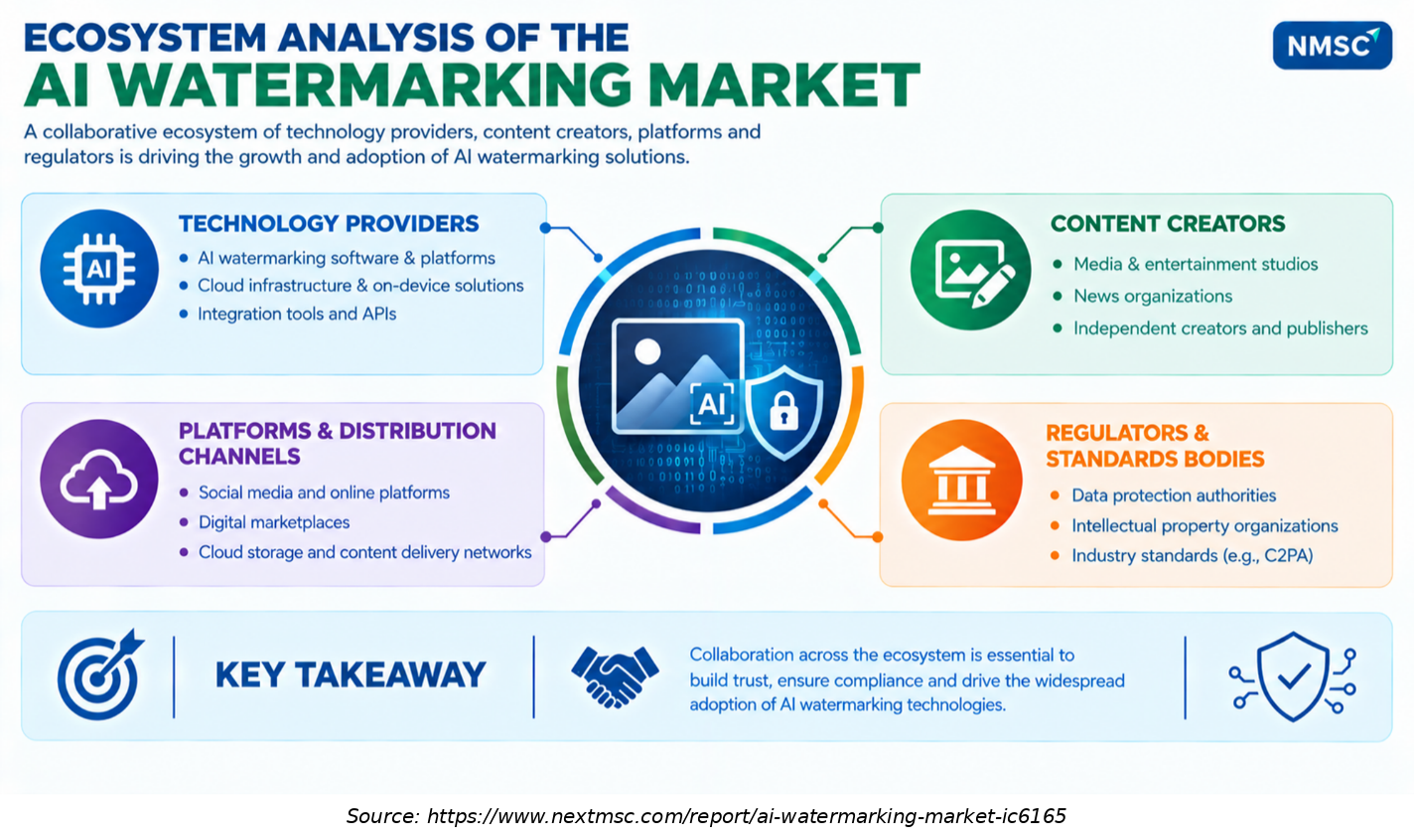
Ecosystem Analysis of the AI Watermarking Market

The AI watermarking market is supported by an interconnected ecosystem of technology providers, content creators, digital platforms, distribution channels, and regulatory bodies. Collaboration among these stakeholders enables watermarking deployment across media and digital content environments. Advancements in AI, cloud infrastructure, content authentication, data protection, and industry standards are reinforcing trust, transparency, and broader adoption.

Market Drivers & Dynamics

Interactive Dataset
EU AI Act synthetic content labeling mandate effective August 2026 driver +4.2% Europe, North America 2026–2030
Cross-industry convergence on interoperable watermarking standards driver +3.1% Global 2026–2032
China's mandatory AI content labeling requirements for domestic platforms driver +2.4% Asia-Pacific 2026–2035
Rising deepfake and synthetic media incidents driving platform-level adoption driver +1.8% Global 2026–2035
Consumer-facing provenance verification embedded into mainstream browsers and search driver +1.2% North America, Europe 2026–2030
Expanding watermarking coverage across audio and text content types driver +0.8% Global 2026–2030
Watermark removal and evasion techniques undermining detection reliability restraint −2.1% Global 2026–2032
Fragmented national regulatory definitions of AI-generated content restraint −1.3% Asia-Pacific, Latin America, Middle East & Africa 2026–2032
Limited retrofitting of watermarking into legacy generative AI models already in production restraint −0.7% Global 2026–2029
Source: Next Move Strategy Consulting

Growth Drivers

What Is the Primary Growth Driver of the AI Watermarking Market?

The European Union AI Act's synthetic content labeling mandate is the primary driver of the AI Watermarking Market. The regulation requires generative AI system providers to mark synthetic audio, image, video, and text output in a machine-readable format starting in August 2026, backed by penalties reaching 3% of global annual turnover for non-compliance. We found that this binding deadline gives every AI provider selling into the European market a fixed date by which watermarking infrastructure must already be operational, not merely planned.

How Is Cross-Platform Standard Adoption Driving Market Growth?

Convergence on interoperable provenance standards and watermarking technologies is accelerating market growth by making verification signals more transferable across participating platforms. Alphabet Inc.'s SynthID had watermarked more than 100 billion pieces of content by mid-2026, a scale reached in large part because OpenAI, Inc. and other developers adopted the same standard rather than building separate, incompatible systems. This shared-infrastructure approach lowers the integration cost for every subsequent platform that joins, compounding adoption momentum industry-wide.

Growth Inhibitors

What Is Restraining AI Watermarking Market Expansion?

Watermark removal and evasion techniques restrain confidence in watermarking as a standalone content authentication solution. Independent security researchers have repeatedly demonstrated that certain invisible watermarks can be degraded or stripped through common image processing operations such as cropping, compression, or format conversion. We observed that this vulnerability is pushing platforms toward layered verification combining watermarking with cryptographic metadata rather than relying on watermarking alone, adding implementation cost and complexity.

What Are the Growth Opportunities?

How Is Audio Watermarking Creating Opportunities for Voice AI Vendors?

Audio watermarking coverage still trails image and video, leaving room for vendors that specialize in synthetic speech authentication. Companies that commercialize robust, compression-resistant audio watermarking stand to capture licensing revenue from the fast-growing voice AI category as regulators extend labeling mandates to synthetic speech.

Why Is Browser-Native Verification Emerging as a Growth Opportunity for Platform Vendors?

Embedding provenance verification directly into browsers and search interfaces presents an underpenetrated opportunity beyond the handful of companies that have done so already. Vendors that license verification infrastructure to smaller browsers, social platforms, and productivity software can capture recurring integration revenue as consumer expectation for built-in verification spreads beyond early movers.

How Is Regulatory Compliance Tooling Unlocking Opportunities for Enterprise Software Vendors?

Mid-sized enterprises deploying generative AI internally need compliance tooling to meet EU AI Act labeling obligations without building watermarking infrastructure themselves. Vendors that package turnkey compliance modules can capture recurring subscription revenue from enterprises that would otherwise lack in-house capability to meet the August 2026 deadline.

Segmentation Analysis

2025 (USD Million)
2035 (USD Million)
Image Watermarking 2025: $285.4 Million | 2035: $2,150.2 Million
Image Waterm
Video Watermarking 2025: $185.0 Million | 2035: $1,950.0 Million
Video Waterm
Text Watermarking 2025: $105.0 Million | 2035: $950.0 Million
Text Waterma
Audio Watermarking 2025: $78.0 Million | 2035: $680.0 Million
Audio Waterm
Code and Software Watermarking 2025: $43.0 Million | 2035: $349.0 Million
Code and Sof
Image Watermarking $285.4 Million $2,150.2 Million 22.4%
Video Watermarking $185.0 Million $1,950.0 Million 26.6%
Text Watermarking $105.0 Million $950.0 Million 24.6%
Audio Watermarking $78.0 Million $680.0 Million 24.2%
Code and Software Watermarking $43.0 Million $349.0 Million 23.2%

Which Content Type Dominates the AI Watermarking Market?

Image Watermarking led the market with USD 285.35 Million in 2025 because image generation was the first widely deployed generative AI capability and the first content type major regulators targeted for labeling requirements. Video Watermarking is the fastest-growing content type, expanding at a 26.6% CAGR from 2026 to 2035, as synthetic video capability scales rapidly and video deepfakes carry disproportionate misinformation risk relative to their current market share.

2025 (USD Million)
2035 (USD Million)
Invisible Wa
Metadata-Bas
Visible Wate
Segment Item 2025 (USD Million) 2035 (USD Million) CAGR
Invisible Watermarking $10.0 USD Million $40.0 USD Million 25.0%
Metadata-Based Provenance $17.1 USD Million $51.1 USD Million 11.0%
Visible Watermarking $24.2 USD Million $62.2 USD Million 25.0%

Segment-wise data is locked

Unlock complete segment-wise numbers for By Watermarking Technique.

Unlock Full Data
2025 (USD Million)
2035 (USD Million)
Software and
Services
Segment Item 2025 (USD Million) 2035 (USD Million) CAGR
Software and Platforms $10.0 USD Million $40.0 USD Million 27.0%
Services $17.1 USD Million $51.1 USD Million 9.0%

Segment-wise data is locked

Unlock complete segment-wise numbers for By Component.

Unlock Full Data
2025 (USD Million)
2035 (USD Million)
Deepfake and
Content Auth
Regulatory C
Copyright an
Brand and En
Segment Item 2025 (USD Million) 2035 (USD Million) CAGR
Deepfake and Misinformation Detection $10.0 USD Million $40.0 USD Million 14.0%
Content Authentication and Provenance $17.1 USD Million $51.1 USD Million 24.0%
Regulatory Compliance $24.2 USD Million $62.2 USD Million 22.0%
Copyright and IP Protection $31.3 USD Million $73.3 USD Million 12.0%
Brand and Enterprise Protection $38.4 USD Million $84.4 USD Million 27.0%

Segment-wise data is locked

Unlock complete segment-wise numbers for By Application.

Unlock Full Data
2025 (USD Million)
2035 (USD Million)
AI and Techn
Media and En
Social Media
Government a
Financial Se
Segment Item 2025 (USD Million) 2035 (USD Million) CAGR
AI and Technology Companies $10.0 USD Million $40.0 USD Million 24.0%
Media and Entertainment $17.1 USD Million $51.1 USD Million 22.0%
Social Media and Content Platforms $24.2 USD Million $62.2 USD Million 20.0%
Government and Public Sector $31.3 USD Million $73.3 USD Million 22.0%
Financial Services $38.4 USD Million $84.4 USD Million 13.0%

Segment-wise data is locked

Unlock complete segment-wise numbers for By End User.

Unlock Full Data
2025 (USD Million)
2035 (USD Million)
North Americ
Canada
Mexico
Europe: UK
Germany
Segment Item 2025 (USD Million) 2035 (USD Million) CAGR
North America: U.S. $10.0 USD Million $40.0 USD Million 23.0%
Canada $17.1 USD Million $51.1 USD Million 9.0%
Mexico $24.2 USD Million $62.2 USD Million 19.0%
Europe: UK $31.3 USD Million $73.3 USD Million 13.0%
Germany $38.4 USD Million $84.4 USD Million 10.0%

Segment-wise data is locked

Unlock complete segment-wise numbers for By Region.

Unlock Full Data

Growth Opportunities

Three forward-looking opportunities stand out for stakeholders positioning within the AI Watermarking Market over the 2026-2035 forecast period.

How Is Audio Watermarking Creating Opportunities for Voice AI Vendors?
Audio watermarking coverage still trails image and video, leaving room for vendors that specialize in synthetic speech authentication. Companies that commercialize robust, compression-resistant audio watermarking stand to capture licensing revenue from the fast-growing voice AI category as regulators extend labeling mandates to synthetic speech.
Why Is Browser-Native Verification Emerging as a Growth Opportunity for Platform Vendors?
Embedding provenance verification directly into browsers and search interfaces presents an underpenetrated opportunity beyond the handful of companies that have done so already. Vendors that license verification infrastructure to smaller browsers, social platforms, and productivity software can capture recurring integration revenue as consumer expectation for built-in verification spreads beyond early movers.
How Is Regulatory Compliance Tooling Unlocking Opportunities for Enterprise Software Vendors?
Mid-sized enterprises deploying generative AI internally need compliance tooling to meet EU AI Act labeling obligations without building watermarking infrastructure themselves. Vendors that package turnkey compliance modules can capture recurring subscription revenue from enterprises that would otherwise lack in-house capability to meet the August 2026 deadline.

Regional Outlook

2025 (USD Million)
2035 (USD Million)
North Americ
Europe
Asia-Pacific
Middle East
Latin Americ
Region 2025 (USD Million) 2035 (USD Million) CAGR (%)
North America $10.0 USD Million $40.0 USD Million 9.0%
Europe $17.1 USD Million $51.1 USD Million 27.0%
Asia-Pacific $24.2 USD Million $62.2 USD Million 25.0%
Middle East & Africa $31.3 USD Million $73.3 USD Million 23.0%
Latin America $38.4 USD Million $84.4 USD Million 12.0%

Regional data is locked

Unlock complete regional numbers for this market.

Unlock Full Data

Competitive Landscape

The AI Watermarking Market features a moderately consolidated competitive landscape, with major generative AI developers embedding proprietary-turned-shared watermarking standards alongside specialized provenance technology vendors.
Dimension Description
Market Structure Moderately consolidated; a small number of large AI developers set the dominant technical standard, while specialized vendors compete for detection, compliance tooling, and content-type-specific niches.
Innovation Focus Cross-platform standard adoption, browser-native verification, and expansion into audio and text watermarking dominate current vendor innovation pipelines.
M&A Activity Limited direct acquisition activity to date; growth instead concentrated in standards partnerships, exemplified by OpenAI, Inc.'s 2026 adoption of Alphabet Inc.'s SynthID watermark alongside its own C2PA metadata implementation.

How Do Companies Compete in the AI Watermarking Market?

Companies compete primarily on watermark durability, standards adoption, and integration reach across partner platforms. Alphabet Inc. and Microsoft Corporation both leverage founding roles in the Coalition for Content Provenance and Authenticity to embed their preferred technical approach as the de facto industry standard, while specialized vendors such as Digimarc Corporation and Truepic Inc. compete on detection accuracy and content-type-specific expertise that large platform vendors have not built in-house.

Which Competitive Archetypes Dominate the AI Watermarking Market?

Two archetypes dominate the market: large generative AI developers that embed watermarking directly into their own model output, and specialized provenance technology vendors that supply detection and verification tools to platforms that did not build watermarking themselves. Alphabet Inc. and OpenAI, Inc. exemplify the embedded archetype through SynthID and C2PA integration into their own generation pipelines, while Truepic Inc. and Digimarc Corporation exemplify the specialized archetype serving customers across multiple upstream AI providers.

How Are Companies Differentiating Through Innovation in AI Watermarking?

Innovation and differentiation strategy increasingly center on extending watermark durability and expanding coverage to previously underserved content types. Alphabet Inc.'s SynthID reached over 100 billion watermarked items by mid-2026 in part by expanding from images into audio, closing a content-type gap that had persisted since the technology's initial 2023 launch. Vendors unable to demonstrate cross-content-type coverage risk losing platform partnerships to competitors offering a single system spanning image, video, audio, and text.

What Partnership and Expansion Activity Is Shaping the AI Watermarking Market?

Standards partnership, rather than acquisition, is the primary consolidation mechanism shaping this young market. OpenAI, Inc.'s May 2026 decision to join the C2PA steering committee and adopt SynthID for image generation, followed by its July 2026 extension of the partnership to audio watermarking, illustrates how competing AI developers are choosing interoperability over building separate proprietary systems. This pattern suggests future consolidation will concentrate around a small number of shared technical standards rather than corporate acquisition of rival watermarking vendors.

Key Market Players

The following 20 companies represent the validated competitive set actively shaping product innovation, standards adoption, and strategic positioning within the global AI Watermarking Market.

Alphabet Inc. Microsoft Corporation Adobe Inc. Meta Platforms, Inc. OpenAI, Inc. Amazon.com, Inc. Digimarc Corporation Truepic Inc. Sony Group Corporation Qualcomm Incorporated Intel Corporation Nikon Corporation Canon Inc. Baidu, Inc. Imatag SAS Steg.AI, Inc. DeepMedia, Inc. Resemble AI, Inc. Verimatrix, Inc. Kudelski SA

Latest Developments

Recent product launches and standards adoption within the AI Watermarking Market are concentrated on cross-platform provenance integration ahead of binding regulatory deadlines.

Date Event
July 2026 OpenAI expanded its provenance stack by adding SynthID watermarking to supported audio generated through ChatGPT and the API, alongside image coverage. It also expanded its public verification tool to audio and introduced verification API access, extending machine-verifiable provenance across more AI-generated media and enterprise workflows.
May 2026 Google expanded AI-content verification across Search, Gemini, Chrome, Pixel, and Cloud while deepening industry collaboration around SynthID and Content Credentials. The rollout broadens access to watermark detection and provenance signals across multiple modalities, supporting verification workflows for consumers, platforms, and enterprises handling increasingly synthetic digital content.
May 2026 Canon launched its Authenticity Imaging System for news organizations, providing C2PA-based provenance management, trusted timestamps, certificates, and content-history verification for supported cameras. Initially rolling out in Europe, the Middle East, and Africa, the solution strengthens capture-stage authenticity and extends provenance infrastructure into professional imaging workflows.
April 2026 Microsoft introduced watermarking options in Microsoft 365 for AI-generated or AI-altered images, videos, and audio, alongside AI-related metadata. Organizations can control watermark application through policy settings, giving enterprises a built-in mechanism to disclose synthetic content and strengthening the software-platform market for AI transparency and provenance.

Investment Opportunities

What Areas Are Attracting Investment in the AI Watermarking Market?

Investment activity is increasingly focused on cross-platform provenance infrastructure and regulatory compliance tooling ahead of the EU AI Act's August 2026 transparency requirements. Alphabet Inc.'s continued investment in expanding SynthID coverage across images, audio, and text reflects sustained capital commitment to maintaining its position as the widely adopted watermarking technology. Specialized vendors such as Truepic Inc. and Digimarc Corporation continue to attract investment tied to enterprise compliance demand from companies that lack in-house watermarking capability.

How Is Infrastructure Investment Supporting AI Watermarking Deployment?

Infrastructure investment in browser-native and search-native verification is expanding the consumer-facing reach of provenance technology beyond specialist tools. Alphabet Inc.'s integration of SynthID and C2PA verification directly into Google Search, Chrome, and the Gemini app represents a significant infrastructure investment intended to normalize provenance checking as a default consumer behavior rather than an optional lookup. This infrastructure investment lowers the adoption barrier for smaller platforms that can build on existing verification rails.

What ESG Considerations Are Shaping AI Watermarking Investment Decisions?

Governance considerations specific to this market center on transparency, misinformation mitigation, and equitable access to verification tools across regions with uneven regulatory enforcement capacity. The EU AI Act's labeling mandate explicitly frames content provenance as a public transparency requirement rather than a purely commercial feature. Investors increasingly evaluate a vendor's cross-platform standards participation, rather than proprietary technology alone, as a governance indicator of long-term regulatory alignment and market durability.

Key Benefits for Stakeholders

How Does This Report Benefit Enterprise and Industry Leaders?

Enterprise and industry leaders gain validated segmentation, competitive benchmarking, and regional demand forecasts that support compliance planning and vendor selection decisions across the AI Watermarking Market. Detailed content type, application, and regional breakdowns help procurement teams align specifications with regulatory deadlines including the EU AI Act's August 2026 labeling requirement.

How Does This Report Benefit Investors and Financial Analysts?

Investors and financial analysts gain consistent, single-point market size and CAGR estimates that support valuation and capital-allocation decisions across the AI Watermarking Market vendor landscape. The report's regional and segment-level growth differentials help identify which vendors are positioned to capture above-market growth in video watermarking and Asia-Pacific deployment categories through 2035.

How Does This Report Benefit Technology Vendors and Product Teams?

Technology vendors and product teams gain insight into the standards convergence and content-type expansion requirements reshaping the AI Watermarking Market. This analysis helps R&D teams prioritize development roadmaps around cross-platform interoperability and watermark durability increasingly required by AI developer and enterprise procurement processes.

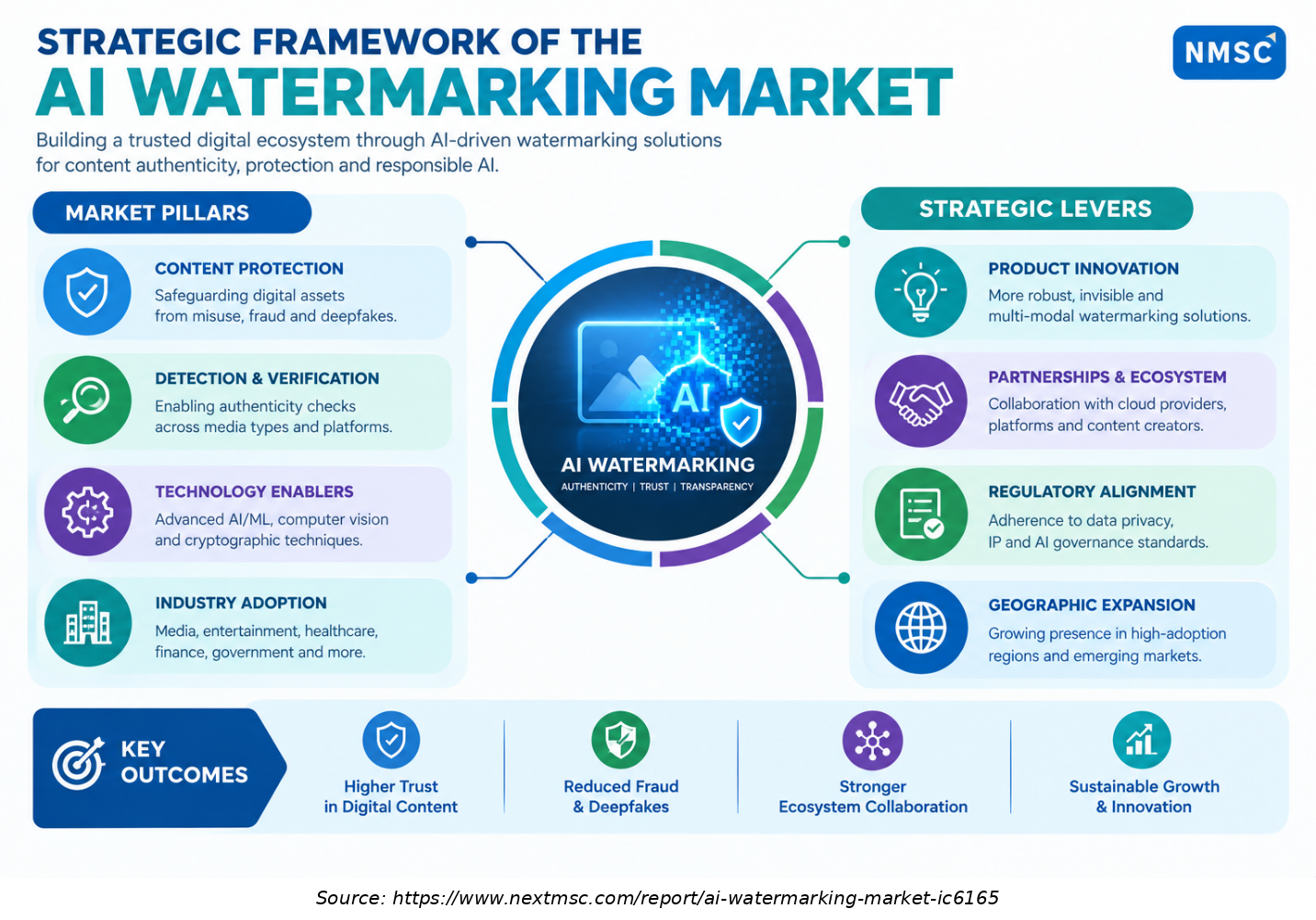
Strategic Framework of the AI Watermarking Market

Strategic Framework of the AI Watermarking Market
The strategic framework of the AI watermarking market centers on content protection, detection and verification, technology enablement, and wider industry adoption. Market participants are emphasizing product innovation, ecosystem partnerships, regulatory alignment, and geographic expansion. These priorities support stronger content authenticity, reduced misuse and deepfake risks, improved digital trust, and sustainable innovation across diverse applications.

Key Market Segments Evaluated

By Content Type

  • Image Watermarking
  • Video Watermarking
  • Text Watermarking
  • Audio Watermarking
  • Code and Software Watermarking

By Watermarking Technique

  • Invisible Watermarking
  • Metadata-Based Provenance
  • Visible Watermarking

By Component

  • Software and Platforms
  • Services

By Application

  • Deepfake and Misinformation Detection
  • Content Authentication and Provenance
  • Regulatory Compliance
  • Copyright and IP Protection
  • Brand and Enterprise Protection

By End User

  • AI and Technology Companies
  • Media and Entertainment
  • Social Media and Content Platforms
  • Government and Public Sector
  • Financial Services
  • Other End Users

By Region

  • North America 
    • U.S.
    • Canada
    • Mexico
  • Europe 
    • UK
    • Germany
    • France
    • Italy
    • Spain
    • Sweden
    • Denmark
    • Finland
    • Netherlands
    • Rest of Europe
  • Asia-Pacific 
    • China
    • India
    • Japan
    • South Korea
    • Taiwan
    • Indonesia
    • Vietnam
    • Australia
    • Philippines
    • Malaysia
    • Rest of APAC
  • Middle East & Africa 
    • Saudi Arabia
    • UAE
    • Egypt
    • Israel
    • Turkey
    • Nigeria
    • South Africa
    • Rest of MEA
  • Latin America 
    • Brazil
    • Argentina
    • Chile
    • Colombia
    • Rest of LATAM

Conclusion & Recommendations

The long-term outlook for the AI Watermarking Market remains strongly positive, with global revenue projected to expand from USD 696.35 Million in 2025 to USD 6,079.19 Million by 2035 at a 19.38% CAGR. Binding regulatory deadlines and cross-platform standards convergence will continue to determine which categories capture the largest share of this growth through the forecast period.

What Strategic Positioning Should Companies Pursue?

Vendors should prioritize participation in shared standards such as C2PA over proprietary alternatives, since interoperability increasingly determines platform partnership eligibility. NMSC analysis indicates that companies investing early in audio and text watermarking coverage may be positioned to address emerging demand in these less-developed content categories.

How Attractive Is the Market for New Investment?

The market presents a highly attractive investment case, supported by a USD 4,844.55 Million absolute dollar opportunity between 2026 and 2035 and above-average growth in Asia-Pacific and video watermarking categories. Investment attractiveness is highest for vendors combining demonstrated standards participation with the content-type breadth needed to serve both established North American AI developers and newly regulated Asian and European markets.

What Market Shifts and Key Risks Should Stakeholders Monitor?

Stakeholders should monitor watermark removal and evasion techniques, fragmented national regulatory definitions, and limited retrofitting of watermarking into legacy AI models as key risks to the AI Watermarking Market. Vendors unable to demonstrate durable, tamper-resistant watermarking risk losing platform trust to competitors offering layered verification combining watermarking with cryptographic metadata.

What Growth Pathways Should Companies Prioritize?

Priority growth pathways include extending watermark coverage into text and code content types, scaling browser and search-native verification infrastructure, and deepening compliance tooling for enterprises facing the EU AI Act's August 2026 deadline. Companies pursuing these pathways while maintaining cross-platform standards compatibility will be best positioned to capture the market's projected growth through 2035.

FAQs

About the Author

Mihul Sharma

Mihul Sharma

Mihul Sharma is Research Associate at Next Move Strategy Consulting, where he has covered technology, industrial, and healthcare markets for 3 years. His work applies structured business research, market analysis, and secondary-source review to assess market trends, competitive developments, and growth opportunities. He supports report development by fully synthesizing industry data, company information, and market signals into concise findings for strategy and investment-focused research teams.

About the Reviewer

Supradip Baul

Supradip Baul

Supradip Baul is an accomplished business consultant and strategist with over a decade of rich experience in market intelligence, strategy, technology, and business transformation. His work has included rigorous qualitative and quantitative analysis across multiple industries, helping clients shape investment decisions and long-term roadmaps. Earlier in his career, he was associated with Gartner, where he contributed to industry-leading reports and market share analyses. He has worked with leading global companies and holds an MBA with a dual specialization in Marketing and Finance.

Download Free Sample

Kevin Coker

KEVIN COKER

Founder, CEO and Board Diector

Proxima Clinical Research

I have been using Next MSC reports for product positioning in a new geography for a long time. They have by far the best reports I have found and the price is reasonable too!

Semih Kavaklioglu

SEMIH KAVAKLIOGLU

Co-Founder & Sales Manager

Decortie

I work a lot in the marketing industry and I know that research is an essential part of any campaign. I have used Market research reports for my own products and I found them to be very informative and well-researched. The team here produces insightful reports for a good price

Nishant Awate

NISHANT AWATE

Business Development Global Sales

Zehnder Group Deutschland GmbH

Our experience working with Next Move Strategy Consulting was positive. The team was responsive, professional, and open to incorporating our specific requirements throughout the project. The India AHU market study was comprehensive and well structured, covering market value and volume forecasts, product and application segments, and key industry trends. The inclusion of both AHU and residential MVHR market insights made the study particularly relevant for our strategic market assessment. Overall, the report provides a solid foundation for evaluating market potential, identifying priority segments, and supporting business-development decisions in India.

Mohit Agarwal

MOHIT AGARWAL

Chief Manager

DryChem India Pvt. Ltd.

Next Move Strategy Consulting is an amazing team of consultants. We required a market study report for our investors on top priority and the team went above and beyond our expectations to deliver the same with ample supporting data within a short time span enabling us to secure the investments and keep our project timeline maintained. Their professionalism, attention to detail, and timely delivery of actionable recommendations have left a lasting impression on our organization.

Robert Sean Trevino

ROBERT SEAN TREVINO

Sr. Director, Head of Strategic Insights & Analytics

Foundation Medicine

I realized that it was a reliable source of information. These days, there are many people who are looking for authentic data, and this is one of the only sources that can offer them with what they need;

Custom Market Research Services

We will customize the research for you if the listed report does not fully match your requirements.

Get 30% Free Customization

Select License

This website uses cookies to ensure you get the best experience on our website. Learn more

✖