AI Agent Safety Market Global Industry Analysis and Forecast (2026–2035)

The global AI Agent Safety Market size was valued at USD 1.14 billion in 2025 and is estimated at USD 1.86 billion in 2026, forecast to reach USD 19.40 billion by 2035, expanding at a 29.8% CAGR between 2026 and 2035. North America leads with approximately 51% share, while Runtime Guardrails and Policy Enforcement account for approximately 30% of market revenue in 2025.
Download Free Sample PDF
Base Year (2025)
$1.14 Billion
Forecast (2035)
$19.40 Billion
CAGR (2026-2035)
29.8%
Top Region
North America

What Is the AI Agent Safety Market Size?
The global AI Agent Safety Market was valued at USD 1.14 Billion in 2025 and is estimated at USD 1.86 Billion in 2026. It is forecast to reach USD 19.40 Billion by 2035, a 29.8% CAGR from 2026–2035. North America leads with about 51% share, while runtime guardrails and policy enforcement holds roughly 30% of 2025 revenue.
Based on our analysis, we observed that agent deployments are outpacing their control layers, leading enterprise buyers to budget for safety tooling as a distinct line item.

AI Agent Safety Market Global Industry Analysis and Forecast (2026–2035) Revenue Forecast

Values in USD Billion

2025 $1.14 Billion
2025
2026 $1.86 Billion
2026
2027 $2.41 Billion
2027
2028 $3.13 Billion
2028
2029 $4.07 Billion
2029
2030 $5.28 Billion
2030
2031 $6.85 Billion
2031
2032 $8.90 Billion
2032
2033 $11.55 Billion
2033
2034 $14.99 Billion
2034
2035 $19.40 Billion
2035

Key Takeaways

By Safety Function: Runtime guardrails and policy enforcement held the largest share, expanding from USD 0.34 Billion in 2025 to USD 4.95 Billion by 2035; agent identity and access control is the fastest growing at 33.0% CAGR from 2026–2035.

By Deployment Mode: Cloud delivered held the largest share, expanding from USD 0.78 Billion in 2025 to USD 14.60 Billion by 2035, and is also the fastest growing at 30.4% CAGR from 2026–2035.

By End User Industry: IT and telecom held the largest share, expanding from USD 0.31 Billion in 2025 to USD 4.55 Billion by 2035; healthcare and life sciences is the fastest growing at 33.4% CAGR from 2026–2035.

Dominant Region: North America accounted for USD 0.58 Billion in 2025, about 51% of global revenue, rising to USD 8.80 Billion by 2035.

Fastest-Growing Region: Asia-Pacific is expected to grow at 32.2% CAGR from 2026–2035, reaching USD 4.70 Billion by 2035.

Dominant Country: The U.S. led with USD 0.53 Billion in 2025 and should reach USD 8.05 Billion by 2035.

Fastest-Growing Country: India is expected to grow at 36.1% CAGR from 2026–2035, rising from USD 0.03 Billion in 2025 to USD 0.80 Billion by 2035.

The market adds approximately USD 17.54 Billion in absolute revenue between 2026 and 2035, a clear investment case for control layer vendors.

According to NMSC analysis, buyers are consolidating guardrails, identity and audit trails into platform contracts that favor vendors owning existing control points.

What Does the AI Agent Safety Market Encompass?

The AI Agent Safety Market covers software, platforms and services that constrain, test, identify, monitor and govern autonomous AI agents acting on enterprise data, tools and networks. Scope includes runtime guardrails, agent identity and access control, red teaming, governance and compliance management, and monitoring with incident response. General model development tooling, conventional endpoint security and chatbot content filters sold without agent controls sit outside the definition.

Regulation shapes demand from several directions. NIST launched its AI Agent Standards Initiative on February 17, 2026, covering agent security, identity and authorization. The EU Digital Omnibus on AI deferred standalone high-risk obligations to December 2027 without removing them, which keeps compliance budgets active. Technology adoption is moving toward gateway enforced policies, per agent credentials and hardware assisted monitoring, as NVIDIA showed with its September 2026 platform launch.

Market Drivers & Dynamics

Interactive Dataset
Rising production deployments of autonomous agents driver +4.5% Global, led by North America 2026–2035
Standards and regulation (NIST, EU AI Act) driver +3.0% North America, Europe 2026–2030
Platform bundling by hyperscalers and security suites driver +2.5% Global 2026–2032
Agent identity sprawl and over permissioned access driver +2.0% Global 2026–2033
Integration complexity across agent frameworks restraint −2.5% Global 2026–2029
Shortage of AI security skills restraint −1.5% Asia-Pacific, Middle East & Africa, Latin America 2026–2031
Delayed EU high risk obligations restraint −1.0% Europe 2026–2028
Source: Next Move Strategy Consulting

Growth Drivers

What Is the Primary Growth Driver in the AI Agent Safety Market?

Production deployment of agents is the primary driver. A Cisco survey of major enterprise customers found 85% experimenting with agents but only 5% in production as of March 2026, which shows the size of the conversion pool still ahead. The U.S. Census Bureau reports that 37% of firms with at least 250 employees used AI by May 2026. Each production release needs identity, guardrails and audit controls before approval, converting pilots into safety purchases.

How Is Regulation Driving Market Growth?

NIST's Center for AI Standards and Innovation launched the AI Agent Standards Initiative on February 17, 2026, organized around industry-led standards, open protocols and research on agent security and identity. The EU AI Omnibus set December 2, 2027 for standalone high-risk systems and August 2, 2028 for embedded systems. Our findings suggest that buyers treat the delay as a preparation window, funding governance and logging foundations early because conformity work cannot be compressed later.

Growth Inhibitors

What Is Restraining the AI Agent Safety Market?

Integration complexity and cost are the main restraints. Agents run across hyperscaler platforms, workflow suites and custom frameworks, so a single policy often needs several connectors before it is enforced consistently. Research cited by Okta in March 2026 found that 88% of organizations had suspected or confirmed agent incidents, yet only 22% treated agents as independent identities, showing that process maturity lags tooling. Bundled platform controls also compress standalone pricing, delaying paid conversion for smaller vendors.

What Are the Growth Opportunities?

Can Agent Identity Governance Become a Standalone Budget Line?

Agent identity governance is the largest whitespace because most enterprises cannot yet list the agents holding credentials. Okta states that 90% of enterprise agents are over permissioned, and Cisco extended discovery to agent identities in March 2026. Vendors offering registry, ownership assignment and instant revocation can sell to identity and security teams at once, and the identity segment grows at 33.0% through 2035.

Does Regulated Industry Demand Create a Premium Compliance Niche?

Healthcare, financial services and public agencies need evidence that agent actions were authorized, logged and reviewable. Governance, risk and compliance management supplies audit trails, framework mapping and human approval workflows, as IBM illustrates by validating agents against twelve frameworks including the EU AI Act and ISO 42001. Healthcare and life sciences grows at 33.4%, making regulated buyers the beneficiary segment willing to pay for assurance.

Can Managed Services Unlock the Mid Market?

Mid market firms lack security engineers to tune agent policies, creating room for managed detection and response style services. Census Bureau data show 32% of firms with 100 to 249 employees used AI by May 2026, so demand is moving below the large enterprise tier. Vendors that package pretuned guardrails and monitoring through partners can scale subscriptions without heavy implementation teams, and cloud delivered offerings capture most of this volume.

Segmentation Analysis

2025 (USD Billion)
2035 (USD Billion)
Runtime guardrails and policy enforcement 2025: $0.34 Billion | 2035: $4.95 Billion
Runtime guar
Agent identity and access control 2025: $0.24 Billion | 2035: $5.20 Billion
Agent identi
Red teaming and predeployment testing 2025: $0.18 Billion | 2035: $2.60 Billion
Red teaming
Governance, risk and compliance management 2025: $0.22 Billion | 2035: $3.45 Billion
Governance,
Monitoring and incident response 2025: $0.16 Billion | 2035: $3.20 Billion
Monitoring a
Runtime guardrails and policy enforcement $0.34 Billion $4.95 Billion 27.7%
Agent identity and access control $0.24 Billion $5.20 Billion 33.0%
Red teaming and predeployment testing $0.18 Billion $2.60 Billion 28.1%
Governance, risk and compliance management $0.22 Billion $3.45 Billion 28.5%
Monitoring and incident response $0.16 Billion $3.20 Billion 31.6%

Which Safety Function Leads the AI Agent Safety Market?

Runtime guardrails and policy enforcement is the largest safety function, rising from USD 0.34 Billion in 2025 to USD 4.95 Billion by 2035, because every deployment needs inline control and vendors from Palo Alto Networks to F5 sell it. Agent identity and access control is the fastest growing at a 33.0% CAGR from 2026–2035, as Microsoft and Okta bundle agent identities into existing identity contracts, and it overtakes guardrails by value in 2035.

2025 (USD Billion)
2035 (USD Billion)
Cloud delive
Hybrid
On premises
Segment Item 2025 (USD Billion) 2035 (USD Billion) CAGR
Cloud delivered $10.0 USD Billion $40.0 USD Billion 9.0%
Hybrid $17.1 USD Billion $51.1 USD Billion 23.0%
On premises and hardware assisted $24.2 USD Billion $62.2 USD Billion 9.0%

Segment-wise data is locked

Unlock complete segment-wise numbers for By Deployment Mode.

Unlock Full Data
2025 (USD Billion)
2035 (USD Billion)
BFSI
IT and telec
Healthcare a
Government a
Retail and c
Segment Item 2025 (USD Billion) 2035 (USD Billion) CAGR
BFSI $10.0 USD Billion $40.0 USD Billion 20.0%
IT and telecom $17.1 USD Billion $51.1 USD Billion 26.0%
Healthcare and life sciences $24.2 USD Billion $62.2 USD Billion 24.0%
Government and public sector $31.3 USD Billion $73.3 USD Billion 26.0%
Retail and consumer $38.4 USD Billion $84.4 USD Billion 9.0%

Segment-wise data is locked

Unlock complete segment-wise numbers for By End User Industry.

Unlock Full Data

SWOT Analysis

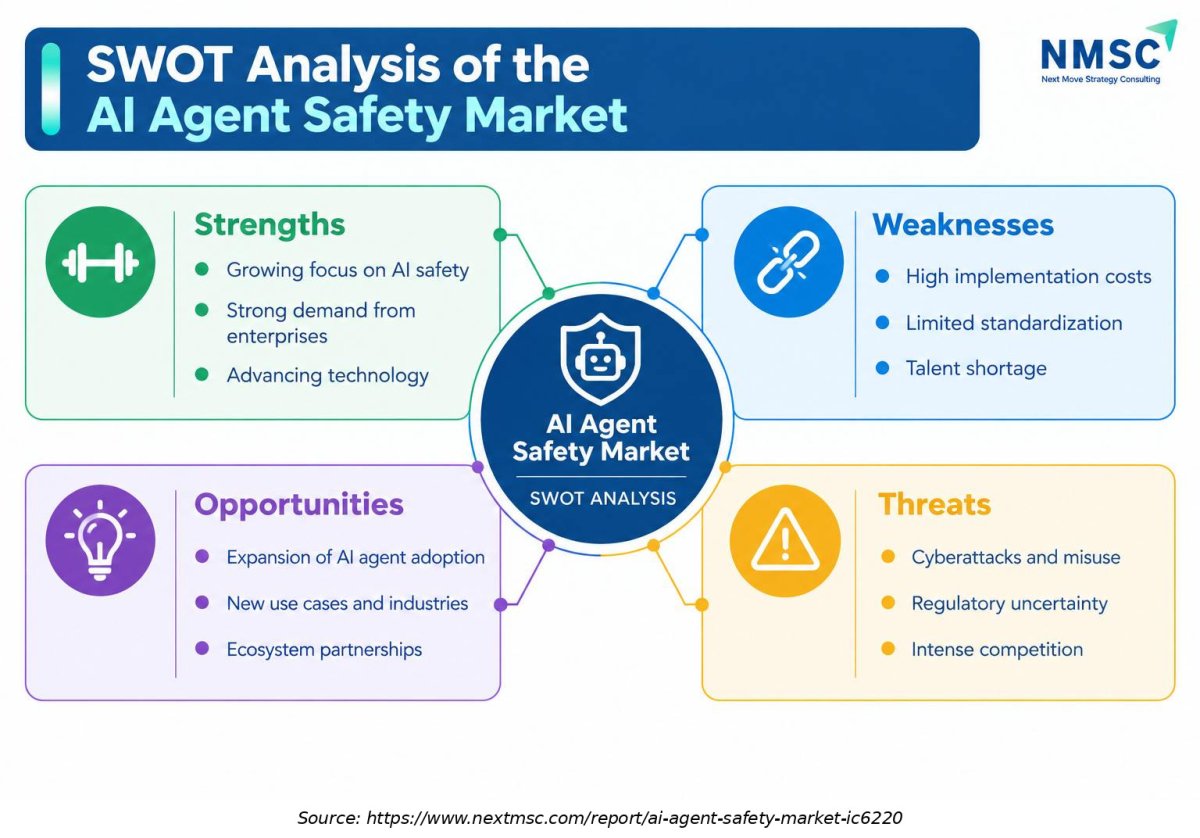
This SWOT view highlights structural strengths, strategic gaps, expansion headroom, and external risks shaping outcomes in the AI Agent Safety Market Global Industry Analysis and Forecast (2026–2035).

Strengths

This infographic presents the key strengths, weaknesses, opportunities, and threats shaping the AI Agent Safety Market. It highlights growing enterprise focus on AI safety, evolving technology capabilities, and expanding adoption opportunities, alongside implementation costs, limited standardization, cybersecurity risks, and regulatory uncertainty. The analysis provides a concise strategic overview of the market’s competitive positioning and development potential.

Weaknesses

This infographic presents the key strengths, weaknesses, opportunities, and threats shaping the AI Agent Safety Market. It highlights growing enterprise focus on AI safety, evolving technology capabilities, and expanding adoption opportunities, alongside implementation costs, limited standardization, cybersecurity risks, and regulatory uncertainty. The analysis provides a concise strategic overview of the market’s competitive positioning and development potential.

Opportunities

This infographic presents the key strengths, weaknesses, opportunities, and threats shaping the AI Agent Safety Market. It highlights growing enterprise focus on AI safety, evolving technology capabilities, and expanding adoption opportunities, alongside implementation costs, limited standardization, cybersecurity risks, and regulatory uncertainty. The analysis provides a concise strategic overview of the market’s competitive positioning and development potential.

Threats

This infographic presents the key strengths, weaknesses, opportunities, and threats shaping the AI Agent Safety Market. It highlights growing enterprise focus on AI safety, evolving technology capabilities, and expanding adoption opportunities, alongside implementation costs, limited standardization, cybersecurity risks, and regulatory uncertainty. The analysis provides a concise strategic overview of the market’s competitive positioning and development potential.

Growth Opportunities

Our analysis shows that three opportunities offer the clearest path to incremental revenue beyond baseline platform bundling.

Can Agent Identity Governance Become a Standalone Budget Line?

Agent identity governance is the largest whitespace because most enterprises cannot yet list the agents holding credentials. Okta states that 90% of enterprise agents are over permissioned, and Cisco extended discovery to agent identities in March 2026. Vendors offering registry, ownership assignment and instant revocation can sell to identity and security teams at once, and the identity segment grows at 33.0% through 2035.

Does Regulated Industry Demand Create a Premium Compliance Niche?

Healthcare, financial services and public agencies need evidence that agent actions were authorized, logged and reviewable. Governance, risk and compliance management supplies audit trails, framework mapping and human approval workflows, as IBM illustrates by validating agents against twelve frameworks including the EU AI Act and ISO 42001. Healthcare and life sciences grows at 33.4%, making regulated buyers the beneficiary segment willing to pay for assurance.

Can Managed Services Unlock the Mid Market?

Mid market firms lack security engineers to tune agent policies, creating room for managed detection and response style services. Census Bureau data show 32% of firms with 100 to 249 employees used AI by May 2026, so demand is moving below the large enterprise tier. Vendors that package pretuned guardrails and monitoring through partners can scale subscriptions without heavy implementation teams, and cloud delivered offerings capture most of this volume.

Regional Outlook

2025 (USD Billion)
2035 (USD Billion)
North Americ
Europe
Asia-Pacific
Middle East
Latin Americ
Region 2025 (USD Billion) 2035 (USD Billion) CAGR (%)
North America $10.0 USD Billion $40.0 USD Billion 9.0%
Europe $17.1 USD Billion $51.1 USD Billion 27.0%
Asia-Pacific $24.2 USD Billion $62.2 USD Billion 25.0%
Middle East & Africa $31.3 USD Billion $73.3 USD Billion 23.0%
Latin America $38.4 USD Billion $84.4 USD Billion 12.0%

Regional data is locked

Unlock complete regional numbers for this market.

Unlock Full Data

Competitive Landscape

Based on research conducted by NMSC, we found that platform vendors and specialists compete on control point ownership rather than feature breadth.

Dimension Description
Market Structure Moderately fragmented, with hyperscalers, security suites, identity providers and specialists competing for the same budgets
Innovation Focus Agent identity, gateway policy enforcement, continuous red teaming and out of band hardware monitoring
M&A Activity High, with Protect AI, Lakera, Prompt Security, CalypsoAI and SPLX acquired and Pangea agreed to be acquired by platform vendors

How Do Companies Compete in the AI Agent Safety Market?

Competition centers on who owns the enforcement point. Hyperscalers such as Microsoft, Amazon and Alphabet embed controls in agent platforms, while Cisco, Palo Alto Networks, CrowdStrike, Zscaler and Check Point extend network, endpoint and identity franchises. Specialists differentiate through detection accuracy and speed. Pricing is moving toward bundles, as Microsoft includes Entra Agent ID capabilities in Agent 365 and Microsoft 365 E7, which pressures standalone vendors.

What Is the M&A Pattern in the AI Agent Safety Market?

Acquisition is the main route to capability. Palo Alto Networks completed Protect AI in July 2025, SentinelOne closed Prompt Security in September 2025, F5 closed CalypsoAI for about USD 0.15 Billion in cash in September 2025, Check Point acquired Lakera, and Zscaler acquired SPLX in November 2025. CrowdStrike agreed to acquire Pangea in September 2025. Specialists with runtime detection or red teaming assets remain the likeliest targets.

Key Market Players

We found that vendors with an existing identity, network or cloud control point lead the ranked group of verified participants.

Microsoft Corporation Palo Alto Networks, Inc. CrowdStrike Holdings, Inc. Cisco Systems, Inc. Amazon.com, Inc. Alphabet Inc. NVIDIA Corporation Check Point Software Technologies Ltd. International Business Machines Corporation Zscaler, Inc. Okta, Inc. SentinelOne, Inc. F5, Inc. UiPath, Inc.

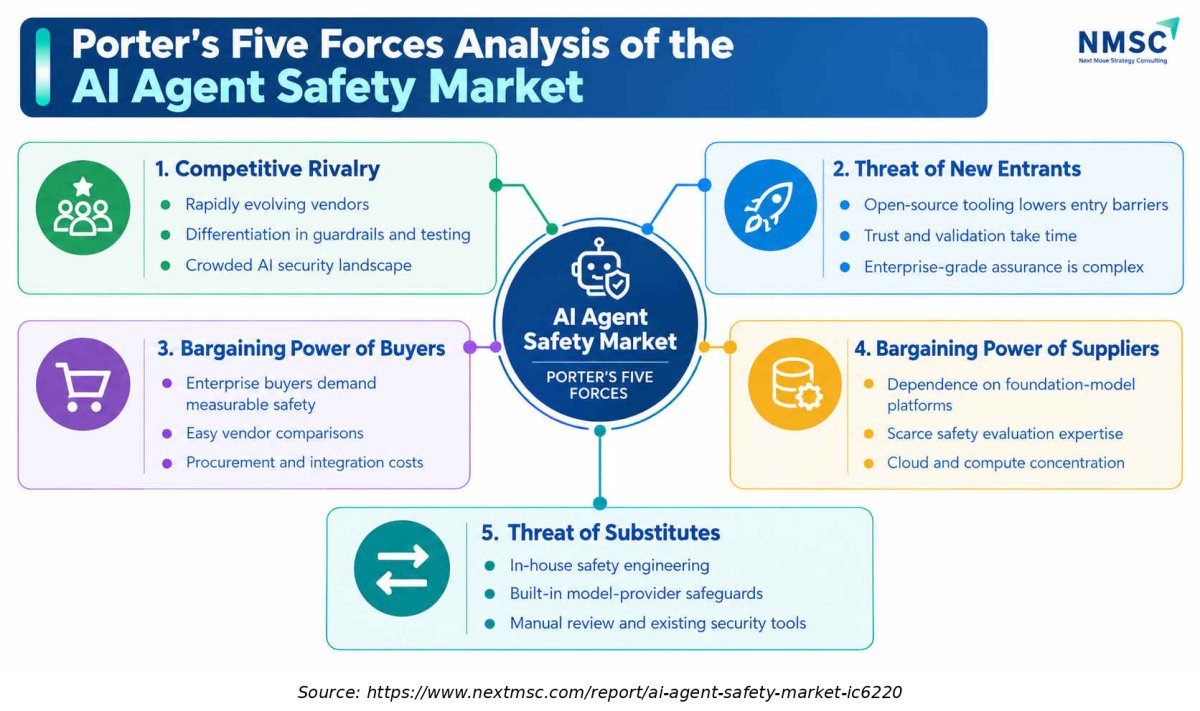
Porter’s Five Forces Analysis of the AI Agent Safety Market

This infographic evaluates the competitive structure of the AI Agent Safety Market through Porter’s Five Forces framework. It examines competitive rivalry, new entrant threats, buyer and supplier bargaining power, and substitute solutions. The analysis highlights the influence of evolving vendors, open-source tools, enterprise assurance requirements, foundation-model dependencies, and alternative safeguards on market competition and long-term positioning.

Latest Developments

During our market evaluation, we noticed that platform launches and standards actions in 2026 are shaping buyer expectations.

Date Event
September 2026 NVIDIA launched an open platform combining OpenShell, an open-source runtime that sandboxes agents and enforces policies, with Sentry, a reference design for out-of-band monitoring on BlueField-4 DPUs. Together, these layers trace agent actions, enforce runtime boundaries and can quarantine agents that violate policies, extending controls across software and underlying infrastructure.
June 2026 AWS added support for Bedrock Guardrails inside AgentCore Policy, enabling policies to inspect agent action outputs and inputs to gateway targets in real time. The controls operate outside agent code and can detect prompt injection, harmful content and sensitive-data exposure. Policy evaluations are also logged for observability and auditing purposes.
May 2026 Microsoft made Agent 365 generally available as a central control plane for discovering, registering, monitoring, governing and securing organizational agents. Features include an agent registry and map, lifecycle management, activity logging, policy guardrails and integration with Microsoft security and identity tools, targeting enterprise-scale agent deployment and administration.
April 2026 Okta announced general availability of Okta for AI Agents, effective 30 April 2026, providing discovery and registration of known and unknown agents, standardized agent identity, gateway controls and centralized access revocation. The platform is designed to enforce least-privilege access and help administrators understand which systems agents can reach and what permissions they exercise.

Investment Opportunities

Where Are Capital Inflows Concentrating in Agent Safety?

Capital is flowing into the AI Agent Safety Market through acquisitions and platform build outs rather than venture rounds alone. SentinelOne paid about USD 0.13 Billion in cash plus stock for Prompt Security, F5 paid about USD 0.15 Billion in cash for CalypsoAI, and NVIDIA says more than 100 organizations are working with its agent safety technologies. Investors should expect continued consolidation of runtime guardrail and red teaming specialists, with identity and monitoring assets drawing growing strategic interest.

Which Infrastructure Investments Support Agent Safety?

Infrastructure investment centers on gateways, registries and hardware backed monitoring. AWS operates AgentCore Policy at the gateway boundary, Google Cloud built Agent Gateway and Agent Identity into its agent platform, and NVIDIA's BlueField 4 based Sentry design places monitoring outside the host. Enterprises also fund logging pipelines and identity governance that feed these controls. Investors benefit from recurring revenue tied to agent counts and tool call volumes rather than one time licenses.

How Do ESG Considerations Shape Investment in Agent Safety?

Environmental, social and governance considerations center on governance and social risk. Boards increasingly ask how autonomous systems are supervised, auditable and reversible, and regulators in the EU and the U.S. are formalizing expectations. Strong controls reduce the likelihood of data exposure incidents that carry reputational and legal cost. Energy use of hardware monitoring raises modest environmental questions, yet most investors treat safety spending as risk mitigation that supports responsible scaling of AI.

Key Benefits for Stakeholders

How Does the Report Benefit Enterprise and Industry Leaders?

Enterprise leaders gain a segment level view of where AI Agent Safety Market spending is moving, from runtime guardrails to agent identity, across three deployment modes and six industries. The forecast of USD 19.40 Billion by 2035 helps size budgets, while regional and country analysis shows where regulation will bind first. Our findings suggest that early investment in identity governance and logging shortens approval cycles when agents move from pilot to production.
What Value Does the Report Offer Investors and Financial Analysts?

Investors receive reconciled 2025, 2026 and 2035 figures across segments and regions, with a 29.8% CAGR benchmark to test company disclosures against. The competitive analysis maps acquisition patterns and ranked participants, helping analysts judge which control points carry durable revenue. The risk assessment matrix quantifies catalysts and restraints, supporting scenario work on consolidation, bundling pressure and regulatory delay.

How Can Technology Vendors and Product Teams Use the Report?

Vendors can use the analysis to prioritize roadmaps toward the fastest growing needs, such as agent identity at 33.0% and monitoring at 31.6%. The deployment mode and industry views show where cloud delivery, hybrid options and regulated vertical packaging pay off. The competitive and developments sections reveal integration partners, bundling threats and gaps that product teams can address with open standards and neutral connectors across agent platforms.

Key Market Segments Evaluated

By Safety Function

  • Runtime guardrails and policy enforcement
  • Agent identity and access control
  • Red teaming and predeployment testing
  • Governance, risk and compliance management
  • Monitoring and incident response

By Deployment Mode

  • Cloud delivered
  • Hybrid
  • On premises and hardware assisted

By End User Industry

  • BFSI
  • IT and telecom
  • Healthcare and life sciences
  • Government and public sector
  • Retail and consumer
  • Manufacturing and energy

By Region

  • North America 
    • U.S.
    • Canada
    • Mexico
  • Europe 
    • UK
    • Germany
    • France
    • Italy
    • Spain
    • Sweden
    • Denmark
    • Finland
    • Netherlands
    • Rest of Europe
  • Asia-Pacific 
    • China
    • India
    • Japan
    • South Korea
    • Taiwan
    • Indonesia
    • Vietnam
    • Australia
    • Philippines
    • Malaysia
    • Rest of APAC
  • Middle East & Africa 
    • Saudi Arabia
    • UAE
    • Egypt
    • Israel
    • Turkey
    • Nigeria
    • South Africa
    • Rest of MEA
  • Latin America 
    • Brazil
    • Argentina
    • Chile
    • Colombia
    • Rest of LATAM

Conclusion & Recommendations

We found that AI Agent Safety Market revenue should expand from USD 1.14 Billion in 2025 to USD 19.40 Billion by 2035 as autonomous agents move from pilots to routine enterprise operations. Growth is broad based across functions, modes and industries, with cloud delivered offerings and agent identity gaining share. North America remains the largest region, while Asia-Pacific adds the fastest percentage growth. The outlook rests on continued production deployment and regulatory pressure rather than any single product cycle.

What Strategic Positioning Recommendations Does NMSC Offer?

Vendors should position around a defensible control point, whether identity, gateway policy, runtime monitoring or assurance evidence. Platform suites should expose open connectors so that agents on competing clouds remain in scope, while specialists should seek integration partnerships that preserve independence. Enterprises should centralize an agent registry, assign owners and apply least privilege before expanding deployments, using NIST guidance as a baseline for procurement requirements.

What Is the Investment Attractiveness of the AI Agent Safety Market?

The market scores high on growth and moderate on concentration risk. Revenue per customer rises with agent counts and tool call volumes, and consolidation provides exit routes for specialists. Bundling by Microsoft and hyperscalers caps pricing for commodity guardrails, so investors should favor assets in identity governance, continuous testing and monitoring that bundles cannot easily replicate. We observed that strategic acquirers pay for runtime detection and red teaming assets.

What Are the Market Shifts and Key Risks in the AI Agent Safety Market?

Key shifts include a move from prompt filtering to authorization and hardware backed containment. Risks include integration complexity, bundled platform controls compressing standalone pricing, and shortages of skilled staff. The EU delay to December 2027 may slow near term spending in Europe, while a serious agent incident could accelerate mandates. Our analysis shows that vendors with transparent evidence of detection performance will fare best if scrutiny rises.

What Are the Primary Growth Pathways Through 2035?

Growth pathways run through agent identity governance, compliance packages for regulated industries, managed services for the mid market, and hardware assisted monitoring for sovereign and industrial users. Asia-Pacific and Middle East & Africa offer the highest regional growth rates from small bases, and partnerships with hyperscalers and telecom operators provide route to market. NMSC's analysis indicates that firms combining two or more pathways should outperform single product specialists.

FAQs

About the Author

Mihul Sharma

Mihul Sharma

Mihul Sharma is Research Associate at Next Move Strategy Consulting, where he has covered technology, industrial, and healthcare markets for 3 years. His work applies structured business research, market analysis, and secondary-source review to assess market trends, competitive developments, and growth opportunities. He supports report development by fully synthesizing industry data, company information, and market signals into concise findings for strategy and investment-focused research teams.

About the Reviewer

Supradip Baul

Supradip Baul

Supradip Baul is an accomplished business consultant and strategist with over a decade of rich experience in market intelligence, strategy, technology, and business transformation. His work has included rigorous qualitative and quantitative analysis across multiple industries, helping clients shape investment decisions and long-term roadmaps. Earlier in his career, he was associated with Gartner, where he contributed to industry-leading reports and market share analyses. He has worked with leading global companies and holds an MBA with a dual specialization in Marketing and Finance.

Download Free Sample

Robert Sean Trevino

ROBERT SEAN TREVINO

Sr. Director, Head of Strategic Insights & Analytics

Foundation Medicine

I realized that it was a reliable source of information. These days, there are many people who are looking for authentic data, and this is one of the only sources that can offer them with what they need;

Pratyush Kumar Das

PRATYUSH KUMAR DAS

Assistant Manager

Polycab India Limited

We would like to express our appreciation for the data and insights provided by nextmsc. We are very pleased with the quality and depth of the information, which has proven to be highly valuable and beneficial for our business decision-making.

Rishabh Jogani

RISHABH JOGANI

Strategy Analyst

Accenture Japan

We are incredibly impressed with the market report on the real estate market in India provided by Next Move Strategy Consulting. The report was thorough, insightful, and well-structured, offering deep analysis and actionable recommendations. It not only captured the current trends and dynamics but also provided a forward-looking perspective that has been invaluable for our strategic planning. Their team demonstrated exceptional professionalism, attention to detail, and a profound understanding of the industry. The data-driven insights and clarity of presentation exceeded our expectations, making complex market trends easy to understand. We highly recommend Next Move Strategy Consulting to anyone looking for reliable and comprehensive market research services. Their expertise has given us the confidence to navigate the complexities of the Indian real estate market with clarity and foresight.

Gaurav Jaiswal

GAURAV JAISWAL

Founder & CEO

Yano Charge Private Limited

The EV Charging market research report provided by the NextMSC was exceptionally detailed and insightful. It offered a comprehensive analysis that proved to be a game-changer for our strategic planning. Truly a testament to the NextMSC’s expertise and thoroughness in EV market landscape & analysis.

Melanie Samko

MELANIE SAMKO

Director of Marketing

TOSOH BIOSCIENCE, INC.

The information provided by NMSC is incredibly valuable, thank you so much for such a excellent work. I really appreciate it. I will make sure to reference all of it, in my summary document.

Custom Market Research Services

We will customize the research for you if the listed report does not fully match your requirements.

Get 30% Free Customization

Select License

This website uses cookies to ensure you get the best experience on our website. Learn more

✖