AI Brand Safety Market by Product and Service (Brand Safety Controls and Suitability Activation, Contextual Data and Intelligence, Managed and Professional Services), by Buying Stage (Pre-bid, In-flight, Post-bid), by Media Environment (Open Web, Mobile App, Connected TV, Social Media, Retail Media Networks, Other Digital Environments), by Risk Taxonomy (Universal Safety Floor, Brand Suitability, Misinformation and AI-Generated Content, Other Policy Risks) — Global Analysis 2025–2035
Industry: ICT & Media | Publishing Date: July 6, 2026 | Last Updated: September 30, 2026 | No of Pages: N/A | No. of Tables: N/A | No. of Figures: N/A | Format: PDF | Report Code: IC4963
What Is the AI Brand Safety Market Size?
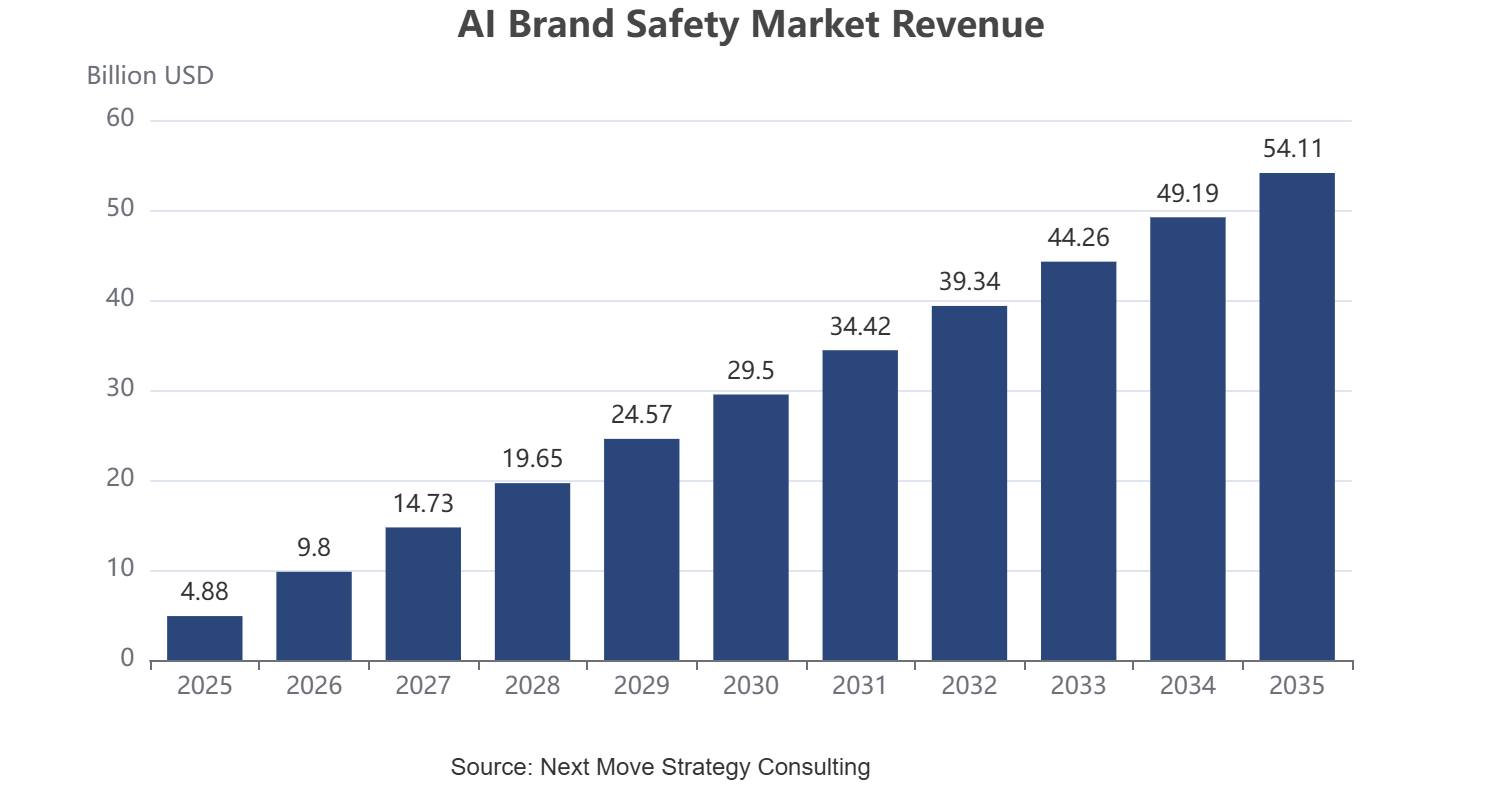
The AI Brand Safety Market is valued at USD 4.88 billion in 2025 and is projected to grow from USD 6.21 billion in 2026 to USD 54.11 billion by 2035, expanding at a CAGR of 27.2% from 2026 to 2035. This robust growth trajectory is driven by the rapid proliferation of programmatic advertising, surging demand for AI-powered content classification, heightened regulatory scrutiny around digital advertising transparency, and the accelerating adoption of brand suitability frameworks across global enterprise advertisers.
|
Parameters |
Details |
|
Market Size in 2025 |
USD 4.88 Billion |
|
Market Size in 2026 |
USD 6.21 Billion |
|
Revenue Forecast in 2035 |
USD 54.11 Billion |
|
Growth Rate |
CAGR of 27.2% from 2026 to 2035 |
|
Analysis Period |
2025–2035 |
|
Base Year Considered |
2025 |
|
Forecast Period |
2026–2035 |
|
Market Size Estimation |
USD Billion |
|
Companies Profiled |
20 |
|
Countries Covered |
33 |
|
Market Share |
Top 10 |
AI Brand Safety Market Overview
What Is the AI Brand Safety Market?
The AI Brand Safety Market encompasses technology solutions and professional services that help advertisers, agencies, publishers, and digital platform operators prevent ad placements alongside content that violates brand values, regulatory requirements, or platform safety standards. These systems use AI-driven detection and classification capabilities to evaluate digital environments across text, images, audio, and video formats at scale. NMSC's analysis indicates that the market includes brand suitability tools, content verification engines, fraud detection systems, and platform-integrated safety APIs embedded within programmatic advertising ecosystems.
How Has the AI Brand Safety Market Evolved?
The AI Brand Safety Market has evolved through clearly defined phases over time. Early solutions were primarily based on static keyword blocklists and manual content review workflows designed to prevent adjacency to explicitly unsafe or irrelevant content. The second phase introduced machine learning-based contextual classification models capable of probabilistic content scoring. Based on research conducted by NMSC, we found that the current phase, accelerating from 2024 onward, is defined by real-time multimodal AI systems that simultaneously analyze semantic context across video, audio, image, and text streams, enabling more precise brand suitability assessments at scale.
How Do Regulations Influence the AI Brand Safety Market?
Regulatory and compliance frameworks are a key structural driver of the AI Brand Safety Market. The European Union's Digital Services Act establishes strict obligations for digital platforms to mitigate exposure to illegal and harmful content, while the UK's Online Safety Act reinforces platform accountability for content monetization and user protection. In the United States, Federal Trade Commission guidelines on deceptive advertising practices continue to shape transparency and fraud prevention requirements in digital advertising ecosystems. NMSC's assessment indicates that these regulatory pressures are accelerating enterprise investment in automated brand safety and verification technologies across programmatic advertising channels.
How Is Technology Adoption Expanding Across the AI Brand Safety Market?
Technology adoption across the AI Brand Safety Market is advancing rapidly as advertisers and platforms shift toward fully automated, real-time content evaluation systems. Demand-side platforms (DSPs) and supply-side platforms (SSPs) are increasingly embedding AI-powered brand safety and suitability APIs directly into bidding and inventory management workflows. Our findings suggest that the transition to multimodal AI models capable of evaluating contextual meaning rather than isolated signals is fundamentally reshaping ad verification architectures, enabling more dynamic and granular control over media quality, placement safety, and monetization integrity across digital advertising ecosystems.
|
Key Takeaways |
|
By Product and Service, Brand Safety Controls and Suitability Activation is the dominant segment, valued at USD 1.66 billion in 2025 and projected to reach USD 18.39 billion by 2035. Growth is driven by wide pre-bid adoption across programmatic advertising. Contextual Data and Intelligence is the fastest-growing segment, expanding at a CAGR of 27.0% from 2026 to 2035, supported by the shift away from third-party cookies. |
|
By Buying Stage, Pre-bid leads the market at USD 2.20 billion in 2025 and is expected to reach USD 24.35 billion by 2035. It dominates as advertisers focus on blocking risky content before ad placement. In-flight monitoring is the fastest-growing segment, enabled by real-time bidding systems and mid-campaign optimization. |
|
By Media Environment, Open Web is the largest segment at USD 1.22 billion in 2025, driven by high programmatic display and video volume. Connected TV is the fastest-growing segment, supported by streaming growth and ad spend shifts from linear TV. |
|
By Buyer Type, Brand Advertisers lead at USD 1.95 billion in 2025, driven by direct investment in brand protection tools. Demand-Side Platforms are the fastest-growing segment as they integrate brand safety features into core bidding systems. |
|
By Commercial Model, Subscription leads at USD 1.71 billion in 2025 due to predictable pricing and continuous monitoring needs. Usage-based pricing is the fastest-growing model, aligning costs with impression volume. |
|
By Risk Taxonomy, Universal Safety Floor is dominant at USD 1.37 billion in 2025 as the baseline exclusion standard. Misinformation and AI-generated content detection is the fastest-growing segment due to rising generative AI risks. |
|
By Region, North America leads at USD 1.95 billion in 2025, supported by strong ad spend and mature verification ecosystems. Asia Pacific is the fastest-growing region at a CAGR of 27.0% from 2026 to 2035, driven by rapid digital advertising expansion. |
|
By Country, the United States is the largest market due to its advanced programmatic ecosystem and leading vendors. India is the fastest-growing market, supported by rising digital ad spend and stronger platform governance. |
Ecosystem Analysis of the AI Brand Safety Market
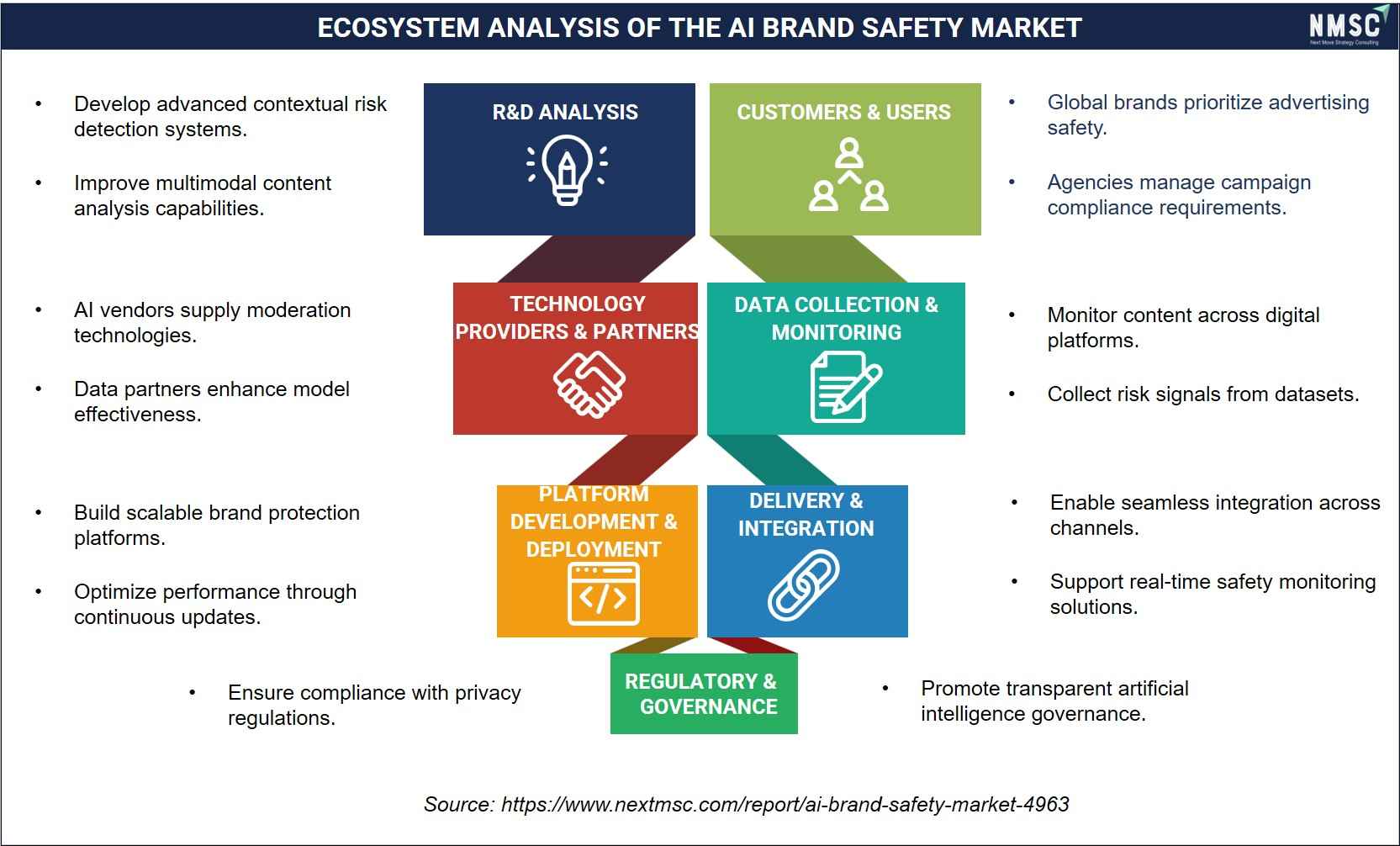
The above framework presents an ecosystem analysis of the AI Brand Safety Market across R&D, technology providers, platform development, delivery and deployment, data monitoring, regulatory governance, and end-user segments. We observed that global brands prioritize advertising safety while agencies manage campaign compliance requirements, shaping customer and user dynamics. Technology providers and partners drive platform development and integration, with delivery and deployment enabling market reach. Data collection and monitoring facilitate real-time brand safety assessments, while regulatory governance enforces content standards and compliance frameworks, collectively fostering innovation and trust in this rapidly evolving market.
Key Emerging Trends in the AI Brand Safety Market
How Is Generative AI Content Proliferation Reshaping Brand Adjacency Risk?
Through our market assessment, we observed that the explosion of generative AI content across open web properties has introduced entirely new categories of brand adjacency risk that legacy keyword filters are unable to address. AI-generated articles, synthetic images, and deepfake video content now constitute a measurable portion of monetized inventory on content networks. Platforms such as DoubleVerify and Integral Ad Science have introduced dedicated AI-generated content detection modules within their classification stacks, recognizing the need to differentiate between human-authored and machine-produced content environments for suitability evaluation.
How Are Multimodal AI Models Transforming Real-Time Content Classification?
NMSC's analysis indicates that multimodal AI models capable of simultaneously analyzing video frames, audio transcripts, on-screen text, and metadata are redefining classification accuracy within the AI Brand Safety Market. Traditional single-modality approaches resulted in false-positive block rates that suppressed brand-safe inventory, reducing campaign reach unnecessarily. Companies including Zefr and GumGum have demonstrated multimodal classification architectures that deliver context-aware scoring across YouTube, TikTok, and CTV environments, reducing misclassification rates while enabling more precise brand suitability enforcement at the placement level.
How Is the Deprecation of Third-Party Cookies Accelerating Contextual Intelligence Investment?
Based on our market evaluation, we noticed that the industry-wide transition away from third-party cookie-based audience targeting has made contextual intelligence the primary alternative signal for both audience identification and brand safety enforcement. Contextual data providers within the AI Brand Safety Market are expanding their taxonomy and signal API licensing businesses as media buyers seek scalable, privacy-compliant targeting mechanisms. The IAB Tech Lab's Content Taxonomy v3.0 has emerged as the interoperability standard, with vendors including Seedtag and Silverbullet Data Services Group building their classification outputs around this framework.
How Are Supply-Path Optimization Practices Embedding Brand Safety at the Infrastructure Layer?
Our findings suggest that supply-path optimization initiatives pursued by major advertisers and agencies are increasingly incorporating brand safety policy enforcement as a structural selection criterion rather than a post-bid overlay. Preferred deal frameworks and curated marketplace agreements now routinely include contractual brand safety SLAs, creating demand for supply-path-level verification tools. Scope3 PBC has emerged as a notable participant in this trend, offering supply-chain transparency scoring that incorporates brand safety metrics alongside carbon footprint data, reflecting the convergence of ESG considerations and advertising quality standards.
What Are the Key Market Drivers, Breakthroughs, and Investment Opportunities That Will Shape the AI Brand Safety Industry in the Next Decade?
Growth Catalyst and Risk Assessment Matrix
|
Drivers / Trends / Restraints |
(+/-) % Impact on CAGR Forecast |
Geographic Relevance |
Impact Timeline |
|
Programmatic ad spend growth driving verification demand |
+3.2% |
Global |
Immediate (2025–2027) |
|
Generative AI content proliferation creating new risk categories |
+2.8% |
North America, Europe |
Near-term (2025–2028) |
|
EU Digital Services Act compliance mandates |
+2.1% |
Europe |
Near-term (2025–2027) |
|
CTV and streaming audience fragmentation |
+1.9% |
North America, Asia Pacific |
Medium-term (2026–2030) |
|
Cookie deprecation accelerating contextual intelligence adoption |
+1.6% |
Global |
Immediate (2025–2026) |
|
Measurement standardization fragmentation across platforms |
-1.4% |
Global |
Persistent (2025–2035) |
|
Walled garden data opacity limiting cross-platform verification |
-1.2% |
Global |
Persistent (2025–2035) |
|
Retail media networks expansion creating new safety verification demand |
+1.5% |
North America, Europe, Asia Pacific |
Medium-term (2027–2032) |
What Are the Growth Drivers of the AI Brand Safety Market?
How Is Programmatic Advertising Scale Creating Structural Demand for AI-Powered Brand Safety Solutions?
Based on NMSC's research, we found that the continued expansion of programmatic advertising creates an irreversible structural demand for automated brand safety enforcement. The Interactive Advertising Bureau (IAB) reports that programmatic channels now account for the majority of digital display advertising transactions globally, generating billions of daily ad placement decisions that cannot be evaluated manually. AI-powered pre-bid classification systems address this scale imperative by scoring inventory at auction speed. The IAB's transparency and consent framework has further institutionalised brand safety as a supply-chain discipline, embedding it into publisher and platform contractual obligations worldwide.
How Is Regulatory Pressure from the EU Digital Services Act Accelerating Enterprise Adoption?
From our research, we found that the EU Digital Services Act, which entered full enforcement for large platforms in August 2023 and extended compliance obligations across additional service categories in 2024, requires platforms to implement systemic risk mitigation for the dissemination of harmful content through advertising placements. Advertisers operating within EU jurisdictions face secondary liability considerations that incentivize investment in independent brand safety verification and audit services. The European Data Protection Board's guidance on advertising transparency reinforces this demand by requiring demonstrable evidence of content-level due diligence, creating sustained procurement pressure for measurement and verification tools within the AI Brand Safety Market.
How Is the Proliferation of AI-Generated Content Driving Next-Generation Risk Detection Investment?
Our assessment indicates that the rapid proliferation of AI-generated content across open web and social media environments is creating demand for dedicated detection capabilities that did not exist within legacy brand safety frameworks. The World Federation of Advertisers has documented growing advertiser concern about brand adjacency to synthetic content, citing reputational risk when advertisements appear adjacent to fabricated news or deepfake video. This emerging risk category requires classification models trained specifically on AI-generated content signatures, driving investment in new product development and model retraining cycles across major brand safety vendors in the AI Brand Safety Market.
What Are the Growth Inhibitors of the AI Brand Safety Market?
How Does Measurement Fragmentation Across Walled Gardens Constrain Market Scalability?
Through NMSC's assessment, we found that the structural opacity of walled garden platforms, including major social media and search environments, materially constrains the ability of independent brand safety vendors to provide consistent cross-platform verification. Platform-native safety reporting methodologies differ from IAB Tech Lab measurement standards, creating reconciliation challenges for advertisers attempting to consolidate campaign-level brand safety reporting. The IAB Tech Lab's Open Measurement SDK provides a partial solution for mobile and CTV environments, but equivalent cross-platform standards for social media content remain absent, limiting the addressable opportunity for third-party verification providers operating within the AI Brand Safety Market.
How Do Talent Scarcity and AI Model Maintenance Costs Limit Smaller Vendor Scalability?
Based on our market evaluation, we noticed that the competitive intensity of AI model development within the AI Brand Safety Market requires continuous investment in specialized machine learning engineering and multilingual content taxonomy maintenance. Smaller and mid-tier vendors face structural disadvantages in sustaining model accuracy across the full breadth of content categories and languages required by global enterprise clients. The cost of acquiring and retaining AI safety researchers with dual expertise in advertising technology and natural language processing represents a meaningful barrier to product parity, contributing to consolidation pressure and limiting the emergence of new independent competitors.
What Are the Growth Opportunities in the AI Brand Safety Market?
How Is the Retail Media Network Expansion Creating a New Frontier for Brand Safety Verification?
Our analysis shows that the emergence of retail media networks operated by major e-commerce and grocery platforms constitutes a structurally distinct and rapidly growing inventory category that requires specialized brand safety frameworks. Retailers operate closed-loop attribution environments where first-party shopper data intersects with advertising delivery, creating both verification opportunities and data privacy compliance challenges. Based on our engagements with industry stakeholders, brands investing in retail media placements are beginning to mandate brand safety SLAs equivalent to those applied to open web and CTV inventory, creating meaningful expansion opportunities for AI Brand Safety Market vendors capable of developing retail-specific classification capabilities.
How Can Audio and Podcast Content Verification Become the Next High-Growth Vertical?
Through our analysis, we observe that digital audio advertising, including streaming audio and podcast placements, represents an underpenetrated segment within the AI Brand Safety Market relative to its share of total digital advertising spend. Audio content classification requires specialized acoustic analysis and transcript-based NLP processing distinct from visual content frameworks. Brands allocating budget to digital audio face meaningful adjacency risk from increasingly unmoderated user-generated podcast content. Investment in audio-specific brand safety AI represents a first-mover opportunity for vendors willing to develop dedicated acoustic classification and real-time transcript monitoring capabilities.
How Does the Growing Importance of ESG in Advertising Create Demand for Expanded Risk Taxonomy Services?
NMSC's analysis indicates that the integration of environmental, social, and governance considerations into corporate advertising policies is expanding the definition of brand risk beyond traditional harmful content categories. Advertisers with formal ESG commitments are adopting carbon-intensity metrics and supply-chain sustainability scores as additional inventory selection criteria alongside conventional brand safety filters. Scope3 PBC's emergence as a carbon measurement provider within the programmatic supply chain reflects this convergence. This trend creates demand for risk taxonomy services that span traditional brand safety, regulatory compliance, and ESG-aligned content curation within unified platform offerings.
How Is the AI Brand Safety Market Segmented, and What Are the Key Insights from the Segmentation Analysis?
By Product and Service
Which Product and Service Category Is Generating the Highest Revenue in the AI Brand Safety Market?
|
Segments |
2025 (USD Billion) |
2035 (USD Billion) |
CAGR (%) |
|
Brand Safety Controls and Suitability Activation |
1.66 |
18.39 |
27.3% |
|
Measurement and Verification |
1.42 |
15.74 |
27.2% |
|
Contextual Data and Intelligence |
0.98 |
10.82 |
27.0% |
|
Managed and Professional Services |
0.82 |
9.16 |
27.1% |
Brand Safety Controls and Suitability Activation is the dominant product category within the AI Brand Safety Market, generating USD 1.66 billion in 2025 and projected to reach USD 18.39 billion by 2035 at a CAGR of 27.3%. This segment encompasses pre-bid avoidance and blocking, inclusion and exclusion list management, brand suitability rule engines, and supply-path policy enforcement. Pre-bid avoidance is the leading sub-segment due to its direct integration within DSP bid decisioning workflows. Brand suitability rule engines are the fastest-growing sub-segment as advertisers move from binary block/allow logic toward nuanced contextual scoring across content verticals.
By Buying Stage
Which Buying Stage Captures the Largest Share of AI Brand Safety Market Spending?
|
Segments |
2025 (USD Billion) |
2035 (USD Billion) |
CAGR (%) |
|
Pre-bid |
2.20 |
24.35 |
27.3% |
|
In-flight |
1.61 |
17.82 |
27.2% |
|
Post-bid |
1.07 |
11.94 |
27.1% |
Pre-bid represents the dominant buying stage within the AI Brand Safety Market, accounting for USD 2.20 billion in 2025 and forecast to reach USD 24.35 billion by 2035, reflecting advertiser preference for proactive inventory exclusion over reactive remediation. Pre-bid brand safety scoring is now embedded as a standard feature within major demand-side platforms, normalizing its adoption across agency trading desks. In-flight monitoring is the fastest-growing stage, as real-time bidding infrastructure improvements enable mid-campaign reassessment and creative reallocation without auction delay. Post-bid reporting, while mature, retains its importance as the primary accountability and audit mechanism for brand safety compliance verification.
By Media Environment
How Does Media Environment Shape AI Brand Safety Market Demand and Classification Complexity?
|
Segments |
2025 (USD Billion) |
2035 (USD Billion) |
CAGR (%) |
|
Open Web |
1.22 |
13.53 |
27.2% |
|
Mobile App |
0.98 |
10.82 |
27.0% |
|
Connected TV |
0.78 |
8.66 |
27.3% |
|
Social Media |
0.73 |
8.12 |
27.2% |
|
Digital Audio |
0.49 |
5.41 |
27.1% |
|
Retail Media Networks |
0.39 |
4.33 |
27.2% |
|
Other Digital Environments |
0.29 |
3.24 |
27.1% |
Open Web remains the largest media environment within the AI Brand Safety Market at USD 1.22 billion in 2025, owing to the breadth of display and video inventory transacted through open programmatic exchanges. Mobile App safety verification is the second-largest segment, supported by the IAB's Open Measurement SDK adoption across app-ads.txt-compliant inventory. Connected TV is the fastest-growing media environment at a CAGR of 27.3%, as streaming audience growth and the convergence of linear and digital advertising budgets demand multimodal CTV content classification. Social Media, Digital Audio, and Retail Media Networks represent expanding frontier opportunities for specialized AI Brand Safety Market solutions.
By Buyer Type
Which Buyer Type Is the Largest Consumer of AI Brand Safety Market Solutions?
|
Segments |
2025 (USD Billion) |
2035 (USD Billion) |
CAGR (%) |
|
Brand Advertiser |
1.95 |
21.64 |
27.3% |
|
Advertising Agency |
1.32 |
14.65 |
27.2% |
|
Publisher |
0.73 |
8.12 |
27.2% |
|
Demand-Side Platform |
0.59 |
6.49 |
27.1% |
|
Supply-Side Platform |
0.29 |
3.21 |
27.0% |
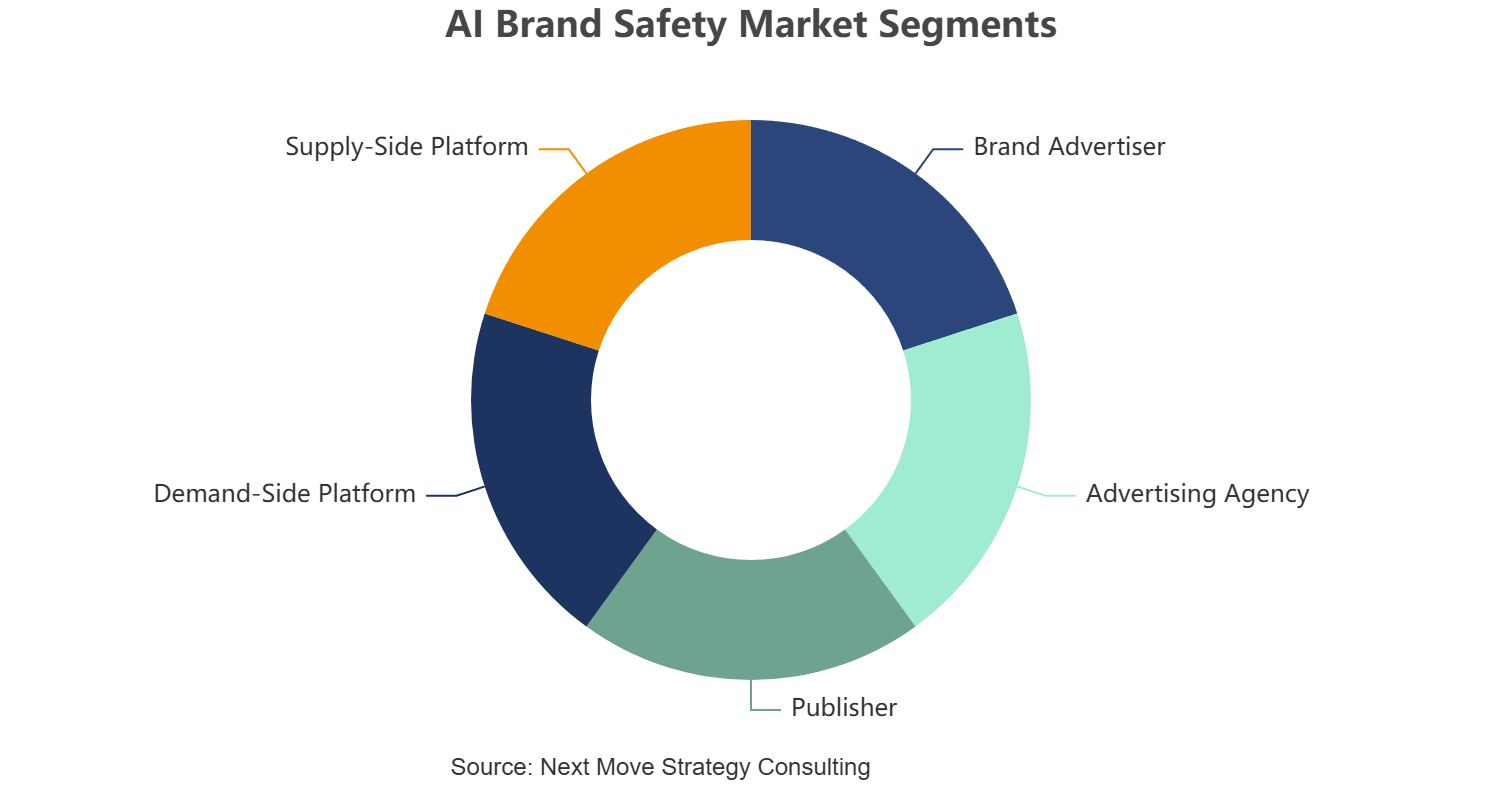
Brand Advertisers are the dominant buyer type within the AI Brand Safety Market, representing USD 1.95 billion in 2025 as multinational enterprises directly procure verification and suitability tools to protect global campaign investments. Advertising Agencies account for USD 1.32 billion, acting as intermediaries that standardize brand safety vendor selection across client portfolios. Publishers are an increasingly active buyer type as supply-side brand safety compliance becomes a prerequisite for preferred deal access. Demand-Side Platforms are the fastest-growing buyer type as they embed brand safety classification APIs natively into their platform architecture to meet advertiser certification requirements.
By Commercial Model
What Commercial Model Is Driving Recurring Revenue Growth in the AI Brand Safety Market?
|
Segments |
2025 (USD Billion) |
2035 (USD Billion) |
CAGR (%) |
|
Subscription |
1.71 |
18.93 |
27.2% |
|
Usage-based |
1.32 |
14.65 |
27.2% |
|
License |
0.98 |
10.82 |
27.1% |
|
Managed Service |
0.87 |
9.71 |
27.2% |
Subscription is the leading commercial model within the AI Brand Safety Market at USD 1.71 billion in 2025, preferred by enterprise advertisers seeking predictable cost structures and continuous monitoring entitlements. Usage-based pricing is the fastest-growing commercial model, gaining traction among mid-market advertisers and independent agencies that require impression-aligned cost structures. License agreements retain importance for platform operators seeking perpetual access to taxonomy and API libraries. Managed Service contracts, while the smallest segment at USD 0.87 billion, deliver the highest per-contract revenue yield due to the inclusion of dedicated analyst teams and custom policy development services.
By Risk Taxonomy Applied
How Do Risk Taxonomies Define the Scope of AI Brand Safety Market Coverage?
|
Segments |
2025 (USD Billion) |
2035 (USD Billion) |
CAGR (%) |
|
Universal Safety Floor |
1.37 |
15.20 |
27.2% |
|
Brand Suitability |
1.17 |
12.99 |
27.2% |
|
Regulatory Compliance |
0.83 |
9.20 |
27.2% |
|
Content Quality and Made-for-Advertising |
0.68 |
7.56 |
27.2% |
|
Misinformation and AI-Generated Content |
0.54 |
5.95 |
27.1% |
|
Other Policy Risks |
0.29 |
3.21 |
27.1% |
Universal Safety Floor is the dominant risk taxonomy at USD 1.37 billion in 2025, establishing the baseline content exclusion standard applied universally across all programmatic campaigns regardless of advertiser industry or campaign objective. Brand Suitability taxonomy addresses the contextual fit dimension beyond absolute safety, enabling advertisers to define acceptable adjacency tiers. Regulatory Compliance is the third-largest taxonomy, growing in relevance as DSA and Online Safety Act obligations create audit trail requirements. Misinformation and AI-Generated Content is the fastest-growing taxonomy within the AI Brand Safety Market, reflecting the urgency of addressing synthetic content adjacency risk at scale.
Regional Outlook of the AI Brand Safety Market
Geographic Performance Snapshot
|
Region |
2025 (USD Billion) |
2035 (USD Billion) |
CAGR (%) |
|
North America |
1.95 |
21.64 |
27.3% |
|
Europe |
1.17 |
12.99 |
27.1% |
|
Asia Pacific |
0.98 |
10.82 |
27.0% |
|
Middle East & Africa |
0.39 |
4.33 |
27.2% |
|
Latin America |
0.39 |
4.33 |
27.2% |
North America AI Brand Safety Market
North America is the dominant region in the AI Brand Safety Market, valued at USD 1.95 billion in 2025 and projected to reach USD 21.64 billion by 2035 at a CAGR of 27.3%. The region hosts the world's largest programmatic advertising ecosystem and the headquarters of leading verification vendors including DoubleVerify and Integral Ad Science. Regulatory guidance from the FTC on deceptive advertising and the Interactive Advertising Bureau's TAG Brand Safety Certification program reinforce enterprise procurement standards. Our analysis shows that CTV verification is the fastest-growing sub-category within the North America AI Brand Safety Market, reflecting the continued shift of linear television budgets to streaming platforms.
U.S. AI Brand Safety Market
Through our analysis, the United States is the largest single-country market within the AI Brand Safety Market, driven by the highest per-capita programmatic advertising spend globally and the most mature vendor ecosystem for digital ad verification. The FTC's updated guidance on endorsements and testimonials, effective 2023, has increased advertiser awareness of brand association liability. The IAB's TAG certification framework is widely adopted by U.S.-based advertisers and agencies as a procurement requirement. Technology penetration across U.S. enterprises is high, with major holding companies including WPP, Omnicom, IPG, and Publicis integrating brand safety platforms across client portfolios.
Canada AI Brand Safety Market
From our assessment, Canada represents a structurally aligned but smaller market relative to the United States within the AI Brand Safety Market. Digital advertising investment is concentrated in Toronto and Vancouver, with media agencies operating as the primary procurement channel for brand safety services. The Canadian Radio-television and Telecommunications Commission's oversight of digital content and the Competition Bureau's enforcement of advertising standards create a regulatory baseline that supports adoption of independent verification. Technology penetration is advancing as Canadian subsidiaries of multinational advertisers align with global brand safety standards mandated by U.S. and European parent organizations.
Mexico AI Brand Safety Market
According to evaluation of market conditions in Mexico, the AI Brand Safety Market is at an early adoption stage relative to North American peers. Digital advertising growth is concentrated among consumer-packaged goods, financial services, and e-commerce sectors, which represent the primary demand source for brand safety verification. Regulatory influence from the Federal Telecommunications Institute and Profeco's advertising standards framework is beginning to incentivize platform accountability. Competitive intensity is lower than in the United States and Canada, creating first-mover opportunities for vendors willing to invest in Spanish-language content classification capabilities.
Europe AI Brand Safety Market
Europe is the second-largest region in the AI Brand Safety Market at USD 1.17 billion in 2025, supported by the EU Digital Services Act, the UK Online Safety Act, and strong advertising industry self-regulation through the European Advertising Standards Alliance. GDPR compliance requirements intersect with brand safety data collection practices, requiring vendors to adapt consent management workflows for European deployments. Our findings suggest that the EU's regulatory environment is creating a compliance-driven demand cycle that is structurally distinct from the commercially driven adoption patterns observed in North America, benefiting verification vendors with established European legal and compliance frameworks.
UK AI Brand Safety Market
Based on our engagements with UK market stakeholders, the United Kingdom is the largest country-level market within Europe for the AI Brand Safety Market, anchored by London's status as a global hub for programmatic advertising and ad technology innovation. The Online Safety Act 2023 imposes obligations on user-to-user services and search services to protect users from harmful content, with advertising adjacency implications that have accelerated brand safety investment. The UK's IAB chapter has published brand safety guidelines aligned with global IAB Tech Lab standards. Technology penetration is high, with major global brands managing UK-specific brand safety policies through their London-based agency teams.
Germany AI Brand Safety Market
Through our analysis, Germany represents the second-largest European country market for the AI Brand Safety Market, driven by stringent media law enforcement and a large base of automotive, pharmaceutical, and financial services advertisers with high brand sensitivity. The German Interstate Media Treaty and the Medienstaatsvertrag regulate advertising content across digital platforms. German advertisers exhibit conservative brand safety preferences, typically applying broader exclusion lists than their Anglo-Saxon counterparts. The presence of European headquarters for several global ad verification vendors in Germany and the Netherlands reinforces local market penetration and client service capabilities.
France AI Brand Safety Market
From our assessment, France demonstrates growing adoption of AI Brand Safety Market solutions, supported by the Autorité de Régulation de la Communication Audiovisuelle et Numérique (ARCOM) oversight of digital advertising content. French luxury, beauty, and consumer goods advertisers, many operating through LVMH, L'Oréal, and similar holding companies, maintain stringent brand safety standards reflecting the premium positioning of their brands. Contextual intelligence solutions are particularly valued in France due to the importance of placement-level quality for luxury brand communication. Competitive intensity is increasing as global brand safety vendors expand French-language classification capabilities.
Italy AI Brand Safety Market
Based on our market evaluation, Italy's AI Brand Safety Market is developing steadily, supported by growth in digital advertising investment from fashion, automotive, and food and beverage sectors. The Autorità per le Garanzie nelle Comunicazioni (AGCOM) regulates digital content advertising practices. Technology penetration is advancing as Italian subsidiaries of multinational consumer goods companies align with global group-level brand safety procurement standards. Independent agency adoption of brand safety platforms is accelerating as Italian agencies seek to demonstrate measurement credibility to global clients.
Spain AI Brand Safety Market
According to evaluation of Spain's digital advertising landscape, the AI Brand Safety Market is in a growth phase driven by increasing programmatic adoption among Spanish advertisers and international brands operating in the Iberian market. The Comisión Nacional de los Mercados y la Competencia (CNMC) provides regulatory oversight relevant to digital advertising practices. Spanish-language content classification is a critical capability requirement for vendors seeking to address the Spanish market, given the linguistic complexity of regional dialects and colloquial expressions that affect suitability scoring accuracy.
Sweden AI Brand Safety Market
Through our analysis, Sweden demonstrates above-average adoption rates for AI Brand Safety Market solutions relative to its market size, reflecting the country's high digital advertising maturity and strong adherence to IAB industry standards. Swedish advertisers benefit from the Konsumentverket's (Swedish Consumer Agency) transparent advertising guidelines. Major retail, gaming, and technology companies headquartered in Stockholm are active adopters of brand safety verification. Sweden's regulatory alignment with EU DSA obligations and its position as a Nordic hub for ad technology companies support sustained market development.
Denmark AI Brand Safety Market
Based on our engagements, Denmark's AI Brand Safety Market is driven by a highly digitized advertising ecosystem and strong consumer protection standards enforced by the Consumer Ombudsman. Danish advertisers, particularly in retail, financial services, and media, are early adopters of advanced brand suitability frameworks. The country's alignment with EU Digital Services Act requirements creates compliance-driven demand for independent verification services. Technology penetration is high, with Danish agencies increasingly offering brand safety management as a standard programmatic service component.
Finland AI Brand Safety Market
From our assessment, Finland's AI Brand Safety Market benefits from a mature digital advertising ecosystem and strong industry adherence to IAB Finland guidelines. Finnish advertisers in telecommunications, retail, and consumer electronics are active brand safety platform users. The Finnish Consumer Authority's advertising regulations and EU DSA compliance requirements provide a supportive regulatory framework. Technology adoption is advancing, though the relatively smaller market size limits the presence of dedicated local vendor operations, with most procurement occurring through regional Nordic partnerships.
Netherlands AI Brand Safety Market
According to evaluation, the Netherlands is a strategically important market within the Europe AI Brand Safety Market, hosting the European headquarters of several major global programmatic platforms and ad verification companies. The Autoriteit Consument en Markt (ACM) enforces advertising transparency standards. Amsterdam's status as a European programmatic hub means that supply-path brand safety policy enforcement decisions made in the Netherlands have downstream implications for advertiser campaigns across the broader European market. Technology penetration is among the highest in Europe.
Asia Pacific AI Brand Safety Market
Asia Pacific accounts for USD 0.98 billion in the AI Brand Safety Market in 2025, growing to USD 10.82 billion by 2035 at a CAGR of 27.0%. The region is characterised by divergent maturity levels across markets, ranging from highly sophisticated programmatic ecosystems in Australia, Japan, and South Korea to rapidly developing markets in India and Southeast Asia. Our analysis shows that multilingual content classification is the critical technical capability differentiating competitive vendors in Asia Pacific, given the diversity of languages, scripts, and content cultures across the region's 10-plus covered markets.
China AI Brand Safety Market
Based on our market evaluation, China's AI Brand Safety Market operates within a distinct regulatory and technological environment shaped by the Cyberspace Administration of China (CAC) and the National Advertising Association. Domestic brand safety solutions dominate the Chinese market, as international vendors face platform access limitations and data localization requirements. The CAC's Provisions on the Management of Algorithmic Recommendations, effective 2022, and the Generative AI Regulation, effective 2023, create a domestic compliance framework that shapes how brand safety classification is implemented on platforms including Tencent, Alibaba, and ByteDance. Technology penetration is high among multinational advertisers operating in China through licensed joint venture structures.
India AI Brand Safety Market
Through our analysis, India is the fastest-growing country-level market within the Asia Pacific AI Brand Safety Market, driven by the world's largest and most rapidly growing digital advertising ecosystem by user volume. The Ministry of Information and Broadcasting and the Advertising Standards Council of India (ASCI) are intensifying digital advertising oversight. OTT platform proliferation and the rapid growth of programmatic video advertising are creating measurable demand for brand safety verification. The IT Rules 2021 and subsequent amendments require digital intermediaries to implement content moderation mechanisms, creating a compliance framework relevant to brand safety platform deployment.
Japan AI Brand Safety Market
From our assessment, Japan represents a mature and compliance-oriented market within the Asia Pacific AI Brand Safety Market. The Japan Advertisers Association and the Japan Audit Bureau of Circulations have established digital advertising quality standards aligned with global IAB frameworks. Japanese advertisers in automotive, electronics, and consumer goods apply stringent brand safety standards reflecting the cultural premium placed on corporate reputation. Technology penetration is high, with Japanese holding company groups including Dentsu and Hakuhodo implementing brand safety platforms across their programmatic trading operations.
South Korea AI Brand Safety Market
According to evaluation, South Korea's AI Brand Safety Market is developing rapidly, supported by one of Asia's highest digital advertising investment levels per capita and a highly competitive e-commerce advertising environment. The Korea Communications Commission and the Korea Consumer Agency provide regulatory oversight of digital advertising practices. K-pop and Korean entertainment content creates unique brand adjacency considerations that require culturally informed classification models. Technology penetration is advancing as global brand safety vendors invest in Korean-language classification capabilities and local partnerships.
Taiwan AI Brand Safety Market
Based on our engagements, Taiwan's AI Brand Safety Market is in a growth phase, supported by a dynamic technology and consumer electronics advertising sector. The National Communications Commission regulates digital broadcasting and advertising content. Taiwanese advertisers, particularly in semiconductor, technology, and consumer goods sectors, are increasing investment in brand safety solutions as cross-border digital advertising campaigns expand. Technology penetration is moderate, with adoption led by multinational brand subsidiaries and larger domestic enterprises
Indonesia AI Brand Safety Market
Through our analysis, Indonesia represents one of Southeast Asia's highest-growth markets within the Asia Pacific AI Brand Safety Market, driven by a large and rapidly expanding digital advertising ecosystem supported by social media-heavy consumption patterns. The Ministry of Communication and Informatics (Kominfo) and the Indonesian Broadcasting Commission regulate digital content. Bahasa Indonesia-language content classification is a critical capability requirement. International brand safety vendors are partnering with local digital agencies to address the Indonesian market's specific content risk environment.
Vietnam AI Brand Safety Market
From our assessment, Vietnam's AI Brand Safety Market is at an early stage of development but is growing in line with the country's rapid digital advertising investment growth. The Ministry of Information and Communications oversees digital advertising regulation. Vietnamese-language NLP capabilities for content classification are a technical differentiator in this market. International consumer goods, financial services, and technology companies are the primary adopters of brand safety verification in Vietnam as they scale programmatic advertising investment.
Australia AI Brand Safety Market
According to evaluation, Australia is the most mature AI Brand Safety Market in Oceania and among the most advanced in Asia Pacific, supported by a well-developed programmatic advertising infrastructure and strong industry self-regulation through the Australian Association of National Advertisers (AANA) and the Interactive Advertising Bureau Australia. The Online Safety Act 2021, administered by the eSafety Commissioner, creates compliance considerations relevant to brand safety platform deployment. Major Australian retailers and financial services companies are active adopters of enterprise brand safety platforms.
Philippines AI Brand Safety Market
Based on our market evaluation, the Philippines is an emerging AI Brand Safety Market within Southeast Asia, driven by growth in social media and mobile advertising investment. The National Telecommunications Commission and the Advertising Standards Council of the Philippines provide the regulatory framework. English-language and Filipino-language bilingual content classification capability is required for effective brand safety enforcement. Technology penetration is increasing as global brands scale digital advertising investment in the Philippines market.
Malaysia AI Brand Safety Market
Through our analysis, Malaysia's AI Brand Safety Market is developing at a moderate pace, supported by growing programmatic adoption among retail, financial services, and telecommunications advertisers. The Malaysian Communications and Multimedia Commission (MCMC) and the Communications and Multimedia Content Forum regulate digital advertising content. Malay, English, and Chinese multilingual classification capabilities are required to address Malaysia's diverse content environment. Technology penetration is advancing, with adoption led by regional holding company agency teams and global brand subsidiaries.
Middle East & Africa AI Brand Safety Market
The Middle East and Africa region accounts for USD 0.39 billion in the AI Brand Safety Market in 2025, with a CAGR of 27.2% through 2035. Market development is concentrated in the Gulf Cooperation Council countries, Israel, South Africa, and Turkey, which collectively represent the primary demand centers for brand safety verification services. Our findings suggest that regional market growth is supported by increasing multinational advertiser investment, government-mandated digital content governance frameworks, and the expansion of programmatic advertising infrastructure across Gulf markets.
Saudi Arabia AI Brand Safety Market
Based on our engagements, Saudi Arabia is the largest market within the Middle East for the AI Brand Safety Market, driven by Vision 2030's digital transformation agenda and substantial investment in digital advertising from government entities and consumer goods companies. The General Authority for Media Regulation (GAMR) oversees advertising content standards. Technology adoption is advancing rapidly, supported by government-backed digitization programs. Arabic-language content classification is a mandatory capability for vendors addressing the Saudi market.
UAE AI Brand Safety Market
Through our analysis, the UAE is the most commercially mature market within the Middle East for the AI Brand Safety Market. Dubai's position as a regional media and advertising hub concentrates brand safety procurement within agency groups including OMD, GroupM, and Publicis operating from UAE offices. The National Media Council regulates digital advertising content standards. Technology penetration is high among multinational advertisers using the UAE as the MENA regional hub for programmatic campaign management. Arabic and English bilingual classification capabilities are standard requirements.
Egypt AI Brand Safety Market
From our assessment, Egypt's AI Brand Safety Market is in an early development stage, driven by growing digital advertising investment in one of Africa's largest consumer markets. The National Telecom Regulatory Authority (NTRA) and the Egyptian Advertising Federation provide the regulatory framework. Arabic-language content classification is the primary technical capability requirement. Adoption is currently limited to multinational consumer goods and telecommunications companies, with domestic advertiser adoption expected to increase as programmatic trading infrastructure matures.
Israel AI Brand Safety Market
According to evaluation, Israel has a disproportionately sophisticated AI Brand Safety Market relative to its geographic size, reflecting the country's high concentration of ad technology companies and the global programmatic operations managed by Israeli-founded companies. The Israel Advertising Association and the Ministry of Communications provide relevant regulatory oversight. Technology penetration is high, with Israeli ad tech startups active in brand safety-adjacent product categories including fraud detection and contextual intelligence. Hebrew-language content classification is a market-specific requirement.
Turkey AI Brand Safety Market
Based on our market evaluation, Turkey's AI Brand Safety Market is growing in line with the country's expanding digital advertising ecosystem. The Radio and Television Supreme Council (RTUK) regulates digital content advertising. Turkish-language content classification and cultural suitability calibration are critical technical requirements. Adoption is driven by multinational FMCG, automotive, and financial services advertisers investing in programmatic channels. Competitive intensity is increasing as regional and international brand safety vendors seek to establish Turkish-market partnerships.
Nigeria AI Brand Safety Market
Through our analysis, Nigeria represents the largest market opportunity in Sub-Saharan Africa for the AI Brand Safety Market, driven by rapid mobile internet adoption and growing programmatic advertising investment. The National Broadcasting Commission and the Advertising Regulatory Council of Nigeria (ARCON) provide the regulatory framework. English-language and Yoruba, Hausa, Igbo content moderation requirements create technical complexity. Adoption is primarily driven by telecommunications, financial services, and FMCG advertisers. Market maturity is early, but the large addressable opportunity makes Nigeria a medium-term priority for regional expansion strategies.
South Africa AI Brand Safety Market
From our assessment, South Africa is the most mature AI Brand Safety Market in Sub-Saharan Africa, supported by a relatively developed programmatic advertising infrastructure and strong industry standards from the Interactive Advertising Bureau South Africa. The Advertising Regulatory Board (ARB) provides self-regulatory oversight. Technology penetration is higher than in other African markets, with major retail, financial services, and telecommunications companies adopting brand safety platforms. South Africa's position as a regional media hub for Sub-Saharan Africa amplifies the strategic importance of developing local brand safety capabilities.
Latin America AI Brand Safety Market
Latin America accounts for USD 0.39 billion in the AI Brand Safety Market in 2025, growing to USD 4.33 billion by 2035 at a CAGR of 27.2%. Brazil and Mexico represent the dominant country markets within the region, together accounting for the majority of regional digital advertising spend. Our analysis shows that Portuguese and Spanish multilingual content classification capabilities are foundational requirements for vendors seeking to address the Latin American market at scale.
Brazil AI Brand Safety Market
Based on our engagements, Brazil is the largest AI Brand Safety Market in Latin America, driven by a large and growing digital advertising ecosystem and one of the highest social media usage rates globally. The Conselho Nacional de Autorregulamentação Publicitária (CONAR) regulates advertising content, and the Lei Geral de Proteção de Dados Pessoais (LGPD) creates data handling requirements relevant to brand safety platform operations. Portuguese-language NLP classification capabilities are a core differentiator. Major global and Brazilian advertisers in retail, financial services, and consumer goods are the primary adopters.
Argentina AI Brand Safety Market
Through our analysis, Argentina's AI Brand Safety Market is developing steadily despite macroeconomic volatility, driven by continued growth in digital advertising investment among consumer goods and financial services sectors. The Secretaría de Comercio Interior oversees advertising standards. Spanish-language content classification is required. Technology penetration is moderate, with adoption concentrated among multinational subsidiaries and larger domestic enterprises. Market growth is expected to accelerate as programmatic advertising infrastructure matures and regional brand safety vendors expand operations.
Chile AI Brand Safety Market
From our assessment, Chile represents a stable and commercially oriented AI Brand Safety Market within Latin America, supported by a well-developed digital advertising infrastructure and strong financial services and retail advertising sectors. The Servicio Nacional del Consumidor (SERNAC) provides consumer protection oversight relevant to advertising practices. Technology adoption is advancing as Chilean agencies align with global programmatic advertising standards. Competitive intensity is low, creating entry opportunities for regional brand safety solution providers.
Colombia AI Brand Safety Market
According to our evaluation, Colombia's AI Brand Safety Market is growing rapidly, supported by increasing digital advertising investment and the emergence of Bogotá as a regional digital media hub. The Superintendencia de Industria y Comercio (SIC) regulates advertising practices, and Colombia's data protection law (Ley 1581) creates compliance considerations for brand safety data handling. Spanish-language classification capability and regional Spanish dialect accuracy are technical requirements. Adoption is driven by telecommunications, e-commerce, and financial services advertisers expanding programmatic budgets.
PESTEL Analysis of the AI Brand Safety Market
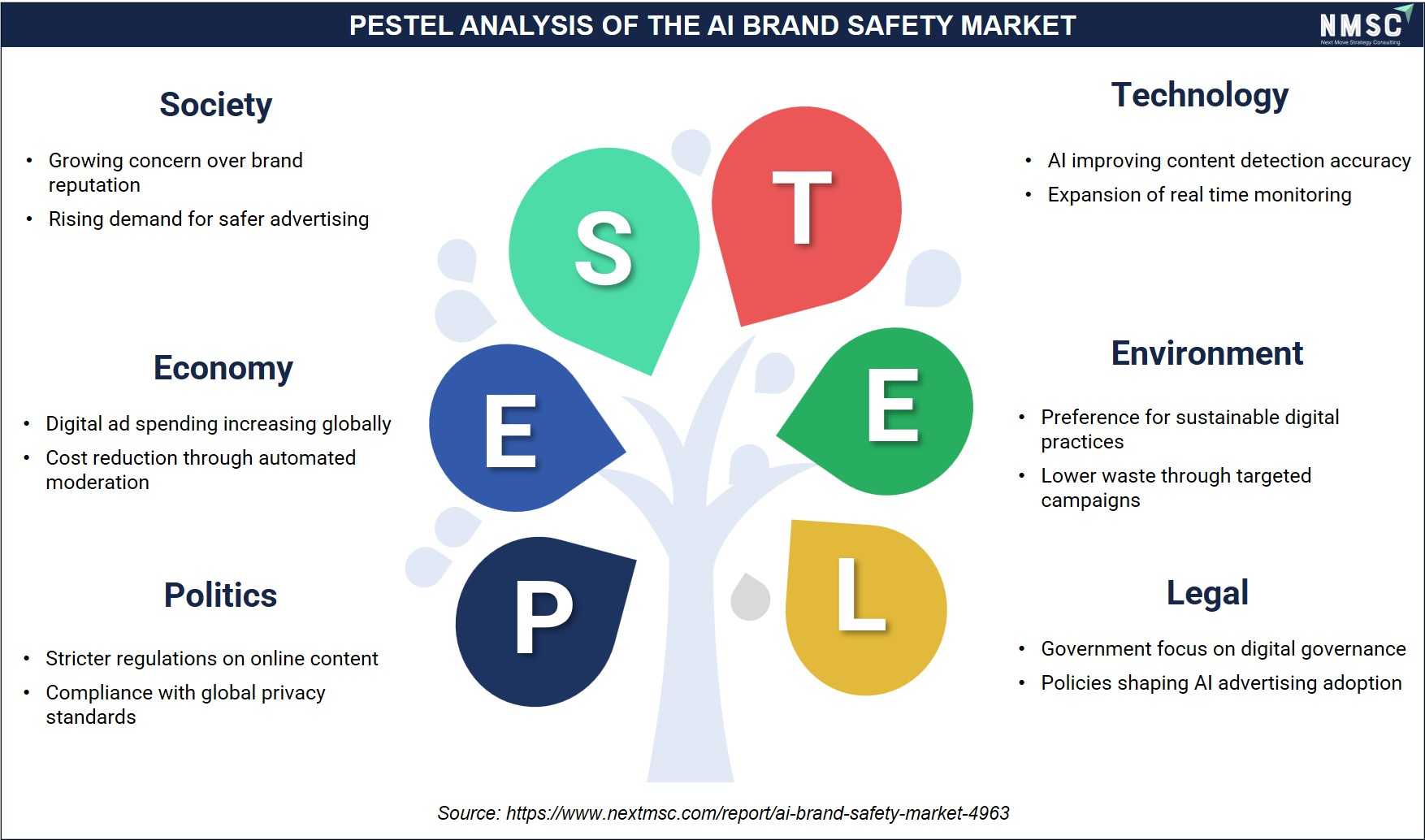
The above framework illustrates a comprehensive PESTEL analysis of the AI brand safety market, outlining key macro-environmental drivers. It systematically evaluates political, economic, social, technological, environmental, and legal factors influencing industry growth. Strategically, the visual highlights critical trends, ranging from rising global digital ad spend and advanced AI real-time monitoring to stricter governance regulations, that authoritative market analysts use to forecast long-term industry adoption and compliance standards.
Competitive Landscape of the AI Brand Safety Market
Competitive Dynamics and M&A Landscape
|
Key Takeaways |
Details |
|
Market Structure |
Moderately concentrated with two dominant publicly traded verification vendors (DoubleVerify and IAS), a second tier of specialized AI-native challengers, and a fragmented long tail of fraud detection and contextual intelligence point solutions. |
|
Innovation Focus |
Multimodal AI content classification, generative AI content detection, CTV suitability measurement, supply-chain transparency scoring, and privacy-preserving contextual intelligence built on IAB Content Taxonomy v3.0. |
|
M&A Activity |
Consolidation is ongoing as scale players acquire specialized contextual intelligence and fraud detection capabilities. DoubleVerify acquired Scibids in 2023 to strengthen AI-driven optimization. Integral Ad Science acquired Publica in 2021 for CTV ad serving and safety capabilities, indicating sustained appetite for capability-expanding acquisitions. |
How Do Companies Compete in the AI Brand Safety Market?
The competitive landscape of the AI Brand Safety Market is defined by a clear bifurcation between large-scale publicly traded verification platforms and a diverse ecosystem of specialized AI-native and point-solution providers. DoubleVerify and Integral Ad Science collectively command the largest market shares in measurement and verification, leveraging global impression coverage, TAG certification status, and deep integration within major DSP and SSP platforms. NMSC's analysis indicates that competitive differentiation has shifted from coverage breadth, which is now largely commoditized among tier-one vendors, toward classification accuracy, false-positive rate reduction, and the ability to extend verification natively into emerging environments including CTV, retail media, and digital audio.
Which Kind of Companies Dominate the AI Brand Safety Market?
The AI Brand Safety Market is dominated by a combination of dedicated ad verification platforms, AI-native contextual intelligence providers, and cybersecurity-origin fraud detection companies. Dedicated verification platforms, including DoubleVerify and Integral Ad Science, maintain the broadest measurement coverage and hold the most significant brand safety certifications, including TAG Brand Safety Certified status. AI-native providers including Zefr, GumGum, and Seedtag have captured market share in video, social, and contextual intelligence segments where traditional verification methods prove insufficient. Cybersecurity-origin companies including HUMAN Security, Pixalate, and CHEQ AI Technologies compete primarily in invalid traffic detection and ad fraud prevention, with adjacency to brand safety verification expanding over time.
AI-Native Differentiation and Open Standards Drive Market Success in the AI Brand Safety Market
Our assessment indicates that AI-native differentiation has become the primary basis for competitive success in the AI Brand Safety Market, superseding scale as the dominant competitive factor for higher-value brand suitability and contextual intelligence use cases. Vendors that have built proprietary large language model-based classification stacks, integrated multimodal analysis, and developed IAB Content Taxonomy v3.0-aligned API outputs are commanding premium pricing and winning enterprise RFP processes. Open standards adoption, particularly through IAB Tech Lab frameworks, serves as a trust signal to agency holding companies evaluating vendor neutrality and interoperability with existing ad technology stacks.
Market Players to opt for Merger and Acquisition Strategies to Expand Their Presence in the AI Brand Safety Market
Through NMSC's assessment, we found that M&A activity within the AI Brand Safety Market is expected to intensify through 2027 as category leaders seek to consolidate specialized capabilities in generative AI detection, audio classification, retail media verification, and geographic language expansion. Private equity-backed brand safety vendors are likely acquisition targets for larger verification platforms seeking to accelerate product roadmap delivery. Cross-category acquisitions involving supply-side platforms acquiring brand safety APIs natively are also anticipated, reflecting the trend toward embedding safety enforcement at the infrastructure layer rather than as a post-bid overlay service.
Who Are the Key Market Players in the AI Brand Safety Market?
-
DoubleVerify Holdings, Inc.
-
Integral Ad Science Holding Corp.
-
Comscore, Inc.
-
HUMAN Security, Inc.
-
Zefr, Inc.
-
GumGum, Inc.
-
Channel Factory, Inc.
-
Scope3 PBC
-
Pixalate, Inc.
-
CHEQ AI Technologies Ltd.
-
Seedtag Advertising, S.L.
-
Adloox SA
-
White Bullet Solutions Ltd.
-
Silverbullet Data Services Group plc
-
Zvelo, Inc.
-
TrafficGuard Pty Ltd.
-
Precise TV Ltd.
-
Fraudlogix LLC
-
24metrics GmbH
-
Anura Solutions LLC
What Are the Latest Developments in the AI Brand Safety Market?
The AI Brand Safety Market is witnessing continuous progress through enhancements in contextual intelligence, multimodal content analysis, fraud detection, and real-time suitability verification capabilities. Market participants, including DoubleVerify, Integral Ad Science, Zefr, HUMAN Security, and Scope3 are increasingly focusing on AI-driven transparency, cross-platform protection, and scalable content governance solutions to help advertisers maintain brand integrity and ensure responsible media placements across the evolving digital advertising ecosystem
Expert Insights
 “Today is a watershed moment for Brand Safety. Historically, many of the industry’s challenges stemmed from relying on property-level controls rather than true content-level measurement. Now, advertisers can have greater confidence that content-level safety measurement is robust and accurate.”
- Rich Raddon, Co-Founder and Co-CEO of Zefr
Statement made during the company’s announcement on receiving MRC Accreditation for Content-Level Brand Safety and Suitability Reporting on YouTube.
Market Interpretation:
The statement reflects a fundamental transformation in the AI Brand Safety market, where advertisers are moving away from broad, channel-based or property-level controls toward granular, content-level intelligence powered by AI classification systems. This shift enables more precise brand suitability decisions, improves transparency in digital media adjacency, and strengthens accountability across video-first platforms like YouTube. As a result, independent verification and standardized measurement frameworks are becoming central to brand safety infrastructure in the AI-driven advertising ecosystem.
What Are the Investment Opportunities in the AI Brand Safety Market?
Capital Inflows and Venture Investment Activity
The AI Brand Safety Market is attracting sustained venture capital and growth equity investment as the category's structural growth trajectory and recurring revenue characteristics appeal to technology-focused investors. HUMAN Security, Inc. completed a USD 100 million funding round in 2021 backed by Goldman Sachs, supporting expansion of its advertising integrity platform. CHEQ AI Technologies Ltd. has raised over USD 100 million in cumulative venture funding. Our assessment indicates that early-stage investment is increasingly targeting audio classification, retail media verification, and AI-generated content detection as the next high-growth product verticals within the broader AI Brand Safety Market ecosystem.
Infrastructure Investment in Multimodal AI Classification
Infrastructure investment within the AI Brand Safety Market is concentrated in the development of multimodal AI classification engines capable of processing video, audio, image, and text content simultaneously at programmatic scale. The compute infrastructure requirements for running large-scale multimodal inference across billions of daily impressions represent a significant and ongoing capital expenditure for leading verification vendors. Our analysis shows that cloud infrastructure partnerships with major hyperscalers including Google Cloud, Amazon Web Services, and Microsoft Azure are central to the scalability strategies of AI Brand Safety Market participants, with co-innovation agreements supplementing proprietary model development.
ESG Considerations and the Convergence of Brand Safety with Sustainable Advertising
Environmental, social, and governance criteria are increasingly influencing investment decisions within the AI Brand Safety Market, reflecting the broader ESG integration trend in technology sector capital allocation. Investors are evaluating brand safety platforms through an ESG lens that encompasses the social impact of reducing harmful content monetization, the governance implications of advertising transparency standards, and the environmental footprint of AI inference compute. Scope3 PBC's carbon measurement framework for programmatic supply chains exemplifies the convergence of ESG and brand safety investment themes, attracting impact-oriented investors alongside traditional venture capital.
Digital Transformation and Enterprise Procurement Expansion
Enterprise digital transformation programs are creating sustained organic investment flows into the AI Brand Safety Market as marketing technology stacks are upgraded to incorporate AI-native verification capabilities. Our findings suggest that large consumer goods companies, financial services firms, and pharmaceutical companies are allocating increasing portions of their marketing technology budgets to brand safety platform subscriptions, reflecting the institutionalization of advertising integrity as a core marketing operations function. This enterprise procurement expansion is expected to accelerate as global brand safety certification programs, including TAG and JICWEBS, become standard inclusion criteria in agency holding company framework agreements.
Private Equity Activity and Consolidation Opportunity
Private equity firms focused on advertising technology have identified the AI Brand Safety Market as a structurally attractive consolidation opportunity, driven by the large number of specialized point-solution providers operating below scale in fraud detection, contextual intelligence, and audio verification. Roll-up strategies targeting complementary capabilities in geographic language coverage, media environment specialization, and AI model architecture represent a credible investment thesis. Based on our market evaluation, the combination of high growth rates, recurring subscription revenue, and mission-critical customer relationships creates a compelling PE investment profile for AI Brand Safety Market participants positioned in the mid-market vendor segment.
Key Benefits for Stakeholders
For Brand Advertisers
Brand advertisers gain access to a comprehensive and vendor-neutral view of the AI Brand Safety Market, including segmentation-level insights across programmatic channels, CTV, social, and the open web. The report enables identification of optimal brand safety and suitability investment strategies, provides ROI benchmarks across key segments, and supports informed vendor selection decisions to enhance media quality, reduce risk exposure, and improve campaign performance.
For Advertising Agencies
Advertising agencies benefit from structured competitive intelligence on brand safety platform capabilities, market positioning, and adoption trends. The analysis supports client advisory functions by standardizing measurement approaches and improving transparency in media governance. It also informs trading desk procurement strategies through data-backed insights on vendor performance and market share distribution across key technology providers.
For Technology Vendors
Technology vendors gain granular segmentation intelligence that identifies white-space opportunities in emerging areas such as audio advertising, retail media networks, and AI-generated content detection. The report also provides competitive positioning analysis and visibility into potential M&A targets, enabling vendors to refine product roadmaps, strengthen differentiation strategies, and accelerate growth in high-expansion segments of the market.
For Investors (VC & Private Equity Firms)
Investors gain a quantified assessment of the total addressable market across multiple segmentation dimensions, along with identification of the fastest-growing sub-segments and geographic regions. This supports robust due diligence processes, investment thesis validation, and risk-adjusted evaluation of brand safety platforms operating within the rapidly evolving digital advertising ecosystem.
For Publishers
Publishers receive insights into compliance requirements and certification standards necessary for participation in preferred deals and premium advertising ecosystems. The analysis highlights supply-side brand safety investment priorities and guides decisions around technology adoption for supply-path optimization, enabling improved monetization, advertiser trust, and inventory quality assurance.
For Platform Operators (DSPs & SSPs)
Demand-side and supply-side platform operators gain actionable guidance on native brand safety API integration investments and capability enhancement strategies. The report provides benchmarking data for evaluating existing brand safety infrastructure, identifies gaps in platform capabilities, and highlights potential acquisition targets to accelerate in-house feature development and improve competitive positioning.
For Regulators and Policy Bodies
Regulators and policy organizations gain structured market intelligence that supports the development of digital advertising transparency frameworks and policy enforcement mechanisms. The analysis identifies industry self-regulatory gaps and provides evidence-based insights relevant to legislative frameworks such as the Digital Services Act (DSA), Online Safety Act, and other global digital advertising governance initiatives.
Key Market Segments
By Product and Service
-
Brand Safety Controls and Suitability Activation
-
Pre-Bid Avoidance and Blocking
-
Inclusion and Exclusion List Management
-
Brand Suitability Rule Engines
-
Supply-Path Policy Enforcement
-
-
Measurement and Verification
-
Post-Bid Safety and Suitability Reporting
-
Pre-Bid and In-flight Monitoring
-
Invalid Traffic and Fraud Detection
-
Viewability and Attention Measurement
-
-
Contextual Data and Intelligence
-
AI Content Classification Taxonomies
-
Contextual Audience and Sentiment Segments
-
Taxonomy and Signal API Licensing
-
-
Managed and Professional Services
-
Brand Safety Policy Design and Setup
-
Ongoing Monitoring and Managed Blocking
-
Independent Audit and Certification
-
Strategy Consulting
-
By Buying Stage
-
Pre-bid
-
In-flight
-
Post-bid
By Media Environment
-
Open Web
-
Mobile App
-
Connected TV
-
Social Media
-
Digital Audio
-
Retail Media Networks
-
Other Digital Environments
By Buyer Type
-
Brand Advertiser
-
Advertising Agency
-
Publisher
-
Demand-Side Platform
-
Supply-Side Platform
By Commercial Model
-
Subscription
-
Usage-based
-
License
-
Managed Service
By Risk Taxonomy Applied
-
Universal Safety Floor
-
Brand Suitability
-
Regulatory Compliance
-
Content Quality and Made-for-Advertising
-
Misinformation and AI-Generated Content
-
Other Policy Risks
By Region
-
North America: U.S., Canada, and Mexico.
-
Europe: UK, Germany, France, Italy, Spain, Sweden, Denmark, Finland, the Netherlands, and the rest of Europe.
-
Asia Pacific: China, India, Japan, South Korea, Taiwan, Indonesia, Vietnam, Australia, Philippines, Malaysia and the rest of APAC.
-
Middle East & Africa (MEA): Saudi Arabia, UAE, Egypt, Israel, Turkey, Nigeria, South Africa, and the rest of MEA.
-
Latin America: Brazil, Argentina, Chile, Colombia, and the rest of LATAM.
Conclusion and Recommendations
Long-Term Outlook
The AI Brand Safety Market is on a sustained high-growth trajectory, supported by structural demand drivers that are unlikely to abate within the forecast period. The proliferation of AI-generated content across digital media environments, the continued fragmentation of advertising inventory across connected TV, digital audio, retail media, and social platforms, and the intensification of regulatory advertising transparency requirements create a durable demand environment for AI-powered brand safety solutions. Our analysis shows that the market will reach USD 54.11 billion by 2035, representing a tenfold expansion from the 2025 base of USD 4.88 billion.
Strategic Positioning
NMSC's analysis indicates that strategic success in the AI Brand Safety Market through 2035 will be defined by three factors: multimodal AI classification capability, coverage of emerging media environments, and open standards interoperability. Vendors that invest in transformer-based content classification architectures, develop native integrations within CTV, retail media, and digital audio supply chains, and align API outputs with IAB Tech Lab Content Taxonomy v3.1 standards will be best positioned to capture premium enterprise contracts and command above-market revenue growth. Point-solution specialists that fail to broaden their platform scope risk displacement by comprehensive verification platforms.
Investment Attractiveness
The AI Brand Safety Market presents a compelling investment opportunity across both public equity and private capital markets. The recurring subscription and usage-based revenue models dominant within the market provide predictable cash flow visibility. The market's mission-critical status in advertiser marketing technology stacks creates high switching costs and retention rates. Our findings suggest that the most attractive investment opportunities lie in platform-layer verification vendors serving CTV, retail media, and AI-generated content detection, as well as in geographic expansion plays targeting Asia Pacific and MENA language model development.
Market Shifts and Key Risks
The primary risk to the AI Brand Safety Market growth forecast is platform consolidation by walled garden operators that develop proprietary brand safety tools and restrict third-party access. A secondary risk is regulatory fragmentation, where divergent national advertising transparency frameworks impose market-specific compliance costs that disadvantage globally scaled vendors. The AI classification arms race also presents a model accuracy risk, as adversarial content generation techniques evolve in response to brand safety enforcement, requiring continuous model retraining investment. Our assessment indicates that vendors maintaining both technical depth and regulatory expertise will be best equipped to navigate these market shift scenarios.
Growth Pathways
The principal growth pathways for participants in the AI Brand Safety Market include geographic expansion into underpenetrated Asia Pacific, MENA, and Latin American markets through language model investment and local partnership development; vertical expansion into retail media networks and digital audio as these inventory categories mature programmatically; product expansion into ESG-aligned supply quality scoring as advertiser sustainability mandates intersect with brand safety policy; and platform consolidation through M&A that combines measurement verification, contextual intelligence, and fraud detection into unified advertising integrity platforms.
About the Author
 Mayurima Roy
— Mayurima Roy is Research Analyst at Next Move Strategy Consulting, where she has spent 4 years working across the firm's full industry coverage rather than a single fixed vertical. Her work centers on structured research, ongoing trend tracking, competitive assessment, and insight-led content development, translating complex market data into clear, decision-ready narratives that support informed client decision-making across diverse global industries, market sectors, and world regions every day.
Mayurima Roy
— Mayurima Roy is Research Analyst at Next Move Strategy Consulting, where she has spent 4 years working across the firm's full industry coverage rather than a single fixed vertical. Her work centers on structured research, ongoing trend tracking, competitive assessment, and insight-led content development, translating complex market data into clear, decision-ready narratives that support informed client decision-making across diverse global industries, market sectors, and world regions every day.
About the Reviewer
 Supradip Baul
— Supradip Baul is an accomplished business consultant and strategist with over a decade of rich experience in market intelligence, strategy, technology, and business transformation. His work has included rigorous qualitative and quantitative analysis across multiple industries, helping clients shape investment decisions and long-term roadmaps. Earlier in his career, he was associated with Gartner, where he contributed to industry-leading reports and market share analyses. He has worked with leading global companies and holds an MBA with a dual specialization in Marketing and Finance.
Supradip Baul
— Supradip Baul is an accomplished business consultant and strategist with over a decade of rich experience in market intelligence, strategy, technology, and business transformation. His work has included rigorous qualitative and quantitative analysis across multiple industries, helping clients shape investment decisions and long-term roadmaps. Earlier in his career, he was associated with Gartner, where he contributed to industry-leading reports and market share analyses. He has worked with leading global companies and holds an MBA with a dual specialization in Marketing and Finance.
At Next Move Strategy Consulting, we understand that insightful market research is the cornerstone of successful business decisions. That's why we employ a robust and multifaceted approach, combining various methodologies to deliver the most accurate and actionable data for our clients.

Research Landscape
We navigate the world of research with two primary approaches:
Qualitative Approach
Our qualitative research methodologies involve immersive techniques such as in-depth interviews, focus groups, and observational studies. By engaging directly with individuals and stakeholders, we uncover valuable insights that quantitative data alone may overlook.

Quantitative Research
In tandem with qualitative methodologies, NMSC leverages the power of Quantitative Research to provide a robust foundation of numerical insights. Through systematic data collection and analysis, we quantify patterns, preferences, and market trends, offering a comprehensive view of the business landscape.
Our quantitative research approach employs diverse tools, including surveys, experiments, and statistical modelling. These methodologies enable us to gather data from a large and representative sample, ensuring the statistical significance of our findings. By employing structured questionnaires and standardized data collection methods, we guarantee the reliability and validity of the information we present to our clients.
Quantitative research is particularly effective in measuring the prevalence of trends, assessing market size, and gauging the impact of various factors on consumer behavior. The numerical precision attained through this approach equips our clients with actionable insights, facilitating data-driven decision-making and strategy formulation.


Our Specialized Toolbox for Industry-Specific Market Research
We deploy a specialized arsenal of techniques tailored to meet your unique requirements. Here's a glimpse into our comprehensive toolbox:

Information Procurement
The stage entails acquiring market data or relevant information through various sources and methodologies.


Market Research Approach
We utilize both top-down and bottom-up approaches in market research analysis to achieve a comprehensive understanding of the market dynamics, leveraging the broad perspective of industry trends and macroeconomic factors alongside detailed insights from specific segments and individual companies.

Porters Five Forces Analysis
We conduct Porter's Five Forces analysis to evaluate the competitive landscape of an industry, providing us with insights into factors that affect profitability and strategic positioning.

SWOT Analysis

Forecasting
We utilize a forecasting model to predict future consumption by considering parameters like population, economics, regulations, market competition, drivers, constraints, technology, and pricing. We also employ statistical techniques such as multilinear regression, exponential smoothing, moving average, ARIMA, and Monte Carlo simulations for accurate predictions. In econometric forecasting, we analyzed short-term and long-term event impacts, attributing values based on regulatory frameworks, economic factors, and market events.





 Speak to Our Analyst