AI Agent Orchestration Market Size, Share, Growth, Trends, and Forecast 2025–2035, By Product Family (Application Embedded Agents, Workflow Orchestration Platforms, Developer Frameworks and Runtimes, Customer Experience Agent Platforms, Services), By Deployment Model (SaaS, Customer Managed Cloud, On-Premises, Hybrid), By Monetization, By Buyer Type, By End User Industry, and By Distribution Channel — Global Analysis 2025–2035
Industry: ICT & Media | Publishing Date: July 6, 2026 | Last Updated: September 30, 2026 | No of Pages: N/A | No. of Tables: N/A | No. of Figures: N/A | Format: PDF | Report Code: IC4955
What Is the AI Agent Orchestration Market Size?
The global AI Agent Orchestration Market was valued at USD 12.84 billion in 2025 and is projected to reach USD 15.97 billion in 2026, expanding to USD 121.36 billion by 2035, registering a CAGR of 25.2% over the 2026–2035 forecast period. This strong expansion trajectory is driven by the accelerating enterprise adoption of autonomous multi-agent AI systems, growing demand for low-latency agentic workflows in BFSI and healthcare sectors, proliferation of large language model (LLM)-powered orchestration platforms from hyperscalers, and increasing regulatory mandates driving investment in governed, auditable AI operations across North America and Europe.
|
Parameters |
Details |
|
Market Size in 2025 |
USD 12.84 Billion |
|
Market Size in 2026 |
USD 15.97 Billion |
|
Revenue Forecast in 2035 |
USD 121.36 Billion |
|
Growth Rate |
CAGR of 25.2% from 2026 to 2035 |
|
Analysis Period |
2025–2035 |
|
Base Year Considered |
2025 |
|
Forecast Period |
2026–2035 |
|
Market Size Estimation |
USD Billion |
|
Companies Profiled |
20 |
|
Countries Covered |
33 |
|
Market Share |
Top 10 |
AI Agent Orchestration Market Overview
What Is the AI Agent Orchestration Market?
The AI Agent Orchestration Market encompasses the software platforms, developer frameworks, embedded application agents, and professional services that enable organizations to design, deploy, manage, and coordinate multiple autonomous AI agents across enterprise workflows. These orchestration systems function as the coordination layer between individual agents by directing task allocation, facilitating inter-agent communication, monitoring execution, and consolidating outputs into actionable business outcomes. NMSC's analysis indicates that the market spans low-code automation platforms, robotic process automation (RPA) tools, multi-agent developer frameworks, and customer experience orchestration solutions supporting enterprise AI deployments.
How Has the AI Agent Orchestration Market Evolved?
The AI Agent Orchestration Market has progressed through distinct phases over the past decade. Early orchestration capabilities relied primarily on rule-based workflow automation and scripted bot sequences embedded within RPA platforms. The emergence of transformer-based large language models and the commercialization of foundation models from 2022 onward enabled reasoning-capable agents capable of understanding natural language, planning multi-step workflows, utilizing external tools, and adapting to changing contexts. Based on research conducted by NMSC, we found that the current market phase is characterised by rapid vendor expansion, experimentation with agentic architectures, and the gradual standardization of enterprise deployments around a limited number of leading orchestration frameworks.
How Do Regulations Influence the AI Agent Orchestration Market?
Regulatory and governance frameworks are increasingly shaping the AI Agent Orchestration Market. The European Union's Artificial Intelligence Act, which came into force in 2024, imposes requirements for transparency, human oversight, and conformity assessments for certain high-risk AI applications. In parallel, the National Institute of Standards and Technology (NIST) AI Risk Management Framework has emerged as a widely adopted governance reference for enterprises evaluating agentic AI solutions. Our assessment indicates that compliance-oriented procurement is becoming a significant driver of market activity, particularly across BFSI, healthcare, and public sector organizations where AI governance and accountability requirements are most stringent.
How Is Technology Adoption Expanding Across the AI Agent Orchestration Market?
Technology adoption across the AI Agent Orchestration Market is accelerating rapidly as organizations transition from pilot programs to production-scale agentic workflows. Enterprises are increasingly deploying AI agents across customer operations, IT service management, financial processes, and knowledge-intensive business functions to achieve measurable productivity improvements. Our findings suggest that the convergence of orchestration platforms with enterprise knowledge repositories, API management layers, and identity governance systems is emerging as a defining architectural trend, positioning AI agent orchestration as a foundational layer for next-generation digital enterprise operations.
|
Key Takeaways |
|
By Product Family, Application Embedded Agents held the largest share of the AI Agent Orchestration Market at USD 3.85 billion in 2025 and are projected to reach USD 36.60 billion by 2035, registering a CAGR of 25.3%. Developer Frameworks and Runtimes represent the fastest-growing product family segment, expanding at a CAGR of 25.6% from 2026 to 2035, supported by rising adoption of open-source agent SDKs and developer tools. |
|
By Deployment Model, SaaS commanded the largest market share at USD 5.78 billion in 2025 and is expected to reach USD 55.82 billion by 2035, growing at a CAGR of 25.5%. Hybrid deployment is the fastest-growing model, projected to advance at a CAGR of 25.9% from 2026 to 2035, driven by increasing data residency and compliance requirements. |
|
By Monetization Model, Subscription-based offerings dominated the AI Agent Orchestration Market with USD 5.78 billion in 2025 and are forecast to reach USD 55.02 billion by 2035, reflecting a CAGR of 25.4%. Consumption-based pricing is the fastest-growing model, expanding at a CAGR of 25.5% from 2026 to 2035 as enterprises seek more flexible payment structures. |
|
By Buyer Type, IT and Platform buyers represented the largest segment, generating USD 3.85 billion in 2025 and reaching USD 36.40 billion by 2035. Business Operations buyers are the fastest-growing category, projected to register a CAGR of 25.6% from 2026 to 2035, supported by rising demand for process automation and AI-enabled decision-making. |
|
By End User Industry, BFSI held the largest revenue share at USD 2.31 billion in 2025 and is expected to reach USD 23.45 billion by 2035, growing at a CAGR of 26.1%. Healthcare and Life Sciences is the fastest-growing vertical, projected to expand at a CAGR of 26.4% from 2026 to 2035, driven by increasing use of AI agents in clinical and patient engagement applications. |
|
By Distribution Channel, Direct Sales led the AI Agent Orchestration Market with USD 5.14 billion in 2025 and are forecast to reach USD 49.35 billion by 2035. Cloud Marketplace is the fastest-growing channel, advancing at a CAGR of 25.5% from 2026 to 2035, supported by growing adoption of hyperscaler ecosystems. |
|
North America held the largest regional share of the AI Agent Orchestration Market at USD 5.13 billion in 2025 and is projected to reach USD 47.53 billion by 2035, registering a CAGR of 24.8%, supported by strong enterprise AI adoption and the presence of leading technology vendors. |
|
Asia Pacific is the fastest-growing region in the AI Agent Orchestration Market, projected to expand at a CAGR of 26.6% from 2026 to 2035 and reach USD 30.08 billion by 2035, driven by digital transformation initiatives and expanding AI ecosystems. |
|
The United States is the largest country market in the AI Agent Orchestration Market and represents the largest contributor to North America's USD 5.13 billion revenue in 2025, supported by extensive enterprise deployments and the presence of leading orchestration platform providers. |
|
India is the fastest-growing country market, supported by rapid IT sector expansion, Digital India initiatives, and strong adoption of open-source orchestration frameworks, making it a major contributor to Asia Pacific's projected CAGR of 26.6% through 2035. |
|
By Product Family, Application Embedded Agents held the largest share of the AI Agent Orchestration Market at USD 3.85 billion in 2025 and are projected to reach USD 36.60 billion by 2035, registering a CAGR of 25.3%. Developer Frameworks and Runtimes represent the fastest-growing product family segment, expanding at a CAGR of 25.6% from 2026 to 2035, supported by rising adoption of open-source agent SDKs and developer tools. |
|
By Deployment Model, SaaS commanded the largest market share at USD 5.78 billion in 2025 and is expected to reach USD 55.82 billion by 2035, growing at a CAGR of 25.5%. Hybrid deployment is the fastest-growing model, projected to advance at a CAGR of 25.9% from 2026 to 2035, driven by increasing data residency and compliance requirements. |
|
By Monetization Model, Subscription-based offerings dominated the AI Agent Orchestration Market with USD 5.78 billion in 2025 and are forecast to reach USD 55.02 billion by 2035, reflecting a CAGR of 25.4%. Consumption-based pricing is the fastest-growing model, expanding at a CAGR of 25.5% from 2026 to 2035 as enterprises seek more flexible payment structures. |
|
By Buyer Type, IT and Platform buyers represented the largest segment, generating USD 3.85 billion in 2025 and reaching USD 36.40 billion by 2035. Business Operations buyers are the fastest-growing category, projected to register a CAGR of 25.6% from 2026 to 2035, supported by rising demand for process automation and AI-enabled decision-making. |
|
By End User Industry, BFSI held the largest revenue share at USD 2.31 billion in 2025 and is expected to reach USD 23.45 billion by 2035, growing at a CAGR of 26.1%. Healthcare and Life Sciences is the fastest-growing vertical, projected to expand at a CAGR of 26.4% from 2026 to 2035, driven by increasing use of AI agents in clinical and patient engagement applications. |
|
By Distribution Channel, Direct Sales led the AI Agent Orchestration Market with USD 5.14 billion in 2025 and are forecast to reach USD 49.35 billion by 2035. Cloud Marketplace is the fastest-growing channel, advancing at a CAGR of 25.5% from 2026 to 2035, supported by growing adoption of hyperscaler ecosystems. |
Ecosystem Analysis of the AI Agent Orchestration Market
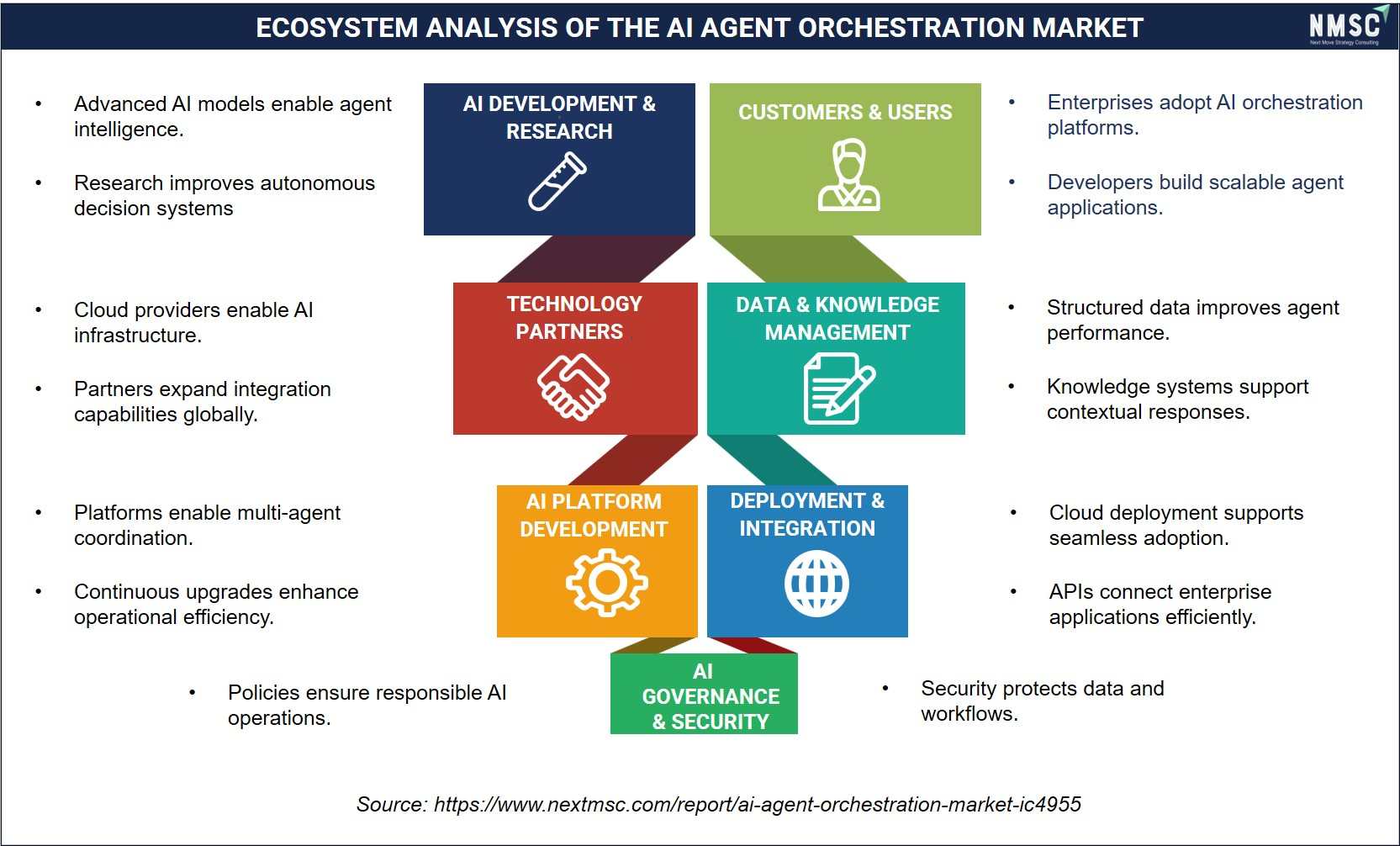
The above infographic depicts the ecosystem structure of the AI Agent Orchestration Market, illustrating how AI development and research, customers and users, technology partners, and data and knowledge management collectively support AI platform development and deployment. It also highlights the critical role of AI governance and security in ensuring reliable and scalable operations, while emphasizing enterprise adoption and developers’ efforts to build sophisticated multi-agent applications.
Key Emerging Trends in the AI Agent Orchestration Market
How Is the Shift from Single-Agent to Multi-Agent Architectures Reshaping Enterprise AI Deployments?
The transition from isolated AI assistant deployments to coordinated multi-agent systems represents the most consequential architectural shift in enterprise AI infrastructure since the adoption of cloud computing. Through our market assessment, we observed that enterprises are deploying specialized agent networks where individual agents handle discrete sub-tasks, research, validation, generation, and execution, and orchestration platforms manage task routing, state management, and result aggregation. Microsoft's Copilot Studio and Google's Vertex AI Agent Builder exemplify this trend, enabling visual composition of multi-agent pipelines that handle complex workflows autonomously.
How Is Open-Source Agent Frameworks Disrupting the Commercial AI Agent Orchestration Market?
Open-source orchestration frameworks including LangChain, LangGraph, AutoGen, and CrewAI are fundamentally altering competitive dynamics in the AI Agent Orchestration Market by lowering the technical barrier for enterprise adoption and community-driven innovation. NMSC's analysis indicates that enterprises are using open-source frameworks for rapid prototyping and custom agent development, then migrating to commercial managed runtimes for production-scale governance, security, and SLA-backed reliability. This open-source-to-enterprise pipeline is becoming a primary customer acquisition channel, with vendors including LangChain and Airbyte demonstrating the commercial potential of developer-community growth strategies.
How Is Agentic AI Integration Within CRM and ERP Systems Creating New Revenue Streams for Application Vendors?
Salesforce's Agentforce, SAP's AI agents within SAP Datasphere, and Oracle's embedded agent capabilities are demonstrating how enterprise application vendors are monetizing the AI Agent Orchestration Market through deeply embedded, workflow-native agent experiences. From our research, we found that enterprises show a pronounced preference for AI agents that operate within their existing ERP and CRM data environments over standalone orchestration tools that require additional integration overhead. This integration advantage is creating significant switching cost advantages for incumbent application vendors while simultaneously compressing the addressable market for pure-play AI orchestration platforms.
How Are AI Governance and Responsible AI Frameworks Shaping Orchestration Platform Procurement Decisions?
The expansion of the EU AI Act's compliance requirements, NIST AI RMF adoption, and sector-specific AI governance mandates in financial services and healthcare are elevating AI governance capabilities from optional features to non-negotiable procurement criteria in the AI Agent Orchestration Market. Our findings suggest that enterprises in regulated industries are specifically evaluating orchestration platforms on the basis of explainability tooling, human-in-the-loop intervention capabilities, audit trail completeness, and bias detection support. Vendors including IBM, Salesforce, and ServiceNow are investing in Responsible AI dashboards and agent behaviour monitoring as primary competitive differentiators for regulated enterprise accounts.
What Are the Key Market Drivers, Breakthroughs, and Investment Opportunities That Will Shape the AI Agent Orchestration Industry in the Next Decade?
|
Drivers / Trends / Restraints |
(+/-) % Impact on CAGR Forecast |
Geographic Relevance |
Impact Timeline |
|
Proliferation of enterprise agentic AI platforms from hyperscalers |
+3.2% |
North America, Europe |
2025–2028 |
|
Rising demand for autonomous multi-agent workflow automation |
+2.8% |
Global |
2025–2030 |
|
Integration of LLMs as reasoning cores in orchestration layers |
+2.5% |
North America, APAC |
2026–2035 |
|
Government AI investment and digital transformation mandates |
+1.9% |
Europe, APAC, MEA |
2025–2030 |
|
Expanding open-source-to-enterprise developer adoption pipeline |
+1.4% |
North America, APAC |
2026–2035 |
|
AI governance, data privacy, and security compliance burdens |
-1.2% |
Global |
2025–2035 |
|
Fragmented vendor ecosystem and enterprise integration complexity |
-0.8% |
Global |
2025–2028 |
|
Shortage of AI engineering talent limiting deployment pace |
-0.6% |
Global |
2025–2032 |
|
Healthcare and life sciences agentic AI adoption wave |
+1.1% |
North America, Europe |
2026–2035 |
What Are the Growth Drivers of the AI Agent Orchestration Market?
How Is Hyperscaler Investment in Agentic AI Platforms Structurally Expanding the AI Agent Orchestration Market?
Microsoft, Amazon Web Services, and Google are collectively investing billions in embedding AI agent orchestration capabilities directly within their cloud platform offerings, creating a structural demand amplifier that compresses the adoption cycle for enterprise buyers. Microsoft's Copilot Studio, AWS Bedrock Agents, and Google Vertex AI Agent Builder are embedding orchestration functionality within existing cloud service agreements, significantly lowering procurement friction. Through NMSC's assessment, we found that hyperscaler platform bundling is dramatically accelerating enterprise AI Agent Orchestration Market adoption timelines, particularly among organizations with existing cloud commitments, while simultaneously expanding the platform's total addressable market. The U.S. National AI Initiative Act establishes federal R&D investment in AI infrastructure that reinforces hyperscaler alignment with government digital modernization programs.
How Is the Enterprise Demand for End-to-End Workflow Automation Fueling AI Agent Orchestration Market Growth?
Enterprises across all sectors are reaching the limits of traditional RPA and rule-based workflow tools in handling dynamic, unstructured, and judgment-intensive processes that require contextual reasoning and adaptive decision-making. The AI Agent Orchestration Market directly addresses this capability gap by enabling agentic systems that can handle open-ended tasks, use external tools, access enterprise knowledge bases, and escalate exceptions to human operators when required. Our analysis shows that organizations deploying AI agent orchestration for IT service management, financial audit, and customer support functions report meaningful reductions in resolution time and manual escalation rates. The U.S. Office of Management and Budget have documented federal agency investment in AI-driven process automation as part of government efficiency initiatives, validating enterprise-grade agentic AI demand.
How Are Regulatory Digital Transformation Mandates Creating Public Sector Demand for AI Agent Orchestration Solutions?
Government-mandated digital transformation programs across the EU, India, Saudi Arabia, and the United States are directing public sector organizations to modernize service delivery through intelligent automation, creating a structurally enforced demand signal for AI agent orchestration capabilities. The European Commission's Digital Decade Policy Program 2030 targets digital transformation of public services, while India's Digital India mission and Saudi Arabia's Vision 2030 National Digital Transformation Strategy explicitly commit government organizations to intelligent automation investment. Based on NMSC's research, we found that public sector AI orchestration procurement is growing at above-average rates in regions with formalized digital government mandates, providing a relatively stable, non-cyclical demand base that complements commercial market growth.
What Are the Growth Inhibitors of the AI Agent Orchestration Market?
How Are AI Governance and Data Privacy Regulations Creating Implementation Barriers in the AI Agent Orchestration Market?
The EU AI Act, GDPR enforcement actions, and sector-specific AI regulations in financial services and healthcare are creating significant compliance overhead for organizations deploying AI agent orchestration systems. High-risk AI classification under the EU AI Act requires extensive conformity assessment, technical documentation, and human oversight implementation for agentic systems deployed in customer-facing, credit-scoring, or critical infrastructure contexts. Our assessment indicates that compliance requirements are extending enterprise AI orchestration deployment timelines by an average of three to nine months in European markets and in regulated U.S. sectors, creating a meaningful near-term CAGR headwind. The European Data Protection Board has issued guidance specifically addressing automated decision-making systems that directly affects AI orchestration procurement.
How Is the Shortage of AI Engineering Talent Constraining AI Agent Orchestration Market Adoption Velocity?
Designing, implementing, and operating production-grade multi-agent orchestration systems requires specialized expertise spanning AI engineering, prompt optimization, tool integration, agent evaluation, and LLMOps, skill sets that are in severe short supply across both developed and emerging markets. The U.S. Bureau of Labor Statistics projects substantially above-average employment growth for AI and machine learning specialist roles through 2032, yet supply-side constraints remain acute as training pipeline output lags demand. NMSC's analysis indicates that talent scarcity is particularly acute among mid-market enterprises that lack the employer branding and compensation capacity to compete with hyperscalers and AI-native startups for qualified AI orchestration engineers, creating adoption inequality across buyer segments.
What Are the Growth Opportunities in the AI Agent Orchestration Market?
How Is the Healthcare Sector Creating a High-Value Expansion Opportunity for AI Agent Orchestration Platforms?
The healthcare and life sciences sector represents one of the most structurally attractive expansion opportunities in the AI Agent Orchestration Market, driven by the convergence of EHR interoperability mandates, clinical AI adoption acceleration, and expanding pharmaceutical R&D data complexity. The U.S. 21st Century Cures Act information blocking provisions require healthcare organizations to enable data exchange at scale, creating data pipeline complexity that AI agent orchestration directly addresses. Based on our engagements with healthcare IT buyers, we observed active procurement of orchestration platforms for clinical trial data coordination, prior authorization automation, and multi-source patient record integration, representing an emerging high-value use case cluster with strong recurring contract potential.
How Is the Open-Source-to-Enterprise Pathway Creating Scalable Customer Acquisition for AI Orchestration Vendors?
The developer community's enthusiastic adoption of open-source agent frameworks is creating a structurally efficient enterprise customer acquisition pipeline for vendors that manage the commercial transition from open-source usage to enterprise-licensed deployments. Companies including LangChain, n8n, and Airbyte have demonstrated that community-built connector ecosystems, developer documentation investments, and GitHub-based organic adoption can generate enterprise pipeline conversion at significantly lower customer acquisition costs than traditional direct sales motions. Through NMSC's assessment, we found that enterprises that begin AI agent orchestration adoption through open-source frameworks demonstrate higher long-term platform commitment and expansion revenue potential, as their technical teams develop deep platform expertise before transitioning to paid tiers.
How Is Vertical-Specific AI Agent Orchestration Creating Premium Pricing and Differentiation Opportunities?
The development of industry-vertical-specific AI agent orchestration platforms tailored to BFSI compliance workflows, manufacturing operational analytics, or telecom network operations is creating premium pricing differentiation opportunities for vendors willing to invest in domain expertise and regulatory alignment. Industry-derived estimate (no publicly verifiable dataset available): vertical-focused orchestration deployments command meaningfully higher average contract values than horizontal platform deployments due to the reduced customization burden and faster time-to-value delivered to industry-specific buyers. Our findings suggest that vendors pursuing vertical specialization strategies in BFSI, healthcare, and manufacturing are establishing defensible competitive positions against hyperscaler-native orchestration platforms that prioritize horizontal breadth over vertical depth.
How Is the AI Agent Orchestration Market Segmented in This Report, and What Are the Key Insights from the Segmentation Analysis?
How Do the Five Product Family Categories Define the Competitive Structure of the AI Agent Orchestration Market?
|
Segment |
2025 (USD Billion) |
2035 (USD Billion) |
CAGR (%) |
|
Application Embedded Agents |
3.85 |
36.6 |
25.3% |
|
Workflow Orchestration Platforms |
2.96 |
27.9 |
25.1% |
|
Developer Frameworks and Runtimes |
2.44 |
23.9 |
25.6% |
|
Customer Experience Agent Platforms |
2.3 |
21.8 |
25.2% |
|
Services |
1.29 |
11.16 |
24.0% |
The product family segment of the AI Agent Orchestration Market is structured across application embedded agents, workflow orchestration platforms, developer frameworks and runtimes, customer experience agent platforms, and professional services. Application embedded agents, encompassing CRM-native agents such as Salesforce Agentforce, ERP-integrated agents within SAP and Oracle, ITSM agents in ServiceNow, and HCM productivity agents, constitute the dominant sub-segment because they leverage existing enterprise application data environments and user adoption channels without requiring standalone platform procurement. Workflow orchestration platforms, including low-code automation, RPA-led automation, iPaaS, and case management tools, represent the second-largest category, with RPA vendors including UiPath and Automation Anywhere migrating their customer bases toward agent-augmented automation. Developer frameworks and runtimes are the fastest-growing product family sub-segment, driven by SDK adoption, open-source framework proliferation, and the expansion of managed runtimes for production AI agent deployment. Customer experience agent platforms serving contact center, messaging, voice, and self-service channels are gaining traction as enterprises prioritize AI-mediated customer interaction at scale.
Which Deployment Architecture Is Gaining the Most Enterprise Traction in the AI Agent Orchestration Market?
|
Segment |
2025 (USD Billion) |
2035 (USD Billion) |
CAGR (%) |
|
SaaS |
5.78 |
55.82 |
25.5% |
|
Customer Managed Cloud |
2.57 |
24.27 |
25.2% |
|
On-Premises |
2.57 |
22.24 |
24.2% |
|
Hybrid |
1.92 |
19.03 |
25.9% |
Deployment model preferences in the AI Agent Orchestration Market reflect the broader enterprise cloud maturity landscape. SaaS deployment holds the dominant position, driven by hyperscaler-hosted orchestration platforms that deliver automatic updates, elastic scalability, and consumption-aligned pricing within established cloud service agreements. Customer managed cloud deployments serve enterprises requiring dedicated virtual private cloud isolation for sensitive AI workflow data while maintaining cloud-native scalability advantages. On-premises deployment retains a significant share, particularly in defense, public sector, and financial services organizations operating within strict data residency mandates. Hybrid deployment is the fastest-growing model, enabling organizations to run sensitive data processing on-premise while leveraging cloud-hosted LLM inference and orchestration management capabilities, satisfying both performance and compliance requirements simultaneously.
How Are Evolving Monetization Models Reshaping Revenue Dynamics in the AI Agent Orchestration Market?
|
Segment |
2025 (USD Billion) |
2035 (USD Billion) |
CAGR (%) |
|
Subscription |
5.78 |
55.02 |
25.4% |
|
Consumption |
3.21 |
31.21 |
25.5% |
|
Services |
2.57 |
24.21 |
25.1% |
|
Perpetual |
1.28 |
10.92 |
23.9% |
Monetization dynamics in the AI Agent Orchestration Market are evolving from traditional perpetual and subscription models toward consumption-based pricing that aligns vendor revenue with actual agent execution activity. Subscription monetization remains the dominant model, preferred by enterprises seeking predictable annual software costs and comprehensive platform entitlements within established SaaS procurement frameworks. Consumption-based pricing is the fastest-growing monetization model, particularly for organizations with variable or unpredictable agent workload profiles; major orchestration vendors including AWS, Microsoft Azure, and Google Cloud are leading this shift through API call-based pricing for LLM inference and agent execution. Services monetization, encompassing implementation, advisory, and managed operations, represents a substantial and growing revenue category as the complexity of production AI orchestration deployments drives sustained demand for expert professional services. Perpetual licensing is declining as a share of new contracts but persists among government and regulated enterprise buyers requiring cost-certainty and offline-capable deployments.
How Does Buyer Type Influence Platform Selection, Procurement Cycles, and Deployment Scope in the AI Agent Orchestration Market?
|
Segment |
2025 (USD Billion) |
2035 (USD Billion) |
CAGR (%) |
|
IT and Platform |
3.85 |
36.4 |
25.2% |
|
Developers |
3.21 |
31.05 |
25.5% |
|
Business Operations |
2.57 |
25.12 |
25.6% |
|
Customer Operations |
1.92 |
18.23 |
25.3% |
|
Procurement |
1.29 |
10.56 |
23.5% |
Buyer type is a critical determinant of AI agent orchestration platform selection criteria, procurement complexity, and deployment scope. IT and platform buyers represent the largest segment, controlling enterprise infrastructure standardization decisions, AI governance policy enforcement, and platform security validation. Developer buyers, the second-largest and fastest-growing technical segment, drive adoption through bottom-up community influence, SDK and API consumption, and open-source framework selection, increasingly converting to enterprise license procurement as production deployments scale. Business operations buyers are the fastest-growing buyer type overall, as line-of-business leaders directly procure agentic AI tools for operational use cases including supply chain optimization, financial close automation, and HR workflow management. Customer operations buyers focus on contact center, messaging, and self-service orchestration platforms, while procurement buyers increasingly influence platform consolidation decisions as AI orchestration spending reaches strategic category scale.
Which Industry Verticals Are Driving the Highest Value and Fastest Growth in the AI Agent Orchestration Market?
|
Segment |
2025 (USD Billion) |
2035 (USD Billion) |
CAGR (%) |
|
BFSI |
2.31 |
23.45 |
26.1% |
|
Healthcare and Life Sciences |
1.67 |
17.22 |
26.4% |
|
Public Sector |
1.29 |
11.82 |
24.6% |
|
Manufacturing |
1.54 |
14.42 |
25.0% |
|
Retail and Consumer Goods |
1.54 |
15.01 |
25.7% |
|
Telecom and Media |
1.16 |
10.42 |
24.5% |
|
Technology |
1.54 |
14.12 |
24.7% |
|
Energy and Utilities |
0.64 |
5.48 |
23.8% |
|
Transportation and Logistics |
0.64 |
5.12 |
23.1% |
|
Other |
0.51 |
4.3 |
23.7% |
End-user industry demand within the AI Agent Orchestration Market spans all major economic sectors, with BFSI and healthcare leading by both current market value and growth trajectory. BFSI is the dominant vertical, reflecting the sector's data-intensive operational complexity, high automation ROI in fraud detection and compliance workflows, and established AI governance maturity among tier-1 financial institutions; BFSI buyers are deploying orchestration platforms for multi-agent trade surveillance, regulatory reporting automation, and AI-mediated wealth management advisory. Healthcare and life sciences are the fastest-growing vertical at a CAGR of 26.4%, driven by clinical workflow automation mandates, drug discovery AI agent deployment, and patient engagement orchestration under FHIR interoperability standards. Retail and consumer goods buyers are significant contributors, leveraging orchestration for personalized marketing automation, inventory optimization agents, and omnichannel customer service coordination. Manufacturing, technology, and public sector represent mature but sustained growth verticals, while energy, utilities, transportation, and logistics are emerging verticals with increasing AI orchestration investment tied to operational digital twin and predictive maintenance programs.
How Are Sales and Distribution Channels Evolving to Deliver AI Agent Orchestration Capabilities to Enterprise Buyers?
|
Segment |
2025 (USD Billion) |
2035 (USD Billion) |
CAGR (%) |
|
Direct |
5.14 |
49.35 |
25.4% |
|
Partner |
3.85 |
36.4 |
25.2% |
|
Marketplace |
2.57 |
24.8 |
25.5% |
|
Open Source to Enterprise |
1.28 |
10.81 |
23.8% |
Distribution channel dynamics in the AI Agent Orchestration Market reflect the convergence of traditional enterprise software sales motions with newer cloud-native and community-led acquisition strategies. Direct sales retains the dominant channel share, driven by hyperscaler and major platform vendor enterprise accounts that require customized implementation planning, executive relationship management, and multi-year contract structuring. Partner channel distribution, encompassing systems integrators, managed service providers, and value-added resellers, represents a critical route to market for complex multi-system agentic AI deployments requiring professional service bundling. Cloud marketplace distribution is the fastest-growing channel, enabling frictionless AI orchestration platform discovery and procurement within AWS Marketplace, Azure Marketplace, and Google Cloud Marketplace, particularly attractive to SMB and mid-market buyers seeking consolidated cloud billing. The open-source-to-enterprise channel is distinctive to the AI Agent Orchestration Market, providing a community-driven acquisition funnel that converts developer adoption of open-source frameworks into commercial platform licensing as organizations scale from prototype to production.
Regional Outlook
Geographic Performance Snapshot
|
Region |
2025 (USD Billion) |
2035 (USD Billion) |
CAGR (%) |
Key Growth Driver |
|
North America |
5.13 |
47.53 |
24.8% |
Hyperscaler platforms, enterprise AI adoption, regulatory frameworks |
|
Europe |
3.08 |
28.52 |
24.8% |
EU AI Act compliance, digital transformation mandates |
|
Asia Pacific |
2.83 |
30.08 |
26.6% |
Cloud infrastructure expansion, government AI programs |
|
Middle East & Africa |
0.9 |
8.06 |
24.5% |
Smart city investments, Vision programs, digital economy |
|
Latin America |
0.9 |
7.17 |
23.1% |
Fintech expansion, cloud adoption, e-commerce growth |
North America AI Agent Orchestration Market
North America commands the dominant share of the global AI Agent Orchestration Market, underpinned by the concentration of hyperscaler platform vendors, a highly mature enterprise AI adoption ecosystem, and well-developed regulatory governance frameworks including the NIST AI Risk Management Framework and sector-specific AI guidance from the Financial Industry Regulatory Authority. NMSC's analysis indicates that North American enterprises are advancing from pilot-stage agentic deployments to production-scale orchestration within compressed timelines relative to other regions. The region benefits from a self-reinforcing innovation cycle driven by proximity to leading AI research institutions, dense venture capital investment in agentic AI startups, and deep enterprise software procurement expertise.
U.S. AI Agent Orchestration Market
Through our analysis of the U.S. AI Agent Orchestration Market, we observed that the country is the world's single largest national market, driven by the headquarters concentration of Microsoft, Salesforce, Google, Amazon, ServiceNow, IBM, and Oracle, all major AI agent orchestration platform vendors. Federal digital modernization initiatives documented by the U.S. Office of Management and Budget are driving public sector agentic AI procurement, while financial services firms regulated by the Securities and Exchange Commission and Consumer Financial Protection Bureau are deploying governed orchestration platforms for compliance automation. The technology sector's high AI engineering talent density in San Francisco, Seattle, and New York further accelerates deployment velocity.
Canada AI Agent Orchestration Market
From our assessment of the Canada AI Agent Orchestration Market, we found that financial services, healthcare, and public sector digitalization are primary demand drivers. Canada's National AI Strategy and the Pan-Canadian Artificial Intelligence Strategy fund AI research and enterprise adoption that directly stimulates orchestration platform procurement. Toronto's financial technology cluster and Vancouver's technology sector host growing concentrations of AI orchestration early adopters. Canada's alignment with GDPR-comparable privacy standards under PIPEDA creates compliance-driven demand for governed agentic AI platforms with explainability and audit capabilities.
Mexico AI Agent Orchestration Market
According to our evaluation of the Mexico AI Agent Orchestration Market, demand is primarily driven by manufacturing sector digitalization, expanding financial services technology adoption, and the country's growing role as a nearshore technology services hub for U.S. enterprises. Mexico's proximity to American technology ecosystems and its participation in regional AI governance discussions support orchestration platform adoption. Based on NMSC's research, we found that multinational manufacturers operating production facilities in Mexico are deploying AI agent orchestration platforms for supply chain visibility, quality control automation, and operational analytics.
Europe AI Agent Orchestration Market
Europe represents the second-largest regional market for AI agent orchestration, shaped by the EU AI Act's comprehensive regulatory requirements, Digital Decade Policy Program targets for public sector AI adoption, and a sophisticated enterprise buyer base across financial services, manufacturing, and healthcare sectors. Our assessment indicates that European enterprises approach AI orchestration procurement with a compliance-first evaluation framework, prioritizing vendors that demonstrate EU AI Act conformity, GDPR data processing transparency, and Gaia-X data sovereignty alignment. The region's strong industrial heritage in Germany, France, and the Netherlands is creating unique demand for AI orchestration applications in smart manufacturing and industrial operations management.
U.K. AI Agent Orchestration Market
Based on our engagements with U.K. technology buyers, we observed that the AI Agent Orchestration Market benefits from the country's highly developed financial services sector, active NHS digital transformation program, and government AI strategy under the Department for Science, Innovation and Technology. Post-Brexit AI regulatory alignment with the EU's AI Act framework creates compliance complexity for multinational vendors serving both U.K. and EU markets simultaneously. London's fintech hub is a significant demand center for BFSI-specific AI orchestration deployments, while NHS AI Lab programs are creating structured healthcare AI adoption pipelines.
Germany AI Agent Orchestration Market
Through our analysis of the Germany AI Agent Orchestration Market, we observed that manufacturing, automotive, and engineering industries are primary demand centers, driven by Industry 4. Continuing the HTML conversion from where it was cut off: ```html
Germany AI Agent Orchestration Market
Through our analysis of the Germany AI Agent Orchestration Market, we observed that manufacturing, automotive, and engineering industries are primary demand centers, driven by Industry 4.0 digitalization programs requiring AI-mediated operational intelligence and production orchestration. German data sovereignty concerns and Federal Data Protection Act compliance requirements drive preference for customer-managed cloud and on-premise AI orchestration deployments. SAP's dominant presence in German enterprise software creates a natural channel for AI agent orchestration adoption through SAP-native agent capabilities, while Siemens and BMW are pioneering industrial agentic AI applications.
France AI Agent Orchestration Market
Our assessment of the France AI Agent Orchestration Market indicates that financial services, public sector, and defense industries are leading adoption, supported by France's national AI strategy and Plan d'investissement dans les compétences. France's ANSSI cybersecurity certification requirements influence AI orchestration platform procurement toward certified vendors. French enterprises in insurance and banking are deploying orchestration platforms for claims processing automation and anti-money laundering workflow coordination. The French government's support for sovereign AI infrastructure under the Gaia-X framework shapes deployment architecture preferences.
Italy AI Agent Orchestration Market
According to our evaluation of the Italy AI Agent Orchestration Market, financial services, manufacturing, and retail sectors drive adoption. Italy's National Recovery and Resilience Plan allocates digital transformation funding that includes intelligent automation investment for public administration services, creating structured AI orchestration procurement cycles. Italian enterprises are increasingly deploying SaaS AI orchestration platforms as part of broader cloud migration programs, with compliance with Bank of Italy AI governance guidance reinforcing demand for auditable, explainable orchestration tooling. Milan's financial and technology hub concentrates enterprise orchestration buyer activity.
Spain AI Agent Orchestration Market
From our assessment of the Spain AI Agent Orchestration Market, we found that financial services, telecommunications, and retail sectors lead adoption. Spain's National AI Strategy 2024 aligns government AI investment with EU AI Act implementation, creating public sector orchestration demand. Spanish banks including Santander and BBVA are deploying AI orchestration platforms for customer service automation and regulatory compliance, while telecom operators including Telefónica are implementing multi-agent networks for network operations management and personalized service orchestration.
Sweden AI Agent Orchestration Market
Based on NMSC's research in the Sweden AI Agent Orchestration Market, we found that technology, financial services, and retail sectors are early and active adopters of AI orchestration platforms. Sweden's highly digitized enterprise base, advanced cloud infrastructure, and strong AI talent pool at institutions including KTH Royal Institute of Technology and Chalmers University support rapid orchestration adoption. Swedish fintech companies and e-commerce platforms are leveraging AI orchestration for personalization automation, fraud detection, and customer journey management in competitive digital consumer markets.
Denmark AI Agent Orchestration Market
Through our analysis of the Denmark AI Agent Orchestration Market, we observed that the country's advanced public sector digitalization, life sciences industry, and financial services concentration create diversified orchestration demand. Denmark's national digitalization strategy for public services creates structured procurement pipelines for AI orchestration platforms in government agencies. Danish pharmaceutical companies including Novo Nordisk are exploring agentic AI for drug discovery data orchestration, representing a high-value healthcare AI orchestration use case.
Finland AI Agent Orchestration Market
Our assessment of the Finland AI Agent Orchestration Market indicates that telecommunications, technology, and public sector are primary demand contributors. Finland's heritage in network infrastructure, anchored by Nokia's legacy and expanding technology ecosystem, supports early adoption of AI orchestration for network operations management. The Finnish Government's AI program and AuroraAI national AI initiative create public sector AI adoption momentum. Nordic regulatory alignment and GDPR compliance requirements reinforce governed orchestration platform procurement across Finnish enterprises.
Netherlands AI Agent Orchestration Market
Based on our engagements with Dutch enterprise technology buyers, we observed that the Netherlands serves as a significant European AI orchestration demand hub, hosting EMEA headquarters of major technology vendors and operating one of Europe's most advanced cloud data center ecosystems. Financial services, logistics, and agri-tech sectors drive orchestration adoption, with Amsterdam's financial technology ecosystem hosting active AI orchestration deployments for algorithmic trading support, compliance automation, and customer advisory services. The Netherlands' strong cloud infrastructure supports advanced AI orchestration deployment at scale.
Asia Pacific AI Agent Orchestration Market
Asia Pacific is the fastest-growing regional AI Agent Orchestration Market, driven by massive cloud infrastructure investment, government-backed AI adoption programs, and rapidly expanding enterprise digital transformation across China, India, Japan, South Korea, and Southeast Asian economies. Through NMSC's assessment, we found that the region's large technology talent pools, government AI investment programs, and digital-first enterprise cultures are creating favorable conditions for accelerated AI orchestration adoption. Regulatory diversity across APAC jurisdictions — from China's AI governance regulations to India's emerging AI policy framework — is creating complex compliance landscapes that favor vendors with localized governance capabilities.
China AI Agent Orchestration Market
Through our analysis of the China AI Agent Orchestration Market, we observed that domestic AI ecosystem development, led by Alibaba Cloud, Baidu, Tencent, and Huawei Cloud, is creating a parallel AI orchestration vendor landscape that operates largely independently of Western platform vendors. China's New Generation Artificial Intelligence Development Plan and Data Security Law shape both the regulatory environment and investment priorities for AI orchestration adoption. Chinese enterprises in BFSI, manufacturing, and e-commerce are heavy consumers of AI orchestration capabilities, while domestic vendors including DingTalk and Baidu ERNIE Bot are developing competing orchestration platforms tailored to Chinese language and compliance requirements.
India AI Agent Orchestration Market
Based on NMSC's research in the India AI Agent Orchestration Market, we found that India is the fastest-growing individual country market for AI orchestration platforms, driven by its USD 6.5 billion cloud infrastructure investment trajectory under the government's Digital India program, the country's large and rapidly expanding IT services sector, and a developer community that is among the most active globally in adopting open-source AI orchestration frameworks including LangChain and AutoGen. India's National AI Mission allocates government funding to AI adoption across healthcare, agriculture, and public services, creating institutional demand alongside commercial enterprise procurement. Indian IT services firms including TCS, Infosys, and Wipro are building AI orchestration practice capabilities to serve global enterprise clients.
Japan AI Agent Orchestration Market
Our assessment of the Japan AI Agent Orchestration Market indicates that manufacturing, financial services, and retail sectors are primary demand centers. Japan's Society 5.0 vision and Digital Transformation Strategy are driving enterprise adoption of intelligent automation, with AI agent orchestration positioned as a key enabling technology for human-AI collaborative workflows. Japanese enterprises tend toward structured, governance-heavy AI procurement, creating demand for orchestration platforms with strong audit, explainability, and human-in-the-loop control features. SoftBank, Toyota, and Fujitsu are among the early enterprise adopters of large-scale AI orchestration deployments in Japan.
South Korea AI Agent Orchestration Market
According to our evaluation of the South Korea AI Agent Orchestration Market, the country's advanced semiconductor industry, highly connected digital economy, and government Digital New Deal investment program are creating strong AI orchestration demand. South Korean enterprises in electronics, financial services, and e-commerce are deploying orchestration platforms for intelligent customer engagement, supply chain optimization, and financial product recommendation. Korea's Personal Information Protection Act creates GDPR-comparable compliance requirements that influence orchestration platform governance feature procurement.
Taiwan AI Agent Orchestration Market
From our assessment of the Taiwan AI Agent Orchestration Market, we found that the semiconductor and electronics manufacturing sector drives primary demand, with high-complexity production environments requiring sophisticated AI orchestration for yield optimization, equipment maintenance coordination, and supply chain intelligence. Taiwan's pivotal role in global semiconductor supply chains creates interconnected data orchestration requirements with multinational customers and partners. Government support for AI adoption through the Digital Ministry and smart manufacturing initiatives is accelerating enterprise orchestration investment.
Indonesia AI Agent Orchestration Market
Based on our engagements in the Indonesia AI Agent Orchestration Market, we observed that the country's rapidly expanding digital economy, driven by large-scale e-commerce, fintech, and ride-hailing platforms, is creating high-volume AI orchestration demand for personalization, fraud prevention, and customer service automation. Indonesia's Personal Data Protection Law, enacted in 2022, is stimulating compliance-driven procurement of governed AI orchestration platforms. Government digital transformation programs including the National Data Center initiative are driving public sector AI adoption. Gojek, Tokopedia, and Bank Mandiri represent active enterprise AI orchestration adopters.
Vietnam AI Agent Orchestration Market
Through our analysis of the Vietnam AI Agent Orchestration Market, we observed that the country's expanding manufacturing base, growing fintech sector, and government National Digital Transformation Program are creating emerging AI orchestration demand. Vietnam's strategic positioning as a manufacturing alternative destination for global supply chain diversification is attracting foreign investment that brings enterprise software adoption. The Ministry of Information and Communications' digital transformation targets include AI adoption benchmarks for government services that create structured public sector orchestration procurement pipelines.
Australia AI Agent Orchestration Market
Our assessment of the Australia AI Agent Orchestration Market indicates that financial services, healthcare, and government sectors are primary demand contributors, supported by the country's highly mature cloud adoption ecosystem and strong enterprise technology investment. Australia's AI Ethics Framework and Responsible AI guidelines from the Department of Industry, Science and Resources create governance-aligned procurement requirements for AI orchestration platforms. Australian banks including Commonwealth Bank and ANZ are deploying AI orchestration for personalized banking advisory, fraud detection automation, and regulatory compliance workflows.
Philippines AI Agent Orchestration Market
According to our evaluation of the Philippines AI Agent Orchestration Market, the BPO and shared services sector is a significant AI orchestration consumer, as large offshore service delivery operations invest in AI-augmented agent capabilities to enhance productivity and service quality. The Philippines' expanding digital economy, underpinned by a young technology-savvy workforce and growing fintech adoption, is creating commercial enterprise orchestration demand. Government digital transformation programs are creating public sector AI adoption momentum, with the Department of Information and Communications Technology leading AI initiative coordination.
Malaysia AI Agent Orchestration Market
Based on NMSC's research in the Malaysia AI Agent Orchestration Market, we found that financial services, manufacturing, and telecommunications sectors lead adoption, supported by the government's Malaysia Digital Economy Blueprint and Ekonomi MADANI framework that prioritize intelligent automation investment. Malaysia's positioning as a regional cloud infrastructure hub, hosting hyperscaler availability zones, supports advanced AI orchestration deployment. Maybank and Public Bank are active AI orchestration adopters in the financial services sector, while Petronas is exploring AI agent coordination for energy operations management.
Middle East and Africa AI Agent Orchestration Market
The Middle East and Africa AI Agent Orchestration Market is a high-growth emerging region driven by national Vision programs, smart city infrastructure investment, and expanding enterprise digital transformation across the Gulf Cooperation Council states and major African economies. From our assessment, we observed that government-led AI investment in Saudi Arabia, UAE, and Egypt is creating institutional demand for AI orchestration platforms within e-government services, smart city operations, and national digital transformation programs. Data sovereignty mandates and cybersecurity requirements across GCC countries shape deployment architecture preferences toward private and government cloud orchestration environments.
Saudi Arabia AI Agent Orchestration Market
Through our analysis of the Saudi Arabia AI Agent Orchestration Market, we observed that Vision 2030 digital transformation priorities, including NEOM smart city development and national e-government modernization, are primary demand drivers. The Saudi Authority for Data and Artificial Intelligence (SDAIA) and the National Data Management Office are establishing AI governance frameworks that directly influence enterprise orchestration procurement standards. Saudi financial institutions regulated by the Saudi Arabian Monetary Authority are deploying AI orchestration for Islamic finance product personalization, fraud detection, and regulatory compliance automation.
UAE AI Agent Orchestration Market
Based on our engagements with UAE technology buyers, we observed that the AI Agent Orchestration Market benefits from the country's advanced digital infrastructure, high enterprise technology spending, and strategic positioning as a regional AI hub under the UAE National AI Strategy 2031. The Dubai AI Program and Abu Dhabi's AI investment through Mohamed bin Zayed University of Artificial Intelligence create a favorable institutional ecosystem for AI orchestration adoption. UAE financial institutions operating within the Dubai International Financial Centre are deploying AI orchestration for wealth management automation and compliance workflow coordination.
Egypt AI Agent Orchestration Market
Our assessment of the Egypt AI Agent Orchestration Market indicates that financial services, government, and telecommunications sectors are primary demand contributors. Egypt's Vision 2030 and Digital Egypt Transformation Initiative create government-mandated AI adoption programs for public service modernization. The Central Bank of Egypt's Fintech and Innovation Strategy is stimulating financial sector AI orchestration procurement among Egyptian banks and payment operators. Egypt's large and growing technology talent pool, centered on Cairo's technology hubs, supports AI orchestration implementation capability development.
Israel AI Agent Orchestration Market
According to our evaluation of the Israel AI Agent Orchestration Market, the country's globally recognized cybersecurity, AI research, and enterprise software ecosystem creates both high-value AI orchestration vendor activity and sophisticated enterprise buyer demand. The Israeli Innovation Authority funds AI technology development that includes orchestration platform R&D. Israeli defense and intelligence sector AI orchestration deployments are driving edge-case governance capability requirements that are subsequently commercialized for civilian enterprise applications. Israeli cybersecurity firms are integrating AI orchestration for autonomous threat detection and incident response coordination.
Turkey AI Agent Orchestration Market
From our assessment of the Turkey AI Agent Orchestration Market, we found that financial services, manufacturing, and retail sectors drive adoption within the country's large and digitally active economy. Turkey's National AI Strategy 2021–2025 and Digital Turkey Vision create public sector AI adoption frameworks. The Banking Regulation and Supervision Agency of Turkey's digital banking guidelines are stimulating financial sector AI orchestration procurement. Istanbul's growing technology and startup ecosystem is becoming a regional AI orchestration adoption center, with emerging local AI vendors complementing global platform adoption.
Nigeria AI Agent Orchestration Market
Based on NMSC's research in the Nigeria AI Agent Orchestration Market, we found that financial services and telecommunications sectors are primary early adopters, supported by Nigeria's rapidly expanding fintech ecosystem and the Central Bank of Nigeria's digital finance regulatory framework. Nigeria's large mobile-first consumer population is creating high-volume AI orchestration demand for customer service automation, credit scoring coordination, and mobile banking agent deployment. The National Information Technology Development Agency (NITDA) is developing AI governance guidelines that will shape enterprise orchestration procurement requirements.
South Africa AI Agent Orchestration Market
Through our analysis of the South Africa AI Agent Orchestration Market, we observed that financial services, mining, and retail sectors are primary demand contributors. South Africa's Protection of Personal Information Act (POPIA) creates GDPR-comparable governance requirements for AI orchestration deployments. Johannesburg's concentration of financial services and technology enterprises makes it sub-Saharan Africa's primary AI orchestration demand hub. South African banks including Standard Bank and FNB are deploying AI orchestration for customer advisory automation, credit risk management, and financial crime detection.
Latin America AI Agent Orchestration Market
Latin America is an emerging but fast-growing AI Agent Orchestration Market, driven by rapid fintech sector expansion, accelerating cloud adoption, and increasing enterprise investment in intelligent automation across Brazil, Mexico, Colombia, and Argentina. Our findings suggest that the region's digital economy growth, large underbanked consumer population, and expanding middle class are creating high-volume AI orchestration demand for financial inclusion, e-commerce personalization, and customer service automation. National data protection laws modeled on GDPR principles across the region are reinforcing compliance-driven orchestration procurement.
Brazil AI Agent Orchestration Market
Based on our engagements with Brazilian technology buyers, we observed that financial services, retail, and agribusiness sectors are the primary AI Agent Orchestration Market demand drivers. Brazil's Lei Geral de Proteção de Dados (LGPD) creates GDPR-comparable data governance obligations that shape AI orchestration procurement requirements. Brazilian fintech leaders including Nubank and Itaú Unibanco are deploying AI orchestration platforms for personalized financial advisory, fraud prevention, and regulatory compliance automation. Brazil's National AI Strategy and MCTI digital transformation programs create public sector agentic AI adoption momentum. São Paulo's technology hub hosts the majority of enterprise AI orchestration deployment activity.
Argentina AI Agent Orchestration Market
Our assessment of the Argentina AI Agent Orchestration Market indicates that financial services, technology services, and retail sectors are key demand contributors. Argentina's established IT services sector, with significant software development export activity, provides both domestic AI orchestration implementation capability and export market exposure. Argentina's Personal Data Protection Law update process aligns with GDPR-comparable standards, creating compliance-driven orchestration platform governance requirements. Economic conditions influence procurement timing but the country's technology talent quality continues to drive enterprise AI adoption interest among multinational corporations operating regional operations.
Chile AI Agent Orchestration Market
According to our evaluation of the Chile AI Agent Orchestration Market, mining, financial services, and retail sectors are primary demand centers. Chile's advanced digital infrastructure relative to Latin American peers supports sophisticated enterprise AI orchestration adoption. Santiago's role as a regional technology hub attracts multinational enterprise shared service center investment in AI-augmented operations. Chile's Personal Data Protection Law modernization process aligns with GDPR principles, creating compliance-driven orchestration procurement among Chilean enterprises handling sensitive consumer and financial data.
Colombia AI Agent Orchestration Market
From our assessment of the Colombia AI Agent Orchestration Market, we found that financial services, retail, and telecommunications sectors lead adoption. Colombia's Data Protection Law (Law 1581) creates regulatory compliance requirements for AI orchestration platform governance. Bogotá's growing technology and fintech ecosystem is becoming a regional AI orchestration adoption center, with Colombian neobanks and digital financial platforms deploying agent-coordinated customer engagement and credit decisioning workflows. Government digital transformation programs are creating incremental public sector AI orchestration procurement activity.
Competitive Landscape
Competitive Dynamics and M&A Landscape
|
Key Takeaways |
Details |
|
Market Structure |
The AI Agent Orchestration Market exhibits a layered competitive structure comprising hyperscaler-native platform orchestrators (Microsoft, AWS, Google), enterprise application-embedded orchestrators (Salesforce, SAP, Oracle, ServiceNow), specialized automation vendors pivoting to agentic AI (UiPath, Automation Anywhere, Pega), and AI-native pure-play orchestration platforms (LangChain, OpenAI, Kore.ai, n8n). No single vendor holds a dominant cross-segment position, resulting in a fragmented but rapidly consolidating competitive landscape where hyperscaler bundling advantages are offset by specialist platform depth. |
|
Innovation Focus |
Innovation activity in the AI Agent Orchestration Market is concentrated in multi-agent coordination protocols, tool-use and function-calling reliability, memory management and stateful conversation design, AI observability and evaluation tooling, and human-in-the-loop escalation interface development. Vendors are investing heavily in reducing AI agent hallucination rates, improving task completion reliability, and expanding pre-built connector ecosystems that lower enterprise integration time-to-value. |
|
M&A Activity |
M&A dynamics in the AI Agent Orchestration Market are intensifying as established enterprise software vendors acquire AI-native orchestration capabilities to accelerate product roadmaps. Salesforce's acquisition of multiple AI companies to build Agentforce, ServiceNow's AI acquisition program, and IBM's strategic investments in AI orchestration capability represent the primary M&A patterns. Venture investment in AI agent orchestration startups reached substantial levels in 2024–2025, setting the stage for further consolidation as platform leaders seek to absorb differentiated point solutions. |
How Do Companies Compete in the AI Agent Orchestration Market?
The AI Agent Orchestration Market competitive landscape is defined by a multi-dimensional rivalry across platform breadth, AI model quality, connector ecosystem depth, governance capability, and deployment flexibility. Hyperscaler-native platforms including Microsoft Copilot Studio, AWS Bedrock Agents, and Google Vertex AI Agent Builder compete through tight integration with cloud service portfolios, consumption-based pricing, and enterprise cloud commitment alignment. Specialist enterprise application vendors including Salesforce, ServiceNow, and SAP compete through workflow-native agent experiences that leverage existing customer data relationships and reduce integration complexity. NMSC's analysis indicates that competitive differentiation is increasingly concentrated in AI model quality, memory and reasoning reliability, and enterprise-grade governance tooling.
Which Kind of Companies Dominate the AI Agent Orchestration Market?
The AI Agent Orchestration Market is currently dominated by two primary company archetypes: hyperscaler cloud platform providers that embed orchestration within their data and AI platform ecosystems, and established enterprise application vendors that integrate agent capabilities within existing ERP, CRM, and ITSM software suites. Hyperscalers, Microsoft, AWS, and Google, benefit from infrastructure-level access, consumption-aligned monetization, and enterprise cloud budget commitment advantages. Enterprise application vendors, Salesforce, ServiceNow, SAP, and Oracle, leverage deep workflow integration, existing customer data assets, and established trust relationships to deploy AI agents within high-value business process contexts. AI-native startups including LangChain, OpenAI, and Kore.ai compete by offering superior model quality, developer experience, and platform flexibility in specific use-case categories.
AI-Native Differentiation and Open Standards Drive Market Success in the AI Agent Orchestration Market
AI-native vendors in the AI Agent Orchestration Market are demonstrating that superior model reasoning quality, open-source community engagement, and developer experience can create competitive moats against hyperscaler bundling advantages. LangChain's dominance in the developer framework category, driven by open-source GitHub adoption, and OpenAI's function-calling and tool-use API quality are demonstrating that AI-native differentiation commands enterprise budget despite competition from bundled hyperscaler services. Open standards including OpenAI's Agent Protocol specification and emerging multi-agent communication standards are creating interoperability expectations that benefit platform-agnostic orchestration vendors while placing standardization pressure on closed proprietary ecosystems.
Market Players to Opt for Merger and Acquisition Strategies to Expand Their Presence in the AI Agent Orchestration Market
Merger and acquisition activity in the AI Agent Orchestration Market is intensifying as established enterprise software vendors recognize that organic AI orchestration development timelines cannot match the pace of market evolution. Salesforce's acquisition strategy to build Agentforce capabilities, IBM's acquisition of several AI technology companies, and ServiceNow's investment in AI orchestration startups represent the primary strategic patterns. Our findings suggest that the most attractive M&A targets in the AI Agent Orchestration Market are vendors with differentiated memory management technology, enterprise-grade evaluation and observability tooling, and sector-specific agent libraries for BFSI, healthcare, or manufacturing use cases that hyperscaler-native platforms have not yet addressed with comparable depth.
Who Are the Key Market Players in the AI Agent Orchestration Market?
-
Microsoft Corporation
-
Salesforce, Inc.
-
Alphabet Inc.
-
Amazon.com, Inc.
-
ServiceNow, Inc.
-
International Business Machines Corporation
-
Oracle Corporation
-
SAP SE
-
UiPath Inc.
-
Palantir Technologies Inc.
-
OpenAI, Inc.
-
Pegasystems Inc.
-
Workato, Inc.
-
Automation Anywhere, Inc.
-
Appian Corporation
-
Kore.ai, Inc.
-
n8n GmbH
-
LangChain, Inc.
-
Cognigy GmbH
-
NICE Ltd.
What Are the Latest Developments in the AI Agent Orchestration Market?
|
Date |
Event |
|
June 2025 |
Salesforce launched Agentforce 3, introducing Command Center observability and governance capabilities for enterprise AI agents. |
|
May 2025 |
Microsoft launched multi-agent orchestration capabilities in Copilot Studio at Build 2025, enabling autonomous agent-to-agent task delegation across enterprise workflows. |
|
March 2025 |
Salesforce introduced Agentforce 2dx, enabling AI agents to be embedded into workflows and operate proactively across functions. |
Expert Insights
 “Multi-agent orchestration in Copilot Studio enables agents to exchange data, collaborate on tasks, and divide their work based on each agent’s expertise.”
— Jared Spataro, Chief Marketing Officer, AI at Work, Microsoft
Statement made during Microsoft's Build 2025 announcement introducing multi-agent orchestration capabilities in Copilot Studio.
Market Interpretation
The statement highlights the transition from standalone AI assistants to collaborative agent ecosystems. As enterprises increasingly deploy specialized AI agents, orchestration platforms are becoming essential for coordinating interactions, distributing tasks, and managing information flow. This trend is expected to drive demand for AI agent orchestration solutions that support interoperability, scalability, and complex workflow automation.
SWOT Analysis of the AI Agent Orchestration Market
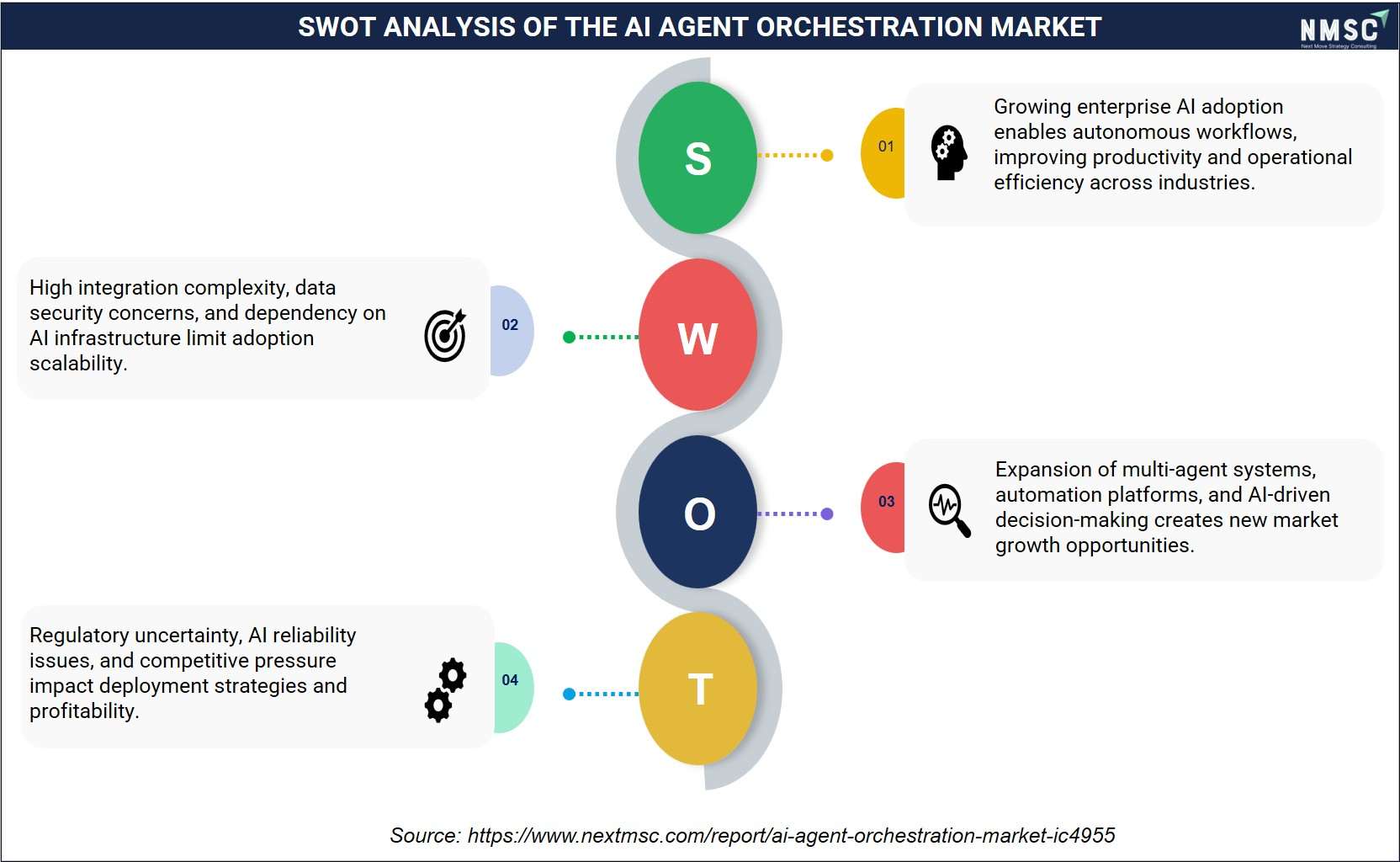
The above SWOT framework identifies the key strategic factors shaping the AI Agent Orchestration Market across strengths, weaknesses, opportunities, and threats. We observed that growing enterprise AI adoption enabling autonomous workflows and improved productivity serves as a core strength, while high integration complexity, data security concerns, and dependency on AI infrastructure emerge as key weaknesses limiting scalability. Expansion of multi-agent systems, automation platforms, and AI-driven decision-making presents significant growth opportunities, yet regulatory uncertainty, AI reliability issues, and competitive pressure continue to threaten deployment strategies and profitability.
What Are the Investment Opportunities in the AI Agent Orchestration Market?
Capital Inflows and Venture Activity
The AI Agent Orchestration Market is experiencing exceptionally strong capital inflows, with venture funding for agentic AI platform providers reaching multi-billion-dollar levels during 2024–2025. Companies such as LangChain, Kore.ai, and Cognigy have secured substantial funding rounds, while OpenAI has established new valuation benchmarks for AI platform businesses. From our research, we found that investors are increasingly prioritizing companies with differentiated memory management capabilities, enterprise governance tools, and proven large-scale deployments over vendors with strong demonstrations but limited production references. Strategic investors including Microsoft, Google, Salesforce, and Workday are reinforcing long-term platform consolidation trends within the market.
Infrastructure Investment
Infrastructure spending represents one of the most important investment drivers for the AI Agent Orchestration Market. Investment opportunities span GPU compute infrastructure for LLM inference, vector databases, memory management platforms, enterprise API gateways, and AI observability solutions. Hyperscale cloud providers are investing heavily in expanding AI infrastructure capacity to support rising orchestration workloads, while specialized vendors in vector search, LLMOps, and AI evaluation technologies continue to attract independent capital. Through our market assessment, we observed that enterprises are increasingly classifying AI orchestration infrastructure as a dedicated capital expenditure category, comparable to cloud computing and data warehouse investments, highlighting its growing strategic importance.
ESG Considerations
Environmental, social, and governance factors are becoming increasingly important in investment decision-making within the AI Agent Orchestration Market, particularly among European institutional investors and public-sector organizations. Platforms that demonstrate energy-efficient model inference, carbon footprint transparency, and responsible AI governance capabilities are gaining competitive advantages in sustainability-focused procurement processes. From our research, we found that vendors incorporating environmental reporting and algorithmic fairness monitoring into their governance frameworks are better positioned to address the requirements of public-sector agencies and sustainability-conscious enterprises. These trends are encouraging investment in responsible AI technologies and energy-efficient orchestration architectures.
Digital Transformation Enablement
Digital transformation remains the principal investment theme underpinning the AI Agent Orchestration Market, as organizations across industries pursue multi-year agentic AI adoption strategies. AI orchestration platforms are becoming foundational components of enterprise automation, knowledge management, and intelligent workflow initiatives. Our assessment indicates that demand for orchestration capabilities is expanding as enterprises seek to integrate multiple AI agents into existing business systems and digital ecosystems. Vendors capable of delivering scalable, secure, and industry-specific orchestration frameworks are expected to benefit from sustained digital transformation spending over the coming decade.
Private Equity and Strategic M&A Activity
Strategic acquisitions and private equity investments are increasingly targeting AI Agent Orchestration Market participants as larger enterprise software companies seek to strengthen their AI capabilities. Our analysis indicates that mid-market orchestration platform providers with strong customer retention, established vertical expertise in industries such as BFSI and healthcare, and defensible open-source ecosystems represent attractive acquisition candidates. Through NMSC's assessment, we found that consolidation is expected to accelerate during the 2026–2030 period, as leading enterprise software vendors position AI orchestration as a core platform capability rather than a standalone solution category. This environment is expected to create significant opportunities for strategic partnerships, technology acquisitions, and platform expansion initiatives.
Key Benefits for Stakeholders
For Investors and Venture Capital Firms
Investors and venture capital firms gain access to a structured and data-rich assessment of the AI Agent Orchestration Market, including market sizing, CAGR forecasts, and segment-level opportunities across platform categories, buyer segments, and regions. The analysis highlights high-growth areas such as real-time orchestration, healthcare AI agents, and developer frameworks, enabling investors to build informed investment theses and identify emerging opportunities with above-average growth potential.
For Technology Vendors and Independent Software Vendors (ISVs)
Technology vendors and ISVs gain actionable intelligence on competitive positioning, M&A activity, and go-to-market channel dynamics across the AI Agent Orchestration Market. The study provides insights that support product roadmap development, partnership strategies, and channel investment decisions. Competitive landscape assessments also help vendors identify underserved verticals and geographic markets where white-space opportunities exist for differentiation and expansion.
For Enterprise IT Leaders and CIOs
Enterprise IT leaders and CIOs obtain a comprehensive and vendor-neutral evaluation of deployment models, orchestration capabilities, and governance frameworks across the AI Agent Orchestration Market. Platform benchmarking and product family analysis provide decision-makers with objective information for vendor selection, enterprise architecture planning, and ROI assessment. These insights support board-level business cases for AI investments and help organizations align orchestration strategies with broader digital transformation initiatives.
For System Integrators and Consulting Firms
System integrators and consulting firms gain visibility into regional adoption trends, industry-specific use cases, and AI orchestration maturity levels across key sectors. The analysis enables service providers to identify high-value opportunities for advisory, implementation, integration, and managed services. Regional and vertical insights further support resource allocation and the development of specialized offerings tailored to evolving enterprise AI requirements.
For Government Agencies and Regulatory Bodies
Government agencies and regulatory authorities gain a structured understanding of how AI governance frameworks, compliance requirements, and public sector adoption trends are influencing the development of the AI Agent Orchestration Market. Country- and region-level insights provide policymakers with evidence-based perspectives on how regulatory initiatives are shaping investment priorities and platform capabilities, supporting the formulation of effective AI governance and digital transformation policies.
For Academic and Research Institutions
Academic institutions and research organizations gain access to comprehensive market segmentation frameworks, technology adoption trends, and regional development patterns within the AI Agent Orchestration ecosystem. These insights serve as valuable reference points for enterprise AI adoption studies, AI systems research, and technology policy analysis, while also supporting investigations into the evolution of multi-agent systems, orchestration architectures, and emerging enterprise AI deployment models.
Key Market Segments
By Product Family
-
Application Embedded Agents
-
CRM
-
ERP
-
ITSM
-
HCM
-
Productivity
-
-
Workflow Orchestration Platforms
-
Low Code Automation
-
RPA Led Automation
-
IPaaS
-
Case Management
-
-
Developer Frameworks and Runtimes
-
SDK
-
Open-Source Framework
-
Managed Runtime
-
Visual Builder
-
-
Customer Experience Agent Platforms
-
Contact Center
-
Messaging
-
Voice
-
Self Service
-
-
Services
-
Advisory
-
Build and Integrate
-
Managed Operations
-
By Deployment Model
-
SaaS
-
Customer Managed Cloud
-
On-Premises
-
Hybrid
By Monetization
-
Subscription
-
Consumption
-
Services
-
Perpetual
By Buyer Type
-
IT and Platform
-
Developers
-
Business Operations
-
Customer Operations
-
Procurement
By End User Industry
-
BFSI
-
Healthcare and Life Sciences
-
Public Sector
-
Manufacturing
-
Retail and Consumer Goods
-
Telecom and Media
-
Technology
-
Energy and Utilities
-
Transportation and Logistics
-
Other
By Distribution Channel
-
Direct
-
Partner
-
Marketplace
-
Open Source to Enterprise
By Region
-
North America: U.S., Canada, and Mexico.
-
Europe: UK, Germany, France, Italy, Spain, Sweden, Denmark, Finland, the Netherlands, and the rest of Europe.
-
Asia Pacific: China, India, Japan, South Korea, Taiwan, Indonesia, Vietnam, Australia, Philippines, Malaysia and the rest of APAC.
-
Middle East & Africa (MEA): Saudi Arabia, UAE, Egypt, Israel, Turkey, Nigeria, South Africa, and the rest of MEA.
-
Latin America: Brazil, Argentina, Chile, Colombia, and the rest of LATAM.
Conclusion and Recommendations
Long-Term Growth Trajectory and Market Maturity Outlook
The global AI Agent Orchestration Market is positioned for exceptional long-term growth, expanding from USD 15.97 billion in 2026 to USD 121.36 billion by 2035 at a CAGR of 25.2%. This trajectory reflects the structural irreversibility of enterprise adoption of agentic AI architectures, the expanding deployment of LLM-powered orchestration platforms across all major industry verticals, and the progressive institutionalization of AI agent governance frameworks that will define the market's maturation path. NMSC's analysis indicates that the market is currently transitioning from early-adopter experimentation toward early-majority enterprise standardization, a phase that typically accelerates both deployment scale and average contract value expansion.
Strategic Positioning Recommendations for Market Participants
AI orchestration vendors should prioritize vertical-specific use case depth over horizontal feature breadth in their near-term product investment strategies, as regulated industries including BFSI and healthcare are demonstrating willingness to pay premium prices for compliance-aligned, domain-specialized orchestration platforms. Vendors targeting mid-market buyers should accelerate self-serve onboarding, consumption-based pricing, and cloud marketplace distribution channel development to compete against hyperscaler-bundled orchestration services. Geographic expansion into Asia Pacific and Middle East markets, supported by localized AI governance compliance capabilities and regional cloud hosting, represents the highest-growth-potential international opportunity for North American and European AI orchestration platform companies.
Investment Attractiveness and Capital Allocation Priorities
Investment attractiveness within the AI Agent Orchestration Market is highest for platforms demonstrating strong production deployment evidence, enterprise customer retention metrics, differentiated memory management and multi-agent coordination reliability, and scalable open-source-to-enterprise conversion pipelines. PE and VC investors should evaluate AI orchestration targets against their connector ecosystem breadth, observable AI governance tool investment, and cloud marketplace revenue contribution as proxies for competitive moat durability. Infrastructure investment in GPU compute, vector database, and AI observability tooling represents high-conviction complementary investment opportunities that will grow in proportion with AI orchestration platform adoption.
Critical Market Shifts to Monitor Through 2035
The most consequential market shifts in the AI Agent Orchestration Market to monitor include the potential consolidation of the multi-agent protocol ecosystem around one or two dominant open standards, which could rapidly commoditize orchestration middleware and shift competitive advantage toward specialized agent capability and data asset quality. The progression of the EU AI Act's high-risk AI provisions from enactment to enforcement will materially reshape enterprise procurement timelines and compliance cost structures for regulated-sector AI orchestration buyers. The emergence of hardware-accelerated AI inference at the edge could create new orchestration deployment paradigms for manufacturing, retail, and transportation sectors that currently rely on cloud-centric architectures.
Key Risks and Mitigation Strategies
The primary risks to AI Agent Orchestration Market growth include macroeconomic IT budget compression that delays enterprise agentic AI investment, accelerated hyperscaler bundling that captures mid-market and SMB AI orchestration budget within existing cloud service agreements, and regulatory enforcement actions that create liability concerns around autonomous AI decision-making in high-stakes contexts. Market participants should mitigate these risks by building demonstrable business outcome evidence for AI orchestration ROI, investing in legal-grade audit trail and governance documentation capabilities, and diversifying distribution channels beyond direct sales to reduce hyperscaler platform dependency. Vendors should also engage proactively with regulatory bodies and standards organizations to influence AI governance frameworks in ways that create competitive differentiation for responsible AI platform design.
Growth Pathways and Emerging Opportunity Clusters
The highest-confidence growth pathways in the AI Agent Orchestration Market include the healthcare data integration and clinical workflow automation wave driven by U.S. interoperability mandates and European health data space development, the OEM-embedded AI agent distribution channel within vertical SaaS applications and industry-specific software platforms, and the government digital transformation programs in Saudi Arabia, India, UAE, and Southeast Asian economies that are creating structured multi-year public sector AI orchestration procurement cycles. The developer framework segment presents a long-term option value opportunity for vendors that can translate open-source community adoption into enterprise platform commitments through superior managed runtime, observability, and governance tooling.
Final Outlook and Summary Assessment
The AI Agent Orchestration Market represents one of the most significant enterprise software market opportunity formations of the current decade. The market's expansion from USD 12.84 billion in 2025 to USD 121.36 billion by 2035 reflects the transformation of AI from a point-solution analytics tool into the operational coordination layer of modern enterprise technology stacks. NMSC's comprehensive assessment indicates that organizations that invest in governed, production-grade AI orchestration infrastructure during the 2025–2028 window will build compounding operational advantages as agentic AI capabilities mature. The market's long-term trajectory is supported by structural demand drivers — data volume growth, regulatory compliance investment, developer ecosystem expansion, and vertical AI application proliferation — that collectively create a durable, multi-decade expansion opportunity for AI orchestration platform vendors, investors, and enterprise buyers alike.
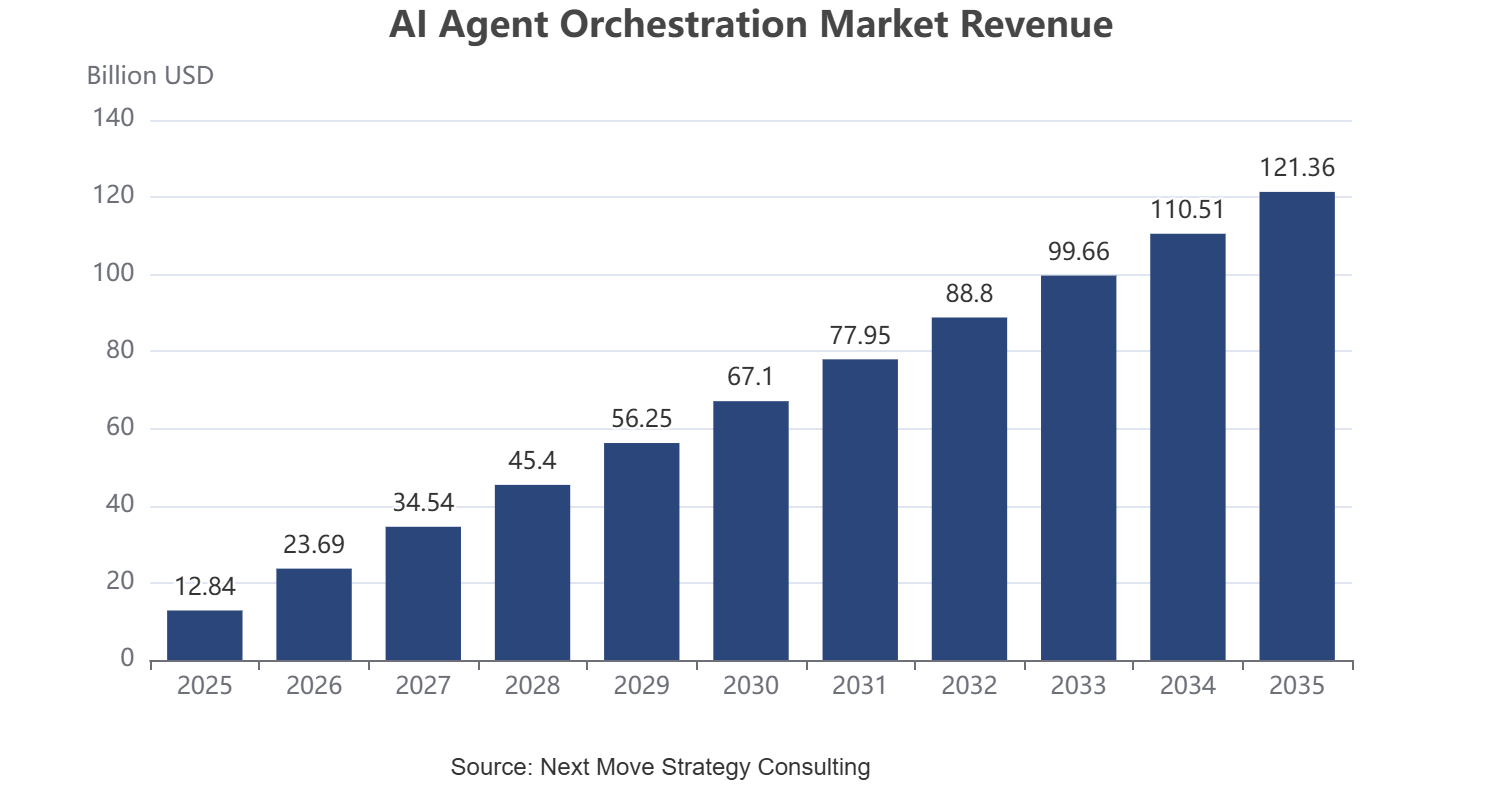
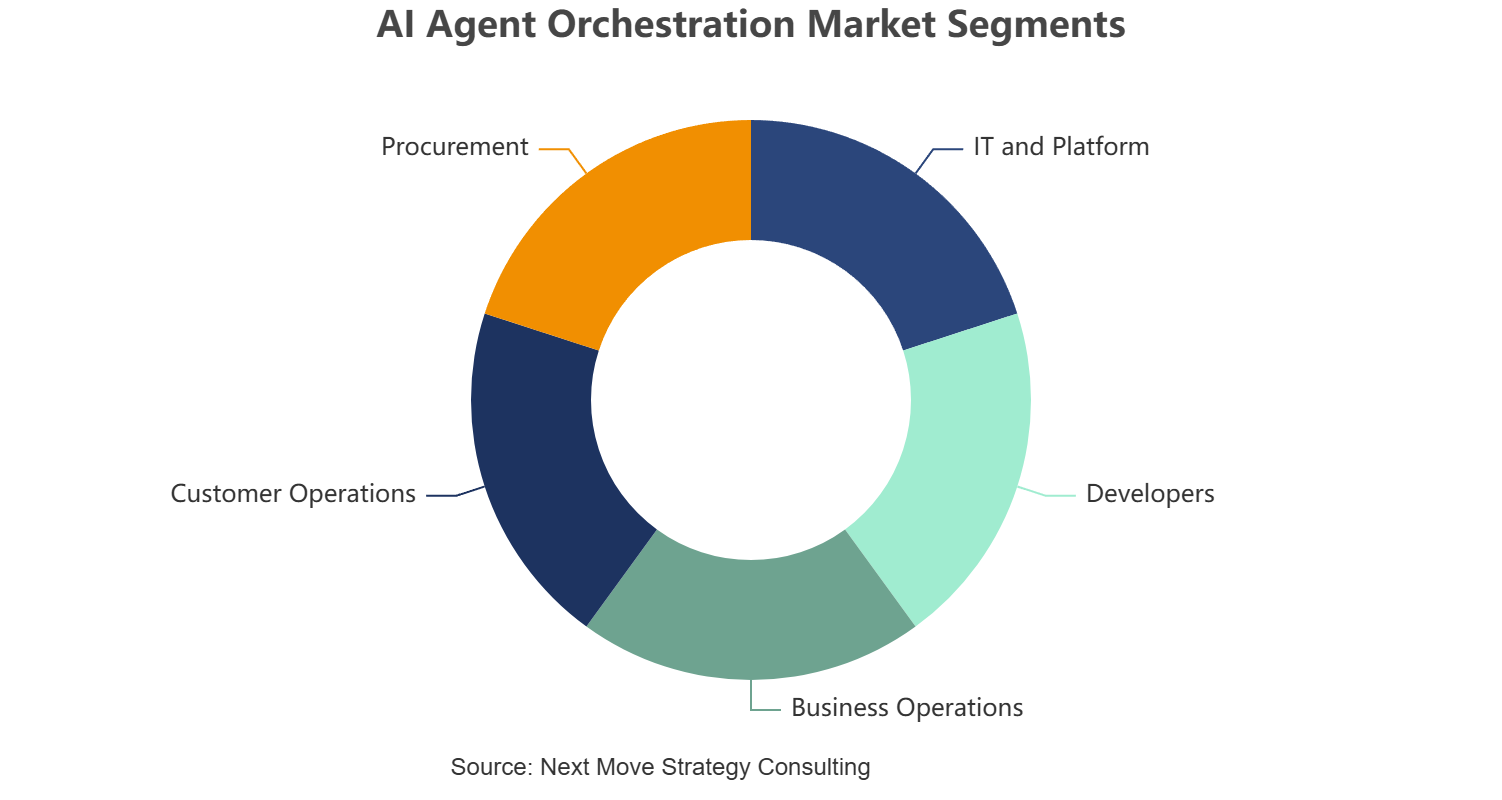
About the Author
 Mayurima Roy
— Mayurima Roy is Research Analyst at Next Move Strategy Consulting, where she has spent 4 years working across the firm's full industry coverage rather than a single fixed vertical. Her work centers on structured research, ongoing trend tracking, competitive assessment, and insight-led content development, translating complex market data into clear, decision-ready narratives that support informed client decision-making across diverse global industries, market sectors, and world regions every day.
Mayurima Roy
— Mayurima Roy is Research Analyst at Next Move Strategy Consulting, where she has spent 4 years working across the firm's full industry coverage rather than a single fixed vertical. Her work centers on structured research, ongoing trend tracking, competitive assessment, and insight-led content development, translating complex market data into clear, decision-ready narratives that support informed client decision-making across diverse global industries, market sectors, and world regions every day.
About the Reviewer
 Supradip Baul
— Supradip Baul is an accomplished business consultant and strategist with over a decade of rich experience in market intelligence, strategy, technology, and business transformation. His work has included rigorous qualitative and quantitative analysis across multiple industries, helping clients shape investment decisions and long-term roadmaps. Earlier in his career, he was associated with Gartner, where he contributed to industry-leading reports and market share analyses. He has worked with leading global companies and holds an MBA with a dual specialization in Marketing and Finance.
Supradip Baul
— Supradip Baul is an accomplished business consultant and strategist with over a decade of rich experience in market intelligence, strategy, technology, and business transformation. His work has included rigorous qualitative and quantitative analysis across multiple industries, helping clients shape investment decisions and long-term roadmaps. Earlier in his career, he was associated with Gartner, where he contributed to industry-leading reports and market share analyses. He has worked with leading global companies and holds an MBA with a dual specialization in Marketing and Finance.
At Next Move Strategy Consulting, we understand that insightful market research is the cornerstone of successful business decisions. That's why we employ a robust and multifaceted approach, combining various methodologies to deliver the most accurate and actionable data for our clients.

Research Landscape
We navigate the world of research with two primary approaches:
Qualitative Approach
Our qualitative research methodologies involve immersive techniques such as in-depth interviews, focus groups, and observational studies. By engaging directly with individuals and stakeholders, we uncover valuable insights that quantitative data alone may overlook.

Quantitative Research
In tandem with qualitative methodologies, NMSC leverages the power of Quantitative Research to provide a robust foundation of numerical insights. Through systematic data collection and analysis, we quantify patterns, preferences, and market trends, offering a comprehensive view of the business landscape.
Our quantitative research approach employs diverse tools, including surveys, experiments, and statistical modelling. These methodologies enable us to gather data from a large and representative sample, ensuring the statistical significance of our findings. By employing structured questionnaires and standardized data collection methods, we guarantee the reliability and validity of the information we present to our clients.
Quantitative research is particularly effective in measuring the prevalence of trends, assessing market size, and gauging the impact of various factors on consumer behavior. The numerical precision attained through this approach equips our clients with actionable insights, facilitating data-driven decision-making and strategy formulation.


Our Specialized Toolbox for Industry-Specific Market Research
We deploy a specialized arsenal of techniques tailored to meet your unique requirements. Here's a glimpse into our comprehensive toolbox:

Information Procurement
The stage entails acquiring market data or relevant information through various sources and methodologies.


Market Research Approach
We utilize both top-down and bottom-up approaches in market research analysis to achieve a comprehensive understanding of the market dynamics, leveraging the broad perspective of industry trends and macroeconomic factors alongside detailed insights from specific segments and individual companies.

Porters Five Forces Analysis
We conduct Porter's Five Forces analysis to evaluate the competitive landscape of an industry, providing us with insights into factors that affect profitability and strategic positioning.

SWOT Analysis

Forecasting
We utilize a forecasting model to predict future consumption by considering parameters like population, economics, regulations, market competition, drivers, constraints, technology, and pricing. We also employ statistical techniques such as multilinear regression, exponential smoothing, moving average, ARIMA, and Monte Carlo simulations for accurate predictions. In econometric forecasting, we analyzed short-term and long-term event impacts, attributing values based on regulatory frameworks, economic factors, and market events.





 Speak to Our Analyst