AI Analytics Chip Manufacturing Market Global Industry Analysis and Forecast (2026–2035)

AI Analytics Chip Manufacturing Market size was USD 280.00 billion in 2026, projected to reach USD 1,150.00 billion by 2035, growing at a CAGR of 17.0% from 2026 to 2035. Key drivers include hyperscaler capital spending, rising AI inference demand, and custom XPU adoption, with North America leading the market.

Download Free Sample PDF
Base Year (2025)
$160.00 Billion
Forecast (2035)
$1,150.00 Billion
CAGR (2026-2035)
17.0%
Top Region
North America

What Is the AI Analytics Chip Manufacturing Market Size?

The global AI Analytics Chip Manufacturing Market was valued at USD 160.00 Billion in 2025 and is estimated at USD 280.00 Billion in 2026. It is forecast to reach USD 1,150.00 Billion by 2035, expanding at a 17.0% CAGR from 2026–2035. North America leads with a 58.0% share in 2026, while GPUs dominate with a 70.0% share.

We observed that three segmentation axes explain most of the revenue concentration across this market.

AI Analytics Chip Manufacturing Market Global Industry Analysis and Forecast (2026–2035) Revenue Forecast

Values in USD Billion

2025 $160.00 Billion
2025
2026 $280.00 Billion
2026
2027 $327.60 Billion
2027
2028 $383.29 Billion
2028
2029 $448.45 Billion
2029
2030 $524.69 Billion
2030
2031 $613.89 Billion
2031
2032 $718.25 Billion
2032
2033 $840.35 Billion
2033
2034 $983.21 Billion
2034
2035 $1,150.00 Billion
2035

Key Takeaways

By Chip Type: GPUs held the largest share, expanding from USD 122.50 Billion in 2025 to USD 560.00 Billion by 2035; Custom ASICs and XPUs are the fastest growing at 27.6% CAGR from 2026–2035.

By Application: Model training held the largest share, expanding from USD 88.00 Billion in 2025 to USD 380.00 Billion by 2035; Inference and analytics is the fastest growing at 21.3% CAGR from 2026–2035.

By End User: Hyperscale cloud providers held the largest share, expanding from USD 94.40 Billion in 2025 to USD 500.00 Billion by 2035; Enterprise, sovereign and industrial is the fastest growing at 24.0% CAGR from 2026–2035.

Dominant Region: North America, expanding from USD 97.60 Billion in 2025 to USD 595.00 Billion by 2035.

Fastest-Growing Region: Middle East & Africa at 19.9% CAGR from 2026–2035, rising from USD 8.00 Billion in 2025 to USD 100.00 Billion by 2035.

Dominant Country: U.S., expanding from USD 90.50 Billion in 2025 to USD 553.00 Billion by 2035.

Fastest-Growing Country: India at 24.8% CAGR from 2026–2035, rising from USD 1.40 Billion in 2025 to USD 22.00 Billion by 2035.

Our assessment indicates an absolute revenue opportunity of USD 870.00 Billion between 2026 and 2035 for accelerator suppliers.

According to NMSC analysis, custom silicon programs at cloud providers will lift ASIC and XPU revenue nearly ninefold by 2035.

What Does the AI Analytics Chip Manufacturing Market Encompass?

The AI Analytics Chip Manufacturing Market covers revenue from the design, fabrication and supply of processors that run AI training, inference and data analytics workloads. Included products are GPUs, custom ASICs and XPUs, FPGAs, and NPUs and other AI SoCs, valued at accelerator processor level. Excluded items are standalone high bandwidth memory, networking, servers, host CPUs and foundry wafer services, which prevents double counting across adjacent markets. This market report measures chip sales as the single point of valuation.
We observed that buying behavior moved from GPU only procurement toward mixed fleets during 2025 and 2026, as cloud providers commissioned custom XPU programs while enterprises kept buying merchant GPUs. Regulation shapes supply, because the U.S. Bureau of Industry and Security moved H200 and MI325X exports to China to case by case review in January 2026. Leading edge nodes at 2 nanometers entered volume at TSMC, and advanced packaging capacity remains the gating technology factor.

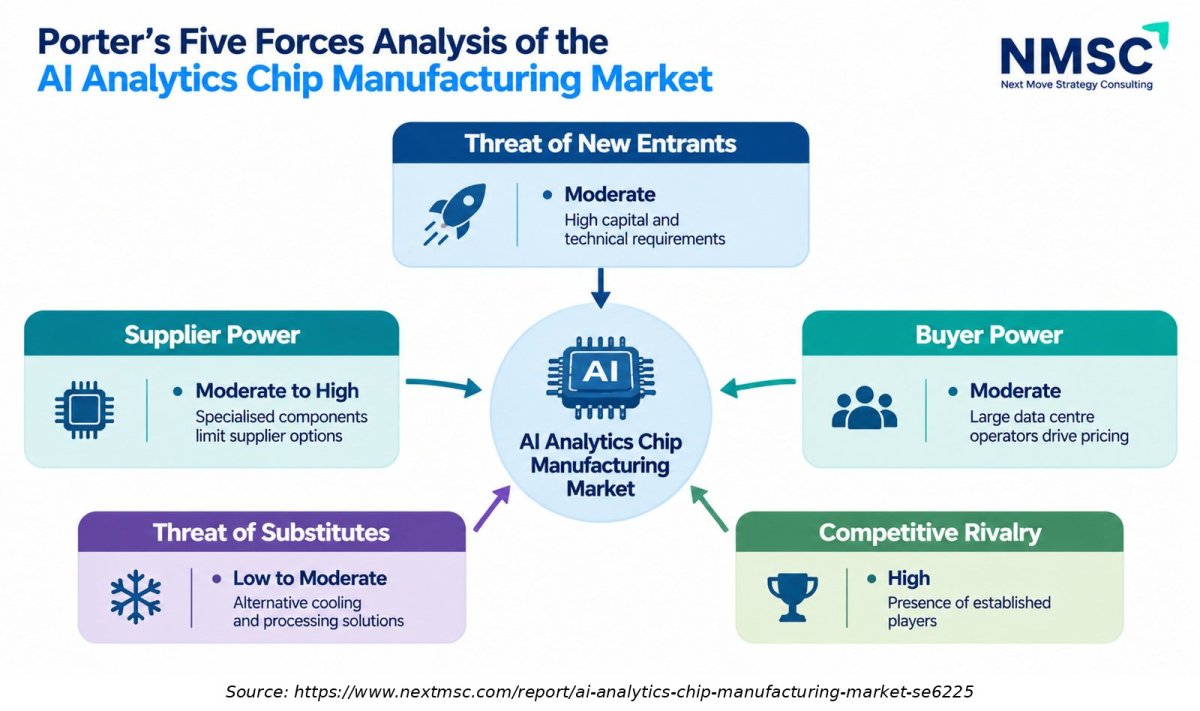
Porter’s Five Forces Analysis of the AI Analytics Chip Manufacturing Market

The AI analytics chip manufacturing market faces strong competitive rivalry driven by rapid innovation and performance improvements. Supplier power is moderate to high because advanced semiconductor materials and manufacturing capabilities are concentrated among specialised providers. Buyer power is moderate, influenced by large cloud and data centre operators. High capital requirements constrain new entrants, while CPUs, GPUs, FPGAs, and other accelerators create substitution pressure.

Market Drivers & Dynamics

Interactive Dataset
Hyperscaler and AI cloud capital spending driver +5.5% North America, Asia Pacific 2026–2030
Inference workload expansion from agentic AI driver +4.0% Global 2026–2032
Custom XPU adoption by cloud providers driver +3.5% North America, Asia Pacific 2026–2033
Sovereign AI compute programs driver +2.5% Middle East & Africa, Europe, Asia Pacific 2026–2031
Advanced packaging and memory supply limits restraint −3.0% Global 2026–2028
Power and data center site availability restraint −2.5% North America, Europe 2026–2030
Export controls and trade barriers restraint −1.5% Asia Pacific, North America 2026–2035
Customer concentration and spending digestion risk restraint −2.0% Global 2027–2030
Source: Next Move Strategy Consulting

Growth Drivers

What Is the Primary Growth Driver in the AI Analytics Chip Manufacturing Market?

Capital spending by hyperscalers and AI clouds is the primary driver. NVIDIA management stated that its five largest customers are expected to spend nearly USD 800.00 Billion in 2026 and USD 1,300.00 Billion in 2027. The World Semiconductor Trade Statistics organization reported global semiconductor revenue of USD 702.00 Billion in the first half of 2026, up 102% year over year, with logic up 45%. Purchases in the AI Analytics Chip Manufacturing Market follow this spending directly.

How Is Inference Demand Driving Market Growth?

Reasoning and agentic workloads raise compute per task, so inference chips are deployed in volume. NVIDIA reported Data Center revenue of USD 89.00 Billion in its July 2026 quarter, up 117% year over year, while AMD reported Data Center revenue of USD 6.70 Billion, up 107%. Our findings suggest that inference and analytics adds the most revenue between 2026 and 2035, rising from USD 128.00 Billion to USD 728.00 Billion.

Growth Inhibitors

What Is Restraining the AI Analytics Chip Manufacturing Market?

The primary restraint is constrained supply of advanced packaging, high bandwidth memory and power. The World Semiconductor Trade Statistics organization reported memory revenue growth of 305% in the first half of 2026, which shows how sharply memory demand and pricing have tightened. NVIDIA described its fiscal 2028 outlook as supply constrained. Export controls add uncertainty, because licensing outcomes for China remain contested between executive agencies and Congress.

What Are the Growth Opportunities?

Can Custom Silicon Programs Capture Stable Inference Workloads?

Cloud providers running mature models at predictable volume gain the most from tailored chips in the AI Analytics Chip Manufacturing Market, because fixed workloads let designers remove unused circuitry and cut power per token. Design partners with proven packaging and memory access, such as Broadcom and Marvell, are placed to win additional programs. Custom ASICs and XPUs rise from USD 48.00 Billion in 2026 to USD 430.00 Billion in 2035, the largest share gain of any chip type.

Does Sovereign and Enterprise Compute Represent an Untapped Volume Pool?

Governments and regulated enterprises are building domestic clusters for data residency, which creates demand outside the largest cloud providers. Qualcomm named Humain as first customer for 200 megawatts of AI200 racks starting in 2026. Enterprise, sovereign and industrial buyers expand from USD 47.60 Billion in 2026 to USD 330.00 Billion in 2035, and suppliers with local partners and export approvals capture the largest portion.

Will Domestic Substitution in China Open a Protected Supplier Market?

Chinese buyers are directing orders toward local designers because foreign supply is uncertain. Cambricon set a full year 2026 revenue threshold of at least RMB 13.5 billion in its incentive plan, more than double its first half revenue. Local suppliers with secured foundry and packaging capacity can scale in Asia Pacific, where the market grows from USD 70.00 Billion in 2026 to USD 330.00 Billion in 2035.

Segmentation Analysis

2025 (USD Billion)
2035 (USD Billion)
GPUs 2025: $122.50 Billion | 2035: $560.00 Billion
GPUs
Custom ASICs and XPUs 2025: $18.00 Billion | 2035: $430.00 Billion
Custom ASICs
FPGAs 2025: $3.00 Billion | 2035: $9.00 Billion
FPGAs
NPUs and other AI SoCs 2025: $16.50 Billion | 2035: $151.00 Billion
NPUs and oth
GPUs $122.50 Billion $560.00 Billion 12.4%
Custom ASICs and XPUs $18.00 Billion $430.00 Billion 27.6%
FPGAs $3.00 Billion $9.00 Billion 10.7%
NPUs and other AI SoCs $16.50 Billion $151.00 Billion 18.7%

Which Chip Type Leads the AI Analytics Chip Manufacturing Market?

GPUs lead with USD 196.00 Billion in 2026, equal to 70.0% of revenue, because NVIDIA and AMD ship merchant accelerators that every cloud and enterprise buyer can deploy without design effort. Custom ASICs and XPUs grow fastest at 27.6% CAGR from 2026–2035 as cloud providers move stable inference workloads to tailored silicon. We found that FPGAs stay niche at 10.7% CAGR, while NPUs and other AI SoCs reach USD 151.00 Billion by 2035.

2025 (USD Billion)
2035 (USD Billion)
Model traini
Inference an
Edge AI anal
Segment Item 2025 (USD Billion) 2035 (USD Billion) CAGR
Model training $10.0 USD Billion $40.0 USD Billion 18.0%
Inference and analytics $17.1 USD Billion $51.1 USD Billion 16.0%
Edge AI analytics $24.2 USD Billion $62.2 USD Billion 22.0%

Segment-wise data is locked

Unlock complete segment-wise numbers for By Application.

Unlock Full Data
2025 (USD Billion)
2035 (USD Billion)
Hyperscale c
AI clouds an
Enterprise
sovereign an
Segment Item 2025 (USD Billion) 2035 (USD Billion) CAGR
Hyperscale cloud providers $10.0 USD Billion $40.0 USD Billion 26.0%
AI clouds and neoclouds $17.1 USD Billion $51.1 USD Billion 16.0%
Enterprise $24.2 USD Billion $62.2 USD Billion 18.0%
sovereign and industrial $31.3 USD Billion $73.3 USD Billion 8.0%

Segment-wise data is locked

Unlock complete segment-wise numbers for By End User.

Unlock Full Data

Growth Opportunities

Our analysis shows that three whitespace opportunities are positioned to generate disproportionate revenue between 2026 and 2035.

Can Custom Silicon Programs Capture Stable Inference Workloads?

Cloud providers running mature models at predictable volume gain the most from tailored chips in the AI Analytics Chip Manufacturing Market, because fixed workloads let designers remove unused circuitry and cut power per token. Design partners with proven packaging and memory access, such as Broadcom and Marvell, are placed to win additional programs. Custom ASICs and XPUs rise from USD 48.00 Billion in 2026 to USD 430.00 Billion in 2035, the largest share gain of any chip type.

Does Sovereign and Enterprise Compute Represent an Untapped Volume Pool?

Governments and regulated enterprises are building domestic clusters for data residency, which creates demand outside the largest cloud providers. Qualcomm named Humain as first customer for 200 megawatts of AI200 racks starting in 2026. Enterprise, sovereign and industrial buyers expand from USD 47.60 Billion in 2026 to USD 330.00 Billion in 2035, and suppliers with local partners and export approvals capture the largest portion.

Will Domestic Substitution in China Open a Protected Supplier Market?

Chinese buyers are directing orders toward local designers because foreign supply is uncertain. Cambricon set a full year 2026 revenue threshold of at least RMB 13.5 billion in its incentive plan, more than double its first half revenue. Local suppliers with secured foundry and packaging capacity can scale in Asia Pacific, where the market grows from USD 70.00 Billion in 2026 to USD 330.00 Billion in 2035.

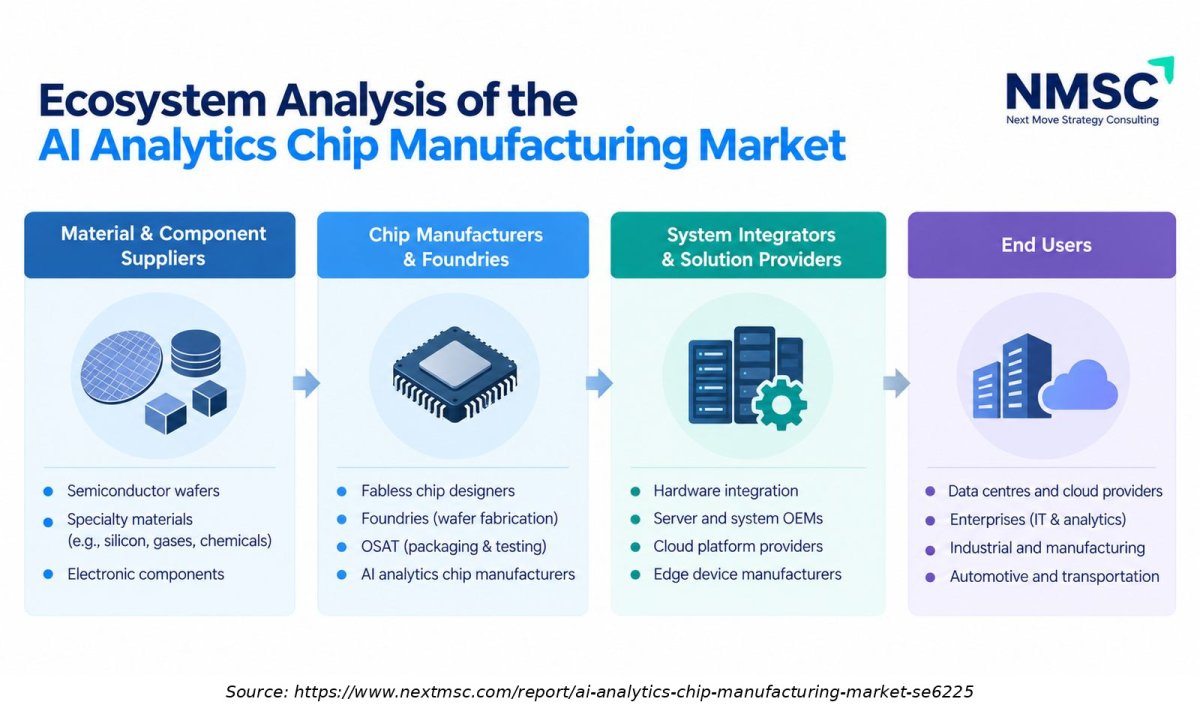
Ecosystem Analysis of the AI Analytics Chip Manufacturing Market

The AI analytics chip manufacturing ecosystem includes semiconductor material suppliers, chip designers, foundries, packaging and testing providers, system integrators, and end users. Component suppliers provide wafers and specialised materials, while manufacturers develop and produce chips optimised for AI analytics workloads. System integrators incorporate these chips into servers and computing platforms, serving data centres, cloud providers, enterprises, and industrial applications.

Regional Outlook

2025 (USD Billion)
2035 (USD Billion)
North Americ
Europe AI An
Asia-Pacific
Middle East
Latin Americ
Region 2025 (USD Billion) 2035 (USD Billion) CAGR (%)
North America AI Analytics Chip Manufacturing Market $10.0 USD Billion $40.0 USD Billion 9.0%
Europe AI Analytics Chip Manufacturing Market $17.1 USD Billion $51.1 USD Billion 27.0%
Asia-Pacific AI Analytics Chip Manufacturing Market $24.2 USD Billion $62.2 USD Billion 25.0%
Middle East & Africa AI Analytics Chip Manufacturing Market $31.3 USD Billion $73.3 USD Billion 23.0%
Latin America AI Analytics Chip Manufacturing Market $38.4 USD Billion $84.4 USD Billion 12.0%

Regional data is locked

Unlock complete regional numbers for this market.

Unlock Full Data

Competitive Landscape

We found that competition rests on performance per watt, software depth and delivery certainty rather than on list price.

Dimension Description
Market Structure Concentrated at the top, with one merchant GPU leader, a small group of custom silicon partners and regional champions in China
Innovation Focus Rack scale platforms, inference accelerators, 2 nanometer manufacturing, advanced packaging and in house memory
M&A Activity Targeted purchases of interconnect and photonics assets, including Marvell's Celestial AI and XConn deals and Qualcomm's Alphawave deal

How Do Companies Compete in the AI Analytics Chip Manufacturing Market?

Competition in the AI Analytics Chip Manufacturing Market runs on performance per watt, software ecosystem depth and delivery certainty. NVIDIA combines GPUs, networking and software into rack scale platforms, while AMD competes on memory capacity and open software, and Broadcom and Marvell compete through custom design services. Pricing power sits with suppliers that control scarce capacity, and geographic expansion follows sovereign programs in the Middle East and Asia.

Which Supplier Archetypes Dominate the Market?

Five archetypes shape the market. Merchant platform leaders sell standard accelerators at scale, custom silicon partners build chips for individual cloud providers, and a foundry enabler supplies leading edge capacity to nearly all of them. Regional champions such as Cambricon and Huawei serve protected domestic demand, while challengers including Intel and Qualcomm target inference with differentiated memory and power profiles.

How Do Suppliers Differentiate Through Innovation and Technology?

Differentiation now happens at system level. AMD is ramping its Helios rack platform, NVIDIA has Vera Rubin in full production, and Huawei has moved Ascend 950 supernodes into commercial use with in house memory. Our analysis shows that suppliers pairing silicon with interconnect, software and secured packaging capacity retain higher gross margins, which NVIDIA reported at 75.0% in its July 2026 quarter.

What Is the M&A Activity in the Market?

Acquisition activity concentrates on interconnect, photonics and design assets that raise cluster scale. Marvell completed purchases of Celestial AI and XConn Technologies, and Qualcomm acquired Alphawave for about USD 2.40 Billion to strengthen data center connectivity. We observed that these deals favor vertical integration around the accelerator, while large horizontal combinations among chip designers remain constrained by regulatory review.

Key Market Players

Our findings suggest that nine verified suppliers shape the market through chip design, manufacturing capacity or both, listed here in ranked order.

NVIDIA Corporation Broadcom Inc. Taiwan Semiconductor Manufacturing Company Limited Advanced Micro Devices, Inc. Huawei Technologies Co., Ltd. Marvell Technology, Inc. Intel Corporation Qualcomm Incorporated Cambricon Technologies Corporation Limited

Latest Developments

Our assessment indicates that recent company and policy announcements confirm the demand and supply themes described above.

Date Event
October 2026 NVIDIA introduced the cuPotential CUDA-X library and highlighted adoption of its accelerated computing and AI software by semiconductor companies including Applied Materials, Cadence, KLA, Lam Research, Siemens and Synopsys. The tools target simulation, inspection, design and advanced packaging; NVIDIA reported Lam Research achieved 30× faster chipmaking simulation.
September 2026 Huawei unveiled the Atlas 960E SuperPoD, built around Ascend 960 NPUs and near-packaged optics (NPO), and said Ascend 960DT availability had moved to Q1 2027. The system can scale to 4,096 NPUs and 8 EFLOPS FP8 compute, while its Hi-ONE optical engine provides 7.2 Tbit/s per unit.

Expert Insights

Jensen Huang

Founder and CEO | NVIDIA

"AI is advancing at light speed, and companies are racing to build AI factories that can scale to meet the processing demands of reasoning AI and inference time scaling."

Analyst Interpretation

The statement highlights the growing need for specialised computing infrastructure to support increasingly complex AI workloads. As businesses expand AI-driven analytics, demand is rising for high-performance accelerator chips capable of processing large datasets, supporting advanced reasoning and delivering rapid inference. These requirements are encouraging semiconductor manufacturers to improve processing throughput, memory bandwidth, chip-to-chip connectivity and energy efficiency. The expansion of AI factories also creates opportunities for manufacturers developing advanced AI processors and integrated computing platforms. Consequently, continued investment in accelerator architectures and scalable semiconductor infrastructure is expected to remain an important factor shaping the AI Analytics Chip Manufacturing Market.

Where Is Capital Flowing in the AI Analytics Chip Manufacturing Market?

Where Is Capital Flowing in the AI Analytics Chip Manufacturing Market?

Capital is flowing toward accelerator supply, packaging capacity and customer financing. NVIDIA returned about USD 26.00 Billion to shareholders in its July 2026 quarter while holding roughly USD 105.00 Billion in supply and capacity obligations. Marvell plans about USD 1.00 Billion of supplier prepayments in fiscal 2027 to secure capacity. Investors favor suppliers with locked capacity, diversified customers and a credible inference roadmap.

How Is Infrastructure Investment Expanding Manufacturing Capacity?

Manufacturers are adding leading edge wafer, packaging and substrate capacity to meet accelerator demand. TSMC spent USD 15.70 Billion on capital expenditure in the second quarter of 2026 alone, and Intel said it is raising spending on equipment and clean rooms. Infrastructure investors also benefit from data center power and cooling demand, because every accelerator cluster needs matching grid connections and site capacity.

How Do ESG Considerations Affect Investment Decisions?

Energy use is the central environmental issue, so performance per watt increasingly decides purchases. Intel positioned its Xeon 6+ processor on sustained performance under real world power constraints, and Huawei said its optical interconnect design cuts power use by more than 550 kilowatts in a supernode. Investors screen suppliers on efficiency, water use in fabs and supply chain governance, which favors vendors with transparent disclosures.

What Do Enterprise and Industry Leaders Gain From This Report?

What Do Enterprise and Industry Leaders Gain From This Report?

Enterprise and industry leaders gain a segment level view of how chip supply, pricing and architecture choices will evolve through 2035. The report sizes chip types, applications and end users, so buyers can compare merchant GPUs with custom and edge options. Procurement teams can time commitments against the supply limits identified in the analysis, and planners can align compute budgets with the forecast growth in inference demand.

What Do Investors and Financial Analysts Gain From This Report?

Investors and financial analysts gain a reconciled forecast that ties segment and regional revenue of the AI Analytics Chip Manufacturing Market to the global total of USD 1,150.00 Billion by 2035. The analysis separates fast growing pools, such as custom ASICs and XPUs and enterprise and sovereign demand, from large but slower pools such as GPU based training. It also flags concentration, export control and supply risks that affect valuation and capital allocation decisions.

What Do Chip Vendors and Product Teams Gain From This Report?

Chip vendors and product teams gain competitive context on supplier archetypes, innovation priorities and M&A patterns. The country level outlook shows where sovereign programs and domestic substitution create protected demand, and the application split shows where inference and edge products can win. Product managers can prioritize memory capacity, power efficiency and software compatibility against documented buyer behavior.

Key Market Segments Evaluated

By Chip Type

  • GPUs
  • Custom ASICs and XPUs
  • FPGAs
  • NPUs and other AI SoCs

By Application

  • Model training
  • Inference and analytics
  • Edge AI analytics

By End User

  • Hyperscale cloud providers
  • AI clouds and neoclouds
  • Enterprise, sovereign and industrial

By Region

  • North America 
    • U.S.
    • Canada
    • Mexico.
  • Europe 
    • UK
    • Germany
    • France
    • Italy
    • Spain
    • Sweden
    • Denmark
    • Finland
    • Netherlands
    • Rest of Europe.
  • Asia-Pacific 
    • China
    • India
    • Japan
    • South Korea
    • Taiwan
    • Indonesia
    • Vietnam
    • Australia
    • Philippines
    • Malaysia
    • Rest of APAC.
  • Middle East & Africa 
    • Saudi Arabia
    • UAE
    • Egypt
    • Israel
    • Turkey
    • Nigeria
    • South Africa
    • Rest of MEA.
  • Latin America 
    • Brazil
    • Argentina
    • Chile
    • Colombia
    • Rest of LATAM.

Conclusion & Recommendations

Our analysis shows that revenue in the AI Analytics Chip Manufacturing Market rises from USD 280.00 Billion in 2026 to USD 1,150.00 Billion in 2035, with growth easing from above 40% in 2027 to the low teens by the early 2030s. Inference, custom silicon and sovereign demand carry the later years, while GPU based training matures. The outlook depends on continued customer spending and on supply of packaging, memory and power, which we treat as the binding constraints throughout the forecast.

What Strategic Positioning Recommendations Does NMSC Offer?

NMSC recommends that merchant suppliers defend share through rack scale platforms and software, while custom silicon partners lock in multi year programs with cloud providers. Challengers should target inference with memory and power advantages, and regional champions should secure domestic foundry and packaging capacity. All suppliers should diversify customers, because concentration among a few buyers amplifies the effect of any spending pause.

How Strong Is the Investment Attractiveness of the Market?

Based on research conducted by NMSC, we found that investment attractiveness is high but uneven. Custom ASICs and XPUs, inference and analytics, and enterprise and sovereign demand show the fastest growth, while GPU training offers scale with lower incremental growth. Manufacturing enablers with secured capacity capture value across suppliers. Valuation risk is material, because current growth rates rely on sustained cloud spending.

What Are the Market Shifts and Key Risks in the AI Analytics Chip Manufacturing Market?

Three shifts matter most: inference overtaking training, custom silicon gaining share and domestic substitution in China. The main risks are supply limits in packaging, memory and power, export control changes, and a slowdown in customer spending after the current build cycle. Concentration is also notable, as NVIDIA reported that hyperscale customers supplied about 55% of its Data Center revenue.

What Are the Primary Growth Pathways Through 2035?

We found that growth follows four pathways. Inference and analytics adds the most revenue, rising to USD 728.00 Billion by 2035. Custom ASICs and XPUs expand to USD 430.00 Billion, enterprise and sovereign buyers reach USD 330.00 Billion, and Middle East & Africa leads regional growth at 19.9% CAGR from 2026–2035.

FAQs

Sources & References

1.

World Semiconductor Trade Statistics, Q2 2026 release

wsts.org
2.

World Semiconductor Trade Statistics, Spring 2026 forecast (JEITA publication)

jeita.or.jp
3.

NVIDIA Corporation, Investor Relations

investor.nvidia.com
4.

Broadcom Inc., Form 8-K, third quarter fiscal 2026

sec.gov
5.

Advanced Micro Devices, Inc., second quarter 2026 results

ir.amd.com
6.

Advanced Micro Devices, Inc., Form 8-K, second quarter 2026

sec.gov
7.

Intel Corporation, second quarter 2026 results

intc.com
8.

Intel Corporation, Form 8-K, second quarter 2026

sec.gov
9.

Taiwan Semiconductor Manufacturing Company Limited, Investor Relations

investor.tsmc.com
10.

Marvell Technology, Inc., Investor Relations

investor.marvell.com
11.

Qualcomm Incorporated, Newsroom

qualcomm.com/news
12.

Cambricon Technologies Corporation Limited, Shanghai Stock Exchange disclosures

sse.com.cn
13.

Huawei Technologies Co., Ltd., Newsroom

huawei.com
14.

U.S. Bureau of Industry and Security

bis.gov

About the Author

Liza Phukan

Liza Phukan

Liza Phukan is Research Associate at Next Move Strategy Consulting, where she has covered emerging industries and market research across sectors for 3.5 years. Her work includes analyzing industry developments, validating market data, and developing structured business content from research findings. She uses secondary research and data-validation practices to turn complex market information into clear decision-useful market analysis for business audiences and support report development and B2B.

About the Reviewer

Supradip Baul

Supradip Baul

Supradip Baul is an accomplished business consultant and strategist with over a decade of rich experience in market intelligence, strategy, technology, and business transformation. His work has included rigorous qualitative and quantitative analysis across multiple industries, helping clients shape investment decisions and long-term roadmaps. Earlier in his career, he was associated with Gartner, where he contributed to industry-leading reports and market share analyses. He has worked with leading global companies and holds an MBA with a dual specialization in Marketing and Finance.

Download Free Sample

Pratyush Kumar Das

PRATYUSH KUMAR DAS

Assistant Manager

Polycab India Limited

We would like to express our appreciation for the data and insights provided by nextmsc. We are very pleased with the quality and depth of the information, which has proven to be highly valuable and beneficial for our business decision-making.

Rishabh Jogani

RISHABH JOGANI

Strategy Analyst

Accenture Japan

We are incredibly impressed with the market report on the real estate market in India provided by Next Move Strategy Consulting. The report was thorough, insightful, and well-structured, offering deep analysis and actionable recommendations. It not only captured the current trends and dynamics but also provided a forward-looking perspective that has been invaluable for our strategic planning. Their team demonstrated exceptional professionalism, attention to detail, and a profound understanding of the industry. The data-driven insights and clarity of presentation exceeded our expectations, making complex market trends easy to understand. We highly recommend Next Move Strategy Consulting to anyone looking for reliable and comprehensive market research services. Their expertise has given us the confidence to navigate the complexities of the Indian real estate market with clarity and foresight.

Kishu Kanda

KISHU KANDA

Strategy Analyst

Accenture

We purchased the AI Consumer Market Report from this company. Not only did they customize the report to meet our specific requirements, but they also showed great flexibility in accommodating our budget. The report we received fully met our expectations. Additionally, they provided prompt and thorough responses to both our pre-purchase and follow-up questions. We look forward to working with this company again in the future.

Semih Kavaklioglu

SEMIH KAVAKLIOGLU

Co-Founder & Sales Manager

Decortie

I work a lot in the marketing industry and I know that research is an essential part of any campaign. I have used Market research reports for my own products and I found them to be very informative and well-researched. The team here produces insightful reports for a good price

Henri Knyphausen

HENRI KNYPHAUSEN

Partner at Singulier [Ex-BCG]

Singulier

I recently engaged NEXTMSC.com for a commercial due diligence project within the intralogistics sector, and I am pleased to provide a reference based on my experience. In utilizing NEXTMSC.com's services, I found their report to offer valuable insights into market dynamics and key industry players. The initial report provided a solid foundation for our analysis. However, as we were investigating a smaller target in the market, and I had specific customization requests requiring additional research. These requests included detailed information on product portfolios of various players and sub-market sizes, both inclusive and exclusive of certain product categories. NEXTMSC.com demonstrated commendable responsiveness and agility in accommodating these customization requests. Within a timeframe of 1-2 weeks, they delivered a revised report that met our specific needs. Furthermore, they were receptive to my follow-up inquiries, ensuring clarity and understanding of the data provided. The final deliverable significantly contributed to our due diligence efforts. One of NEXTMSC.com's notable strengths lies in their qualitative research capabilities. However, for future engagements, I would recommend the inclusion of a quantified market model in Excel format. Such a model would offer the ability to conduct in-depth analyses and explore various market segments, including country-specific data and subcomponent breakdowns. Based on my positive experience, I would not hesitate to work with NEXTMSC.com again. Their responsiveness, willingness to accommodate customization requests, and commitment to delivering actionable insights make them a reliable partner for commercial research projects.

Custom Market Research Services

We will customize the research for you if the listed report does not fully match your requirements.

Get 30% Free Customization

Select License

This website uses cookies to ensure you get the best experience on our website. Learn more

✖