AI Analytics for Chip Manufacturing Market Size, Share, Trends and Growth Analysis, By Offering (Software and Services), By Application (Yield Optimization and Analytics, Predictive Maintenance, Defect Detection and Quality Inspection, Process Control and Optimization, and Supply Chain and Production Planning), By Deployment Mode (Cloud, On-Premise, and Hybrid), By End User (Integrated Device Manufacturers, Foundries, and Others), and Region — Global Industry Report and Forecast, 2026–2035
Industry: Semiconductor & Electronics | Publishing Date: August 7, 2026 | Last Updated: August 7, 2026 | No of Pages: N/A | No. of Tables: N/A | No. of Figures: N/A | Format: PDF | Report Code: SE5626
What Is the AI Analytics for Chip Manufacturing Market Size?
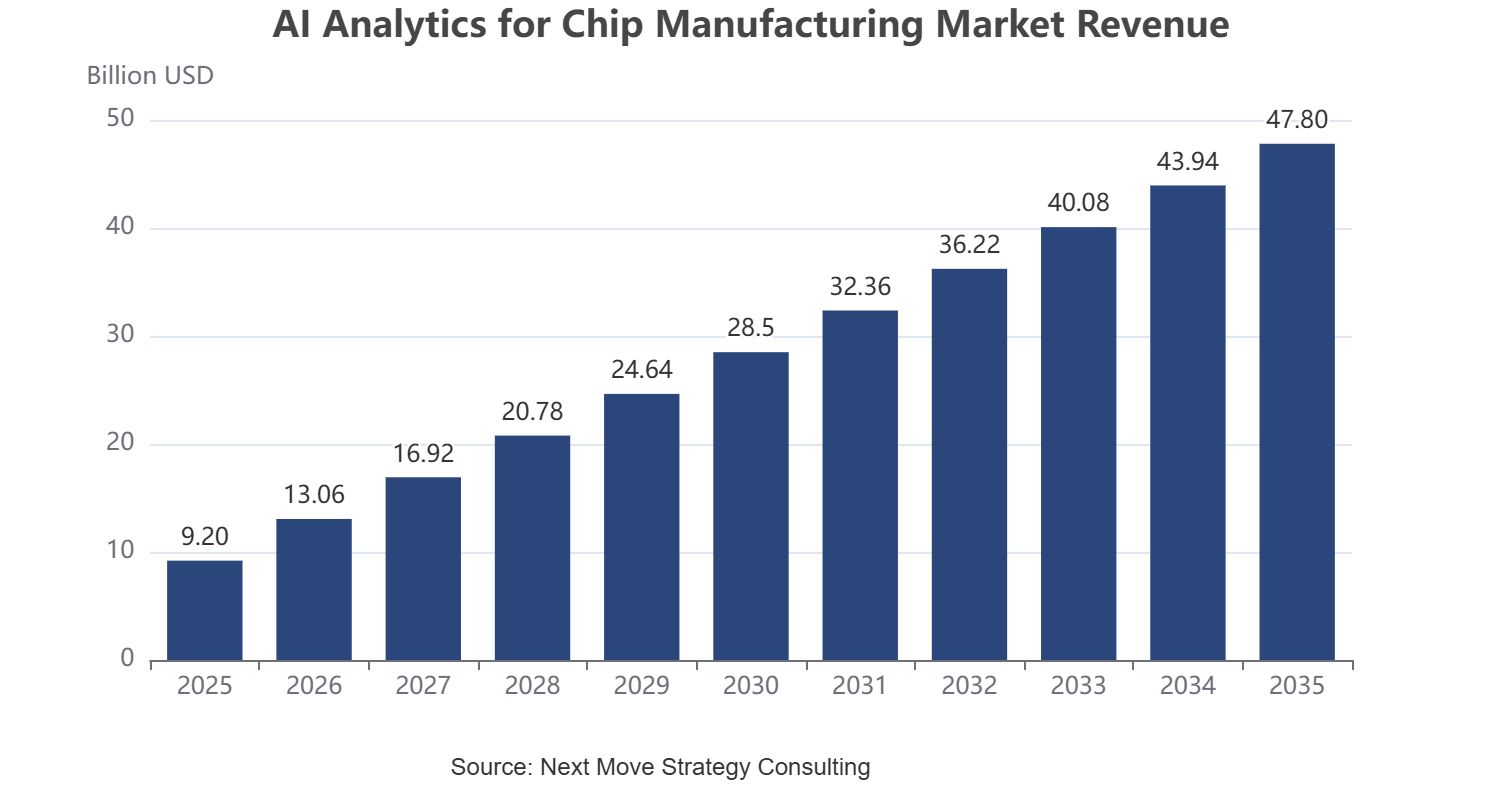
The global AI Analytics for Chip Manufacturing Market size was valued at USD 9.20 Billion in 2025 and is estimated at USD 10.80 Billion in 2026, forecast to reach USD 47.80 Billion by 2035, expanding at a 17.95% CAGR between 2026 and 2035. Asia-Pacific leads with approximately 52% share, while Software dominates all other offerings with approximately 68% share.
We observed that adoption is broadening across every segmentation axis, with expanding yield analytics deployment and rising cloud-based fab intelligence platforms driving the dominant structural shifts through 2035.
|
Parameters |
Details |
|
Market Size in 2025 |
USD 9.20 Billion |
|
Market Size in 2026 |
USD 10.80 Billion |
|
Revenue Forecast in 2035 |
USD 47.80 Billion |
|
Growth Rate |
CAGR of 17.95% from 2026 to 2035 |
|
Analysis Period |
2025–2035 |
|
Base Year Considered |
2025 |
|
Forecast Period |
2026–2035 |
|
Market Size Estimation |
Revenue (USD Billion) |
|
Companies Profiled |
20 |
|
Countries Covered |
33 |
|
Market Share |
Available for Top 10 Companies |
Market Opportunity: The AI analytics for chip manufacturing market is expected to create an absolute dollar opportunity of USD 37.00 billion between 2026 and 2035, presenting significant investment potential across yield optimization, predictive maintenance, and defect detection value chains.
According to Next Move Strategy Consulting analysis, fabs are increasingly consolidating disparate process-control data streams into unified AI analytics platforms to accelerate yield ramp cycles, a shift that favors integrated software providers over point-solution vendors as advanced-node production complexity intensifies through 2035.
What Does the AI Analytics for Chip Manufacturing Market Encompass?
The AI analytics for chip manufacturing market encompasses software platforms and services that apply machine learning and statistical analytics to semiconductor fabrication, assembly, and test data to improve yield, quality, and equipment reliability. Our assessment indicates that the scope spans yield optimization, predictive maintenance, defect detection, process control, and production planning applications deployed across integrated device manufacturers, foundries, outsourced assembly and test providers, and fabless companies through cloud, on-premise, and hybrid architectures.
Regulatory frameworks such as export-control statutes governing semiconductor manufacturing equipment and data-localization requirements in strategic fabrication hubs shape platform deployment architecture, while rising integration with manufacturing execution system infrastructure is reshaping process-data workflows. We observed that technology adoption is shifting toward generative and predictive AI models trained on high-dimensional fab sensor data, a structural change that is redefining analytics platform architecture across the AI analytics for chip manufacturing market.
|
Key Takeaways |
|
By Offering: Software held the largest share of approximately 68% (USD 6.26 Billion) in 2025; Services is the fastest-growing sub-segment at 19.89% CAGR from 2026–2035. |
|
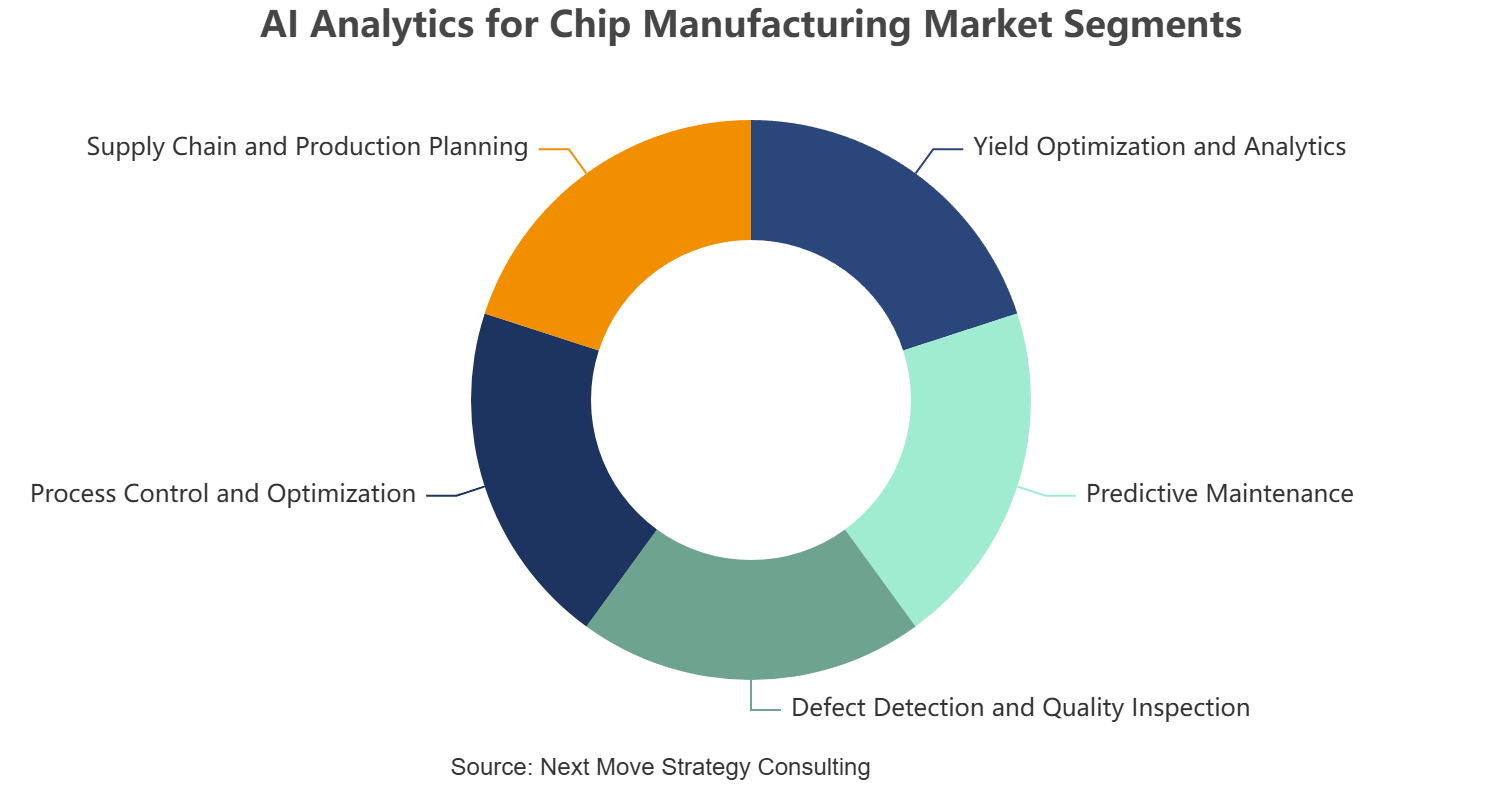
By Application: Yield Optimization and Analytics held the largest share of approximately 30% (USD 2.76 Billion) in 2025; Supply Chain and Production Planning is the fastest-growing sub-segment at 19.53% CAGR from 2026–2035. |
|
By Deployment Mode: Cloud held the largest share of approximately 46% (USD 4.23 Billion) in 2025; Hybrid is the fastest-growing sub-segment at 21.31% CAGR from 2026–2035. |
|
By End User: Integrated Device Manufacturers held the largest share of approximately 42% (USD 3.86 Billion) in 2025; Fabless Companies is the fastest-growing sub-segment at 19.23% CAGR from 2026–2035. |
|
Dominant Region: Asia-Pacific dominated with approximately 52% revenue share (USD 4.78 Billion) in 2025. |
|
Fastest-Growing Region: Middle East and Africa is expected to register the highest CAGR of 21.80% during 2026–2035. |
|
Dominant Country: Taiwan led with approximately USD 1.44 Billion in 2025. |
|
Fastest-Growing Country: Vietnam is the fastest-growing country at approximately 28.21% CAGR from 2026–2035. |
Key Emerging Trends
Based on research conducted by Next Move Strategy Consulting, we found that four structural trends are reshaping platform architecture, adoption, and stakeholder engagement across the AI analytics for chip manufacturing market.
How Are Generative AI Models Transforming Yield Root-Cause Analysis?
Generative AI models trained on historical process and defect data are replacing manual root-cause investigation to accelerate yield excursion resolution. We observed that KLA Corporation's disclosed analytics platform enhancements, referenced in its official investor communications, target fabs seeking faster excursion diagnosis through generative AI pattern recognition. Process engineers are adopting these tools to reduce diagnostic cycle time, while smaller analytics vendors face pressure to integrate comparable generative capability to remain competitive.
Why Is Cloud-Based Fab Analytics Gaining Adoption?
Cloud-based fab analytics deployment is gaining adoption as manufacturers seek scalable compute for training high-dimensional yield and defect models across multiple fabrication sites. Our findings suggest that multi-fab operators increasingly favor cloud architectures that centralize cross-site analytics benchmarking. This trend is positioning cloud-native analytics providers as a differentiated, higher-scalability category within the broader segmentation structure.
How Is Computer Vision Reshaping Defect Detection Capability?
Advanced computer vision models are reshaping wafer and package-level defect detection accuracy beyond traditional rule-based inspection systems. We observed that this trend is accelerating adoption of edge computer vision inspection systems at the equipment level, while legacy inspection vendors face pressure to integrate deep-learning detection models to match new-entrant accuracy benchmarks.
What Role Does Advanced Packaging Play in Analytics Platform Expansion?
Growth in heterogeneous integration and advanced chip packaging complexity is expanding demand for analytics platforms capable of monitoring multi-die assembly and test processes. Our analysis shows that Onto Innovation Inc.'s ongoing platform disclosures highlight expanded packaging-level inspection analytics aimed at supporting advanced-node assembly yield. This direction exemplifies how packaging complexity is becoming a driver of analytics platform capability expansion.
Ecosystem Analysis of the AI Analytics for Chip Manufacturing Industry
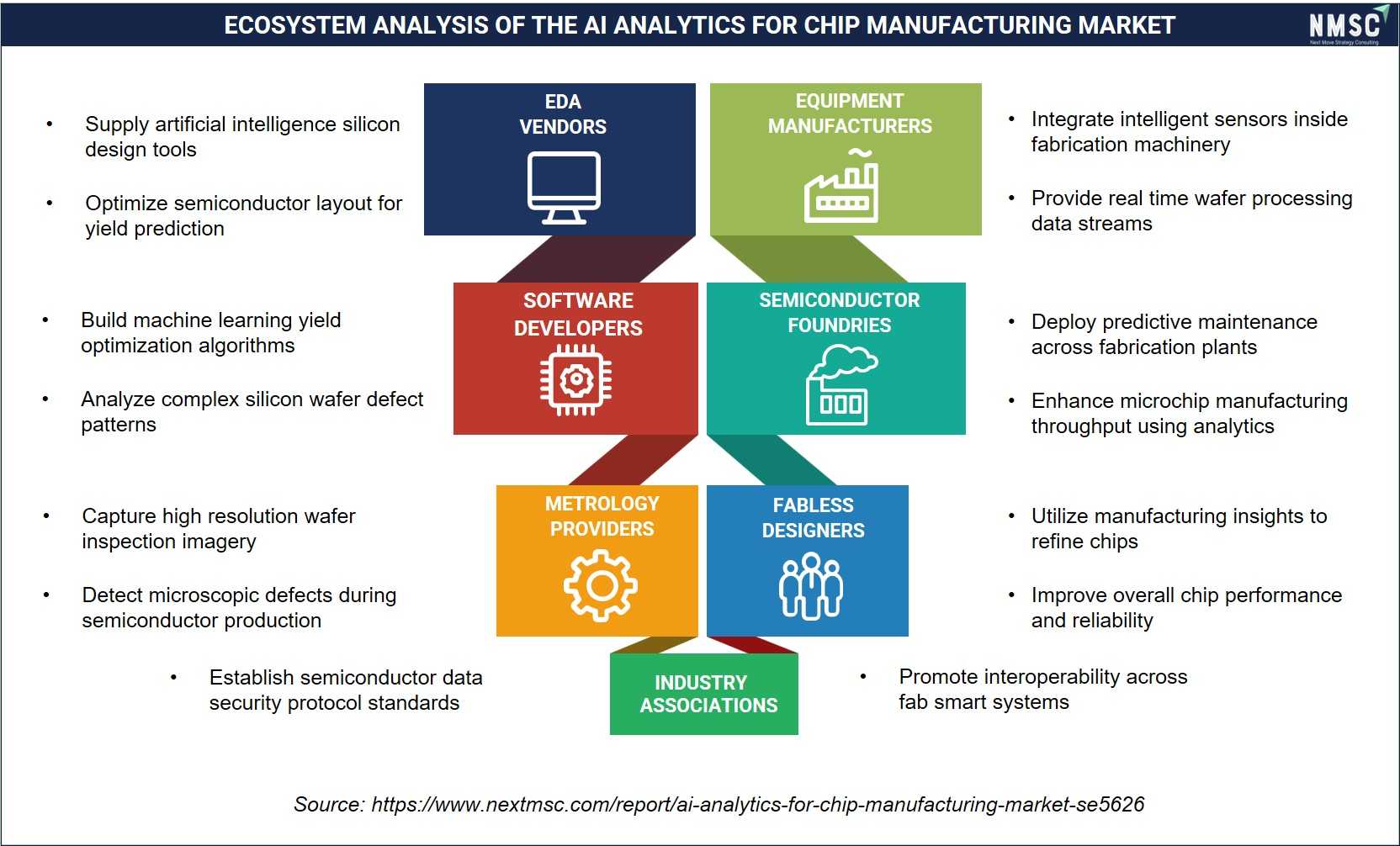
NMSC's analysis indicates that the AI Analytics for Chip Manufacturing Market functions within an interconnected ecosystem uniting EDA vendors, equipment manufacturers, software developers, and foundries. Furthermore, metrology providers capture high-resolution imagery to detect microscopic wafer defects, while fabless designers leverage manufacturing insights to refine chip layouts. Ultimately, industry associations establish robust data security standards and promote interoperability across smart fab systems to optimize yield prediction and operational throughput.
Growth Drivers and Restraints
Growth Catalyst and Risk Assessment Matrix
|
Factors |
Type |
(+/-) % Impact on CAGR |
Geographic Relevance |
Impact Timeline |
|
Rising advanced-node production complexity and yield pressure |
Driver |
+4.2% |
Asia-Pacific, North America |
2026–2035 |
|
Expanding global fab capacity investment and new facility construction |
Driver |
+3.6% |
Asia-Pacific, North America |
2026–2035 |
|
Growing adoption of predictive maintenance for capital equipment |
Driver |
+2.5% |
Global |
2026–2035 |
|
Rising demand for generative and predictive AI in process control |
Driver |
+2.0% |
North America, Asia-Pacific |
2026–2032 |
|
Government semiconductor manufacturing incentive programs |
Driver |
+1.5% |
North America, Asia-Pacific, Europe |
2026–2032 |
|
Increasing heterogeneous integration and advanced packaging complexity |
Driver |
+1.2% |
Asia-Pacific |
2026–2035 |
|
Data-security and export-control constraints on fab data sharing |
Restraint |
-2.0% |
Asia-Pacific, North America |
2026–2035 |
|
High integration cost for legacy fab infrastructure |
Restraint |
-1.3% |
Global |
2026–2032 |
|
Shortage of skilled AI and semiconductor process engineering talent |
Restraint |
-0.9% |
Global |
2026–2035 |
What Is the Primary Growth Driver of the AI Analytics for Chip Manufacturing Market?
Rising advanced-node production complexity and yield pressure is the primary driver of the market. The U.S. National Institute of Standards and Technology continues to document increasing process-control complexity at sub-5-nanometer nodes, reinforcing demand for AI-driven yield analytics. We observed that this technical complexity, combined with tightening capacity utilization targets, continues to anchor baseline consumption of analytics platforms across leading-edge fabrication facilities.
How Is Fab Capacity Investment Driving Market Growth?
Expanding global fab capacity investment and new facility construction is accelerating bulk analytics platform procurement. Government-backed semiconductor manufacturing incentive programs, documented by national industry ministries, are pushing new fab construction toward AI-integrated process-control architecture from initial commissioning. Our assessment indicates that this institutional investment, combined with rising capital equipment deployment, is compressing procurement cycles for analytics providers across Asia-Pacific and North America.
What Is Restraining AI Analytics for Chip Manufacturing Market Expansion?
Data-security and export-control constraints on fab data sharing restrain platform expansion across strategically sensitive manufacturing regions. The U.S. Bureau of Industry and Security maintains export-control regulations governing semiconductor manufacturing technology data flows that increase compliance complexity for analytics vendors. We found that smaller analytics providers face particular exposure, as limited compliance infrastructure reduces their ability to navigate cross-border data-transfer restrictions compared with larger, established platform vendors.
Segmentation Analysis
Segment Sizing: By Offering
|
Segment |
2025 (USD) |
2035 (USD) |
CAGR% (2026–2035) |
|
Software |
USD 6.26 Billion |
USD 30.11 Billion |
16.97% |
|
Services |
USD 2.94 Billion |
USD 17.69 Billion |
19.89% |
|
Total |
USD 9.20 Billion |
USD 47.80 Billion |
17.95% |
Which Offering Dominates the AI Analytics for Chip Manufacturing Market?
Software led the market with USD 6.26 Billion in 2025, supported by widespread deployment of yield analytics, defect detection, and process-control platforms across fabrication sites. We observed that Services is the fastest-growing offering, expanding at 19.89% CAGR from 2026 to 2035, as fabs increasingly require implementation, model tuning, and integration support to operationalize complex analytics platforms.
Segment Sizing: By Application
|
Segment |
2025 (USD) |
2035 (USD) |
CAGR% (2026–2035) |
|
Yield Optimization and Analytics |
USD 2.76 Billion |
USD 13.86 Billion |
17.53% |
|
Predictive Maintenance |
USD 2.21 Billion |
USD 10.04 Billion |
16.23% |
|
Defect Detection and Quality Inspection |
USD 2.02 Billion |
USD 11.47 Billion |
19.12% |
|
Process Control and Optimization |
USD 1.47 Billion |
USD 8.13 Billion |
18.77% |
|
Supply Chain and Production Planning |
USD 0.74 Billion |
USD 4.30 Billion |
19.53% |
|
Total |
USD 9.20 Billion |
USD 47.80 Billion |
17.95% |
Which Application Leads AI Analytics for Chip Manufacturing Market Demand?
Yield Optimization and Analytics remained the leading application, valued at USD 2.76 Billion in 2025 due to its direct link to fab profitability and capacity utilization. Our findings suggest that Supply Chain and Production Planning is the fastest-growing application, registering 19.53% CAGR from 2026 to 2035, as fabs integrate analytics into broader production scheduling and materials planning workflows.
Segment Sizing: By Deployment Mode
|
Segment |
2025 (USD) |
2035 (USD) |
CAGR% (2026–2035) |
|
Cloud |
USD 4.23 Billion |
USD 24.86 Billion |
19.59% |
|
On-Premise |
USD 3.68 Billion |
USD 14.34 Billion |
14.26% |
|
Hybrid |
USD 1.29 Billion |
USD 8.60 Billion |
21.31% |
|
Total |
USD 9.20 Billion |
USD 47.80 Billion |
17.95% |
Which Deployment Mode Is Growing Fastest in the AI Analytics for Chip Manufacturing Market?
Cloud remained the dominant deployment mode, reaching USD 4.23 Billion in 2025 due to scalable compute access for training complex analytics models. Based on research conducted by Next Move Strategy Consulting, we found that Hybrid is the fastest-growing deployment mode, expanding at 21.31% CAGR from 2026 to 2035, as fabs balance data-sovereignty requirements with cloud-based model training capability.
Segment Sizing: By End User
|
Segment |
2025 (USD) |
2035 (USD) |
CAGR% (2026–2035) |
|
Integrated Device Manufacturers |
USD 3.86 Billion |
USD 18.16 Billion |
16.67% |
|
Foundries |
USD 3.13 Billion |
USD 17.21 Billion |
18.72% |
|
Outsourced Semiconductor Assembly and Test Providers |
USD 1.29 Billion |
USD 7.17 Billion |
18.88% |
|
Fabless Companies |
USD 0.92 Billion |
USD 5.26 Billion |
19.23% |
|
Total |
USD 9.20 Billion |
USD 47.80 Billion |
17.95% |
Which End User Segment Anchors AI Analytics for Chip Manufacturing Market Revenue?
Integrated Device Manufacturers accounted for the largest end-user share, valued at USD 3.86 Billion in 2025, reflecting extensive in-house fabrication capacity requiring continuous analytics support. Our analysis shows that Fabless Companies is growing fastest at 19.23% CAGR from 2026 to 2035, as design-stage analytics integration with foundry partners expands.
Growth Opportunities
We identified three forward-looking whitespace opportunities that stakeholders across the AI analytics for chip manufacturing market can pursue through 2035.
How Can Cross-Fab Benchmarking Platforms Unlock Multi-Site Value?
Cross-fab benchmarking platforms that compare yield and process performance across multiple manufacturing sites offer a mechanism to accelerate best-practice replication for multi-fab operators. This mechanism benefits cloud-native analytics providers positioned to serve integrated device manufacturers operating geographically distributed fabrication networks.
How Can Advanced Packaging Analytics Expand Assembly Yield?
Extending analytics platforms into heterogeneous integration and multi-die packaging processes offers a mechanism to capture yield-improvement opportunities beyond front-end wafer fabrication. This mechanism benefits outsourced assembly and test providers positioned to differentiate through packaging-specific analytics capability.
How Can Predictive Maintenance Expand Equipment Uptime Revenue?
Expanding predictive maintenance coverage to legacy capital equipment offers a mechanism to capture retrofit analytics revenue beyond new equipment deployments. This mechanism benefits analytics vendors with equipment-agnostic sensor integration capability positioned to serve fabs operating mixed-generation tool fleets.
Regional Outlook
Geographic Performance Snapshot
|
Region |
2025 (USD) |
2035 (USD) |
CAGR% |
Key Driver |
|
Asia-Pacific |
USD 4.78 Billion |
USD 26.29 Billion |
18.71% |
Fab capacity expansion investment |
|
North America |
USD 2.58 Billion |
USD 11.95 Billion |
16.50% |
Advanced-node yield pressure |
|
Europe |
USD 1.29 Billion |
USD 6.21 Billion |
17.00% |
Government semiconductor incentive programs |
|
Middle East and Africa |
USD 0.28 Billion |
USD 1.91 Billion |
21.80% |
Chip design and R&D hub investment |
|
Latin America |
USD 0.28 Billion |
USD 1.43 Billion |
17.97% |
Emerging assembly and test capacity |
|
Total |
USD 9.20 Billion |
USD 47.80 Billion |
17.95% |
— |
Asia-Pacific AI Analytics for Chip Manufacturing Market
Asia-Pacific's AI analytics for chip manufacturing market benefits from concentrated advanced-node fabrication capacity and sustained fab construction investment across Taiwan, South Korea, and China
We observed that regulatory oversight from national industry ministries supports semiconductor manufacturing incentive programs that favor AI-integrated new fab construction. Technology adoption is advancing through cloud and hybrid analytics deployment, while the region's strategic outlook favors continued expansion as capacity investment accelerates.
North America AI Analytics for Chip Manufacturing Market
North America's AI analytics for chip manufacturing market reflects strong advanced-node yield pressure and expanding domestic fab capacity investment under national semiconductor incentive programs. Our assessment indicates that regulatory support from federal manufacturing incentive statutes is accelerating AI-integrated fab construction. Technology adoption in generative AI-based root-cause analysis is advancing rapidly, and the region's strategic outlook favors continued leadership in advanced analytics platform innovation.
Europe AI Analytics for Chip Manufacturing Market
Europe's AI analytics for chip manufacturing market reflects steady growth supported by government semiconductor manufacturing incentive programs under regional industrial policy frameworks. We found that regulatory emphasis on domestic semiconductor capacity expansion is shaping analytics platform procurement priorities across the region. Technology adoption in process-control analytics is steady, and the region's strategic outlook favors continued growth anchored by expanding lithography and equipment ecosystem investment.
Middle East and Africa AI Analytics for Chip Manufacturing Market
The Middle East and Africa AI analytics for chip manufacturing market reflects growing chip design and research investment concentrated in established technology hubs. Our analysis shows that government-backed technology diversification programs are supporting analytics platform adoption among design-focused semiconductor operations. Technology adoption remains selective given limited regional fabrication capacity, and the region's strategic outlook favors continued growth concentrated in design-stage analytics applications.
Latin America AI Analytics for Chip Manufacturing Market
Latin America's AI analytics for chip manufacturing market reflects emerging assembly and test capacity investment alongside gradually expanding electronics manufacturing activity in Brazil and Argentina. We observed that organized analytics platform adoption remains comparatively lower than in developed manufacturing regions, supporting continued reliance on global platform vendors. Technology adoption in analytics platforms is gradual, and the region's strategic outlook favors steady growth anchored by Brazil's expanding electronics assembly sector.
U.S. AI Analytics for Chip Manufacturing Market
Based on our estimates, the U.S. AI analytics for chip manufacturing market was valued at approximately USD 2.11 Billion in 2025 and is projected to reach USD 9.56 Billion by 2035, expanding at a 16.18% CAGR from 2026 to 2035. Demand is anchored by extensive advanced-node fab investment and strong federal semiconductor manufacturing incentive support, with technology adoption led by generative AI-based analytics platforms amid intense competitive activity among national and global analytics vendors.
Canada AI Analytics for Chip Manufacturing Market
The market in Canada was valued at approximately USD 0.28 Billion in 2025 and is projected to reach USD 1.43 Billion by 2035, expanding at a 17.63% CAGR from 2026 to 2035. Growth is supported by expanding domestic semiconductor investment and rising demand for predictive maintenance analytics, with Innovation, Science and Economic Development Canada's industrial policy shaping investment incentives and moderate competitive intensity among regional providers.
UK AI Analytics for Chip Manufacturing Market
As per our estimate, the UK AI analytics for chip manufacturing market was valued at approximately USD 0.15 Billion in 2025 and is projected to reach USD 0.75 Billion by 2035, expanding at a 17.00% CAGR from 2026 to 2035. Demand structure favors chip design-stage analytics and compound semiconductor manufacturing support, supported by national semiconductor strategy initiatives, with steady technology penetration in process-control analytics platforms.
Germany AI Analytics for Chip Manufacturing Market
According to our analysis, the Germany AI analytics for chip manufacturing market was valued at approximately USD 0.31 Billion in 2025 and is projected to reach USD 1.43 Billion by 2035, expanding at a 16.45% CAGR from 2026 to 2035. Demand is driven by extensive automotive and industrial semiconductor fabrication capacity and strong government manufacturing incentive programs under national industrial policy, with technology adoption advancing through integrated process-control analytics and high competitive intensity among European and global providers.
France AI Analytics for Chip Manufacturing Market
Based on our estimates, the France AI analytics for chip manufacturing market was valued at approximately USD 0.18 Billion in 2025 and is projected to reach USD 0.87 Billion by 2035, expanding at a 17.00% CAGR from 2026 to 2035. Growth reflects steady semiconductor fabrication investment and expanding analytics platform adoption, with regulatory oversight from national industrial policy statutes shaping incentive eligibility, and moderate technology adoption in yield analytics channels.
China AI Analytics for Chip Manufacturing Market
The market in China was valued at approximately USD 1.05 Billion in 2025 and is projected to reach USD 6.31 Billion by 2035, expanding at a 19.86% CAGR from 2026 to 2035. Demand is driven by rapidly expanding domestic fab capacity investment and national semiconductor self-sufficiency initiatives, with technology adoption accelerating through domestically developed analytics platforms and high competitive intensity among domestic and international vendors.
India AI Analytics for Chip Manufacturing Market
As per our estimate, the India AI analytics for chip manufacturing market was valued at approximately USD 0.14 Billion in 2025 and is projected to reach USD 1.05 Billion by 2035, expanding at a 22.57% CAGR from 2026 to 2035. Growth is supported by emerging semiconductor fabrication investment and government-backed India Semiconductor Mission programs, with the Ministry of Electronics and Information Technology shaping incentive eligibility, and technology adoption gradually advancing through new fab commissioning.
Japan AI Analytics for Chip Manufacturing Market
According to our analysis, the Japan AI analytics for chip manufacturing market was valued at approximately USD 0.53 Billion in 2025 and is projected to reach USD 2.63 Billion by 2035, expanding at a 17.46% CAGR from 2026 to 2035. Demand structure favors advanced materials and equipment-integrated analytics supported by strong domestic semiconductor equipment ecosystem, with the Ministry of Economy, Trade and Industry overseeing manufacturing incentive programs, and moderate competitive intensity among established domestic vendors.
South Korea AI Analytics for Chip Manufacturing Market
Based on our estimates, the South Korea AI analytics for chip manufacturing market was valued at approximately USD 1.15 Billion in 2025 and is projected to reach USD 6.05 Billion by 2035, expanding at a 18.15% CAGR from 2026 to 2035. Growth is driven by extensive memory and logic fabrication capacity and government-backed K-Semiconductor Belt investment programs, with steady technology adoption in yield analytics and high competitive intensity among domestic and global providers.
Australia AI Analytics for Chip Manufacturing Market
The market in Australia was valued at approximately USD 0.05 Billion in 2025 and is projected to reach USD 0.26 Billion by 2035, expanding at a 18.71% CAGR from 2026 to 2035. Demand reflects emerging semiconductor design and specialty fabrication activity, with technology adoption gradually advancing through analytics platform pilots, and competitive intensity concentrated among a small group of specialized regional providers.
UAE AI Analytics for Chip Manufacturing Market
As per our estimate, the UAE AI analytics for chip manufacturing market was valued at approximately USD 0.04 Billion in 2025 and is projected to reach USD 0.33 Billion by 2035, expanding at a 22.63% CAGR from 2026 to 2035. Growth is anchored by expanding technology diversification investment and rising chip design activity, with technology adoption in analytics platforms advancing steadily, and competitive intensity concentrated among a small group of specialized regional operators.
Saudi Arabia AI Analytics for Chip Manufacturing Market
According to our analysis, the Saudi Arabia AI analytics for chip manufacturing market was valued at approximately USD 0.04 Billion in 2025 and is projected to reach USD 0.29 Billion by 2035, expanding at a 22.74% CAGR from 2026 to 2035. Demand is supported by national technology diversification initiatives under Vision 2030 industrial development programs, with government-backed technology investment driving early-stage analytics adoption, and moderate technology adoption reflecting nascent regional fabrication capacity.
South Africa AI Analytics for Chip Manufacturing Market
Based on our estimates, the South Africa AI analytics for chip manufacturing market was valued at approximately USD 0.02 Billion in 2025 and is projected to reach USD 0.13 Billion by 2035, expanding at a 21.80% CAGR from 2026 to 2035. Growth reflects steady electronics manufacturing demand and gradually expanding analytics platform interest, with national industrial development authorities overseeing technology investment incentives, and moderate competitive intensity among regional providers.
Brazil AI Analytics for Chip Manufacturing Market
The market in Brazil was valued at approximately USD 0.12 Billion in 2025 and is projected to reach USD 0.60 Billion by 2035, expanding at a 17.36% CAGR from 2026 to 2035. Demand is driven by expanding electronics assembly capacity and rising interest in predictive maintenance analytics, with national industrial development authorities overseeing manufacturing incentive programs, and technology adoption gradually advancing through organized platform expansion.
Argentina AI Analytics for Chip Manufacturing Market
As per our estimate, the Argentina AI analytics for chip manufacturing market was valued at approximately USD 0.05 Billion in 2025 and is projected to reach USD 0.27 Billion by 2035, expanding at a 17.97% CAGR from 2026 to 2035. Growth reflects steady electronics manufacturing demand and gradually expanding analytics platform activity, with moderate regulatory oversight from national industrial authorities and gradual technology adoption in analytics deployment channels.
Strategic Framework of the AI Analytics for Chip Manufacturing Industry
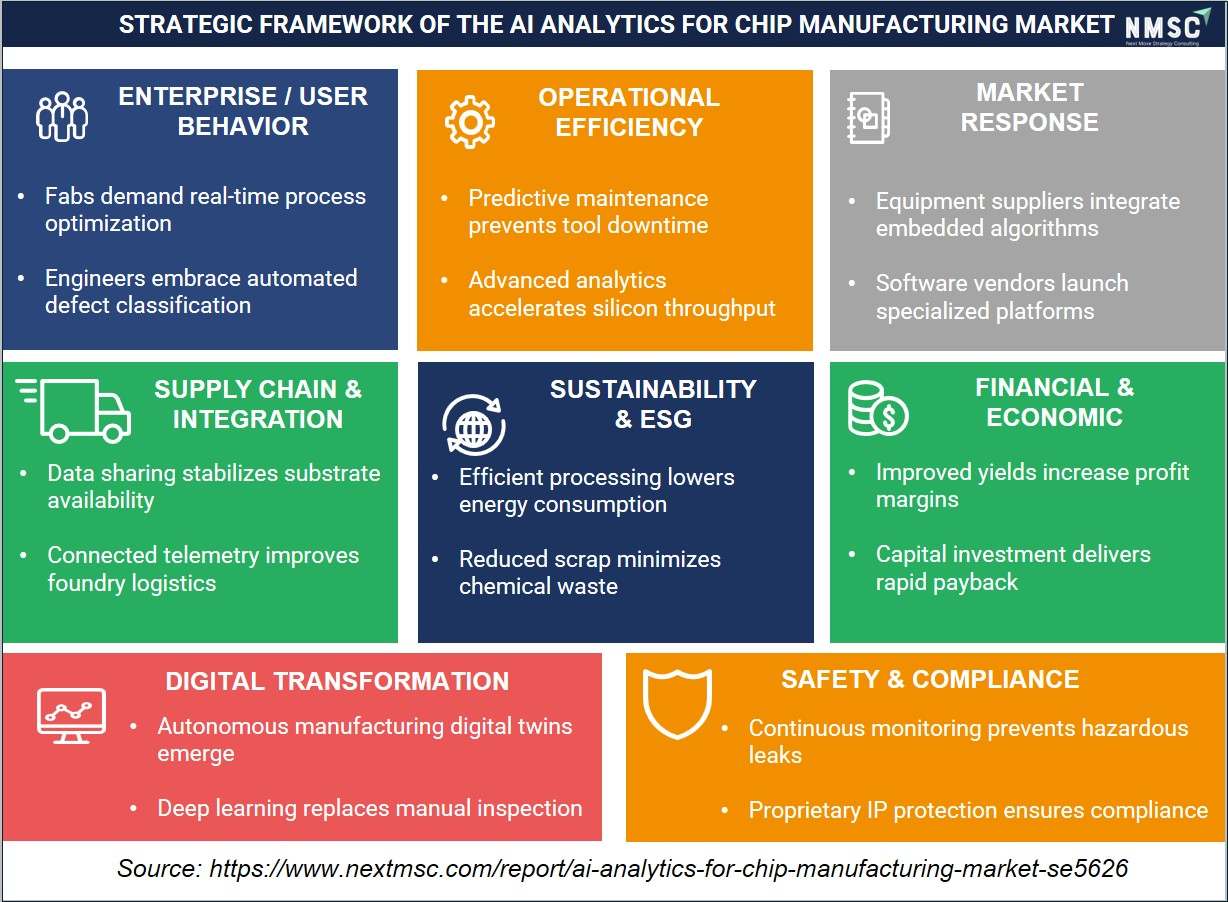
Based on research conducted by NMSC, we found that real-time process optimization and automated defect classification drive growth in the AI Analytics for Chip Manufacturing Market. Predictive maintenance prevents tool downtime, while deep learning digital twins replace manual inspection. Furthermore, reduced scrap lowers chemical waste and energy usage to support ESG targets. Concurrently, improved silicon yields maximize profit margins, whereas continuous monitoring and proprietary IP protection ensure regulatory compliance across foundries.
Competitive Landscape
We observed that the AI analytics for chip manufacturing market Industry remains moderately concentrated, with established process-control and equipment vendors competing alongside cloud-native analytics and AI platform providers.
Competitive Landscape Key Takeaways
|
Dimension |
Details |
|
Market Structure |
Moderately concentrated, with the top 10 companies accounting for a substantial share of global revenue |
|
Innovation Focus |
Generative AI root-cause analysis, computer vision defect detection, and predictive maintenance modeling |
|
M&A Activity |
Active acquisition of AI analytics startups by established equipment and process-control vendors |
How Do Companies Compete in the AI Analytics for Chip Manufacturing Market?
Companies compete primarily on model accuracy, fab integration depth, and breadth of process-data access across equipment and process-control systems. We found that established equipment vendors leverage proprietary sensor and tool-level data access to sustain integration advantages, while cloud and AI-native entrants compete on advanced modeling capability and cross-platform data interoperability within specific analytics applications.
Which Competitive Archetypes Dominate the AI Analytics for Chip Manufacturing Market?
Two archetypes dominate the AI analytics for chip manufacturing market: established semiconductor equipment and process-control vendors with deep fab integration, and cloud and AI-native platform providers offering advanced modeling capability. Our findings suggest that equipment vendors sustain scale advantages through proprietary tool-level data access, while AI-native providers differentiate through faster model iteration and cross-vendor data integration.
What Innovation and Differentiation Strategies Define the Industry?
Innovation strategy centers on generative AI-based root-cause analysis, computer vision defect detection, and predictive maintenance modeling for capital equipment. Our analysis shows that leading vendors are investing in domain-specific foundation models trained on proprietary fab data to differentiate platform accuracy, while pricing strategies increasingly bundle software subscriptions with implementation and model-tuning services.
What M&A and Geographic Expansion Activity Is Shaping the Market?
M&A activity remains active, concentrated on acquisitions of specialized AI analytics startups by established equipment and process-control vendors seeking to expand software capability. We observed that geographic expansion is prioritizing Asia-Pacific fab construction corridors, where established vendors are establishing regional support infrastructure to accelerate deployment alongside new fabrication capacity.
Key Market Players
Our assessment indicates that the following companies represent the leading verified participants in the global AI analytics for chip manufacturing market based on platform scale, fab integration depth, and confirmed operating presence.
-
Applied Materials, Inc.
-
KLA Corporation
-
Lam Research Corporation
-
ASML Holding N.V.
-
Siemens AG
-
Synopsys, Inc.
-
Cadence Design Systems, Inc.
-
Microsoft Corporation
-
Alphabet Inc.
-
Amazon.com, Inc.
-
C3.ai, Inc.
-
PDF Solutions, Inc.
-
Onto Innovation Inc.
-
Advantest Corporation
-
Teradyne, Inc.
-
Hitachi, Ltd.
-
Yokogawa Electric Corporation
-
Rockwell Automation, Inc.
Latest Developments
|
Date |
Event |
|
June 2026 |
Applied Materials introduced a suite of new chipmaking systems for building advanced 3D chip architectures powering next-generation AI. The materials engineering portfolio spans DRAM, advanced packaging, and process control systems with eBeam and metrology tools to help customers bring AI chips to high-volume production faster and at higher yields. |
|
May 2026 |
Synopsys announced an expanded collaboration with Samsung Foundry featuring a production-ready portfolio of AI-powered Electronic Design Automation tools, certified interface IP, and silicon-based test capabilities. The solution fuses AI-driven automation and multiphysics intelligence across design and manufacturing flows to address chip engineering complexity and boost yield. |
|
October 2025 |
PDF Solutions announced a strategic collaboration with Lavorro Inc. to integrate PDF Solutions' Exensio AI-ready manufacturing data infrastructure with Lavorro's Generative and Agentic AI platform. The combined solution provides fab personnel with conversational, context-aware assistance and real-time process data to accelerate yield-enhancing decision-making. |
|
June 2025 |
Siemens Digital Industries Software launched two new Electronic Design Automation solutions, Innovator3D IC suite and Calibre 3DStress software. The platform uses stress-aware multiphysics analysis and thermo-mechanical simulation to evaluate chip-package interactions, reducing risk and improving production yield for complex 2.5D and 3D integrated circuit designs. |
Expert Insights
 “Our collaboration with Synopsys on generative AI and digital twins is central to the future design, automation and manufacturing of chips.”
— Jensen Huang, Founder & CEO, NVIDIA
Statement made during the announcement of the NVIDIA–Synopsys collaboration, highlighting the growing role of generative AI and digital twin technologies in advancing semiconductor design, automation, and chip manufacturing.
Market Interpretation
The statement highlights the increasing integration of AI-driven analytics and digital twin technologies across semiconductor manufacturing to enhance chip design, automate engineering workflows, and optimize production processes. As semiconductor fabrication becomes increasingly data-intensive and technologically complex, manufacturers are adopting AI-powered analytics to improve process control, accelerate innovation, and enhance manufacturing efficiency, driving the growth of the AI analytics for chip manufacturing market.
Investment Opportunities
Where Are Capital Inflows Concentrated in the AI Analytics for Chip Manufacturing Market?
Capital inflows are concentrating in generative AI and foundation-model development trained on proprietary fab process data. We observed that private and strategic investment is favoring platforms with proven multi-fab deployment scale, positioning them to capture expanding capacity investment across Asia-Pacific and North America.
How Is Infrastructure Investment Supporting Market Expansion?
Infrastructure investment is expanding cloud compute capacity and secure data-pipeline architecture to support training of increasingly complex yield and defect models. Our assessment indicates that vendors investing in scalable, compliant cloud infrastructure are better positioned to meet rising demand from multi-site fab operators.
What ESG Considerations Are Shaping AI Analytics for Chip Manufacturing Investment?
Environmental, Social, and Governance considerations are increasingly shaping investment decisions, with analytics vendors prioritizing energy-efficient model training and reduced fab resource waste through improved yield and equipment uptime. We found that ESG-aligned analytics providers are gaining preferential access to fab investment programs that increasingly specify sustainability-linked procurement criteria.
Key Benefits for Stakeholders
How Does This Report Benefit Industry Leaders and Analytics Vendors?
Industry leaders and analytics vendors gain access to validated segmentation, competitive benchmarking, and regional demand forecasts that support platform and geographic expansion decisions. Our analysis shows that this data enables vendors to prioritize investment toward the fastest-growing segments and geographies identified through 2035.
How Does This Report Benefit Investors and Financial Analysts?
Investors and financial analysts benefit from independently derived market sizing, CAGR methodology, and company-level competitive positioning that support capital-allocation and due-diligence decisions. We observed that the report's regional and segment-level forecasts help quantify addressable opportunity across yield, maintenance, and defect-detection demand channels.
How Does This Report Benefit Fabs and Equipment Vendors?
Fabs and equipment vendors gain insight into platform adoption patterns, enabling more informed procurement and technology-partnership planning. Our findings suggest that this analysis helps fabs align analytics investment strategy with shifting yield, maintenance, and defect-detection priorities across advanced-node production.
Key Market Segments
By Offering
-
Software
-
Services
By Application
-
Yield Optimization and Analytics
-
Predictive Maintenance
-
Defect Detection and Quality Inspection
-
Process Control and Optimization
-
Supply Chain and Production Planning
By Deployment Mode
-
Cloud
-
On-Premise
-
Hybrid
By End User
-
Integrated Device Manufacturers
-
Foundries
-
Outsourced Semiconductor Assembly and Test Providers
-
Fabless Companies
By Region
-
North America: U.S., Canada, Mexico
-
Europe: UK, Germany, France, Italy, Spain, Sweden, Denmark, Finland, Netherlands, Rest of Europe
-
Asia-Pacific: China, India, Japan, South Korea, Taiwan, Indonesia, Vietnam, Australia,Philippines, Malaysia, Rest of APAC
-
Middle East and Africa: Saudi Arabia, UAE, Egypt, Israel, Turkey, Nigeria, South Africa, Rest of MEA
-
Latin America: Brazil, Argentina, Chile, Colombia, Rest of LATAM
Conclusion and Recommendations
What Is the Long-Term Outlook for the AI Analytics for Chip Manufacturing Market?
The long-term outlook remains highly favorable, with the market projected to grow from USD 10.80 Billion in 2026 to USD 47.80 Billion by 2035 at a 17.95% CAGR. We observed that sustained advanced-node complexity, expanding global fab capacity investment, and rising generative AI adoption collectively support durable growth across both established and emerging manufacturing regions through the forecast period.
What Strategic Positioning Should Companies Pursue?
Companies should prioritize generative AI model development and deepen fab integration capability while expanding cloud and hybrid deployment options. Our assessment indicates that vendors combining strong tool-level data access with advanced modeling capability are best positioned to capture share across both integrated device manufacturer and foundry demand segments.
How Attractive Is the AI Analytics for Chip Manufacturing Market for Investment?
The market presents strong investment attractiveness, anchored by high growth rates and expanding fab capacity investment across strategic manufacturing regions. We found that generative AI model development and cloud infrastructure represent the most capital-efficient investment avenues, given their direct link to platform differentiation and multi-fab scalability.
What Market Shifts and Key Risks Should Stakeholders Monitor?
Stakeholders should monitor export-control and data-security constraints, high legacy integration costs, and skilled talent shortages. Our findings suggest that vendors with diversified geographic deployment footprints are better insulated against regional regulatory and talent shocks that could otherwise disrupt platform expansion and client retention.
What Are the Key Growth Pathways Through 2035?
Key growth pathways include expanding generative AI-based root-cause analysis, deepening advanced-packaging analytics integration, and scaling predictive maintenance coverage across legacy equipment fleets. We observed that companies pursuing these pathways simultaneously are best positioned to capture the full breadth of demand across yield, maintenance, and defect-detection applications through 2035.
About the Author
 Saista Faiyaz
— Saista Faiyaz is Research Associate at Next Move Strategy Consulting, where she has covered consumer markets and healthcare technologies for 3 years. Her work includes primary interview review, secondary-source validation, market sizing, and structured analysis of company and industry data. She supports research by comparing evidence across sources, organizing findings into market narratives, and documenting assumptions used in analysis. Her scope includes cross-market benchmarking, and reports.
Saista Faiyaz
— Saista Faiyaz is Research Associate at Next Move Strategy Consulting, where she has covered consumer markets and healthcare technologies for 3 years. Her work includes primary interview review, secondary-source validation, market sizing, and structured analysis of company and industry data. She supports research by comparing evidence across sources, organizing findings into market narratives, and documenting assumptions used in analysis. Her scope includes cross-market benchmarking, and reports.
About the Reviewer
 Supradip Baul
— Supradip Baul is an accomplished business consultant and strategist with over a decade of rich experience in market intelligence, strategy, technology, and business transformation. His work has included rigorous qualitative and quantitative analysis across multiple industries, helping clients shape investment decisions and long-term roadmaps. Earlier in his career, he was associated with Gartner, where he contributed to industry-leading reports and market share analyses. He has worked with leading global companies and holds an MBA with a dual specialization in Marketing and Finance.
Supradip Baul
— Supradip Baul is an accomplished business consultant and strategist with over a decade of rich experience in market intelligence, strategy, technology, and business transformation. His work has included rigorous qualitative and quantitative analysis across multiple industries, helping clients shape investment decisions and long-term roadmaps. Earlier in his career, he was associated with Gartner, where he contributed to industry-leading reports and market share analyses. He has worked with leading global companies and holds an MBA with a dual specialization in Marketing and Finance.
At Next Move Strategy Consulting, we understand that insightful market research is the cornerstone of successful business decisions. That's why we employ a robust and multifaceted approach, combining various methodologies to deliver the most accurate and actionable data for our clients.

Research Landscape
We navigate the world of research with two primary approaches:
Qualitative Approach
Our qualitative research methodologies involve immersive techniques such as in-depth interviews, focus groups, and observational studies. By engaging directly with individuals and stakeholders, we uncover valuable insights that quantitative data alone may overlook.

Quantitative Research
In tandem with qualitative methodologies, NMSC leverages the power of Quantitative Research to provide a robust foundation of numerical insights. Through systematic data collection and analysis, we quantify patterns, preferences, and market trends, offering a comprehensive view of the business landscape.
Our quantitative research approach employs diverse tools, including surveys, experiments, and statistical modelling. These methodologies enable us to gather data from a large and representative sample, ensuring the statistical significance of our findings. By employing structured questionnaires and standardized data collection methods, we guarantee the reliability and validity of the information we present to our clients.
Quantitative research is particularly effective in measuring the prevalence of trends, assessing market size, and gauging the impact of various factors on consumer behavior. The numerical precision attained through this approach equips our clients with actionable insights, facilitating data-driven decision-making and strategy formulation.


Our Specialized Toolbox for Industry-Specific Market Research
We deploy a specialized arsenal of techniques tailored to meet your unique requirements. Here's a glimpse into our comprehensive toolbox:

Information Procurement
The stage entails acquiring market data or relevant information through various sources and methodologies.


Market Research Approach
We utilize both top-down and bottom-up approaches in market research analysis to achieve a comprehensive understanding of the market dynamics, leveraging the broad perspective of industry trends and macroeconomic factors alongside detailed insights from specific segments and individual companies.

Porters Five Forces Analysis
We conduct Porter's Five Forces analysis to evaluate the competitive landscape of an industry, providing us with insights into factors that affect profitability and strategic positioning.

SWOT Analysis

Forecasting
We utilize a forecasting model to predict future consumption by considering parameters like population, economics, regulations, market competition, drivers, constraints, technology, and pricing. We also employ statistical techniques such as multilinear regression, exponential smoothing, moving average, ARIMA, and Monte Carlo simulations for accurate predictions. In econometric forecasting, we analyzed short-term and long-term event impacts, attributing values based on regulatory frameworks, economic factors, and market events.





 Speak to Our Analyst