AI-Assisted SOC Market Global Industry Analysis and Forecast (2026–2035)

Rising analyst workload, agentic triage and security data lake adoption lift the sector from USD 5.85 Billion in 2025 to USD 38.40 Billion by 2035, a 19.7% CAGR across 2026 to 2035, with North America leading.

Download Free Sample PDF
Base Year (2025)
$5.85 Billion
Forecast (2035)
$38.40 Billion
CAGR (2026-2035)
19.7%
Top Region
North America

What Is the AI-Assisted SOC Market Size?
The global AI-Assisted SOC Market reached USD 5.85 Billion in 2025 and is estimated at USD 7.60 Billion in 2026. It is projected to reach USD 38.40 Billion by 2035, growing at a CAGR of 19.7% over the forecast period. North America leads with approximately 44% share in 2025, while AI-enabled SIEM and XDR is the dominant offering with approximately 44%.
Security teams face rising alert volumes and persistent cybersecurity skills shortages. As a result, some organizations are evaluating AI-assisted SOC platforms that automate alert triage, investigation, and response recommendations while retaining human oversight. Revenue is therefore shifting from conventional log management toward AI-enabled detection platforms and agent layers that sit on top of them.

AI-Assisted SOC Market Global Industry Analysis and Forecast (2026–2035) Revenue Forecast
Values in USD Billion

2025 $5.85 Billion
2025
2026 $7.60 Billion
2026
2027 $9.10 Billion
2027
2028 $10.89 Billion
2028
2029 $13.03 Billion
2029
2030 $15.60 Billion
2030
2031 $18.68 Billion
2031
2032 $22.36 Billion
2032
2033 $26.76 Billion
2033
2034 $32.03 Billion
2034
2035 $38.40 Billion
2035

Key Takeaways

By Offering: AI-enabled SIEM and XDR held the largest share, expanding from USD 2.60 Billion in 2025 to USD 12.40 Billion by 2035; AI SOC agents and platforms is the fastest growing at 27.8% CAGR from 2026–2035.

By Deployment Model: Cloud-native held the largest share, expanding from USD 3.40 Billion in 2025 to USD 26.80 Billion by 2035; Cloud-native is the fastest growing at 21.5% CAGR from 2026–2035.

By End User Industry: BFSI held the largest share, expanding from USD 1.55 Billion in 2025 to USD 9.20 Billion by 2035; Government and defense is the fastest growing at 22.0% CAGR from 2026–2035.

Dominant Region: North America dominated with approximately 44% revenue share in 2025, at USD 2.55 Billion, anchored by the concentration of platform vendors and large enterprise SOC programs.

Fastest-Growing Region: Asia-Pacific is expected to register the highest CAGR of 23.0% during 2026–2035, driven by digital banking, telecom and government modernization.

Dominant Country: The U.S. led the market with an estimated USD 2.20 Billion in 2025, supported by early enterprise adoption of agentic SOC platforms.

Fastest-Growing Country: India is projected to expand from USD 0.15 Billion in 2025 at a CAGR of 28.1% from 2026–2035, as talent scarcity pushes buyers toward automation.

The AI-Assisted SOC Market is projected to expand by approximately USD 30.80 billion between 2026 and 2035, increasing from USD 7.60 billion to USD 38.40 billion. AI SOC agents and cloud-native detection platforms represent potential investment areas, although their relative capital efficiency requires separate evaluation of costs, margins, and expected returns.

NMSC's analysis indicates that auditability and explainability are important competitive factors alongside detection accuracy, particularly in regulated sectors. Approval controls and decision logs can help buyers assess the reliability and accountability of AI-driven security decisions before permitting autonomous actions.

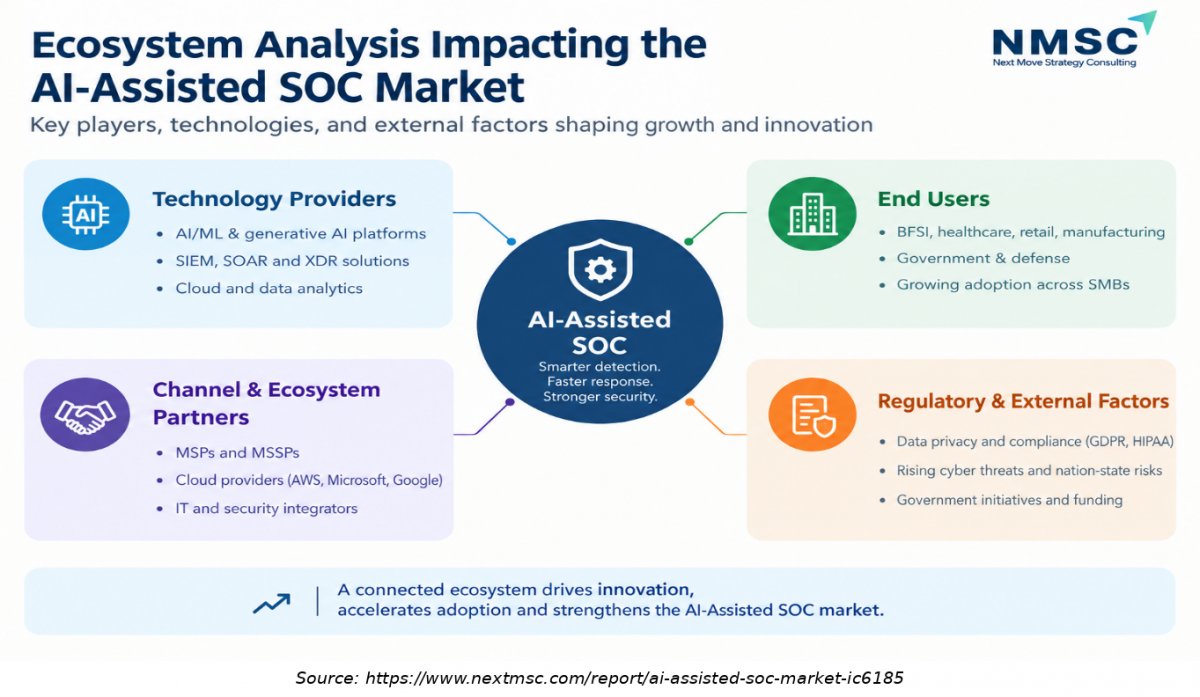
Ecosystem Analysis Impacting the AI-Assisted SOC Market

The infographic on Ecosystem Analysis Impacting the AI-Assisted SOC Market highlights the key factors shaping the market, including AI-driven threat detection, security automation, and real-time incident response. It illustrates how technology providers, cybersecurity teams, and emerging AI solutions work together to improve SOC efficiency, reduce manual workloads, and strengthen threat management. Overall, the ecosystem reflects the growing role of AI in building faster, smarter, and more adaptive security operations.

What Does the AI-Assisted SOC Market Encompass?

The AI-Assisted SOC market covers software and services in which machine learning and agentic AI perform triage, investigation, correlation and response work inside a security operations center. Offerings include AI SOC agents and platforms, AI-enabled SIEM and XDR, AI-enabled SOAR and automation, and AI-assisted managed SOC services. Our scope sits within the wider AI-based security operations category but counts revenue only where AI materially drives the alert workflow.

During our market evaluation, we noticed that the category is moving from copilots that summarize alerts toward agents that investigate them. Microsoft has delivered over a dozen Security Copilot agents since March 2025. Similarly, Palo Alto Networks expanded its Cortex AgentiX agents in February 2026, while Google Security Operations launched an integrated Triage and Investigation agent. Governance, human approval and FedRAMP authorization increasingly decide which vendors enterprises and agencies can adopt.

Market Drivers & Dynamics

Interactive Dataset
Analyst skills gap and alert overload driver +3.4% Global, strongest in North America and Europe 2026–2030
Agentic triage and investigation maturity driver +4.1% Global 2026–2032
SIEM consolidation and security data lake adoption driver +2.6% North America and Europe 2026–2031
AI-enabled attack volume and rising cybercrime losses driver +2.2% Global 2026–2035
FedRAMP style authorization of AI SOC tools driver +1.5% North America 2026–2029
Model accuracy, explainability and governance concerns restraint −2.3% Global 2026–2030
Data ingestion cost and integration complexity restraint −1.8% Global, higher in hybrid estates 2026–2032
Source: Next Move Strategy Consulting

Growth Drivers

What is the primary growth driver of the AI-Assisted SOC Market?

The primary driver is alert volume set against a constrained workforce. ISC2 reports that skills shortages have overtaken headcount as the top concern in its 2025 study of 16,029 respondents, and the FBI Internet Crime Complaint Center logged 1,008,597 complaints in 2025. Security leaders cannot hire to match that load, so they buy AI that triages and investigates at machine speed, which supports the 19.7% CAGR we project through 2035.

How is rising cybercrime driving AI-Assisted SOC Market growth?

FBI data shows reported losses of USD 20.877 billion in 2025, up 26% from 2024, while AI related complaints reached 22,364 with losses near USD 893 million. As attackers adopt AI, defenders face shorter windows between intrusion and impact, and AI-assisted detection and response becomes a budget priority. This pressure moves buyers beyond AI in cybersecurity pilots and into production SOC contracts.

Growth Inhibitors

What is restraining the AI-Assisted SOC Market?

Trust and cost restrain adoption. Major vendors such as Microsoft now require agents to document their decision logs, confirming that auditability is a critical prerequisite for enterprise confidence in autonomous verdicts. Our assessment indicates that data ingestion costs and integration work add further friction, particularly in hybrid estates. Combined, we estimate these two restraints trim the CAGR by about 4.1 percentage points (industry derived estimate), and they ease as accuracy evidence accumulates.

What Are the Growth Opportunities?

How can mid-market organizations gain from AI-assisted market SOC services?

Mid-market firms cannot staff a round the clock SOC, so providers that bundle agentic triage with human oversight can sell outcomes instead of tools. Managed services reach USD 7.80 Billion by 2035 in our forecast. Providers that build on platforms from Microsoft, Google and CrowdStrike can lower delivery cost per alert and win accounts that previously relied on part-time monitoring.

Where do operational technology environments create demand?

Manufacturing and energy operators are connecting plant networks to enterprise SOCs, which creates demand for AI that correlates plant alerts with IT telemetry. The segment grows from USD 1.00 Billion in 2026 to USD 5.20 Billion in 2035. Vendors that pair attack surface management context with agentic investigation can rank exposures that matter and cut noise for lean plant security teams.

How can data platforms monetize AI agents?

Security data platforms can attach agents, detections and pipeline tools to existing ingestion contracts. CrowdStrike expanded its agentic security workforce in late 2025, and Elastic positions agents on unified telemetry. This bundling lifts revenue per customer and supports the 27.8% CAGR we project for AI SOC agents and platforms through 2035.

Segmentation Analysis

2025 (USD Billion)
2035 (USD Billion)
AI SOC agents and platforms 2025: $1.05 Billion | 2035: $14.60 Billion
AI SOC agent
AI-enabled SIEM and XDR 2025: $2.60 Billion | 2035: $12.40 Billion
AI-enabled S
AI-enabled SOAR and automation 2025: $0.90 Billion | 2035: $3.60 Billion
AI-enabled S
AI-assisted managed SOC services 2025: $1.30 Billion | 2035: $7.80 Billion
AI-assisted
AI SOC agents and platforms $1.05 Billion $14.60 Billion 27.8%
AI-enabled SIEM and XDR $2.60 Billion $12.40 Billion 16.0%
AI-enabled SOAR and automation $0.90 Billion $3.60 Billion 14.7%
AI-assisted managed SOC services $1.30 Billion $7.80 Billion 18.4%

Which offering leads the AI-Assisted SOC Market?

AI-enabled SIEM and XDR led the offering segment with USD 2.60 Billion in 2025, accounting for approximately 44% market share. Leading platforms—including Microsoft Sentinel, Splunk, Google Security Operations, CrowdStrike, and SentinelOne—embed native AI capabilities into existing enterprise deployments. AI SOC agents and platforms are the fastest growing at 27.8% CAGR from 2026 to 2035 as agents move from preview to general availability, and managed services follow at 18.4%.

2025 (USD Billion)
2035 (USD Billion)
Category A
Category B
Category C
Category D
Segment Item 2025 (USD Billion) 2035 (USD Billion) CAGR
Category A $10.0 USD Billion $40.0 USD Billion 25.0%
Category B $17.1 USD Billion $51.1 USD Billion 11.0%
Category C $24.2 USD Billion $62.2 USD Billion 25.0%
Category D $31.3 USD Billion $73.3 USD Billion 11.0%

Segment-wise data is locked

Unlock complete segment-wise numbers for By Deployment Model.

Unlock Full Data
2025 (USD Billion)
2035 (USD Billion)
Category A
Category B
Category C
Category D
Segment Item 2025 (USD Billion) 2035 (USD Billion) CAGR
Category A $10.0 USD Billion $40.0 USD Billion 27.0%
Category B $17.1 USD Billion $51.1 USD Billion 9.0%
Category C $24.2 USD Billion $62.2 USD Billion 19.0%
Category D $31.3 USD Billion $73.3 USD Billion 17.0%

Segment-wise data is locked

Unlock complete segment-wise numbers for By End User Industry.

Unlock Full Data
2025 (USD Billion)
2035 (USD Billion)
Category A
Category B
Category C
Category D
Segment Item 2025 (USD Billion) 2035 (USD Billion) CAGR
Category A $10.0 USD Billion $40.0 USD Billion 14.0%
Category B $17.1 USD Billion $51.1 USD Billion 24.0%
Category C $24.2 USD Billion $62.2 USD Billion 22.0%
Category D $31.3 USD Billion $73.3 USD Billion 12.0%

Segment-wise data is locked

Unlock complete segment-wise numbers for By Region.

Unlock Full Data

Growth Opportunities

NMSC's analysis indicates that three opportunities offer the clearest commercial upside through 2035.

How can mid-market organizations gain from AI-assisted market SOC services?

Mid-market firms cannot staff a round the clock SOC, so providers that bundle agentic triage with human oversight can sell outcomes instead of tools. Managed services reach USD 7.80 Billion by 2035 in our forecast. Providers that build on platforms from Microsoft, Google and CrowdStrike can lower delivery cost per alert and win accounts that previously relied on part-time monitoring.

Where do operational technology environments create demand?

Manufacturing and energy operators are connecting plant networks to enterprise SOCs, which creates demand for AI that correlates plant alerts with IT telemetry. The segment grows from USD 1.00 Billion in 2026 to USD 5.20 Billion in 2035. Vendors that pair attack surface management context with agentic investigation can rank exposures that matter and cut noise for lean plant security teams.

How can data platforms monetize AI agents?

Security data platforms can attach agents, detections and pipeline tools to existing ingestion contracts. CrowdStrike expanded its agentic security workforce in late 2025, and Elastic positions agents on unified telemetry. This bundling lifts revenue per customer and supports the 27.8% CAGR we project for AI SOC agents and platforms through 2035.

Regional Outlook

2025 (USD Billion)
2035 (USD Billion)
North Americ
Europe
Asia-Pacific
Middle East
Latin Americ
Region 2025 (USD Billion) 2035 (USD Billion) CAGR (%)
North America $10.0 USD Billion $40.0 USD Billion 9.0%
Europe $17.1 USD Billion $51.1 USD Billion 27.0%
Asia-Pacific $24.2 USD Billion $62.2 USD Billion 25.0%
Middle East & Africa $31.3 USD Billion $73.3 USD Billion 23.0%
Latin America $38.4 USD Billion $84.4 USD Billion 12.0%

Regional data is locked

Unlock complete regional numbers for this market.

Unlock Full Data

Competitive Landscape

Our assessment indicates that the industry is led by platform vendors that own data, detection and agent layers, with specialists competing on workflow depth.

How do companies compete in the AI-Assisted SOC Market?

Vendors compete on data breadth, agent accuracy and total cost. Platform providers actively bundle agentic modules into existing enterprise contracts. For instance, CrowdStrike reported over USD 1.35 billion in ending ARR from Falcon Flex subscriptions in late 2025, demonstrating how flexible licensing accelerates cross-module adoption. Pricing is shifting toward consumption and platform commitments, while specialists emphasize integrations across mixed tool estates and faster deployment than incumbents can offer.

Which vendor archetypes dominate the AI-Assisted SOC Market?

Three archetypes dominate. Hyperscale platform vendors such as Microsoft and Alphabet differentiate through cloud scale and model access. Security platform vendors such as Palo Alto Networks, CrowdStrike, Cisco and SentinelOne differentiate through unified telemetry and detection content. Open and workflow specialists such as Elastic and Swimlane differentiate through flexibility, and each archetype is expanding geographically through partners and cloud marketplaces.

How do vendors differentiate through innovation?

Innovation centers on agents that complete investigations end to end. Google Security Operations provides access to triage agents through its console and supports custom-agent integrations. Microsoft has enabled partner-built agents through the Security Store, while Palo Alto Networks integrates Cortex agents with its data lake. Vendors now compete on transparency features, including decision logs and approval gates, because buyers will not grant autonomy without evidence.

What role does M&A play in the AI-Assisted SOC Market?

Acquisitions fill capability gaps in AI security and data handling. CrowdStrike acquired Pangea to add AI security controls to its platform, which shows incumbents buying adjacent technology rather than building every layer. We expect further tuck in deals as platform vendors seek agent talent and pipeline tools, and as specialists weigh independence against the reach that larger distribution provides.

Key Market Players

We found that eight companies met our verification standard for scale, product relevance and official disclosure, and they are listed here in ranked order.

Microsoft Corporation Palo Alto Networks, Inc. Cisco Systems, Inc. CrowdStrike Holdings, Inc. Alphabet Inc. SentinelOne, Inc. Elastic N.V. Swimlane

Latest Developments

Our analysis shows that vendor announcements since late 2025 concentrate on agents, data platforms and authorization.

Date Event
October 2026 Elastic introduced Alert Zero as an agentic layer for Elastic Security, with specialized agents that continuously triage alerts, investigate incidents, hunt threats, tune detections and conduct forensic analysis
September 2026 Microsoft announced Integrated Security Operations Center (ISOC) in Microsoft Defender, combining SIEM and threat-protection capabilities in a shared environment for people and agents
August 2026 Swimlane added intelligent routing to AI SOC, evaluating each alert and assigning it to deterministic automation, AI-assisted investigation or a fully agentic investigation
August 2026 SentinelOne announced governed, closed-loop response across Singularity, combining Purple AI and Singularity Hyper automation to investigate alerts, determine verdicts and execute responses
June 2026 Google expanded Google Security Operations' agentic capabilities for AI-driven threats, highlighting autonomous detection coverage analysis, detection-rule generation, investigation, containment and retroactive hunting

Expert Insights

Royal Hansen

Vice President, Engineering for Privacy, Safety, and Security | Google

"Using agents in the security operations center is a key goal of how we’re innovating with AI, and you’ll continue to see more related offerings throughout 2026."

Analyst Interpretation

The statement highlights the growing role of agentic AI in transforming security operations centers through automated investigation, alert triage, threat hunting, and incident response. As organizations face increasing volumes of security alerts and increasingly sophisticated cyber threats, AI-assisted SOC platforms can help security analysts prioritize incidents, correlate threat intelligence, and reduce repetitive manual tasks. Integrating AI agents with existing SIEM, EDR, and SOAR systems creates opportunities for coordinated security operations. This unified approach significantly reduces response latency and operational overhead. However, adoption will depend on detection accuracy, reliable integration, appropriate access controls, and human oversight of critical security decisions

The statement highlights the growing role of agentic AI in transforming security operations centers through automated investigation, alert triage, threat hunting, and incident response. As organizations face increasing volumes of security alerts and increasingly sophisticated cyber threats, AI-assisted SOC platforms can help security analysts prioritize incidents, correlate threat intelligence, and reduce repetitive manual tasks. Integrating AI agents with existing SIEM, EDR, and SOAR systems creates opportunities for coordinated security operations. This unified approach significantly reduces response latency and operational overhead. However, adoption will depend on detection accuracy, reliable integration, appropriate access controls, and human oversight of critical security decisions

Investment Opportunities

Where are capital inflows concentrating?

Capital is concentrating in scaled platform vendors that can fund agent development from recurring revenue. CrowdStrike ended Q3 fiscal 2026 with ARR of USD 4.92 billion, up 23%, and SentinelOne passed USD 1 billion in revenue in fiscal 2026. Investors targeting the AI-Assisted SOC Market gain exposure through these platforms and through managed providers that resell them, where recurring contracts offer visibility into expansion.

Which infrastructure investments support the AI-Assisted SOC Market?

Infrastructure spending centers on data lakes, pipelines and AI compute. CrowdStrike announced a partnership with Core Weave for secure AI cloud capacity and collaborated with NVIDIA on agent models, while Palo Alto Networks expanded its Extended Data Lake. We found that vendors controlling the data layer capture the most value, because agents need high-quality telemetry to produce reliable verdicts.

How do ESG considerations influence investment?

ESG considerations center on workforce sustainability and responsible AI. Automation reduces analyst burnout and extends coverage to small organizations, while buyers increasingly request transparent controls aligned with AI governance expectations. Inference workloads also add energy demand, so vendors that report efficiency and offer audit logs will find it easier to win institutional buyers.

Key Benefits for Stakeholders

What do enterprise and industry leaders gain from this report?

Enterprise leaders gain a benchmark of the AI-Assisted SOC Market at USD 5.85 Billion in 2025 and USD 38.40 Billion in 2035, plus the segment shifts that decide where to place budget. The analysis separates platform embedded AI from standalone agents and managed services, helping buyers compare architectures, plan staffing and set realistic automation targets across regions and industries.

What do investors and financial analysts gain from this report?

Investors receive a reconciled view of growth by offering, deployment model, industry and region, including a USD 30.80 Billion opportunity between 2026 and 2035. The matrix of drivers and restraints quantifies risks to the 19.7% CAGR, and the competitive assessment shows where platform bundling concentrates value for public equity and private market investors.

What do technology vendors and product teams gain from this report?

Vendors and product teams gain evidence on which capabilities buyers prioritize, including explainability, data architecture and authorization. Regional and country analysis highlights where to localize hosting and partnerships, while the competitive archetypes clarify how peers differentiate and where integration, partnership or acquisition could close product gaps in their roadmaps.

Key Market Segments Evaluated

By Offering

  • AI SOC agents and platforms
  • AI-enabled SIEM and XDR
  • AI-enabled SOAR and automation
  • AI-assisted managed SOC services

By Deployment Model

  • Cloud-native
  • Hybrid
  • On-premises

By End User Industry

  • BFSI
  • IT and telecom
  • Government and defense
  • Healthcare and life sciences
  • Manufacturing and energy
  • Retail and consumer services

By Region

  • North America 
    • U.S.
    • Canada
    • Mexico
  • Europe 
    • UK
    • Germany
    • France
    • Italy
    • Spain
    • Sweden
    • Denmark
    • Finland
    • Netherlands
    • Rest of Europe
  • Asia-Pacific 
    • China
    • India
    • Japan
    • South Korea
    • Taiwan
    • Indonesia
    • Vietnam
    • Australia
    • Philippines
    • Malaysia
    • Rest of APAC
  • Middle East & Africa 
    • Saudi Arabia
    • UAE
    • Egypt
    • Israel
    • Turkey
    • Nigeria
    • South Africa
    • Rest of MEA
  • Latin America 
    • Brazil
    • Argentina
    • Chile
    • Colombia
    • Rest of LATAM

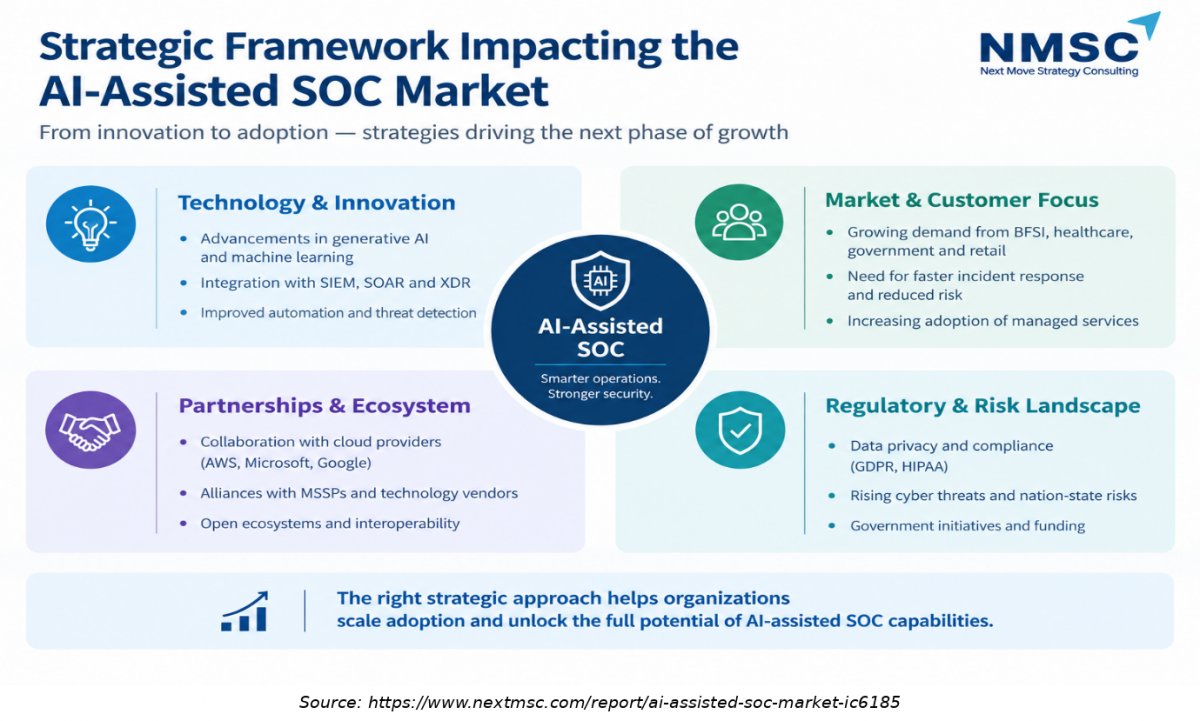
Strategic Framework Impacting the AI-Assisted SOC Market
Strategic Framework Impacting the AI-Assisted SOC Market
The infographic on Strategic Framework Impacting the AI-Assisted SOC Market highlights the key strategies driving the adoption of AI in Security Operations Centers (SOCs). It focuses on AI integration, workflow automation, threat intelligence, and human-AI collaboration to improve security performance. These strategic elements help organizations enhance threat detection, accelerate incident response, and build more efficient and resilient cybersecurity operations.

Conclusion & Recommendations

Based on our market analysis, we observed that the sector will expand from USD 7.60 Billion in 2026 to USD 38.40 Billion in 2035 at a 19.7% CAGR. This growth is driven by AI agents evolving from basic analyst assistants into supervised investigation platforms. Growth stays strongest in Asia-Pacific and in cloud-native deployments, while North America remains the largest base throughout the forecast period.

What Strategic Positioning Recommendations Does NMSC Offer?

Vendors should invest in explainability, approval controls and data pipeline economics before adding more autonomy. Enterprise buyers should pilot agents on high-volume alert categories to evaluate containment speed and labor savings. Furthermore, consolidating telemetry onto open platforms prevents vendor lock-in while maximizing automation efficiency.

How Strong Is the Investment Attractiveness of the Market?

Attractiveness is high but concentrated. Platform vendors with recurring revenue and data assets capture most value, while specialists carry integration and funding risk. The USD 30.80 Billion expansion between 2026 and 2035 favors investors who back governed agents, managed service providers and data layer technologies rather than unproven point solutions.

What Are the Market Shifts and Key Risks in the AI-Assisted SOC Market?

Key shifts include consolidation of SIEM, SOAR and agents into single platforms and movement toward consumption pricing. Principal market risks include model inaccuracies, unverified audit trails, rising log ingestion costs, and tightening regulatory scrutiny. Consequently, responsible AI practices have become a commercial imperative for vendors serving regulated industries.

What Are the Primary Growth Pathways Through 2035?

Three pathways stand out through 2035. Agent platforms expand fastest as general availability replaces previews, government and defense workloads open as authorization spreads, and managed services reach mid-sized organizations that cannot staff a full SOC. India and wider Asia-Pacific add scale as digital payments and cloud adoption expand, while operational technology environments open a further layer of demand for the AI-Assisted SOC Market.

FAQs

Sources & References

1.

FBI Internet Crime Complaint Center, 2025 Internet Crime Report

ic3.gov
2.

ISC2, 2025 Cybersecurity Workforce Study release

isc2.org
3.

CrowdStrike Holdings, Inc., Third Quarter Fiscal Year 2026 results

ir.crowdstrike.com
4.

SentinelOne, Inc., Form 8-K Exhibit 99.1, fiscal 2026 results

sec.gov
5.

Microsoft, Empowering defenders in the era of agentic AI with Microsoft Sentinel

microsoft.com/en-us/security/blog
6.

Palo Alto Networks, The SOC Is Now Agentic

www2.paloaltonetworks.com
7.

Splunk, Inside the Cisco Live Agentic SOC

splunk.com
8.

Cisco, Agentic SOC by Splunk, Cisco Connect 21 May 2026

cisco.com
9.

Google Cloud, Agentic AI to orchestrate security operations workflows

docs.cloud.google.com
10.

Elastic, why 2026 is the year to upgrade to an agentic AI SOC

elastic.co
11.

Swimlane, 5 Predictions That Will Redefine Your SOC in 2026

swimlane.com

About the Author

Mayurima Roy

Mayurima Roy

Mayurima Roy is Research Analyst at Next Move Strategy Consulting, where she has spent 4 years working across the firm's full industry coverage rather than a single fixed vertical. Her work centers on structured research, ongoing trend tracking, competitive assessment, and insight-led content development, translating complex market data into clear, decision-ready narratives that support informed client decision-making across diverse global industries, market sectors, and world regions every day.

About the Reviewer

Supradip Baul

Supradip Baul

Supradip Baul is an accomplished business consultant and strategist with over a decade of rich experience in market intelligence, strategy, technology, and business transformation. His work has included rigorous qualitative and quantitative analysis across multiple industries, helping clients shape investment decisions and long-term roadmaps. Earlier in his career, he was associated with Gartner, where he contributed to industry-leading reports and market share analyses. He has worked with leading global companies and holds an MBA with a dual specialization in Marketing and Finance.

Download Free Sample

Kevin Coker

KEVIN COKER

Founder, CEO and Board Diector

Proxima Clinical Research

I have been using Next MSC reports for product positioning in a new geography for a long time. They have by far the best reports I have found and the price is reasonable too!

Mohit Agarwal

MOHIT AGARWAL

Chief Manager

DryChem India Pvt. Ltd.

Next Move Strategy Consulting is an amazing team of consultants. We required a market study report for our investors on top priority and the team went above and beyond our expectations to deliver the same with ample supporting data within a short time span enabling us to secure the investments and keep our project timeline maintained. Their professionalism, attention to detail, and timely delivery of actionable recommendations have left a lasting impression on our organization.

Robert Sean Trevino

ROBERT SEAN TREVINO

Sr. Director, Head of Strategic Insights & Analytics

Foundation Medicine

I realized that it was a reliable source of information. These days, there are many people who are looking for authentic data, and this is one of the only sources that can offer them with what they need;

Pratyush Kumar Das

PRATYUSH KUMAR DAS

Assistant Manager

Polycab India Limited

We would like to express our appreciation for the data and insights provided by nextmsc. We are very pleased with the quality and depth of the information, which has proven to be highly valuable and beneficial for our business decision-making.

Kishu Kanda

KISHU KANDA

Strategy Analyst

Accenture

We purchased the AI Consumer Market Report from this company. Not only did they customize the report to meet our specific requirements, but they also showed great flexibility in accommodating our budget. The report we received fully met our expectations. Additionally, they provided prompt and thorough responses to both our pre-purchase and follow-up questions. We look forward to working with this company again in the future.

Custom Market Research Services

We will customize the research for you if the listed report does not fully match your requirements.

Get 30% Free Customization

Select License

This website uses cookies to ensure you get the best experience on our website. Learn more

✖