Cybersecurity in IoT Market Size, Share, Trends and Growth Analysis, By Offering (Software, Managed Security & Others), By Deployment, By Commercial Model, By Organization Size, By Technology (Enterprise IoT, Industrial IoT & Others), By Customer Type (Enterprise, Government, Telecom & Others), By Sales Channel, By End-User Industry (Manufacturing, Energy, Utilities, Oil and Gas, Healthcare, Transportation and Logistics & Others), and Region — Global Industry Report and Forecast, 2026–2035
Industry: ICT & Media | Publishing Date: July 27, 2026 | Last Updated: September 30, 2026 | No of Pages: N/A | No. of Tables: N/A | No. of Figures: N/A | Format: PDF | Report Code: IC5422
What Is the Cybersecurity in IoT Market Size?
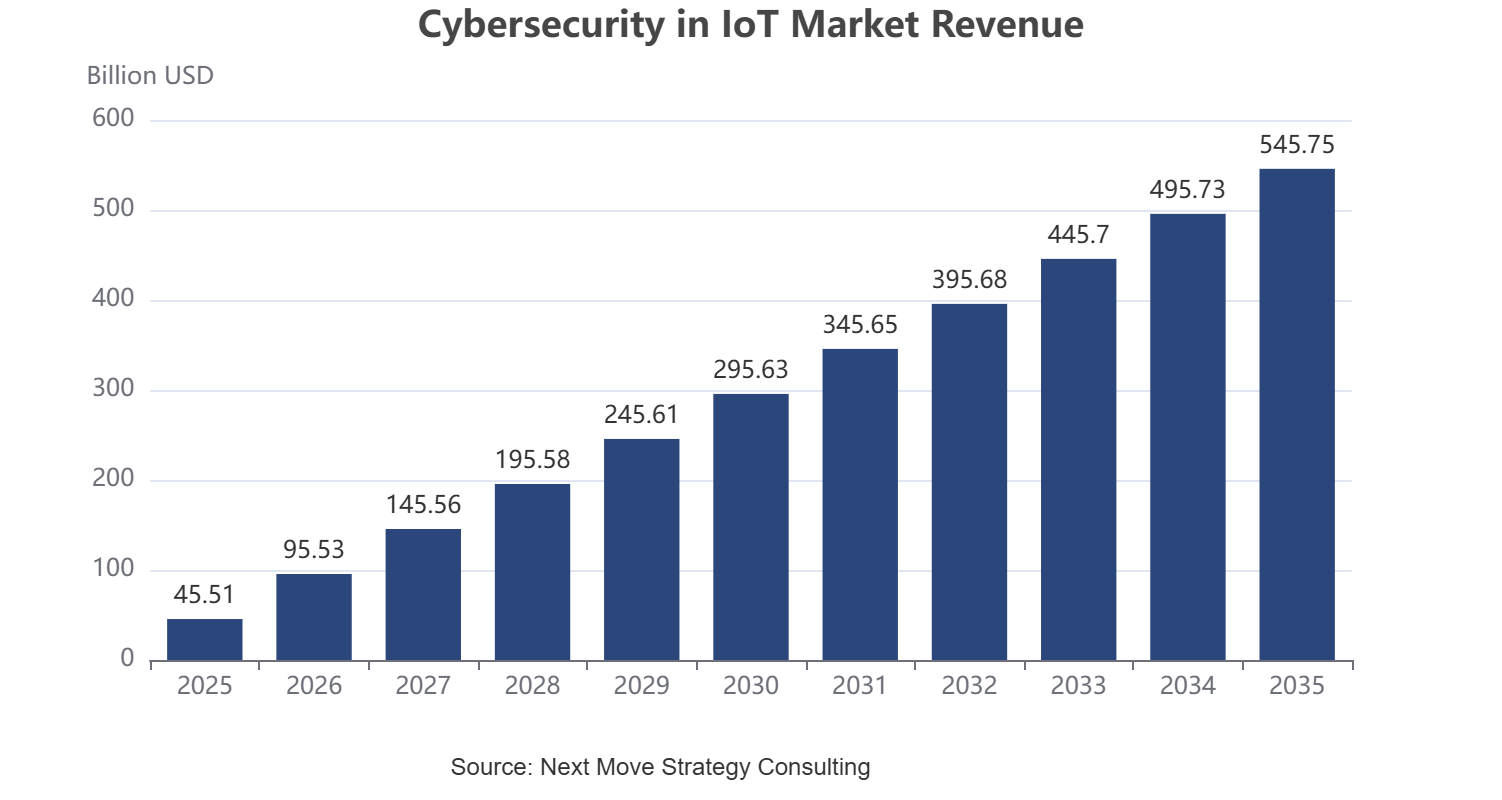
The global Cybersecurity in IoT Market size was valued at USD 45.51 billion in 2025 and is estimated at USD 58.35 billion in 2026, forecast to reach USD 545.75 billion by 2035, expanding at a 28.2% CAGR between 2026 and 2035. North America leads with approximately 40% share, while Software dominates all other offerings with approximately 68% share.
We observed that growth is broad-based across every segmentation axis, with managed security services and operational technology protection driving the most pronounced structural shifts through 2035.
|
Key Takeaways |
|
By Offering: Software held the largest share of approximately 68% (USD 30.95 billion) in 2025; Managed Security Services is the fastest-growing sub-segment at 32.1% CAGR from 2026–2035. |
|
By Deployment: Cloud held the largest share of approximately 52% (USD 23.67 billion) in 2025; Hybrid is the fastest-growing sub-segment at 30.8% CAGR from 2026–2035. |
|
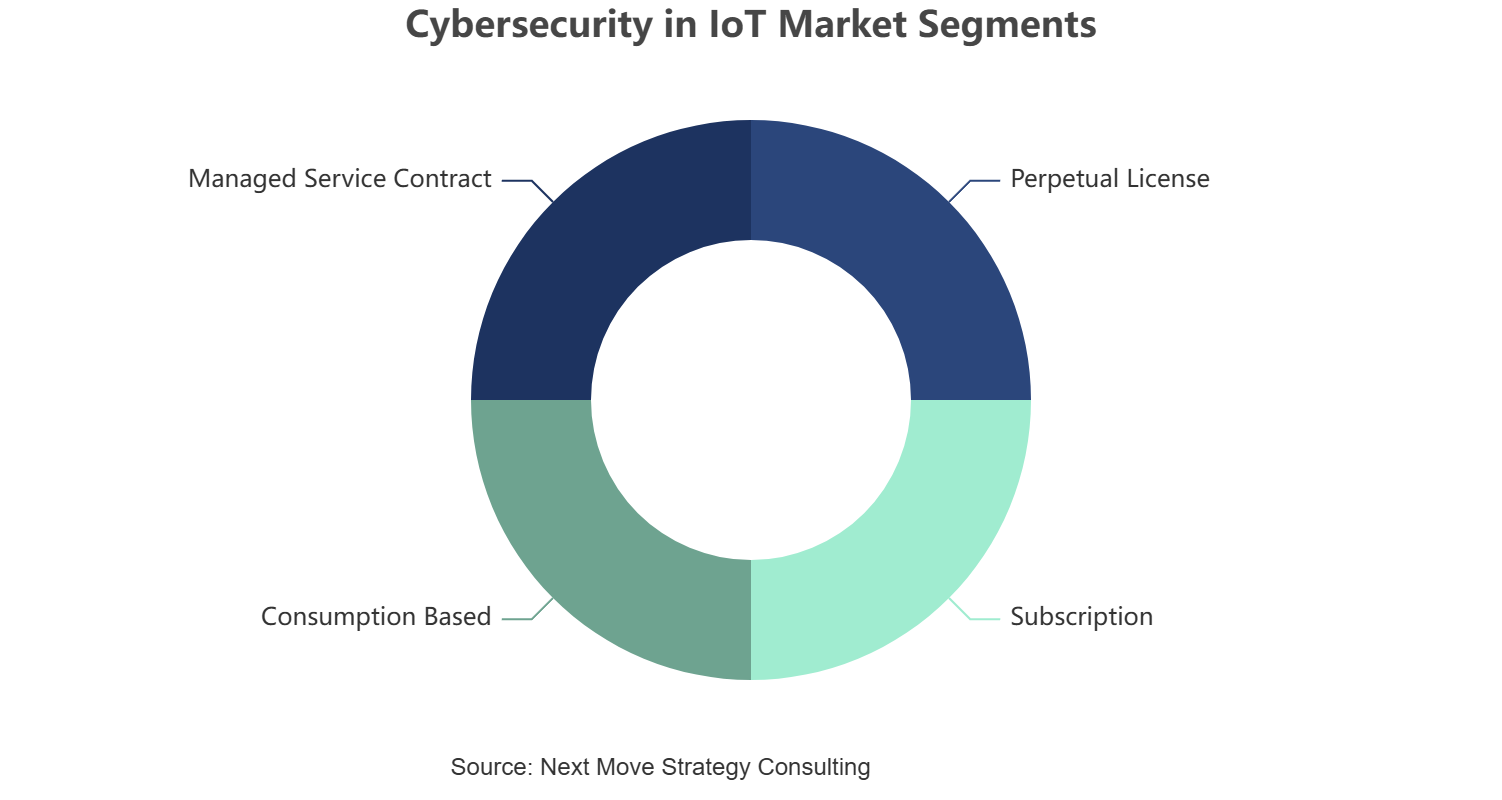
By Commercial Model: Subscription held the largest share of approximately 48% (USD 21.85 billion) in 2025; Consumption Based is the fastest-growing sub-segment at 32.9% CAGR from 2026–2035. |
|
By Organization Size: Large Enterprise held the largest share of approximately 66% (USD 30.04 billion) in 2025; SMEs is the fastest-growing sub-segment at 30.3% CAGR from 2026–2035. |
|
By Technology: Enterprise IoT held the largest share of approximately 34% (USD 15.47 billion) in 2025; Operational Technology is the fastest-growing sub-segment at 31.0% CAGR from 2026–2035. |
|
By Customer Type: Enterprise held the largest share of approximately 44% (USD 20.03 billion) in 2025; Small and Medium Business is the fastest-growing sub-segment at 31.3% CAGR from 2026–2035. |
|
By Sales Channel: Direct Sales held the largest share of approximately 30% (USD 13.65 billion) in 2025; Cloud Marketplace is the fastest-growing sub-segment at 39.0% CAGR from 2026–2035. |
|
By End-User Industry: Manufacturing held the largest share of approximately 21% (USD 9.78 billion) in 2025; Smart Cities is the fastest-growing sub-segment at 33.5% CAGR from 2026–2035. |
|
Dominant Region: North America dominated with approximately 40% revenue share (USD 18.20 billion) in 2025. |
|
Fastest-Growing Region: Middle East & Africa is expected to register the highest CAGR of 31.6% during 2026–2035. |
|
Dominant Country: The U.S. led with approximately USD 15,564 million in 2025. |
|
Fastest-Growing Country: Saudi Arabia is the fastest-growing country at approximately 32.8% CAGR from 2026–2035. |
Market Opportunity: The cybersecurity in IoT market is expected to create an absolute dollar opportunity of USD 487.4 billion between 2026 and 2035, presenting significant investment potential across managed detection, operational technology protection, and device identity security platforms.
According to Next Move Strategy Consulting analysis, high-profile acquisitions of asset visibility and OT security specialists are consolidating the vendor landscape faster than end-user demand is maturing, a dynamic that is reshaping procurement leverage for enterprises evaluating platform consolidation through 2035.
What Does the Cybersecurity in IoT Market Encompass?
The cybersecurity in IoT market encompasses software, managed security services, and professional services that protect connected devices, industrial control systems, and operational technology networks across asset visibility, device security, identity security, network security, threat detection, vulnerability management, application security, and data security capabilities. We observed that the scope spans enterprises, government agencies, telecom service providers, original equipment manufacturers, and small and medium businesses sourcing cloud, on-premises, and hybrid deployments through direct sales, system integrator, and managed security service provider channels across manufacturing, energy, healthcare, and transportation end-user industries.
Regulatory frameworks such as the European Union's Cyber Resilience Act (EU) 2024/2847 and the U.S. IoT Cybersecurity Improvement Act shape secure-by-design, vulnerability reporting, and lifecycle support requirements across the industry. Our assessment indicates that technology adoption is shifting toward AI-enabled behavioral analytics and unified cyber-physical systems protection platforms that consolidate previously siloed point tools. Next Move Strategy Consulting's analysis indicates that this structural shift, combined with accelerating vendor consolidation, is redefining procurement criteria across the cybersecurity in IoT market.
|
Parameters |
Details |
|
Market Size in 2025 |
USD 45.51 Billion |
|
Market Size in 2026 |
USD 58.35 Billion |
|
Revenue Forecast in 2035 |
USD 545.75 Billion |
|
Growth Rate |
CAGR of 28.2% from 2026 to 2035 |
|
Analysis Period |
2025–2035 |
|
Base Year Considered |
2025 |
|
Forecast Period |
2026–2035 |
|
Market Size Estimation |
USD Billion |
|
Companies Profiled |
20 |
|
Countries Covered |
33 |
|
Market Share |
Available for Top 10 Companies |
Key Emerging Trends
Based on research conducted by Next Move Strategy Consulting, we found that four structural trends are reshaping product design, vendor consolidation, and stakeholder engagement across the industry.
How Is Vendor Consolidation Reshaping the Asset Visibility Landscape?
Vendor consolidation is reshaping the asset visibility and OT security landscape as larger technology platforms acquire specialized IoT security vendors. We observed that ServiceNow agreed in December 2025 to acquire Armis, Inc. for USD 7.75 billion, while Mitsubishi Electric completed its USD 1 billion acquisition of Nozomi Networks in September 2025. This consolidation is narrowing the pool of independent pure-play OT and IoT asset visibility vendors, elevating the strategic value of remaining independents such as Claroty.
Why Is Cyber-Physical Systems Protection Attracting Growth Capital?
Cyber-physical systems protection is attracting substantial growth capital as investors recognize the convergence of digital and physical asset risk. Our findings suggest that Claroty Ltd. secured USD 150 million in Series F funding in January 2026, led by Golub Growth, to expand its cyber-physical systems protection platform. This capital inflow reflects growing investor conviction that securing operational technology and industrial IoT environments represents a durable, high-growth category distinct from traditional endpoint security.
How Is the EU Cyber Resilience Act Driving Secure-by-Design Adoption?
The European Union's Cyber Resilience Act is driving secure-by-design adoption across connected product manufacturers. We observed that the regulation entered into force in December 2024, with mandatory vulnerability reporting obligations beginning September 11, 2026, ahead of full enforcement in December 2027. Device manufacturers are increasingly embedding firmware protection, secure boot, and secure update management capabilities to meet these phased compliance deadlines.
What Role Does AI-Enabled Behavioral Analytics Play in Threat Detection?
AI-enabled behavioral analytics is playing a growing role in detecting anomalous device behavior across large, heterogeneous IoT fleets. Based on research conducted by Next Move Strategy Consulting, we found that leading vendors are embedding machine learning-based behavioral analytics directly into threat detection and extended detection and response platforms to identify novel attack patterns without relying solely on signature-based methods. This capability is becoming a key differentiator in vendor selection for large enterprise and government customers.
Regulatory Framework Impacting The Cybersecurity In Iot Market
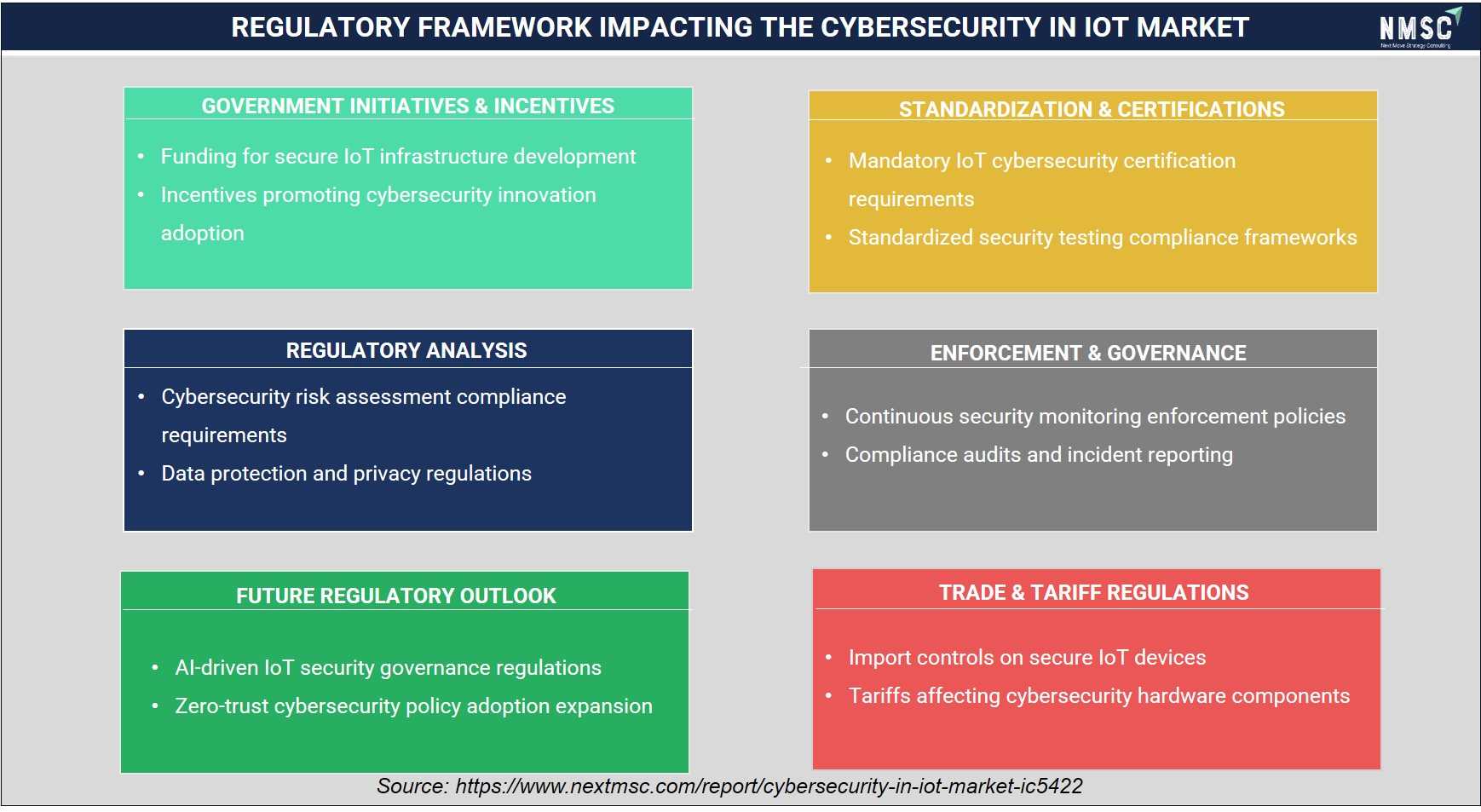
The regulatory framework impacting the Cybersecurity in IoT Market is shaped by government initiatives, cybersecurity standards, privacy regulations, and compliance requirements that strengthen the security of connected devices and networks. Standardization, certification programs, continuous security monitoring, and incident reporting enhance trust and resilience across IoT ecosystems. Additionally, evolving AI governance policies, zero-trust security adoption, and trade regulations influencing secure hardware components are expected to drive long-term market development and compliance.
Growth Drivers and Restraints
Growth Catalyst and Risk Assessment Matrix
|
Factors |
Type |
(+/−) % Impact on CAGR |
Geographic Relevance |
Impact Timeline |
|
Rapid expansion of connected device attack surface across enterprises |
Driver |
+7.8% |
Global |
2026–2035 |
|
EU Cyber Resilience Act secure-by-design and reporting mandates |
Driver |
+3.6% |
Europe |
2026–2032 |
|
Vendor consolidation accelerating platform-based procurement |
Driver |
+2.9% |
North America, Global |
2026–2030 |
|
Rising OT and industrial IoT security investment following high-profile incidents |
Driver |
+3.1% |
Global |
2026–2035 |
|
Middle East critical infrastructure digitalization programs |
Driver |
+2.4% |
Middle East & Africa |
2026–2035 |
|
Growth of managed security services among resource-constrained SMEs |
Driver |
+2.0% |
Global |
2026–2035 |
|
Shortage of skilled OT and IoT security personnel |
Restraint |
−1.8% |
Global |
2026–2032 |
|
Fragmented device protocols complicating unified security deployment |
Restraint |
−1.3% |
Global |
2026–2032 |
|
Budget constraints among small and medium enterprises |
Restraint |
−0.9% |
Global |
2026–2030 |
What Is the Primary Growth Driver of the Cybersecurity in IoT Market?
Rapid expansion of the connected device attack surface is the primary driver of the market. Regulators have responded with the European Union's Cyber Resilience Act (EU) 2024/2847, which establishes mandatory cybersecurity requirements for products with digital elements across the European market. We observed that this regulatory pressure, combined with rising enterprise IoT device counts, is sustaining sequential capacity investment among leading IoT security vendors.
How Is Vendor Consolidation Driving the Market Growth?
Vendor consolidation is driving growth by concentrating capital and go-to-market resources behind fewer, larger IoT security platforms. ServiceNow's confirmed December 2025 agreement to acquire Armis, Inc. for USD 7.75 billion illustrates how larger technology companies are integrating real-time connected device monitoring into broader enterprise workflow and security platforms. Our assessment indicates that this consolidation is accelerating platform-based procurement cycles among large enterprise customers through 2035.
What Is Restraining Cybersecurity in IoT Market Expansion?
A persistent shortage of skilled operational technology and IoT security personnel restrains broader market expansion. Industry-derived estimates indicate that the specialized skill set required to secure heterogeneous industrial control systems and embedded devices remains scarce relative to demand, extending deployment timelines for new security platforms. We found that this shortage is prompting increased reliance on managed security services among enterprises unable to build sufficient in-house expertise.
Segmentation Analysis
Segment Sizing: By Offering
|
Segment |
2025 (USD) |
2035 (USD) |
CAGR% (2026–2035) |
|
Software |
USD 30.95 Billion |
USD 338.37 Billion |
27.0% |
|
Managed Security Services |
USD 9.10 Billion |
USD 147.35 Billion |
32.1% |
|
Professional Services |
USD 5.46 Billion |
USD 60.03 Billion |
27.1% |
|
Total |
USD 45.51 Billion |
USD 545.75 Billion |
28.2% |
Which Offering Segment Dominates the Cybersecurity in IoT Market?
Software led the market with USD 30.95 billion in 2025, supported by enterprise demand for asset visibility, device security, and threat detection platforms embedded directly into IT and OT infrastructure. We observed that Managed Security Services is the fastest-growing offering, expanding at a 32.1% CAGR from 2026 to 2035, as resource-constrained enterprises increasingly outsource continuous monitoring and incident response given the persistent shortage of skilled in-house security personnel.
Segment Sizing: By Technology
|
Segment |
2025 (USD) |
2035 (USD) |
CAGR% (2026–2035) |
|
Enterprise IoT |
USD 15.47 Billion |
USD 158.27 Billion |
26.2% |
|
Industrial IoT |
USD 12.29 Billion |
USD 141.90 Billion |
27.7% |
|
Operational Technology |
USD 11.38 Billion |
USD 169.18 Billion |
31.0% |
|
Connected Products |
USD 6.37 Billion |
USD 76.41 Billion |
28.2% |
|
Total |
USD 45.51 Billion |
USD 545.75 Billion |
28.2% |
Which Technology Segment Leads Market Demand?
Enterprise IoT remained the leading technology segment, valued at USD 15.47 billion in 2025, reflecting the sheer scale of connected endpoints across corporate networks. Our findings suggest that Operational Technology is the fastest-growing technology segment, registering a 31.0% CAGR from 2026 to 2035, driven by high-profile acquisitions such as Mitsubishi Electric's purchase of Nozomi Networks that underscore surging enterprise investment in industrial control system protection.
Segment Sizing: By End-User Industry
|
Segment |
2025 (USD) |
2035 (USD) |
CAGR% (2026–2035) |
|
Manufacturing |
USD 9.78 Billion |
USD 106.42 Billion
|
27.0% |
|
Energy |
USD 4.55 Billion |
USD 51.85 Billion |
27.5% |
|
Utilities |
USD 3.64 Billion |
USD 40.93 Billion |
27.4% |
|
Oil and Gas |
USD 3.19 Billion |
USD 30.02 Billion |
25.1% |
|
Healthcare |
USD 4.10 Billion |
USD 62.76 Billion |
31.4% |
|
Transportation and Logistics |
USD 3.19 Billion |
USD 40.93 Billion |
29.1% |
|
Automotive |
USD 2.73 Billion |
USD 35.47 Billion |
29.2% |
|
Building Automation |
USD 2.28 Billion |
USD 27.29 Billion |
28.2% |
|
Smart Cities |
USD 1.82 Billion |
USD 32.74 Billion |
33.5% |
|
Retail |
USD 2.28 Billion |
USD 27.29 Billion |
28.2% |
|
Financial Services |
USD 2.73 Billion |
USD 30.02 Billion |
27.1% |
|
Government and Defense |
USD 2.28 Billion |
USD 24.56 Billion |
26.9% |
|
Telecommunications |
USD 1.36 Billion |
USD 10.91 Billion |
23.1% |
|
Consumer Electronics |
USD 0.91 Billion |
USD 5.46 Billion |
19.6% |
|
Agriculture |
USD 0.46 Billion |
USD 2.73 Billion |
19.6% |
|
Other Commercial Industries |
USD 0.23 Billion |
USD 16.37 Billion |
53.3% |
|
Total |
USD 45.51 Billion |
USD 545.75 Billion |
28.2% |
Which End-User Industry Segment Dominates the Cybersecurity in IoT Market?
Manufacturing remained the leading end-user industry, reaching USD 9.78 billion in 2025, as factory operators expand connected sensor and industrial control system deployments requiring dedicated protection. Based on research conducted by Next Move Strategy Consulting, we found that Smart Cities is the fastest-growing end-user industry, expanding at a 33.5% CAGR from 2026 to 2035, as municipal infrastructure operators scale connected traffic, utility, and public safety systems requiring integrated security oversight.
Growth Opportunities
Our analysis shows that three forward-looking opportunities stand out for stakeholders positioning within the cybersecurity in IoT market over the 2026–2035 forecast period.
How Can Managed Detection and Response Unlock Value for Resource-Constrained Enterprises?
Managed detection and response services present a whitespace opportunity for vendors serving small and medium enterprises unable to build dedicated in-house security operations. Providers that package continuous monitoring, threat hunting, and incident response into predictable subscription contracts stand to capture recurring revenue as smaller organizations prioritize outsourced expertise over capital-intensive in-house platforms.
Where Does Cyber Resilience Act Compliance Create New Demand?
European Union Cyber Resilience Act compliance requirements create a significant opportunity for vendors offering firmware protection, secure boot, and vulnerability reporting capabilities. Suppliers that help connected product manufacturers meet the September 2026 reporting obligations and December 2027 full compliance deadline can secure long-term consulting and platform contracts across the region's device manufacturing base.
How Can Unified Cyber-Physical Systems Platforms Benefit Critical Infrastructure Operators?
Critical infrastructure operators managing both IT and operational technology environments create an opportunity for vendors offering unified cyber-physical systems protection platforms. Suppliers that consolidate asset visibility, threat detection, and vulnerability management across previously siloed IT and OT tools can capture larger, multi-year enterprise contracts as buyers increasingly favor platform consolidation over point solutions.
Porter's Five Forces Analysis Of The Cybersecurity In Iot Market
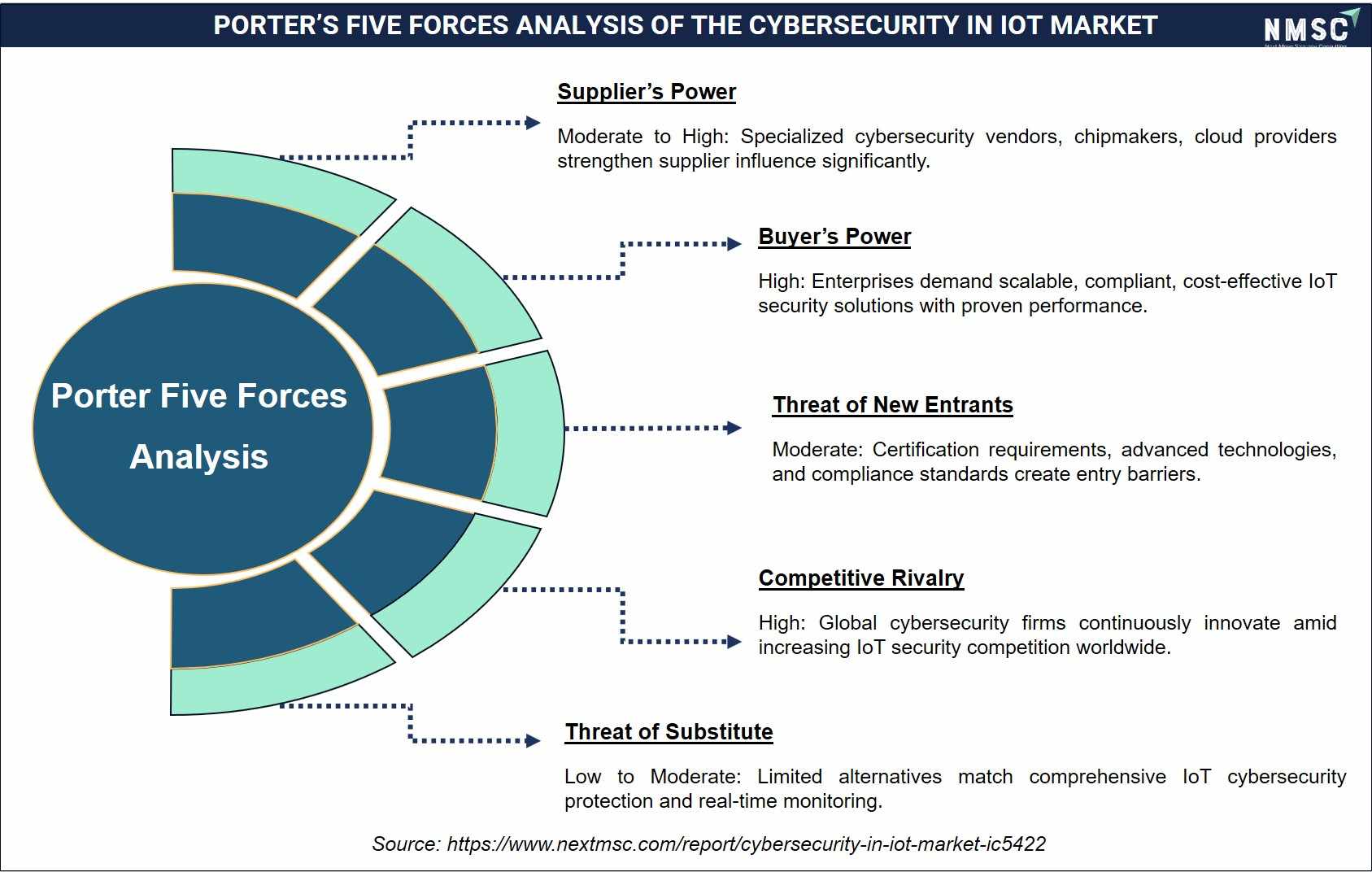
Porter's Five Forces analysis of the Cybersecurity in IoT Market evaluates the competitive dynamics influencing industry growth. Supplier bargaining power is shaped by specialized security technology providers, while buyer power reflects growing enterprise demand for integrated protection. The threat of new entrants is moderated by regulatory and technological barriers, substitutes remain limited due to evolving cyber risks, and intense competitive rivalry drives continuous innovation, partnerships, and advanced security solution development.
Regional Outlook
Geographic Performance Snapshot
|
Region |
2025 (USD) |
2035 (USD) |
CAGR% (2026–2035) |
Key Driver |
|
North America |
USD 18.20 Billion |
USD 201.93 Billion |
27.2% |
Vendor consolidation and critical infrastructure protection investment |
|
Europe |
USD 10.92 Billion |
USD 122.79 Billion |
27.4% |
EU Cyber Resilience Act secure-by-design compliance requirements |
|
Asia-Pacific |
USD 12.29 Billion |
USD 163.72 Billion |
29.6% |
Rapid industrial IoT and smart manufacturing deployment |
|
Middle East & Africa |
USD 2.28 Billion |
USD 35.47 Billion |
31.6% |
Critical infrastructure digitalization and national cybersecurity programs |
|
Latin America |
USD 1.82 Billion |
USD 21.83 Billion |
28.2% |
Expanding enterprise and government IoT security adoption |
|
Total |
USD 45.51 Billion |
USD 545.75 Billion |
28.2% |
— |
North America Cybersecurity in IoT Market Outlook
North America is the dominant region in the cybersecurity in IoT market, anchored by the highest concentration of enterprise IoT deployments and recent high-value vendor consolidation. We observed that ServiceNow's pending acquisition of Armis, Inc. and Claroty's January 2026 Series F funding round both reflect concentrated investor and acquirer confidence in the region's IoT security vendor base. Technology adoption favors AI-enabled threat detection, and strategic outlook remains strongly positive through 2035.
Europe Cybersecurity in IoT Market Outlook
Europe's market reflects a regulation-intensive landscape shaped by the European Union's Cyber Resilience Act (EU) 2024/2847. Our findings suggest that mandatory vulnerability reporting obligations beginning September 2026 are accelerating demand for firmware protection and secure update management capabilities among connected product manufacturers in Germany, France, and the UK. Technology adoption favors compliance-oriented platforms, and competitive intensity remains high among established European and global vendors.
Asia-Pacific Cybersecurity in IoT Market Outlook
Asia-Pacific is expanding rapidly, supported by large-scale industrial IoT and smart manufacturing deployment across China, Japan, and South Korea. We found that regional demand is increasingly concentrated in operational technology protection as manufacturers digitalize production environments. Regulatory frameworks remain less harmonized than in North America or Europe, and technology adoption is accelerating as regional vendors introduce localized threat detection and device identity platforms.
Middle East & Africa Cybersecurity in IoT Market Outlook
The Middle East & Africa is the fastest-growing region, propelled by national critical infrastructure digitalization programs across Saudi Arabia and the UAE. Our analysis shows that these programs are driving sustained demand for operational technology and industrial IoT security platforms suited to energy, utilities, and smart city infrastructure. Regulatory frameworks remain centrally coordinated through national cybersecurity authorities, and technology adoption is advancing quickly across managed security services.
Latin America Cybersecurity in IoT Market Outlook
Latin America's market is supported by expanding enterprise and government IoT security adoption in Brazil and Argentina. We observed that regulatory frameworks remain less harmonized than in North America or Europe, though national data protection and critical infrastructure initiatives continue to drive demand. Technology adoption remains centered on cloud-delivered platforms, with competitive intensity increasing as global vendors expand regional distributor and system integrator partnerships.
U.S. Cybersecurity in IoT Market
Based on our estimates, the U.S. market was valued at approximately USD 15,564 million in 2025 and is projected to reach USD 168,609 million by 2035, growing at a 26.9% CAGR. Demand is anchored by large-scale enterprise IoT deployments and recent high-value vendor consolidation activity. Technology penetration favors AI-enabled behavioral analytics and unified cyber-physical systems platforms, and competitive intensity is high among Microsoft, Cisco, Palo Alto Networks, Armis, and Claroty serving national enterprise and government customers.
Canada Cybersecurity in IoT Market
The market in Canada reached roughly USD 1,911 million in 2025 and is forecast to hit USD 23,222 million by 2035 at a 28.4% CAGR. Demand structure mirrors U.S. enterprise and critical infrastructure protection patterns, supported by national cybersecurity strategy initiatives. Technology penetration is rising as government agencies specify integrated threat detection platforms, with competitive intensity moderate given reliance on cross-border vendor supply from U.S.-based providers.
UK Cybersecurity in IoT Market
As per our estimate, the UK market stood at about USD 2,840 million in 2025, advancing toward USD 30,698 million by 2035 at a 26.9% CAGR. Demand is driven by financial services and critical national infrastructure operators strengthening connected device protection. Regulatory influence remains significant under post-Brexit cybersecurity and data protection frameworks, technology penetration favors managed detection services, and competitive intensity remains steady among domestic and international vendors.
Germany Cybersecurity in IoT Market
According to our analysis, Germany's market was valued near USD 3,113 million in 2025 and is set to reach USD 34,382 million by 2035, expanding at a 27.2% CAGR. Demand structure benefits from Germany's strong industrial manufacturing base and Siemens' domestic operational technology security leadership. Germany's implementation of the EU Cyber Resilience Act drives regulatory influence, while technology penetration favors industrial IoT and operational technology protection platforms.
France Cybersecurity in IoT Market
Based on our estimates, France's market reached approximately USD 1,911 million in 2025, projected to climb to USD 20,875 million by 2035 at a 27.0% CAGR. Demand is supported by expanding government and defense sector IoT security investment, reinforced by Thales' domestic presence. Regulatory influence from EU Cyber Resilience Act compliance is notable, and competitive intensity remains moderate given the concentration of European vendors serving domestic enterprise customers.
China Cybersecurity in IoT Market
The market in China stood at roughly USD 3,809 million in 2025 and is forecast to reach USD 45,024 million by 2035, registering a 28.0% CAGR. Demand is fueled by rapid industrial IoT deployment across the country's expansive manufacturing base. Regulatory influence is increasing gradually under domestic cybersecurity law, technology penetration is advancing across operational technology protection platforms, and competitive intensity remains high among domestic and international vendors.
India Cybersecurity in IoT Market
As per our estimate, India's market was valued at about USD 2,335 million in 2025, projected to reach USD 39,294 million by 2035 at a 32.6% CAGR, the fastest among Asia-Pacific countries covered. Demand structure reflects rapidly expanding enterprise digitalization and government smart city initiatives. Regulatory influence remains developing under national data protection rules, while technology penetration is rising quickly as international vendors expand local delivery capacity.
Japan Cybersecurity in IoT Market
According to our analysis, Japan's market reached close to USD 2,335 million in 2025 and is expected to hit USD 27,015 million by 2035, growing at a 27.7% CAGR. Demand is supported by Japan's advanced industrial automation base and strong domestic manufacturing security requirements. Regulatory influence is well established, technology penetration is advanced across operational technology and industrial IoT protection, and competitive intensity remains high among established domestic and international vendors.
South Korea Cybersecurity in IoT Market
Based on our estimates, South Korea's market stood at approximately USD 1,720 million in 2025, forecast to reach USD 21,284 million by 2035 at a 28.6% CAGR. Demand structure benefits from the country's advanced telecommunications infrastructure and expanding smart manufacturing base. Technology penetration is rising as enterprises adopt device identity and network security platforms, and competitive intensity remains moderate amid growing international vendor presence.
Australia Cybersecurity in IoT Market
The market in Australia reached about USD 983 million in 2025 and is projected to reach USD 12,279 million by 2035, expanding at a 28.7% CAGR. Demand is supported by growing critical infrastructure protection requirements and government cybersecurity strategy initiatives. Regulatory influence stems from national critical infrastructure security legislation, while technology penetration favors cloud-delivered managed security services amid moderate competitive intensity.
UAE Cybersecurity in IoT Market
As per our estimate, the UAE market was valued near USD 762 million in 2025, projected to reach USD 11,352 million by 2035 at a 31.0% CAGR. Demand structure is shaped by national critical infrastructure digitalization and smart city development programs. Regulatory influence remains centrally coordinated through national cybersecurity authorities, and technology penetration is advancing quickly toward integrated operational technology and IoT security platforms.
Saudi Arabia Cybersecurity in IoT Market
According to our analysis, Saudi Arabia's market reached roughly USD 853 million in 2025 and is expected to hit USD 14,544 million by 2035, growing at a 32.8% CAGR, the fastest among all covered countries. Demand is driven by national critical infrastructure protection programs tied to economic diversification goals. Regulatory influence is developing under national cybersecurity authority guidelines, and technology penetration is advancing rapidly as international vendors scale regional operations.
South Africa Cybersecurity in IoT Market
Based on our estimates, South Africa's market stood at about USD 319 million in 2025, forecast to reach USD 4,612 million by 2035 at a 30.6% CAGR. Demand structure reflects a developing enterprise and government IoT security base addressing rising connected device adoption. Regulatory influence remains moderate, technology penetration is gradually improving, and competitive intensity is limited given reliance on international vendors routing delivery through regional partners.
Brazil Cybersecurity in IoT Market
The market in Brazil reached approximately USD 992 million in 2025 and is projected to reach USD 11,570 million by 2035, registering a 27.8% CAGR. Demand is underpinned by Brazil's expanding enterprise digitalization and financial services sector investment in connected device protection. Regulatory influence stems from national data protection law, technology penetration favors cloud-delivered platforms, and competitive intensity remains moderate among regional distributors.
Argentina Cybersecurity in IoT Market
As per our estimate, Argentina's market was valued near USD 364 million in 2025, projected to reach USD 4,584 million by 2035 at a 28.8% CAGR. Demand structure is supported by steady enterprise cybersecurity investment despite macroeconomic volatility. Regulatory influence remains limited, technology penetration is modest, and competitive intensity is centered on a small number of regional distributors partnering with global IoT security vendors.
Competitive Landscape
We observed that the competitive landscape spans large diversified technology and networking vendors, specialized OT and IoT security pure plays, and industrial conglomerates embedding security into their own automation portfolios.
|
Category |
Assessment |
|
Market Structure |
Moderately fragmented; large platform vendors compete alongside specialized asset visibility and OT security pure plays, with rapid consolidation narrowing the independent vendor pool |
|
Innovation Focus |
AI-enabled behavioral analytics, unified cyber-physical systems protection, device identity security, and Cyber Resilience Act-aligned secure-by-design tooling |
|
M&A Activity |
Major consolidation reshaping the sector, including ServiceNow's pending USD 7.75 billion acquisition of Armis and Mitsubishi Electric's completed USD 1 billion acquisition of Nozomi Networks |
How Do Companies Compete in the Cybersecurity in IoT Market?
Companies compete primarily on breadth of device coverage, depth of threat intelligence, and the ability to integrate security across both IT and operational technology environments. We found that platform consolidation strategies, exemplified by ServiceNow's pending acquisition of Armis, increasingly anchor competitive positioning. Pricing strategies remain closely tied to subscription-based, per-device licensing models, pushing vendors toward platform breadth to justify premium contract values.
Which Competitive Archetypes Dominate the Cybersecurity in IoT Market?
Two archetypes dominate the cybersecurity in IoT market: large diversified technology and networking vendors that compete on platform breadth and existing enterprise relationships, and specialized OT and IoT security pure plays that compete on deep device-level visibility and industrial protocol expertise. Our analysis shows that differentiation increasingly centers on unified cyber-physical systems protection, positioning integrated vendors to capture greater wallet share as buyers consolidate point solutions.
How Are Companies Differentiating Through Innovation?
Leading vendors are differentiating through AI-enabled behavioral analytics, extended detection and response capabilities, and device identity management tailored to industrial protocols. During our market evaluation, we noticed that several vendors are simultaneously expanding managed detection and response service lines and pursuing Cyber Resilience Act-aligned compliance tooling, positioning themselves as full-service partners across the device lifecycle rather than single-layer security vendors.
What M&A and Geographic Expansion Activity Is Reshaping the Market?
Geographic expansion and acquisition activity are reshaping competitive positioning across the industry. We observed that ServiceNow's December 2025 agreement to acquire Armis, Inc. for USD 7.75 billion and Mitsubishi Electric's September 2025 acquisition of Nozomi Networks for USD 1 billion both illustrate how larger technology and industrial conglomerates are absorbing specialized IoT security capability, while Claroty's January 2026 Series F funding round signals continued independent growth capital for remaining pure plays.
Key Market Players
Our assessment indicates that the following companies represent the leading vendors shaping competitive dynamics across the cybersecurity in IoT market.
-
Microsoft Corporation
-
Fortinet, Inc.
-
Armis, Inc.
-
Claroty Ltd.
-
Nozomi Networks Inc.
-
Forescout Technologies, Inc.
-
Siemens AG
-
Honeywell International Inc.
-
Schneider Electric SE
-
Trend Micro Incorporated
-
TXOne Networks Inc.
-
Thales S.A.
-
DigiCert, Inc.
-
Entrust Corporation
-
International Business Machines Corporation
-
Zscaler, Inc.
-
Broadcom Inc.
Latest Developments
We found that recent acquisitions, funding rounds, and regulatory milestones underscore the pace of change across the cybersecurity in IoT supply chain.
|
Date |
Event |
|
March 2026 |
Palo Alto Networks partnered with Nokia, Aeris, U Mobile and Celerway to secure AI factories, autonomous edge environments, 5G infrastructure and IoT networks. |
Expert Insights

"There are currently more Internet of Things (IoT) connections in the workplace than there are non-IoT connections... Many security teams don't even know how many IoT and OT devices are in their environment. When not secured, these devices can provide attackers with an easy route into a company's data."
— Chris Rouland, CEO, Phosphorus Cybersecurity
Statement shared during an industry interview with Expert Insights (May 2025), discussing the growing enterprise adoption of IoT devices and the increasing need for automated IoT security, credential management, and firmware lifecycle protection.
Market Interpretation
This insight highlights one of the strongest growth drivers for the Cybersecurity in IoT Market the rapid expansion of connected enterprise devices without corresponding visibility and security controls. As organizations deploy millions of IoT and operational technology (OT) devices across manufacturing, healthcare, utilities, transportation, and smart buildings, attack surfaces continue to expand. Consequently, enterprises are increasingly investing in IoT asset discovery, vulnerability management, device authentication, firmware management, and Zero Trust security platforms, supporting sustained market growth.
Investment Opportunities
Where Are Capital Inflows Concentrated in the Cybersecurity in IoT Market?
Capital inflows are concentrated in cyber-physical systems protection and asset visibility platforms. We observed that Claroty Ltd. secured USD 150 million in Series F funding in January 2026, while ServiceNow's pending USD 7.75 billion acquisition of Armis and Mitsubishi Electric's completed USD 1 billion acquisition of Nozomi Networks represent significant strategic capital commitments since September 2025. This pattern reflects sustained investor confidence in the sector's long-term growth trajectory.
How Is Infrastructure Investment Expanding Security Platform Capacity?
Infrastructure investment is expanding platform capacity as vendors integrate acquired capabilities into broader enterprise workflows. We found that ServiceNow's planned integration of Armis's real-time device monitoring technology and Mitsubishi Electric's incorporation of Nozomi Networks' OT detection capabilities both reflect a broader pattern of embedding specialized IoT security functionality into larger enterprise and industrial automation platforms.
What ESG Considerations Are Shaping Cybersecurity in IoT Investment?
Environmental, social, and governance considerations are shaping investment as regulators mandate secure-by-design product development. Our findings suggest that the European Union's Cyber Resilience Act, requiring lifecycle vulnerability management and transparent reporting, is establishing a governance benchmark that investors increasingly expect connected device manufacturers and their security vendors to meet, favoring companies with documented compliance readiness over less transparent alternatives.
Key Benefits for Stakeholders
How Does This Report Benefit Enterprise and Industry Leaders?
Enterprise and industry leaders gain a structured view of segment-level demand across offering, deployment, commercial model, organization size, technology, customer type, sales channel, and end-user industry, supported by Next Move Strategy Consulting's forecasts through 2035. Our analysis shows that this data enables platform investment decisions, helping enterprises prioritize the fastest-growing segments, including managed security services and operational technology protection.
How Does This Report Benefit Investors and Financial Analysts?
Investors and financial analysts benefit from validated market sizing, regional growth differentials, and competitive landscape analysis that inform capital allocation decisions. We found that the report's country-level revenue breakdowns and CAGR projections support comparative evaluation of expansion opportunities across North America, Europe, Asia-Pacific, the Middle East & Africa, and Latin America, strengthening due diligence on IoT security-related investment targets.
How Does This Report Benefit Technology Vendors and Product Teams?
Technology vendors and product teams gain insight into emerging trends, including AI-enabled behavioral analytics, unified cyber-physical systems protection, and Cyber Resilience Act compliance requirements. Our assessment indicates that this analysis helps product teams prioritize research and development roadmaps toward the offerings and technologies showing the strongest forecast growth, improving alignment between innovation investment and evolving enterprise procurement specifications.
Key Market Segments
By Offering
-
Software
-
Asset Visibility
-
Asset Discovery
-
Asset Inventory
-
Device Classification
-
Device Security
-
Embedded Security
-
Device Hardening
-
Runtime Protection
-
Identity Security
-
Device Identity
-
Device Authentication
-
Certificate Management
-
Public Key Infrastructure
-
Network Security
-
Network Access Control
-
Microsegmentation
-
Secure Gateway
-
Secure Remote Access
-
Threat Detection and Response
-
Threat Detection
-
Behavioral Analytics
-
Threat Intelligence
-
Extended Detection and Response
-
Vulnerability Management
-
Vulnerability Assessment
-
Risk Prioritization
-
Patch Management
-
Security Configuration Management
-
Application Security
-
Firmware Protection
-
Secure Boot
-
Secure Update Management
-
Application Protection
-
Data Security
-
Encryption
-
Key Management
-
Secure Communications
-
Security Platform
-
Unified IoT Security Platform
-
Security Policy Management
-
Compliance Management
-
Managed Security Services
-
Managed Detection and Response
-
Managed Monitoring
-
Incident Response
-
Threat Hunting
-
Device Lifecycle Security
-
Professional Services
-
Assessment
-
Consulting
-
Architecture and Design
-
Deployment
-
Integration
-
Training
-
Technical Support
By Deployment
-
Cloud
-
On-Premises
-
Hybrid
By Commercial Model
-
Perpetual License
-
Subscription
-
Consumption Based
-
Managed Service Contract
By Organization Size
-
SMEs
-
Large Enterprise
By Technology
-
Enterprise IoT
-
Industrial IoT
-
Operational Technology
-
Connected Products
By Customer Type
-
Enterprise
-
Government
-
Telecom Service Provider
-
Original Equipment Manufacturer
-
Small and Medium Business
By Sales Channel
-
Direct Sales
-
Value-Added Resellers
-
Distributors
-
System Integrators
-
Managed Security Service Providers
-
Original Equipment Manufacturer Partners
-
Cloud Marketplace
By End-User Industry
-
Manufacturing
-
Energy
-
Utilities
-
Oil and Gas
-
Healthcare
-
Transportation and Logistics
-
Automotive
-
Building Automation
-
Smart Cities
-
Retail
-
Financial Services
-
Government and Defense
-
Telecommunications
-
Consumer Electronics
-
Agriculture
-
Other Commercial Industries
By Region
-
North America: U.S., Canada, Mexico
-
Europe: UK, Germany, France, Italy, Spain, Sweden, Denmark, Finland, Netherlands, Rest of Europe
-
Asia-Pacific: China, India, Japan, South Korea, Taiwan, Indonesia, Vietnam, Australia, Philippines, Malaysia, Rest of APAC
-
Middle East & Africa: Saudi Arabia, UAE, Egypt, Israel, Turkey, Nigeria, South Africa, Rest of MEA
-
Latin America: Brazil, Argentina, Chile, Colombia, Rest of LATAM
Conclusion and Recommendations
What Is the Long-Term Outlook for the Cybersecurity in IoT Market?
The long-term outlook remains strongly positive, with the market projected to expand from USD 58.35 billion in 2026 to USD 545.75 billion by 2035 at a 28.2% CAGR. Our assessment indicates that this growth will be increasingly concentrated in managed security services and operational technology protection as connected device deployment continues to scale across every major region and industry through 2035.
What Strategic Positioning Should Vendors Pursue?
Vendors should pursue unified cyber-physical systems positioning that bridges traditional IT security with operational technology and industrial IoT protection. We found that companies pursuing platform consolidation, either through acquisition as demonstrated by ServiceNow and Mitsubishi Electric, or through independent growth capital as demonstrated by Claroty, are best positioned to capture long-term enterprise and government contracts through 2035.
How Attractive Is the Market for New Investment?
The market presents high investment attractiveness given its 28.2% forecast CAGR and the rapid pace of strategic acquisitions across the sector. Our findings suggest that investors focusing on managed security services, operational technology protection, and Cyber Resilience Act compliance tooling stand to benefit from above-market growth relative to the broader cybersecurity in IoT category.
What Are the Key Market Shifts and Risks?
Key shifts include accelerating vendor consolidation and rising enterprise demand for unified cyber-physical systems protection platforms. We observed that principal risks include a persistent shortage of skilled operational technology security personnel, fragmented device protocols complicating unified deployment, and integration risk following large-scale acquisitions, all of which could slow the pace of the industry's consolidation-driven growth if unresolved.
What Are the Primary Growth Pathways Through 2035?
Primary growth pathways include scaling managed detection and response services, deepening operational technology security investment following high-profile acquisitions, and expanding Cyber Resilience Act-aligned compliance platforms. Based on research conducted by Next Move Strategy Consulting, we found that vendors combining these three pathways with unified cyber-physical systems platforms are best positioned to capture the USD 487.4 billion absolute dollar opportunity created between 2026 and 2035.
About the Author
 Liza Phukan
— Liza Phukan is Research Associate at Next Move Strategy Consulting, where she has covered emerging industries and market research across sectors for 3.5 years. Her work includes analyzing industry developments, validating market data, and developing structured business content from research findings. She uses secondary research and data-validation practices to turn complex market information into clear decision-useful market analysis for business audiences and support report development and B2B.
Liza Phukan
— Liza Phukan is Research Associate at Next Move Strategy Consulting, where she has covered emerging industries and market research across sectors for 3.5 years. Her work includes analyzing industry developments, validating market data, and developing structured business content from research findings. She uses secondary research and data-validation practices to turn complex market information into clear decision-useful market analysis for business audiences and support report development and B2B.
About the Reviewer
 Supradip Baul
— Supradip Baul is an accomplished business consultant and strategist with over a decade of rich experience in market intelligence, strategy, technology, and business transformation. His work has included rigorous qualitative and quantitative analysis across multiple industries, helping clients shape investment decisions and long-term roadmaps. Earlier in his career, he was associated with Gartner, where he contributed to industry-leading reports and market share analyses. He has worked with leading global companies and holds an MBA with a dual specialization in Marketing and Finance.
Supradip Baul
— Supradip Baul is an accomplished business consultant and strategist with over a decade of rich experience in market intelligence, strategy, technology, and business transformation. His work has included rigorous qualitative and quantitative analysis across multiple industries, helping clients shape investment decisions and long-term roadmaps. Earlier in his career, he was associated with Gartner, where he contributed to industry-leading reports and market share analyses. He has worked with leading global companies and holds an MBA with a dual specialization in Marketing and Finance.
At Next Move Strategy Consulting, we understand that insightful market research is the cornerstone of successful business decisions. That's why we employ a robust and multifaceted approach, combining various methodologies to deliver the most accurate and actionable data for our clients.

Research Landscape
We navigate the world of research with two primary approaches:
Qualitative Approach
Our qualitative research methodologies involve immersive techniques such as in-depth interviews, focus groups, and observational studies. By engaging directly with individuals and stakeholders, we uncover valuable insights that quantitative data alone may overlook.

Quantitative Research
In tandem with qualitative methodologies, NMSC leverages the power of Quantitative Research to provide a robust foundation of numerical insights. Through systematic data collection and analysis, we quantify patterns, preferences, and market trends, offering a comprehensive view of the business landscape.
Our quantitative research approach employs diverse tools, including surveys, experiments, and statistical modelling. These methodologies enable us to gather data from a large and representative sample, ensuring the statistical significance of our findings. By employing structured questionnaires and standardized data collection methods, we guarantee the reliability and validity of the information we present to our clients.
Quantitative research is particularly effective in measuring the prevalence of trends, assessing market size, and gauging the impact of various factors on consumer behavior. The numerical precision attained through this approach equips our clients with actionable insights, facilitating data-driven decision-making and strategy formulation.


Our Specialized Toolbox for Industry-Specific Market Research
We deploy a specialized arsenal of techniques tailored to meet your unique requirements. Here's a glimpse into our comprehensive toolbox:

Information Procurement
The stage entails acquiring market data or relevant information through various sources and methodologies.


Market Research Approach
We utilize both top-down and bottom-up approaches in market research analysis to achieve a comprehensive understanding of the market dynamics, leveraging the broad perspective of industry trends and macroeconomic factors alongside detailed insights from specific segments and individual companies.

Porters Five Forces Analysis
We conduct Porter's Five Forces analysis to evaluate the competitive landscape of an industry, providing us with insights into factors that affect profitability and strategic positioning.

SWOT Analysis

Forecasting
We utilize a forecasting model to predict future consumption by considering parameters like population, economics, regulations, market competition, drivers, constraints, technology, and pricing. We also employ statistical techniques such as multilinear regression, exponential smoothing, moving average, ARIMA, and Monte Carlo simulations for accurate predictions. In econometric forecasting, we analyzed short-term and long-term event impacts, attributing values based on regulatory frameworks, economic factors, and market events.





 Speak to Our Analyst