AI Cybersecurity Platform Market By Platform Category (Endpoint Security, Network Security, Cloud Security and Others), By Deployment Model (Cloud-Native SaaS, Hybrid Deployment, and On-Premise), By Customer Type (Large Enterprise, Mid-Market, and Small Business), By Sales Channel (Direct Enterprise Sales, Cloud Marketplaces, and Managed Security Providers), and By Industry Vertical (BFSI, Government and Defense, Healthcare, Manufacturing, and Others) – Global Analysis & Forecast, 2025–2035
Industry: ICT & Media | Publishing Date: June 5, 2026 | Last Updated: September 30, 2026 | No of Pages: N/A | No. of Tables: N/A | No. of Figures: N/A | Format: PDF | Report Code: IC4607
Industry Outlook
The global AI Cybersecurity Platform Market size was valued at USD 31.21 billion in 2025 and is expected to be valued at USD 38.89 billion by the end of 2026. The industry is projected to grow, hitting USD 277.46 billion by 2035, with a CAGR of 24.41% between 2026 and 2035.
AI Cybersecurity Platform Industry Size & Forecast
|
Parameters |
Details |
|
Market Size in 2026 |
USD 38.89 Billion |
|
Revenue Forecast in 2035 |
USD 277.46 Billion |
|
Growth Rate |
CAGR of 24.41% from 2026 to 2035 |
|
Analysis Period |
2025–2035 |
|
Base Year Considered |
2025 |
|
Forecast Period |
2026–2035 |
|
Market Size Estimation |
Billion (USD) |
|
Companies Profiled |
20 |
|
Countries Covered |
33 |
|
Market Share |
Available for 10 companies |
Based on NMSC’s primary research, we observed that the global AI cybersecurity platform market demand is witnessing strong growth, driven by the rising frequency of sophisticated cyberattacks, rapid enterprise digitalisation, and expansion of cloud and hybrid IT environments. AI-powered platforms detect threats in real time, automate incident response, and minimise dwell time across complex networks. Advanced capabilities, including machine learning-based anomaly detection and behavioural analytics, strengthen security operations while reducing manual intervention. Moreover, our interactions with enterprise SOC teams and cybersecurity platform providers indicate that organizations prioritise integrated, platform-centric architectures that unify endpoint, network, identity, and cloud security. These platforms enhance visibility, accelerate threat correlation, and streamline response workflows, improving operational efficiency. Software platforms dominate market share, while managed services and AI-driven analytics act as key enablers of scalability.
Further, through assessment of enterprise deployments across North America, Europe, and Asia-Pacific, we observed that adoption is driven by regulatory compliance requirements, rising ransomware incidents, and zero-trust security implementation. North America leads due to strong cybersecurity investments, while Europe focuses on data protection and resilience. Asia-Pacific demonstrates accelerated adoption, supported by rapid digital transformation. Additionally, leading players, including CrowdStrike, Palo Alto Networks, Darktrace, and Fortinet, show that competition centres on AI accuracy, platform integration, and real-time threat intelligence. Continuous innovation in XDR and autonomous security operations strengthens long-term value, scalability, and enterprise security resilience. This shift marks the transition from reactive cybersecurity models to predictive, AI-driven security architectures.
What Are the Key Trends in the AI Cybersecurity Platform Market?
How Are Agentic AI SOCs Transforming Security Operations into Autonomous, Intelligence-Driven Ecosystems?
Based on NMSC’s primary research, we observed that agentic AI SOCs are transforming security operations by shifting from human-led alert handling to autonomous, intelligence-driven execution. Additionally, our interactions with enterprise SOC teams and cybersecurity platform providers confirm that organizations deploy AI agents that independently conduct multi-step forensic investigations, correlate cross-domain threat signals, and execute containment protocols across endpoint, network, and cloud environments in real time. Moreover, agentic architectures eliminate alert fatigue and compress incident response timelines by replacing sequential workflows with parallel, AI-driven decision loops. Further, autonomous agents continuously refine detection and response strategies based on evolving attack patterns, establishing self-improving security operations. This transition strengthens operational precision and advances a fully autonomous SOC model that enhances enterprise-wide threat resilience.
How Are Hyper-Converged Identity Fabrics Redefining Cybersecurity Architectures?
Through our market analysis, we identified that hyper-converged identity fabrics redefine cybersecurity architectures by establishing identity as the primary control plane. Our interactions with enterprise IT leaders and identity security teams confirm that organizations implement AI-driven identity fabrics that unify human users, machine identities, and non-human AI agents within a single, continuously monitored framework. These platforms enforce real-time, risk-based authentication and dynamically adjust access controls based on behavioural intelligence and contextual risk signals. Further, identity-centric models replace static perimeter-based controls with continuous verification across distributed environments. Additionally, AI-powered identity fabrics deliver granular visibility, enforce adaptive access policies, and ensure persistent trust validation across cloud, SaaS, and on-premise systems. This architectural shift establishes a resilient and scalable security foundation aligned with modern digital ecosystems.
How Is Sovereign AI Deployment Reshaping Data Security and Compliance?
Our evaluation indicates that sovereign AI deployment is reshaping platforms by embedding data sovereignty and regulatory alignment directly into AI architectures. Our interactions with enterprise security leaders and regulatory authorities confirm that organizations deploy localized AI stacks, including private large language models trained exclusively on enterprise-specific data within regional or private cloud environments. Additionally, sovereign AI architectures ensure complete control over sensitive data while delivering high-performance threat detection and automated analysis. In parallel, localized AI models strengthen data governance, align with jurisdictional regulations, and enhance enterprise trust in AI-driven security systems. As a result, the evolution establishes a regionally compliant, secure, and scalable AI framework that supports long-term cybersecurity resilience.
Ecosystem Analysis of the AI Cybersecurity Platform Market
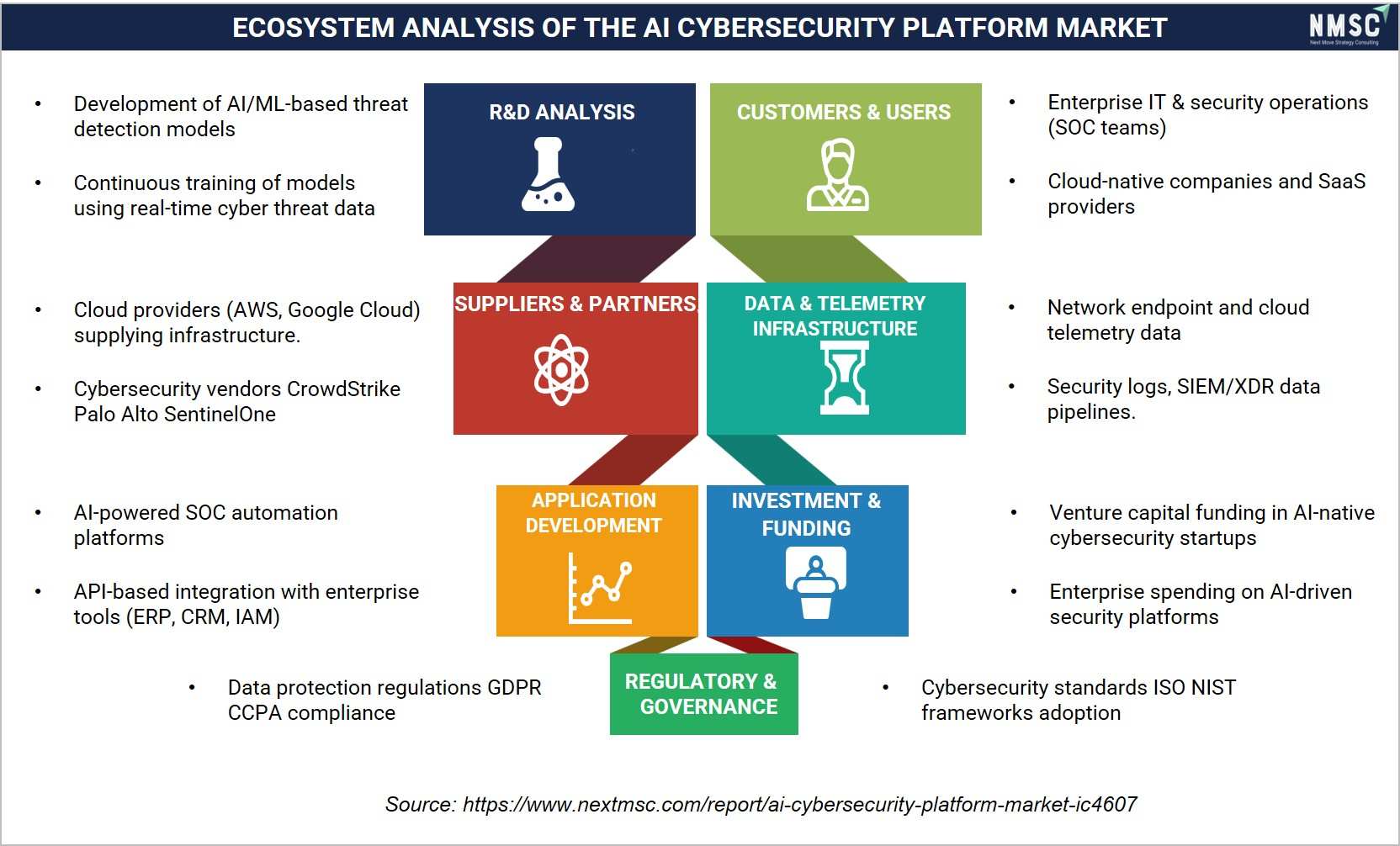
Based on our market evaluation, we noticed that the AI cybersecurity platform market ecosystem is driven by tight integration across R&D, data infrastructure, and enterprise users. Moreover, our assessment indicates that collaboration between technology providers, cloud infrastructure players, and system integrators strengthens platform innovation and deployment scalability. In parallel, investment flows and regulatory frameworks reinforce governance and trust. This interconnected ecosystem accelerates application development, enhances real-time threat intelligence, and supports scalable, intelligence-driven cybersecurity operations.
What Are the Key Market Drivers, Breakthroughs, and Investment Opportunities That Will Shape the AI Cybersecurity Platform Market in the Next Decade?
Growth Catalyst & Risk Assessment Matrix
|
DRIVERS / TRENDS / RESTRAINTS |
(+/–) % IMPACT ON CAGR FORECAST |
GEOGRAPHIC RELEVANCE |
IMPACT TIMELINE |
|
Machine-speed driven by generative AI-enabled attacks accelerating adoption of AI-native cybersecurity platforms for real-time threat detection and autonomous response |
+1.4% |
North America, Europe, Asia-Pacific (India, China, Japan) |
Short to medium term (1–4 years) |
|
Collapse of vulnerability-to-exploit window driving rapid replacement of legacy security tools with AI-driven, real-time threat intelligence and automated containment platforms |
+1.2% |
North America, Europe, Israel, Asia-Pacific |
Short term (1–3 years) |
|
Increasing enterprise shift toward AI-driven, platform-centric security architectures integrating endpoint, identity, network, and cloud protection layers |
+1.0% |
North America, Europe, Asia-Pacific |
Medium term (2–5 years) |
|
AI “hallucination” liability and governance complexity influencing deployment cycles and slowing adoption of fully autonomous security operations in critical environments |
–0.9% |
North America, Europe |
Short to medium term (1–4 years) |
|
Emergence of post-quantum crypto-agility driving demand for AI platforms enabling automated encryption discovery, migration, and quantum-resilient security architectures |
+0.8% |
North America, Europe, Asia-Pacific |
Medium to long term (3–7 years) |
Based on our evaluation of global cybersecurity trends, we identified that the AI cybersecurity platform market experiences strong growth, driven by the rising frequency of advanced cyber threats, rapid enterprise digitalisation, and expansion of cloud and hybrid IT environments. Additionally, insights from enterprise SOC teams and cybersecurity platform providers confirm that organizations deploy AI-driven platforms as a strategic layer to strengthen real-time threat detection, automate incident response, and reduce operational complexity. Moreover, advancements in machine learning, behavioural analytics, and real-time threat intelligence enhance platform capabilities, enabling precise anomaly detection and faster containment across endpoints, networks, identities, and cloud environments. In parallel, organizations prioritise integrated, platform-centric architectures that unify multiple security layers, improving visibility, accelerating threat correlation, and streamlining response workflows. Further, enterprise deployments across North America, Europe, and Asia-Pacific align with regulatory compliance requirements and zero-trust security frameworks. At the same time, the expansion of managed detection and response services and AI-driven analytics strengthens scalability and ensures continuous protection. As a result, this evolution establishes a resilient, intelligence-driven cybersecurity ecosystem that supports long-term enterprise security and digital transformation.
Growth Drivers:
How Is Machine-Speed Forcing Adoption of AI Cybersecurity Platforms?
Based on our analysis of evolving cyber threat patterns, we observed that machine-speed “reality poisoning” is accelerating the adoption of AI-powered threat detection platforms as attackers operationalize generative AI to execute model poisoning and deepfake-driven social engineering at scale. Insights from enterprise SOC teams and cybersecurity platform providers confirm that attack volumes, velocity, and sophistication have surpassed human-led monitoring capabilities, forcing organizations to transition toward AI-native defense systems. Moreover, AI-powered attacks continuously adapt to detection mechanisms, requiring equally adaptive, self-learning security platforms. According to the Press Information Bureau, in 2025 the Indian Computer Emergency Response Team (CERT-In) handled over 2.94 million cyber incidents, issuing 1,530 alerts, 390 vulnerability notes, and 65 advisories, reflecting the country’s large-scale national cyber response capability. Further, AI-driven cybersecurity platforms identify anomalous patterns, validate behavioural inconsistencies, and neutralize threats in real time across identity, communication, and network layers. This shift establishes AI as the primary defense mechanism against high-velocity, deception-driven cyberattacks.
How Is the Collapse of the Vulnerability-to-Exploit Window Driving Urgent Platform Modernization?
Based on our evaluation of vulnerability management trends, we identified that the collapse of the vulnerability-to-exploit window is driving urgent replacement of legacy security tools with AI-native platforms. Through our assessment of enterprise security teams and threat intelligence units, we found that the time between zero-day discovery and exploit execution has compressed to near-instant intervals, rendering manual patching and reactive defenses ineffective. The Cybersecurity and Infrastructure Security Agency (CISA) reported a major acceleration in its Known Exploited Vulnerabilities (KEV) Catalog, adding 245 new vulnerabilities in 2025, a 30% increase in the growth rate compared to 2023–2024. By early 2026, the KEV catalog reached a total of 1,484 active threats. Further, automated AI-driven exploits initiate lateral movement and privilege escalation immediately after exposure, leaving no margin for delayed response. In parallel, organizations deploy AI-powered threat detection platforms that continuously monitor attack surfaces, predict exploit pathways, and initiate autonomous containment actions. As a result, this transition accelerates real-time defense capabilities and establishes proactive, intelligence-driven security architectures across enterprise environments.
Growth Inhibitor:
How Is AI “Hallucination” Liability Limiting Enterprise Adoption of Autonomous Security Platforms?
Based on our assessment of AI-driven security deployments, we observed that AI “hallucination” liability acts as a critical restraint by introducing risk and accountability challenges in autonomous security operations. Also, organizations remain cautious when deploying AI agents in mission-critical environments due to the potential for incorrect autonomous decisions impacting sensitive systems and operations. According to International AI Safety Report in 2026, emerging risks from general-purpose AI systems include documented cases of misleading or incorrect outputs, highlighting ongoing challenges in ensuring model reliability and trustworthiness. Moreover, our evaluation indicates that concerns around decision accuracy, auditability, and regulatory compliance extend validation cycles and slow large-scale deployment of fully autonomous security platforms. In parallel, organizations implement structured governance frameworks, including human-in-the-loop oversight and explainable AI models, which increase operational complexity and influence implementation timelines. This dynamic reinforces a controlled adoption approach, where enterprises prioritise reliability and accountability while gradually scaling autonomous capabilities within cybersecurity environments.
Growth Opportunity:
How Is Post-Quantum Crypto-Agility Creating New AI Cybersecurity Platforms Market Opportunities?
Based on our evaluation of emerging cryptographic transitions, we identified that post-quantum crypto-agility is creating a significant growth frontier for Cyber defense platforms as enterprises prepare for quantum-era threats. Insights from enterprise security leaders and cryptography specialists confirm that organizations prioritise automated discovery, inventory, and migration of legacy encryption systems toward quantum-safe algorithms. As of December, 2025, the Cybersecurity and Infrastructure Security Agency (CISA), per Executive Order 14306, released a finalized PQC Product Category List. This directive mandates that federal agencies and their contractors prioritize the procurement of PQC-capable products in categories including Endpoint Security, Cloud Services, and PKI Management. Additionally, AI platforms play a central role in identifying cryptographic dependencies across complex infrastructures and orchestrating large-scale migration without operational disruption. In parallel, organizations adopt AI-driven crypto-agility solutions that continuously monitor encryption standards and dynamically update security protocols. Consequently, this evolution positions AI cybersecurity platforms at the core of future-ready, quantum-resilient security architectures.
Regulatory Framework Impacting the AI Cybersecurity Platform Market
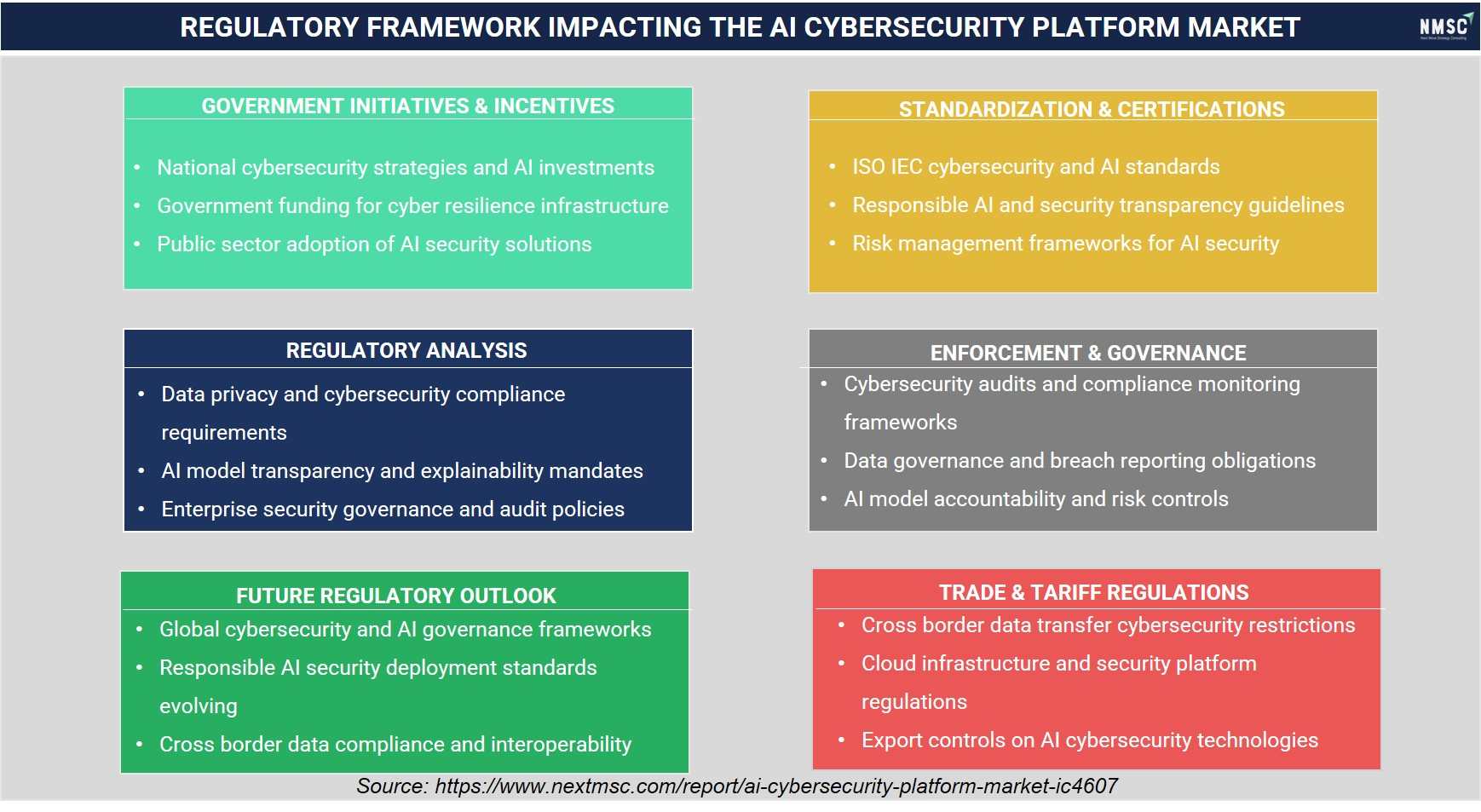
Based on NMSC’s evaluation, we noticed that the regulatory framework for AI cybersecurity platforms is evolving rapidly, driven by increasing emphasis on data privacy, AI transparency, and enterprise security governance. Moreover, standardization initiatives and certification frameworks are strengthening compliance consistency across global markets. In parallel, enforcement mechanisms, including audits and breach reporting obligations, are reinforcing accountability. This regulatory landscape, supported by government incentives and cross-border data policies, accelerates secure adoption while ensuring trust, compliance, and long-term market stability.
How Is the AI Cybersecurity Platform Market Segmented in This Report, And What Are the Key Insights from the Segmentation Analysis?
Market Highlights & Strategic Insights – AI Cybersecurity Platform Market:
|
Segments |
Key Takeaways |
|
Platform Category |
Identity and cloud security platforms lead adoption, driven by identity-centric architectures and multi-cloud expansion. ITDR and PAM gain traction as identity becomes the primary attack surface, while CSPM and CWPP expand with cloud complexity. Security analytics and SIEM evolve toward AI-driven detection, and SOAR platforms strengthen autonomous response. |
|
Deployment Model |
Cloud-native SaaS dominates due to scalability and faster deployment. Hybrid models grow among large enterprises managing legacy systems, while on-premise remains relevant in regulated sectors requiring strict data control. |
|
Customer Type |
Large enterprises lead demand due to complex infrastructures and high-risk exposure. Mid-market adoption grows through managed and cloud-based solutions, while small businesses adopt simplified, subscription-based platforms. |
|
Pricing Model |
Subscription-based models dominate, reflecting platform-led security adoption. Usage-based pricing grows in cloud and analytics solutions, while per-user and enterprise licensing support large-scale deployments. |
|
Sales Channel |
Direct sales lead enterprise adoption, while system integrators and channel partners support implementation. Cloud marketplaces expand procurement, and MSSPs drive adoption among mid-sized organizations. |
|
Industry Vertical |
BFSI leads due to regulatory and risk exposure, followed by government and defense. Healthcare adoption rises with data security needs, while IT, retail, manufacturing, and energy sectors expand with digital and operational risks. |
By Platform Category Insights
Which Platform Categories Drive Growth in the AI Cybersecurity Platform Market in 2025?
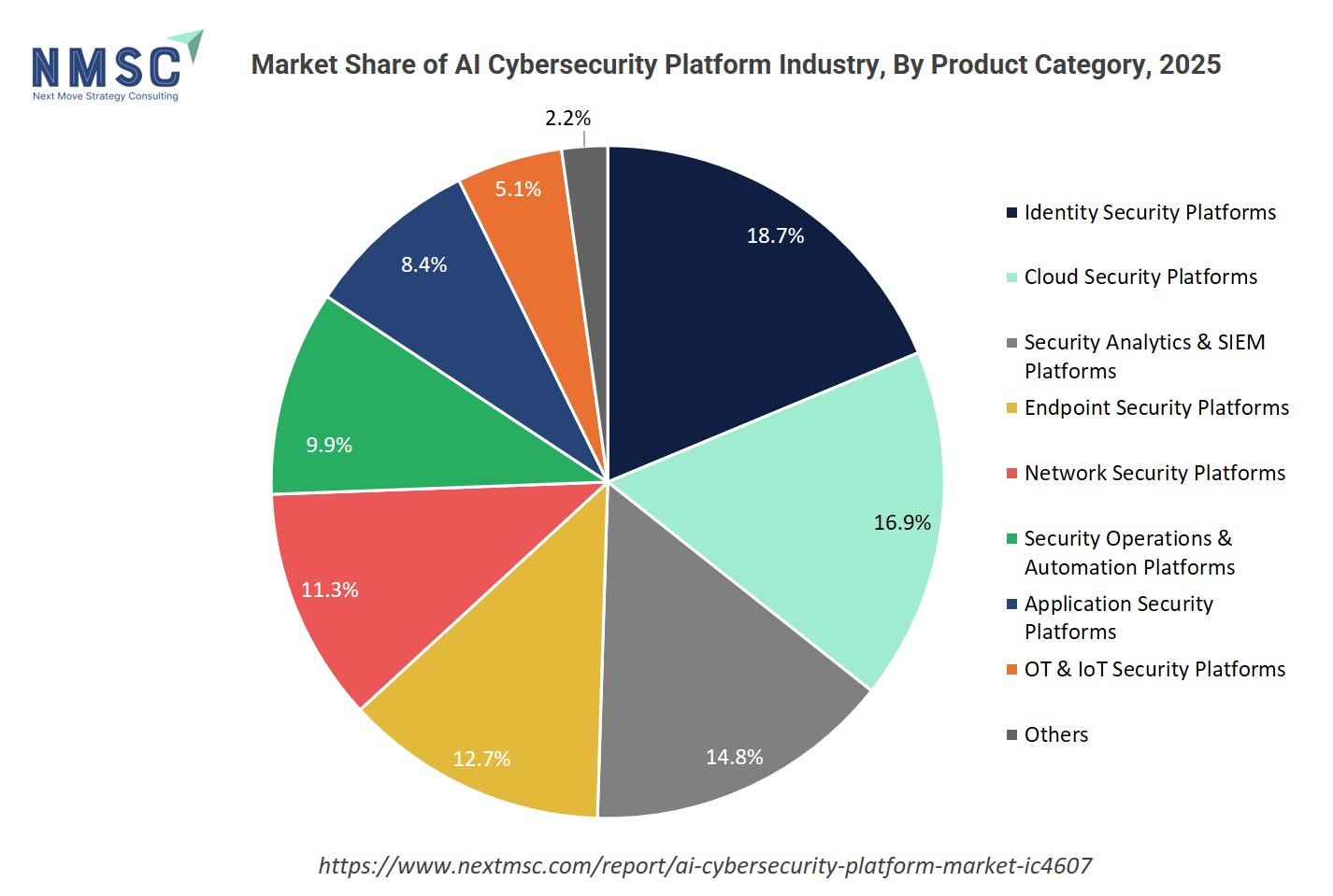
Based on our analysis of enterprise cybersecurity deployments, we observed that the AI cybersecurity platform market share is segmented into identity security, cloud security, network security, endpoint security, application security, security analytics & SIEM, and security operations & automation platforms.
From our evaluation of enterprise security architectures, we found that identity security platforms lead market growth, driven by the shift toward identity-centric security models and increasing identity-based attacks. Our interactions with enterprise security teams and identity management specialists indicate that Identity Threat Detection & Response (ITDR) and Privileged Access Management (PAM) are prioritized to secure human and machine identities across distributed environments. In addition, cloud security platforms gained strong traction as organizations secure multi-cloud infrastructures through CSPM and CWPP solutions. Security analytics and SIEM platforms continue evolving toward AI-driven detection, while SOAR and SOC automation platforms strengthen autonomous response capabilities. This progression establishes identity and cloud security as core control layers in modern cybersecurity architectures.
By Deployment Model Insights
How Does Deployment Model Influence Adoption in the AI Cybersecurity Platform Market?
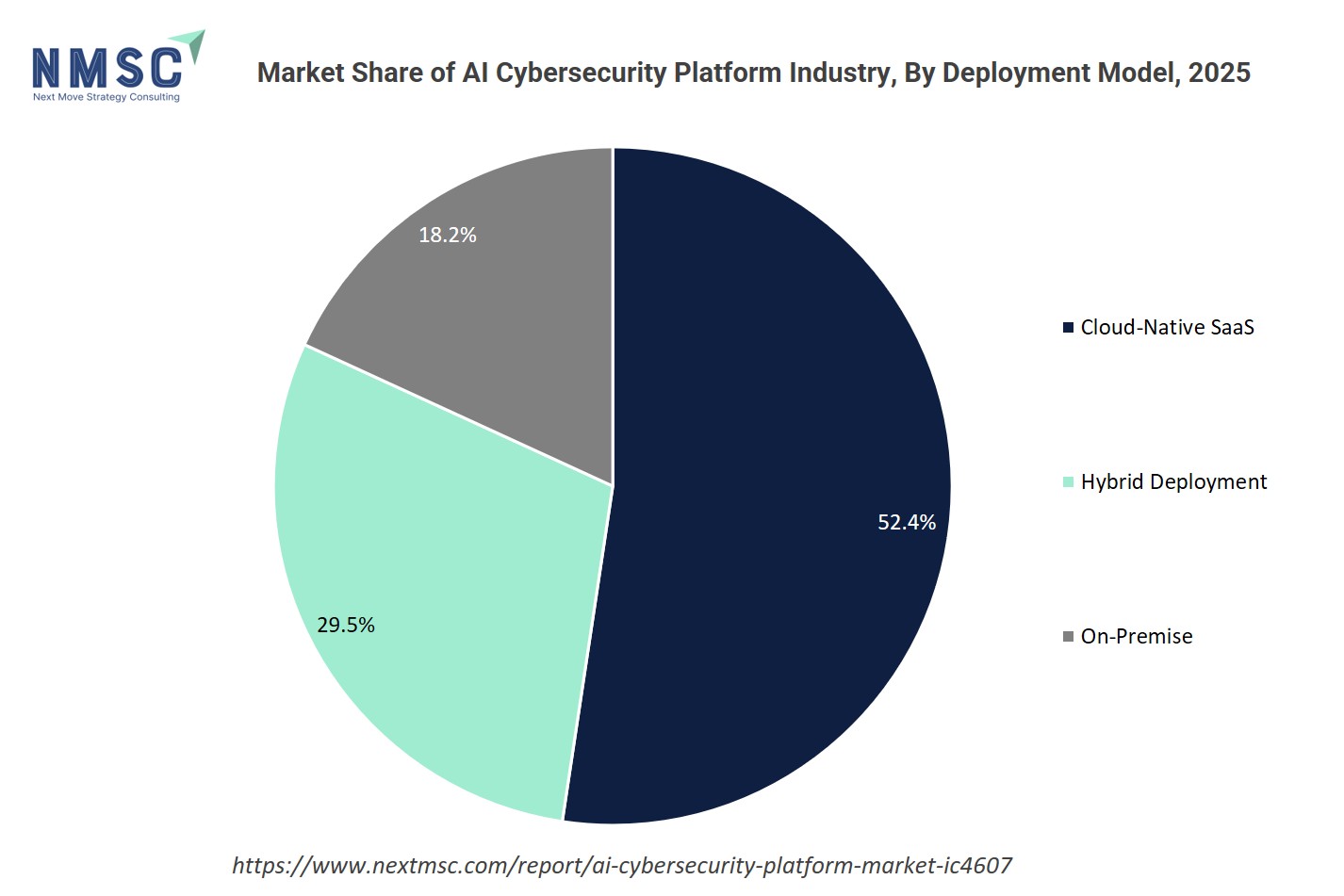
Based on our assessment of enterprise security implementations, we observed that the AI cybersecurity platform market is segmented into cloud-native SaaS, hybrid deployment, and on-premise models.
From our evaluation of adoption patterns, we identified that cloud-native SaaS dominates the market, driven by scalability, rapid deployment, and continuous updates across distributed digital infrastructure. Our interactions with enterprise IT teams and cloud architects indicate that organizations increasingly prefer SaaS-based security platforms to manage dynamic workloads and reduce infrastructure complexity. At the same time, hybrid deployment models gained importance among large enterprises balancing legacy systems with modern cloud environments. On-premise deployment remains relevant in regulated sectors where data sovereignty and compliance requirements influence deployment decisions. This shift reinforces cloud-first security strategies while maintaining flexibility for enterprise-specific requirements.
By Industry Vertical Insights
Which Industry Verticals Drive Demand in the AI Cybersecurity Platform Market?
Based on our analysis of industry-specific cybersecurity adoption, we observed that the AI cybersecurity platform market is segmented into BFSI, government and defense, digital healthcare, IT & telecom, retail & e-commerce, manufacturing, energy & utilities, and others.
Our assessment of threat exposure and security investments indicates that BFSI dominates AI cybersecurity platform market demand, driven by high-value digital assets, regulatory compliance requirements, and increasing frequency of financial cyberattacks. Our interactions with cybersecurity teams and risk management professionals indicate that financial institutions prioritise AI-driven threat detection and fraud prevention systems. In addition, government and defense sectors maintain strong adoption to secure critical infrastructure and national data systems. Healthcare demand continues to expand due to ransomware risks and sensitive patient data protection, while IT, retail, and manufacturing sectors strengthen adoption to secure digital transactions and operational systems. This pattern reflects risk-driven security investment across industries with varying threat intensities.
Regional Outlook:
Geographic Performance Snapshot:
|
Geography |
Key Takeaways |
|
North America |
North America leads the AI cybersecurity platform market, supported by advanced digital infrastructure, high cybersecurity spending, and early adoption of AI-driven security solutions. Strong presence of leading vendors and increasing ransomware and identity-based threats drive enterprise adoption across BFSI, healthcare, and government sectors. |
|
Europe |
Europe demonstrates strong growth driven by stringent data privacy regulations and focus on cybersecurity resilience. Regulatory frameworks and increasing enterprise investments in compliance-driven security solutions accelerate adoption across critical infrastructure and industrial sectors. |
|
Asia Pacific |
Asia Pacific emerges as the fastest-growing region, driven by rapid digital transformation, expanding cloud adoption, and rising cyber threat intensity. Government initiatives and increasing enterprise IT investments accelerate adoption of AI-driven security platforms across telecom, banking, and manufacturing sectors. |
|
Latin America |
Latin America shows steady growth supported by increasing digitalisation, cloud adoption, and rising cybersecurity awareness. Expanding enterprise IT infrastructure and growing demand for managed security services drive gradual market adoption. |
|
Middle East & Africa |
Middle East & Africa witness emerging adoption driven by expanding digital infrastructure, rising cyber risks, and government-led cybersecurity initiatives. Increasing investments in smart cities and critical infrastructure strengthen demand for AI-driven cybersecurity solutions. |
The AI cybersecurity platform market is geographically studied across North America, Europe, Asia Pacific, Latin America and Middle East & Africa and each region is further studied across countries.
AI Cybersecurity Platform Market in North America
North America stands as a mature, innovation-driven AI cybersecurity platform market, where advanced digital infrastructure, high cybersecurity spending, and strong enterprise readiness sustain demand. From our regional assessment, we identified that the region accounts for a significant share of global market revenue, supported by early adoption of AI-native security architectures across large enterprises. The United States drives large-scale deployments across BFSI, healthcare, and government sectors, while Canada demonstrates steady expansion through enterprise digitalisation and cloud security investments. Moreover, our analysis indicates that the rising frequency of ransomware, identity-based attacks, and zero-day exploits accelerates platform adoption across complex IT environments. Enterprises increasingly prioritise unified, platform-centric security models integrating endpoint, identity, and cloud protection. In parallel, regulatory emphasis on data privacy, AI governance, and cyber resilience strengthens demand for explainable and compliant AI-driven security solutions. This ecosystem continues to advance toward autonomous security operations, increasing average contract value and long-term platform adoption across the region.
AI Cybersecurity Platform Market in the United States
The United States remains the largest AI cybersecurity platform market in North America, accounting for the majority of regional demand driven by high digital maturity and extensive enterprise IT infrastructure. Based on our engagements with enterprise security teams and cybersecurity providers, we observed that adoption is driven by the need to address high-frequency cyberattacks, large-scale cloud deployments, and stringent security requirements across critical sectors. Further, our evaluation shows that organizations deploy AI-driven platforms to enhance threat detection, automate incident response, and strengthen zero-trust security frameworks. Advanced capabilities such as XDR, identity-centric security, and agentic AI SOCs dominate implementation strategies. Additionally, a strong ecosystem of cybersecurity vendors, cloud providers, and managed service firms supports rapid deployment and continuous platform innovation. The market increasingly shifts toward subscription-based and managed security models, strengthening recurring revenue streams and long-term vendor engagement.
AI Cybersecurity Platform Market in Canada
Based on our evaluation of enterprise security deployments and IT environments, we identified that Canada’s AI cybersecurity platform market advances through a structured, compliance-driven adoption model supported by increasing digitalisation and cloud integration. Financial institutions, healthcare providers, and public sector organizations deploy AI-driven platforms to strengthen threat detection and align with evolving data protection frameworks. Rising cyber risk exposure continues to reinforce investment in intelligent and automated security systems. Moreover, organizations prioritise integrated platforms that deliver continuous monitoring, identity-centric security, and real-time response across distributed infrastructures. Adoption follows a measured approach focused on governance, system reliability, and long-term performance. In parallel, expanding adoption of managed security services and subscription-based models supports scalable implementation and predictable spending. This approach strengthens operational resilience and sustains steady market expansion across Canada.
AI Cybersecurity Platform Market in Europe
Europe’s AI cybersecurity platform market reflects a regulation-intensive and resilience-driven landscape shaped by strict data protection frameworks and enterprise focus on governance. The region sustains strong adoption across financial services, industrial systems, and public infrastructure, where compliance requirements elevate demand for explainable and interoperable AI-driven security solutions. GDPR enforcement, AI governance policies, and cyber resilience mandates strengthen enterprise investment in identity-centric security and unified platforms. Moreover, Western Europe prioritises regulatory compliance and zero-trust architectures, while Northern Europe advances digital resilience and automation-led security operations. Southern Europe focuses on scalable and cost-efficient deployments aligned with enterprise transformation. In parallel, increasing integration of AI-driven threat intelligence, XDR platforms, and cloud-native security frameworks enhances real-time detection and operational efficiency. These dynamics strengthen vendor positioning, improve long-term platform reliability, and support sustained expansion across Europe’s cybersecurity ecosystem.
AI Cybersecurity Platform Market in the United Kingdom
The United Kingdom represents a digitally advanced AI cybersecurity platform market supported by strong enterprise adoption and mature cloud ecosystems. Organizations across financial services, government, and large enterprises deploy AI-driven platforms to address high-frequency cyber threats and evolving compliance requirements. Increasing ransomware incidents and identity-based attacks accelerate demand for real-time detection and automated response capabilities. Further, enterprises prioritise XDR platforms, identity-centric security models, and AI-enabled threat intelligence to strengthen operational resilience. A robust ecosystem of cybersecurity vendors, cloud providers, and managed service firms supports rapid deployment and continuous innovation. In parallel, regulatory emphasis on data protection and operational transparency reinforces adoption of compliant and explainable AI systems. This environment strengthens long-term vendor engagement, drives recurring revenue models, and sustains the UK’s leadership in AI cybersecurity adoption.
AI Cybersecurity Platform Market in Germany
Through our evaluation of enterprise security deployments and industrial IT environments, we found that Germany’s AI cybersecurity platform market advances through a disciplined, engineering-led adoption model anchored in reliability and system integrity. Industrial enterprises, automotive manufacturers, and critical infrastructure operators deploy AI-driven platforms to secure interconnected production systems and cloud-integrated environments. Moreover, organizations prioritise solutions that deliver real-time monitoring, identity-centric control, and automated threat response across complex operational networks. Strong emphasis on certifications, compliance standards, and long-term system performance shapes vendor selection. In parallel, collaboration between cybersecurity providers, system integrators, and industrial enterprises supports high-value, customised deployments. This structured approach strengthens platform reliability, enhances enterprise trust, and sustains premium growth across Germany’s cybersecurity ecosystem.
AI Cybersecurity Platform Market in France
In France, the market demonstrates steady expansion supported by regulatory alignment and increasing enterprise focus on cyber resilience. Financial institutions, healthcare systems, and public sector organizations adopt AI-driven platforms to enhance threat detection and ensure compliance with evolving data protection requirements. Moreover, we noticed that enterprises prioritise solutions that integrate real-time monitoring, identity security, and data governance across cloud and hybrid infrastructures. National emphasis on digital sovereignty and secure data handling strengthens demand for locally compliant AI systems. In parallel, vendors offering strong integration capabilities and localised deployment support achieve higher enterprise adoption. This trend enhances operational efficiency, strengthens regulatory compliance, and supports consistent AI cybersecurity platform market growth across France’s cybersecurity landscape.
AI Cybersecurity Platform Market in Italy
Through our assessment of enterprise IT environments and security modernization initiatives, we identified that Italy’s AI cybersecurity platform market evolves through increasing digital transformation and infrastructure protection requirements. Financial services, manufacturing firms, and public institutions deploy AI-driven platforms to strengthen cyber resilience and secure expanding digital operations. Moreover, organizations prioritise scalable and modular solutions capable of integrating with legacy systems and distributed infrastructures. Government-led digitalisation initiatives and cybersecurity awareness programs reinforce enterprise investment in AI-based security frameworks. In parallel, growing adoption of managed security services and flexible deployment models supports broader penetration across mid-sized enterprises. This approach strengthens long-term system performance, enhances operational security, and sustains steady expansion across Italy’s cybersecurity ecosystem.
AI Cybersecurity Platform Market in Spain
The AI cybersecurity platform market in Spain is evolving as enterprises respond to increasing operational complexity across digitally expanding service environments. Banking, telecom, and retail sectors drive adoption as organizations manage high transaction volumes and distributed customer interfaces. Based on our evaluation of enterprise security deployments and IT environments, we observed that Spain demonstrates strong momentum in automation-led security adoption, where enterprises prioritise platforms that reduce manual intervention and improve operational efficiency. At the same time, rising cost pressures and fragmented infrastructures reinforce demand for scalable and integrated solutions. Consequently, platforms combining ease of deployment with strong interoperability gain faster traction. This positions Spain as an efficiency-driven cybersecurity market, where automation and operational simplicity define long-term platform demand.
AI Cybersecurity Platform Market in the Nordics
Enterprise cybersecurity adoption across the Nordics reflects a trust-centric and governance-led model, supported by advanced digital infrastructure and strong regulatory maturity. Sweden, Finland, and Norway demonstrate early and structured adoption across public systems, financial services, and critical infrastructure. Notably, the region differentiates through its emphasis on transparent and explainable AI security systems, where organizations prioritise accountability alongside performance. Moreover, high institutional trust in automation accelerates adoption of identity-centric security, autonomous response, and real-time intelligence platforms. From our evaluation of enterprise security frameworks and regulatory alignment, we identified that buyers consistently favour solutions with open architectures, interoperability, and strong governance credentials. This positions the Nordics as a trust-driven cybersecurity market, where transparency, compliance, and long-term reliability define competitive advantage.
AI Cybersecurity Platform Market in Asia-Pacific
Based on our evaluation of regional cybersecurity deployments and enterprise IT environments, we observed that Asia-Pacific represents the largest and fastest-growing AI cybersecurity platform market, driven by rapid digital transformation, expanding cloud ecosystems, and increasing cyber threat intensity. Large-scale adoption across China, Japan, South Korea, and Southeast Asia is supported by growing enterprise reliance on AI-driven threat detection and automated security operations. Moreover, distinct adoption patterns define the region, where China drives scale and cost efficiency, Japan emphasises reliability and precision, South Korea advances early technology integration, and Southeast Asia accelerates deployment across digital-first economies. In parallel, government-led cybersecurity initiatives and strong local technology ecosystems reduce deployment barriers and strengthen enterprise readiness. Additionally, increasing integration of AI-driven threat intelligence and identity-centric platforms enhances real-time response capabilities. This dynamic ecosystem supports scalable adoption and sustains long-term market expansion across Asia-Pacific.
AI Cybersecurity Platform Market in China
China’s AI cybersecurity platform market is characterized by scale-driven deployment and strong domestic ecosystem control supported by government-led digital security initiatives. The country accounts for the largest share of regional demand, driven by rapid enterprise digitalisation and widespread adoption of cloud-native infrastructures across industries. Domestic cybersecurity providers shape platform architectures, identity frameworks, and threat intelligence systems, enabling rapid innovation cycles. Moreover, we noticed that organizations across e-commerce, financial services, and industrial sectors deploy AI-driven platforms to secure high-volume digital environments and manage sophisticated cyber threats. Strong integration between domestic cloud providers, AI developers, and enterprise systems accelerates deployment and operational efficiency. In parallel, regulatory frameworks around data sovereignty and cybersecurity standards reinforce localized platform adoption. Additionally, continuous investments in AI-driven security analytics and automation strengthen long-term scalability. This ecosystem positions China as a global scale leader, supporting sustained expansion in AI cybersecurity platforms.
AI Cybersecurity Platform Market in Japan
Through our assessment of enterprise security deployments and digital infrastructure environments, we identified that Japan’s AI cybersecurity platform market advances through a reliability-focused and precision-driven adoption model supported by high digital standards and strong enterprise governance. Organizations across manufacturing, financial services, and public infrastructure deploy AI-driven platforms to ensure operational continuity and strengthen cyber resilience. Moreover, enterprises prioritise high-accuracy threat detection, system stability, and long-term service reliability, driving adoption of identity-centric security, real-time monitoring, and automated response systems. Further, strong preference for certified solutions, trusted vendors, and local service support shapes procurement decisions across high-value deployments. In parallel, integration with legacy systems and advanced digital infrastructure enhances platform effectiveness and operational efficiency. This structured approach strengthens enterprise trust, improves system performance, and sustains steady growth across Japan’s cybersecurity ecosystem.
AI Cybersecurity Platform Market in India
India represents a high-growth AI cybersecurity platform market, driven by rapid digitalisation, expanding cloud adoption, and increasing enterprise exposure to cyber threats. Financial services, e-commerce platforms, and public digital infrastructure actively deploy AI-driven security solutions to manage large-scale digital ecosystems and high transaction volumes. Rising adoption of digital payments and government-led digital initiatives further strengthen demand for real-time threat detection and automated response systems. Moreover, organizations prioritise cost-efficient and scalable platforms capable of securing distributed environments and hybrid infrastructures. Based on our interactions with enterprise IT environments and cybersecurity providers, we observed that vendors offering modular deployment models, cloud-native security, and strong local integration capabilities achieve faster adoption. In parallel, increasing demand for managed security services supports broader penetration across mid-sized enterprises. This dynamic strengthens India’s position as a rapidly expanding and innovation-driven cybersecurity market.
AI Cybersecurity Platform Market in South Korea
South Korea demonstrates an advanced, technology-driven AI cybersecurity platform market characterized by high digital maturity and rapid adoption of next-generation security capabilities. Enterprises across telecom, electronics, and financial sectors deploy AI-driven platforms to secure highly connected digital infrastructures and real-time service environments. From our engagements with enterprise security teams and technology providers, we identified strong adoption of integrated security platforms combining AI-driven threat intelligence, automated response, and identity-centric security frameworks. Moreover, domestic technology ecosystems and strong collaboration between telecom operators, cloud providers, and cybersecurity vendors accelerate innovation and deployment speed. In parallel, organizations prioritise high-performance, low-latency security systems aligned with advanced digital services. This environment supports premium solution adoption, strengthens platform integration, and positions South Korea as a leader in advanced AI cybersecurity implementation.
AI Cybersecurity Platform Market in Taiwan
Taiwan’s AI cybersecurity platform market is driven by semiconductor fabs and critical IP protection requirements. Enterprises across semiconductor manufacturing, electronics, and high-value goods sectors deploy AI-driven security platforms to protect intellectual property and secure complex supply chains. Moreover, organizations prioritise system reliability, interoperability, and real-time monitoring across integrated industrial and enterprise environments. Through our assessment of enterprise security deployments and industrial IT systems, we identified that AI-driven platforms play a critical role in securing connected manufacturing processes and cloud-integrated operations. In parallel, pilot deployments and phased implementation strategies support validation of security performance and return on investment. Vendors offering seamless integration with existing enterprise systems and strong technical support achieve faster scaling. This approach strengthens Taiwan’s cybersecurity maturity and supports sustained adoption of advanced AI security solutions.
AI Cybersecurity Platform Market in Indonesia
Indonesia’s AI cybersecurity platform market is expanding through a capacity-building phase, where enterprises strengthen foundational security capabilities alongside rapid digital growth. E-commerce platforms, fintech ecosystems, and cloud-based services drive adoption across major urban centres. Through our assessment of enterprise IT environments and regional deployments, we noticed that organizations prioritise accessible and easy-to-deploy security platforms that operate effectively with limited in-house expertise. Unlike mature markets, demand strongly shifts toward managed security services and cloud-native solutions that externalize operational complexity. In parallel, partnerships with local integrators enable deployment and long-term scalability. As a result, Indonesia evolves as a service-led cybersecurity market, where simplicity, affordability, and ecosystem support drive expansion.
AI Cybersecurity Platform Market in Australia
Based on our evaluation of enterprise security deployments and critical infrastructure environments, we found that Australia’s AI cybersecurity platform market is defined by high enterprise security maturity and elevated spending intensity, supported by strong regulatory oversight and resilience-focused security strategies. Organizations across financial services, mining, and public sector systems deploy advanced AI-driven platforms to secure geographically dispersed operations and sensitive infrastructure. Moreover, enterprises prioritise continuous monitoring, automated response, and system reliability to ensure uninterrupted operations across distributed environments. At the same time, demand strengthens for integrated platforms combining analytics, automation, and lifecycle services, enabling long-term performance and accountability. In parallel, buyers favour vendors offering end-to-end capabilities and strong service support, reinforcing recurring engagement models. This positions Australia as a high-value cybersecurity market, where resilience, performance, and service depth drive sustained adoption.
AI Cybersecurity Platform Market in Latin America
The AI cybersecurity platform market in Latin America is characterized by a security outsourcing–driven adoption model, where enterprises increasingly rely on external expertise to manage cyber risks. Brazil, Mexico, and Chile lead demand across financial services, telecom, and digital commerce ecosystems. Based on our evaluation of enterprise security operations and regional adoption patterns, we assessed that organizations prioritise managed detection and response (MDR) and platform-based security services over fully in-house capabilities. This shift is reinforced by skill gaps and the need for continuous monitoring across complex environments. Consequently, vendors offering integrated platforms combined with managed services achieve stronger traction. This establishes Latin America as a service-centric cybersecurity market, where outsourcing and scalability define long-term growth.
AI Cybersecurity Platform Market in Middle East & Africa
Through our assessment of enterprise cybersecurity deployments and digital infrastructure expansion, we identified that the Middle East & Africa region demonstrates emerging yet rapidly advancing adoption of AI cybersecurity platforms, driven by increasing digital transformation and rising exposure to cyber threats. Countries such as the UAE, Saudi Arabia, and South Africa lead adoption through investments in smart infrastructure, financial systems, and government digital initiatives. Moreover, organizations across critical infrastructure, energy, and public sector environments deploy AI-driven platforms to strengthen threat detection, protect sensitive data, and ensure operational continuity. In parallel, government-led cybersecurity frameworks and national digital strategies reinforce demand for compliant and resilient security solutions. Additionally, increasing reliance on cloud services and connected systems accelerates adoption of automated and intelligence-driven platforms. This landscape strengthens regional cybersecurity capabilities and supports long-term expansion of AI-driven security solutions across the Middle East & Africa.
SWOT Analysis of the AI Cybersecurity Platform Market
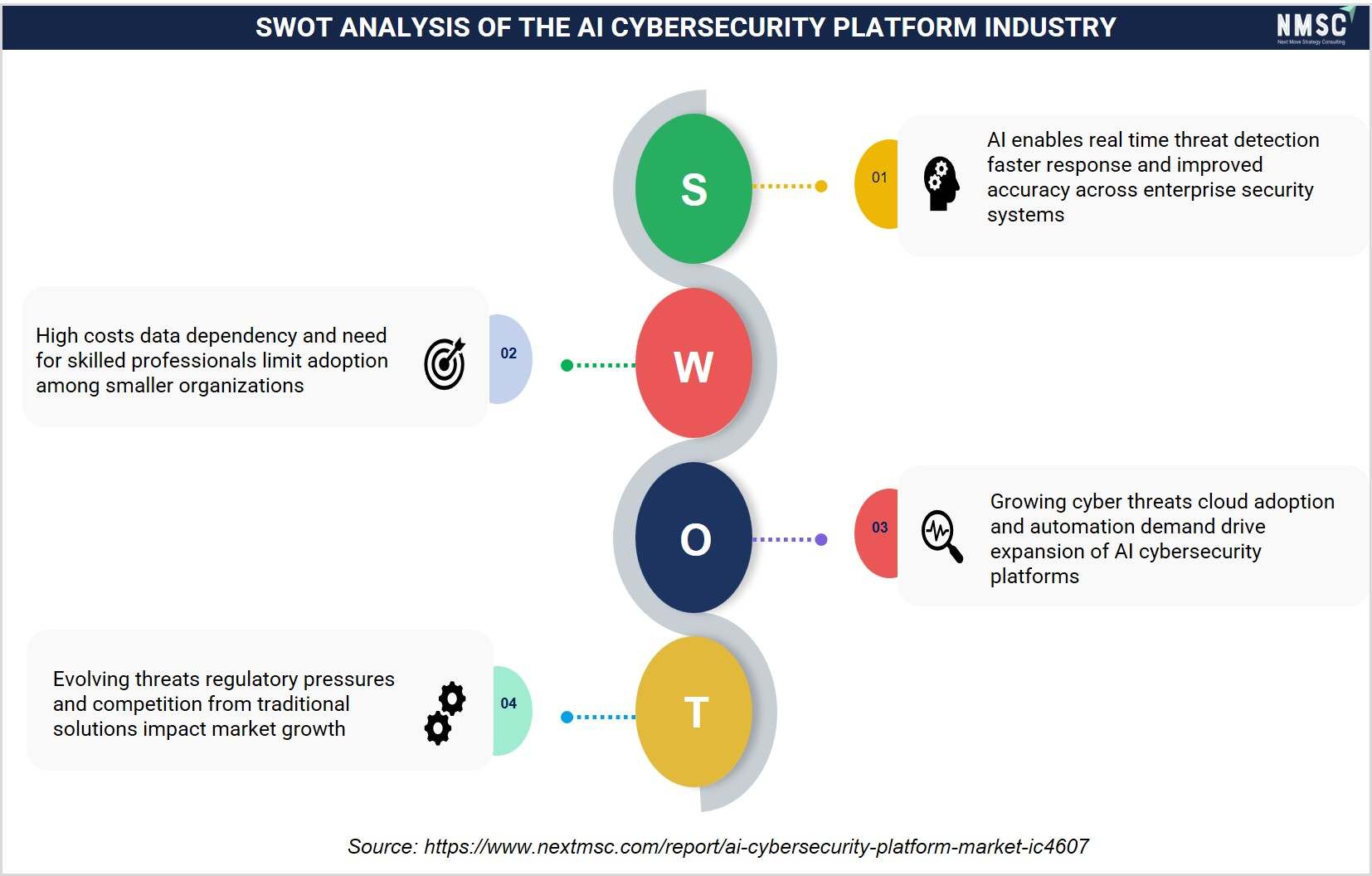
Based on NMSC’s evaluation, we noticed that the AI cybersecurity platform market demonstrates strong strengths through real-time threat detection, automated response, and enhanced accuracy across enterprise environments. Moreover, weaknesses persist in the form of high implementation costs, data dependency, and reliance on skilled professionals, particularly impacting smaller organizations. In parallel, growing cyber threats, cloud adoption, and automation demand create significant expansion opportunities. This dynamic reflects a transition toward governance-driven AI security, where platform performance and explainability evolve simultaneously.
Competitive Landscape
Competitive Dynamics & M&A Landscape:
|
Key Takeaways |
|
The AI cybersecurity platform market is led by global technology providers alongside AI-native security firms. Companies such as Palo Alto Networks, Microsoft, IBM, Cisco, Check Point, and Fortinet leverage integrated platforms and strong enterprise reach, while players like CrowdStrike, Zscaler, SentinelOne, Darktrace, Wiz, Orca Security, and Securonix compete through advanced AI-driven threat detection and cloud-native security capabilities. |
|
From our assessment of competitive strategies, we found companies prioritise platform consolidation, AI-driven security operations, and identity-centric architectures to deliver unified protection across hybrid environments. Additionally, expansion of cloud security, XDR platforms, and managed detection and response (MDR) services continue to shape market innovation. |
|
Recent developments highlight increasing focus on strategic partnerships, acquisitions, and portfolio expansion to strengthen cloud security and real-time threat intelligence capabilities. This approach enhances platform integration, supports automation-driven security operations, and strengthens long-term competitive positioning across the market. |
Which Companies Dominate the AI Cybersecurity Platform Industry and How Do They Compete?
Our analysis indicates that the AI cybersecurity platform market is led by global technology providers alongside AI-native security specialists. Companies such as Palo Alto Networks, Microsoft, IBM, Cisco, Check Point, and Fortinet dominate large-scale enterprise deployments where platform integration, reliability, and global service capabilities remain critical decision factors. From our evaluation of enterprise security environments, we identified that these vendors are consistently selected for unified architectures integrating endpoint, network, identity, and cloud protection across complex hybrid ecosystems. Moreover, their ability to deliver end-to-end visibility, centralized control, and seamless interoperability strengthens enterprise trust and long-term adoption. As a result, competition at this level is driven by platform depth, scalability, and execution across multi-layered security environments.
Market Dominated by AI Cybersecurity Platform Giants and Specialists
From our observation, we found that AI-native cybersecurity firms such as CrowdStrike, SentinelOne, Darktrace, Vectra AI, Wiz, Orca Security, and Securonix strengthen competition through advanced threat detection, autonomous response, and cloud-native security capabilities. In addition, our interactions with enterprise security teams indicate that these players gain traction through rapid deployment, AI-driven analytics, and flexible platform-based models that significantly reduce operational complexity and time-to-value. Notably, their focus on behavioral analytics, real-time anomaly detection, and continuous learning systems enables faster threat identification across dynamic environments. Consequently, while large technology providers establish platform standards, AI-native firms accelerate innovation and adoption through software-centric, intelligence-driven solutions.
Innovation and Adaptability Drive Market Success
Innovation remains a key differentiator in the AI cybersecurity platform market, as observed through our assessment of enterprise deployments and live security operations. Leading players continue to advance capabilities in AI-driven threat intelligence, identity-centric security, and automated response systems that operate at machine speed. Further, from our market evaluation, we identified that vendors investing in unified platforms, real-time analytics, and scalable architectures are better positioned to support multi-cloud and distributed enterprise infrastructures. At the same time, integration with SIEM, SOAR, and identity management systems enhances operational efficiency and reduces response latency. Consequently, these advancements reflect deep expertise in AI modelling, cloud security, and data analytics, enabling continuous adaptation to evolving threat landscapes and strengthening long-term customer engagement.
Market Players to Opt for Merger & Acquisition Strategies to Expand Their Presence
Based on our primary research, we found that mergers, acquisitions, and strategic partnerships act as key growth levers as companies expand platform capabilities and accelerate innovation cycles. Vendors increasingly target firms specializing in cloud security, AI analytics, identity management, and threat intelligence to strengthen end-to-end offerings. For instance, in January 2026, Palo Alto Networks acquired Chronosphere, a cloud-native monitoring platform, to enhance real-time visibility across infrastructure and AI systems while optimising data costs, reflecting a clear shift toward integrated, intelligence-driven security platforms. In parallel, partnerships with cloud providers and managed security service firms enhance deployment reach and ecosystem integration. Additionally, our analysis indicates that these strategies improve platform interoperability, reduce deployment complexity, and support scalable security operations across enterprise environments. Therefore, as competition intensifies, consolidation continues to strengthen platform depth, service capabilities, and long-term enterprise engagement across the AI cybersecurity platform market.
List of Key AI Cybersecurity Platform Companies
-
Microsoft Corporation
-
Check Point Software Technologies Ltd.
-
Fortinet, Inc.
-
CrowdStrike Holdings, Inc.
-
Zscaler, Inc.
-
Trend Micro Incorporated
-
SentinelOne, Inc.
-
Darktrace plc
-
Sophos Limited
-
Rapid7, Inc.
-
Okta, Inc.
-
Vectra AI, Inc.
-
Reliaquest, LLC
-
Wiz, Inc.
-
Orca Security Ltd.
-
Abnornal AI, Inc.
-
Securonix, Inc.
What Are the Latest Key Industry Developments?
-
April 2026 – IBM launched Autonomous Security, a multi-agent AI system designed to counter agentic attacks through automated vulnerability remediation at machine speed, signalling a shift toward fully autonomous security operations.
-
March 2026 – SentinelOne introduced agentic AI security solutions enabling one-click forensic investigations, reflecting growing demand for automation and reduced analyst dependency.
Expert Insights
“If we want to both secure AI systems and also ensure privacy, we need to scrutinise how these systems work. ENISA is looking into the technical complexity of AI to best mitigate the cybersecurity risks. We also need to strike the right balance between security and system performance.”
Juhan Lepassaar
Statement made during ENISA’s discussion on secure and trustworthy artificial intelligence, emphasizing the need to address cybersecurity, privacy, and performance challenges in AI system deployment.
Market Interpretation
The statement highlights the growing regulatory and technical focus on securing AI systems as enterprises increasingly integrate artificial intelligence into cybersecurity operations. As AI-driven platforms become more sophisticated, concerns around privacy protection, model transparency, and cyber risk mitigation are driving demand for secure-by-design security architectures. This is accelerating investments in AI-powered cybersecurity platforms that can balance threat detection performance with compliance, explainability, and data protection requirements.
What Are the Key Factors Influencing Investment Analysis & Opportunities in the AI Cybersecurity Platform Market?
Investment analysis in the AI cybersecurity platform market is increasingly shaped by a shift in capital allocation toward platform-centric and service-led security models, rather than standalone point solutions. Based on our evaluation of recent funding activity, M&A transactions, and strategic partnerships, we observed that investors prioritise vendors with recurring revenue streams derived from subscription-based platforms, managed detection and response (MDR), and AI-driven security analytics. Companies demonstrating strong AI model accuracy, unified platform architectures, and seamless integration across endpoint, network, identity, and cloud environments consistently attract premium valuations.
We also identified investment concentration around agentic AI security operations, identity-centric security frameworks, and real-time threat intelligence platforms, particularly in solutions addressing high-velocity cyber threats, zero-day vulnerabilities, and complex hybrid IT environments. Strategic investments increasingly outweigh purely financial funding, as cloud providers, enterprises, and cybersecurity vendors seek platform consolidation, ecosystem control, and accelerated innovation. For investors, the most compelling opportunities emerge in vendors combining technological differentiation with scalable deployment models, proven security outcomes, and long-term platform extensibility.
Key Benefits for Stakeholders:
Next Move Strategy Consulting (NMSC) presents a comprehensive analysis of the AI cybersecurity platform market trends, covering historical developments from 2020 to 2025 and providing forward-looking forecasts through 2035. The study evaluates the market at global, regional, and country levels, delivering quantitative forecasts alongside qualitative insights into key growth drivers, adoption barriers, technology shifts, and investment trends.
From our observation, we noticed the AI cybersecurity platform market delivers measurable value across a diverse stakeholder base. Investors benefit from recurring revenue streams driven by subscription-based platforms, managed detection and response (MDR), and AI-driven analytics. Enterprises and security operations teams enhance threat detection accuracy, reduce response time, and strengthen operational resilience through automation and real-time intelligence. In addition, cloud providers, system integrators, and cybersecurity vendors benefit from platform expansion, ecosystem partnerships, and long-term service contracts. By aligning AI-driven security innovation with enterprise risk management and compliance requirements, the market creates sustained value while strengthening digital trust and long-term cybersecurity resilience.
|
Parameters |
Details |
|
Customization Scope |
Free customization (equivalent to up to 80 analyst-working hours) after purchase. Addition or alteration to country, regional & segment scope. |
|
Pricing and Purchase Options |
Avail customized purchase options to meet your exact research needs. |
|
Approach |
In-depth primary and secondary research; proprietary databases; rigorous quality control and validation measures. |
|
Analytical Tools |
Porter's Five Forces, SWOT, value chain, and Harvey ball analysis to assess competitive intensity, stakeholder roles, and relative impact of key factors. |
AI Cybersecurity Platform Market Key Segments
By Platform Category
-
Endpoint Security Platforms
-
Endpoint Detection and Response
-
Endpoint Protection Platform
-
Mobile Threat Defense
-
-
Network Security Platforms
-
Network Detection and Response
-
Network Traffic Analysis
-
Secure Access Service Edge Platform
-
Firewall Software Platforms
-
-
Cloud Security Platforms
-
Cloud Security Posture Management
-
Cloud Workload Protection Platform
-
Cloud Infrastructure Entitlement Management
-
Container and Kubernetes Security
-
-
Application Security Platforms
-
Static Application Security Testing
-
Dynamic Application Security Testing
-
Runtime Application Self Protection
-
API Security Platforms
-
-
Identity Security Platforms
-
Identity Threat Detection and Response
-
Privileged Access Management
-
Identity Governance and Administration
-
Authentication and Risk Intelligence
-
-
Security Analytics & SIEM Platforms
-
Security Information and Event Management
-
User and Entity Behavior Analytics
-
Threat Intelligence Platforms
-
AI Driven Security Analytics
-
-
Security Operations and Automation Platforms
-
Security Orchestration Automation and Response
-
Incident Response Platforms
-
SOC Automation Platforms
-
-
OT and IoT Security Platforms
-
Industrial Control System Security
-
IoT Device Security Platforms
-
Operational Technology Threat Detection
-
-
Others
By Deployment Model
-
Cloud-Native SaaS
-
Hybrid Deployment
-
On-Premise
By Customer Type
-
Large enterprise
-
Mid-market
-
Small business
By Pricing Model
-
Subscription recurring
-
Per user pricing
-
Per device pricing
-
Usage-based pricing
-
Enterprise license agreement
By Sales Channel
-
Direct enterprise sales
-
Channel partners
-
Value-added resellers
-
System integrators
-
-
Cloud marketplaces
-
Managed security providers
By Industry Vertical
-
BFSI
-
Government and Defense
-
Healthcare
-
IT & Telecom
-
Retail & Ecommerce
-
Manufacturing
-
Energy & Utilities
-
Others
Geographical Breakdown
-
North America: U.S., Canada, and Mexico.
-
Europe: UK, Germany, France, Italy, Spain, Sweden, Denmark, Finland, the Netherlands, and the Rest of Europe.
-
Asia Pacific: China, India, Japan, South Korea, Taiwan, Indonesia, Vietnam, Australia, Philippines, Malaysia and the rest of APAC.
-
Middle East & Africa (MEA): Saudi Arabia, UAE, Egypt, Israel, Turkey, Nigeria, South Africa, and the rest of MEA.
-
Latin America: Brazil, Argentina, Chile, Colombia, and the rest of LATAM.
Conclusion & Recommendations
This report provides stakeholders, service providers, investors, and consultants with actionable insights to capitalise on the structural transformation underway in the market. By combining rigorous data-driven analysis with proven strategic frameworks, NMSC’s AI Cybersecurity Platform Market report serves as a critical decision-support resource for navigating an increasingly complex and rapidly evolving threat landscape. The market is positioned for sustained expansion, supported by the rising scale and sophistication of AI-driven cyberattacks, growing enterprise digitalisation, and increasing reliance on cloud and hybrid infrastructures. Key strategic insights highlight the shift toward autonomous, platform-centric security architectures, agentic AI-driven operations, and identity-centric security models, as these capabilities strengthen real-time threat detection, operational efficiency, and long-term security resilience. Vendors that prioritise AI model accuracy, unified platform integration, and scalable deployment frameworks achieve stronger customer retention and recurring revenue growth.
For executives and investors, capturing value requires focusing on high-impact areas such as autonomous security operations, identity-driven access control, and AI-powered threat intelligence, while continuing investments in explainable AI, platform interoperability, and regulatory compliance frameworks. Expanding presence across digitally advanced enterprises and critical infrastructure sectors unlocks significant demand potential. Scalability, real-time response capabilities, and measurable risk reduction outcomes further strengthen vendor credibility and accelerate adoption, creating durable value across the global AI cybersecurity ecosystem.


About the Author
 Saista Faiyaz
— Saista Faiyaz is Research Associate at Next Move Strategy Consulting, where she has covered consumer markets and healthcare technologies for 3 years. Her work includes primary interview review, secondary-source validation, market sizing, and structured analysis of company and industry data. She supports research by comparing evidence across sources, organizing findings into market narratives, and documenting assumptions used in analysis. Her scope includes cross-market benchmarking, and reports.
Saista Faiyaz
— Saista Faiyaz is Research Associate at Next Move Strategy Consulting, where she has covered consumer markets and healthcare technologies for 3 years. Her work includes primary interview review, secondary-source validation, market sizing, and structured analysis of company and industry data. She supports research by comparing evidence across sources, organizing findings into market narratives, and documenting assumptions used in analysis. Her scope includes cross-market benchmarking, and reports.
About the Reviewer
 Supradip Baul
— Supradip Baul is an accomplished business consultant and strategist with over a decade of rich experience in market intelligence, strategy, technology, and business transformation. His work has included rigorous qualitative and quantitative analysis across multiple industries, helping clients shape investment decisions and long-term roadmaps. Earlier in his career, he was associated with Gartner, where he contributed to industry-leading reports and market share analyses. He has worked with leading global companies and holds an MBA with a dual specialization in Marketing and Finance.
Supradip Baul
— Supradip Baul is an accomplished business consultant and strategist with over a decade of rich experience in market intelligence, strategy, technology, and business transformation. His work has included rigorous qualitative and quantitative analysis across multiple industries, helping clients shape investment decisions and long-term roadmaps. Earlier in his career, he was associated with Gartner, where he contributed to industry-leading reports and market share analyses. He has worked with leading global companies and holds an MBA with a dual specialization in Marketing and Finance.
At Next Move Strategy Consulting, we understand that insightful market research is the cornerstone of successful business decisions. That's why we employ a robust and multifaceted approach, combining various methodologies to deliver the most accurate and actionable data for our clients.

Research Landscape
We navigate the world of research with two primary approaches:
Qualitative Approach
Our qualitative research methodologies involve immersive techniques such as in-depth interviews, focus groups, and observational studies. By engaging directly with individuals and stakeholders, we uncover valuable insights that quantitative data alone may overlook.

Quantitative Research
In tandem with qualitative methodologies, NMSC leverages the power of Quantitative Research to provide a robust foundation of numerical insights. Through systematic data collection and analysis, we quantify patterns, preferences, and market trends, offering a comprehensive view of the business landscape.
Our quantitative research approach employs diverse tools, including surveys, experiments, and statistical modelling. These methodologies enable us to gather data from a large and representative sample, ensuring the statistical significance of our findings. By employing structured questionnaires and standardized data collection methods, we guarantee the reliability and validity of the information we present to our clients.
Quantitative research is particularly effective in measuring the prevalence of trends, assessing market size, and gauging the impact of various factors on consumer behavior. The numerical precision attained through this approach equips our clients with actionable insights, facilitating data-driven decision-making and strategy formulation.


Our Specialized Toolbox for Industry-Specific Market Research
We deploy a specialized arsenal of techniques tailored to meet your unique requirements. Here's a glimpse into our comprehensive toolbox:

Information Procurement
The stage entails acquiring market data or relevant information through various sources and methodologies.


Market Research Approach
We utilize both top-down and bottom-up approaches in market research analysis to achieve a comprehensive understanding of the market dynamics, leveraging the broad perspective of industry trends and macroeconomic factors alongside detailed insights from specific segments and individual companies.

Porters Five Forces Analysis
We conduct Porter's Five Forces analysis to evaluate the competitive landscape of an industry, providing us with insights into factors that affect profitability and strategic positioning.

SWOT Analysis

Forecasting
We utilize a forecasting model to predict future consumption by considering parameters like population, economics, regulations, market competition, drivers, constraints, technology, and pricing. We also employ statistical techniques such as multilinear regression, exponential smoothing, moving average, ARIMA, and Monte Carlo simulations for accurate predictions. In econometric forecasting, we analyzed short-term and long-term event impacts, attributing values based on regulatory frameworks, economic factors, and market events.





 Speak to Our Analyst