Managed SIEM Services Market Global Industry Analysis and Forecast (2026–2035)

The global Managed SIEM Services Market size was valued at USD 4.85 billion in 2025 and is estimated at USD 5.55 billion in 2026, forecast to reach USD 19.80 billion by 2035, expanding at a 15.1% CAGR between 2025 and 2035. North America leads with approximately 42% share, while Managed Detection and Monitoring dominates all other service types with approximately 30% share.

Download Free Sample PDF
Base Year (2025)
$4.85 Billion
Forecast (2035)
$19.80 Billion
CAGR (2026-2035)
15.1%
Top Region
North America

What Is the Managed SIEM Services Market Size?

The global managed SIEM services market size was valued at USD 4.85 billion in 2025 and is estimated at USD 5.55 billion in 2026, forecast to reach USD 19.80 billion by 2035, expanding at a 15.1% CAGR between 2025 and 2035. North America leads with approximately 42% share, while managed detection and monitoring dominates all other service types with approximately 30% share.

We observed that growth is broad-based across every segmentation axis, with threat intelligence integration and cloud-based deployment adoption among small and medium enterprises driving the dominant structural shifts through 2035.

Managed SIEM Services Market Global Industry Analysis and Forecast (2026–2035) Revenue Forecast

Values in USD Billion

2025 $4.85 Billion
2025
2026 $5.55 Billion
2026
2027 $6.39 Billion
2027
2028 $7.35 Billion
2028
2029 $8.46 Billion
2029
2030 $9.74 Billion
2030
2031 $11.21 Billion
2031
2032 $12.90 Billion
2032
2033 $14.85 Billion
2033
2034 $17.10 Billion
2034
2035 $19.80 Billion
2035

Key Takeaways

By Service Type: Managed Detection and Monitoring held the largest share of approximately 30% (USD 1.46 Billion) in 2025; Threat Intelligence Integration is the fastest-growing sub-segment at 16.4% CAGR from 2025–2035.

By Deployment Mode: Cloud Based held the largest share of approximately 58% (USD 2.81 Billion) in 2025; Hybrid is the fastest-growing sub-segment.

By Organization Size: Large Enterprises held the largest share of approximately 68% (USD 3.30 Billion) in 2025; Small and Medium Enterprises is the fastest-growing sub-segment at 17.7% CAGR from 2025–2035.

By Industry Vertical: Banking, Financial Services and Insurance held the largest share of approximately 28% (USD 1.36 Billion) in 2025; Healthcare and Life Sciences is the fastest-growing sub-segment at 17.1% CAGR from 2025–2035.

By Pricing Model: Subscription Based held the largest share of approximately 54% (USD 2.62 Billion) in 2025; Custom Enterprise Contracts is the fastest-growing sub-segment.

By Threat Coverage: Network Security Monitoring held the largest share of approximately 34% (USD 1.65 Billion) in 2025; Cloud Security Monitoring is the fastest-growing sub-segment.

Dominant Region: North America dominated with approximately 42% revenue share (USD 2.04 Billion) in 2025.

Fastest-Growing Region: Asia-Pacific is the fastest-growing region at 16.3% CAGR from 2025–2035.

Dominant Country: The U.S. led with approximately USD 1.65 Billion in 2025.

Fastest-Growing Country: India is the fastest-growing country at approximately 16.6% CAGR from 2025–2035.

Market Opportunity: The market is estimated to create an absolute dollar opportunity of USD 14.25 billion between 2026 and 2035, presenting significant investment potential across enterprise threat detection, cloud security monitoring, and regulatory compliance service delivery.

According to Next Move Strategy Consulting analysis, managed security providers are increasingly bundling threat intelligence feeds with core log monitoring contracts to reduce mean time to detect, a shift that favors vendors with proprietary threat research capability as enterprises consolidate security operations center outsourcing relationships through 2035.

What Does the Managed SIEM Services Market Encompass?

The managed SIEM services market encompasses outsourced security information and event management offerings in which third-party providers monitor, correlate, and analyze log and telemetry data on behalf of client organizations to detect and respond to cyber threats. Our assessment indicates that the scope spans managed detection and monitoring, threat intelligence integration, incident response management, log management, compliance reporting, and vulnerability management delivered across cloud, on-premises, and hybrid deployment models. The category has evolved from basic log aggregation into AI-assisted correlation platforms capable of automated threat triage across distributed enterprise environments.
Regulatory frameworks and incident-reporting guidance, including the European Union's NIS2 Directive, are shaping monitoring and disclosure timelines for regulated sectors, while the NIST Cybersecurity Framework continues to inform managed SIEM service level design. We observed that technology adoption is shifting toward artificial intelligence in cybersecurity for automated alert triage, reducing analyst workload amid a persistent cybersecurity talent shortage. Next Move Strategy Consulting's analysis indicates that this structural shift, combined with expanding cloud workload monitoring requirements, is redefining sourcing criteria across the market.

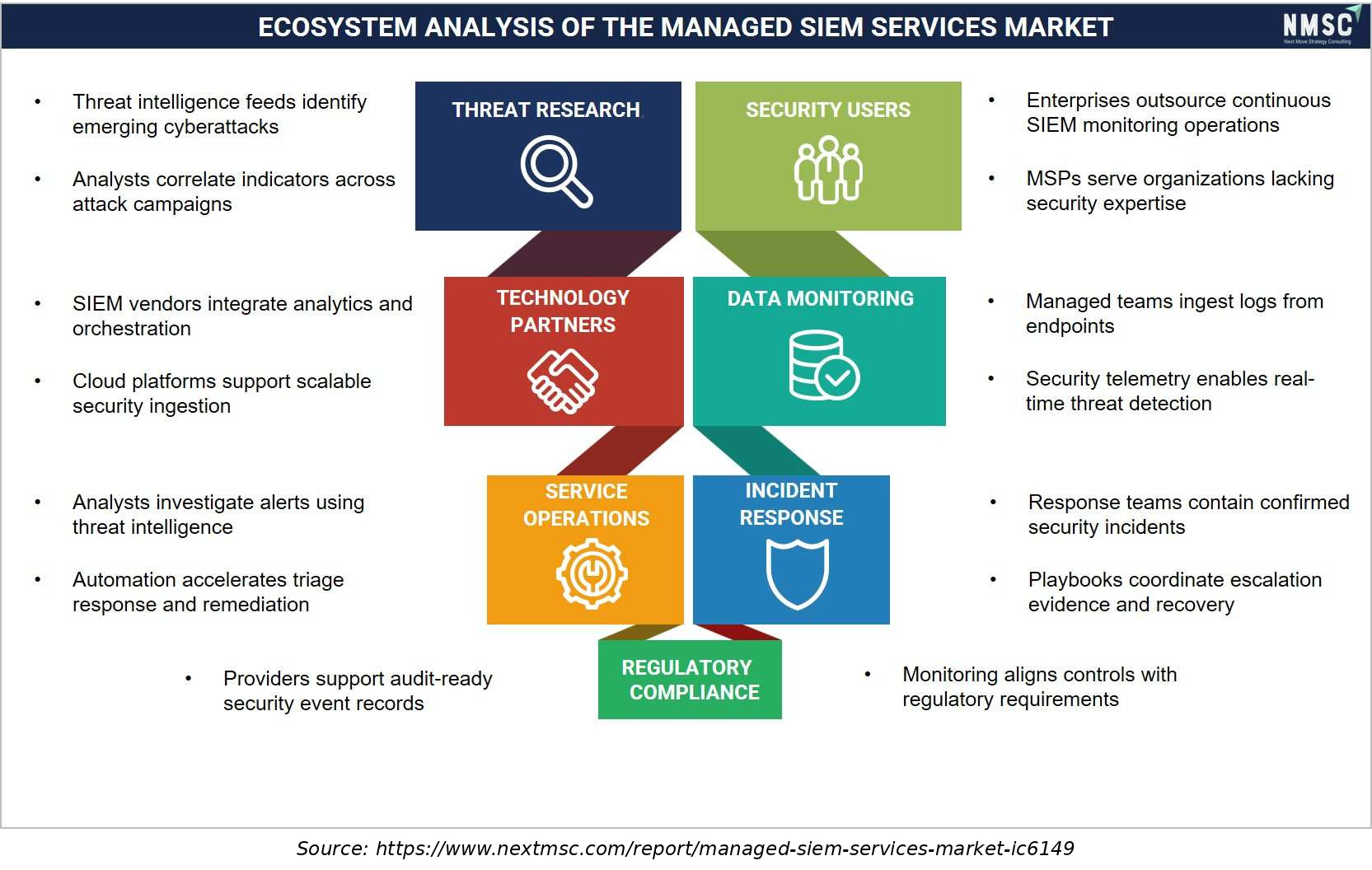
Ecosystem Analysis of the Managed SIEM Services Market

In our observation, the Managed SIEM Services Market operates within an ecosystem connecting threat research, technology partners, data monitoring, and incident response teams. Managed security service providers ingest endpoint logs and leverage real-time security telemetry to detect emerging cyberattacks. Ultimately, playbooks coordinate incident containment and escalation, while audit-ready event records align controls with strict regulatory requirements across the Managed SIEM Services Industry.

Market Drivers & Dynamics

Interactive Dataset
Rising frequency of ransomware and advanced persistent threat attacks driver +3.1% Global 2026–2033
Expanding regulatory compliance mandates including NIS2 and DORA driver +2.4% Europe, North America 2026–2030
Persistent cybersecurity talent shortage driving MSSP outsourcing driver +2.0% Global 2026–2032
Growing multi-cloud workload security requirements driver +1.8% North America, Asia-Pacific 2026–2035
Rising adoption of AI-driven threat detection platforms driver +1.5% Global 2026–2034
High cost of enterprise-grade managed SIEM contracts restraint -1.4% Global 2026–2029
Data privacy and sovereignty concerns limiting cloud SIEM adoption restraint -1.1% Europe, Asia-Pacific 2026–2031
Integration complexity with legacy IT infrastructure restraint -0.9% North America, Europe 2026–2030
Alert fatigue and false-positive management challenges restraint -0.7% Global 2026–2029
Source: Next Move Strategy Consulting

Growth Drivers

What Is the Primary Growth Driver?

Rising frequency of ransomware and advanced persistent threat attacks is the primary growth driver, as enterprises increasingly require continuous monitoring to detect intrusions before data exfiltration occurs. According to the U.S. Cybersecurity and Infrastructure Security Agency, ransomware remains one of the most disruptive threats facing critical infrastructure operators, reinforcing demand for continuous log correlation. We observed that publicized breaches increase demand for continuous monitoring as organizations strengthen detection and response capabilities.

How Is Regulatory Compliance Driving the Market Growth?

Expanding regulatory compliance mandates are driving market growth as the EU NIS2 Directive and the European Union's Digital Operational Resilience Act (DORA) shape incident reporting and ICT risk-management requirements within their respective regulated sectors. Our analysis shows that compliance reporting and auditing services are increasingly bundled into managed SIEM contracts rather than sold separately. Based on research conducted by Next Move Strategy Consulting, we found that financial services and healthcare providers are among the leading adopters of mandate-driven managed monitoring arrangements.

Growth Inhibitors

What Is Restraining Market Growth?

High cost of enterprise-grade managed SIEM contracts is restraining broader adoption, particularly among small and mid-sized organizations operating with constrained security budgets. We found that per-device and per-user pricing models scale unfavorably for organizations with large distributed device fleets, elevating total contract value beyond available budget allocations. This cost sensitivity slows managed SIEM adoption among smaller enterprises, though the effect is partially offset by expanding subscription-based pricing tiers targeted at resource-constrained buyers.

Segmentation Analysis

2025 (USD Billion)
2035 (USD Billion)
Managed Detection and Monitoring 2025: $1.46 Billion | 2035: $5.25 Billion
Managed Dete
Threat Intelligence Integration 2025: $0.78 Billion | 2035: $3.55 Billion
Threat Intel
Incident Response Management 2025: $0.87 Billion | 2035: $3.55 Billion
Incident Res
Log Management and Correlation 2025: $0.73 Billion | 2035: $3.05 Billion
Log Manageme
Compliance Reporting and Auditing 2025: $0.58 Billion | 2035: $2.55 Billion
Compliance R
Vulnerability Management 2025: $0.43 Billion | 2035: $1.85 Billion
Vulnerabilit
Managed Detection and Monitoring $1.46 Billion $5.25 Billion 13.7%
Threat Intelligence Integration $0.78 Billion $3.55 Billion 16.4%
Incident Response Management $0.87 Billion $3.55 Billion 15.1%
Log Management and Correlation $0.73 Billion $3.05 Billion 15.4%
Compliance Reporting and Auditing $0.58 Billion $2.55 Billion 16.0%
Vulnerability Management $0.43 Billion $1.85 Billion 15.7%

Which Service Type Dominates the Managed SIEM Services Market?

Managed detection and monitoring dominates the market with approximately 30% share in 2025, reflecting its position as the foundational service layer underpinning all other managed offerings. We observed that threat intelligence integration is the fastest-growing category at a 16.4% CAGR from 2025 to 2035, driven by demand for contextualized alerts that reduce analyst investigation time. Its integration with proprietary threat research feeds positions threat intelligence as the preferred upsell for providers deepening client engagements.

2025 (USD Billion)
2035 (USD Billion)
Cloud Based
On Premise
Hybrid
Segment Item 2025 (USD Billion) 2035 (USD Billion) CAGR
Cloud Based $10.0 USD Billion $40.0 USD Billion 24.0%
On Premise $17.1 USD Billion $51.1 USD Billion 26.0%
Hybrid $24.2 USD Billion $62.2 USD Billion 12.0%

Segment-wise data is locked

Unlock complete segment-wise numbers for By Deployment Mode.

Unlock Full Data
2025 (USD Billion)
2035 (USD Billion)
Large Enterp
Small and Me
Segment Item 2025 (USD Billion) 2035 (USD Billion) CAGR
Large Enterprises $10.0 USD Billion $40.0 USD Billion 19.0%
Small and Medium Enterprises $17.1 USD Billion $51.1 USD Billion 21.0%

Segment-wise data is locked

Unlock complete segment-wise numbers for By Organization Size.

Unlock Full Data

Which Organization Size Segment Leads Demand?

Large enterprises lead demand with approximately 68% share in 2025, supported by established security budgets and complex multi-site monitoring requirements. Our findings suggest that small and medium enterprises represent the fastest-growing segment at a 17.7% CAGR from 2025 to 2035, as constrained internal security staffing pushes smaller organizations toward fully outsourced monitoring arrangements rather than building dedicated in-house security operations center capability.

2025 (USD Billion)
2035 (USD Billion)
Banking
Financial Se
Healthcare a
Government a
IT and Telec
Segment Item 2025 (USD Billion) 2035 (USD Billion) CAGR
Banking $10.0 USD Billion $40.0 USD Billion 21.0%
Financial Services and Insurance $17.1 USD Billion $51.1 USD Billion 11.0%
Healthcare and Life Sciences $24.2 USD Billion $62.2 USD Billion 9.0%
Government and Public Sector $31.3 USD Billion $73.3 USD Billion 23.0%
IT and Telecom $38.4 USD Billion $84.4 USD Billion 12.0%

Segment-wise data is locked

Unlock complete segment-wise numbers for By Industry Vertical.

Unlock Full Data

Which Industry Vertical Is the Fastest-Growing?

Banking, financial services and insurance leads the market with approximately 28% share in 2025, underpinned by stringent regulatory monitoring obligations and high-value transaction exposure. We found that healthcare and life sciences is the fastest-growing vertical at a 17.1% CAGR from 2025 to 2035, driven by rising ransomware attacks on hospital networks and expanding health data protection mandates requiring continuous monitoring of patient information systems.

2025 (USD Billion)
2035 (USD Billion)
Subscription
Per Device P
Per User Pri
Custom Enter
Segment Item 2025 (USD Billion) 2035 (USD Billion) CAGR
Subscription Based $10.0 USD Billion $40.0 USD Billion 13.0%
Per Device Pricing $17.1 USD Billion $51.1 USD Billion 19.0%
Per User Pricing $24.2 USD Billion $62.2 USD Billion 13.0%
Custom Enterprise Contracts $31.3 USD Billion $73.3 USD Billion 19.0%

Segment-wise data is locked

Unlock complete segment-wise numbers for By Pricing Model.

Unlock Full Data
2025 (USD Billion)
2035 (USD Billion)
Network Secu
Endpoint Sec
Cloud Securi
Identity and
Segment Item 2025 (USD Billion) 2035 (USD Billion) CAGR
Network Security Monitoring $10.0 USD Billion $40.0 USD Billion 20.0%
Endpoint Security Monitoring $17.1 USD Billion $51.1 USD Billion 18.0%
Cloud Security Monitoring $24.2 USD Billion $62.2 USD Billion 16.0%
Identity and Access Monitoring $31.3 USD Billion $73.3 USD Billion 22.0%

Segment-wise data is locked

Unlock complete segment-wise numbers for By Threat Coverage.

Unlock Full Data
2025 (USD Billion)
2035 (USD Billion)
North Americ
Canada
Mexico.
Europe: UK
Germany
Segment Item 2025 (USD Billion) 2035 (USD Billion) CAGR
North America: U.S. $10.0 USD Billion $40.0 USD Billion 25.0%
Canada $17.1 USD Billion $51.1 USD Billion 19.0%
Mexico. $24.2 USD Billion $62.2 USD Billion 17.0%
Europe: UK $31.3 USD Billion $73.3 USD Billion 15.0%
Germany $38.4 USD Billion $84.4 USD Billion 16.0%

Segment-wise data is locked

Unlock complete segment-wise numbers for By Region.

Unlock Full Data

Growth Opportunities

Next Move Strategy Consulting's analysis identifies three forward-looking whitespace opportunities within the market through 2035.

Can Identity-Centric Monitoring Unlock New Cross-Sell Revenue?

Extending managed SIEM contracts to include identity and access monitoring presents an opportunity to capture adjacent security budget from enterprises consolidating vendor relationships, benefiting providers offering unified identity and network telemetry correlation within a single managed contract.

Does Mid-Market Bundled Pricing Open SME Whitespace?

Flat-rate bundled pricing tiers designed for resource-constrained buyers create an opportunity to capture small and medium enterprise budgets currently underserved by per-device contract structures, benefiting providers able to standardize service delivery at lower per-client cost.

Can Sector-Specific Compliance Packages Expand Healthcare and Energy Adoption?

Pre-configured compliance reporting packages aligned to sector-specific mandates present an opportunity for providers to accelerate adoption among healthcare and energy operators facing evolving disclosure timelines, benefiting vendors with dedicated regulatory affairs expertise.

Regional Outlook

2025 (USD Billion)
2035 (USD Billion)
North Americ
Europe
Asia-Pacific
Middle East
Latin Americ
Region 2025 (USD Billion) 2035 (USD Billion) CAGR (%)
North America $10.0 USD Billion $40.0 USD Billion 9.0%
Europe $17.1 USD Billion $51.1 USD Billion 27.0%
Asia-Pacific $24.2 USD Billion $62.2 USD Billion 25.0%
Middle East & Africa $31.3 USD Billion $73.3 USD Billion 23.0%
Latin America $38.4 USD Billion $84.4 USD Billion 12.0%

Regional data is locked

Unlock complete regional numbers for this market.

Unlock Full Data

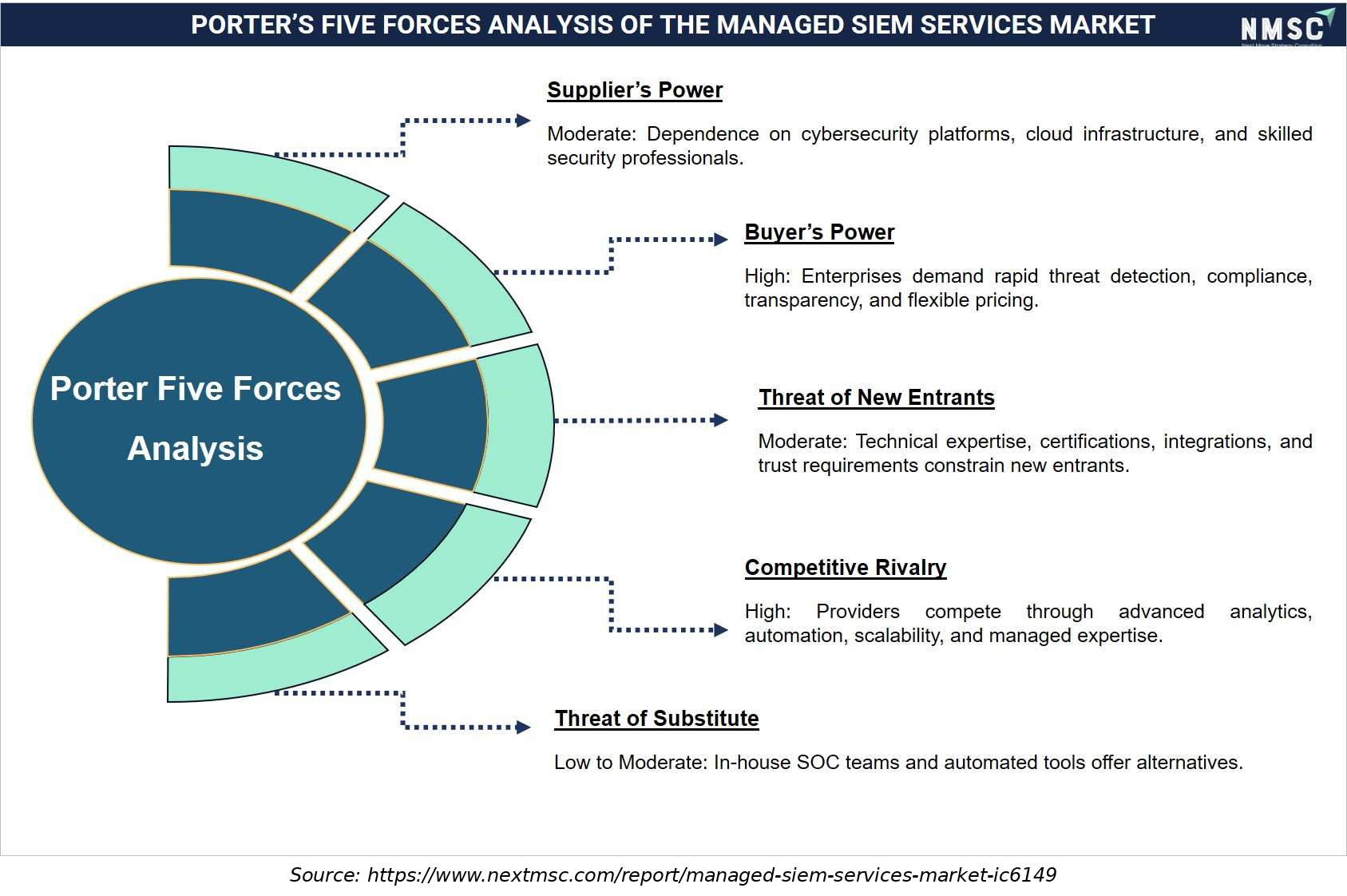
Porter's Five Forces Analysis of the Managed SIEM Services Market

Through NMSC's assessment, we found that competitive rivalry in the Managed SIEM Services Market is high as service providers compete through advanced analytics, automation, and managed expertise. Enterprises exert high buyer power by demanding rapid threat detection and flexible pricing, whereas cloud platforms and skilled professionals hold moderate supplier power. Concurrently, technical certifications constrain new entrants, while in-house SOC teams present a low-to-moderate threat of substitutes across the Managed SIEM Services Industry.

Competitive Landscape

We observed that the market remains moderately consolidated, with diversified technology and services conglomerates competing alongside specialized managed detection providers across regional strongholds.

Dimension Description
Market Structure Moderately consolidated, with top companies collectively holding a meaningful but not dominant share of industry revenue
Innovation Focus AI-assisted threat triage, cloud-native monitoring, and unified identity and endpoint telemetry correlation
M&A Activity Selective acquisitions of threat intelligence and cloud security startups to expand managed service portfolios

How Do Companies Compete in This Market?

Companies compete primarily on detection accuracy, mean time to respond, and depth of proprietary threat intelligence integrated into managed contracts. We found that vendors differentiate through analyst-to-client ratios and service level commitments, offering tiered response guarantees that reduce client risk exposure. Pricing strategies vary by tier, with subscription-based offerings competing on predictable cost while custom enterprise contracts compete on breadth of coverage across the Industry.

Which Competitive Archetypes Dominate the Managed SIEM Services Market?

Two archetypes dominate the managed SIEM services industry: diversified technology and consulting conglomerates with global delivery scale, and specialized managed detection and response innovators competing on speed and detection precision. Our analysis shows that diversified players leverage existing enterprise IT relationships and broad service portfolios, while specialized innovators win share in mid-market and cloud-native segments where differentiation themes center on analyst responsiveness rather than scale alone.

What Innovation and Differentiation Strategies Are Companies Pursuing?

Companies are pursuing innovation strategies centered on generative AI-assisted investigation, automated playbook-driven response, and unified telemetry correlation across cloud and endpoint environments. We observed that several providers are expanding proprietary threat research teams to differentiate alert context quality, while others are investing in self-service client portals to improve transparency into ongoing detection and response activity across managed contracts.

What Is the Level of M&A Activity in the Managed SIEM Services Market?

M&A activity remains selective, with established managed security providers acquiring specialized threat intelligence and cloud security startups to accelerate capability expansion rather than pursue headcount-driven service scaling alone. Our findings suggest that acquisitions are also being used to expand regional delivery footprint, particularly into Asia-Pacific and Latin American markets, supporting localized security operations center coverage across the market.

Key Market Players

Next Move Strategy Consulting's analysis identifies the following companies as key participants shaping competitive dynamics across the industry.

International Business Machines Corporation Accenture plc Secureworks Inc. Fortinet, Inc. Check Point Software Technologies Ltd. Palo Alto Networks, Inc. CrowdStrike Holdings, Inc. Rapid7, Inc. Sophos Ltd. Arctic Wolf Networks, Inc. NTT Data Group Corporation Atos SE Wipro Limited DXC Technology Company Verizon Communications Inc. Orange S.A. BT Group plc eSentire, Inc. Deepwatch, Inc. NCC Group plc

Latest Developments

We observed continued platform expansion and service portfolio broadening activity among leading managed security providers through 2025 and 2026.

Date Event
June 2026 Wipro and Palo Alto Networks expanded their strategic partnership to deliver AI-powered cyber defense by integrating Cortex XSIAM with Wipro’s managed security capabilities. The combined offering uses AI, machine learning, and automation to improve threat detection, investigation, and response while helping enterprises streamline security operations and strengthen managed SIEM services.
February 2026 Deepwatch expanded its SIEM-agnostic Guardian MDR Platform with native support for Securonix Unified Defense SIEM. The integration combines Securonix SIEM capabilities with Deepwatch’s 24/7 managed SOC, threat hunting, SIEM engineering, and AI-powered operations, allowing enterprises to retain existing SIEM investments while receiving outsourced monitoring and response services.
November 2025 EY selected CrowdStrike Falcon Next-Gen SIEM as the foundational platform for its global cybersecurity managed services. The collaboration combines CrowdStrike’s AI-powered SIEM capabilities with EY’s managed-service expertise, supporting enterprise security operations and helping organizations modernize from legacy SIEM technologies toward consolidated, AI-driven security monitoring and response.

Expert Insights

Daniel Bernard

Chief Business Officer | CrowdStrike

"“The agentic era is accelerating everything, and legacy SIEMs simply can’t cope with threat landscape realities as well as enterprise data proliferation. By making Falcon Next-Gen SIEM the foundation of EY US global managed services, we’re helping clients modernize faster and achieve outcomes legacy tools could never deliver.”"

Analyst Interpretation

The comment highlights the growing limitations of legacy SIEM platforms as enterprises face increasingly sophisticated cyber threats and rapidly expanding volumes of security and enterprise data. The adoption of next-generation SIEM through managed services helps organizations modernize security operations while reducing the complexity of managing SIEM infrastructure internally. This supports the growth of Managed SIEM Services as enterprises increasingly seek scalable threat detection, centralized security visibility, automation, and faster incident response.

Investment Opportunities

Where Are Capital Inflows Concentrated?

Capital inflows are concentrated in AI-driven threat detection platforms and cloud-native monitoring infrastructure, reflecting rising enterprise demand for automated triage capability. We observed that private investment is increasingly directed toward proprietary threat intelligence research teams capable of supporting differentiated alert context across managed detection contracts serving regulated industries.

How Is Infrastructure Investment Shaping the Managed SIEM Services Market?

Infrastructure investment tied to expanding security operations center capacity and regional data residency requirements is directly expanding addressable demand for managed SIEM services. According to the U.S. Cybersecurity and Infrastructure Security Agency, sustained federal emphasis on critical infrastructure protection supports continued cybersecurity investment across regulated sectors through the forecast period.

What ESG Considerations Are Influencing Investment Decisions?

Environmental, social, and governance considerations are influencing investment decisions as managed security providers adopt energy-efficient data center practices to reduce the carbon footprint of continuous log processing infrastructure. We found that investors are increasingly evaluating provider data governance practices and workforce diversity in security operations hiring as part of due diligence for managed service portfolio expansion.

Key Benefits for Stakeholders

How Does This Report Benefit Industry Leaders?

Industry leaders benefit from the report's segmentation analysis, competitive benchmarking, and regional demand forecasts, which support service portfolio planning and market entry prioritization. Our analysis shows that the report's growth driver and restraint assessment enables security services leaders to anticipate compliance-driven demand shifts and align investment with the fastest-growing service categories identified through 2035.

How Does This Report Benefit Investors and Financial Analysts?

Investors and financial analysts benefit from the report's market sizing, CAGR validation, and competitive landscape assessment, which support capital allocation decisions across the managed security services value chain. We found that the country-level revenue breakdown assists analysts in evaluating geographic concentration risk and identifying the fastest-growing markets for portfolio diversification within the industry.

How Does This Report Benefit Technology Vendors and Product Teams?

Technology vendors and product teams benefit from the report's trend analysis and segmentation sizing, which inform service roadmap prioritization across deployment mode, pricing model, and threat coverage categories. Our findings suggest that the growth opportunity assessment helps product teams identify underserved application niches, such as identity-centric monitoring bundles, ahead of broader competitive entry.

Key Market Segments Evaluated

By Service Type

  • Managed Detection and Monitoring
  • Threat Intelligence Integration
  • Incident Response Management
  • Log Management and Correlation
  • Compliance Reporting and Auditing
  • Vulnerability Management

By Deployment Mode

  • Cloud Based
  • On Premise
  • Hybrid

By Organization Size

  • Large Enterprises
  • Small and Medium Enterprises

By Industry Vertical

  • Banking, Financial Services and Insurance
  • Healthcare and Life Sciences
  • Government and Public Sector
  • IT and Telecom
  • Retail and E-Commerce
  • Manufacturing
  • Energy and Utilities
  • Other Verticals

By Pricing Model

  • Subscription Based
  • Per Device Pricing
  • Per User Pricing
  • Custom Enterprise Contracts

By Threat Coverage

  • Network Security Monitoring
  • Endpoint Security Monitoring
  • Cloud Security Monitoring
  • Identity and Access Monitoring

By Region

  • North America 
    • U.S.
    • Canada
    • Mexico.
  • Europe 
    • UK
    • Germany
    • France
    • Italy
    • Spain
    • Sweden
    • Denmark
    • Finland
    • Netherlands
    • Rest of Europe.
  • Asia-Pacific 
    • China
    • India
    • Japan
    • South Korea
    • Taiwan
    • Indonesia
    • Vietnam
    • Australia
    • Philippines
    • Malaysia
    • Rest of APAC.
  • Middle East & Africa 
    • Saudi Arabia
    • UAE
    • Egypt
    • Israel
    • Turkey
    • Nigeria
    • South Africa
    • Rest of MEA.
  • Latin America 
    • Brazil
    • Argentina
    • Chile
    • Colombia
    • Rest of LATAM.

Conclusion & Recommendations

The long-term outlook remains favorable, with the market projected to expand from USD 5.55 billion in 2026 to USD 19.80 billion by 2035 at a 15.1% CAGR. We observed that sustained ransomware activity and expanding regulatory mandates underpin durable demand across service types, positioning the market for consistent expansion through the forecast period.

What Strategic Positioning Should Providers Pursue?

Providers should pursue strategic positioning around threat intelligence integration and compliance reporting service lines, given their premium pricing and faster growth trajectory relative to standard log monitoring. Our analysis shows that providers investing in AI-assisted triage and rapid client onboarding are better positioned to capture share among small and medium enterprises entering the outsourced monitoring category.

How Attractive Is the Market for Investment?

The market presents high investment attractiveness, supported by a 15.1% CAGR and an absolute dollar opportunity of USD 14.25 billion between 2026 and 2035. We found that investment attractiveness is strongest in Asia-Pacific and among small and medium enterprise buyer segments, where expanding digitalization is driving above-average demand growth relative to mature Western enterprise markets.

What Market Shifts and Key Risks Should Stakeholders Monitor?

Stakeholders should monitor rising analyst staffing costs and data sovereignty restrictions on cross-border log processing as key risks to near-term growth. Our findings suggest that alert fatigue among client security teams could pressure contract renewal rates if providers fail to demonstrate measurable reductions in false-positive volume relative to earlier monitoring generations.

What Are the Primary Growth Pathways Through 2035?

Primary growth pathways include expansion into small and medium enterprise bundled pricing tiers, broader adoption of identity-centric monitoring within existing contracts, and deeper penetration of cloud-native threat detection across regulated industries. Next Move Strategy Consulting's analysis indicates that providers combining service breadth with proprietary threat intelligence capability are best positioned to capture growth across these pathways.

FAQs

About the Author

Saista Faiyaz

Saista Faiyaz

Saista Faiyaz is Research Associate at Next Move Strategy Consulting, where she has covered consumer markets and healthcare technologies for 3 years. Her work includes primary interview review, secondary-source validation, market sizing, and structured analysis of company and industry data. She supports research by comparing evidence across sources, organizing findings into market narratives, and documenting assumptions used in analysis. Her scope includes cross-market benchmarking, and reports.

About the Reviewer

Supradip Baul

Supradip Baul

Supradip Baul is an accomplished business consultant and strategist with over a decade of rich experience in market intelligence, strategy, technology, and business transformation. His work has included rigorous qualitative and quantitative analysis across multiple industries, helping clients shape investment decisions and long-term roadmaps. Earlier in his career, he was associated with Gartner, where he contributed to industry-leading reports and market share analyses. He has worked with leading global companies and holds an MBA with a dual specialization in Marketing and Finance.

Download Free Sample

Semih Kavaklioglu

SEMIH KAVAKLIOGLU

Co-Founder & Sales Manager

Decortie

I work a lot in the marketing industry and I know that research is an essential part of any campaign. I have used Market research reports for my own products and I found them to be very informative and well-researched. The team here produces insightful reports for a good price

Kishu Kanda

KISHU KANDA

Strategy Analyst

Accenture

We purchased the AI Consumer Market Report from this company. Not only did they customize the report to meet our specific requirements, but they also showed great flexibility in accommodating our budget. The report we received fully met our expectations. Additionally, they provided prompt and thorough responses to both our pre-purchase and follow-up questions. We look forward to working with this company again in the future.

Melanie Samko

MELANIE SAMKO

Director of Marketing

TOSOH BIOSCIENCE, INC.

The information provided by NMSC is incredibly valuable, thank you so much for such a excellent work. I really appreciate it. I will make sure to reference all of it, in my summary document.

Ross J Mckenzie

ROSS J MCKENZIE

Business Insight Manager

Staysure Group

“Next MSC have been incredibly helpful in providing detailed & robust information on our market, alongside quantifying growth by different segments. The process to procure was simple and easy, with sample reports and regular contact to ensure we had what we needed. Succinct detail on their sources & methodologies is also greatly received, allowing transparency in this respect helps build trust in the detail you pay for. Joseph in particular was fantastic, and helped ensure efficient provision of the insight pack – thank you NMSC!”.

Pratyush Kumar Das

PRATYUSH KUMAR DAS

Assistant Manager

Polycab India Limited

We would like to express our appreciation for the data and insights provided by nextmsc. We are very pleased with the quality and depth of the information, which has proven to be highly valuable and beneficial for our business decision-making.

Custom Market Research Services

We will customize the research for you if the listed report does not fully match your requirements.

Get 30% Free Customization

Select License

This website uses cookies to ensure you get the best experience on our website. Learn more

✖