Positioning, Navigation, and Timing (PNT) Security Market Global Industry Analysis and Forecast (2026–2035)

The global Positioning, Navigation, and Timing (PNT) Security Market size was valued at USD 2.5 Billion in 2025 and is estimated at USD 2.95 Billion in 2026, forecast to reach USD 12.0 Billion by 2035, expanding at a 16.9% CAGR between 2026 and 2035. North America leads with approximately 42% share, while Anti-Jamming Systems dominate the solution type segmentation with approximately 42% share.

Download Free Sample PDF
Base Year (2025)
$2.50 Billion
Forecast (2035)
$12.00 Billion
CAGR (2026-2035)
16.9%
Top Region
North America

What Is the PNT Security Market Size?

The global Positioning, Navigation, and Timing (PNT) Security Market size was valued at USD 2.5 Billion in 2025 and is estimated at USD 2.95 Billion in 2026, forecast to reach USD 12.0 Billion by 2035, expanding at a 16.9% CAGR between 2026 and 2035. North America leads with approximately 42% share, while under solution type, Anti-Jamming Systems dominates with approximately 42% share.

We observed that growth is accelerating across every segmentation axis, with rising GNSS interference incidents, alternative timing infrastructure investment, and critical infrastructure resilience mandates driving the dominant structural shifts through 2035.

Positioning, Navigation, and Timing (PNT) Security Market Global Industry Analysis and Forecast (2026–2035) Revenue Forecast

Values in USD Billion

2025 $2.50 Billion
2025
2026 $2.92 Billion
2026
2027 $3.42 Billion
2027
2028 $3.99 Billion
2028
2029 $4.67 Billion
2029
2030 $5.46 Billion
2030
2031 $6.38 Billion
2031
2032 $7.46 Billion
2032
2033 $8.72 Billion
2033
2034 $10.19 Billion
2034
2035 $12.00 Billion
2035

Key Takeaways

By Solution Type: Anti-Jamming Systems held the largest share of approximately 42% (USD 1.05 Billion) in 2025; Alternative PNT Systems is the fastest-growing sub-segment at 18.1% CAGR from 2026–2035.

By Component: Hardware held the largest share of approximately 58% (USD 1.45 Billion) in 2025; Software is the fastest-growing sub-segment at 19.6% CAGR from 2026–2035.

By Technology: GNSS-Based PNT Security held the largest share of approximately 62% (USD 1.55 Billion) in 2025; Non-GNSS PNT Security is the fastest-growing sub-segment at 19.6% CAGR from 2026–2035.

By Platform: Ground-Based Platforms held the largest share of approximately 46% (USD 1.15 Billion) in 2025; Space-Based Platforms is the fastest-growing sub-segment at 21.9% CAGR from 2026–2035.

By End User: Defense and Military held the largest share of approximately 46% (USD 1.15 Billion) in 2025; Government and Critical Infrastructure is the fastest-growing sub-segment at 21.7% CAGR from 2026–2035.

Dominant Region: North America dominated with approximately 42% revenue share (USD 1.05 Billion) in 2025.

Fastest-Growing Region: Asia-Pacific is expected to register the highest CAGR of 19.0% during 2026–2035.

Dominant Country: U.S. led with approximately USD 900 Million in 2025.

Fastest-Growing Country: India is the fastest-growing country at approximately 22.4% CAGR from 2026–2035.

What Does the PNT Security Market Encompass?

The PNT Security Market encompasses anti-jamming, anti-spoofing, alternative positioning, and monitoring solutions that protect satellite-based and terrestrial timing and navigation infrastructure from intentional and unintentional interference. Our assessment indicates that the market's scope spans hardware, software, and services deployed across ground, airborne, maritime, and space-based platforms serving defense, aerospace, telecommunications, financial services, and GPS tracking device applications. The category has evolved from niche military navigation warfare capability into a broad critical infrastructure protection requirement as GNSS interference incidents outside conflict zones have become routine.

Regulatory frameworks such as the U.S. Department of Homeland Security's Resilient PNT conformance framework and the European Commission's anti-spoofing authentication service increasingly shape enterprise and government investment in layered PNT protection. We observed that technology adoption is shifting toward multi-sensor fusion architectures combining GNSS, inertial navigation, and terrestrial timing references. NMSC's analysis indicates that this shift, combined with escalating documented interference incidents, is redefining procurement priorities across the PNT Security Market.

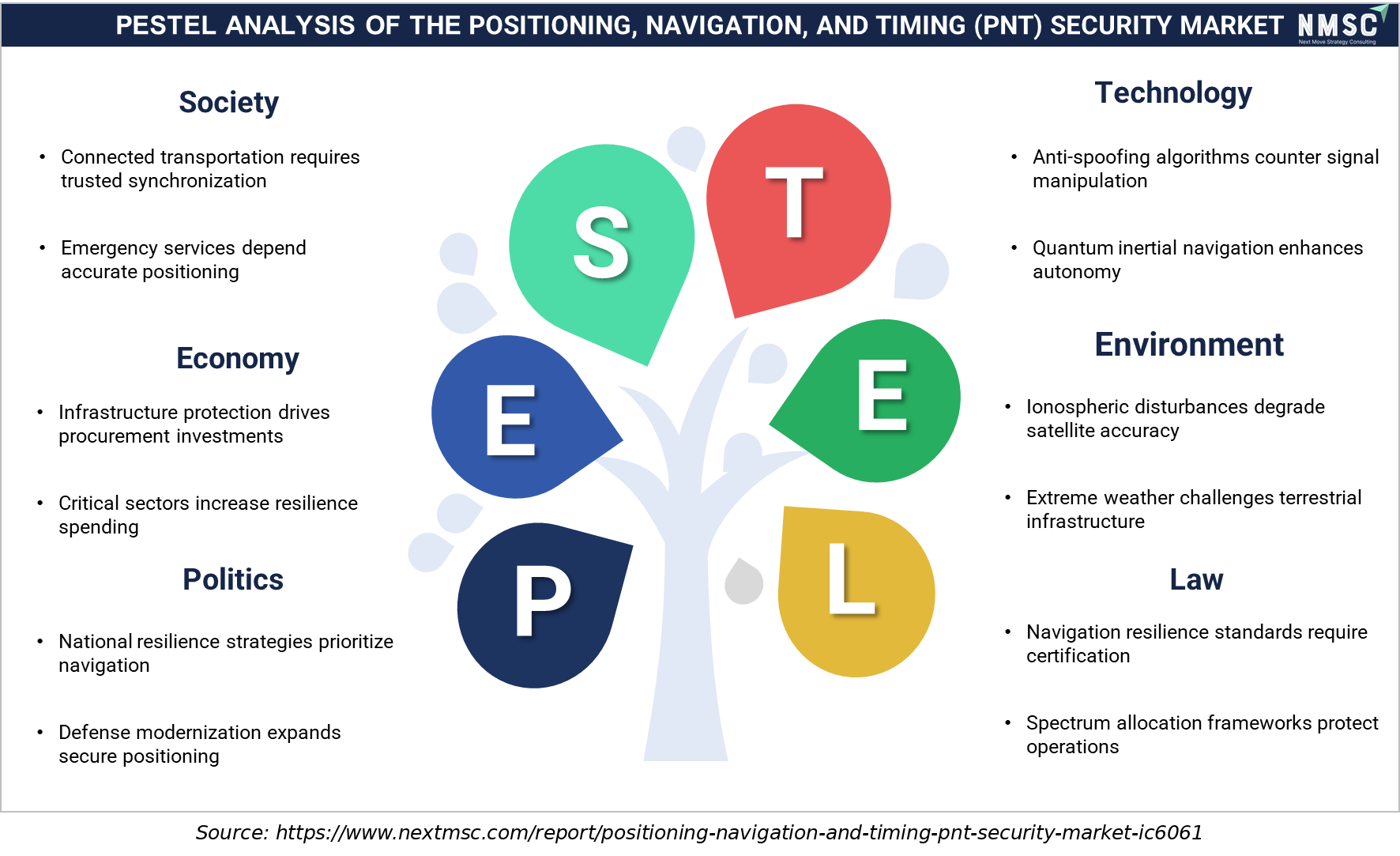
PESTEL ANALYSIS OF THE POSITIONING, NAVIGATION, AND TIMING (PNT) SECURITY MARKET

PESTEL ANALYSIS OF THE POSITIONING, NAVIGATION, AND TIMING (PNT) SECURITY MARKET
This PESTEL analysis highlights the key external factors shaping the Positioning, Navigation, and Timing (PNT) Security Market. Political priorities, economic investment, social dependence on reliable navigation, technological advancements, environmental conditions, and legal or regulatory requirements collectively influence market development. The framework emphasizes increasing demand for resilient PNT solutions, driven by GNSS vulnerabilities, signal disruption, cybersecurity threats, modernization of critical infrastructure, and the need for secure positioning and timing across defense, transportation, telecommunications, and other critical applications.

Market Drivers & Dynamics

Interactive Dataset
Escalating documented GNSS jamming and spoofing incidents outside conflict zones driver +3.6% Europe, Middle East & Africa 2026–2035
Government resilient PNT conformance mandates for critical infrastructure driver +2.8% North America, Europe 2026–2033
Expanding aviation regulator guidance requiring interference detection capability driver +2.1% Global 2026–2032
Rising defense navigation warfare investment amid contested electromagnetic environments driver +1.7% North America, Europe, Asia-Pacific 2026–2035
Growing financial services and telecommunications reliance on precise timing synchronization driver +1.2% Global 2026–2032
Government authentication infrastructure enabling commercial anti-spoofing integration driver +0.8% Europe, North America 2026–2030
High integration cost of multi-sensor fusion architectures for smaller operators restraint −1.4% Latin America, Middle East & Africa 2026–2032
Fragmented national interference reporting standards limiting coordinated response restraint −0.9% Global 2026–2030
Limited awareness of PNT vulnerability among non-defense critical infrastructure operators restraint −0.6% Asia-Pacific, Latin America 2026–2030
Source: Next Move Strategy Consulting

Growth Drivers

What Is the Primary Growth Driver of the PNT Security Market?

Escalating documented GNSS jamming and spoofing incidents outside conflict zones is the primary driver of the PNT Security Market. The Federal Aviation Administration issued an official safety alert in 2024 instructing pilots to monitor GPS and GNSS integrity and prepare to operate without satellite navigation, later updated in 2026 with a revised interference resource guide. We observed that this sustained interference trend, combined with the International Civil Aviation Organization's resolutions condemning GNSS interference, continues to anchor procurement of layered anti-jamming and anti-spoofing capability.

How Is Government Resilience Mandating Driving Market Growth?

Government resilient PNT conformance mandates for critical infrastructure are accelerating market growth toward standardized, multi-layer protection deployments. The U.S. Department of Homeland Security's Resilient PNT conformance framework defines Prevent, Respond, and Recover protection steps that critical infrastructure operators increasingly adopt as baseline requirements. Our assessment indicates that this regulatory framework, combined with the European Commission's September 2025 anti-spoofing authentication service announcement, is compressing adoption timelines for layered PNT protection across regulated sectors.

Growth Inhibitors

What Is Restraining PNT Security Market Expansion?

High integration cost of multi-sensor fusion architectures restrains the pace of adoption among smaller operators and critical infrastructure providers. Deploying combined GNSS, inertial navigation, and precision timing protection requires significant upfront capital investment relative to single-layer anti-jamming solutions. We found that smaller telecommunications and utility operators face particular exposure, as budget constraints delay comprehensive multi-layer protection despite documented rising interference risk in their operating regions.

Segmentation Analysis

2025 (USD Billion)
2035 (USD Billion)
Anti-Jamming Systems 2025: $1.05 Billion | 2035: $4.60 Billion
Anti-Jamming
Anti-Spoofing Systems 2025: $650.00 Billion | 2035: $3.40 Billion
Anti-Spoofin
Alternative PNT Systems 2025: $550.00 Billion | 2035: $2.90 Billion
Alternative
PNT Monitoring and Assurance Software 2025: $250.00 Billion | 2035: $1.10 Billion
PNT Monitori
Anti-Jamming Systems $1.05 Billion $4.60 Billion 15.9%
Anti-Spoofing Systems $650.00 Billion $3.40 Billion 18.0%
Alternative PNT Systems $550.00 Billion $2.90 Billion 18.1%
PNT Monitoring and Assurance Software $250.00 Billion $1.10 Billion 16.0%

Which Solution Type Dominates the PNT Security Market?

Anti-Jamming Systems led the market with USD 1.05 Billion in 2025, supported by sustained demand for controlled reception pattern antennas and nulling systems protecting military and aviation platforms from signal denial. We observed that Alternative PNT Systems is the fastest-growing solution type, expanding at an 18.1% CAGR from 2026 to 2035, as operators increasingly deploy inertial navigation, chip-scale atomic clocks, and terrestrial beacon systems to reduce dependency on vulnerable satellite signals.

2025 (USD Billion)
2035 (USD Billion)
Hardware
Software
Services
Segment Item 2025 (USD Billion) 2035 (USD Billion) CAGR
Hardware $10.0 USD Billion $40.0 USD Billion 25.0%
Software $17.1 USD Billion $51.1 USD Billion 11.0%
Services $24.2 USD Billion $62.2 USD Billion 25.0%

Segment-wise data is locked

Unlock complete segment-wise numbers for By Component.

Unlock Full Data

By Component: Hardware held the largest share of approximately 58% (USD 1.45 Billion) in 2025; Software is the fastest-growing sub-segment at 19.6% CAGR from 2026–2035.

2025 (USD Billion)
2035 (USD Billion)
GNSS-Based P
Non-GNSS PNT
Hybrid PNT S
Segment Item 2025 (USD Billion) 2035 (USD Billion) CAGR
GNSS-Based PNT Security $10.0 USD Billion $40.0 USD Billion 27.0%
Non-GNSS PNT Security $17.1 USD Billion $51.1 USD Billion 9.0%
Hybrid PNT Security $24.2 USD Billion $62.2 USD Billion 19.0%

Segment-wise data is locked

Unlock complete segment-wise numbers for By Technology.

Unlock Full Data

By Technology: GNSS-Based PNT Security held the largest share of approximately 62% (USD 1.55 Billion) in 2025; Non-GNSS PNT Security is the fastest-growing sub-segment at 19.6% CAGR from 2026–2035.

2025 (USD Billion)
2035 (USD Billion)
Ground-Based
Airborne Pla
Maritime Pla
Space-Based
Segment Item 2025 (USD Billion) 2035 (USD Billion) CAGR
Ground-Based Platforms $10.0 USD Billion $40.0 USD Billion 14.0%
Airborne Platforms $17.1 USD Billion $51.1 USD Billion 24.0%
Maritime Platforms $24.2 USD Billion $62.2 USD Billion 22.0%
Space-Based Platforms $31.3 USD Billion $73.3 USD Billion 12.0%

Segment-wise data is locked

Unlock complete segment-wise numbers for By Platform.

Unlock Full Data

By Platform: Ground-Based Platforms held the largest share of approximately 46% (USD 1.15 Billion) in 2025; Space-Based Platforms is the fastest-growing sub-segment at 21.9% CAGR from 2026–2035.

2025 (USD Billion)
2035 (USD Billion)
Defense and
Aerospace
Telecommunic
Financial Se
Energy and U
Segment Item 2025 (USD Billion) 2035 (USD Billion) CAGR
Defense and Military $10.0 USD Billion $40.0 USD Billion 24.0%
Aerospace $17.1 USD Billion $51.1 USD Billion 22.0%
Telecommunications $24.2 USD Billion $62.2 USD Billion 20.0%
Financial Services $31.3 USD Billion $73.3 USD Billion 22.0%
Energy and Utilities $38.4 USD Billion $84.4 USD Billion 13.0%

Segment-wise data is locked

Unlock complete segment-wise numbers for By End User.

Unlock Full Data

Which End User Segment Leads PNT Security Market Demand?

Defense and Military remained the dominant end user, reaching USD 1.15 Billion in 2025 due to sustained navigation warfare investment protecting mission-critical systems from jamming and spoofing. Based on research conducted by NMSC, we found that Government and Critical Infrastructure represents the fastest-growing end user at a 21.7% CAGR from 2026 to 2035, reflecting expanding resilient PNT conformance mandates extending beyond defense into civilian infrastructure protection.

2025 (USD Billion)
2035 (USD Billion)
North Americ
Canada
Mexico
Europe: UK
Germany
Segment Item 2025 (USD Billion) 2035 (USD Billion) CAGR
North America: U.S. $10.0 USD Billion $40.0 USD Billion 23.0%
Canada $17.1 USD Billion $51.1 USD Billion 9.0%
Mexico $24.2 USD Billion $62.2 USD Billion 19.0%
Europe: UK $31.3 USD Billion $73.3 USD Billion 13.0%
Germany $38.4 USD Billion $84.4 USD Billion 10.0%

Segment-wise data is locked

Unlock complete segment-wise numbers for By Region.

Unlock Full Data

Which Region Leads PNT Security Market Demand?

North America remained the dominant region, reaching USD 1.05 Billion in 2025 supported by the Department of Homeland Security's Resilient PNT conformance framework and sustained defense modernization funding. Our findings suggest that Asia-Pacific is the fastest-growing region, registering a 19.0% CAGR from 2026 to 2035, driven by rising GNSS interference incidents and expanding indigenous PNT programs across China and India.

Growth Opportunities

Our analysis shows that three forward-looking opportunities stand out for stakeholders positioning within the PNT Security Market over the 2026-2035 forecast period.

How Is Terrestrial Backup Infrastructure Creating Opportunities for Alternative PNT Vendors?

Ground-based terrestrial timing and positioning infrastructure presents a whitespace opportunity for vendors seeking to serve maritime and aviation operators in high-interference regions. Vendors that commercialize scalable ground-based beacon and precision timing networks stand to capture recurring infrastructure contracts as coastal nations expand backup navigation capability.

Why Is Financial Sector Timing Security Emerging as a Growth Opportunity for Precision Timing Vendors?

Financial services firms present an underpenetrated opportunity for precision timing security vendors given regulatory requirements for synchronized transaction timestamps. Vendors that secure exchange and clearinghouse contracts can establish durable, high-value relationships as regulators scrutinize timing infrastructure resilience following documented interference incidents.

How Is Authenticated Signal Infrastructure Unlocking Opportunities for Anti-Spoofing Receiver Manufacturers?

Government-backed authenticated signal services create an opportunity for receiver manufacturers seeking to integrate next-generation anti-spoofing capability. Early movers that achieve compatibility with new authentication services can differentiate with government and critical infrastructure customers pursuing verified, tamper-resistant positioning data.

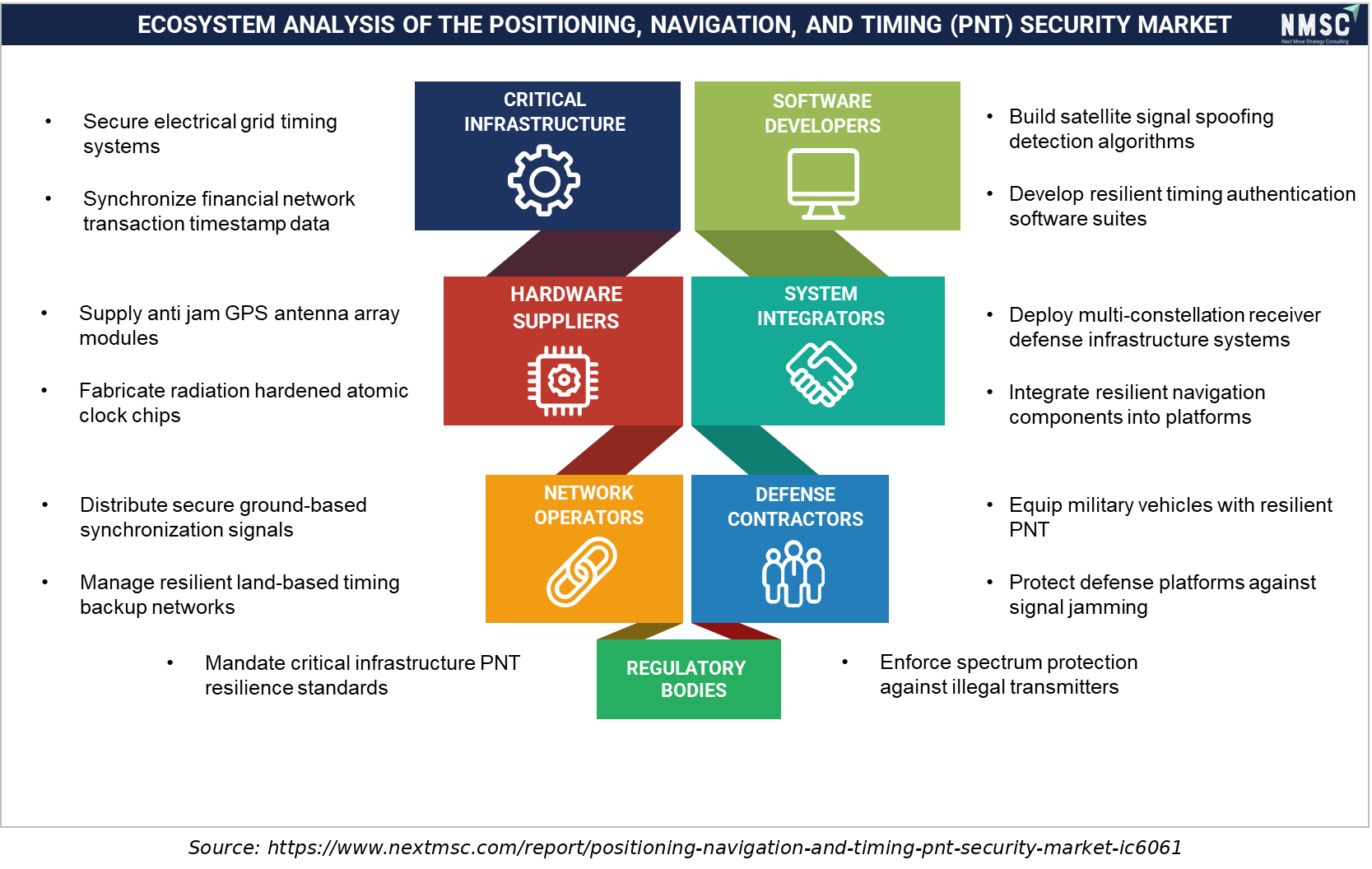
ECOSYSTEM ANALYSIS OF THE POSITIONING, NAVIGATION, AND TIMING (PNT) SECURITY MARKET

This ecosystem analysis illustrates the interconnected stakeholders shaping the Positioning, Navigation, and Timing (PNT) Security Market. Critical infrastructure, hardware suppliers, software developers, system integrators, network operators, defense contractors, and regulatory bodies collectively support the development and deployment of resilient PNT solutions. Their collaboration enables secure navigation, timing resilience, GNSS protection, infrastructure modernization, and reliable services across defense, transportation, telecommunications, and other mission-critical sectors.

Regional Outlook

2025 (USD Billion)
2035 (USD Billion)
North Americ
Europe
Asia-Pacific
Middle East
Latin Americ
Region 2025 (USD Billion) 2035 (USD Billion) CAGR (%)
North America $10.0 USD Billion $40.0 USD Billion 9.0%
Europe $17.1 USD Billion $51.1 USD Billion 27.0%
Asia-Pacific $24.2 USD Billion $62.2 USD Billion 25.0%
Middle East & Africa $31.3 USD Billion $73.3 USD Billion 23.0%
Latin America $38.4 USD Billion $84.4 USD Billion 12.0%

Regional data is locked

Unlock complete regional numbers for this market.

Unlock Full Data

Competitive Landscape

We observed that the PNT Security Market features a moderately consolidated competitive landscape, with defense primes competing alongside specialized GNSS resilience vendors on interference detection accuracy and multi-sensor integration depth.

Dimension Description
Market Structure Moderately consolidated; the top companies profiled in this report collectively account for a majority of global market revenue, while numerous specialized GNSS resilience vendors compete for civilian critical infrastructure demand.
Innovation Focus Multi-sensor fusion architectures, chip-scale atomic clocks, and anti-spoofing authentication integration dominate current innovation pipelines across leading vendors.
M&A Activity Active, exemplified by Safran S.A.'s acquisition of Orolia to establish an integrated resilient timing and navigation portfolio spanning military and critical infrastructure applications.

How Do Companies Compete in the PNT Security Market?

Companies compete primarily on interference detection accuracy, multi-sensor integration depth, and AI in cybersecurity capability across the PNT Security Market. Global defense primes such as Safran S.A. and RTX Corporation leverage extensive military qualification credentials to secure long-term navigation warfare contracts, while specialized vendors such as Septentrio NV and u-blox Holding AG compete on receiver-level anti-jamming and anti-spoofing chipset performance.

Which Competitive Archetypes Dominate the PNT Security Market?

Two archetypes dominate the market: diversified defense and aerospace primes offering integrated navigation warfare and resilient timing portfolios, and specialized GNSS technology vendors focused on receiver and antenna-level anti-jamming and anti-spoofing components. Safran S.A. and Honeywell International Inc. exemplify the diversified archetype through combined inertial navigation and resilient timing delivery, while Septentrio NV and Infinidome Ltd exemplify the specialized archetype built around receiver-level interference mitigation technology.

How Are Companies Differentiating Through Innovation in PNT Security?

Innovation and differentiation strategy increasingly center on multi-sensor fusion and government authentication service compatibility. Honeywell International Inc.'s development of advanced inertial systems, anti-spoofing receivers, and multi-sensor fusion solutions following 2026 EASA-IATA workshops illustrates how vendors are integrating multiple mitigation layers into unified platforms. Our analysis shows that vendors unable to demonstrate credible multi-layer interference detection and mitigation capability risk exclusion from critical infrastructure procurement shortlists.

What M&A and Expansion Activity Is Shaping the PNT Security Market?

Consolidation and capacity expansion continue to reshape competitive positioning within the market. Safran S.A.'s acquisition of Orolia established an integrated resilient timing and navigation portfolio combining precision timing references, PNT sensor fusion technology, and defense inertial navigation solutions under Safran Federal Systems. This move illustrates how diversified aerospace and defense manufacturers are consolidating specialized PNT resilience capability to serve both military and expanding civilian critical infrastructure demand.

Key Market Players

Our assessment indicates that the following 20 companies represent the validated competitive set actively shaping product innovation, capacity expansion, and strategic positioning within the global PNT Security Market.

Safran S.A. RTX Corporation L3Harris Technologies, Inc. Northrop Grumman Corporation Honeywell International Inc. Hexagon AB Trimble Inc. u-blox Holding AG Septentrio NV Spirent Communications plc Microchip Technology Inc. Frequency Electronics, Inc. Chronos Technology Ltd Infinidome Ltd Rohde & Schwarz GmbH & Co KG Thales Group BAE Systems plc General Dynamics Corporation Lockheed Martin Corporation Leonardo S.p.A.

Latest Developments

We found that recent regulatory actions and product developments within the PNT Security Market are concentrated on interference guidance updates and layered resilience infrastructure.

Date Event
April 2026 u-blox launched the ZED-X20P-01B GNSS module with global PPP, Galileo HAS, Moving Base and stronger jamming and spoofing resilience. Verified during Jammertest 2025, the module combines high-precision positioning with interference mitigation for global OEM deployments.
April 2026 Hexagon completed its acquisition of Inertial Sense, adding tactical-grade GNSS+INS technology and more than 30,000 deployed inertial systems to its assured PNT portfolio. The acquisition expands resilient navigation capabilities for GPS-challenged environments across aerospace, defense, robotics and UAV applications.

Investment Opportunities

What Capital Inflows Are Targeting the PNT Security Market?

Capital inflows into the market are increasingly directed toward multi-sensor fusion platforms and government-compatible authentication technology. Government funding commitments, including the FY2026 Defense Appropriations Bill's investment in modernized GPS satellite infrastructure, reflect continued public capital commitment to PNT resilience. We observed that investors favor vendors demonstrating credible interference detection accuracy, viewing documented detection performance as a proxy for long-term government and critical infrastructure contract retention.

How Is Infrastructure Investment Supporting PNT Security Deployment?

Infrastructure investment in terrestrial backup timing networks and authentication service deployment is expanding the operational foundation required for resilient PNT protection. Sweden's activation of ground-based radio beacons and the European Commission's planned 2026 interference monitoring and localization service reflect broader public infrastructure investment supporting layered PNT resilience across critical maritime and aviation corridors.

What ESG Considerations Are Shaping PNT Security Investment Decisions?

Environmental, social, and governance considerations intersect with PNT Security Market investment decisions primarily through public safety and critical infrastructure governance rather than environmental impact. Regulators including the International Civil Aviation Organization continue to emphasize interference-free navigation as a public safety governance priority. We found that investors increasingly favor vendors with transparent interference detection track records, treating public safety governance credentials as a proxy for durable government and enterprise market access.

Key Benefits for Stakeholders

How Does This Report Benefit Enterprise and Industry Leaders?

Enterprise and industry leaders gain access to validated segmentation, competitive benchmarking, and regional demand forecasts that support technology sourcing and resilience planning decisions across the PNT Security Market. Our analysis shows that detailed solution type, end-user, and regional breakdowns help procurement teams align specifications with regulatory and operational requirements while identifying underserved protection categories for portfolio expansion.

How Does This Report Benefit Investors and Financial Analysts?

Investors and financial analysts benefit from consistent, single-point market size and CAGR estimates that support valuation and capital-allocation decisions across the PNT Security Market vendor landscape. We observed that the report's regional and segment-level growth differentials help identify which vendors are best positioned to capture above-market growth in alternative PNT and critical infrastructure categories through 2035.

How Does This Report Benefit Technology Vendors and Product Teams?

Technology vendors and product teams gain insight into emerging design requirements, including multi-sensor fusion, chip-scale atomic clocks, and authentication service compatibility, that are reshaping the PNT Security Market. Our findings suggest that this analysis helps R&D teams prioritize development roadmaps around interference detection accuracy and regulatory compliance increasingly required by government and enterprise procurement processes.

Key Market Segments Evaluated

By Solution Type

  • Anti-Jamming Systems
  • Anti-Spoofing Systems
  • Alternative PNT Systems
  • PNT Monitoring and Assurance Software

By Component

  • Hardware
  • Software
  • Services

By Technology

  • GNSS-Based PNT Security
  • Non-GNSS PNT Security
  • Hybrid PNT Security

By Platform

  • Ground-Based Platforms
  • Airborne Platforms
  • Maritime Platforms
  • Space-Based Platforms

By End User

  • Defense and Military
  • Aerospace
  • Telecommunications
  • Financial Services
  • Energy and Utilities
  • Transportation and Logistics
  • Government and Critical Infrastructure

By Region

  • North America
  • Europe
  • Asia-Pacific
  • Middle East & Africa
  • Latin America

Conclusion & Recommendations

The long-term outlook for the PNT Security Market remains strongly positive, with global revenue projected to expand nearly fivefold from USD 2.5 Billion in 2025 to USD 12.0 Billion by 2035 at a 16.9% CAGR. We observed that sustained GNSS interference incidents, combined with expanding government resilience mandates, will continue underpinning demand across anti-jamming, anti-spoofing, and alternative PNT categories through the forecast period.

What Strategic Positioning Should PNT Security Vendors Pursue?

Vendors should prioritize multi-sensor fusion capability while pursuing government authentication service compatibility to secure long-term defense and critical infrastructure contracts. Our assessment indicates that companies investing early in chip-scale atomic clock technology and terrestrial backup integration will be best positioned to capture premium pricing within the PNT Security Market.

How Attractive Is the PNT Security Market for New Investment?

The market presents a highly attractive investment case, supported by a USD 9.1 Billion absolute dollar opportunity between 2026 and 2035 and above-average growth in Asia-Pacific and government critical infrastructure categories. We found that investment attractiveness is highest for vendors combining verified interference detection performance with scaled multi-sensor delivery capacity, positioning them to serve both defense and expanding civilian infrastructure segments simultaneously.

What Market Shifts and Key Risks Should Stakeholders Monitor?

Stakeholders should monitor high multi-sensor integration costs, fragmented national interference reporting standards, and limited awareness among non-defense operators as key risks to the PNT Security Market. Our analysis shows that vendors unable to demonstrate credible multi-layer detection and mitigation capability risk losing procurement consideration to competitors with certified, comprehensive resilience platforms, particularly within Europe's increasingly urgent regulatory environment.

What Are the Key Growth Pathways for the PNT Security Market?

Key growth pathways include expanding alternative PNT infrastructure deployment, scaling anti-spoofing authentication integration, and deepening penetration into financial services and energy sector timing protection. NMSC's analysis indicates that vendors pursuing these pathways while maintaining certified interference detection accuracy will be best positioned to capture the market's projected growth through 2035.

FAQs

About the Author

Liza Phukan

Liza Phukan

Liza Phukan is Research Associate at Next Move Strategy Consulting, where she has covered emerging industries and market research across sectors for 3.5 years. Her work includes analyzing industry developments, validating market data, and developing structured business content from research findings. She uses secondary research and data-validation practices to turn complex market information into clear decision-useful market analysis for business audiences and support report development and B2B.

About the Reviewer

Supradip Baul

Supradip Baul

Supradip Baul is an accomplished business consultant and strategist with over a decade of rich experience in market intelligence, strategy, technology, and business transformation. His work has included rigorous qualitative and quantitative analysis across multiple industries, helping clients shape investment decisions and long-term roadmaps. Earlier in his career, he was associated with Gartner, where he contributed to industry-leading reports and market share analyses. He has worked with leading global companies and holds an MBA with a dual specialization in Marketing and Finance.

Download Free Sample

Mohit Agarwal

MOHIT AGARWAL

Chief Manager

DryChem India Pvt. Ltd.

Next Move Strategy Consulting is an amazing team of consultants. We required a market study report for our investors on top priority and the team went above and beyond our expectations to deliver the same with ample supporting data within a short time span enabling us to secure the investments and keep our project timeline maintained. Their professionalism, attention to detail, and timely delivery of actionable recommendations have left a lasting impression on our organization.

Robert Sean Trevino

ROBERT SEAN TREVINO

Sr. Director, Head of Strategic Insights & Analytics

Foundation Medicine

I realized that it was a reliable source of information. These days, there are many people who are looking for authentic data, and this is one of the only sources that can offer them with what they need;

Nishant Awate

NISHANT AWATE

Business Development Global Sales

Zehnder Group Deutschland GmbH

Our experience working with Next Move Strategy Consulting was positive. The team was responsive, professional, and open to incorporating our specific requirements throughout the project. The India AHU market study was comprehensive and well structured, covering market value and volume forecasts, product and application segments, and key industry trends. The inclusion of both AHU and residential MVHR market insights made the study particularly relevant for our strategic market assessment. Overall, the report provides a solid foundation for evaluating market potential, identifying priority segments, and supporting business-development decisions in India.

Amos Chang

AMOS CHANG

Strategy Consultant

Kardex Group

I have bought the intralogistics market reports from NMSC two times so far. Joseph and his team are always very helpful and flexible in responding to any customization requirements on the report. Their expertise in market reports really helps us steer the day-to-day business. I will definitely recommend and come back myself whenever there is a need.

Kevin Coker

KEVIN COKER

Founder, CEO and Board Diector

Proxima Clinical Research

I have been using Next MSC reports for product positioning in a new geography for a long time. They have by far the best reports I have found and the price is reasonable too!

Custom Market Research Services

We will customize the research for you if the listed report does not fully match your requirements.

Get 30% Free Customization

Select License

This website uses cookies to ensure you get the best experience on our website. Learn more

✖