Solvent Capture Market Size, Share, Trends and Growth Analysis, By Offering (Technology License and Process IP, Packaged Capture Plant, EPC and Integration, Equipment and Internals), By Solvent Chemistry (Aqueous Amine, Hot Potassium Carbonate, Physical Solvent, Water-Lean Solvent), By Feed Gas, By Deployment Mode, By End User (Power, Hydrogen and Ammonia, Cement, Steel, Refining and Petrochemicals, and Other Industrial), and Region -- Global Industry Report and Forecast, 2026–2035
Industry: Energy & Power | Publishing Date: July 22, 2026 | Last Updated: September 30, 2026 | No of Pages: N/A | No. of Tables: N/A | No. of Figures: N/A | Format: PDF | Report Code: EP5300
What Is the Solvent Capture Market Size?
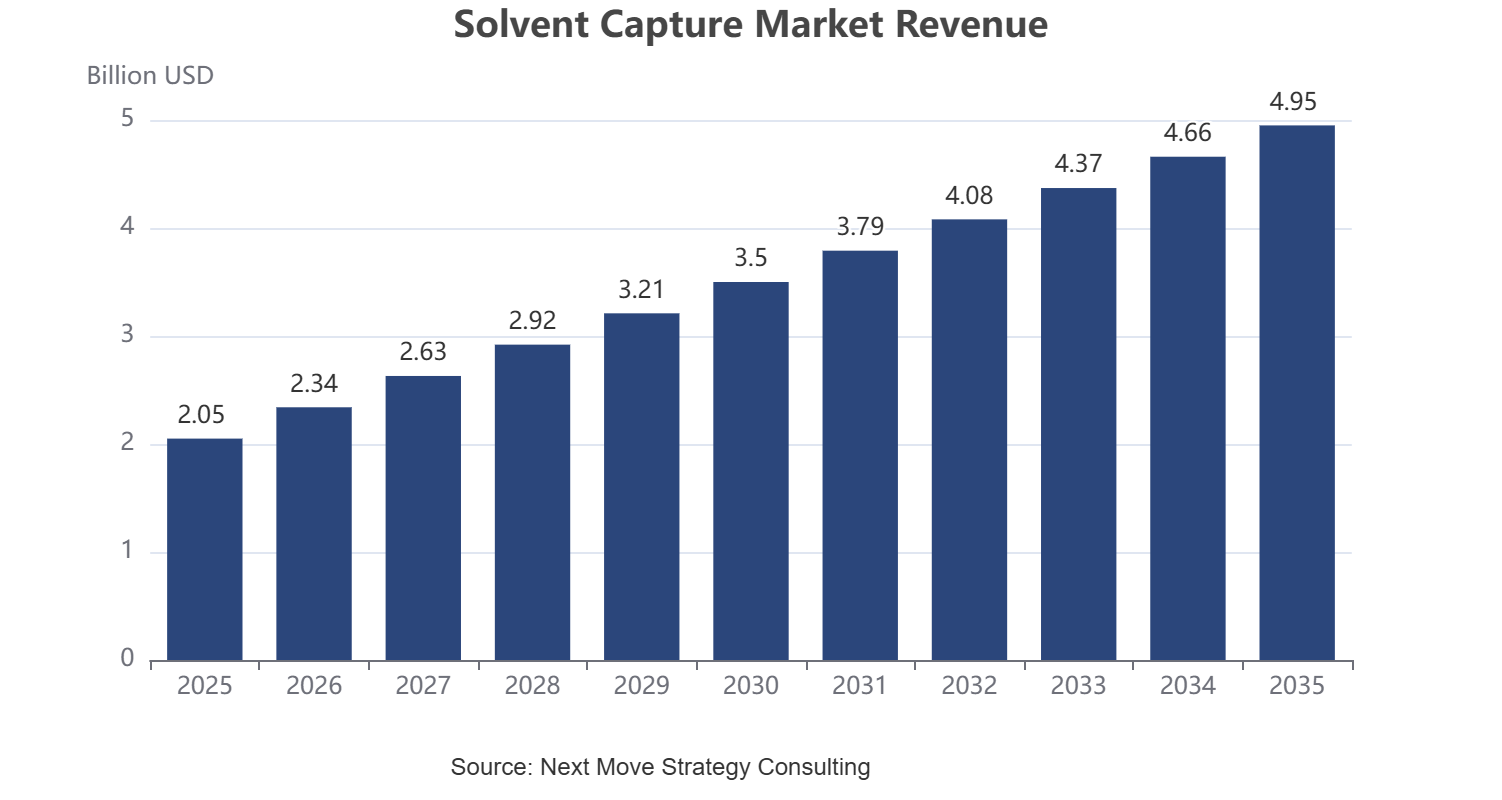
The global solvent capture market size was valued at USD 2.05 billion in 2025 and is estimated at USD 2.24 billion in 2026, forecast to reach USD 4.95 billion by 2035, expanding at a 9.22% CAGR between 2026 and 2035. North America leads with approximately 34% share, while equipment and internals dominate all other offering categories with approximately 28% share.
We observed that growth is broad-based across every segmentation axis, with commercial-scale deployment and water-lean solvent chemistries driving the dominant structural shifts through 2035.
|
Key Takeaways |
|
|
By Offering: Equipment and Internals held the largest share of approximately 28% (USD 0.57 billion) in 2025; Operations and Performance Services is the fastest-growing sub-segment at 11.1% CAGR from 2026–2035. |
By Solvent Chemistry: Aqueous Amine held the largest share of approximately 58% (USD 1.19 billion) in 2025; Enzymatic Solvent is the fastest-growing sub-segment at 18.4% CAGR from 2026–2035. |
|
By Feed Gas: Flue Gas held the largest share of approximately 46% (USD 0.94 billion) in 2025; Atmospheric Air is the fastest-growing sub-segment at 20.5% CAGR from 2026–2035. |
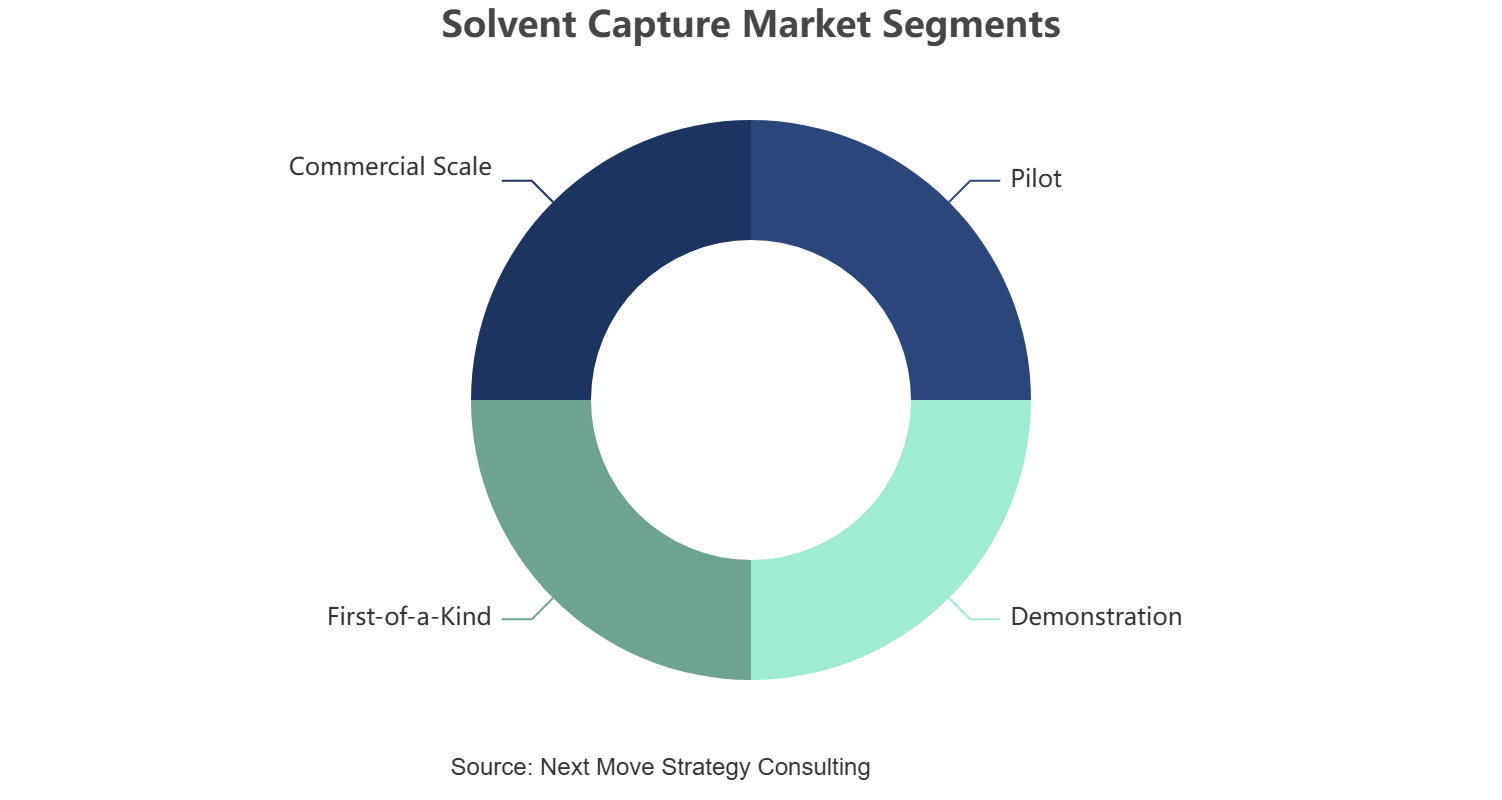
By Deployment Mode: Commercial Scale held the largest share of approximately 50% (USD 1.02 billion) in 2025 and is also the fastest-growing sub-segment at 13.0% CAGR from 2026–2035. |
|
By End User: Power held the largest share of approximately 27% (USD 0.55 billion) in 2025; Maritime is the fastest-growing sub-segment at 18.4% CAGR from 2026–2035. |
Dominant Region: North America dominated with approximately 34% revenue share (USD 0.70 billion) in 2025. |
|
Fastest-Growing Region: Asia-Pacific is expected to register the highest CAGR of 11.8% during 2026–2035. |
Dominant Country: U.S. led with approximately USD 546 million in 2025. |
|
Fastest-Growing Country: India is the fastest-growing country at approximately 12.5% CAGR from 2026–2035. |
|
Market Opportunity: The solvent capture market is expected to create an absolute dollar opportunity of USD 2.71 billion between 2026 and 2035, presenting significant investment potential across the industrial decarbonization and CO2 capture technology value chain.
According to NMSC analysis, technology licensors are increasingly bundling process IP with long-term operations and performance service contracts to lock in recurring revenue, a shift that favors diversified providers over single-scope equipment vendors as commercial-scale project counts accelerate through 2035.
Ecosystem Analysis of the Solvent Capture Industry
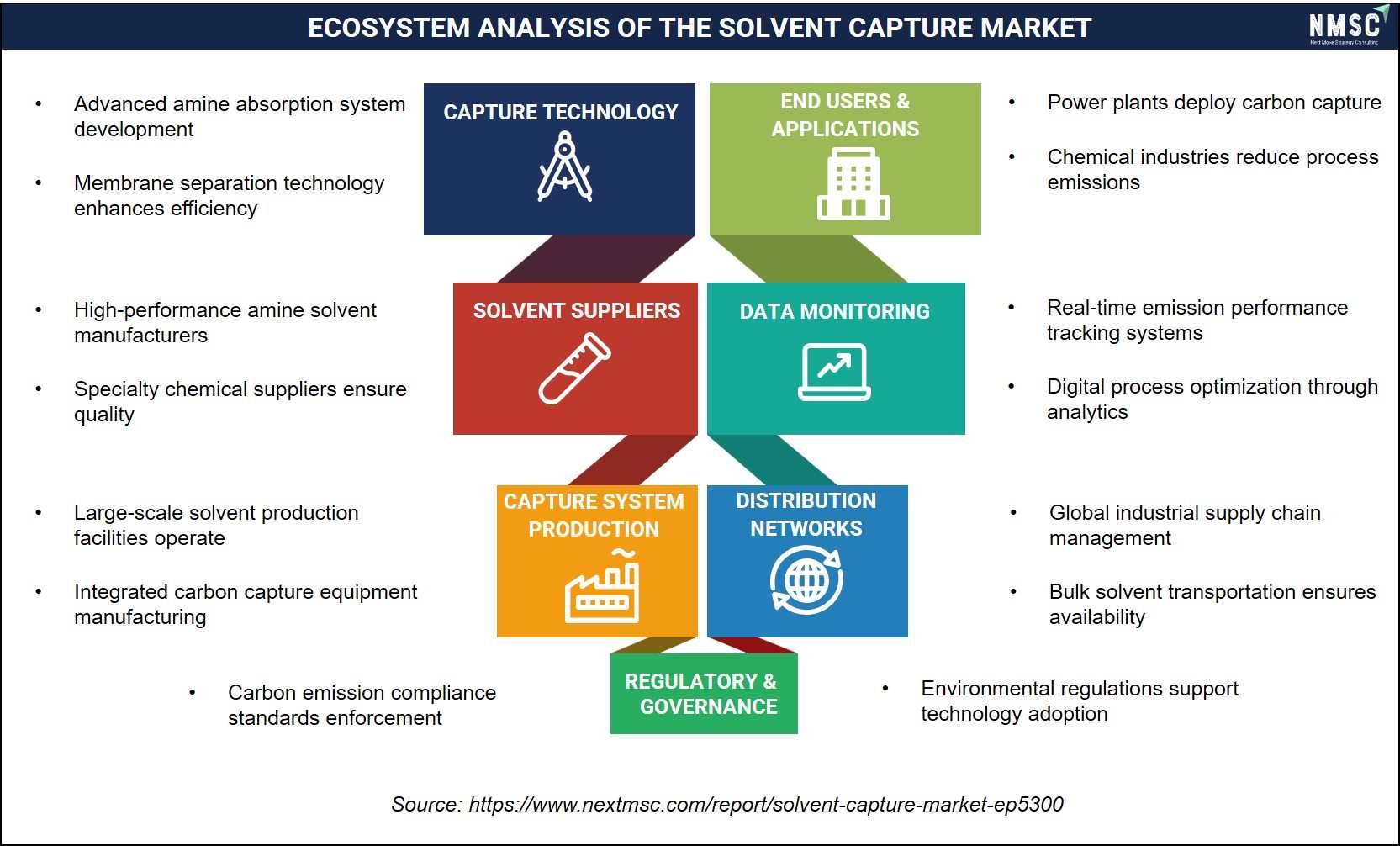
The above infographic presents an ecosystem analysis of the solvent capture market, covering capture technology, solvent suppliers, production, end users, data monitoring, and regulation. Advanced amine absorption and membrane separation technologies are enhancing capture efficiency, supported by high-performance solvent manufacturers and specialty chemical suppliers. Large-scale production facilities and integrated equipment manufacturing enable system deployment, while environmental regulations and carbon compliance standards drive adoption across chemical industries. At the same time, real-time monitoring and digital process optimization ensure operational performance, with bulk solvent transportation and global supply chains maintaining availability. Looking ahead, we observed that these interconnected elements collectively shape the market's evolution across the sector.
What Does the Solvent Capture Market Encompass?
The solvent capture market encompasses the technology licenses, packaged plants, engineering, procurement and construction (EPC) services, equipment, solvents, and operations and performance services used to separate carbon dioxide from flue gas, syngas, natural gas, biogas, and atmospheric air using chemical or physical solvents. Our assessment indicates that the scope spans technology licensors, packaged plant integrators, EPC contractors, equipment fabricators, and solvent suppliers serving power generators, cement and steel producers, refiners, and blue hydrogen developers across the carbon capture, utilization and storage value chain worldwide.
Regulatory frameworks such as the U.S. Internal Revenue Code Section 45Q tax credit and the European Union Emissions Trading System shape project economics and final investment decisions, while the International Energy Agency's carbon management tracking increasingly informs national CCUS strategies. We observed that technology adoption is shifting toward modular, first-of-a-kind plant architectures that compress deployment timelines. NMSC's analysis indicates that this structural shift, combined with rising blue hydrogen and maritime decarbonization demand, is redefining vendor selection criteria across the market.
|
Field |
Details |
|
Market Size in 2025 |
USD 2.05 Billion |
|
Market Size in 2026 |
USD 2.24 Billion |
|
Revenue Forecast in 2035 |
USD 4.95 Billion |
|
Growth Rate |
CAGR of 9.22% from 2026 to 2035 |
|
Analysis Period |
2025–2035 |
|
Base Year Considered |
2025 |
|
Forecast Period |
2026–2035 |
|
Market Size Estimation |
USD Billion |
|
Companies Profiled |
20 |
|
Countries Covered |
38 |
|
Market Share |
Available for Top 10 Companies |
Key Emerging Trends
Based on research conducted by NMSC, we found that four structural trends are reshaping technology selection, project economics, and stakeholder engagement across the industry.
How Is Modular Plant Design Transforming Solvent Capture Deployment Economics?
Modular, factory-fabricated capture units are replacing conventional stick-built plants to compress installation timelines and reduce capital cost. We observed that Carbon Clean's CycloneCC modular unit reached roughly 4,000 operating hours at Fertiglobe's Abu Dhabi nitrogen fertilizer plant in early 2026, advancing the technology-to-technology Readiness Level 7. Technology licensors are adopting rotating packed bed internals and skid-mounted delivery to cut equipment footprint, while EPC contractors retool fabrication yards to accommodate truckable, prefabricated modules across power, cement, and industrial applications.
Why Are Water-Lean and Enzymatic Solvents Gaining Traction?
Water-lean and enzymatic solvent chemistries are gaining share as operators respond to stricter regeneration-energy and operating-cost expectations. Our findings suggest that these next-generation chemistries reduce reboiler duty and corrosion relative to conventional aqueous amine systems, extending solvent lifespan and lowering make-up volumes. Solvent suppliers and technology licensors are expanding water-lean and enzymatic portfolios, positioning these formats as a premium, lower-opex category within the broader solvent chemistry segmentation structure.
How Is AI-Enabled Solvent Monitoring Reshaping Plant Operations?
Artificial intelligence-enabled monitoring platforms are pushing operations and performance service providers toward predictive degradation management and adaptive process control. We observed that Carbon Clean has applied artificial intelligence to improve solvent reliability and plant availability across its modular deployments. This trend is elevating demand for solvent monitoring and performance optimization services among asset operators, while operations providers redesign maintenance contracts to minimize unplanned downtime and extend turnaround intervals.
How Is Offshore and Maritime Deployment Expanding the Addressable Market?
Offshore and maritime capture retrofit programs are emerging as a response to tightening shipping-sector emissions scrutiny. Our analysis shows that MODEC and Carbon Clean are collaborating to scale CycloneCC toward a commercial-scale offshore deployment targeting up to 300,000 tonnes of CO2 per year on floating production platforms. Technology providers are engineering compact, motion-tolerant capture skids for maritime and offshore applications, extending the solvent capture market beyond traditional onshore power and industrial installations.
Growth Drivers and Restraints
Growth Catalyst and Risk Assessment Matrix
|
Factors |
Type |
(+/−) % Impact on CAGR |
Geographic Relevance |
Impact Timeline |
|
U.S. Section 45Q tax credit expansion |
Driver |
+2.3% |
North America |
2026-2035 |
|
EU Emissions Trading System carbon price escalation |
Driver |
+1.9% |
Europe |
2026-2035 |
|
National net-zero mandates and CCUS strategies |
Driver |
+1.6% |
Global |
2026-2035 |
|
Blue hydrogen and ammonia project buildout |
Driver |
+1.4% |
Global |
2026-2035 |
|
Modular and first-of-a-kind plant commercialization |
Driver |
+1.1% |
Global |
2026-2032 |
|
IMO maritime decarbonization rules |
Driver |
+0.7% |
Global |
2028-2035 |
|
High solvent regeneration energy penalty |
Restraint |
-1.3% |
Global |
2026-2035 |
|
Amine solvent degradation and corrosion costs |
Restraint |
-0.9% |
Global |
2026-2035 |
|
Permitting delays for CO2 transport and storage |
Restraint |
-0.8% |
North America, Europe |
2026-2032 |
|
High upfront capital cost for first-of-a-kind plants |
Restraint |
-0.6% |
Global |
2026-2030 |
What Is the Primary Growth Driver of the Solvent Capture Industry?
Expansion of the U.S. Section 45Q tax credit is the primary driver of the market. The U.S. Internal Revenue Service administers 45Q credits of up to USD 85 per tonne for permanently stored carbon dioxide, directly improving the economics of amine and physical solvent capture retrofits at power and industrial facilities. We observed that this policy certainty, reinforced by multi-year credit eligibility windows, continues to anchor final investment decisions for commercial-scale projects across North America.
How Is Carbon Pricing Driving the Market Growth?
Carbon pricing mechanisms are accelerating market growth toward commercial-scale deployment in emissions-intensive sectors. The European Commission's Emissions Trading System has sustained allowance prices that make capture retrofit investment economically rational for German and French industrial emitters. NMSC's analysis indicates that this regulatory pressure, combined with national hydrogen strategies, is compressing final investment decision timelines for cement, steel, and power generation capture projects across Europe.
What Is Restraining the Market Expansion?
The energy penalty associated with solvent regeneration restrains net efficiency and operating economics across the value chain. The U.S. Department of Energy has documented that conventional amine-based regeneration can consume a substantial share of a power plant's gross output, compressing project returns. We found that operators without access to low-cost steam or waste heat face particular exposure, as reboiler duty remains the single largest recurring operating cost for aqueous amine capture systems.
Segmentation Analysis
Segment Sizing: By Offering
|
Segment |
2025 (USD) |
2035 (USD) |
CAGR% (2026–2035) |
|
Technology License and Process IP |
USD 0.18 Billion |
USD 0.40 Billion |
8.2% |
|
Packaged Capture Plant |
USD 0.35 Billion |
USD 0.89 Billion |
9.8% |
|
EPC and Integration |
USD 0.49 Billion |
USD 1.09 Billion |
8.2% |
|
Equipment and Internals |
USD 0.57 Billion |
USD 1.44 Billion |
9.8% |
|
Solvent Supply and Make-Up |
USD 0.25 Billion |
USD 0.54 Billion |
7.9% |
|
Operations and Performance Services |
USD 0.21 Billion |
USD 0.59 Billion |
11.1% |
|
Total |
USD 2.05 Billion |
USD 4.95 Billion |
9.22% |
Which Offering Segment Dominates the Solvent Capture Industry?
Equipment and Internals, encompassing absorber systems, stripper systems, and solvent regeneration systems, led the market with USD 0.57 billion in 2025, reflecting the capital intensity of column internals and heat exchange equipment. Our findings suggest that Operations and Performance Services is the fastest-growing offering, registering an 11.1% CAGR from 2026 to 2035, as asset operators increasingly outsource solvent monitoring and performance optimization to specialized service providers managing multi-year plant availability commitments.
Segment Sizing: By Solvent Chemistry
|
Segment |
2025 (USD) |
2035 (USD) |
CAGR% (2026–2035) |
|
Aqueous Amine |
USD 1.19 Billion |
USD 2.48 Billion |
7.4% |
|
Hot Potassium Carbonate |
USD 0.29 Billion |
USD 0.59 Billion |
7.2% |
|
Physical Solvent |
USD 0.35 Billion |
USD 0.94 Billion |
10.5% |
|
Water-Lean Solvent |
USD 0.12 Billion |
USD 0.59 Billion |
18.2% |
|
Enzymatic Solvent |
USD 0.04 Billion |
USD 0.20 Billion |
18.4% |
|
Other Solvent |
USD 0.06 Billion |
USD 0.15 Billion |
9.6% |
|
Total |
USD 2.05 Billion |
USD 4.95 Billion |
9.22% |
Which Solvent Chemistry Is Most Widely Used in Solvent Capture?
Aqueous Amine chemistries remained dominant across the market, reaching USD 1.19 billion in 2025 due to decades of commercial operating experience and well-characterized carbon dioxide absorption performance. Based on research conducted by NMSC, we found that Enzymatic Solvent represents the fastest-growing chemistry at an 18.4% CAGR from 2026 to 2035, reflecting operator interest in lower regeneration-energy alternatives that reduce reboiler duty and extend solvent life relative to conventional amine systems.
Segment Sizing: By End User
|
Segment |
2025 (USD) |
2035 (USD) |
CAGR% (2026–2035) |
|
Power |
USD 0.55 Billion |
USD 1.09 Billion |
6.8% |
|
Hydrogen and Ammonia |
USD 0.31 Billion |
USD 0.84 Billion |
10.6% |
|
Cement |
USD 0.29 Billion |
USD 0.74 Billion |
9.9% |
|
Steel |
USD 0.20 Billion |
USD 0.59 Billion |
11.7% |
|
Refining and Petrochemicals |
USD 0.33 Billion |
USD 0.69 Billion |
7.5% |
|
Waste-to-Energy |
USD 0.16 Billion |
USD 0.45 Billion |
11.1% |
|
Bioenergy and Ethanol |
USD 0.10 Billion |
USD 0.25 Billion |
9.6% |
|
Pulp and Paper |
USD 0.04 Billion |
USD 0.10 Billion |
9.6% |
|
Maritime |
USD 0.02 Billion |
USD 0.10 Billion |
18.4% |
|
Other Industrial |
USD 0.05 Billion |
USD 0.10 Billion |
6.9% |
|
Total |
USD 2.05 Billion |
USD 4.95 Billion |
9.22% |
Which End User Segment Leads Solvent Capture Market Demand?
Power remained the leading end user within the market, valued at USD 0.55 billion in 2025 on sustained coal and natural gas plant retrofit activity. Our findings suggest that Maritime is the fastest-growing end user, registering an 18.4% CAGR from 2026 to 2035, as offshore and shipboard capture pilots move toward commercial-scale deployment alongside expanding hydrogen and ammonia bunkering infrastructure investment.
Growth Opportunities
Our analysis shows that three forward-looking opportunities stand out for stakeholders' positioning within the solvent capture market over the 2026-2035 forecast period.
How Can Water-Lean Solvent Licensing Unlock Value for Technology Providers?
Water-lean and enzymatic solvent licensing presents a whitespace opportunity for technology providers seeking to differentiate on regeneration-energy performance. Licensors that commercialize validated, lower-opex chemistries stand to capture premium royalty and service revenue as operators shift away from conventional aqueous amine systems, particularly among steel and cement producers seeking to minimize the parasitic energy load of capture retrofits.
Where Do Modular Capture Plants Create New Demand Among Small and Mid-Size Emitters?
Small and mid-size industrial emitters lacking space or capital for stick-built plants represent an underpenetrated opportunity for packaged and modular capture systems. Providers that scale factory-fabricated, truckable units can secure procurement contracts with waste-to-energy and pulp and paper facilities, benefiting from shorter installation cycles and standardized replacement-part revenue tied to modular equipment fleets.
How Can Offshore and Maritime Capture Retrofit Programs Benefit EPC Contractors?
Offshore platforms and maritime vessels seeking compliance with tightening shipping emissions rules create an opportunity for EPC contractors offering motion-tolerant, compact capture skids. Early movers that secure floating production platform and vessel retrofit contracts can differentiate with engineering expertise tailored to offshore weight and footprint constraints, capturing recurring commissioning and integration revenue across the maritime end-user segment.
Regional Outlook
Geographic Performance Snapshot
|
Region |
2025 (USD) |
2035 (USD) |
CAGR% (2026–2035) |
Key Driver |
|
North America |
USD 0.70 Billion |
USD 1.49 Billion |
7.7% |
45Q tax credit and mature CCS project pipeline |
|
Europe |
USD 0.57 Billion |
USD 1.29 Billion |
8.4% |
EU ETS carbon pricing and industrial decarbonization mandates |
|
Asia-Pacific |
USD 0.45 Billion |
USD 1.34 Billion |
11.8% |
Expanding the coal-to-CCS retrofit pipeline and national hydrogen strategies |
|
Middle East & Africa |
USD 0.23 Billion |
USD 0.59 Billion |
9.9% |
Blue hydrogen and ammonia export project buildout |
|
Latin America |
USD 0.10 Billion |
USD 0.24 Billion |
9.1% |
Growing bioenergy and industrial decarbonization investment |
|
Total |
USD 2.05 Billion |
USD 4.95 Billion |
9.22% |
– |
North America
North America leads the solvent capture market with an established commercial-scale project pipeline and mature 45Q tax credit support. Regulatory influence remains strong, with the U.S. Department of Energy funding regional CO2 transport hubs that de-risk downstream storage access. Technology adoption favors proven amine chemistries at scale, though water-lean pilots are advancing. NMSC's analysis indicates that strategic outlook remains favorable as multi-year credit eligibility continues to anchor final investment decisions across power and industrial retrofits.
Europe
Europe's market maturity is shaped by sustained EU Emissions Trading System allowance pricing that makes capture retrofit investment economically viable for industrial emitters. Regulatory influence is pronounced, with national CCUS strategies in Germany, the UK, and the Netherlands directing public funding toward cement and power generation projects. Technology adoption spans aqueous amine and emerging water-lean chemistries. Our assessment indicates a strategic outlook centered on cross-border CO2 transport infrastructure supporting regional storage hubs.
Asia-Pacific
Asia-Pacific's market maturity is earlier-stage but accelerating, driven by an expanding coal and gas power retrofit pipeline. Regulatory influence is strengthening as China, Japan, and South Korea formalize national CCUS roadmaps. Technology adoption is shifting toward packaged and modular plants suited to space-constrained industrial sites. We observed that competitive intensity is rising as regional EPC contractors partner with global technology licensors, supporting a strategic outlook of the fastest regional CAGR through 2035.
Middle East & Africa
The Middle East & Africa market is shaped by blue hydrogen and ammonia export project development, particularly across the Gulf Cooperation Council. Regulatory influence stems from national net-zero commitments tied to economic diversification programs. Technology adoption favors large-scale, commercial-stage plants integrated with enhanced oil recovery infrastructure. Our findings suggest a strategic outlook anchored in export-oriented blue hydrogen and ammonia projects requiring high-capacity solvent capture integration through 2035.
Latin America
Latin America's market remains nascent relative to other regions, with demand concentrated in bioenergy and industrial decarbonization pilots. Regulatory influence is limited but growing as Brazil advances carbon market legislation. Technology adoption centers on smaller-scale and demonstration deployments tied to ethanol and cement facilities. NMSC's analysis indicates a strategic outlook of steady, policy-linked growth as regional carbon pricing frameworks mature through the forecast period.
U.S.
Based on our estimates, the U.S. solvent capture market was valued at approximately USD 546 million in 2025, projected to reach USD 1.16 billion by 2035 at a 7.6% CAGR. Demand structure is anchored in commercial-scale power and industrial retrofits supported by 45Q tax credits. Adoption levels are high, regulatory influence is strong, technology penetration favors proven amine chemistries, and competitive intensity is elevated among global technology licensors and domestic EPC contractors pursuing a strategic outlook centered on regional CO2 transport hub development.
Canada
The market in Canada was valued at approximately USD 120 million in 2025, projected to reach USD 255 million by 2035 at a 7.8% CAGR. Demand structure is concentrated in natural gas processing and power generation retrofits across Alberta and Saskatchewan. Regulatory influence stems from federal carbon pricing and provincial CCUS incentive programs. Technology penetration favors established amine systems, with competitive intensity moderate and strategic outlook tied to continued natural gas sweetening capacity expansion.
UK
As per our estimate, the UK solvent capture market was valued at approximately USD 140 million in 2025, projected to reach USD 320 million by 2035 at an 8.5% CAGR. Demand structure centers on industrial cluster projects linked to government-backed CO2 transport and storage networks. Regulatory influence is substantial, technology penetration spans amine and physical solvent systems, and competitive intensity is elevated as global EPC contractors compete for cluster-anchored capture contracts through the forecast period.
Germany
According to our analysis, the German market was valued at approximately USD 170 million in 2025, projected to reach USD 390 million by 2035 at an 8.6% CAGR. Demand structure reflects cement and industrial decarbonization mandates under national CCUS legislation. Regulatory influence is strong, technology penetration favors proven chemistries with growing water-lean pilots, and competitive intensity is high given Germany's concentration of engineering and equipment fabrication capacity.
France
Based on our estimates, the French market was valued at approximately USD 115 million in 2025, projected to reach USD 255 million by 2035 at an 8.2% CAGR. Demand structure is supported by cement and waste-to-energy decarbonization projects tied to national carbon neutrality targets. Regulatory influence is significant, technology penetration is moderate, and competitive intensity centers on EPC contractors partnering with global technology licensors for industrial cluster deployments.
China
The market in China was valued at approximately USD 180 million in 2025, projected to reach USD 540 million by 2035 at an 11.6% CAGR. Demand structure is driven by coal power retrofit pilots and steel sector decarbonization programs. Regulatory influence is strengthening under national CCUS demonstration policy, technology penetration favors domestically manufactured amine systems, and competitive intensity is rising as local EPC contractors scale capacity to serve expanding project pipelines.
India
As per our estimate, the Indian solvent capture market was valued at approximately USD 90 million in 2025, projected to reach USD 275 million by 2035 at a 12.5% CAGR, the fastest among countries covered. Demand structure centers on steel and cement pilot projects, with adoption levels rising as public-private CCUS partnerships expand. Regulatory influence is emerging, technology penetration is early-stage, and competitive intensity is increasing as international technology licensors establish local partnerships.
Japan
According to our analysis, the Japanese market was valued at approximately USD 68 million in 2025, projected to reach USD 198 million by 2035 at an 11.2% CAGR. Demand structure reflects power generation and industrial gas processing applications tied to national carbon neutrality goals. Regulatory influence is well established, technology penetration favors proven Japanese-engineered amine and physical solvent systems, and competitive intensity remains concentrated among established domestic technology licensors.
South Korea
Based on our estimates, the South Korean market was valued at approximately USD 45 million in 2025, projected to reach USD 132 million by 2035 at an 11.3% CAGR. Demand structure is supported by steel and petrochemical decarbonization pilots under the national green growth strategy. Regulatory influence is growing, technology penetration is moderate, and competitive intensity centers on domestic industrial conglomerates partnering with global capture technology licensors.
Australia
The market in Australia was valued at approximately USD 36 million in 2025, projected to reach USD 105 million by 2035 at an 11.3% CAGR. Demand structure is concentrated in natural gas sweetening and LNG processing applications. Regulatory influence stems from federal safeguard mechanism compliance requirements, technology penetration favors established physical and amine solvent systems, and competitive intensity remains moderate with global EPC contractors serving resource-sector clients.
UAE
As per our estimate, the UAE solvent capture market was valued at approximately USD 69 million in 2025, projected to reach USD 178 million by 2035 at a 9.9% CAGR. Demand structure is anchored in blue hydrogen and ammonia export project development. Regulatory influence is strong under the national net-zero strategy, technology penetration favors commercial-scale plants integrated with enhanced oil recovery, and competitive intensity is elevated among global EPC contractors pursuing Gulf project awards.
Saudi Arabia
According to our analysis, the Saudi Arabian solvent capture market was valued at approximately USD 80 million in 2025, projected to reach USD 210 million by 2035 at a 10.1% CAGR. Demand structure reflects large-scale blue hydrogen and petrochemical decarbonization investment under national diversification programs. Regulatory influence is substantial, technology penetration favors commercial-scale amine systems, and competitive intensity is high as international technology licensors compete for mega-project awards.
South Africa
Based on our estimates, the South African market was valued at approximately USD 34 million in 2025, projected to reach USD 86 million by 2035 at a 9.7% CAGR. Demand structure is supported by power generation and industrial gas processing pilot projects. Regulatory influence is emerging under national carbon tax legislation, technology penetration remains early-stage, and competitive intensity is limited to a small number of international EPC contractors and regional distributors.
Brazil
The market in Brazil was valued at approximately USD 45 million in 2025, projected to reach USD 106 million by 2035 at an 8.9% CAGR. Demand structure is driven by ethanol and bioenergy decarbonization projects tied to national biofuel programs. Regulatory influence is growing under emerging carbon market legislation, technology penetration favors smaller-scale demonstration plants, and competitive intensity centers on a limited pool of regional engineering contractors.
Argentina
As per our estimate, Argentina's market was valued at approximately USD 20 million in 2025, projected to reach USD 47 million by 2035 at an 8.9% CAGR. Demand structure is supported by natural gas processing applications tied to Vaca Muerta shale development. Regulatory influence remains limited, technology penetration is modest, and competitive intensity is centered on a small number of regional distributors serving domestic energy sector clients.
Regulatory Framework Impacting the Solvent Capture Industry
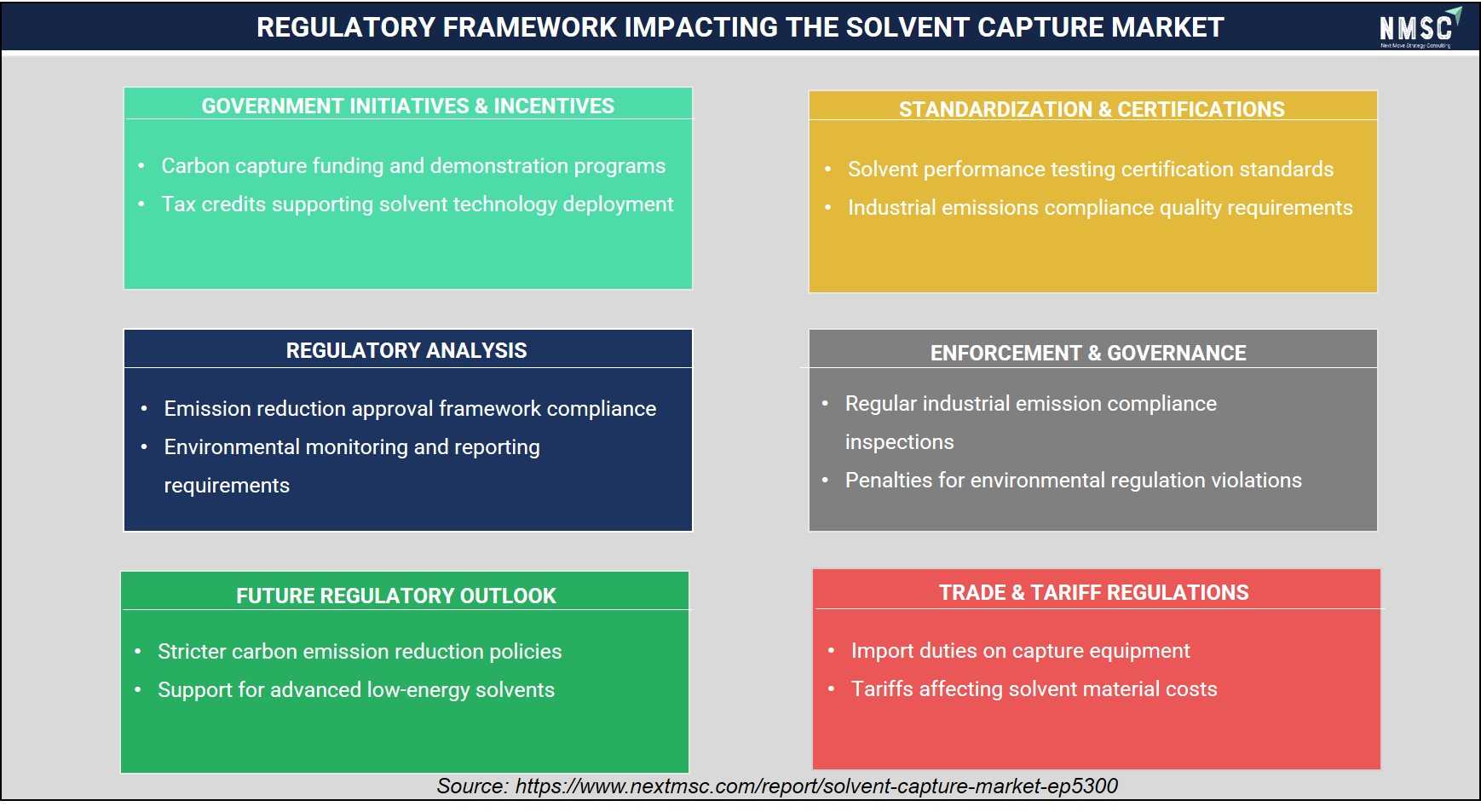
The above infographic presents a regulatory framework impacting the solvent capture market, where government funding and tax credits are actively supporting carbon capture and solvent technology deployment. These efforts are complemented by emission reduction approvals and environmental monitoring requirements that ensure regulatory compliance. Standardization through solvent performance testing and emissions certification reinforces quality, while regular inspections and penalties strengthen enforcement and governance. Looking ahead, we observed that stricter carbon reduction policies and support for advanced low-energy solvents are gaining momentum. At the same time, import duties and tariffs on capture equipment and solvent materials continue to influence cost structures and market dynamics across the sector.
Competitive Landscape
We observed that the solvent capture market features a moderately consolidated competitive landscape, with diversified engineering conglomerates competing alongside specialized modular-technology entrants on licensing terms, project references, and lifecycle service capability.
|
Field |
Details |
|
Market Structure |
Moderately consolidated; the top companies profiled in this report collectively account for a majority of global solvent capture market revenue, while regional EPC contractors serve cost-sensitive retrofit demand. |
|
Innovation Focus |
Modular plant architectures, water-lean and enzymatic solvent chemistries, and AI-enabled performance monitoring dominate current innovation pipelines across leading technology providers. |
|
M&A Activity |
Selective consolidation through joint ventures, exemplified by SLB's integration of Aker Carbon Capture into the SLB Capturi joint venture to broaden industrial decarbonization capability. |
How Do Companies Compete in the Solvent Capture Industry?
Companies compete primarily on proprietary solvent performance, commercial operating references, and engineering delivery capability across the industry. Global players such as Mitsubishi Heavy Industries and Shell Catalysts & Technologies leverage decades of commercial-scale references to serve multinational power and industrial clients, while modular-technology entrants such as Carbon Clean and Capsol Technologies compete on installation speed and capital efficiency for space-constrained emitters.
Which Competitive Archetypes Dominate the Solvent Capture Market?
Two archetypes dominate the market: diversified engineering and technology conglomerates offering full-scope licensing, EPC, and lifecycle service capability, and specialized modular-technology providers focused on compact, factory-fabricated deployment. Fluor Corporation and Technip Energies exemplify the diversified archetype through integrated project delivery, while Carbon Clean and Capsol Technologies exemplify the modular-technology archetype serving small and mid-size industrial emitters.
How Are Companies Differentiating Through Innovation in Solvent Capture?
Innovation and differentiation strategy increasingly center on regeneration, energy reduction, and modular fabrication. Carbon Clean's CycloneCC platform and BASF's OASE blue technology both target lower operating costs through proprietary solvent formulations and process intensification. Our analysis shows that providers unable to demonstrate credible energy-penalty reduction risk exclusion from operator shortlists as commercial-scale project economics tighten.
What M&A and Expansion Activity Is Shaping the Solvent Capture Market?
Joint ventures, technology partnerships, and geographic expansion continue to consolidate capture capabilities within the industry. SLB's integration of Aker Carbon Capture into SLB Capturi broadened its industrial decarbonization portfolio across cement, waste-to-energy, and biogenic emissions applications, while Shell Catalysts & Technologies' expanded cooperation with Technip Energies around the CANSOLV CO2 capture system illustrates how technology licensors pursue geographic reach through EPC partnerships.
Key Market Players
Our assessment indicates that the following 20 companies are actively shaping technology licensing, plant delivery, and lifecycle service strategy within the global solvent capture market.
-
Mitsubishi Heavy Industries, Ltd.
-
Shell Catalysts & Technologies
-
SLB Capturi AS
-
Fluor Corporation
-
Technip Energies N.V.
-
Air Liquide S.A.
-
Carbon Clean Solutions Limited
-
Linde plc
-
ANDRITZ AG
-
Capsol Technologies ASA
-
KBR, Inc.
-
JGC Holdings Corporation
-
thyssenkrupp Uhde GmbH
-
Saipem S.p.A.
-
ION Clean Energy, Inc.
-
C-Capture Ltd.
-
Babcock & Wilcox Enterprises, Inc.
-
Sulzer Ltd
Latest Developments
We found that recent milestones within the solvent capture market are concentrated on modular technology validation and offshore expansion, reflecting the industry's broader commercialization push.
|
Date |
Event |
|
November 2025 |
Carbon Clean and Samsung E&A formed an alliance to accelerate global deployment of modular carbon capture solutions. The collaboration integrates Carbon Clean's APBS-CDRMax amine-promoted buffer salt solvent and rotating packed bed technology with Samsung E&A's EPC capabilities, supporting faster and more cost-effective deployment across hard-to-abate industries. |
|
November 2025 |
SLB Capturi and CO280 completed a field pilot validating SLB Capturi's liquid amine technology for capturing biogenic CO₂ from pulp mill emissions. The pilot achieved a consistent 95% capture rate efficiency while validating solvent durability, energy consumption, and absorber emissions performance, supporting commercial-scale deployment of solvent-based carbon capture. |
|
May 2025 |
Carbon Clean successfully completed factory testing of its commercial-scale CycloneCC C1 technology, combining rotating packed beds with the company's proprietary APBS-CDRMax solvent. The system can capture up to 285 tonnes of CO₂ per day, representing a major scale-up of solvent-based carbon capture technology for industrial applications. |
Expert Insights
 “The strong performance and results of the MTU at this mill validates all key process parameters and demonstrates that there are no technical barriers to deploying commercial-scale carbon capture plants. CO280 and SLB Capturi are now well-positioned to bring this proven solution to the pulp and paper industry.”
— Egil Fagerland, CEO of SLB Capturi
Statement made following the successful field pilot of SLB Capturi's liquid amine carbon capture technology at a U.S. pulp and paper mill.
Market Interpretation
The statement highlights the growing technical maturity of liquid amine-based solvent capture systems and their transition from pilot testing toward commercial-scale deployment. NMSC's analysis indicates that successful validation of capture efficiency, energy consumption, solvent durability, and absorber emissions is strengthening confidence in solvent-based carbon capture for hard-to-abate industries. Our findings suggest that proven solvent performance and reduced technology risk will increasingly support large-scale adoption across industrial carbon capture applications.
Investment Opportunities
What Capital Inflows Are Targeting the Solvent Capture Market?
Capital inflows into the solvent capture market are increasingly directed toward modular manufacturing capacity and joint venture technology platforms. SLB's cash investment to acquire an 80% stake in Aker Carbon Capture Holdings, forming SLB Capturi, illustrates continued strategic capital deployment. We observed that investors favor providers demonstrating validated commercial-scale operating references, viewing technology readiness level progression as a proxy for long-term contract retention.
How Significant Is Infrastructure Investment in the Solvent Capture Market?
Infrastructure investment tied to CO2 transport and storage networks is a critical enabler of solvent capture project bankability. The U.S. Department of Energy continues to fund regional carbon transport hub development, reducing downstream storage access risk for capture project developers. Our assessment indicates that operators increasingly condition final investment decisions on confirmed transport and storage infrastructure availability rather than on capture technology performance alone.
What ESG Considerations Are Shaping Solvent Capture Investment?
Environmental, social, and governance considerations increasingly shape capital allocation toward verified, permanent carbon dioxide removal pathways. Microsoft's purchase of carbon removal from SLB Capturi's Kalundborg biogenic CO2 hub in Denmark demonstrates growing corporate demand for durable removal credits. NMSC's analysis indicates that ESG-linked offtake agreements are emerging as a meaningful revenue stream that supplements traditional capture project financing structures.
Key Benefits for Stakeholders
How Does This Report Benefit Industrial and Power Generation Leaders?
Industrial and power generation leaders gain access to validated segmentation, technology benchmarking, and regional regulatory analysis that support capture technology procurement decisions. The report's offering and solvent chemistry breakdowns help operators evaluate technology license, EPC, and operations service options against project-specific emissions profiles, supporting more informed vendor selection across commercial-scale and modular deployment pathways.
How Does This Report Benefit Investors and Financial Analysts?
Investors and financial analysts benefit from consolidated market sizing, regional growth forecasts, and competitive positioning data that inform capital allocation across the solvent capture value chain. The report's country-level revenue estimates and growth catalyst matrix support due diligence on technology licensors, EPC contractors, and equipment fabricators positioned to capture forecast demand growth through 2035.
How Does This Report Benefit Technology Vendors and Product Teams?
Technology vendors and product teams gain competitive intelligence on solvent chemistry innovation, modular plant architecture trends, and recent developments among the 20 companies profiled. This supports product roadmap decisions around water-lean and enzymatic solvent development, AI-enabled monitoring capability, and offshore or maritime deployment strategy aligned with the fastest-growing end-user and regional segments identified in this report.
Key Market Segments
By Offering
-
Technology License and Process IP
-
New Technology License
-
Technology Upgrade
-
Process Optimization License
-
-
Packaged Capture Plant
-
Modular Capture System
-
Standard Capture Plant
-
Customized Capture Plant
-
-
EPC and Integration
-
Engineering
-
Procurement
-
Construction
-
Plant Integration
-
Commissioning
-
-
Equipment and Internals
-
Absorber Systems
-
Stripper Systems
-
Heat Recovery Systems
-
Solvent Regeneration Systems
-
Columns and Internals
-
Pumps and Heat Exchangers
-
Process Control Systems
-
Other Equipment
-
-
Solvent Supply and Make-Up
-
Fresh Solvent
-
Solvent Reclaiming
-
Solvent Replacement
-
Solvent Additives
-
-
Operations and Performance Services
-
Plant Operation
-
Asset Management
-
Solvent Monitoring
-
Performance Optimization
-
Maintenance
-
Operator Training
-
By Solvent Chemistry
-
Aqueous Amine
-
Monoethanolamine
-
Methyldiethanolamine
-
Piperazine Blends
-
Proprietary Amine Blends
-
-
Hot Potassium Carbonate
-
Physical Solvent
-
Selexol-Type
-
Rectisol-Type
-
Morphysorb-Type
-
Genosorb-Type
-
Other Physical Solvents
-
-
Water-Lean Solvent
-
Enzymatic Solvent
-
Other Solvent
By Feed Gas
-
Flue Gas
-
Syngas
-
Natural Gas Sweetening
-
Biogas and Fermentation Gas
-
Atmospheric Air
-
Other Industrial Gas
By Deployment Mode
-
Pilot
-
Demonstration
-
First-of-a-Kind
-
Commercial Scale
By End User
-
Power
-
Coal-Fired Power
-
Natural Gas Power
-
Biomass Power
-
-
Hydrogen and Ammonia
-
Blue Hydrogen
-
Ammonia
-
-
Cement
-
Steel
-
Refining and Petrochemicals
-
Waste-to-Energy
-
Bioenergy and Ethanol
-
Pulp and Paper
-
Maritime
-
Other Industrial
By Region
-
North America: U.S., Canada, Mexico.
-
Europe: UK, Germany, France, Italy, Spain, Sweden, Denmark, Finland, Netherlands, Rest of Europe.
-
Asia-Pacific: China, India, Japan, South Korea, Taiwan, Indonesia, Vietnam, Australia, Philippines, Malaysia, Rest of APAC.
-
Middle East & Africa: Saudi Arabia, UAE, Egypt, Israel, Turkey, Nigeria, South Africa, Rest of MEA.
-
Latin America: Brazil, Argentina, Chile, Colombia, Rest of LATAM.
Conclusion & Recommendations
What Is the Long-Term Outlook for the Solvent Capture Market?
The long-term outlook for the solvent capture market remains structurally positive, supported by a USD 2.71 billion absolute dollar opportunity between 2026 and 2035 and durable policy support across North America and Europe. We found that commercial-scale deployment will continue to dominate revenue as first-of-a-kind and demonstration projects mature into repeatable, bankable project structures through the forecast period.
What Strategic Positioning Should Stakeholders Pursue?
Stakeholders should pursue strategic positioning that combines proprietary solvent chemistry with modular delivery capability to serve both large commercial-scale emitters and space-constrained industrial sites. NMSC's analysis indicates that providers bundling technology licenses, EPC, and operations and performance services into integrated offerings are best positioned to capture recurring, multi-year revenue across the solvent capture market.
How Attractive Is the Solvent Capture Market for New Investment?
The solvent capture industry presents an attractive investment case, supported by a USD 2.71 billion absolute dollar opportunity between 2026 and 2035 and above-average growth in Asia-Pacific and maritime end-use categories. We found that investment attractiveness is highest for technology providers combining validated commercial-scale references with modular manufacturing capacity, positioning them to serve both mature and emerging regional markets simultaneously.
What Market Shifts and Key Risks Should Stakeholders Monitor?
Stakeholders should monitor regeneration-energy penalty economics, CO2 transport and storage permitting delays, and policy continuity risk tied to tax credit and carbon pricing mechanisms as key risks to the solvent capture market. Our analysis shows that providers unable to demonstrate credible energy-penalty reduction risk losing project awards to competitors offering validated water-lean or enzymatic solvent alternatives, particularly across Europe's increasingly regulated industrial landscape.
What Are the Key Growth Pathways for the Solvent Capture Market?
Key growth pathways include scaling water-lean and enzymatic solvent commercialization, expanding modular plant manufacturing capacity, and deepening penetration into maritime and offshore end-use channels. NMSC's analysis indicates that providers pursuing these pathways while maintaining cost competitiveness in commercial-scale aqueous amine categories will be best positioned to capture the solvent market's projected growth through 2035.
About the Author
 Mayurima Roy
— Mayurima Roy is Research Analyst at Next Move Strategy Consulting, where she has spent 4 years working across the firm's full industry coverage rather than a single fixed vertical. Her work centers on structured research, ongoing trend tracking, competitive assessment, and insight-led content development, translating complex market data into clear, decision-ready narratives that support informed client decision-making across diverse global industries, market sectors, and world regions every day.
Mayurima Roy
— Mayurima Roy is Research Analyst at Next Move Strategy Consulting, where she has spent 4 years working across the firm's full industry coverage rather than a single fixed vertical. Her work centers on structured research, ongoing trend tracking, competitive assessment, and insight-led content development, translating complex market data into clear, decision-ready narratives that support informed client decision-making across diverse global industries, market sectors, and world regions every day.
About the Reviewer
 Supradip Baul
— Supradip Baul is an accomplished business consultant and strategist with over a decade of rich experience in market intelligence, strategy, technology, and business transformation. His work has included rigorous qualitative and quantitative analysis across multiple industries, helping clients shape investment decisions and long-term roadmaps. Earlier in his career, he was associated with Gartner, where he contributed to industry-leading reports and market share analyses. He has worked with leading global companies and holds an MBA with a dual specialization in Marketing and Finance.
Supradip Baul
— Supradip Baul is an accomplished business consultant and strategist with over a decade of rich experience in market intelligence, strategy, technology, and business transformation. His work has included rigorous qualitative and quantitative analysis across multiple industries, helping clients shape investment decisions and long-term roadmaps. Earlier in his career, he was associated with Gartner, where he contributed to industry-leading reports and market share analyses. He has worked with leading global companies and holds an MBA with a dual specialization in Marketing and Finance.
At Next Move Strategy Consulting, we understand that insightful market research is the cornerstone of successful business decisions. That's why we employ a robust and multifaceted approach, combining various methodologies to deliver the most accurate and actionable data for our clients.

Research Landscape
We navigate the world of research with two primary approaches:
Qualitative Approach
Our qualitative research methodologies involve immersive techniques such as in-depth interviews, focus groups, and observational studies. By engaging directly with individuals and stakeholders, we uncover valuable insights that quantitative data alone may overlook.

Quantitative Research
In tandem with qualitative methodologies, NMSC leverages the power of Quantitative Research to provide a robust foundation of numerical insights. Through systematic data collection and analysis, we quantify patterns, preferences, and market trends, offering a comprehensive view of the business landscape.
Our quantitative research approach employs diverse tools, including surveys, experiments, and statistical modelling. These methodologies enable us to gather data from a large and representative sample, ensuring the statistical significance of our findings. By employing structured questionnaires and standardized data collection methods, we guarantee the reliability and validity of the information we present to our clients.
Quantitative research is particularly effective in measuring the prevalence of trends, assessing market size, and gauging the impact of various factors on consumer behavior. The numerical precision attained through this approach equips our clients with actionable insights, facilitating data-driven decision-making and strategy formulation.


Our Specialized Toolbox for Industry-Specific Market Research
We deploy a specialized arsenal of techniques tailored to meet your unique requirements. Here's a glimpse into our comprehensive toolbox:

Information Procurement
The stage entails acquiring market data or relevant information through various sources and methodologies.


Market Research Approach
We utilize both top-down and bottom-up approaches in market research analysis to achieve a comprehensive understanding of the market dynamics, leveraging the broad perspective of industry trends and macroeconomic factors alongside detailed insights from specific segments and individual companies.

Porters Five Forces Analysis
We conduct Porter's Five Forces analysis to evaluate the competitive landscape of an industry, providing us with insights into factors that affect profitability and strategic positioning.

SWOT Analysis

Forecasting
We utilize a forecasting model to predict future consumption by considering parameters like population, economics, regulations, market competition, drivers, constraints, technology, and pricing. We also employ statistical techniques such as multilinear regression, exponential smoothing, moving average, ARIMA, and Monte Carlo simulations for accurate predictions. In econometric forecasting, we analyzed short-term and long-term event impacts, attributing values based on regulatory frameworks, economic factors, and market events.





 Speak to Our Analyst