Printed Circuit Heat Exchanger Market Size, Share, Trends and Growth Analysis, By Offerings (Finished PCHE, and Aftermarket Services), By Heat Transfer Service (Gas to Gas, Gas to Liquid, Liquid to Liquid, and Multi Stream), By Construction Material (Stainless Steel, Titanium and Titanium Alloys, Nickel Alloys, and Other Materials), By Application (Oil and Gas, Hydrogen and Clean Energy, and Other Industrial), By Sales Channel, and Region — Global Industry Report and Forecast, 2026–2035
Industry: Energy & Power | Publishing Date: July 27, 2026 | Last Updated: September 30, 2026 | No of Pages: N/A | No. of Tables: N/A | No. of Figures: N/A | Format: PDF | Report Code: EP5407
What Is the Printed Circuit Heat Exchanger Market Size?
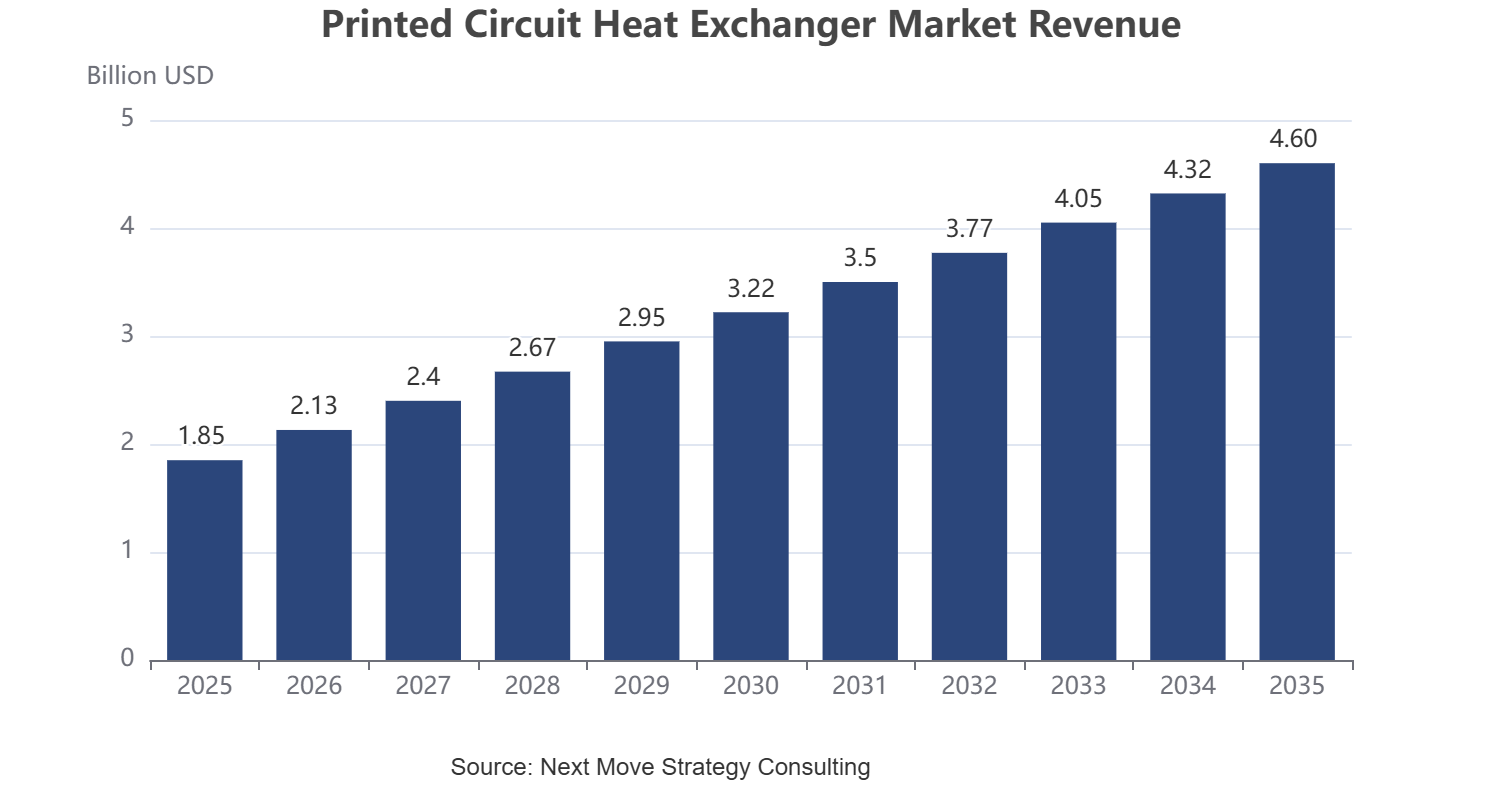
The global printed circuit heat exchanger market size was valued at USD 1.85 billion in 2025 and is estimated at USD 2.03 billion in 2026, forecast to reach USD 4.60 billion by 2035, expanding at a 9.5% CAGR between 2026 and 2035. North America leads with approximately 33% share, while the oil and gas application dominates with approximately 34% share.
We observed that growth is broad based across every segmentation axis, with hydrogen infrastructure buildout and nuclear and supercritical CO2 power programs driving the dominant structural shifts through 2035.
|
Key Takeaways |
|
By Offerings: Finished PCHE held the largest share of approximately 79% (USD 1.46 Billion) in 2025; Aftermarket Services is the fastest-growing sub-segment at 10.8% CAGR from 2026–2035. |
|
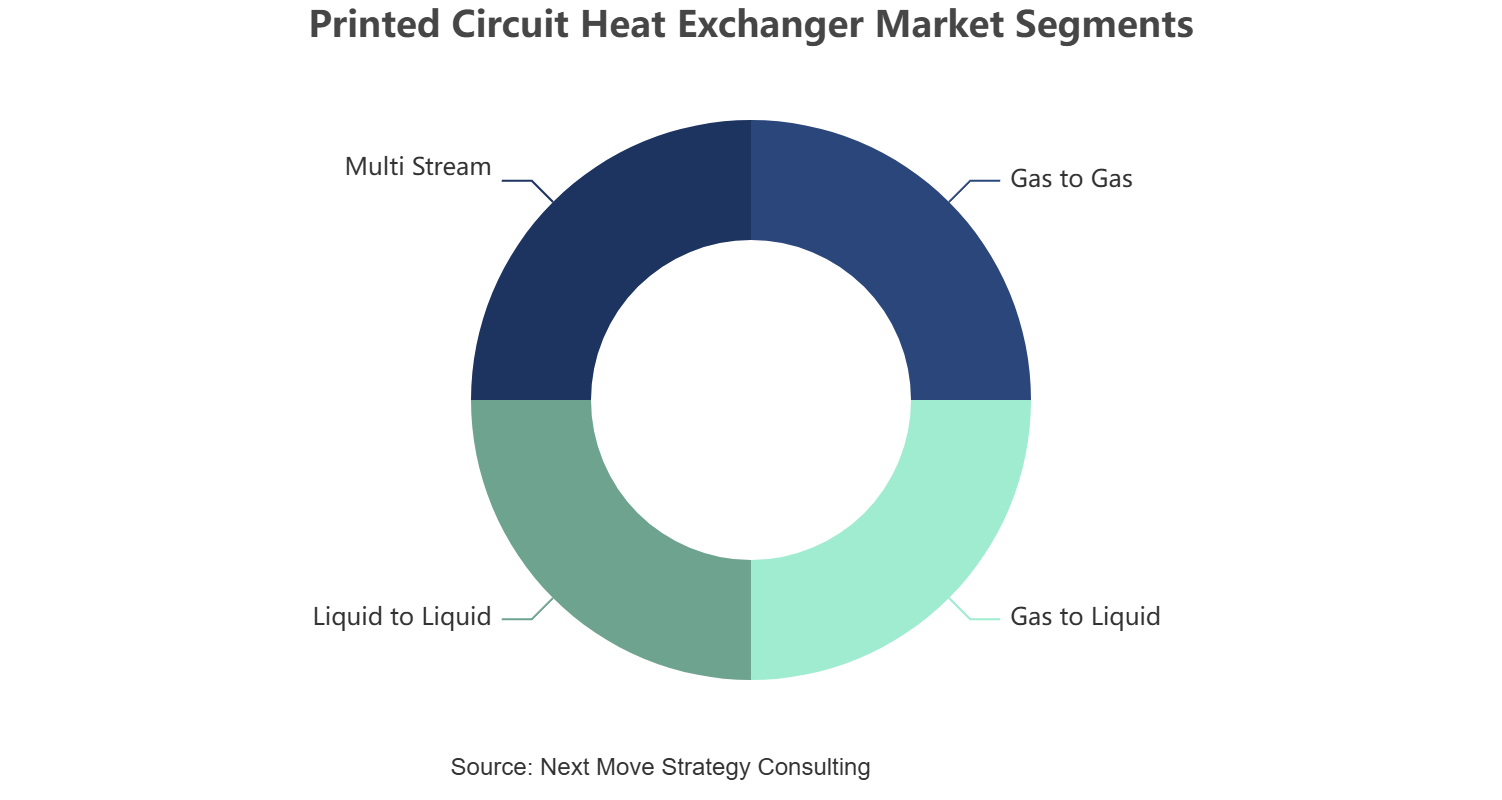
By Heat Transfer Service: Gas to Liquid held the largest share of approximately 36% (USD 0.67 Billion) in 2025; Multi Stream is the fastest-growing sub-segment at 12.4% CAGR from 2026–2035. |
|
By Construction Material: Stainless Steel held the largest share of approximately 46% (USD 0.85 Billion) in 2025; Titanium and Titanium Alloys is the fastest-growing sub-segment at 10.4% CAGR from 2026–2035. |
|
By Application: Oil and Gas held the largest share of approximately 34% (USD 0.63 Billion) in 2025; Hydrogen and Clean Energy is the fastest-growing sub-segment at 13.1% CAGR from 2026–2035. |
|
By Sales Channel: Direct Sales held the largest share of approximately 68% (USD 1.26 Billion) in 2025; Distributor and Agent is the fastest-growing sub-segment at 10.7% CAGR from 2026–2035. |
|
Dominant Region: North America dominated with approximately 33% revenue share (USD 0.61 Billion) in 2025. |
|
Fastest-Growing Region: Asia-Pacific is expected to register the highest CAGR of 11.0% during 2026–2035. |
|
Dominant Country: U.S. led with approximately USD 0.41 Billion in 2025. |
|
Fastest-Growing Country: China is the fastest-growing country at approximately 12.6% CAGR from 2026–2035. |
Market Opportunity: The printed circuit heat exchanger market is expected to create an absolute dollar opportunity of USD 2.57 billion between 2026 and 2035, presenting significant investment potential across the LNG, hydrogen, nuclear, and chemical processing value chain.
According to Next Move Strategy Consulting analysis, engineering, procurement, and construction contractors are increasingly pre-qualifying diffusion-bonded heat exchanger suppliers earlier in front-end engineering design, a shift that favors manufacturers with proven high-pressure hydrogen and sCO2 track records over new entrants lacking code-stamped fabrication history.
What does the Printed Circuit Heat Exchanger Market Encompass?
The printed circuit heat exchanger market encompasses diffusion-bonded compact heat exchangers manufactured through photochemical etching of fine flow channels into metal plates, which are then stacked and bonded into a monolithic core. Our assessment indicates that the scope spans standard, configured-to-order, and custom-engineered finished units supplied alongside aftermarket spare parts, inspection, cleaning, and repair services to oil and gas, hydrogen, power generation, chemical processing, marine, and aerospace end users seeking extreme pressure and temperature tolerance within a compact footprint.
The category has evolved from a niche cryogenic and offshore gas-processing component into a mainstream thermal-management technology, driven by LNG liquefaction expansion, supercritical CO2 power cycles, and green hydrogen infrastructure investment. Regulatory frameworks such as the U.S. Department of Energy hydrogen program guidance and the European Union's F-Gas Regulation shape refrigerant handling and equipment-efficiency requirements, while classification-society pressure vessel codes govern marine and offshore installations. We observed that technology adoption is shifting toward hybrid diffusion-bonded and additively manufactured cores that reduce lead times without compromising pressure ratings, a trend also visible in the adjacent Air Cooled Heat Exchanger (ACHE) Market, where compact-footprint design is similarly reshaping procurement criteria across process industries.
|
Parameters |
Details |
|
Market Size in 2025 |
USD 1.85 Billion |
|
Market Size in 2026 |
USD 2.03 Billion |
|
Revenue Forecast in 2035 |
USD 4.60 Billion |
|
Growth Rate |
CAGR of 9.5% from 2026 to 2035 |
|
Analysis Period |
2025–2035 |
|
Base Year Considered |
2025 |
|
Forecast Period |
2026–2035 |
|
Market Size Estimation |
Revenue (USD Billion) |
|
Companies Profiled |
20 |
|
Countries Covered |
33 |
|
Market Share |
Available for Top 10 Companies |
Key Emerging Trends
Based on research conducted by Next Move Strategy Consulting, we found that four structural trends are reshaping product development, sourcing, and stakeholder engagement across the industry.
How Is Hydrogen Refuelling Infrastructure Transforming PCHE Demand?
Hydrogen refuelling precooling duty is emerging as a distinct demand pool for compact diffusion-bonded exchangers capable of withstanding cryogenic-to-ambient swings at high pressure. We observed that Alfa Laval's HyBloc range is engineered specifically as a precooler for hydrogen refuelling stations, enabling back-to-back vehicle filling with minimal waiting time. Station operators are specifying these units to shrink civil works, while component suppliers expand standard model ranges to match rising Green Hydrogen Market deployment pipelines across mobility corridors.
Why Are Long-Duration Energy Storage Projects Adopting PCHE Technology?
Grid-scale long-duration energy storage projects are adopting printed circuit heat exchangers to manage the extreme thermal cycling inherent in liquid-air and thermal storage architectures. Our findings suggest that Parker Hannifin's Heatric technology was selected in May 2025 to supply the United Kingdom's first large-scale long-duration storage facility developed by Highview Power, supporting 300 MWh of capacity. Utilities and independent developers are treating this reference project as a benchmark for future Energy Storage Systems (ESS) Market procurement decisions.
How Is Supercritical CO2 Power Cycle Development Influencing Design Priorities?
Supercritical CO2 power cycle pilots for nuclear and waste-heat recovery applications are pushing suppliers toward higher pressure ratings and improved corrosion-resistant alloys. We observed that developers increasingly specify nickel alloy cores for recuperator duty where stainless steel exhibits shorter service life under repeated thermal cycling. Original equipment manufacturers are expanding qualification testing programs, positioning sCO2-rated recuperators as a premium, higher-margin category within the broader market segmentation structure.
What Role Does Digital Condition Monitoring Play in PCHE Innovation?
Sensor-enabled condition monitoring is emerging as a differentiator among aftermarket service providers seeking to extend core service life and reduce unplanned fouling-related shutdowns. Our analysis shows that suppliers are bundling inspection and monitoring subscriptions with new equipment sales to secure recurring revenue. This trend is elevating the strategic importance of the aftermarket services offering, reshaping supplier relationships from single transaction sales toward multi-year service agreements across critical process units.
Ecosystem Analysis of the Printed Circuit Heat Exchanger Market
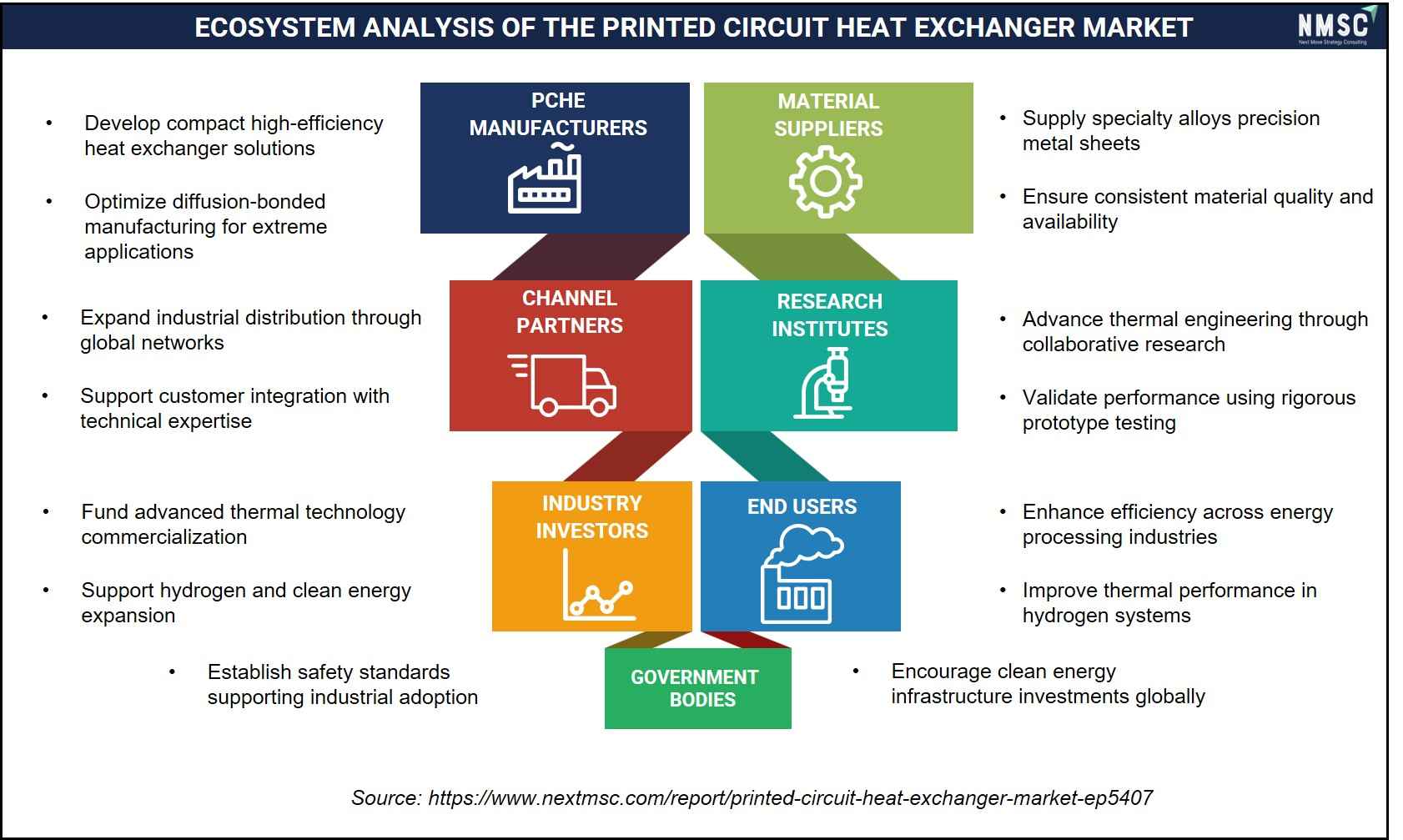
Our analysis indicates that the Printed Circuit Heat Exchanger Market ecosystem is driven by collaboration among PCHE manufacturers, material suppliers, research institutes, channel partners, industry investors, end users, and government bodies. Material suppliers provide high-performance alloys, while research organizations support technological innovation and product development. Manufacturers integrate these advancements into commercial solutions, supported by distribution partners and investors. Government regulations and industrial demand collectively encourage technology adoption, product standardization, and long-term market expansion across energy-intensive industries.
Growth Drivers & Restraints
Growth Catalyst & Risk Assessment Matrix
|
Factors |
Type |
(+/−) % Impact on CAGR |
Geographic Relevance |
Impact Timeline |
|
Global LNG liquefaction capacity expansion |
Driver |
+2.1% |
North America, Asia-Pacific |
2026–2032 |
|
Green and blue hydrogen infrastructure investment |
Driver |
+1.8% |
Europe, Asia-Pacific, MEA |
2026–2035 |
|
Advanced nuclear and sCO2 power cycle deployment |
Driver |
+1.4% |
North America, Europe, Asia-Pacific |
2028–2035 |
|
Mono-material recyclability and compact-footprint retrofit demand |
Driver |
+0.9% |
Global |
2026–2030 |
|
Offshore and marine LNG carrier fleet growth |
Driver |
+0.7% |
Asia-Pacific, Europe |
2026–2033 |
|
High upfront fabrication and code-certification cost |
Restraint |
−1.1% |
Global |
2026–2030 |
|
Limited fabrication capacity among certified diffusion-bonding suppliers |
Restraint |
−0.8% |
North America, Europe |
2026–2029 |
|
Volatility in nickel and titanium raw material pricing |
Restraint |
−0.6% |
Global |
2026–2031 |
|
Long qualification and lead-time cycles for custom-engineered units |
Restraint |
−0.4% |
Global |
2026–2030 |
What Is the Primary Growth Driver for the Printed Circuit Heat Exchanger Market?
LNG liquefaction and regasification capacity expansion is the primary growth driver, as diffusion-bonded cores replace bulkier shell-and-tube designs in cryogenic gas-processing trains. The U.S. Department of Energy has approved multiple large-scale LNG export authorizations in recent years, supporting sustained capital deployment. Our assessment indicates that this expansion directly increases order volumes for gas-to-gas and gas-to-liquid configurations across North American and Asia-Pacific liquefaction hubs.
How Is Hydrogen Infrastructure Investment Driving Market Growth?
Hydrogen production, storage, and refuelling infrastructure investment is accelerating demand for precoolers and cryogenic-duty exchangers. The International Energy Agency tracks rising electrolyser capacity additions worldwide, underscoring the scale of thermal-management equipment required across the value chain. Regional programs, including hydrogen hub designations, are catalyzing procurement pipelines for suppliers positioned around these Hydrogen Hubs Market clusters.
What Is Restraining the Printed Circuit Heat Exchanger Market?
High upfront fabrication and third-party code-certification cost is restraining broader adoption, particularly among mid-sized process operators evaluating diffusion-bonded units against conventional shell-and-tube alternatives. Certification against pressure-vessel codes such as ASME Section VIII extends procurement timelines and raises qualification expenditure. Next Move Strategy Consulting's analysis indicates that this cost barrier is most pronounced in price-sensitive Latin American and African chemical processing segments.
Segmentation Analysis
Segment Sizing: By Offerings
|
Segment |
2025 (USD) |
2035 (USD) |
CAGR% (2026–2035) |
|
Finished PCHE |
1.46 Billion |
3.51 Billion |
9.2% |
|
Aftermarket Services |
0.39 Billion |
1.09 Billion |
10.8% |
|
Total |
1.85 Billion |
4.60 Billion |
9.5% |
Which Offering Sub-Segment Dominates the Printed Circuit Heat Exchanger Market?
Finished PCHE dominates with approximately 79% share in 2025, reflecting the capital-intensive nature of new liquefaction, hydrogen, and power-generation installations. Our findings suggest that Aftermarket Services is the fastest-growing sub-segment as operators extend the service life of installed cores through inspection, cleaning, and repair contracts rather than full replacement, a pattern reinforced by rising fabrication lead times for new custom-engineered units.
Segment Sizing: By Construction Material
|
Segment |
2025 (USD) |
2035 (USD) |
CAGR% (2026–2035) |
|
Stainless Steel |
0.85 Billion |
2.02 Billion |
9.0% |
|
Titanium and Titanium Alloys |
0.42 Billion |
1.13 Billion |
10.4% |
|
Nickel Alloys |
0.39 Billion |
0.95 Billion |
9.3% |
|
Other Materials |
0.19 Billion |
0.50 Billion |
10.2% |
|
Total |
1.85 Billion |
4.60 Billion |
9.5% |
Which Construction Material Leads the Printed Circuit Heat Exchanger Market?
Stainless steel leads with approximately 46% share in 2025, favored for its cost balance and broad compatibility across gas-processing and chemical duties, an advantage it shares with the broader Stainless Steel Market. We observed that titanium and titanium alloys are the fastest-growing material category as marine and offshore operators specify corrosion resistance for seawater-cooled duty, while nickel alloys gain share in high-temperature sCO2 recuperator applications.
Segment Sizing: By Application
|
Segment |
2025 (USD) |
2035 (USD) |
CAGR% (2026–2035) |
|
Oil and Gas |
0.63 Billion |
1.39 Billion |
8.2% |
|
Hydrogen and Clean Energy |
0.35 Billion |
1.20 Billion |
13.1% |
|
Power Generation |
0.31 Billion |
0.75 Billion |
9.2% |
|
Chemical Processing |
0.27 Billion |
0.62 Billion |
8.7% |
|
Marine |
0.14 Billion |
0.33 Billion |
9.0% |
|
Aerospace and Defence |
0.07 Billion |
0.15 Billion |
7.9% |
|
Food and Beverage |
0.03 Billion |
0.06 Billion |
7.2% |
|
HVAC and District Energy |
0.03 Billion |
0.06 Billion |
7.2% |
|
Research and Test |
0.01 Billion |
0.02 Billion |
7.2% |
|
Other Industrial |
0.01 Billion |
0.02 Billion |
7.2% |
|
Total |
1.85 Billion |
4.60 Billion |
9.5% |
Which Application Segment Is Growing Fastest?
Oil and gas remains dominant with approximately 34% share, anchored by LNG liquefaction and gas-processing capital programs across established hydrocarbon basins. Our analysis shows that hydrogen and clean energy is the fastest-growing application segment at 13.1% CAGR, propelled by electrolyser scale-up, refuelling network build-out, and early-stage carbon capture pilot deployments that increasingly specify diffusion-bonded core technology for compact, high-pressure thermal duty.
Growth Opportunities
We observed three forward-looking whitespace opportunities emerging as the market structure matures through 2035.
Can Modular sCO2 Waste-Heat Recovery Units Unlock New Industrial Demand?
Modular, skid-mounted sCO2 waste-heat recovery packages built around nickel-alloy recuperators could open a new addressable segment among mid-sized chemical and metals processors seeking decarbonization without full plant redesign, benefiting nickel-alloy core suppliers and power-generation-focused fabricators.
Does Marine LNG Bunkering Growth Create Whitespace for Compact Vaporizers?
Expanding LNG bunkering infrastructure for dual-fuel vessels creates whitespace for compact, deck-mountable vaporizers that reduce footprint versus legacy shell-and-tube units, favoring gas-to-liquid specialists serving shipyards and offshore vessel operators across Asia-Pacific and European bunkering hubs.
Can Standardized Hydrogen Refuelling Modules Accelerate Aftermarket Growth?
Standardized, factory-tested hydrogen refuelling precooler modules could shorten station commissioning timelines and create recurring inspection and monitoring revenue, benefiting aftermarket service providers positioned around fast-growing refuelling network operators in Europe and Asia-Pacific.
Regional Outlook
|
Region |
2025 (USD) |
2035 (USD) |
CAGR% (2026–2035) |
Key Driver |
|
North America |
0.61 Billion |
1.38 Billion |
8.5% |
LNG export capacity expansion |
|
Europe |
0.46 Billion |
1.06 Billion |
8.7% |
Hydrogen hub and F-Gas compliance investment |
|
Asia-Pacific |
0.52 Billion |
1.48 Billion |
11.0% |
Shipbuilding and nuclear power buildout |
|
Middle East & Africa |
0.15 Billion |
0.41 Billion |
10.6% |
Green hydrogen mega-projects |
|
Latin America |
0.11 Billion |
0.27 Billion |
9.4% |
Offshore gas processing expansion |
|
Total |
1.85 Billion |
4.60 Billion |
9.5% |
— |
North America Printed Circuit Heat Exchanger Market
North America leads the market at approximately 33% share in 2025, anchored by an established LNG export base and deep supplier presence including Parker Hannifin's Heatric business. Regulatory support through federal hydrogen production incentives is reinforcing capital commitments, while technology adoption favors code-certified stainless steel and nickel-alloy cores. Strategic outlook remains positive as liquefaction trains under construction sustain multi-year order backlogs for regional fabricators.
Europe Printed Circuit Heat Exchanger Market
Europe's market is shaped by the European Union's F-Gas Regulation and aggressive hydrogen hub targets that push equipment makers toward compact, high-efficiency designs. Germany's chemical processing and power generation clusters anchor regional demand, while the United Kingdom's long-duration energy storage projects add momentum. Technology adoption favors titanium and nickel-alloy cores for corrosion-sensitive duty, and strategic outlook points to steady share gains through hydrogen infrastructure spending.
Asia-Pacific Printed Circuit Heat Exchanger Market
Asia-Pacific is the fastest-growing region at 11.0% CAGR, driven by shipbuilding demand for LNG carrier fuel-gas systems and expanding nuclear and sCO2 power pilots across China, Japan, and South Korea. Regulatory frameworks supporting clean energy transition are accelerating adoption, while competitive intensity is rising as domestic Chinese and Korean fabricators scale diffusion-bonding capacity to serve both regional and export markets.
Middle East & Africa Printed Circuit Heat Exchanger Market
Middle East & Africa demand is concentrated around green hydrogen mega-projects and gas-processing capacity additions in the Gulf. Regulatory environments favor large state-backed energy programs, and technology adoption is skewed toward custom-engineered units suited to extreme ambient temperatures. Strategic outlook favors suppliers able to support long-distance logistics and extended commissioning support across greenfield hydrogen and LNG developments.
Latin America Printed Circuit Heat Exchanger Market
Latin America's market centers on offshore gas processing expansion in Brazil and onshore petrochemical modernization in Argentina. Regulatory support remains uneven across countries, moderating technology adoption relative to other regions, though competitive intensity is increasing as international suppliers establish local service partnerships. Strategic outlook favors aftermarket service expansion alongside new offshore platform commissioning through the forecast period.
U.S. Printed Circuit Heat Exchanger Market
Based on our estimates… the U.S. printed circuit heat exchanger market was valued at approximately USD 0.41 billion in 2025 and is projected to reach approximately USD 0.90 billion by 2035, growing at an 8.2% CAGR. Demand structure is anchored by Gulf Coast LNG liquefaction trains, with high technology adoption of nickel-alloy and titanium cores. Regulatory influence from federal hydrogen incentives and strong competitive intensity among established fabricators support a stable strategic outlook.
Canada Printed Circuit Heat Exchanger Market
The market in… Canada's market was valued at approximately USD 0.09 billion in 2025 and is projected to reach approximately USD 0.21 billion by 2035, expanding at an 8.8% CAGR. Demand structure reflects LNG export terminal construction on the west coast, with moderate technology adoption and growing regulatory influence from provincial emissions frameworks. Strategic outlook favors suppliers supporting cryogenic and cold-climate installation requirements.
UK Printed Circuit Heat Exchanger Market
As per our estimate… the UK market was valued at approximately USD 0.13 billion in 2025 and is projected to reach approximately USD 0.31 billion by 2035, growing at a 9.1% CAGR. Demand structure benefits from long-duration energy storage and hydrogen strategy targets, with high technology adoption led by domestic diffusion-bonding capability. Competitive intensity remains concentrated among a small group of certified fabricators supporting a favorable strategic outlook.
Germany Printed Circuit Heat Exchanger Market
According to our analysis… Germany's market was valued at approximately USD 0.12 billion in 2025 and is projected to reach approximately USD 0.28 billion by 2035, expanding at an 8.8% CAGR. Demand structure is driven by chemical processing and power generation clusters, with high technology adoption of stainless steel and nickel-alloy cores. Regulatory influence from EU F-Gas compliance and strong competitive intensity support continued equipment modernization investment.
France Printed Circuit Heat Exchanger Market
Based on our estimates… France's market was valued at approximately USD 0.08 billion in 2025 and is projected to reach approximately USD 0.19 billion by 2035, growing at a 9.0% CAGR. Demand structure reflects nuclear power infrastructure investment and chemical processing modernization, with moderate technology adoption and rising regulatory influence tied to national decarbonization targets shaping a constructive strategic outlook.
China Printed Circuit Heat Exchanger Market
The market in… China's market was valued at approximately USD 0.14 billion in 2025 and is projected to reach approximately USD 0.46 billion by 2035, expanding at a 12.6% CAGR, the fastest among covered countries. Demand structure is dominated by LNG carrier shipbuilding and nuclear power expansion, with rapidly rising technology adoption and intensifying competitive activity among domestic fabricators scaling capacity to serve both local and export markets.
India Printed Circuit Heat Exchanger Market
As per our estimate… India's market was valued at approximately USD 0.05 billion in 2025 and is projected to reach approximately USD 0.16 billion by 2035, growing at a 12.3% CAGR. Demand structure reflects gas-processing capacity additions and an expanding green hydrogen program, with moderate technology adoption and increasing regulatory influence from national hydrogen mission targets supporting a positive strategic outlook.
Japan Printed Circuit Heat Exchanger Market
According to our analysis… Japan's market was valued at approximately USD 0.08 billion in 2025 and is projected to reach approximately USD 0.21 billion by 2035, expanding at a 10.1% CAGR. Demand structure is led by LNG carrier construction and hydrogen import infrastructure, with high technology adoption and strong competitive intensity among established shipbuilding-linked fabricators supporting a stable strategic outlook.
South Korea Printed Circuit Heat Exchanger Market
Based on our estimates… South Korea's market was valued at approximately USD 0.08 billion in 2025 and is projected to reach approximately USD 0.20 billion by 2035, growing at a 9.6% CAGR. Demand structure centers on shipyard fuel-gas systems and nuclear power equipment, with high technology adoption and intensifying regulatory influence from national hydrogen and shipbuilding decarbonization policy driving a favorable strategic outlook.
Australia Printed Circuit Heat Exchanger Market
The market in… Australia's market was valued at approximately USD 0.04 billion in 2025 and is projected to reach approximately USD 0.09 billion by 2035, expanding at an 8.5% CAGR. Demand structure reflects LNG export operations and emerging hydrogen export ambitions, with moderate technology adoption and growing regulatory influence from state clean-energy targets supporting steady strategic outlook through the forecast period.
UAE Printed Circuit Heat Exchanger Market
As per our estimate… the UAE market was valued at approximately USD 0.06 billion in 2025 and is projected to reach approximately USD 0.17 billion by 2035, growing at an 11.0% CAGR. Demand structure is shaped by gas-processing expansion and green hydrogen project development, with rising technology adoption and strong regulatory influence from national energy diversification strategy supporting a constructive strategic outlook.
Saudi Arabia Printed Circuit Heat Exchanger Market
According to our analysis… Saudi Arabia's market was valued at approximately USD 0.05 billion in 2025 and is projected to reach approximately USD 0.15 billion by 2035, expanding at an 11.6% CAGR. Demand structure is anchored by NEOM-linked green hydrogen mega-projects and gas-processing capacity growth, with increasing technology adoption and strong regulatory influence from national hydrogen strategy supporting a favorable strategic outlook.
South Africa Printed Circuit Heat Exchanger Market
Based on our estimates… South Africa's market was valued at approximately USD 0.02 billion in 2025 and is projected to reach approximately USD 0.05 billion by 2035, growing at a 9.6% CAGR. Demand structure reflects gradual chemical processing modernization, with moderate technology adoption and developing regulatory influence tied to energy-sector reform shaping a cautiously positive strategic outlook.
Brazil Printed Circuit Heat Exchanger Market
The market in… Brazil's market was valued at approximately USD 0.06 billion in 2025 and is projected to reach approximately USD 0.19 billion by 2035, expanding at a 12.2% CAGR. Demand structure is driven by offshore pre-salt gas processing expansion, with rising technology adoption and growing regulatory influence from national offshore content requirements supporting a positive strategic outlook among regional and international suppliers.
Argentina Printed Circuit Heat Exchanger Market
As per our estimate… Argentina's market was valued at approximately USD 0.02 billion in 2025 and is projected to reach approximately USD 0.06 billion by 2035, growing at an 11.6% CAGR. Demand structure reflects Vaca Muerta shale gas processing investment, with moderate technology adoption and developing regulatory influence tied to energy export policy supporting a gradually improving strategic outlook.
Supply Chain Structure of the Printed Circuit Heat Exchanger Market
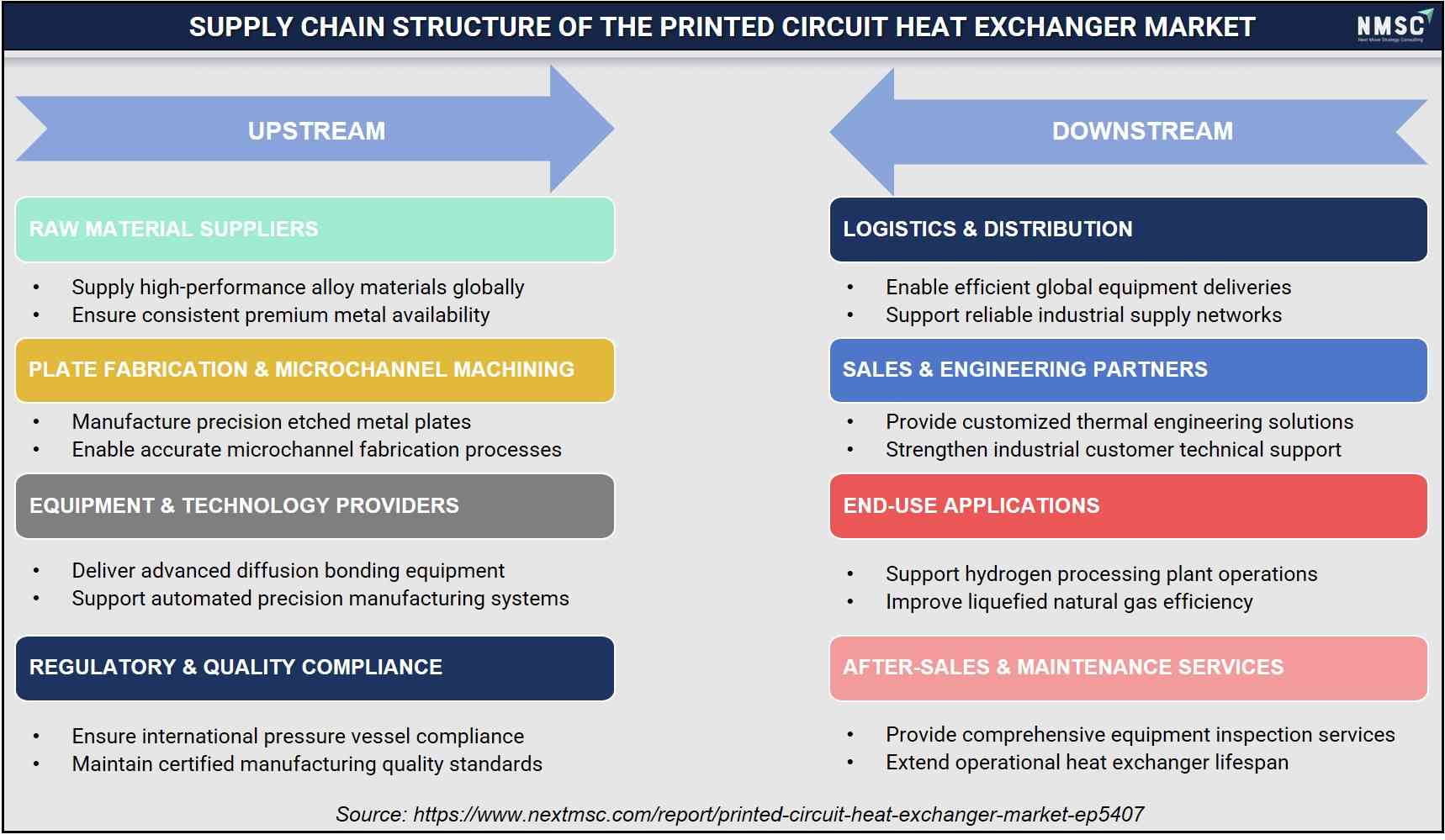
Our analysis indicates that the Printed Circuit Heat Exchanger Market supply chain begins with high-performance alloy suppliers, followed by precision plate fabrication, microchannel machining, and diffusion bonding supported by advanced manufacturing equipment. Regulatory and quality compliance ensure product reliability and adherence to international standards. Downstream activities include global logistics, engineering partners, industrial end-use applications such as hydrogen and LNG processing, and after-sales maintenance services that improve equipment performance, operational reliability, and service life.
Competitive Landscape
Our analysis shows that the printed circuit heat exchanger market remains moderately consolidated, with established fabricators competing on certification depth, delivery reliability, and application-specific engineering expertise.
|
Dimension |
Assessment |
|
Market Structure |
Moderately consolidated; top 10 companies account for a majority of certified diffusion-bonded fabrication capacity |
|
Innovation Focus |
Hydrogen-duty precoolers, sCO2 recuperators, and mono-material recyclable core designs |
|
M&A Activity |
Selective bolt-on acquisitions of regional fabricators and aftermarket service specialists |
How Do Companies Compete in the Printed Circuit Heat Exchanger Market?
Companies compete primarily on pressure-vessel code certification breadth, proven high-temperature and cryogenic service references, and the ability to meet compressed project delivery schedules for large capital programs. Our findings suggest that suppliers with in-house diffusion-bonding and photochemical etching capability retain pricing power over subcontracted fabricators, while aftermarket service depth increasingly influences long-term account retention across process-industry customers.
Which Competitive Archetypes Dominate the Market?
Two archetypes dominate: diversified industrial conglomerates leveraging broad filtration and fluid-control portfolios to bundle PCHE sales with adjacent equipment, and specialized heat-transfer manufacturers differentiated by decades of application-specific metallurgical expertise. We observed that specialized players retain an edge in custom-engineered sCO2 and hydrogen-duty projects, while diversified conglomerates dominate standardized offshore and LNG procurement through established global service networks.
What Innovation and Differentiation Strategies Are Companies Pursuing?
Suppliers are pursuing differentiation through expanded pressure and temperature qualification envelopes, sensor-integrated cores for predictive maintenance, and mono-material designs that ease end-of-life material recovery. Next Move Strategy Consulting's analysis indicates that companies investing in dedicated hydrogen and sCO2 test facilities are winning a disproportionate share of early-stage clean-energy contracts as customers prioritize demonstrated qualification over price alone.
What M&A Activity Is Shaping the Competitive Landscape?
M&A activity remains selective, concentrated on acquiring regional fabrication footholds and aftermarket service capability rather than large horizontal consolidation. Our assessment indicates that acquirers are prioritizing targets with existing code certifications and installed-base service contracts, as these shorten the multi-year qualification timelines otherwise required to enter new geographic or application-specific procurement panels.
Key Market Players
We observed a competitive set of established fabricators and diversified industrial suppliers shaping the printed circuit heat exchanger market.
-
Alfa Laval AB
-
Kobe Steel, Ltd.
-
Sumitomo Precision Products Co., Ltd.
-
Vacuum Process Engineering, Inc.
-
DongHwa Entec Co., Ltd.
-
Kelvion Holding GmbH
-
Doosan Enerbility Co., Ltd.
-
Nexson Industry SAS
-
Microchannel Devices S.r.l.
-
Shanghai Heat Transfer Equipment Co., Ltd.
-
Hangzhou Shenshi Energy Conservation Technology Co., Ltd.
-
Tempco S.r.l.
-
Energyn Co., Ltd.
-
Morimatsu Energies and Materials Co., Ltd.
-
Gas and Oil Technology (Shanghai) Co., Ltd.
-
Precision Micro Ltd.
-
Lanzhou LS Heat Exchange Equipment Co., Ltd.
-
Jiangsu Sunpower Heat Exchanger & Pressure Vessel Co., Ltd.
-
Mitsubishi Heavy Industries, Ltd.
Latest Developments
We observed several notable commercial and technology developments across the industry in recent periods.
|
Date |
Event |
|
June 2026 |
Sumitomo Precision Products Co., Ltd. successfully completed the first real-world-level demonstration experiment in Japan for its newly developed liquefied hydrogen heat exchanger, marking a key technological achievement in clean energy and cryogenic transport infrastructure. |
|
May 2026 |
Alfa Laval announced the commercial launch of its TS45 semi-welded plate heat exchanger, engineered to meet growing demands for high-capacity and high-pressure thermal transfer across heavy industries and large-scale energy transition applications, expanding its high-efficiency portfolio into duties traditionally served by shell-and-tube units. |
|
May 2026 |
Doosan Enerbility secured a major contract expansion in the North American power sector, signing a supplier agreement with a U.S. client to deliver four 370 MW steam turbines and generators to Texas by 2029, reinforcing its thermal efficiency and energy management capabilities. |
Investment Opportunities
Where Are Capital Inflows Concentrating in the Printed Circuit Heat Exchanger Value Chain?
Capital inflows are concentrating in diffusion-bonding fabrication capacity expansion and hydrogen-duty testing infrastructure, as suppliers race to meet certification requirements for growing clean-energy order books. Our findings suggest that private capital is also targeting aftermarket service platforms that offer recurring inspection and monitoring revenue, a lower-cyclicality complement to new-equipment sales tied to large capital project timing.
How Is Infrastructure Investment Shaping Equipment Demand?
Public and private infrastructure investment in LNG export terminals, hydrogen refuelling networks, and Advanced Nuclear Reactors Market deployment programs is translating directly into multi-year order visibility for certified heat exchanger fabricators. We observed that government-backed hydrogen hub funding in the United States and the European Union is de-risking early orders for suppliers able to demonstrate qualified precooler and process-gas exchanger designs.
What ESG Considerations Are Influencing Investment Decisions?
Environmental, social, and governance considerations are influencing investment decisions as buyers increasingly favor mono-material, recyclable core designs and suppliers with documented emissions-reduction roadmaps. Our analysis shows that association with hydrogen and carbon-capture end uses is improving the ESG profile of equipment manufacturers, supporting favorable financing terms for capacity expansion tied to clean-energy order books.
Key Benefits for Stakeholders
How Does This Report Benefit Industry Leaders?
Industry leaders gain a validated view of segment-level revenue opportunity, competitive positioning, and regional demand drivers that informs capacity investment and certification prioritization decisions. The report's growth catalyst matrix and segmentation analysis support strategic roadmap decisions around which application verticals and construction materials warrant near-term engineering investment.
How Does This Report Benefit Investors and Financial Analysts?
Investors and financial analysts gain quantified market sizing, forecast trajectories, and regional growth differentials that support valuation and capital allocation decisions across the heat-transfer equipment value chain. The competitive landscape and latest developments sections provide context for assessing acquisition targets and partnership opportunities among established and emerging fabricators.
How Does This Report Benefit Technology Vendors and Product Teams?
Technology vendors and product teams gain insight into emerging application requirements, including hydrogen precooling, sCO2 recuperation, and mono-material recyclability, that inform product roadmap and testing infrastructure investment. Segmentation data by construction material and heat transfer service supports engineering prioritization aligned with the fastest-growing demand pools identified in this analysis.
Key Market Segments
By Offerings
-
Finished PCHE
-
Standard Product
-
Configured To Order
-
Custom Engineered
-
-
Aftermarket Services
-
Spare Parts
-
Commissioning
-
Inspection and Maintenance
-
Cleaning
-
Monitoring
-
Repair and Refurbishment
-
Technical Support
-
By Heat Transfer Service
-
Gas to Gas
-
Gas to Liquid
-
Liquid to Liquid
-
Multi Stream
By Construction Material
-
Stainless Steel
-
Titanium and Titanium Alloys
-
Nickel Alloys
-
Other Materials
By Application
-
Oil and Gas
-
LNG
-
Gas Processing
-
Refining
-
Petrochemicals
-
-
Hydrogen and Clean Energy
-
Hydrogen Production
-
Hydrogen Refuelling and Storage
-
Carbon Capture
-
-
Power Generation
-
Nuclear
-
sCO2 Power
-
Renewable Thermal
-
-
Chemical Processing
-
Bulk Chemicals
-
Speciality Chemicals
-
-
Marine
-
LNG Carriers
-
Offshore Vessels
-
Other Vessels
-
-
Aerospace and Defence
-
Engine Thermal Management
-
Environmental Control
-
-
Food and Beverage
-
HVAC and District Energy
-
Research and Test
-
Other Industrial
By Sales Channel
-
Direct Sales
-
Distributor and Agent
By Region
-
North America: U.S., Canada, Mexico
-
Europe: UK, Germany, France, Italy, Spain, Sweden, Denmark, Finland, Netherlands, Rest of Europe
-
Asia-Pacific: China, India, Japan, South Korea, Taiwan, Indonesia, Vietnam
-
Middle East & Africa: Saudi Arabia, UAE, Egypt, Israel, Turkey, Nigeria, South Africa, Rest of MEA
-
Latin America: Brazil, Argentina, Chile, Colombia, Rest of LATAM
Conclusion & Recommendations
What Is the Long-Term Outlook for the Printed Circuit Heat Exchanger Market?
The long-term outlook remains constructive, with the market projected to expand from USD 1.85 billion in 2025 to USD 4.60 billion by 2035 at a 9.5% CAGR, underpinned by durable LNG, hydrogen, and nuclear power infrastructure investment cycles that extend well beyond the current forecast window.
What Strategic Positioning Should Suppliers Pursue?
Suppliers should prioritize expanding certified fabrication capacity for hydrogen and sCO2 duty while building out aftermarket service networks that capture recurring revenue from the growing installed base. Positioning around application-specific qualification, rather than price competition alone, offers the most durable differentiation as procurement panels tighten technical requirements.
How Attractive Is the Market for New Investment?
Investment attractiveness is favorable given the combination of double-digit growth in hydrogen and clean-energy applications alongside a stable base of oil and gas replacement demand. Our assessment indicates that capital directed toward certified fabrication capacity and testing infrastructure offers the clearest path to capturing share in the fastest-growing segments.
What Market Shifts and Key Risks Should Stakeholders Monitor?
Stakeholders should monitor raw material price volatility for nickel and titanium alloys, potential delays in large hydrogen infrastructure programs, and the pace at which fabrication capacity scales to meet certification-constrained demand. A slower-than-expected hydrogen infrastructure rollout represents the most material downside risk to the forecast CAGR.
What Are the Key Growth Pathways Through 2035?
Key growth pathways include hydrogen refuelling and production infrastructure build-out, sCO2 power cycle commercialization, LNG carrier fleet expansion, and aftermarket service network development. Suppliers that align capacity investment with these four pathways are best positioned to capture the USD 2.57 billion absolute dollar opportunity identified between 2026 and 2035.
About the Author
 Saista Faiyaz
— Saista Faiyaz is Research Associate at Next Move Strategy Consulting, where she has covered consumer markets and healthcare technologies for 3 years. Her work includes primary interview review, secondary-source validation, market sizing, and structured analysis of company and industry data. She supports research by comparing evidence across sources, organizing findings into market narratives, and documenting assumptions used in analysis. Her scope includes cross-market benchmarking, and reports.
Saista Faiyaz
— Saista Faiyaz is Research Associate at Next Move Strategy Consulting, where she has covered consumer markets and healthcare technologies for 3 years. Her work includes primary interview review, secondary-source validation, market sizing, and structured analysis of company and industry data. She supports research by comparing evidence across sources, organizing findings into market narratives, and documenting assumptions used in analysis. Her scope includes cross-market benchmarking, and reports.
About the Reviewer
 Supradip Baul
— Supradip Baul is an accomplished business consultant and strategist with over a decade of rich experience in market intelligence, strategy, technology, and business transformation. His work has included rigorous qualitative and quantitative analysis across multiple industries, helping clients shape investment decisions and long-term roadmaps. Earlier in his career, he was associated with Gartner, where he contributed to industry-leading reports and market share analyses. He has worked with leading global companies and holds an MBA with a dual specialization in Marketing and Finance.
Supradip Baul
— Supradip Baul is an accomplished business consultant and strategist with over a decade of rich experience in market intelligence, strategy, technology, and business transformation. His work has included rigorous qualitative and quantitative analysis across multiple industries, helping clients shape investment decisions and long-term roadmaps. Earlier in his career, he was associated with Gartner, where he contributed to industry-leading reports and market share analyses. He has worked with leading global companies and holds an MBA with a dual specialization in Marketing and Finance.
At Next Move Strategy Consulting, we understand that insightful market research is the cornerstone of successful business decisions. That's why we employ a robust and multifaceted approach, combining various methodologies to deliver the most accurate and actionable data for our clients.

Research Landscape
We navigate the world of research with two primary approaches:
Qualitative Approach
Our qualitative research methodologies involve immersive techniques such as in-depth interviews, focus groups, and observational studies. By engaging directly with individuals and stakeholders, we uncover valuable insights that quantitative data alone may overlook.

Quantitative Research
In tandem with qualitative methodologies, NMSC leverages the power of Quantitative Research to provide a robust foundation of numerical insights. Through systematic data collection and analysis, we quantify patterns, preferences, and market trends, offering a comprehensive view of the business landscape.
Our quantitative research approach employs diverse tools, including surveys, experiments, and statistical modelling. These methodologies enable us to gather data from a large and representative sample, ensuring the statistical significance of our findings. By employing structured questionnaires and standardized data collection methods, we guarantee the reliability and validity of the information we present to our clients.
Quantitative research is particularly effective in measuring the prevalence of trends, assessing market size, and gauging the impact of various factors on consumer behavior. The numerical precision attained through this approach equips our clients with actionable insights, facilitating data-driven decision-making and strategy formulation.


Our Specialized Toolbox for Industry-Specific Market Research
We deploy a specialized arsenal of techniques tailored to meet your unique requirements. Here's a glimpse into our comprehensive toolbox:

Information Procurement
The stage entails acquiring market data or relevant information through various sources and methodologies.


Market Research Approach
We utilize both top-down and bottom-up approaches in market research analysis to achieve a comprehensive understanding of the market dynamics, leveraging the broad perspective of industry trends and macroeconomic factors alongside detailed insights from specific segments and individual companies.

Porters Five Forces Analysis
We conduct Porter's Five Forces analysis to evaluate the competitive landscape of an industry, providing us with insights into factors that affect profitability and strategic positioning.

SWOT Analysis

Forecasting
We utilize a forecasting model to predict future consumption by considering parameters like population, economics, regulations, market competition, drivers, constraints, technology, and pricing. We also employ statistical techniques such as multilinear regression, exponential smoothing, moving average, ARIMA, and Monte Carlo simulations for accurate predictions. In econometric forecasting, we analyzed short-term and long-term event impacts, attributing values based on regulatory frameworks, economic factors, and market events.





 Speak to Our Analyst