AI in Defense Market Global Industry Analysis and Forecast (2026-2035)

AI in Defense Market size was USD 18.60 billion in 2026, projected to reach USD 79.40 billion by 2035, growing at a CAGR of 17.5% from 2026 to 2035. Key drivers include dedicated national AI and autonomy budget authority, enterprise consolidation of defense software contracts, and rising adoption of agentic and generative AI, with North America leading the market.

Download Free Sample PDF
Base Year (2025)
$14.85 Billion
Forecast (2035)
$79.40 Billion
CAGR (2026-2035)
17.5%
Top Region
North America

What Is the AI in Defense Market Size?

The global AI in defense market size was valued at USD 14.85 Billion in 2025 and is estimated at USD 18.60 Billion in 2026, forecast to reach USD 79.40 Billion by 2035, expanding at a 17.5% CAGR between 2026 and 2035. North America leads with approximately 46% share, while systems dominate all other offering types with approximately 52% share.

We observed that a first-ever dedicated national AI and autonomy budget line, combined with multibillion-dollar enterprise software contracts, is the dominant structural force behind this growth, with generative AI and allied-government procurement expanding well above the market average through 2035.

AI in Defense Market Global Industry Analysis and Forecast (2026-2035) Revenue Forecast

Values in USD Billion

2025 $14.85 Billion
2025
2026 $17.45 Billion
2026
2027 $20.50 Billion
2027
2028 $24.09 Billion
2028
2029 $28.31 Billion
2029
2030 $33.26 Billion
2030
2031 $39.08 Billion
2031
2032 $45.92 Billion
2032
2033 $53.95 Billion
2033
2034 $63.40 Billion
2034
2035 $79.40 Billion
2035

Key Takeaways

By Offering Type: Systems held the largest share of approximately 52% (USD 7.72 Billion) in 2025; Services is the fastest-growing sub-segment at 21.3% CAGR from 2026–2035.

By AI Function: Perception held the largest share of approximately 22% (USD 3.27 Billion) in 2025; Generative AI is the fastest-growing sub-segment at 34.3% CAGR from 2026–2035.

By Mission Domain: Air held the largest share of approximately 34% (USD 5.05 Billion) in 2025; Joint Multi Domain is the fastest-growing sub-segment at 26.9% CAGR from 2026–2035.

By Buyer Type: Military Organizations held the largest share of approximately 58% (USD 8.60 Billion) in 2025; Allied Government Organizations is the fastest-growing sub-segment at 28.8% CAGR from 2026–2035.

By Deployment Model: On Premise held the largest share of approximately 38% (USD 5.64 Billion) in 2025; Edge Embedded is the fastest-growing sub-segment at 23.4% CAGR from 2026–2035.

By Sales Channel: Direct Government Procurement held the largest share of approximately 30% (USD 4.46 Billion) in 2025; Dual Use Commercial is the fastest-growing sub-segment at 30.7% CAGR from 2026–2035.

Dominant Region: North America dominated with approximately 46% revenue share (USD 6.83 Billion) in 2025.

Fastest-Growing Region: Middle East & Africa is expected to register the highest CAGR of 21.3% during 2026–2035.

Dominant Country: U.S. led with approximately USD 6.28 Billion in 2025.

Fastest-Growing Country: UAE is the fastest-growing country at approximately 23.0% CAGR from 2026–2035.

Market Opportunity: The AI in defense market is expected to create an absolute dollar opportunity of USD 60.80 Billion between 2026 and 2035, presenting significant investment potential across autonomous systems, decision-support software, and allied-government procurement channels.

According to Next Move Strategy Consulting analysis, defense ministries are increasingly consolidating dozens of legacy software contracts into single, multibillion-dollar enterprise agreements with a small number of prime software vendors, a shift that is concentrating market share even as the overall number of individual AI programs of record continues to expand through 2035.

What Does the AI in Defense Market Encompass?

The AI in defense market encompasses software, hardware systems, and services that apply artificial intelligence to military perception, decision-making, autonomy, and cyber defense missions. Our assessment indicates that the scope spans command and control software, autonomous air, land, maritime, undersea, and space systems, AI-enabled sensors, and integration, sustainment, and training services delivered to military organizations, intelligence agencies, homeland security organizations, and allied governments. The category has evolved from isolated pilot programs into programs of record consolidated under enterprise-wide software and systems contracts spanning multiple years.

Regulatory frameworks including the U.S. Department of War's January 2026 Artificial Intelligence Strategy and its associated data-access and acquisition directives are reshaping how AI capability is procured and fielded. We observed that technology adoption is shifting from narrow, single-mission software toward enterprise platforms that fuse sensor data across domains and toward agentic AI systems capable of autonomous decision support. Next Move Strategy Consulting's analysis indicates that this shift, combined with dedicated budget authority for autonomy and AI, is redefining how defense ministries structure technology procurement.

Ecosystem Analysis of the AI in Defense Market

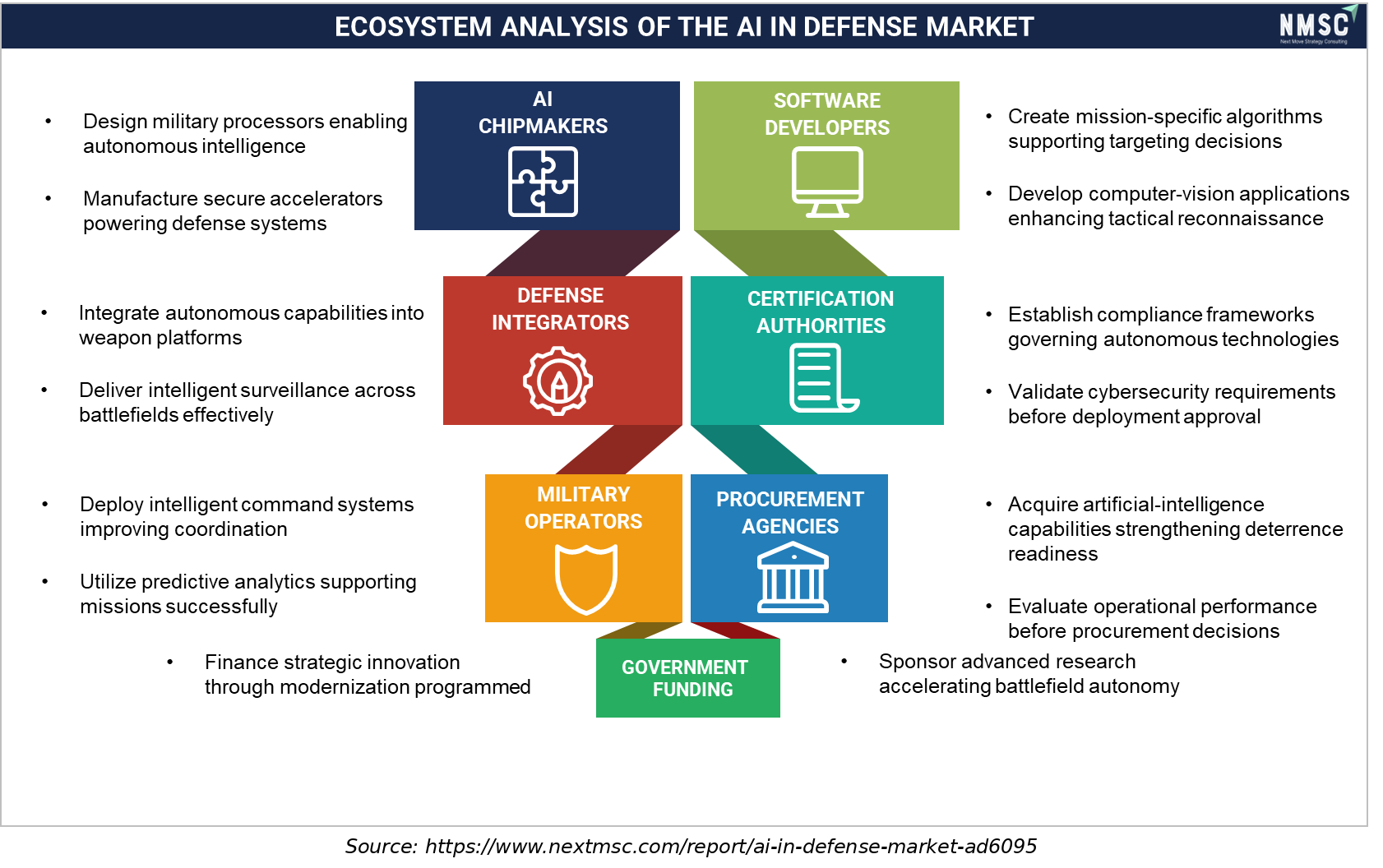
Based on our ecosystem assessment, we identified that the AI in defense market is driven by collaboration among AI chipmakers, software developers, defense integrators, certification authorities, military operators, procurement agencies, and government funding bodies. Furthermore, our industry evaluation indicates that advanced semiconductor technologies, mission-critical AI software, defense system integration, regulatory certification, military procurement programs, and sustained public-sector investments accelerate innovation, strengthen operational readiness, and support the secure deployment of artificial intelligence across modern defense applications.

Market Drivers & Dynamics

Interactive Dataset
First dedicated national AI and autonomy budget authority driver +3.4% North America 2026–2032
Enterprise consolidation of software contracts into multibillion-dollar vehicles driver +2.6% North America, Europe 2026–2033
Rising agentic and generative AI adoption in decision support driver +2.1% Global 2026–2035
Allied and NATO-aligned defense AI procurement expansion driver +1.7% Europe, Asia-Pacific 2026–2034
Growth in edge AI compute for autonomous platforms driver +1.4% Global 2026–2035
Rising Gulf state sovereign AI investment in defense capability driver +1.1% Middle East & Africa 2026–2031
Extended security accreditation cycles for classified AI systems restraint −0.9% Global 2026–2035
Data interoperability gaps across legacy defense IT systems restraint −0.7% Global 2026–2033
Export-control and technology-transfer restrictions on advanced AI models restraint −0.6% North America, Europe 2026–2032
Source: Next Move Strategy Consulting

Growth Drivers

What Is the Primary Growth Driver for the AI in Defense Market?

The primary growth driver is the first-ever dedicated national budget line for AI and autonomy systems, which established a distinct, protected funding category separate from broader procurement accounts. The U.S. Department of Defense's fiscal year 2026 budget request included USD 13.4 billion in dedicated AI and autonomy funding, with unmanned aerial systems receiving the largest single allocation, illustrating how budget-line protection is accelerating program-of-record funding certainty for AI capability.

How Is Enterprise Software Consolidation Driving Market Growth?

Enterprise software consolidation is driving market growth by converting fragmented, program-specific contracts into durable, multiyear platform commitments that guarantee recurring vendor revenue. The U.S. Army's enterprise agreement with Anduril Industries carries a ceiling of up to USD 20 billion over ten years, following a similar USD 10 billion enterprise agreement with Palantir Technologies, illustrating how consolidated procurement vehicles are reshaping vendor concentration across the market.

Growth Inhibitors

What Is Restraining the AI in Defense Market?

The primary restraint is the extended security accreditation timeline required before classified AI systems can be fielded operationally, which slows the transition from pilot demonstration to program of record. Industry-derived estimates (no publicly verifiable dataset available) suggest that accreditation and authority-to-operate cycles for classified AI systems can run considerably longer than commercial software deployment timelines, discouraging smaller vendors from pursuing classified defense AI programs despite growing budget availability.

What Are the Growth Opportunities?

Can Agentic AI Reduce Campaign Planning Cycle Times?

Agentic AI systems capable of autonomously executing multi-step campaign planning and battle management workflows could substantially compress decision cycle times currently dependent on manual staff planning processes. Military organizations and intelligence agencies stand to benefit most from reduced planning latency as agentic decision-support tools mature beyond current pilot demonstrations.

Does Allied Interoperability Create a Multinational Platform Opportunity?

Software platforms designed for interoperability across allied and NATO-aligned command structures could unlock multinational procurement opportunities currently constrained by incompatible national systems. Prime contractors and software vendors serving allied government organizations stand to benefit from establishing interoperability standards ahead of broader multinational adoption.

Can Edge AI Compute Unlock Contested-Environment Autonomy?

Ruggedized edge AI compute systems capable of operating without reliable connectivity to centralized data centers could unlock autonomous mission execution in contested or denied communication environments. Uncrewed systems manufacturers and AI compute providers stand to benefit most from edge-optimized hardware that reduces platform dependence on continuous network links.


Segmentation Analysis

2025 (USD Billion)
2035 (USD Billion)
Software 2025: $4.90 Billion | 2035: $28.58 Billion
Software
Systems 2025: $7.72 Billion | 2035: $34.94 Billion
Systems
Services 2025: $2.23 Billion | 2035: $15.88 Billion
Services
Software $4.90 Billion $28.58 Billion 18.6%
Systems $7.72 Billion $34.94 Billion 15.3%
Services $2.23 Billion $15.88 Billion 21.3%

Which Offering Type Dominates the AI in Defense Market?

Systems dominate the market with approximately 52% share in 2025, reflecting that uncrewed platforms, sensors, and AI compute hardware still represent the largest single procurement category across national autonomy budget lines. Our analysis shows that services are the fastest-growing category at 21.3% CAGR through 2035 as defense organizations increasingly require integration, sustainment, and training support to operationalize AI systems fielded under newly consolidated enterprise contracts.

2025 (USD Billion)
2035 (USD Billion)
Perception
Reasoning
Decision Sup
Autonomy
Optimization
Segment Item 2025 (USD Billion) 2035 (USD Billion) CAGR
Perception $10.0 USD Billion $40.0 USD Billion 25.0%
Reasoning $17.1 USD Billion $51.1 USD Billion 11.0%
Decision Support $24.2 USD Billion $62.2 USD Billion 25.0%
Autonomy $31.3 USD Billion $73.3 USD Billion 11.0%
Optimization $38.4 USD Billion $84.4 USD Billion 16.0%

Segment-wise data is locked

Unlock complete segment-wise numbers for By AI Function.

Unlock Full Data
2025 (USD Billion)
2035 (USD Billion)
Air
Land
Surface Mari
Undersea
Space
Segment Item 2025 (USD Billion) 2035 (USD Billion) CAGR
Air $10.0 USD Billion $40.0 USD Billion 27.0%
Land $17.1 USD Billion $51.1 USD Billion 9.0%
Surface Maritime $24.2 USD Billion $62.2 USD Billion 19.0%
Undersea $31.3 USD Billion $73.3 USD Billion 17.0%
Space $38.4 USD Billion $84.4 USD Billion 18.0%

Segment-wise data is locked

Unlock complete segment-wise numbers for By Mission Domain.

Unlock Full Data

Which Mission Domain Segment Is Growing Fastest?

The air domain dominates with approximately 34% share in 2025, consistent with unmanned aerial systems commanding the largest single allocation within national defense AI and autonomy budget lines. We observed that joint multi-domain applications are the fastest-growing segment at 26.9% CAGR through 2035, driven by rising investment in sensor-fusion platforms that integrate data across air, land, maritime, and space domains into unified command and control systems.

2025 (USD Billion)
2035 (USD Billion)
Military Org
Intelligence
Homeland Sec
Prime Contra
Allied Gover
Segment Item 2025 (USD Billion) 2035 (USD Billion) CAGR
Military Organizations $10.0 USD Billion $40.0 USD Billion 14.0%
Intelligence Agencies $17.1 USD Billion $51.1 USD Billion 24.0%
Homeland Security Organizations $24.2 USD Billion $62.2 USD Billion 22.0%
Prime Contractors $31.3 USD Billion $73.3 USD Billion 12.0%
Allied Government Organizations $38.4 USD Billion $84.4 USD Billion 27.0%

Segment-wise data is locked

Unlock complete segment-wise numbers for By Buyer Type.

Unlock Full Data

Which Buyer Type Leads AI in Defense Demand?

Military organizations lead with approximately 58% share in 2025, reflecting that national armed forces remain the primary budget holders for AI and autonomy procurement. Our findings suggest that allied government organizations are the fastest-growing buyer category at 28.8% CAGR through 2035, driven by NATO-aligned members increasing defense technology spending and following U.S.-pattern enterprise procurement of AI-enabled battlefield platforms.

2025 (USD Billion)
2035 (USD Billion)
On Premise
Private Clou
Hybrid Cloud
Edge Embedde
Segment Item 2025 (USD Billion) 2035 (USD Billion) CAGR
On Premise $10.0 USD Billion $40.0 USD Billion 24.0%
Private Cloud $17.1 USD Billion $51.1 USD Billion 22.0%
Hybrid Cloud $24.2 USD Billion $62.2 USD Billion 20.0%
Edge Embedded $31.3 USD Billion $73.3 USD Billion 22.0%

Segment-wise data is locked

Unlock complete segment-wise numbers for By Deployment Model.

Unlock Full Data
2025 (USD Billion)
2035 (USD Billion)
Direct Gover
Prime Contra
Subcontract
Framework Ag
Partner Chan
Segment Item 2025 (USD Billion) 2035 (USD Billion) CAGR
Direct Government Procurement $10.0 USD Billion $40.0 USD Billion 23.0%
Prime Contract $17.1 USD Billion $51.1 USD Billion 9.0%
Subcontract $24.2 USD Billion $62.2 USD Billion 19.0%
Framework Agreement $31.3 USD Billion $73.3 USD Billion 13.0%
Partner Channel $38.4 USD Billion $84.4 USD Billion 10.0%

Segment-wise data is locked

Unlock complete segment-wise numbers for By Sales Channel.

Unlock Full Data

Growth Opportunities

Beyond the core growth drivers, three forward-looking whitespace opportunities stand out for stakeholders positioning ahead of demand through 2035.

Can Agentic AI Reduce Campaign Planning Cycle Times?

Agentic AI systems capable of autonomously executing multi-step campaign planning and battle management workflows could substantially compress decision cycle times currently dependent on manual staff planning processes. Military organizations and intelligence agencies stand to benefit most from reduced planning latency as agentic decision-support tools mature beyond current pilot demonstrations.

Does Allied Interoperability Create a Multinational Platform Opportunity?

Software platforms designed for interoperability across allied and NATO-aligned command structures could unlock multinational procurement opportunities currently constrained by incompatible national systems. Prime contractors and software vendors serving allied government organizations stand to benefit from establishing interoperability standards ahead of broader multinational adoption.

Can Edge AI Compute Unlock Contested-Environment Autonomy?

Ruggedized edge AI compute systems capable of operating without reliable connectivity to centralized data centers could unlock autonomous mission execution in contested or denied communication environments. Uncrewed systems manufacturers and AI compute providers stand to benefit most from edge-optimized hardware that reduces platform dependence on continuous network links.

Regional Outlook

2025 (USD Billion)
2035 (USD Billion)
North Americ
Europe
Asia-Pacific
Middle East
Latin Americ
Region 2025 (USD Billion) 2035 (USD Billion) CAGR (%)
North America $10.0 USD Billion $40.0 USD Billion 9.0%
Europe $17.1 USD Billion $51.1 USD Billion 27.0%
Asia-Pacific $24.2 USD Billion $62.2 USD Billion 25.0%
Middle East & Africa $31.3 USD Billion $73.3 USD Billion 23.0%
Latin America $38.4 USD Billion $84.4 USD Billion 12.0%

Regional data is locked

Unlock complete regional numbers for this market.

Unlock Full Data

Regulatory Framework Impacting the AI in Defense Market

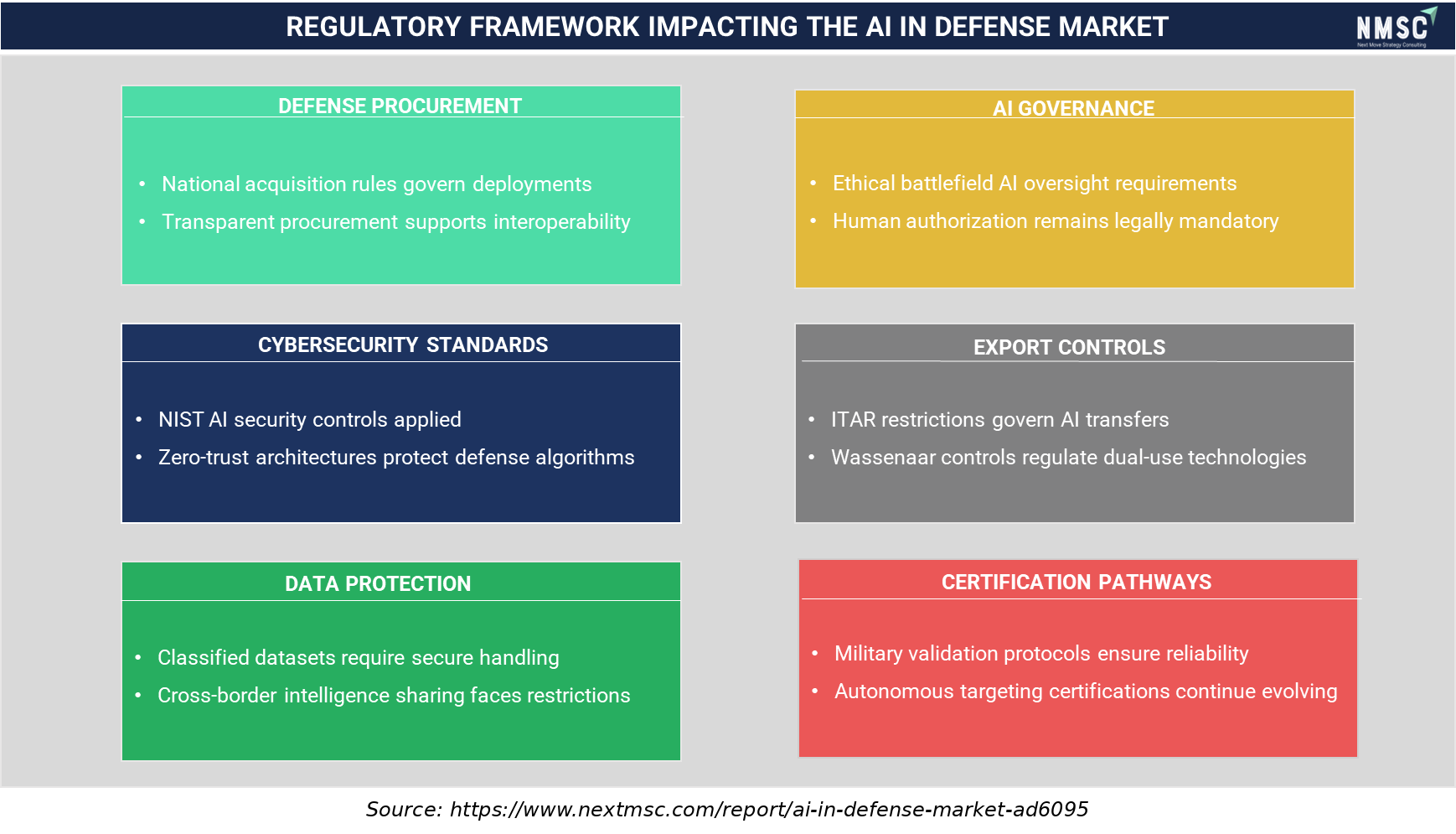
Based on our regulatory assessment, we identified that defense procurement regulations, AI governance policies, cybersecurity standards, export controls, classified data protection requirements, and military certification frameworks shape the AI in defense market. Furthermore, our industry evaluation indicates that transparent procurement procedures, ethical AI oversight, stringent cybersecurity compliance, technology export restrictions, secure handling of classified information, and evolving certification protocols enhance operational security, promote responsible AI adoption, and strengthen defense capabilities.

Competitive Landscape

Our assessment indicates that the AI in defense market remains moderately concentrated among established defense primes and specialist software vendors competing across differentiated platform and application niches.

Dimension Description
Dimension Assessment
Market Structure Moderately concentrated; top 10 companies hold a substantial combined share driven by enterprise contract consolidation
Innovation Focus Agentic decision support, sensor fusion command-and-control, and autonomous uncrewed systems
M&A Activity Selective acquisitions targeting sensor, autonomy, and space-domain awareness capability

How Do Companies Compete in the AI in Defense Industry?

Companies compete primarily on platform interoperability, demonstrated operational deployment track record, and ability to secure large enterprise contract vehicles rather than individual program awards. Our findings suggest that buyers increasingly evaluate vendors on data-fusion capability across previously siloed systems, pushing companies to expand open-architecture software platforms rather than competing on single-domain point solutions alone.

Which Competitive Archetypes Dominate the AI in Defense Industry?

Three archetypes dominate: diversified defense primes with broad systems-integration portfolios spanning hardware and software, specialist software vendors commanding premium positioning on data-fusion and decision-support platforms, and uncrewed systems manufacturers competing on autonomy performance. This structure allows primes to defend share in large enterprise programs while specialists capture premium software and platform revenue.

What Innovation and Differentiation Strategies Are Emerging?

Innovation strategies increasingly center on agentic AI for autonomous decision support, open-architecture sensor-fusion platforms, and ruggedized edge compute for contested-environment autonomy. We observed that vendors investing in interoperable, multi-domain software architecture are capturing disproportionate share of large enterprise agreements where proprietary single-domain systems previously dominated procurement decisions.

What M&A and Geographic Expansion Activity Is Shaping the Market?

M&A activity remains selective, concentrated on acquisitions that add sensor, space-domain awareness, or autonomy subsystem capability rather than large consolidating platform transactions. Geographic expansion is most visible among allied government organizations in Europe and Asia-Pacific, where vendors are pursuing NATO-aligned interoperability standards, while pricing strategies bifurcate between premium enterprise platform agreements and smaller program-specific contracts.

Key Market Players

Our analysis shows that the following companies represent the leading validated participants shaping the competitive structure of the AI in defense market.

Lockheed Martin Corporation RTX Corporation Northrop Grumman Corporation BAE Systems plc The Boeing Company General Dynamics Corporation Thales S.A. Leonardo S.p.A. L3Harris Technologies, Inc. Palantir Technologies Inc. Leidos Holdings, Inc. Anduril Industries, Inc. Elbit Systems Ltd. Saab AB Rheinmetall AG Airbus SE CACI International Inc. Booz Allen Hamilton Holding Corporation Science Applications International Corporation Shield AI, Inc.

Latest Developments

Date Event
March 2026 The U.S. Department of Defense awarded Anduril Industries a massive USD 20 billion enterprise contract to consolidate commercial software and proprietary AI-enabled suites—including its open-architecture Lattice platform—into a unified capability supporting counter-drone operations.
March 2026 Anduril Industries: The U.S. Army awarded Anduril Industries a 10-year enterprise contract with a total estimated value of up to USD 20 billion to consolidate the procurement and management of its commercial technologies, including the proprietary, open-architecture, AI-enabled Lattice suite, integrated hardware, data and computing infrastructure, and technical support services. The agreement is expected to streamline access to Anduril capabilities and support the Army's evolving counter-UAS and command-and-control requirements.
October 2025 Lockheed Martin announced a strategic collaboration with Google Public Sector to integrate generative AI tools, including Gemini models, into its secure, on-premises AI Factory to accelerate defense data analysis and supply chain logistics.

Expert Insights

Kathleen Hicks

Deputy Secretary of Defense | U.S. Department of Defense

"AI-enabled systems can greatly improve the speed, quality, and accuracy of commanders' decisions—which can be decisive in deterring a fight, and winning a fight."

Analyst Interpretation

The statement highlights the growing integration of artificial intelligence into modern defense operations to enhance mission planning, intelligence analysis, surveillance, logistics, and command-and-control capabilities. As defense organizations increasingly prioritize data-driven decision-making, AI technologies are becoming essential for improving operational speed, situational awareness, and mission accuracy. Growing government investments, advancements in autonomous systems, and the adoption of responsible AI frameworks are expected to accelerate the deployment of AI-enabled defense solutions, supporting the long-term growth of the global AI in Defense market.

Investment Opportunities

Where Are Capital Inflows Concentrating in the AI in Defense Market?

Capital inflows are concentrating in enterprise decision-support software and autonomous systems platforms, segments commanding above-average CAGR through 2035. Investment is also flowing into cloud and edge AI compute infrastructure supporting classified defense workloads, where recurring platform subscription revenue is proving more durable than single-program hardware sales.

How Significant Is Infrastructure Investment in Supporting Market Growth?

Infrastructure investment in secure AI compute capacity is significant, particularly across North America, where the Department of Defense is expanding access to AI datacenter and edge infrastructure as part of its autonomy acceleration investments. Government-backed enterprise contract vehicles are indirectly catalyzing this infrastructure buildout by guaranteeing multi-year platform demand tied to programs of record.

What ESG Considerations Are Shaping Investment Decisions?

Environmental, Social, and Governance considerations increasingly influence vendor selection, with defense buyers referencing AI governance and responsible-use frameworks when qualifying software suppliers for autonomous decision-support systems. Social governance considerations extend to human-oversight requirements for autonomous targeting-adjacent systems, a factor increasingly embedded in departmental AI policy directives referenced during vendor accreditation.

Key Benefits for Stakeholders

How Does This Report Benefit Industry Leaders?

Industry leaders gain access to reconciled segmentation, regional, and competitive data that supports platform roadmap and enterprise-contract positioning decisions. The report's forecasts and segmentation analysis help defense program leaders benchmark portfolio exposure against the fastest-growing AI functions and mission domains through 2035.

How Does This Report Benefit Investors and Financial Analysts?

Investors and financial analysts benefit from a reconciled market-sizing model spanning 2025 to 2035, enabling direct comparison of segment-level growth rates when evaluating enterprise contract awards or capital allocation across the AI in defense value chain. The competitive landscape and latest developments sections support diligence on strategic positioning among the twenty profiled companies.

How Does This Report Benefit Technology Vendors and Product Teams?

Technology vendors and product teams benefit from segmentation detail across AI function and deployment model, supporting roadmap alignment with defense agentic AI and edge-compute requirements. Regional outlook data further helps product teams prioritize allied-interoperability localization where technology adoption and competitive intensity are shifting fastest.

Key Market Segments Evaluated

By Offering Type

  • Software
  • Systems
  • Services

By AI Function

  • Perception
  • Reasoning
  • Decision Support
  • Autonomy
  • Optimization
  • Predictive Analytics
  • Cyber Defense
  • Simulation
  • Generative AI
  • Other AI Functions

By Mission Domain

  • Air
  • Land
  • Surface Maritime
  • Undersea
  • Space
  • Cyber
  • Joint Multi Domain

By Buyer Type

  • Military Organizations
  • Intelligence Agencies
  • Homeland Security Organizations
  • Prime Contractors
  • Allied Government Organizations

By Deployment Model

  • On Premise
  • Private Cloud
  • Hybrid Cloud
  • Edge Embedded

By Sales Channel

  • Direct Government Procurement
  • Prime Contract
  • Subcontract
  • Framework Agreement
  • Partner Channel
  • Dual Use Commercial

Conclusion & Recommendations

The long-term outlook remains structurally positive, with the market expanding from USD 18.60 Billion in 2026 to USD 79.40 Billion by 2035 as dedicated budget authority, enterprise contract consolidation, and allied procurement expansion scale simultaneously. Our assessment indicates that agentic AI and multi-domain autonomy demand will continue rising faster than overall defense budget growth, sustaining elevated software and services revenue through the forecast period.

What Strategic Positioning Should Manufacturers Pursue?

Manufacturers should prioritize open-architecture, interoperable platforms capable of winning enterprise-level contract consolidation, since defense ministries increasingly favor fewer, larger vendor relationships over fragmented program-specific awards. Next Move Strategy Consulting's analysis indicates that vendors combining demonstrated operational deployment with allied-interoperability credentials are best positioned to capture share across both domestic and allied government buyer segments.

How Attractive Is the AI in Defense Market for Investment?

Investment attractiveness is elevated in generative and agentic AI, joint multi-domain platforms, and allied government procurement, where above-average CAGR reflects genuine budget-line-driven demand rather than cyclical spending. We found that investors evaluating the space should weigh program-of-record concentration among a small number of prime software vendors, which limits revenue diversification relative to broader enterprise software categories.

What Market Shifts and Key Risks Should Stakeholders Monitor?

Stakeholders should monitor export-control and technology-transfer restrictions affecting cross-border transfer of advanced AI models, alongside extended security accreditation timelines that slow classified-system fielding. Our findings suggest that data interoperability gaps across legacy defense IT systems represent a structural constraint on sensor-fusion adoption that will require continued platform and integration investment to overcome through 2035.

What Are the Clearest Growth Pathways Through 2035?

The clearest growth pathways run through agentic decision-support software, joint multi-domain command and control, and allied government enterprise procurement, each combining above-average CAGR with structurally rising per-program software content. Manufacturers aligning product roadmaps with these three pathways stand to outpace the market's overall 17.5% CAGR through 2035.

FAQs

About the Author

Saista Faiyaz

Saista Faiyaz

Saista Faiyaz is Research Associate at Next Move Strategy Consulting, where she has covered consumer markets and healthcare technologies for 3 years. Her work includes primary interview review, secondary-source validation, market sizing, and structured analysis of company and industry data. She supports research by comparing evidence across sources, organizing findings into market narratives, and documenting assumptions used in analysis. Her scope includes cross-market benchmarking, and reports.

About the Reviewer

Supradip Baul

Supradip Baul

Supradip Baul is an accomplished business consultant and strategist with over a decade of rich experience in market intelligence, strategy, technology, and business transformation. His work has included rigorous qualitative and quantitative analysis across multiple industries, helping clients shape investment decisions and long-term roadmaps. Earlier in his career, he was associated with Gartner, where he contributed to industry-leading reports and market share analyses. He has worked with leading global companies and holds an MBA with a dual specialization in Marketing and Finance.

Download Free Sample

Kevin Coker

KEVIN COKER

Founder, CEO and Board Diector

Proxima Clinical Research

I have been using Next MSC reports for product positioning in a new geography for a long time. They have by far the best reports I have found and the price is reasonable too!

Melanie Samko

MELANIE SAMKO

Director of Marketing

TOSOH BIOSCIENCE, INC.

The information provided by NMSC is incredibly valuable, thank you so much for such a excellent work. I really appreciate it. I will make sure to reference all of it, in my summary document.

Henri Knyphausen

HENRI KNYPHAUSEN

Partner at Singulier [Ex-BCG]

Singulier

I recently engaged NEXTMSC.com for a commercial due diligence project within the intralogistics sector, and I am pleased to provide a reference based on my experience. In utilizing NEXTMSC.com's services, I found their report to offer valuable insights into market dynamics and key industry players. The initial report provided a solid foundation for our analysis. However, as we were investigating a smaller target in the market, and I had specific customization requests requiring additional research. These requests included detailed information on product portfolios of various players and sub-market sizes, both inclusive and exclusive of certain product categories. NEXTMSC.com demonstrated commendable responsiveness and agility in accommodating these customization requests. Within a timeframe of 1-2 weeks, they delivered a revised report that met our specific needs. Furthermore, they were receptive to my follow-up inquiries, ensuring clarity and understanding of the data provided. The final deliverable significantly contributed to our due diligence efforts. One of NEXTMSC.com's notable strengths lies in their qualitative research capabilities. However, for future engagements, I would recommend the inclusion of a quantified market model in Excel format. Such a model would offer the ability to conduct in-depth analyses and explore various market segments, including country-specific data and subcomponent breakdowns. Based on my positive experience, I would not hesitate to work with NEXTMSC.com again. Their responsiveness, willingness to accommodate customization requests, and commitment to delivering actionable insights make them a reliable partner for commercial research projects.

Nishant Awate

NISHANT AWATE

Business Development Global Sales

Zehnder Group Deutschland GmbH

Our experience working with Next Move Strategy Consulting was positive. The team was responsive, professional, and open to incorporating our specific requirements throughout the project. The India AHU market study was comprehensive and well structured, covering market value and volume forecasts, product and application segments, and key industry trends. The inclusion of both AHU and residential MVHR market insights made the study particularly relevant for our strategic market assessment. Overall, the report provides a solid foundation for evaluating market potential, identifying priority segments, and supporting business-development decisions in India.

Mohit Agarwal

MOHIT AGARWAL

Chief Manager

DryChem India Pvt. Ltd.

Next Move Strategy Consulting is an amazing team of consultants. We required a market study report for our investors on top priority and the team went above and beyond our expectations to deliver the same with ample supporting data within a short time span enabling us to secure the investments and keep our project timeline maintained. Their professionalism, attention to detail, and timely delivery of actionable recommendations have left a lasting impression on our organization.

Custom Market Research Services

We will customize the research for you if the listed report does not fully match your requirements.

Get 30% Free Customization

Select License

This website uses cookies to ensure you get the best experience on our website. Learn more

✖