AI Synthetic Media Detection Market Global Industry Analysis and Forecast (2026–2035)

Valued at USD 1.21 Billion in 2025, the industry is projected to reach USD 13.30 Billion by 2035 at a 27.0% CAGR from 2026 to 2035, with North America leading as AI enabled fraud and labelling mandates lift demand.

Download Free Sample PDF
Base Year (2025)
$1.21 Billion
Forecast (2035)
$13.30 Billion
CAGR (2026-2035)
27.0%
Top Region
North America

What Is the AI Synthetic Media Detection Market Size?

The global AI Synthetic Media Detection Market was valued at USD 1.21 Billion in 2025 and is estimated at USD 1.55 Billion in 2026. It is forecast to reach USD 13.30 Billion by 2035, expanding at a 27.0% CAGR from 2026 to 2035. North America leads with roughly 43.0% share, while video detection holds about 36.4%.

We observed that spending concentrates in video and audio verification, where fraud losses are easiest to attribute to a specific channel.

AI Synthetic Media Detection Market Global Industry Analysis and Forecast (2026–2035) Revenue Forecast

Values in USD Billion

2025 $1.21 Billion
2025
2026 $1.55 Billion
2026
2027 $1.97 Billion
2027
2028 $2.50 Billion
2028
2029 $3.17 Billion
2029
2030 $4.03 Billion
2030
2031 $5.12 Billion
2031
2032 $6.50 Billion
2032
2033 $8.26 Billion
2033
2034 $10.49 Billion
2034
2035 $13.30 Billion
2035

Key Takeaways

By Media Type: Video held the largest share in 2025, expanding from USD 0.44 Billion in 2025 to USD 4.35 Billion by 2035; Audio is the fastest growing at 29.9% CAGR from 2026–2035, reaching USD 5.05 Billion by 2035 to become the largest segment.

By Offering: Software platforms and APIs held the largest share, expanding from USD 1.02 Billion in 2025 to USD 11.63 Billion by 2035, and is also the fastest growing at 27.5% CAGR from 2026–2035.

By End User: Banking, financial services and insurance held the largest share, expanding from USD 0.40 Billion in 2025 to USD 4.60 Billion by 2035; Telecom and contact centers is the fastest growing at 29.4% CAGR from 2026–2035.

Dominant Region: North America accounted for USD 0.52 Billion in 2025 and is projected to reach USD 5.20 Billion by 2035.

Fastest-Growing Region: Asia-Pacific is expanding at 29.0% CAGR from 2026–2035, rising from USD 0.27 Billion in 2025 to USD 3.47 Billion by 2035.

Dominant Country: The U.S. accounted for about USD 0.46 Billion in 2025 and is projected to reach USD 4.62 Billion by 2035.

Fastest-Growing Country: India is expanding at 29.8% CAGR from 2026–2035, rising from USD 0.05 Billion in 2025 to USD 0.73 Billion by 2035.

This industry presents an absolute investment opportunity of approximately USD 11.75 Billion between 2026 and 2035, as buyers move from occasional file checks to continuous screening of calls, meetings and onboarding sessions.

According to NMSC analysis, audio detection overtakes video as the largest media type by 2035, reaching USD 5.05 Billion as voice cloning attacks spread across contact centers and meetings.

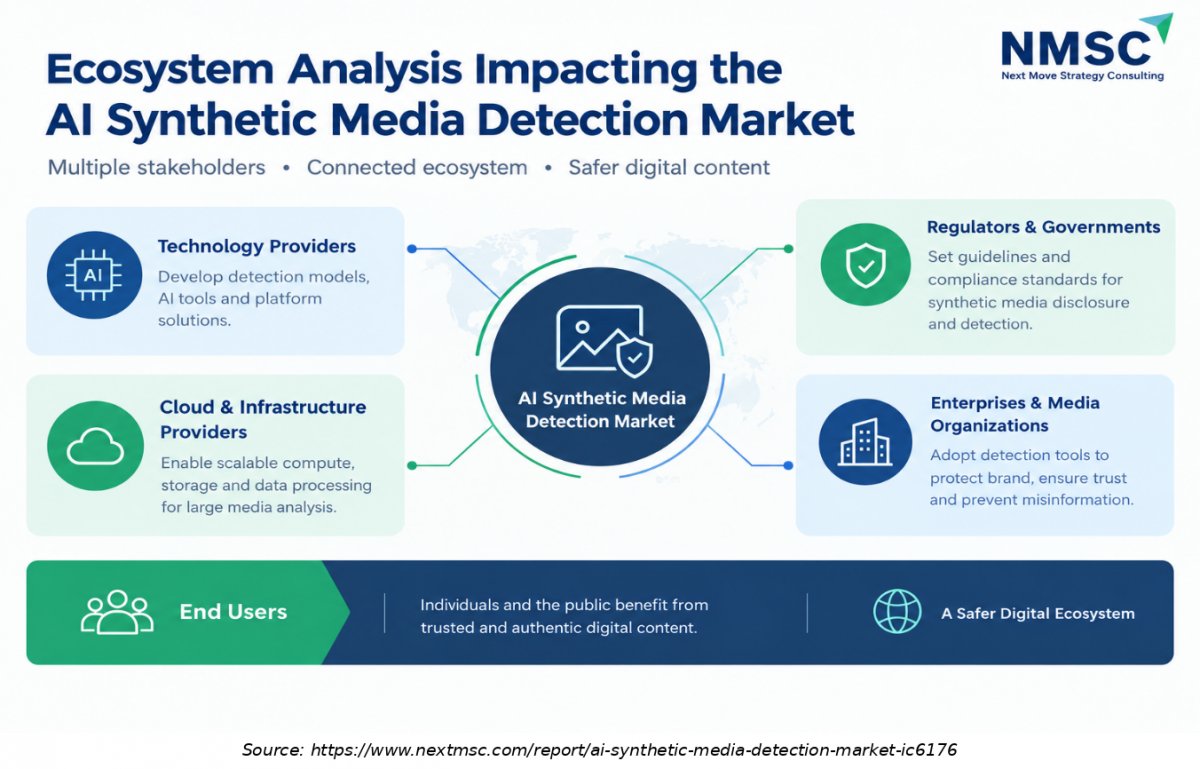
Ecosystem Analysis Impacting the AI Synthetic Media Detection Market

The Ecosystem Analysis infographic for the AI Synthetic Media Detection Market highlights key stakeholders, including AI detection platform providers, generative AI developers, cybersecurity companies, digital media platforms, content verification specialists, regulatory bodies, and enterprise users. It illustrates their interconnected roles in detecting deepfakes, verifying content authenticity, and identifying AI-generated images, audio, and videos.

What Does the AI Synthetic Media Detection Market Encompass?

The AI Synthetic Media Detection Market covers software platforms, application programming interfaces and managed services that identify AI generated or manipulated video, audio, images and text. Products range from forensic scoring of uploaded files to live screening of calls and video meetings. Revenue counts detection licenses, usage-based API fees and forensic services. It excludes provenance tools sold without a detection function, identity verification without deepfake screening, and revenue from generative AI products themselves.

Regulation is reshaping the scope of this AI Synthetic Media Detection market. The EU voluntary code on marking and labelling AI generated content, issued in June 2026, precedes AI Act transparency duties that start in August 2026. Our assessment indicates that watermark checkers and classifier-based detectors now coexist in this market, because labelling rules create verifiable marks while adversarial content still requires inference-based screening.

Market Drivers & Dynamics

Interactive Dataset
Rising AI enabled fraud and impersonation losses driver +4.1% Global, led by North America 2026–2035
Labelling and takedown mandates in the EU, India and the U.S. driver +3.4% Europe, India, North America 2026–2030
Voice cloning attacks on contact centers and meetings driver +2.6% North America, Europe 2026–2032
Injection attacks against remote identity verification driver +2.2% Global, Southeast Asia 2026–2033
Embedded detection on AI PCs and phones driver +1.5% Global 2027–2035
Accuracy decay as new generators appear restraint −2.8% Global 2026–2035
False positive costs and weak explainability restraint −1.6% Global 2026–2031
Privacy and biometric data limits on media analysis restraint −1.3% Europe, North America 2026–2032
Source: Next Move Strategy Consulting

Growth Drivers

What Is the Primary Growth Driver in the AI Synthetic Media Detection Market?

Rising AI enabled fraud is the primary growth driver of the AI Synthetic Media Detection Market. The FBI Internet Crime Complaint Center logged 22,364 complaints with an AI related descriptor in 2025, with adjusted losses of USD 0.89 Billion. Pindrop reported a 680% increase in deepfake activity based on its analysis of more than 1.2 billion calls in 2024. This finding indicates increased exposure to voice-based fraud, but it does not independently establish that the reported increase caused banks and contact centers to convert pilot projects into recurring subscriptions

How Is Regulation Driving the AI Synthetic Media Detection Market Growth?

Rules on labelling and removal are creating compliance demand for detection. The FTC began enforcing the TAKE IT DOWN Act on 19 May 2026, requiring covered platforms to remove nonconsensual intimate images and known identical copies within 48 hours of a valid request. India amended its IT Rules on 10 February 2026 to require labelling and traceable metadata for AI generated content, with a three-hour removal window for unlawful information. During our market evaluation, we noticed that short deadlines Favor automated screening over manual review.

Growth Inhibitors

What Is Restraining the AI Synthetic Media Detection Market?

Accuracy decay is the primary restraint. Detectors trained on today's generators lose reliability when new models appear, and a clean verdict cannot prove that content is authentic. Vendor-reported accuracy figures should be evaluated against their stated test conditions and independently validated benchmarks where available, because performance may vary across media types and newly developed generative models. Our estimate places the cumulative drag from accuracy decay at about 2.8 percentage points of CAGR, since buyers delay multi-year contracts until benchmarks mature.

What Are the Growth Opportunities?

Can Contact Center and Meeting Protection Become the Largest Revenue Pool?

Telecom and contact centers grow from USD 0.28 Billion in 2026 to USD 2.85 Billion by 2035, the fastest end user pace at 29.4% CAGR. Vendors that embed detection inside Zoom, Webex, Microsoft Teams and contact center platforms can sell per seat or per minute subscriptions. Platform integrators and voice authentication specialists gain most, because live screening requires low latency models.

Does Regulatory Compliance Create a Subscription AI Synthetic Media Detection Market for Platforms and Publishers?

Covered U.S. platforms must remove qualifying nonconsensual intimate images within 48 hours of a valid request, while India's amended IT Rules establish a three-hour removal timeline for specified unlawful information following a qualifying order or intimation. Automated screening and takedown workflows turn those deadlines into recurring licenses. The segment expands from USD 0.24 Billion in 2026 to USD 1.78 Billion by 2035, and software vendors with explainable scoring capture the largest share of that spending.

Will Sovereign and Defense Buyers Fund Forensic Grade Detection?

Government and defense buyers need audit trails, offline deployment and court ready reports. Hive holds a Defense Innovation Unit contract with a two-year initial term to deploy five models in an offline, on-premise environment. The segment grows from USD 0.32 Billion in 2026 to USD 2.45 Billion by 2035, which benefits managed and forensic services providers and on-premise software specialists.

Segmentation Analysis

2025 (USD Billion)
2035 (USD Billion)
Video 2025: $0.44 Billion | 2035: $4.35 Billion
Video
Audio 2025: $0.37 Billion | 2035: $5.05 Billion
Audio
Image 2025: $0.30 Billion | 2035: $3.04 Billion
Image
Text 2025: $0.10 Billion | 2035: $0.86 Billion
Text
Video $0.44 Billion $4.35 Billion 25.6%
Audio $0.37 Billion $5.05 Billion 29.9%
Image $0.30 Billion $3.04 Billion 26.0%
Text $0.10 Billion $0.86 Billion 23.4%

Which Media Type Leads the AI Synthetic Media Detection Market?

Video led in 2025 at USD 0.44 Billion, a 36.4% share, because meeting platforms, social feeds and identity checks all rely on face-based verification. Audio is the fastest growing media type at 29.9% CAGR and reaches USD 5.05 Billion by 2035. Pindrop reported a 680% rise in deepfake activity in 2024, and voice cloning needs only short samples. Image and Text remain smaller because screening fits into existing moderation workflows, which limits standalone spending.

2025 (USD Billion)
2035 (USD Billion)
Software pla
Managed and
Segment Item 2025 (USD Billion) 2035 (USD Billion) CAGR
Software platforms and APIs $10.0 USD Billion $40.0 USD Billion 15.0%
Managed and forensic services $17.1 USD Billion $51.1 USD Billion 9.0%

Segment-wise data is locked

Unlock complete segment-wise numbers for By Offering.

Unlock Full Data
2025 (USD Billion)
2035 (USD Billion)
Banking
financial se
Government a
Telecom and
Media
Segment Item 2025 (USD Billion) 2035 (USD Billion) CAGR
Banking $10.0 USD Billion $40.0 USD Billion 26.0%
financial services and insurance $17.1 USD Billion $51.1 USD Billion 16.0%
Government and defense $24.2 USD Billion $62.2 USD Billion 18.0%
Telecom and contact centers $31.3 USD Billion $73.3 USD Billion 8.0%
Media $38.4 USD Billion $84.4 USD Billion 23.0%

Segment-wise data is locked

Unlock complete segment-wise numbers for By End User.

Unlock Full Data

Growth Opportunities

Our analysis shows that three whitespace opportunities are positioned to generate outsized returns through 2035.

Can Contact Center and Meeting Protection Become the Largest Revenue Pool?

Telecom and contact centers grow from USD 0.28 Billion in 2026 to USD 2.85 Billion by 2035, the fastest end user pace at 29.4% CAGR. Vendors that embed detection inside Zoom, Webex, Microsoft Teams and contact center platforms can sell per seat or per minute subscriptions. Platform integrators and voice authentication specialists gain most, because live screening requires low latency models.

Does Regulatory Compliance Create a Subscription AI Synthetic Media Detection Market for Platforms and Publishers?
Covered U.S. platforms must remove qualifying nonconsensual intimate images within 48 hours of a valid request, while India's amended IT Rules establish a three-hour removal timeline for specified unlawful information following a qualifying order or intimation. Automated screening and takedown workflows turn those deadlines into recurring licenses. The segment expands from USD 0.24 Billion in 2026 to USD 1.78 Billion by 2035, and software vendors with explainable scoring capture the largest share of that spending.

Will Sovereign and Defense Buyers Fund Forensic Grade Detection?

Government and defense buyers need audit trails, offline deployment and court ready reports. Hive holds a Defense Innovation Unit contract with a two-year initial term to deploy five models in an offline, on-premise environment. The segment grows from USD 0.32 Billion in 2026 to USD 2.45 Billion by 2035, which benefits managed and forensic services providers and on-premise software specialists.

Regional Outlook

2025 (USD Billion)
2035 (USD Billion)
North Americ
Europe
Asia-Pacific
Middle East
Latin Americ
Region 2025 (USD Billion) 2035 (USD Billion) CAGR (%)
North America $10.0 USD Billion $40.0 USD Billion 9.0%
Europe $17.1 USD Billion $51.1 USD Billion 27.0%
Asia-Pacific $24.2 USD Billion $62.2 USD Billion 25.0%
Middle East & Africa $31.3 USD Billion $73.3 USD Billion 23.0%
Latin America $38.4 USD Billion $84.4 USD Billion 12.0%

Regional data is locked

Unlock complete regional numbers for this market.

Unlock Full Data

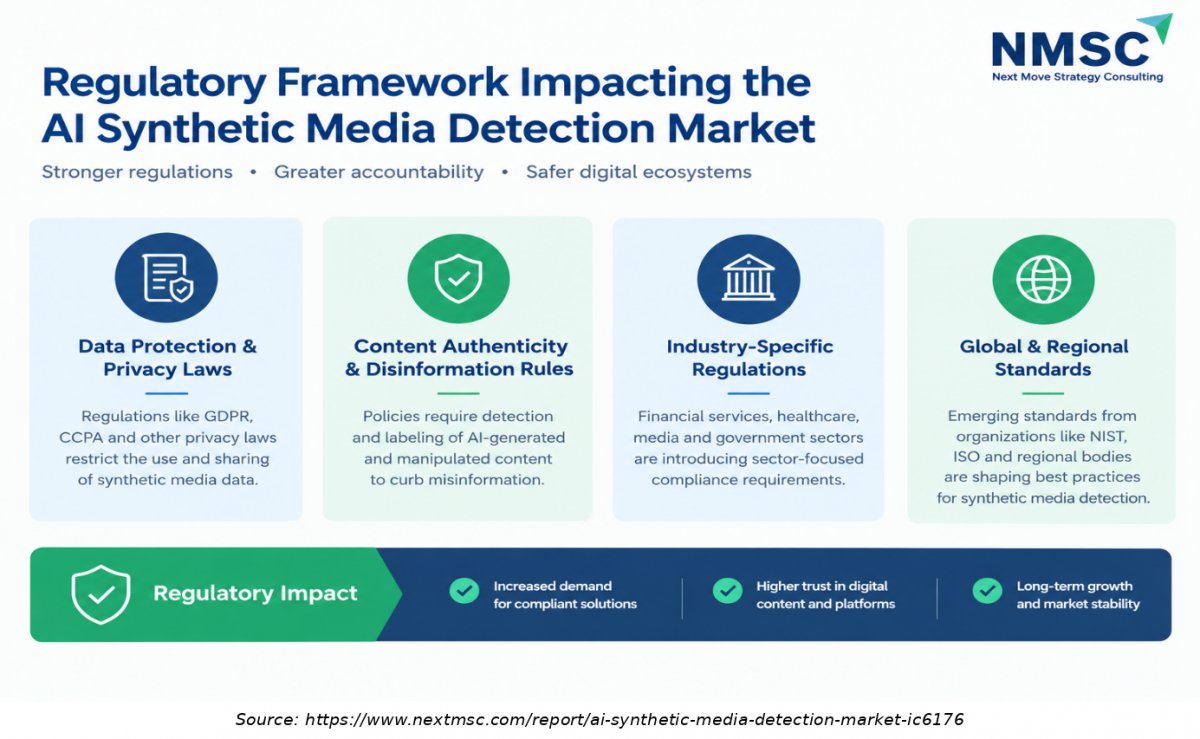
Regulatory Framework Impacting the AI Synthetic Media Detection Market

The Regulatory Framework infographic for the AI Synthetic Media Detection Market highlights key requirements related to AI-generated content disclosure, transparency, digital provenance, data privacy, cybersecurity, and content authenticity. It illustrates how regulatory frameworks influence the development, deployment, and adoption of technologies for detecting synthetic images, audio, videos, and deepfakes.
Competitive Landscape

Our assessment indicates that the AI Synthetic Media Detection Market is fragmented, with specialists, identity suites and device owners competing for the same buyers.
How Do Companies Compete in the AI Synthetic Media Detection Market?

Vendors compete on detection accuracy, latency, explainability and deployment flexibility. Resemble AI offers cloud, on premise and air gapped options with a zero-retention mode, while Sensity AI sells a web app, API and SDK with forensic reports. Pricing is mostly usage based for APIs and per seat or per minute for live screening. Buyers evaluate vendors on integration time with existing fraud and identity stacks.

Which Company Archetypes Dominate the AI Synthetic Media Detection Market?

Four archetypes shape the industry. Detection specialists such as Reality Defender, Resemble AI, Sensity AI and Hive differentiate on model breadth. Pindrop differentiates on voice and contact center depth. Identity suites such as Incode, Jumio, Sumsub, iProov and Verify differentiate on liveness and injection defense. Alphabet, Intel, McAfee and Bitdefender differentiate on device reach and watermark scale.

What Innovation and Differentiation Strategies Are Companies Pursuing?

Innovation centers on broader models and faster verdicts. Resemble AI offers DETECT 3B Omni with an explanation layer called Intelligence, and Incode cites more than 35 in house models. Reality Defender describes an ensemble of models across audio, video and images. Intel built Fake Catcher around blood flow signals and reported 96% accuracy in 2022. We found that explainability now matters as much as raw accuracy.

What Is the Level of M&A Activity in the AI Synthetic Media Detection Market?

Our findings suggest that verified vendor disclosures show partnerships and integrations more often than acquisitions. Pindrop integrates with Zoom, Webex and Microsoft Teams, and Resemble AI lists Google's AI Futures Fund as an investor. Geographic expansion follows the same pattern, as Bitdefender reached 14 countries for Real Check through direct consumer launch. Identity suites may acquire specialists to close capability gaps.

Key Market Players

Our assessment indicates that the following verified companies lead the industry on product breadth and evidence of enterprise or consumer deployment.

Latest Developments

Our analysis shows that regulation and product launches defined recent activity across this industry.

Date Event
September 2026 KPMG announced a minority equity investment in Reality Defender on 10 September 2026
August 2026 Resemble AI launched DETECT-World, a deepfake detector using world-model architecture alongside pattern-based detection
June 2026 Bitdefender introduced Real Check, a standalone consumer solution that assesses whether online video may have been manipulated and whether it signals malicious intent, including financial fraud, credential theft or defamation
May 2026 iProov announced Verified Meetings, a plugin for video-conferencing platforms that checks live participants in real time
April 2026 Sumsub launched Adaptive Deepfake Detector, an upgraded system that uses multilayer fraud signals and online self-learning to adjust to newly observed threats without manual retraining
March 2026 Pindrop announced an expanded integration with Zoom Contact Center, embedding Pindrop Pulse, Passport and Protect into Zoom’s customer-experience environment
December 2025 Incode launched Deepsight, an AI defence engine designed to detect deepfakes, injected virtual-camera feeds and synthetic-identity attacks
July 2025 Reality Defender launched a public developer API and SDK with a free tier allowing 50 detections per month

Expert Insights

Ben Colman

CEO and Co-Founder | Reality Defender

"By the time a deepfake has spread like wildfire, any reporting that calls it a deepfake is already too late."

Analyst Interpretation

Colman made this statement during his April 16, 2024, U.S. Senate testimony on AI-generated election deepfakes, highlighting the need for rapid detection

Investment Opportunities

Where Are Capital Inflows Concentrated in the AI Synthetic Media Detection Market?

Capital flows toward vendors with live screening and identity verification reach. Resemble AI lists Google's AI Futures Fund among its investors, and Reality Defender won the “Most Innovative Startup” award at the RSA Conference 2024 Innovation Sandbox contest in May 2024. Investors should favor companies with enterprise integrations, since the market grows from USD 1.55 Billion in 2026 to USD 13.30 Billion by 2035.

What Infrastructure Investment Does the Market Require?

Detection at scale needs low latency inference, secure data handling and flexible deployment. Vendors invest in cloud APIs, on premise appliances and on device models, as shown by Intel's Fake Catcher running up to 72 streams on one server platform and McAfee's browser-based audio detector on AI PCs. Our analysis shows that benchmark labs and shared threat data are further gaps in this market.

How Do ESG Considerations Shape Investment in This AI Synthetic Media Detection Market?

Detection supports social and governance goals by limiting fraud, nonconsensual imagery and election manipulation. The TAKE IT DOWN Act and India's amended IT Rules turn those goals into legal duties. Privacy is the main tension, because analysing voices and faces involves biometric data. Zero retention modes, such as Resemble AI's, help investors judge governance quality and regulatory exposure in this market.

Key Benefits for Stakeholders

How Does the Report Benefit Enterprise and Industry Leaders?

Enterprise leaders in banking, telecom and media gain a view of which media types and deployment models carry the largest spending, from video at USD 0.44 Billion in 2025 to audio at USD 5.05 Billion by 2035. The regional and country analysis supports budget timing. Our findings suggest leaders can use these forecasts to benchmark vendors and negotiate contract terms.

How Does the Report Benefit Investors and Financial Analysts?

Investors receive a reconciled forecast, segment growth rates and a ranked company set. The 27.0% CAGR and USD 11.75 Billion opportunity between 2026 and 2035 frame sizing, while the growth matrix separates drivers from restraints. Analysts can track regulatory dates, including 2 August 2026 in the European Union, as demand catalysts.

How Does the Report Benefit Technology Vendors and Product Teams?

Vendors and product teams can identify which end users and media types grow fastest, such as telecom and contact centers at 29.4% CAGR. The competitive analysis shows how specialists, identity suites and device owners position themselves. Product teams can use the opportunity analysis to prioritize live screening, explainability and compliance features.

Key Market Segments Evaluated

By Media Type

  • Video
  • Audio
  • Image
  • Text

By Offering

  • Software platforms and APIs
  • Managed and forensic services

By End User

  • Banking, financial services and insurance
  • Government and defense
  • Telecom and contact centers
  • Media, social platforms and entertainment
  • Enterprise IT and cybersecurity

By Region

  • North America 
    • U.S.
    • Canada
    • Mexico
  • Europe 
    • UK
    • Germany
    • France
    • Italy
    • Spain
    • Sweden
    • Denmark
    • Finland
    • Netherlands
    • Rest of Europe
  • Asia-Pacific 
    • China
    • India
    • Japan
    • South Korea
    • Taiwan
    • Indonesia
    • Vietnam
    • Australia
    • Philippines
    • Malaysia
    • Rest of APAC
  • Middle East & Africa 
    • Saudi Arabia
    • UAE
    • Egypt
    • Israel
    • Turkey
    • Nigeria
    • South Africa
    • Rest of MEA
  • Latin America 
    • Brazil
    • Argentina
    • Chile
    • Colombia
    • Rest of LATAM

Conclusion & Recommendations

The AI Synthetic Media Detection Market is forecast to grow from USD 1.55 Billion in 2026 to USD 13.30 Billion by 2035, a 27.0% CAGR. Audio becomes the largest media type, and Asia-Pacific grows fastest at 29.0% CAGR. Our assessment indicates that growth will remain fraud led and regulation supported, with detection embedded into calls, meetings and onboarding flows.
What Strategic Positioning Recommendations Does NMSC Offer?

Vendors should pair classifier verdicts with watermark and provenance checks, publish independent benchmarks and tune thresholds to reduce false alerts. Identity suites should integrate injection attack defense with deepfake screening. Specialists should secure integrations with meeting and contact center platforms. Based on research conducted by NMSC, we found that explainable verdicts and flexible deployment decide most enterprise evaluations.

What Is the Investment Attractiveness of the AI Synthetic Media Detection Market?

The market offers an absolute opportunity of about USD 11.75 Billion between 2026 and 2035, with software platforms and APIs holding about 84.3% of 2025 revenue. Telecom and contact centers and audio detection offer the fastest growth at 29.4% and 29.9% CAGR. Investors should weigh these returns against accuracy decay and a fragmented vendor field.

What Are the Market Shifts and Key Risks in the AI Synthetic Media Detection Market?

Key shifts include live screening, device level detection and the merger of identity and deepfake defences. Risks include accuracy decay as generators improve, false alerts and privacy limits on biometric analysis. A clean detector verdict cannot prove authenticity, so buyers must combine detection with provenance and process controls. We observed that regulation may also vary across jurisdictions.

What Are the Primary Growth Pathways Through 2035?

Growth pathways include contact center and meeting protection, platform compliance with removal deadlines and sovereign forensic programs. Regional expansion in Asia-Pacific, the Middle East and Latin America add volume from a small base. Our findings suggest vendors that localize voice models and offer affordable cloud APIs will capture much of that growth through 2035.

FAQs

Sources & References

1.

Federal Bureau of Investigation, Internet Crime Complaint Center: 2025 Internet Crime Report

ic3.gov
2.

European Commission Digital Strategy: Code of Practice on AI content labelling

digital-strategy.ec.europa.eu
3.

Federal Trade Commission: FTC Begins Enforcing the TAKE IT DOWN Act

ftc.gov
4.

Press Information Bureau, Government of India: Regulatory framework for AI generated deepfakes

pib.gov.in
5.

Google: SynthID Detector

blog.google
6.

Intel Corporation: Intel Introduces Real-Time Deepfake Detector

intel.com
7.

McAfee: Deepfake Detector

mcafee.com
8.

Bitdefender: Bitdefender Launches RealCheck

bitdefender.com
9.

Pindrop: Company and product information

pindrop.com
10.

Pindrop: Deepfake fraud could surge

pindrop.com
11.

Reality Defender: Company and product information

realitydefender.com
12.

Hive: Partnership with the Defense Innovation Unit

thehive.ai
13.

Incode Technologies: Company and product information

incode.com
14.

Jumio: Company and product information

jumio.com
15.

Sumsub: Company and product information

sumsub.com
16.

iProov: 2026 Threat Intelligence Report

iproov.com
17.

Veriff: Company and product information

veriff.com
18.

Resemble AI: Company and product information

resemble.ai
19.

Sensity AI: Company and product information

sensity.ai

About the Author

Mayurima Roy

Mayurima Roy

Mayurima Roy is Research Analyst at Next Move Strategy Consulting, where she has spent 4 years working across the firm's full industry coverage rather than a single fixed vertical. Her work centers on structured research, ongoing trend tracking, competitive assessment, and insight-led content development, translating complex market data into clear, decision-ready narratives that support informed client decision-making across diverse global industries, market sectors, and world regions every day.

About the Reviewer

Supradip Baul

Supradip Baul

Supradip Baul is an accomplished business consultant and strategist with over a decade of rich experience in market intelligence, strategy, technology, and business transformation. His work has included rigorous qualitative and quantitative analysis across multiple industries, helping clients shape investment decisions and long-term roadmaps. Earlier in his career, he was associated with Gartner, where he contributed to industry-leading reports and market share analyses. He has worked with leading global companies and holds an MBA with a dual specialization in Marketing and Finance.

Download Free Sample

Robert Sean Trevino

ROBERT SEAN TREVINO

Sr. Director, Head of Strategic Insights & Analytics

Foundation Medicine

I realized that it was a reliable source of information. These days, there are many people who are looking for authentic data, and this is one of the only sources that can offer them with what they need;

Henri Knyphausen

HENRI KNYPHAUSEN

Partner at Singulier [Ex-BCG]

Singulier

I recently engaged NEXTMSC.com for a commercial due diligence project within the intralogistics sector, and I am pleased to provide a reference based on my experience. In utilizing NEXTMSC.com's services, I found their report to offer valuable insights into market dynamics and key industry players. The initial report provided a solid foundation for our analysis. However, as we were investigating a smaller target in the market, and I had specific customization requests requiring additional research. These requests included detailed information on product portfolios of various players and sub-market sizes, both inclusive and exclusive of certain product categories. NEXTMSC.com demonstrated commendable responsiveness and agility in accommodating these customization requests. Within a timeframe of 1-2 weeks, they delivered a revised report that met our specific needs. Furthermore, they were receptive to my follow-up inquiries, ensuring clarity and understanding of the data provided. The final deliverable significantly contributed to our due diligence efforts. One of NEXTMSC.com's notable strengths lies in their qualitative research capabilities. However, for future engagements, I would recommend the inclusion of a quantified market model in Excel format. Such a model would offer the ability to conduct in-depth analyses and explore various market segments, including country-specific data and subcomponent breakdowns. Based on my positive experience, I would not hesitate to work with NEXTMSC.com again. Their responsiveness, willingness to accommodate customization requests, and commitment to delivering actionable insights make them a reliable partner for commercial research projects.

Kishu Kanda

KISHU KANDA

Strategy Analyst

Accenture

We purchased the AI Consumer Market Report from this company. Not only did they customize the report to meet our specific requirements, but they also showed great flexibility in accommodating our budget. The report we received fully met our expectations. Additionally, they provided prompt and thorough responses to both our pre-purchase and follow-up questions. We look forward to working with this company again in the future.

Rishabh Jogani

RISHABH JOGANI

Strategy Analyst

Accenture Japan

We are incredibly impressed with the market report on the real estate market in India provided by Next Move Strategy Consulting. The report was thorough, insightful, and well-structured, offering deep analysis and actionable recommendations. It not only captured the current trends and dynamics but also provided a forward-looking perspective that has been invaluable for our strategic planning. Their team demonstrated exceptional professionalism, attention to detail, and a profound understanding of the industry. The data-driven insights and clarity of presentation exceeded our expectations, making complex market trends easy to understand. We highly recommend Next Move Strategy Consulting to anyone looking for reliable and comprehensive market research services. Their expertise has given us the confidence to navigate the complexities of the Indian real estate market with clarity and foresight.

Kevin Coker

KEVIN COKER

Founder, CEO and Board Diector

Proxima Clinical Research

I have been using Next MSC reports for product positioning in a new geography for a long time. They have by far the best reports I have found and the price is reasonable too!

Custom Market Research Services

We will customize the research for you if the listed report does not fully match your requirements.

Get 30% Free Customization

Select License

This website uses cookies to ensure you get the best experience on our website. Learn more

✖