
AI Journalism Market Size, Share, Growth & Forecast by Offering (Software, Services, Data & Licensing), Deployment Model (Cloud, Hybrid, On-Premises), Revenue Model (Subscription, Usage-Based, License, Services), Buyer Type (Publishers, Broadcasters, Wire Services, Public Media, Verification Teams), Media Format (Text, Audio, Video, Image), Application, Enterprise Size, and Region — Global Industry Analysis, Market Trends, Competitive Landscape, and Forecast, 2025–2035
Industry: ICT & Media | Publishing Date: July 7, 2026 | Last Updated: September 30, 2026 | No of Pages: N/A | No. of Tables: N/A | No. of Figures: N/A | Format: PDF | Report Code: IC5001
What Is the AI Journalism Market Size?
The global AI Journalism Market was valued at USD 1.32 billion in 2025 and is projected to reach USD 1.61 billion in 2026. By 2035, the market is forecast to expand to USD 9.48 billion, registering a CAGR of 22.4% during the forecast period from 2026 to 2035. The market is experiencing accelerated expansion driven by the rapid integration of natural language generation (NLG) tools into editorial workflows, increased investment in automated newsgathering and fact-verification systems, the growing adoption of AI-powered audience analytics platforms, and rising demand for multilingual content distribution solutions across global media houses.
|
Parameters |
Details |
|
Market Size in 2025 |
USD 1.32 Billion |
|
Market Size in 2026 |
USD 1.61 Billion |
|
Revenue Forecast in 2035 |
USD 9.48 Billion |
|
Growth Rate |
CAGR of 22.4% from 2026 to 2035 |
|
Analysis Period |
2025–2035 |
|
Base Year Considered |
2025 |
|
Forecast Period |
2026–2035 |
|
Market Size Estimation |
Billion USD |
|
Companies Profiled |
20 |
|
Countries Covered |
33 |
|
Market Share |
Top 10 |
AI Journalism Market Overview
What Is the AI Journalism Market?
The AI Journalism Market encompasses artificial intelligence technologies and services used across the media and news production value chain. These solutions include automated story generation platforms, AI-powered fact-checking tools, intelligent content distribution systems, audience analytics engines, and transcription and translation technologies designed for newsroom operations. We observed that the market has expanded beyond basic automation to become an integrated ecosystem that supports editorial workflows, audience engagement, content monetization, and trust-building initiatives across global media organizations.
How Has the AI Journalism Market Evolved?
The AI Journalism Market has progressed through multiple stages of technological transformation. The initial phase focused on automated content generation for structured-data reporting, including financial earnings summaries, weather updates, and sports recaps. The second phase introduced AI-assisted research, monitoring, and content discovery tools that improved newsroom efficiency. We analysed that the current phase is driven by the integration of large language models (LLMs) into end-to-end editorial workflows, enabling real-time reporting, dynamic content personalization, automated moderation, multilingual publishing, and enhanced audience interaction capabilities.
How Do Regulations Influence the AI Journalism Market?
Regulatory developments are becoming a critical factor shaping the AI Journalism Market. The European Union’s AI Act has introduced transparency, accountability, and human oversight requirements for AI systems that influence public information. In parallel, regulatory guidance from government agencies and industry associations across North America, Europe, and Asia-Pacific is promoting responsible AI deployment and content disclosure practices. These evolving frameworks are encouraging media organizations and technology providers to strengthen governance mechanisms, implement AI-generated content labeling, and enhance editorial oversight processes.
How Is Technology Adoption Expanding Across the AI Journalism Market?
Technology adoption across the AI Journalism Market continues to accelerate as media organizations seek greater efficiency, scalability, and audience engagement. Cloud-native Software-as-a-Service (SaaS) platforms have emerged as the preferred deployment model for new implementations due to their flexibility and lower infrastructure requirements. Small and regional publishers are increasingly adopting modular AI solutions for transcription, content optimization, and workflow automation, while large publishers, broadcasters, and news agencies are implementing comprehensive AI ecosystems that support the entire content lifecycle. At the same time, hybrid deployment architectures remain important for organizations requiring enhanced data governance, editorial control, and compliance with regulatory obligations.
|
Key Takeaways |
|
By offering, the Software segment held the largest share of the AI Journalism Market in 2025, driven by widespread adoption of newsroom automation platforms, natural language generation (NLG) tools, and editorial workflow solutions. Within software, Story Production solutions including drafting, rewriting, summarization, and editing tools accounted for the highest adoption levels across media organizations. Trust and Verification solutions are emerging as the fastest-growing software category, supported by increasing demand for AI-powered fact-checking, content authentication, and provenance tracking capabilities. |
|
By deployment, Cloud accounted for the largest revenue share of the AI Journalism Market in 2025, supported by scalable SaaS delivery models, lower implementation costs, and seamless integration with digital publishing ecosystems. Hybrid deployment is the fastest-growing segment, as broadcasters, public media organizations, and large publishers increasingly combine cloud-based AI capabilities with on-premises infrastructure to address data governance, editorial control, and compliance requirements. |
|
By revenue model, Subscription-based pricing represented the dominant share of the AI Journalism Market in 2025, reflecting the preference of publishers and broadcasters for predictable operational expenditure and recurring licensing arrangements. Usage-based pricing is the fastest-growing revenue model, gaining traction among digital-native publishers and regional news organizations seeking flexible, consumption-driven access to AI-powered content generation and audience engagement tools. |
|
By buyer type, National Publishers held the largest share of AI Journalism Market spending in 2025, supported by extensive investments in AI-enabled editorial operations, audience analytics, and content automation initiatives. Digital Native Publishers are the fastest-growing buyer segment, driven by AI-first business models and the need to scale content production, personalization, and monetization strategies efficiently. |
|
By media format, Text remained the largest segment in the AI Journalism Market in 2025, benefiting from the maturity of AI writing, summarization, translation, and SEO optimization technologies. Video is the fastest-growing media format segment, fueled by increasing adoption of AI-powered video clipping, automated captioning, synthetic media production, and content localization solutions. |
|
By application, Content Creation and Production accounted for the largest share of the AI Journalism Market in 2025, as media organizations continue to automate article drafting, editing, and newsroom workflows. Trust, Verification, and Fact-Checking applications are witnessing the fastest growth, supported by growing concerns regarding misinformation, deepfakes, and regulatory transparency requirements. |
|
By organization size, Large Media Enterprises represented the dominant share of the AI Journalism Market in 2025, leveraging extensive AI investments across editorial, operational, and commercial functions. Small and Medium-Sized Media Organizations constitute the fastest-growing segment as cloud-based AI solutions reduce adoption barriers and improve accessibility to advanced journalism technologies. |
|
North America held the largest regional share of the AI Journalism Market in 2025, supported by the presence of leading media conglomerates, AI technology providers, venture capital investment, and advanced digital publishing infrastructure. The region continues to lead adoption of generative AI technologies across newsroom and content distribution workflows. |
|
Asia-Pacific is the fastest-growing regional market in the AI Journalism Market, driven by rapid digital media expansion, multilingual content requirements, growing mobile news consumption, and increasing investments in AI-powered publishing technologies across emerging economies. |
|
The United States remains the largest country market in the AI Journalism Market, benefiting from high levels of media technology investment, a strong ecosystem of AI innovators, and early adoption of generative AI solutions across major publishers and broadcasters. |
|
China and India are among the fastest-growing national markets within the Asia-Pacific AI Journalism Market, supported by large digital audiences, expanding AI ecosystems, increasing demand for multilingual content generation, and accelerating adoption of mobile-first news distribution platforms. |
Key Emerging Trends in the AI Journalism Market
How Are Large Language Models Transforming End-to-End Newsroom Workflows?
Large language models (LLMs) have progressed from experimental tools to production-grade systems embedded across news creation workflows. NMSC's analysis indicates that leading national publishers including The Associated Press and Reuters have deployed LLM-backed platforms for automated earnings summaries, breaking news alerts, and structured data-to-prose conversion. These deployments span newsgathering, drafting, editorial review, and distribution, collapsing workflow stages that previously required multiple specialist headcounts. The transformational impact is most visible in financial and sports journalism, where templated reporting volumes have increased tenfold with substantially reduced production costs.
How Is Multimodal AI Reshaping Audio and Video News Production?
Multimodal AI systems capable of processing and generating text, audio, and video simultaneously are redefining broadcast journalism workflows. From our assessment, broadcasters are deploying AI-powered tools from companies such as Veritone and AI-Media Technologies to automate closed captioning, audio transcription, and real-time translation for multilingual broadcasts. Automated video highlight generation and synthetic anchor technology are entering limited production at Asian broadcast networks, with full commercial deployment expected by 2027. This trend is significantly lowering the barrier for regional broadcasters to produce multilingual content at scale.
How Are AI-Powered Fact-Checking Tools Addressing the Misinformation Crisis?
The proliferation of synthetic media and AI-generated misinformation has catalyzed rapid investment in AI-based fact-checking and content provenance systems. Based on our market evaluation, platforms from NewsGuard Technologies and Logically have expanded their verification coverage to include deepfake detection, source credibility scoring, and automated cross-referencing against certified news archives. The Coalition for Content Provenance and Authenticity (C2PA) standard, adopted by major technology platforms, is becoming an integration requirement for AI journalism tools serving regulated media markets in Europe and North America, driving mandatory procurement cycles.
How Is Audience Personalization AI Changing News Distribution Economics?
AI-driven content personalization and recommendation engines are restructuring the subscription and advertising economics of digital publishing. Our findings suggest that publishers deploying advanced audience analytics platforms are achieving measurable improvements in reader retention, time-on-site, and newsletter open rates. Taboola's AI recommendation infrastructure, deployed across thousands of publisher properties, and Echobox's social publishing optimization platform are representative of the commercially scaled personalization layer emerging within the AI Journalism Market. The shift toward first-party data-driven recommendation is also reducing reliance on third-party cookies, making AI personalization a strategic imperative for digital publishers.
PORTER’s Five Forces Analysis of the AI Journalism Market
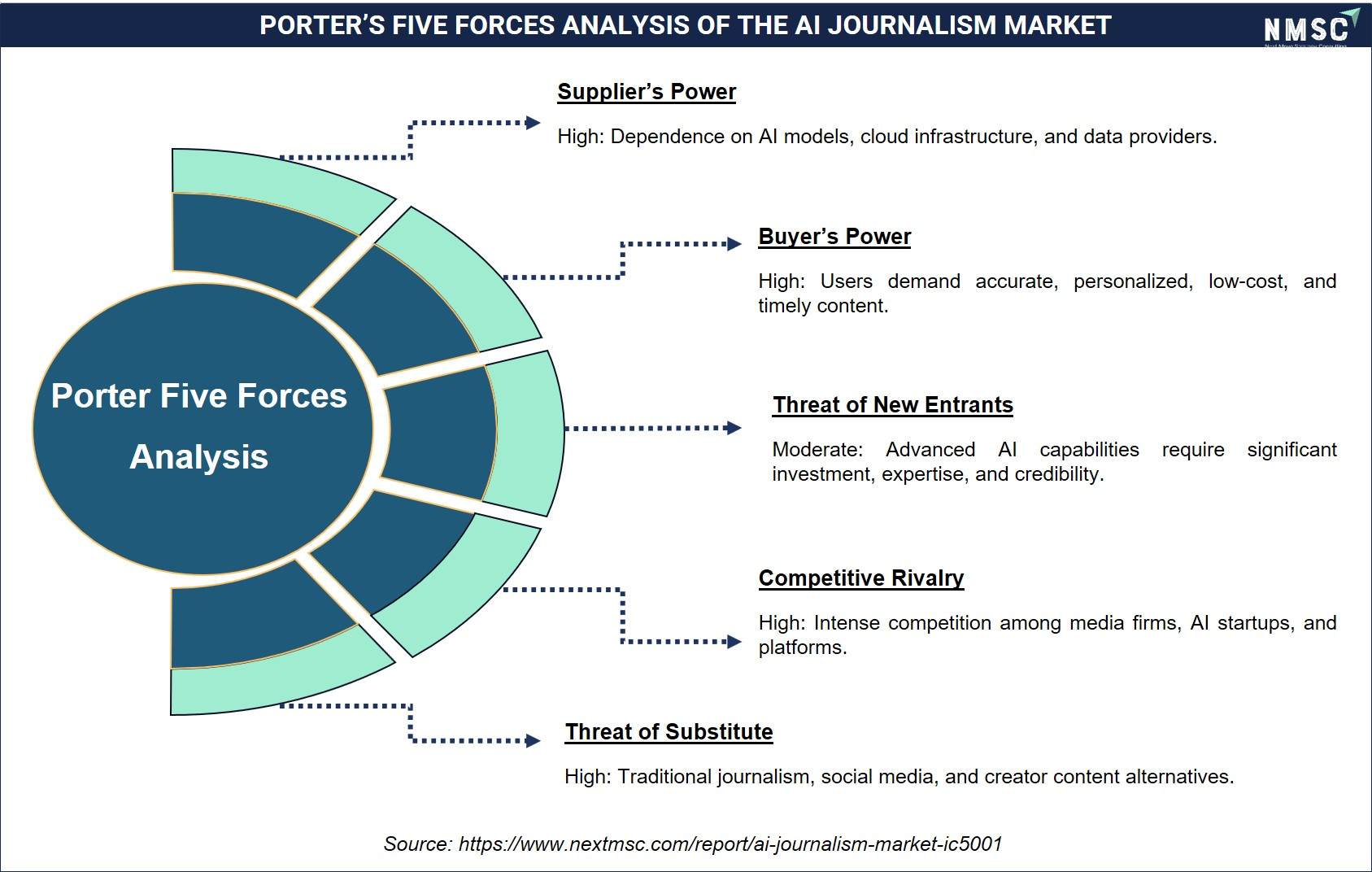
The Porter’s Five Forces Analysis of the AI Journalism Market highlights the competitive dynamics shaping industry growth. Supplier power is relatively high due to the dominance of major AI technology providers, while buyer power is increasing as media organizations seek cost-effective solutions. The threat of new entrants remains moderate because of high technological and regulatory barriers. Substitute threats come from traditional journalism tools and alternative content platforms, whereas intense competition among AI developers and media technology firms drives continuous innovation and strategic partnerships.
What Are the Key Market Drivers, Breakthroughs, and Investment Opportunities That Will Shape the AI Journalism Market Industry in the Next Decade?
The AI Journalism Market is at an inflection point where technological maturity, regulatory pressure, and structural shifts in media economics are converging to drive sustained long-term growth. Our assessment indicates that breakthroughs in generative AI, multimodal processing, and real-time data synthesis are enabling entirely new journalistic capabilities that were economically or technically impossible five years ago. Simultaneously, the market faces material headwinds from editorial trust concerns, data licensing disputes, and workforce transition challenges. The interplay of these forces will determine competitive positioning and investment returns across the 2026 to 2035 forecast period.
|
Drivers / Trends / Restraints |
(+/-) % Impact on CAGR Forecast |
Geographic Relevance |
Impact Timeline |
|
Rising demand for automated news content generation |
+2.8% |
North America, Europe, Asia-Pacific |
Immediate (2025–2027) |
|
Expansion of AI-powered fact-checking and trust verification |
+2.1% |
Europe, North America |
Near-term (2025–2028) |
|
Growth of digital-native media and AI-first newsrooms |
+2.4% |
Global |
Immediate (2025–2026) |
|
Adoption of cloud-based NLG workflow platforms |
+1.9% |
North America, Asia-Pacific |
Immediate (2025–2027) |
|
Rising misinformation risks driving verification investment |
+1.6% |
Global |
Near-term (2026–2029) |
|
Multimodal AI enabling audio and video automation |
+1.3% |
APAC, North America |
Medium-term (2027–2030) |
|
Editorial trust and AI transparency concerns |
-1.4% |
Europe, North America |
Immediate (2025–2027) |
|
Unresolved data licensing and copyright disputes |
-1.1% |
Global |
Near-term (2026–2028) |
|
Workforce resistance and change management challenges |
-0.8% |
Europe, North America |
Immediate (2025–2027) |
What Are the Growth Drivers of the AI Journalism Market?
How Is the Surge in Digital News Consumption Fueling Demand for AI-Powered Content?
The accelerating shift from print to digital news consumption is structurally expanding the addressable market for AI journalism tools. According to the Reuters Institute Digital News Report published by the Reuters Institute for the Study of Journalism at the University of Oxford, digital news consumption has continued to grow globally, with over 50% of audiences in surveyed markets accessing news primarily via smartphones and social platforms. This migration creates unprecedented content volume requirements that legacy editorial teams cannot satisfy cost-effectively, making AI-assisted drafting, summarization, and distribution economically necessary for publishers seeking to maintain competitive content frequency.
How Are Increasing Investments in AI Infrastructure by Media Conglomerates Accelerating Market Growth?
Major media conglomerates are making substantial, publicly documented investments in proprietary and licensed AI journalism infrastructure. The Associated Press has maintained a long-standing partnership with Automated Insights for NLG-based content production, with publicly reported automation covering thousands of quarterly earnings stories annually. The BBC's publicly available machine learning research pages document active development of AI tools for subtitling, content recommendation, and news discovery. These enterprise-level investments signal a structural commitment to AI integration that is driving substantial and durable demand across the AI Journalism Market supply chain.
How Are Regulatory Mandates for AI Transparency Creating New Market Opportunities?
Regulatory requirements for AI transparency in media content are creating mandatory procurement cycles for compliance-grade AI journalism solutions. The European Union's AI Act, which entered into force in August 2024 and is progressively applicable through 2026 and 2027, requires media organizations using AI for content generation to implement transparency disclosures, human oversight mechanisms, and documentation of AI system provenance. Based on NMSC's research, compliance-driven procurement is emerging as a distinct and growing demand driver, particularly in the EU market, where media organizations are actively evaluating and contracting AI provenance and audit trail solutions.
What Are the Growth Inhibitors of the AI Journalism Market?
How Do Editorial Trust Deficits and AI Transparency Gaps Constrain Market Adoption?
Concerns about editorial credibility and audience trust in AI-generated content represent a material constraint on deployment velocity within the AI Journalism Market. Industry body surveys conducted by the International Federation of Journalists (IFJ) have documented widespread concerns among professional journalists about AI systems undermining source verification, factual accuracy standards, and editorial independence. Publishers operating under public interest broadcasting mandates and regulated editorial standards face additional procurement barriers, as AI tools must demonstrably meet journalistic ethics standards before organizational deployment is authorized by editorial leadership.
How Are Unresolved Data Licensing and Copyright Conflicts Limiting Market Expansion?
Legal disputes over data rights and AI training data licensing present a structural risk to market growth, particularly for vendors reliant on large-scale news archive ingestion for model training. The New York Times Company's litigation against Microsoft and OpenAI, filed in December 2023 and reported in public court filings, has highlighted the unresolved legal status of news content used in AI training datasets. NMSC's analysis indicates that this litigation uncertainty is causing procurement delays among risk-averse publishers evaluating AI vendors' data provenance disclosures, and is driving up compliance costs for AI journalism platform providers seeking to offer indemnified data licensing.
What Are the Growth Opportunities in the AI Journalism Market?
How Does the Underserved Local and Regional News Market Represent a Major Expansion Avenue?
The accelerating decline of local and regional newsrooms in North America and Europe is creating a significant unmet demand for cost-effective AI journalism tools calibrated for small editorial teams. According to the Local News Initiative at Northwestern University's Medill School, thousands of local newspapers have closed or significantly reduced their reporting staff since 2004. AI journalism platforms offering affordable modular subscriptions for local government meeting coverage, community event reporting, and structured data story automation are strategically positioned to serve this underserved market segment, representing a high-growth opportunity for vendors with localization and community journalism capabilities.
How Does the Expansion of AI Journalism in Emerging Markets Drive Long-Term Revenue Growth?
Emerging markets in Asia-Pacific, the Middle East, and Latin America represent a substantial and underpenetrated growth opportunity for AI journalism solutions. In markets such as India, Indonesia, Vietnam, and Brazil, rapidly growing digital news audiences consuming content in multiple regional languages are creating demand for AI-powered multilingual translation, local language NLG, and mobile-first news personalization tools. Based on our market evaluation, the combination of large internet user bases, expanding digital advertising markets, and relatively low AI journalism adoption rates makes these geographies among the highest-potential growth regions for the next five to seven years.
How Are Newsroom Automation Platforms Creating Sustainable Revenue Streams for AI Vendors?
The shift toward platform-based, subscription-licensed newsroom automation solutions is enabling AI journalism vendors to build predictable, high-margin recurring revenue streams. From our research, we found that vendors offering integrated workflow automation spanning newsgathering, drafting, distribution, and analytics under unified SaaS agreements are achieving higher annual contract values and lower churn rates compared to point-solution providers. The migration of editorial teams toward API-integrated, AI-native content management systems is accelerating this platform consolidation dynamic, creating significant competitive moat opportunities for vendors able to deliver comprehensive, interoperable AI journalism suites.
SWOT Analysis of the AI Journalism Market
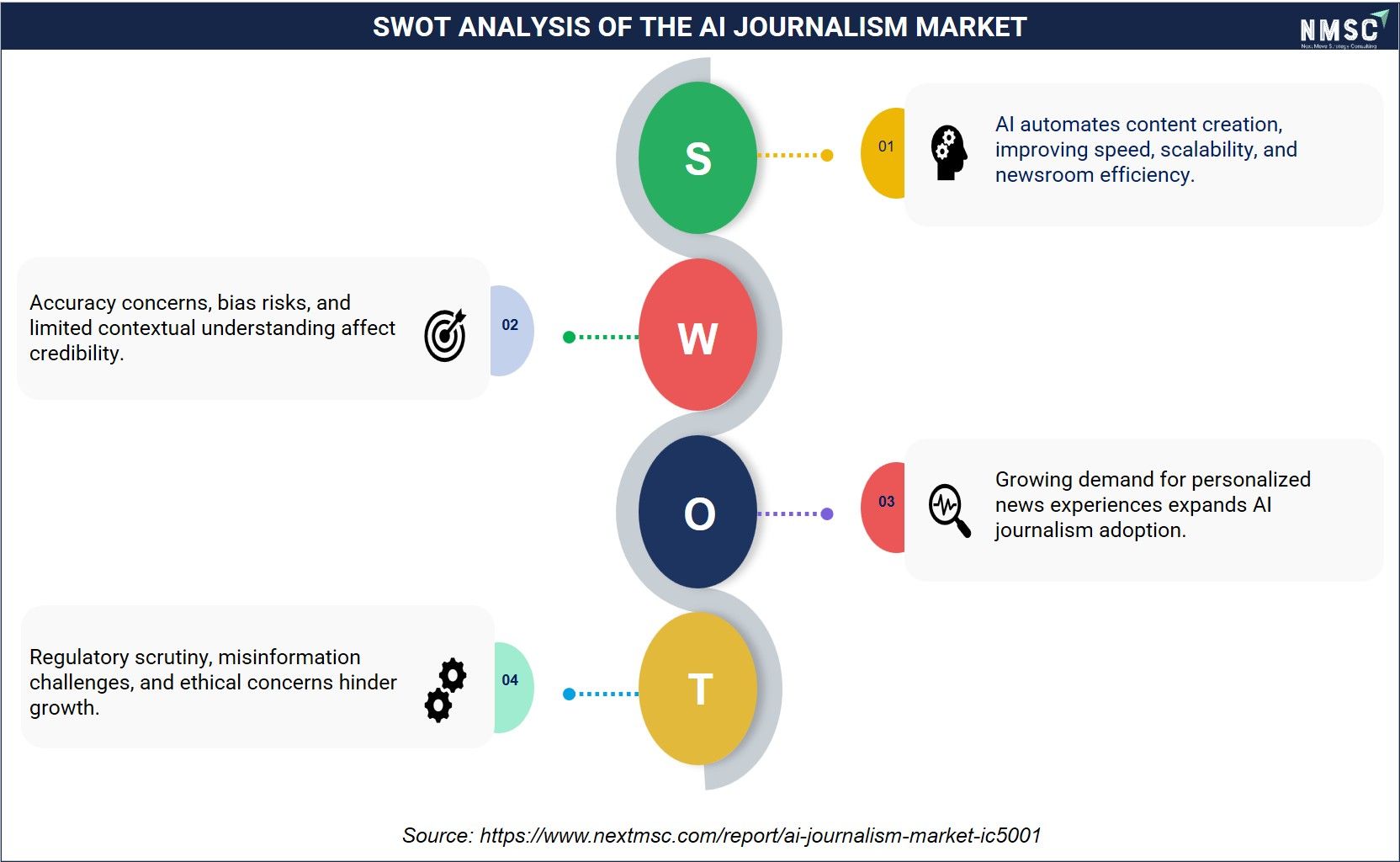
The SWOT Analysis of the AI Journalism Market highlights the key factors influencing industry development. AI-driven automation enhances content creation, newsroom productivity, and operational efficiency, serving as a major strength. However, concerns related to accuracy, bias, and limited contextual understanding remain significant weaknesses. The growing demand for personalized news delivery and data-driven journalism creates substantial growth opportunities. At the same time, increasing regulatory oversight, misinformation risks, copyright issues, and ethical challenges pose threats that could impact long-term market expansion and public trust.
How Is the AI Journalism Market Segmented in This Report, and What Are the Key Insights from the Segmentation Analysis?
How Do Software and Services Offerings Shape the Competitive Dynamics of the AI Journalism Market?
|
Segment |
2025 (USD Billion) |
2035 (USD Billion) |
CAGR (%) |
|
Software |
0.91 |
6.67 |
22.0% |
|
– Model Platforms |
0.18 |
1.38 |
22.6% |
|
– Workflow Applications |
0.73 |
5.29 |
22.0% |
|
Services |
0.28 |
1.82 |
20.5% |
|
Data and Licensing |
0.13 |
0.99 |
22.5% |
The Offering segment of the AI Journalism Market is structurally divided into Software, Services, and Data and Licensing. Software dominates total market revenue and encompasses Model Platforms providing foundational AI infrastructure and Workflow Applications covering the complete editorial lifecycle. Within Workflow Applications, Story Production sub-segments such as Drafting and Rewriting and Summarization and Editing command the highest deployment volumes, driven by their direct productivity impact in daily newsroom operations. Newsgathering tools including Monitoring and Alerts, Research and Extraction, and Transcription and Translation represent the fastest-growing software category, reflecting the expansion of AI-assisted intelligence gathering. Services including Implementation, Managed Services, and Training and Change Management are growing steadily as enterprise media organizations require specialized integration support. Data and Licensing, covering News Archives, Media Rights, and Dataset Licensing, is gaining momentum as AI vendors formalize content ingestion agreements with publisher consortia.
How Does the Choice of Deployment Architecture Influence AI Journalism Adoption Across Media Organizations?
|
Segment |
2025 (USD Billion) |
2035 (USD Billion) |
CAGR (%) |
|
Cloud |
0.81 |
5.88 |
22.0% |
|
Hybrid |
0.32 |
2.47 |
22.8% |
|
On-Premises |
0.19 |
1.13 |
19.6% |
The Deployment segment reflects the infrastructure preferences of media organizations implementing AI journalism solutions. Cloud deployment is the dominant mode, representing approximately 61% of 2025 market revenue, driven by scalable SaaS economics, ease of integration with digital publishing ecosystems, and the operational flexibility required by digital native publishers with variable content production volumes. Hybrid deployment is the fastest-growing architecture, emerging as the preferred model for broadcast networks and public service media organizations that require cloud-based AI inference performance combined with on-premises data residency for editorial content and source identity data. On-premises deployment, while declining in proportional share, remains significant for state broadcasters and regulated media entities in Europe and Asia-Pacific operating under strict data sovereignty requirements. Our assessment indicates that hybrid architecture adoption will accelerate materially from 2027 onward as AI compliance requirements under the EU AI Act mandate documented human oversight mechanisms that are more tractably implemented in controlled on-premises or private cloud environments.
How Are Evolving Revenue Models Reshaping Vendor and Publisher Relationships in the AI Journalism Market?
|
Segment |
2025 (USD Billion) |
2035 (USD Billion) |
CAGR (%) |
|
Subscription |
0.62 |
4.51 |
21.9% |
|
Usage Based |
0.29 |
2.27 |
22.8% |
|
License |
0.22 |
1.52 |
21.2% |
|
Services |
0.19 |
1.18 |
20.0% |
Revenue models in the AI Journalism Market reflect the diverse financial structures of media organizations ranging from large conglomerates to independent digital publishers. Subscription-based licensing dominates the market, constituting approximately 47% of 2025 revenue, as enterprise publishers prefer predictable annual expenditure commitments aligned with editorial headcount and content production planning cycles. Usage-based pricing is the fastest-growing model, enabling smaller and emerging market publishers to access AI journalism capabilities without high upfront commitments, paying proportionally to content volume and feature utilization. License models, typically applied to on-premises NLG and analytics software, remain significant for broadcasters and wire services requiring perpetual software ownership. Services-based revenue, derived from implementation, managed services, and training engagements, supports the full deployment lifecycle and is growing steadily as complex enterprise integrations expand. NMSC's analysis indicates that hybrid subscription and usage-based bundles are emerging as the preferred commercial structure for mid-market publishers seeking cost flexibility within annual budget frameworks.
How Do Different Buyer Segments Drive Differentiated Demand for AI Journalism Solutions?
|
Segment |
2025 (USD Billion) |
2035 (USD Billion) |
CAGR (%) |
|
Publishers |
0.67 |
4.89 |
21.9% |
|
– National |
0.31 |
2.21 |
21.6% |
|
– Regional and Local |
0.18 |
1.34 |
22.3% |
|
– Digital Native |
0.18 |
1.34 |
22.3% |
|
Broadcasters |
0.28 |
2.06 |
22.1% |
|
Wire Services |
0.11 |
0.78 |
21.6% |
|
Public Media |
0.12 |
0.84 |
21.5% |
|
Verification Teams |
0.14 |
0.91 |
20.6% |
The Buyer Type segmentation of the AI Journalism Market reflects the diverse organizational structures and editorial mandates of news industry stakeholders. National Publishers constitute the single largest buyer category, deploying AI journalism tools across the full editorial lifecycle from automated research to personalized distribution at scale. Regional and Local publishers are a rapidly growing buyer segment, driven by acute staffing constraints and the need for cost-effective content automation for community and local government coverage. Digital Native publishers represent the fastest-growing buyer type overall, applying AI-first workflows to achieve high content velocity at lean cost structures. Broadcasters, including TV and Radio and Podcast operations, are significant buyers of transcription, translation, and video AI tools, while Wire Services such as Reuters and the Associated Press deploy enterprise-grade NLG platforms at the infrastructure level. Public Media organizations, subject to editorial charter constraints, are adopting AI tools selectively, prioritizing verification and accessibility applications. Verification Teams at independent fact-checking organizations are a specialized and growing buyer segment driven by platform content governance requirements.
How Is the Diversification of Media Formats Expanding the Scope of AI Journalism Applications?
|
Segment |
2025 (USD Billion) |
2035 (USD Billion) |
CAGR (%) |
|
Text |
0.68 |
4.74 |
21.4% |
|
Audio |
0.24 |
1.85 |
22.6% |
|
Video |
0.26 |
2.06 |
23.0% |
|
Image |
0.14 |
0.83 |
19.5% |
Media Format segmentation reflects the primary content modality to which AI journalism tools are applied. Text remains the dominant format segment, supported by the maturity and commercial scale of NLG, summarization, and SEO optimization platforms deployed by digital publishers globally. Audio is a high-growth format segment, driven by the rapid expansion of podcast production automation, AI transcription, and real-time multilingual translation for radio and digital audio broadcasting. Video represents the fastest-growing media format, propelled by broadcaster investments in AI-powered captioning, automated highlight reel generation, and visual content creation tools. Image-focused AI applications, including automated photo selection, metadata tagging, and infographic generation, are growing steadily but at a relatively slower pace constrained by editorial quality assurance requirements for photojournalism contexts. Based on our market assessment, the convergence of text, audio, and video processing within unified multimodal AI journalism platforms will drive significant cross-format demand expansion through 2030.
Regional Outlook
The AI Journalism Market exhibits distinct regional growth trajectories shaped by media market maturity, digital infrastructure quality, regulatory environment, and the pace of AI technology adoption within local news ecosystems. North America leads in absolute revenue terms while Asia-Pacific drives the highest proportional growth. Europe occupies a strong but compliance-influenced growth path, while the Middle East and Africa and Latin America represent significant long-term expansion opportunities as digital journalism infrastructure matures.
Geographic Performance Snapshot
|
Region |
2025 Market Share (%) |
2035 Projected Share (%) |
CAGR 2026–2035 (%) |
|
North America |
38% |
35% |
21.6% |
|
Europe |
26% |
24% |
21.4% |
|
Asia-Pacific |
23% |
28% |
25.1% |
|
Middle East & Africa |
7% |
8% |
24.8% |
|
Latin America |
6% |
5% |
21.9% |
North America AI Journalism Market
Through our analysis, the North America AI Journalism Market stands as the largest and most commercially advanced regional market, representing approximately 38% of global revenue in 2025. The region benefits from an exceptionally dense concentration of leading AI technology vendors, major media conglomerates, and digital-native publishers that have been early adopters of automated journalism solutions. The United States regulatory environment, shaped by FTC guidance on AI media transparency and voluntary industry self-regulation frameworks, supports innovation while beginning to introduce disclosure requirements that are driving compliance technology procurement. Venture capital investment in AI journalism startups has been disproportionately concentrated in North America, sustaining a robust ecosystem of specialized solution providers.
United States AI Journalism Market
Based on our engagements, the United States AI Journalism Market is the global leader in AI journalism deployment, home to the highest concentration of AI-first newsrooms and vendor headquarters. Demand is driven by the scale imperatives of major wire services, broadcast networks, and large digital publishers operating high-frequency content production environments. Regulatory influence is currently moderated, with the FTC's AI transparency guidelines providing directional guidance without prescriptive mandates, offering a relatively permissive environment for AI journalism innovation. Technology penetration is highest in financial and sports journalism automation, audience personalization, and content verification. Competitive intensity is extreme, with both specialized AI journalism vendors and large technology platform providers competing for enterprise editorial contracts.
Canada AI Journalism Market
Through our analysis, the Canada AI Journalism Market reflects a media landscape defined by publicly funded broadcast mandates, concentrated private media ownership, and a bilingual content requirement that creates unique demand for multilingual AI journalism tools. The Canadian Broadcasting Corporation and major private media groups including Postmedia are actively evaluating AI workflow integration for both English and French content production. Government policy, including the Online News Act (Bill C-18) and its provisions for news organization compensation from digital platforms, is influencing the commercial dynamics of AI content licensing within the market. Adoption of AI summarization and audience analytics tools is accelerating across national broadcasters and digital publishers.
Mexico AI Journalism Market
From our assessment, the Mexico AI Journalism Market is at an earlier stage of AI journalism adoption compared to the United States and Canada, but is demonstrating strong growth momentum driven by the rapid expansion of digital news consumption and mobile internet penetration. Spanish-language AI journalism tools for automated content generation, social publishing, and audience personalization are gaining traction among national digital publishers and broadcast networks. Government policy influence on media is notable, with some regulatory uncertainty creating risk-aware procurement behavior. Competitive intensity is growing as international AI journalism vendors partner with local media groups to establish market presence. Infrastructure investment in digital publishing platforms is a prerequisite for broader AI journalism integration.
Europe AI Journalism Market
Based on our market evaluation, the Europe AI Journalism Market is shaped by a uniquely compliance-conscious media ecosystem in which regulatory requirements from the EU AI Act, GDPR, and national broadcasting standards are active drivers of technology procurement and deployment architectures. The region represents approximately 26% of global AI journalism revenue in 2025 and is home to world-class public broadcasters, established commercial media groups, and a growing community of AI journalism research institutions. The European Broadcasting Union's AI committee has published guidance on responsible AI use in public media, shaping adoption standards across member organizations. Hybrid deployment architectures are particularly prevalent to satisfy data sovereignty requirements.
United Kingdom AI Journalism Market
Based on our engagements, the United Kingdom AI Journalism Market is among the most mature in Europe, driven by the global influence of the BBC, the commercial scale of Sky News and major national newspaper groups, and a vibrant digital media startup ecosystem centered in London. The BBC's publicly documented machine learning research program and its AI deployment in accessibility, subtitling, and content discovery are influential reference implementations for the European market. Regulatory influence is exercised by Ofcom, whose AI and media transparency guidelines are progressively shaping vendor requirements. Technology penetration in text automation, transcription, and audience analytics is advanced, with video AI tools in active pilot deployment across broadcast organizations.
Germany AI Journalism Market
Through our analysis, the Germany AI Journalism Market is characterized by a strong public broadcasting sector led by ARD and ZDF, a robust private publishing market, and a media culture that places high emphasis on editorial independence and data privacy. The stringent application of GDPR and emerging EU AI Act requirements influence deployment decisions significantly, creating strong demand for on-premises and private cloud AI journalism architectures. German media organizations have been active in developing AI standards through industry bodies, and the market has seen early adoption of AI transcription, multilingual content generation, and audience analytics. Competitive intensity is moderate, with both domestic and international AI journalism vendors active in the enterprise segment.
France AI Journalism Market
From our assessment, the France AI Journalism Market reflects a media environment with strong public sector participation through France Televisions and Radio France, alongside a concentrated private publishing market. AI journalism adoption is advancing in automated sports and election reporting, audience personalization for digital platforms, and AI-powered transcription for broadcast archives. The French government's active engagement in digital media regulation and AI oversight creates a compliance-driven procurement environment. ARCOM, the French audiovisual regulator, is monitoring AI use in broadcast media content, and regulatory guidance is expected to formalize AI content transparency standards in the near term. France also benefits from active AI journalism research programs at leading universities.
Italy AI Journalism Market
Based on our market evaluation, the Italy AI Journalism Market is driven by the digital transformation of the RAI public broadcaster and major commercial media groups including Mediaset and RCS MediaGroup. AI journalism adoption is advancing across text automation, content personalization, and digital archive access tools. Italy's media regulatory authority AGCOM has engaged with AI governance issues as part of its broader digital media oversight mandate. Technology penetration remains at an intermediate level relative to leading European markets, with strong growth potential in AI-driven local and regional news automation, multilingual publishing, and broadcast transcription. Investment in digital infrastructure and editorial AI training is increasing across leading Italian media organizations.
Spain AI Journalism Market
Through our analysis, the Spain AI Journalism Market is expanding on the back of digital media growth, the global reach of Spanish-language content, and investments by public broadcaster RTVE in AI production technologies. Automated sports journalism and data-driven reporting are well-established applications within Spanish national publishers, while audience analytics and content personalization tools are gaining traction among digital native media organizations. EU AI Act compliance requirements are shaping vendor selection criteria, and there is growing demand for AI tools that support bilingual Castilian and regional language content production. The competitive landscape is evolving with both domestic startup activity and international vendor market entry.
Sweden AI Journalism Market
From our assessment, the Sweden AI Journalism Market is among the most innovation-oriented in Europe, supported by a strong technology ecosystem, high digital media literacy, and the presence of United Robots, a leading AI journalism company headquartered in Malmo. Swedish public broadcaster SVT and commercial media groups have been early adopters of automated local news generation, with United Robots' platform powering structured data-to-story automation for hundreds of Swedish newsrooms. Regulatory alignment with the EU AI Act is shaping editorial AI governance frameworks across the market. Technology penetration in text automation and audience analytics is advanced, and the market is well-positioned to lead European adoption of next-generation multimodal AI journalism tools.
Denmark AI Journalism Market
Based on our engagements, the Denmark AI Journalism Market is characterized by a highly digitized media environment, a progressive approach to AI adoption in public broadcasting, and a strong research ecosystem exploring ethical AI journalism applications. DR, the public broadcasting corporation, has been publicly active in evaluating AI tools for content accessibility, archive search, and audience engagement. The compact Danish media market supports rapid innovation diffusion, with AI journalism tools quickly adopted by national and regional publishers following successful pilot deployments. EU regulatory compliance is a standard procurement requirement, and the market exhibits relatively high awareness of AI content transparency standards among editorial leadership.
Finland AI Journalism Market
Through our analysis, the Finland AI Journalism Market benefits from world-class digital infrastructure, a strong tradition of public media excellence through Yle, and a forward-looking approach to AI ethics in journalism. Yle has been publicly transparent about its exploration of AI-assisted content production and editorial quality tools. Finnish media organizations are active participants in pan-European AI journalism research networks, contributing to standards development for responsible AI use in news. Technology adoption is advanced in transcription, multilingual publishing, and audience analytics, with growing investment in AI-powered content verification tools. The regulatory environment is supportive of responsible AI innovation, aligned with EU frameworks.
Netherlands AI Journalism Market
From our assessment, the Netherlands AI Journalism Market is supported by a technologically sophisticated media environment anchored by the NPO public broadcaster and a vibrant commercial publishing sector. Dutch media organizations have been active in AI journalism research partnerships with universities, and several leading AI-powered editorial tools have been piloted and deployed by national publishers. Regulatory compliance with GDPR and the EU AI Act is standard across enterprise deployments, and data privacy is a prominent consideration in AI journalism tool procurement. Technology penetration in automated reporting, audience personalization, and digital archive access is above the European average. The competitive market features both international AI vendors and Dutch-native technology companies serving the editorial AI segment.
Rest of Europe AI Journalism Market
Based on our market evaluation, the Rest of Europe segment encompasses markets including Poland, Belgium, Austria, Switzerland, Portugal, Czech Republic, Romania, Greece, Hungary, and the Baltic states, each at varying stages of AI journalism adoption. Growth across these markets is driven by digital media expansion, EU-funded AI research programs, and the standardizing effect of EU AI Act compliance requirements. Public broadcasters in several of these markets are leading AI adoption for content accessibility and archive digitization. Regional language NLG and multilingual AI tools represent priority investment areas, and competitive intensity is lower than in core European markets, creating opportunities for specialized AI journalism vendors serving niche language and regulatory requirements.
Asia-Pacific AI Journalism Market
NMSC's analysis indicates that the Asia-Pacific AI Journalism Market is the fastest-growing regional segment, projected to expand at a CAGR of 25.1% from 2026 to 2035, driven by massive digital news audiences, rapid smartphone penetration, strong government-supported AI investment programs, and the strategic importance of multilingual and vernacular language content automation. The region is home to some of the largest digital media markets globally, and AI journalism adoption is advancing rapidly across national broadcasters, large digital platforms, and a growing cohort of AI-native news startups.
China AI Journalism Market
Based on our engagements, the China AI Journalism Market is one of the largest and most technologically advanced in the world, driven by state investment in AI infrastructure, the scale of domestic internet media platforms, and the operational requirements of high-frequency Chinese-language content production. State media organizations including Xinhua News Agency and China Media Group have publicly deployed AI-powered newswriting, automated broadcasting, and content recommendation systems. Regulatory influence is significant, with AI content generation subject to oversight by the Cyberspace Administration of China (CAC), which has issued rules on deep synthesis and generative AI content that shape platform and media organization compliance obligations. Competitive intensity in domestic AI journalism tools is high.
India AI Journalism Market
Through our analysis, the India AI Journalism Market represents one of the highest-growth opportunities globally, driven by an enormous and rapidly expanding digital news audience consuming content in over twenty recognized languages, high smartphone penetration, and a dynamic independent digital journalism sector. AI journalism applications for automated Hindi and regional language content generation, multilingual translation, and mobile-first content distribution are in active commercial deployment. The regulatory environment is evolving, with the Press Council of India and the Ministry of Information and Broadcasting actively monitoring AI's role in news production. Technology adoption is accelerating among major digital publishers and regional language media groups, supported by cost-effective cloud AI services.
Japan AI Journalism Market
From our assessment, the Japan AI Journalism Market reflects a highly developed media ecosystem with strong demand for AI tools supporting the unique requirements of Japanese-language content production, including complex character processing, stylistic formality requirements, and precise editorial standards. Public broadcaster NHK has been publicly active in AI editorial research, including automated summarization, subtitle generation, and archive search. Japanese media organizations are adopting AI journalism tools primarily for workflow efficiency in structured reporting domains such as financial results and sports, while applying significant human editorial oversight to ensure cultural and linguistic accuracy. Regulatory guidance from the Cabinet Office on AI governance is progressive and supportive of responsible AI adoption.
South Korea AI Journalism Market
Based on our market evaluation, the South Korea AI Journalism Market is at an advanced stage of AI journalism adoption, supported by world-leading digital infrastructure, a highly competitive media market, and strong national investment in AI research and development. Major Korean media organizations and digital news platforms have deployed AI tools for automated reporting, personalized content recommendation, and fact-checking, with several platforms implementing AI anchors for broadcast news delivery. Korea Communications Commission guidelines on AI broadcasting transparency are shaping disclosure requirements. Technology penetration is high across both national broadcasters and digital native publishers, and the market is witnessing active development of Korean-language NLG and multimodal AI journalism systems.
Taiwan AI Journalism Market
Through our analysis, the Taiwan AI Journalism Market is characterized by a vibrant independent media sector, high digital literacy, and strong awareness of information integrity risks given the geopolitical context. AI journalism tools for fact-checking, misinformation detection, and content verification are particularly valued by Taiwanese media organizations and civil society fact-checking groups. Public broadcaster PTS has been exploring AI tools for content accessibility and digital archive enhancement. Technology adoption in text automation and audience analytics is growing steadily, and the market benefits from proximity to advanced semiconductor and technology manufacturing ecosystems that support AI infrastructure development. Regulatory frameworks are evolving to address AI-generated content transparency.
Indonesia AI Journalism Market
From our assessment, the Indonesia AI Journalism Market is one of the fastest-growing in Southeast Asia, driven by the world's fourth-largest population, rapid expansion of digital news consumption, and a large Indonesian-language media market that creates strong demand for vernacular AI journalism tools. Mobile-first news consumption patterns and high social media engagement drive investment in AI personalization, automated social publishing, and mobile-optimized content generation. Regulatory oversight from Kominfo (Ministry of Communication and Information Technology) is evolving to address AI-generated content, and industry self-regulation through press associations is developing. Investment in AI journalism platforms by major Indonesian digital media groups is accelerating, supported by growing advertising market revenues.
Vietnam AI Journalism Market
Based on our engagements, the Vietnam AI Journalism Market is emerging rapidly, supported by strong government investment in digital economy infrastructure and a large and growing digital media sector dominated by national and provincial publishers operating under state oversight. Vietnamese-language AI journalism tools for automated news generation, translation, and digital content distribution are gaining traction. The Ministry of Information and Communications has developed digital transformation roadmaps for the media sector that include AI adoption targets. Technology penetration is at an early-to-intermediate stage, and international AI journalism vendors with localization capabilities for the Vietnamese language are well-positioned to capture market share as the sector matures.
Australia AI Journalism Market
Through our analysis, the Australia AI Journalism Market is well-developed, supported by a mature media ecosystem including public broadcasters ABC and SBS, major commercial television and radio networks, and a strong independent digital publishing sector. Australian media organizations have been active in evaluating AI journalism tools for workflow automation, personalization, and fact-checking, with the ABC publicly documenting its AI editorial principles and guidelines. The Australian Communications and Media Authority (ACMA) is engaged in AI media governance, and voluntary industry codes of practice for AI content labeling are in development. Technology adoption is advanced in text automation and audience analytics, with growing investment in multimodal AI applications for broadcast production.
Philippines AI Journalism Market
From our assessment, the Philippines AI Journalism Market is in an active growth phase driven by high social media penetration, a large English and Filipino-language digital news audience, and increasing awareness of AI journalism capabilities among leading media organizations. ABS-CBN, GMA Network, and major digital news platforms are beginning to evaluate and deploy AI tools for content automation, audience personalization, and misinformation monitoring. Regulatory oversight from the Kapisanan ng mga Brodkaster ng Pilipinas (KBP) and the National Telecommunications Commission is evolving to address emerging digital media challenges. Technology adoption is advancing primarily in mobile-first content distribution and social publishing automation, with fact-checking AI gaining particular strategic importance given the market's prominence in global misinformation research.
Malaysia AI Journalism Market
Based on our market evaluation, the Malaysia AI Journalism Market is expanding on the back of government-supported digital transformation programs, including the Malaysia Digital Economy Blueprint, which prioritizes AI adoption across industries including media. Malay, English, and Chinese-language content requirements create specific demand for multilingual AI journalism tools. National broadcaster RTM and major commercial media organizations are exploring AI tools for content production efficiency and digital audience engagement. The Malaysian Communications and Multimedia Commission (MCMC) provides regulatory oversight for the media sector, and guidelines for AI content labeling are expected to develop in line with international standards. Competitive intensity is growing as international AI journalism vendors partner with local technology integrators.
Rest of APAC AI Journalism Market
Through our analysis, the Rest of APAC segment encompasses markets including Singapore, Thailand, Bangladesh, Pakistan, Sri Lanka, and New Zealand, each presenting distinct AI journalism adoption profiles. Singapore is a standout market within the rest of APAC, home to advanced digital media infrastructure, the Media Development Authority's progressive AI guidelines, and active deployments of AI journalism tools among national broadcasters and digital publishers. Thailand and Bangladesh are experiencing rapid digital news market growth creating demand for AI automation tools in local languages. New Zealand's media sector mirrors Australian trends in AI journalism adoption, with public broadcaster TVNZ publicly engaged in AI editorial governance discussions. Overall, the Rest of APAC segment is expected to grow rapidly as digital advertising markets mature and AI platform costs decline.
Middle East and Africa AI Journalism Market
Based on NMSC's research, the Middle East and Africa AI Journalism Market is at an early but rapidly accelerating stage of development, driven by substantial government investment in media AI infrastructure in Gulf Cooperation Council states, a large and rapidly digitizing African news media market, and growing awareness of AI journalism capabilities among leading regional broadcasters and digital publishers. The MEA region is projected to grow at a CAGR of 24.8% from 2026 to 2035, reflecting the significant catch-up dynamic as digital media infrastructure matures and AI journalism platforms expand their regional language support.
Saudi Arabia AI Journalism Market
From our assessment, the Saudi Arabia AI Journalism Market is among the most strategically active in the Middle East, driven by Vision 2030 initiatives that prioritize digital media modernization and AI adoption across public and commercial sectors. Saudi Broadcasting Authority and major commercial digital media platforms are investing in AI tools for Arabic-language content generation, personalization, and distribution automation. The Communications, Space and Technology Commission (CST) provides regulatory oversight aligned with national AI strategy objectives. Technology penetration in text automation and social media publishing is growing rapidly, and investment in AI journalism platforms is supported by both government programs and private media group capital allocation. Arabic-language NLG capabilities are a priority investment area.
UAE AI Journalism Market
Based on our engagements, the UAE AI Journalism Market is the most commercially advanced in the region, benefiting from Dubai and Abu Dhabi's status as global media hubs, the presence of international media organizations' regional headquarters, and the UAE's AI National Strategy, which drives government-supported AI adoption across strategic sectors including media. TRA (Telecommunications and Digital Government Regulatory Authority) provides a progressive regulatory environment for AI media applications. Technology adoption is advanced for a regional market, with AI tools deployed in content personalization, real-time translation between Arabic and English, and broadcast production automation. Competitive intensity is growing as international AI journalism vendors establish dedicated UAE operations.
Egypt AI Journalism Market
Through our analysis, the Egypt AI Journalism Market represents the largest Arabic-language media market in Africa and the broader Arab world by population reach, creating strong underlying demand for AI journalism tools tailored to Egyptian Arabic content. State broadcaster Nilesat television networks and major private satellite channels are exploring AI-assisted production technologies. Egypt's regulatory framework for media is administered by NTRA and the Supreme Council for Media Regulation, and government digital transformation programs are beginning to include media sector AI adoption targets. Technology adoption is at an early stage for AI journalism, with growth catalysts including rising digital advertising revenues, social media-driven news consumption, and Arabic NLG platform development.
Israel AI Journalism Market
From our assessment, the Israel AI Journalism Market is supported by a globally recognized AI technology innovation ecosystem, with several AI journalism startups and established technology companies based in Israel contributing specialized solutions for content verification, media monitoring, and automated reporting. The regulatory environment for media AI is developing within Israel's broader digital economy governance framework. Technology penetration is high relative to market size, with AI tools integrated into major broadcast and digital news organizations. Israeli media organizations have been particularly active in evaluating AI fact-checking and provenance tools given the sensitive information environment. The market is also a source of AI journalism technology exports to international markets.
Turkey AI Journalism Market
Based on our market evaluation, the Turkey AI Journalism Market is driven by a large and dynamic digital media sector operating in the Turkish language, high mobile internet and social media penetration, and growing adoption of AI tools among leading digital publishers and broadcast networks. TRT, the state broadcaster, and major private media groups are beginning to integrate AI tools for content production and distribution optimization. The regulatory environment for media in Turkey is administered by RTÜK, whose mandate covers AI-generated broadcast content. Technology adoption is advancing in text automation, social media publishing, and audience analytics. Turkish-language NLG capabilities are an important consideration in vendor evaluation, and the market benefits from a growing community of domestic AI startups.
Nigeria AI Journalism Market
Through our analysis, the Nigeria AI Journalism Market is the largest in Sub-Saharan Africa by media market scale, supported by a large English and Pidgin-language digital news ecosystem, high mobile internet adoption, and a dynamic independent journalism sector. AI journalism tools for mobile content delivery, automated social publishing, and AI-powered fact-checking are gaining relevance in the Nigerian media market, particularly as misinformation monitoring becomes a priority. The National Broadcasting Commission (NBC) provides broadcast media oversight. Technology adoption remains at an early stage compared to global benchmarks, but growth is accelerating driven by digital advertising market expansion and international AI journalism vendor engagement with Nigerian media organizations. Nigeria is expected to emerge as a leading AI journalism market in Africa by the early 2030s.
South Africa AI Journalism Market
Based on our engagements, the South Africa AI Journalism Market is the most mature in Sub-Saharan Africa, anchored by SABC's public broadcasting infrastructure, large commercial media groups, and a vibrant digital news sector. AI journalism tools for English-language content automation, multilingual translation across South Africa's 11 official languages, and audience analytics are gaining traction. The Independent Communications Authority of South Africa (ICASA) and the Broadcasting Complaints Commission of South Africa govern the broadcast media regulatory environment. Technology adoption is advancing in text summarization, transcription, and digital content distribution, with growing awareness of AI journalism capabilities among editorial leadership at national media organizations. Investment in AI journalism solutions is supported by broader digital transformation programs.
Rest of MEA AI Journalism Market
From our assessment, the Rest of MEA segment encompasses markets including Kuwait, Qatar, Bahrain, Oman, Jordan, Morocco, Tunisia, Algeria, Ethiopia, Kenya, Ghana, and other markets across the region. Gulf state markets including Qatar and Kuwait mirror UAE adoption trends, supported by government AI investment programs and the concentration of international media organizations including Al Jazeera Media Network, which has publicly documented AI research investments. African markets such as Kenya and Ghana are experiencing rapid digital news growth and represent emerging opportunities for AI journalism platform vendors with multilingual and mobile-first product strategies. Overall, the Rest of MEA segment is expected to grow substantially as media digitization investment accelerates across the region.
Latin America AI Journalism Market
Based on our market evaluation, the Latin America AI Journalism Market is growing at a CAGR of 21.9% from 2026 to 2035, supported by a large and digitally engaged Spanish and Portuguese-language news audience, the rapid expansion of mobile news consumption, and increasing investment in AI journalism capabilities by major regional media groups. The region faces challenges including economic volatility, press freedom concerns in some markets, and uneven digital infrastructure quality, but these are offset by the strong strategic interest of international AI journalism vendors in capturing Latin American market share through partnerships with regional publishers.
Brazil AI Journalism Market
Based on our engagements, the Brazil AI Journalism Market is the largest in Latin America and one of the highest-potential emerging AI journalism markets globally, driven by a large digital news audience, strong commercial media sector, and rapid adoption of mobile-first content platforms. Major Brazilian media organizations including Globo, Folha de S.Paulo, and digital native publishers are exploring AI tools for Portuguese-language NLG, audience personalization, and automated social distribution. ANATEL and ANCINE provide telecommunications and audiovisual regulatory oversight. Technology adoption is advancing steadily in text automation and digital publishing, with growing interest in AI fact-checking tools given the market's prominence in global platform governance conversations on misinformation. Brazil's AI National Strategy creates a supportive policy environment for media sector AI adoption.
Argentina AI Journalism Market
Through our analysis, the Argentina AI Journalism Market reflects a media landscape characterized by strong journalistic traditions, significant economic volatility, and a growing digital news ecosystem. Argentine media organizations are selectively adopting AI tools for content summarization, social publishing, and audience analytics, prioritizing cost-effective cloud-based solutions that accommodate variable budget environments. ENACOM (National Communications Entity) administers the media regulatory environment. Technology adoption is at an intermediate stage, with the most active deployments concentrated in Buenos Aires-based national publishers and digital native outlets. Spanish-language AI journalism tools with support for Argentine Spanish stylistic conventions are valued by editorial teams evaluating vendor platforms.
Chile AI Journalism Market
From our assessment, the Chile AI Journalism Market is among the most stable and commercially progressive in Latin America, supported by strong economic fundamentals, high internet penetration, and a media sector that includes sophisticated national broadcasters and established digital publishers. SUBTEL and the National Television Council provide regulatory oversight for the broadcast media environment. AI journalism tool adoption is advancing in text automation, audience analytics, and social media publishing optimization. Chilean media organizations are increasingly aware of AI content transparency requirements aligned with emerging international standards. Technology penetration is growing steadily, and the market is expected to serve as a regional reference for responsible AI journalism practices in Latin America.
Colombia AI Journalism Market
Based on our market evaluation, the Colombia AI Journalism Market is experiencing strong growth driven by digital media expansion, increasing internet and smartphone penetration, and rising investment in editorial technology by national publishers and broadcast networks. MinTIC (Ministry of Information Technologies and Communications) has supported digital transformation programs that include media sector AI adoption incentives. Colombian media organizations are deploying AI tools for content personalization, automated social publishing, and audience analytics, with growing interest in AI-powered fact-checking and misinformation monitoring tools. Technology adoption is at an early-to-intermediate stage relative to leading Latin American markets, with significant untapped potential in regional language and vernacular content automation.
Rest of LATAM AI Journalism Market
Through our analysis, the Rest of LATAM segment includes markets such as Peru, Venezuela, Ecuador, Bolivia, Uruguay, Paraguay, Central American nations, and Caribbean territories. These markets collectively represent a growing and strategically relevant portion of the Latin American AI journalism ecosystem. Key drivers include expanding mobile internet access, growing digital advertising markets, and the interest of major regional media groups in AI tools for Spanish-language content automation. Regulatory environments vary across these markets, with press freedom conditions and digital infrastructure quality influencing the pace of AI journalism adoption. International AI journalism vendors are increasingly engaging these markets through regional partnership strategies and modular SaaS solutions calibrated for smaller editorial teams.
Competitive Landscape
Competitive Dynamics and M&A Landscape
|
Key Takeaways |
Details |
|
Market Structure |
The AI Journalism Market exhibits a fragmented but rapidly consolidating competitive landscape comprising AI-native journalism technology providers, media workflow automation vendors, content intelligence platforms, transcription specialists, fact-checking solution providers, and established media technology companies. Leading participants include Dataminr, Thomson Reuters, Taboola, Veritone, Echobox, NewsGuard Technologies, Logically, Trint, Speechmatics, and AX Semantics, each competing across different layers of the editorial technology stack. |
|
Innovation Focus |
Innovation within the AI Journalism Market is centered on large language model (LLM)-powered content generation, multimodal AI for text-audio-video workflows, automated fact-checking, content provenance verification, audience personalization engines, multilingual publishing, real-time news monitoring, and AI-assisted editorial decision support. Vendors are increasingly investing in responsible AI frameworks, transparency tools, and newsroom-specific generative AI platforms. |
|
M&A Activity |
Merger and acquisition activity is accelerating as media technology vendors, AI startups, and digital publishing platforms seek to expand capabilities across content creation, verification, analytics, and monetization. Strategic investments are increasingly focused on generative AI startups, fact-checking technologies, content licensing infrastructure, and multimedia automation platforms. Partnerships between publishers and AI technology providers are also becoming a key growth strategy to accelerate newsroom AI adoption and commercialization. |
How Do Companies Compete in the AI Journalism Market?
The AI Journalism Market is characterized by multi-tiered competition among integrated media technology providers, specialized AI journalism vendors, and emerging AI-native startups. Large platform providers such as Thomson Reuters, Veritone, and Taboola compete on the breadth of their product portfolios, global customer reach, and integration across newsroom workflows. Specialized vendors including Trint, Speechmatics, NewsGuard Technologies, Logically, and AX Semantics differentiate through deep expertise in transcription, fact-checking, content verification, and natural language generation. Meanwhile, AI-native startups compete by rapidly introducing innovative generative AI capabilities, workflow automation tools, and cost-efficient solutions tailored to modern digital publishing environments.
Which Kind of Companies Dominate the AI Journalism Market?
Three distinct categories of companies dominate the AI Journalism Market. First, established media technology and information services companies such as Thomson Reuters, Veritone, and Stats Perform leverage extensive content networks, proprietary datasets, and enterprise relationships to deliver comprehensive AI-powered journalism solutions. Second, specialized editorial technology providers including Trint, Speechmatics, Echobox, AI-Media Technologies, NewsGuard Technologies, Logically, and AX Semantics focus on specific newsroom functions such as transcription, audience engagement, fact-checking, accessibility, and automated content creation. Finally, AI-native innovators such as Dataminr, TollBit, Nota Collective, Newsroom AI, and AI Newsrooms Technology GmbH are introducing next-generation generative AI platforms designed specifically for editorial workflow optimization, content monetization, and newsroom productivity enhancement.
Generative AI, Multimodal Workflows, and Trust Technologies Drive Market Success in the AI Journalism Market
Innovation across the AI Journalism Market is concentrated in large language model-powered content generation, multimodal AI processing, real-time news intelligence, and content authenticity verification technologies. Vendors are investing heavily in automated article drafting, multilingual publishing, AI-assisted research, audience personalization, synthetic media generation, and deepfake detection capabilities. At the same time, transparency, explainability, and provenance tracking have become key competitive differentiators as media organizations seek to comply with emerging AI governance requirements. Companies that successfully combine newsroom automation, trust mechanisms, and audience engagement capabilities within unified platforms are increasingly securing premium enterprise contracts and long-term publisher partnerships.
Market Players to Opt for Merger and Acquisition Strategies to Expand Their Presence in the AI Journalism Market
Mergers, acquisitions, and strategic partnerships are reshaping the competitive landscape of the AI Journalism Market. Established media technology providers are increasingly acquiring AI startups to accelerate innovation, strengthen generative AI capabilities, and expand newsroom automation portfolios. Thomson Reuters has continued to expand its AI capabilities through strategic investments across information services and content intelligence technologies, while Veritone has strengthened its position through acquisitions focused on AI-driven media management and content analytics. Similarly, Stats Perform has expanded its AI-powered journalism offerings through the integration of advanced sports data and automated content generation technologies. Looking ahead, consolidation is expected to accelerate across fact-checking platforms, AI content verification providers, newsroom workflow automation vendors, and multimedia content generation specialists as companies seek to build comprehensive AI journalism ecosystems.
Who Are the Key Market Players in the AI Journalism Market?
-
Dataminr, Inc.
-
Taboola.com Ltd.
-
Thomson Reuters Corporation
-
Echobox Ltd.
-
United Robots AB
-
Veritone, Inc.
-
Stats Perform, Inc.
-
Trint Ltd.
-
AI-Media Technologies Limited
-
Speechmatics Limited
-
NewsGuard Technologies, Inc.
-
Logically Ltd.
-
TollBit, Inc.
-
Newsroom AI
-
AI Newsrooms Technology GmbH
-
The Newsroom
-
Nota Collective, Inc.
-
Otter.ai, Inc.
-
Lumen5 Inc.
-
AX Semantics GmbH
What Are the Latest Developments in the AI Journalism Market Industry?
|
Date |
Event |
|
November 2025 |
Thomson Reuters launched new Agentic AI solutions across its professional information platforms, expanding AI-powered content generation, research, and workflow automation capabilities. The announcement strengthens its position in AI-assisted journalism and news intelligence by integrating advanced reasoning and trusted content assets. |
|
April 2025 |
Dataminr unveiled its Agentic AI roadmap and announced Intel Agents, a novel Agentic AI capability designed to autonomously generate real-time context around breaking events, threats, and risks, supporting AI-driven news discovery and reporting workflows. |
Expert Insights

“We greatly value News Corp’s history as a leader in reporting breaking news around the world, and are excited to enhance our users’ access to its high-quality reporting. Together, we are setting the foundation for a future where AI deeply respects, enhances, and upholds the standards of world-class journalism.”
- Sam Altman, CEO of OpenAI
Statement made during the announcement of the landmark multi-year partnership between OpenAI and News Corp, focusing on the integration of trusted journalistic content into AI systems and the future of responsible AI in news publishing.
Market Interpretation:
The statement highlights the growing convergence of artificial intelligence and professional journalism, emphasizing that trusted news organizations are becoming strategic partners in the development of generative AI. As AI companies increasingly seek access to high-quality, verified content, licensing agreements with publishers are emerging as a key business model within the AI Journalism Market. This trend supports the expansion of AI-powered news generation, content distribution, and information retrieval while reinforcing the importance of accuracy, credibility, and ethical AI deployment across the media industry.
What Are the Investment Opportunities in the AI Journalism Market?
Capital Inflows and Venture Activity
The AI Journalism Market continues to attract increasing levels of venture capital, private equity, and strategic corporate investment as media organizations accelerate AI adoption across editorial operations. We observed that investor interest is particularly strong in generative AI content platforms, newsroom workflow automation solutions, fact-checking technologies, and audience intelligence platforms. AI-native media startups focused on multilingual content generation, content provenance, and personalized news delivery are securing substantial funding as investors recognize the long-term transformation of digital publishing. North America remains the largest destination for AI journalism investment, while Asia-Pacific is emerging as a major growth region due to expanding digital media ecosystems and accelerating AI adoption.
Infrastructure Investment
Infrastructure investment is becoming a critical growth catalyst for the AI Journalism Market. Cloud providers, AI platform vendors, and media technology companies are investing heavily in computing infrastructure required to support large language model deployment, real-time content generation, speech recognition, and multimodal media processing. We found that increasing investment in cloud-native newsroom platforms, AI-powered transcription systems, multilingual language models, and real-time content verification infrastructure is expanding the scalability and accessibility of AI journalism solutions. These investments are lowering operational costs while enabling publishers and broadcasters to deploy AI capabilities across larger content volumes and audiences.
ESG and Responsible AI Journalism
Environmental, Social, and Governance (ESG) considerations are playing an increasingly important role in AI Journalism Market investment decisions. Investors and media organizations are evaluating AI solutions based on transparency, accountability, misinformation prevention, and their impact on editorial integrity. Responsible AI frameworks, content authenticity standards, and explainable AI capabilities are becoming important competitive differentiators. Vendors that demonstrate strong governance practices, ethical AI deployment policies, and compliance with emerging regulatory standards are increasingly favored by institutional investors and media organizations with ESG-focused procurement requirements.
Digital Transformation Enablement
AI journalism technologies are becoming a foundational component of broader media digital transformation strategies. Publishers, broadcasters, and digital-native media companies are investing in AI platforms to modernize newsroom operations, automate repetitive editorial tasks, improve audience engagement, and optimize content monetization. We further analysed that AI-powered content generation, audience personalization, multilingual publishing, and automated verification tools are increasingly integrated into enterprise-wide digital transformation programs. As media organizations continue transitioning toward data-driven and AI-enabled operating models, investment opportunities linked to newsroom modernization are expected to remain robust throughout the forecast period.
Private Equity and Strategic M&A Activity
Private equity firms and strategic acquirers are increasingly targeting the AI Journalism Market as consolidation accelerates across the media technology ecosystem. Established media technology providers are actively pursuing acquisitions to strengthen capabilities in generative AI, content verification, transcription, analytics, and audience engagement. We assessed that the most attractive acquisition targets include AI-powered fact-checking platforms, content provenance solution providers, newsroom workflow automation vendors, multilingual content generation specialists, and audience intelligence companies. Investors should closely monitor consolidation activity among AI-native journalism startups and editorial technology providers, as strategic partnerships and M&A transactions are expected to play a significant role in shaping the competitive landscape between 2026 and 2035.
Key Benefits for Stakeholders
For Publishers and Media Organizations
Publishers and media organizations leveraging insights from the AI Journalism Market analysis gain a comprehensive understanding of the technology landscape, vendor capabilities, and deployment strategies available to optimize editorial productivity and reduce content production costs. The report provides a structured framework for evaluating AI journalism tools against organizational requirements, supporting informed procurement decisions and business case development for technology investment. Regional adoption benchmarks enable publishers to assess their competitive positioning relative to peer organizations in their market.
For AI Technology Vendors
AI technology vendors serving the journalism sector benefit from detailed segmentation analysis that identifies high-growth product categories, underserved buyer segments, and geographic expansion opportunities. The competitive landscape assessment provides strategic intelligence on market positioning, partnership opportunities, and white-space areas where new product development investment is likely to generate strong commercial returns. Forecast data enables vendors to align product roadmaps with projected market demand dynamics through 2035.
For Investors and Financial Institutions
Investors and financial institutions evaluating AI journalism sector opportunities benefit from data-driven market sizing, CAGR projections, and segment-level growth analysis that support investment thesis development and portfolio evaluation. The competitive landscape and M&A activity documentation provides context for valuation and strategic fit assessment. Regional growth forecasts enable geographic capital allocation decisions aligned with the most attractive market expansion opportunities.
For Regulators and Policy Makers
Regulators and policy makers engaged in AI media governance benefit from a structured analysis of AI journalism technology deployment trends, market adoption patterns, and the regulatory drivers influencing procurement behavior across different market contexts. The report provides evidence-based insights supporting the development of proportionate, innovation-friendly regulatory frameworks that protect information quality and editorial standards while enabling the productivity benefits of AI journalism technology adoption.
Key Market Segments
By Offering
-
Software
-
Model Platforms
-
Workflow Applications
-
Newsgathering
-
Monitoring and Alerts
-
Research and Extraction
-
Transcription and Translation
-
-
Story Production
-
Drafting and Rewriting
-
Summarization and Editing
-
Visual and Video Creation
-
-
Distribution
-
Personalization and Recommendations
-
SEO and Social Publishing
-
-
Trust and Verification
-
Fact Checking and Provenance
-
Moderation and Misinformation Detection
-
-
Analytics
-
Coverage Insights
-
Audience Analytics
-
Workflow Automation
-
-
-
By Deployment
-
Cloud
-
Hybrid
-
On-Premises
By Revenue Model
-
Subscription
-
Usage Based
-
License
-
Services
By Buyer Type
-
Publishers
-
National
-
Regional
-
Local
-
Digital Native
-
-
Broadcasters
-
TV
-
Radio
-
Podcast
-
-
Wire Services
-
Public Media
-
Verification Teams
By Media Format
-
Text
-
Audio
-
Video
-
Image
By Region
-
North America: U.S., Canada, and Mexico.
-
Europe: UK, Germany, France, Italy, Spain, Sweden, Denmark, Finland, the Netherlands, and the rest of Europe.
-
Asia Pacific: China, India, Japan, South Korea, Taiwan, Indonesia, Vietnam, Australia, Philippines, Malaysia and the rest of APAC.
-
Middle East & Africa (MEA): Saudi Arabia, UAE, Egypt, Israel, Turkey, Nigeria, South Africa, and the rest of MEA.
-
Latin America: Brazil, Argentina, Chile, Colombia, and the rest of LATAM.
Conclusion and Recommendations
Long-Term Outlook
The AI Journalism Market is entering a transformative growth phase driven by the rapid adoption of generative AI, the digitization of newsroom operations, and increasing demand for trusted, scalable content production. The market is projected to expand from USD 1.32 billion in 2025 to USD 9.48 billion by 2035, at a CAGR of 22.4%. We further analysed that this growth reflects a fundamental shift in how media organizations create, distribute, verify, and monetize content, with AI becoming an embedded component of editorial workflows rather than a standalone productivity tool. Expanding adoption across publishers, broadcasters, and digital-native media companies is expected to support sustained long-term market momentum.
Strategic Positioning Recommendations
Technology vendors should prioritize end-to-end editorial AI platforms that combine content generation, workflow automation, audience analytics, and trust verification capabilities within unified ecosystems. Organizations that successfully integrate large language models, multimodal content processing, and content provenance frameworks into newsroom operations will establish stronger competitive differentiation and command premium enterprise contracts. Multilingual AI capabilities should remain a strategic priority, particularly for vendors targeting Asia-Pacific, Latin America, the Middle East, and Africa, where digital media consumption is expanding rapidly. In parallel, investment in explainable AI, auditability, and compliance-ready transparency features will become increasingly important as regulatory oversight of AI-generated content intensifies globally.
Investment Attractiveness
The AI Journalism Market presents a compelling investment opportunity supported by recurring software revenue models, expanding newsroom automation budgets, and long-term structural demand for digital content production. We assessed that the highest-conviction investment themes include AI-powered fact-checking and content verification platforms, generative AI content creation solutions, multilingual natural language generation technologies, audience personalization engines, and multimodal news production systems. Additional opportunities are emerging in AI content licensing infrastructure, synthetic media governance solutions, and first-party data-driven audience engagement platforms. Investors should also monitor consolidation opportunities among editorial workflow automation providers, verification technology vendors, and AI-native journalism startups.
Market Shifts and Key Risks
The most significant shift underway in the AI Journalism Market is the transition from standalone AI tools toward integrated newsroom intelligence platforms that support the entire content lifecycle. This evolution favors vendors capable of combining content creation, verification, distribution, analytics, and monetization within a single environment while increasing competitive pressure on narrowly focused point-solution providers. Key risks include ongoing legal uncertainty surrounding AI training data licensing and intellectual property rights, potential regulatory restrictions on AI-generated content, increasing scrutiny regarding algorithmic bias and misinformation, and the possibility that large general-purpose AI platform providers commoditize core journalism AI capabilities. Economic pressures on media organizations may also delay technology procurement cycles in certain markets.
Growth Pathways
Organizations seeking to maximize value from the AI Journalism Market should adopt a phased growth strategy. In the near term (2025–2027), prioritize AI-assisted content generation, transcription, summarization, and newsroom workflow automation to achieve immediate productivity gains and operational efficiencies. In the mid-term (2027–2031), expand investments into audience personalization, multilingual publishing, AI-powered fact-checking, and content provenance infrastructure to strengthen engagement and trust. In the long term (2031–2035), focus on fully integrated multimodal news ecosystems encompassing text, audio, video, and real-time interactive content experiences. As AI capabilities mature, organizations that successfully combine automation, transparency, and audience intelligence will be best positioned to capture long-term value across the evolving AI Journalism Market.
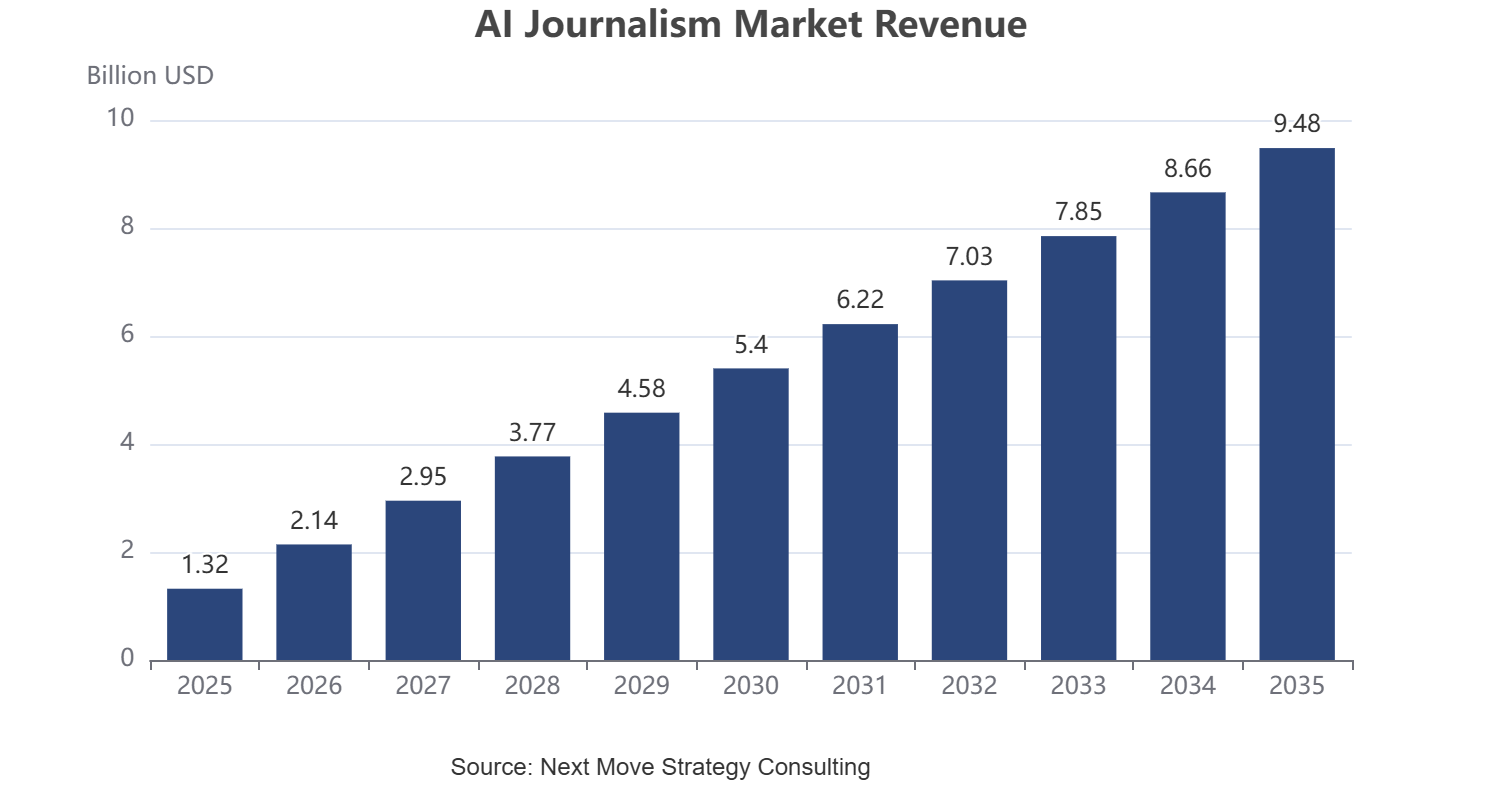
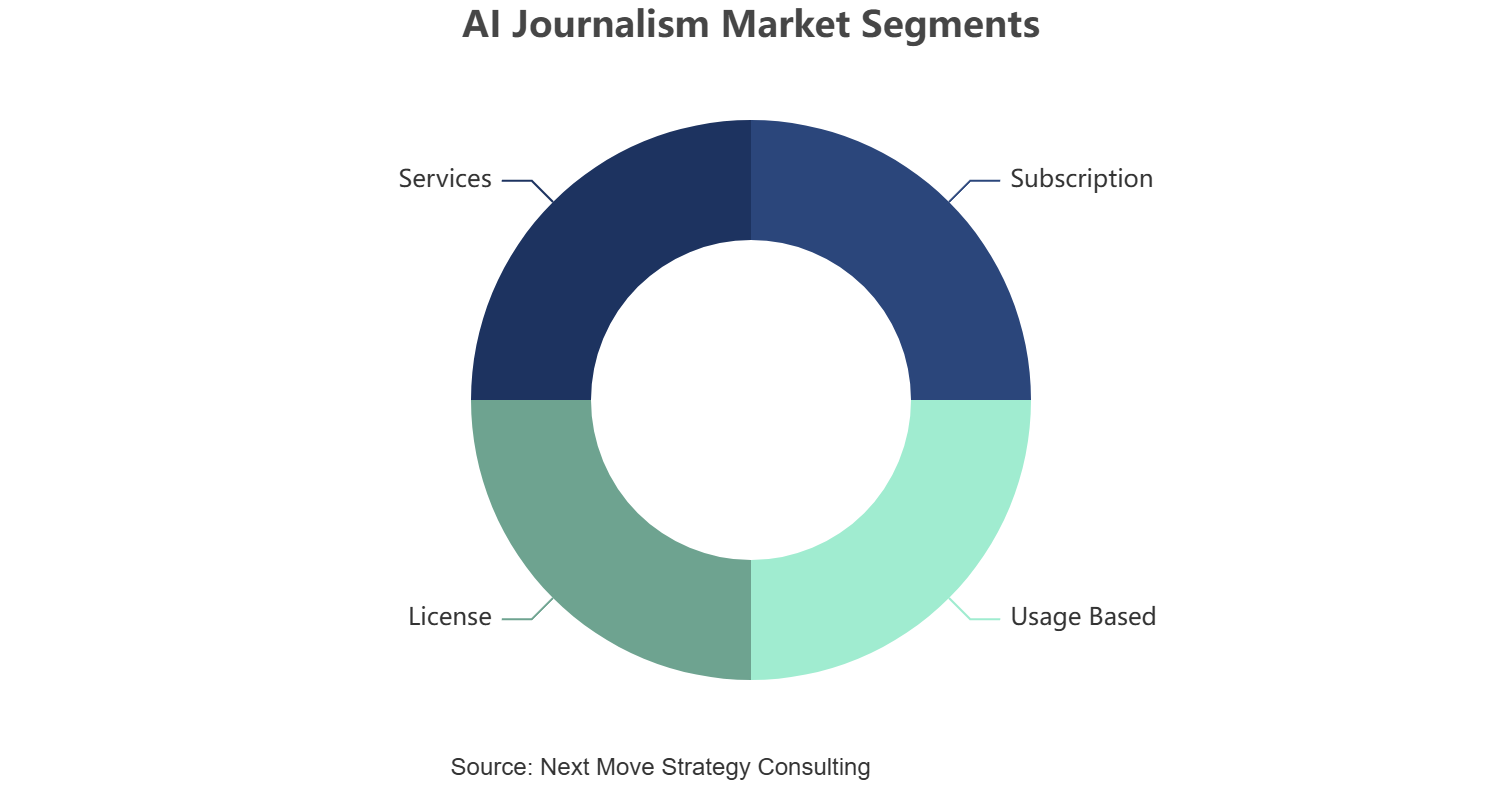
About the Author
 Liza Phukan
— Liza Phukan is Research Associate at Next Move Strategy Consulting, where she has covered emerging industries and market research across sectors for 3.5 years. Her work includes analyzing industry developments, validating market data, and developing structured business content from research findings. She uses secondary research and data-validation practices to turn complex market information into clear decision-useful market analysis for business audiences and support report development and B2B.
Liza Phukan
— Liza Phukan is Research Associate at Next Move Strategy Consulting, where she has covered emerging industries and market research across sectors for 3.5 years. Her work includes analyzing industry developments, validating market data, and developing structured business content from research findings. She uses secondary research and data-validation practices to turn complex market information into clear decision-useful market analysis for business audiences and support report development and B2B.
About the Reviewer
 Supradip Baul
— Supradip Baul is an accomplished business consultant and strategist with over a decade of rich experience in market intelligence, strategy, technology, and business transformation. His work has included rigorous qualitative and quantitative analysis across multiple industries, helping clients shape investment decisions and long-term roadmaps. Earlier in his career, he was associated with Gartner, where he contributed to industry-leading reports and market share analyses. He has worked with leading global companies and holds an MBA with a dual specialization in Marketing and Finance.
Supradip Baul
— Supradip Baul is an accomplished business consultant and strategist with over a decade of rich experience in market intelligence, strategy, technology, and business transformation. His work has included rigorous qualitative and quantitative analysis across multiple industries, helping clients shape investment decisions and long-term roadmaps. Earlier in his career, he was associated with Gartner, where he contributed to industry-leading reports and market share analyses. He has worked with leading global companies and holds an MBA with a dual specialization in Marketing and Finance.
At Next Move Strategy Consulting, we understand that insightful market research is the cornerstone of successful business decisions. That's why we employ a robust and multifaceted approach, combining various methodologies to deliver the most accurate and actionable data for our clients.

Research Landscape
We navigate the world of research with two primary approaches:
Qualitative Approach
Our qualitative research methodologies involve immersive techniques such as in-depth interviews, focus groups, and observational studies. By engaging directly with individuals and stakeholders, we uncover valuable insights that quantitative data alone may overlook.

Quantitative Research
In tandem with qualitative methodologies, NMSC leverages the power of Quantitative Research to provide a robust foundation of numerical insights. Through systematic data collection and analysis, we quantify patterns, preferences, and market trends, offering a comprehensive view of the business landscape.
Our quantitative research approach employs diverse tools, including surveys, experiments, and statistical modelling. These methodologies enable us to gather data from a large and representative sample, ensuring the statistical significance of our findings. By employing structured questionnaires and standardized data collection methods, we guarantee the reliability and validity of the information we present to our clients.
Quantitative research is particularly effective in measuring the prevalence of trends, assessing market size, and gauging the impact of various factors on consumer behavior. The numerical precision attained through this approach equips our clients with actionable insights, facilitating data-driven decision-making and strategy formulation.


Our Specialized Toolbox for Industry-Specific Market Research
We deploy a specialized arsenal of techniques tailored to meet your unique requirements. Here's a glimpse into our comprehensive toolbox:

Information Procurement
The stage entails acquiring market data or relevant information through various sources and methodologies.


Market Research Approach
We utilize both top-down and bottom-up approaches in market research analysis to achieve a comprehensive understanding of the market dynamics, leveraging the broad perspective of industry trends and macroeconomic factors alongside detailed insights from specific segments and individual companies.

Porters Five Forces Analysis
We conduct Porter's Five Forces analysis to evaluate the competitive landscape of an industry, providing us with insights into factors that affect profitability and strategic positioning.

SWOT Analysis

Forecasting
We utilize a forecasting model to predict future consumption by considering parameters like population, economics, regulations, market competition, drivers, constraints, technology, and pricing. We also employ statistical techniques such as multilinear regression, exponential smoothing, moving average, ARIMA, and Monte Carlo simulations for accurate predictions. In econometric forecasting, we analyzed short-term and long-term event impacts, attributing values based on regulatory frameworks, economic factors, and market events.





 Speak to Our Analyst