Augmented and Virtual Reality Market Global Industry Analysis and Forecast (2026-2035)

Augmented and Virtual Reality Market size was USD 110.8 billion in 2026, projected to reach USD 610.5 billion by 2035, growing at a CAGR of 20.9% from 2026 to 2035. Key drivers include rising standalone mixed reality headset adoption, expanding enterprise AI-native extended reality applications, and growing AR-enabled retail and e-commerce experiences, with North America leading the market.

Download Free Sample PDF
Base Year (2025)
$92.40 Billion
Forecast (2035)
$610.50 Billion
CAGR (2026-2035)
20.9%
Top Region
North America

What Is the Augmented and Virtual Reality Market Size?

The global augmented and virtual reality market size was valued at USD 92.4 billion in 2025 and is estimated at USD 110.8 billion in 2026, forecast to reach USD 610.5 billion by 2035, expanding at a 20.9% CAGR between 2026 and 2035. North America leads with approximately 40% share, while Hardware dominates all other components with approximately 58% share.

We observed that the growth is broad-based across every segmentation axis, with standalone mixed reality headset commercialization and enterprise training adoption driving the dominant structural shifts through 2035.

Augmented and Virtual Reality Market Global Industry Analysis and Forecast (2026-2035) Revenue Forecast

Values in USD Billion

2025 $92.40 Billion
2025
2026 $111.71 Billion
2026
2027 $135.06 Billion
2027
2028 $163.29 Billion
2028
2029 $197.41 Billion
2029
2030 $238.67 Billion
2030
2031 $288.56 Billion
2031
2032 $348.86 Billion
2032
2033 $421.78 Billion
2033
2034 $509.93 Billion
2034
2035 $610.50 Billion
2035

Key Takeaways

By Component: Hardware held the largest share of approximately 58% (USD 54.0 billion) in 2025; Software is the fastest-growing sub-segment at 23.2% CAGR from 2026–2035.

By Application: Gaming and Entertainment held the largest share of approximately 41% (USD 38.0 billion) in 2025; Retail and E-Commerce is the fastest-growing sub-segment at 23.4% CAGR from 2026–2035.

By End User: Consumer held the largest share of approximately 56% (USD 52.0 billion) in 2025; Enterprise is the fastest-growing sub-segment at 22.7% CAGR from 2026–2035.

Dominant Region: North America dominated with approximately 40% revenue share (USD 36.5 billion) in 2025.

Fastest-Growing Region: Asia-Pacific is expected to register the highest CAGR of 22.5% during 2026–2035.

Dominant Country: U.S. led with approximately USD 30.0 billion in 2025.

Fastest-Growing Country: India is the fastest-growing country at approximately 27.8% CAGR from 2026–2035.

Market Opportunity: The augmented and virtual reality market is expected to create an absolute dollar opportunity of USD 499.7 billion between 2026 and 2035, presenting significant investment potential across headset, smart glasses, and enterprise software channels.

According to Next Move Strategy Consulting analysis, device makers are increasingly bundling headsets and smart glasses with AI-native software platforms and subscription content libraries to deepen recurring revenue, a shift that favors ecosystem owners over component-only hardware suppliers as multimodal AI interaction becomes a standard expectation through 2035.

What Does the Augmented and Virtual Reality Market Encompass?

The augmented and virtual reality market encompasses hardware, software, and services that overlay digital content onto the physical world or immerse users in fully synthetic environments. Our assessment indicates that the scope spans head mounted displays, smart glasses, and supporting sensors and controllers, paired with operating systems, content, and development tools, supplied to consumers, enterprises, government and defense agencies, and educational institutions. The category has evolved from niche gaming peripherals into AI-native computing platforms, exemplified by Samsung's October 2025 launch of Galaxy XR, the first device built on the Android XR platform co-developed with Google and Qualcomm.
Regulatory environments remain largely shaped by data privacy oversight of spatial and biometric sensor capture rather than device-specific rules, while broader enterprise adoption of mixed reality platforms is accelerating deployment in training, manufacturing, healthcare, and retail settings. We observed that technology adoption is shifting toward multimodal AI interaction through voice, vision, and gesture, alongside lighter smart glasses form factors. Next Move Strategy Consulting's analysis indicates that this structural shift, combined with expanding developer ecosystems built on open standards, is redefining sourcing criteria across the augmented and virtual reality market.

CONSUMER BEHAVIOR ANALYSIS OF THE AUGMENTED AND VIRTUAL REALITY MARKET

CONSUMER BEHAVIOR ANALYSIS OF THE AUGMENTED AND VIRTUAL REALITY MARKET

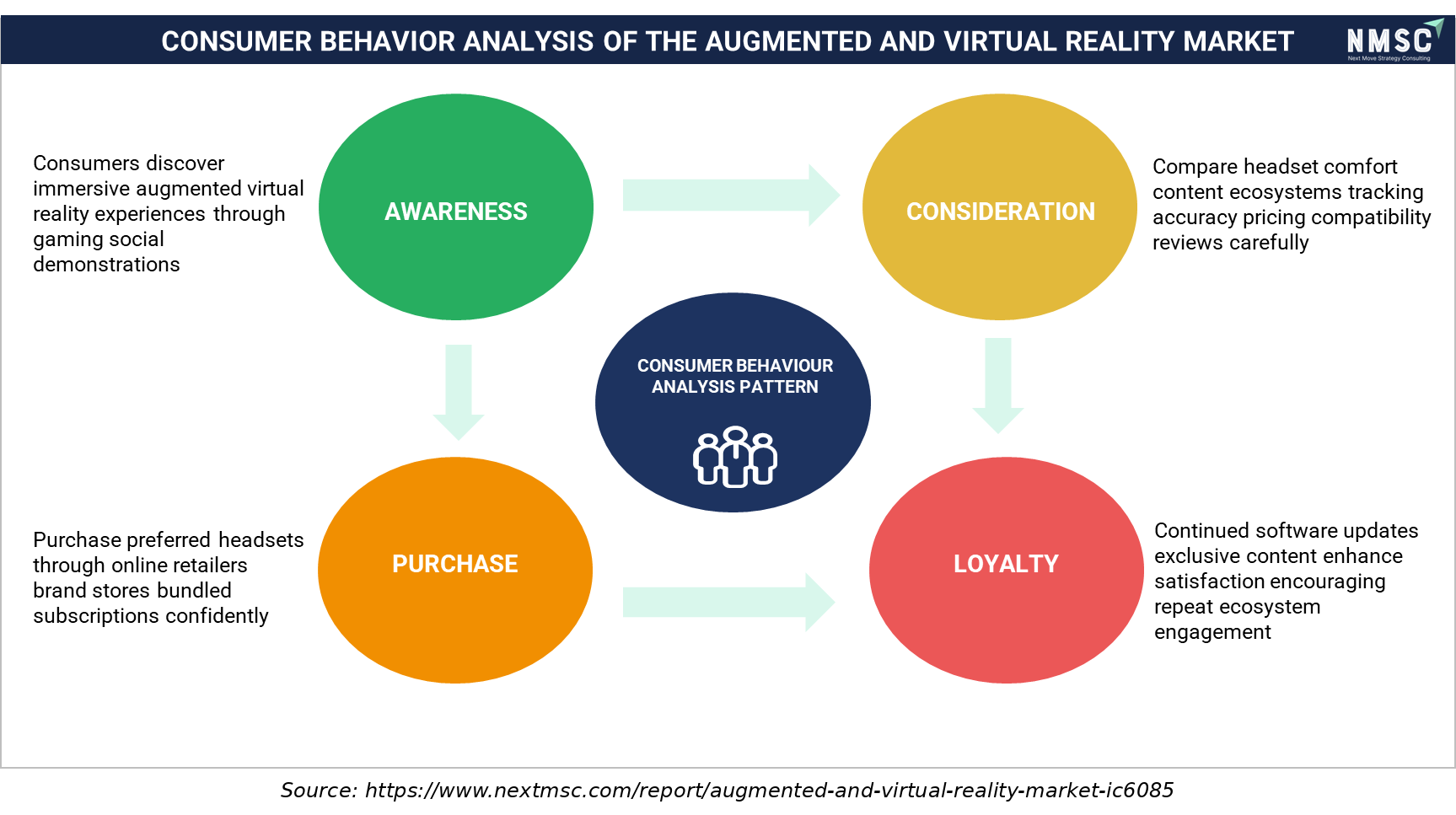
Consumer behaviour analysis in the Augmented and Virtual Reality (AR/VR) market illustrates the customer journey across four stages: awareness, consideration, purchase, and loyalty. Consumers discover immersive technologies through gaming, entertainment, social media, and product demonstrations before evaluating headset comfort, performance, compatibility, pricing, and content ecosystems. Purchasing decisions are influenced by trusted retailers and bundled offerings, while continuous software updates, exclusive content, and enhanced user experiences foster customer satisfaction, repeat purchases, and long-term ecosystem engagement.

Market Drivers & Dynamics

Interactive Dataset
Rising consumer adoption of standalone mixed reality headsets driver +3.2% Global 2026-2035
Expanding enterprise AR adoption for training and remote assistance driver +2.6% North America, Europe 2026-2035
Growth of AR-enabled retail try-on and e-commerce experiences driver +2.1% Global 2026-2035
Advances in smart glasses form factor and battery efficiency driver +1.6% Asia-Pacific, North America 2026-2032
Rising defense and aerospace simulation and training investment driver +1.2% North America, Europe 2026-2035
Expansion of 5G and edge computing supporting cloud rendering driver +0.8% Global 2026-2032
High device costs and limited content library depth restraint −1.3% Global 2026-2032
Motion sickness and user comfort limitations restraint −0.9% Global 2026-2030
Data privacy concerns over spatial and biometric sensor capture restraint −0.7% North America, Europe 2026-2035
Source: Next Move Strategy Consulting

Growth Drivers

What Is the Primary Growth Driver of the Augmented and Virtual Reality Market?

Rising consumer adoption of standalone mixed reality headsets is the primary driver of the market. Independent research firm IDC forecasts that worldwide shipments of augmented and virtual reality headsets and display-less smart glasses will increase by 39.2% in 2025 to 14.3 million units, a milestone reported alongside Meta's smart glasses expansion. We observed that this shipment growth, reinforced by falling entry-level price points, continues to anchor consumer demand across gaming, social, and productivity use cases.

How Is Enterprise AI Integration Driving Augmented and Virtual Reality Market Growth?

Expanding enterprise adoption of AI-native extended reality platforms for training and remote assistance is accelerating market growth toward device-managed, security-certified deployments. Our assessment indicates that Samsung's addition of Android Enterprise support to Galaxy XR in April 2026, enabling device management across training, manufacturing, healthcare, and retail deployments, is compressing enterprise adoption timelines. This pathway, combined with growing developer support for open standards, is expanding demand across North America and Europe.

Growth Inhibitors

What Is Restraining Augmented and Virtual Reality Market Expansion?

High device costs and limited content library depth restrain broader consumer adoption across the augmented and virtual reality supply chain. We found that premium standalone headsets remain priced from roughly USD 1,800 to more than USD 3,000, a cost point that confines near-term mainstream demand relative to smartphones. Smaller developers face particular exposure, as limited content budgets reduce their ability to build compelling applications compared with larger, platform-owning technology companies, delaying mass-market adoption.

Segmentation Analysis

2025 (USD Billion)
2035 (USD Billion)
Hardware 2025: $54.00 Billion | 2035: $320.00 Billion
Hardware
Software 2025: $26.00 Billion | 2035: $210.00 Billion
Software
Services 2025: $12.40 Billion | 2035: $80.50 Billion
Services
Hardware $54.00 Billion $320.00 Billion 19.5%
Software $26.00 Billion $210.00 Billion 23.2%
Services $12.40 Billion $80.50 Billion 20.6%

Which Component Segment Dominates the Augmented and Virtual Reality Market?

Hardware, encompassing head mounted displays and smart glasses, led the market with USD 54.0 billion in 2025, supported by sustained headset and glasses unit sales across consumer and enterprise channels. We observed that Software is the fastest-growing component, expanding at a 23.2% CAGR from 2026 to 2035, as AI-native platforms and expanding content libraries capture a growing share of ecosystem spending relative to one-time hardware purchases.

2025 (USD Billion)
2035 (USD Billion)
Gaming and e
Enterprise t
Healthcare
Retail and e
Education
Segment Item 2025 (USD Billion) 2035 (USD Billion) CAGR
Gaming and entertainment $10.0 USD Billion $40.0 USD Billion 25.0%
Enterprise training and industrial $17.1 USD Billion $51.1 USD Billion 11.0%
Healthcare $24.2 USD Billion $62.2 USD Billion 25.0%
Retail and e-commerce $31.3 USD Billion $73.3 USD Billion 11.0%
Education $38.4 USD Billion $84.4 USD Billion 16.0%

Segment-wise data is locked

Unlock complete segment-wise numbers for By Application.

Unlock Full Data

Which Application Leads Augmented and Virtual Reality Market Demand?

Gaming and Entertainment remained the leading application within the market, valued at USD 38.0 billion in 2025 on sustained VR gaming software and headset sales. Based on research conducted by Next Move Strategy Consulting, we found that Retail and E-Commerce is the fastest-growing application, registering a 23.4% CAGR from 2026 to 2035, as AR-enabled virtual try-on and product visualization tools gain adoption among online retailers.

2025 (USD Billion)
2035 (USD Billion)
Consumer
Enterprise
Government a
Education in
Healthcare p
Segment Item 2025 (USD Billion) 2035 (USD Billion) CAGR
Consumer $10.0 USD Billion $40.0 USD Billion 27.0%
Enterprise $17.1 USD Billion $51.1 USD Billion 9.0%
Government and defense $24.2 USD Billion $62.2 USD Billion 19.0%
Education institutions $31.3 USD Billion $73.3 USD Billion 17.0%
Healthcare providers $38.4 USD Billion $84.4 USD Billion 18.0%

Segment-wise data is locked

Unlock complete segment-wise numbers for By End User.

Unlock Full Data

Which End User Segment Is Most Widely Served in the Augmented and Virtual Reality Market?

Consumer remained the dominant end user, reaching USD 52.0 billion in 2025 due to sustained gaming, social, and everyday smart glasses adoption. Our findings suggest that Enterprise is the fastest-growing end user at a 22.7% CAGR from 2026 to 2035, reflecting rising deployment of device-managed extended reality platforms across training, manufacturing, healthcare, and retail workforce applications.

Growth Opportunities

Our analysis shows that three forward-looking opportunities stand out for stakeholders positioning within the augmented and virtual reality market over the 2026-2035 forecast period.

How Can AI-Native Smart Glasses Unlock Mainstream Consumer Adoption?

Lightweight, AI-native smart glasses present a whitespace opportunity for device makers seeking to move beyond niche headset audiences toward everyday wearable computing. Suppliers that commercialize display-equipped glasses at accessible price points stand to capture recurring software and content subscription sales as consumer end users shift toward all-day wearable form factors.

Where Does Enterprise Device Management Create New Demand?

Enterprises seeking secure, fleet-wide extended reality deployment create an opportunity for platform providers offering AR cloud-integrated device management and analytics. Early movers that secure validated enterprise-grade security certification can differentiate with manufacturing, healthcare, and retail buyers pursuing workforce-wide training and remote assistance deployment.

How Can Open Standards Expand Access for Independent Developers?

Open standards such as OpenXR and WebXR represent an underpenetrated opportunity for independent developers seeking to port content across competing hardware platforms without rebuilding for each device. Suppliers that support these standards natively can secure long-term developer loyalty and expanding content libraries, benefiting from recurring platform and marketplace revenue tied to cross-platform application growth.

STRATEGIC FRAMEWORK OF THE AUGMENTED AND VIRTUAL REALITY MARKET

STRATEGIC FRAMEWORK OF THE AUGMENTED AND VIRTUAL REALITY MARKET
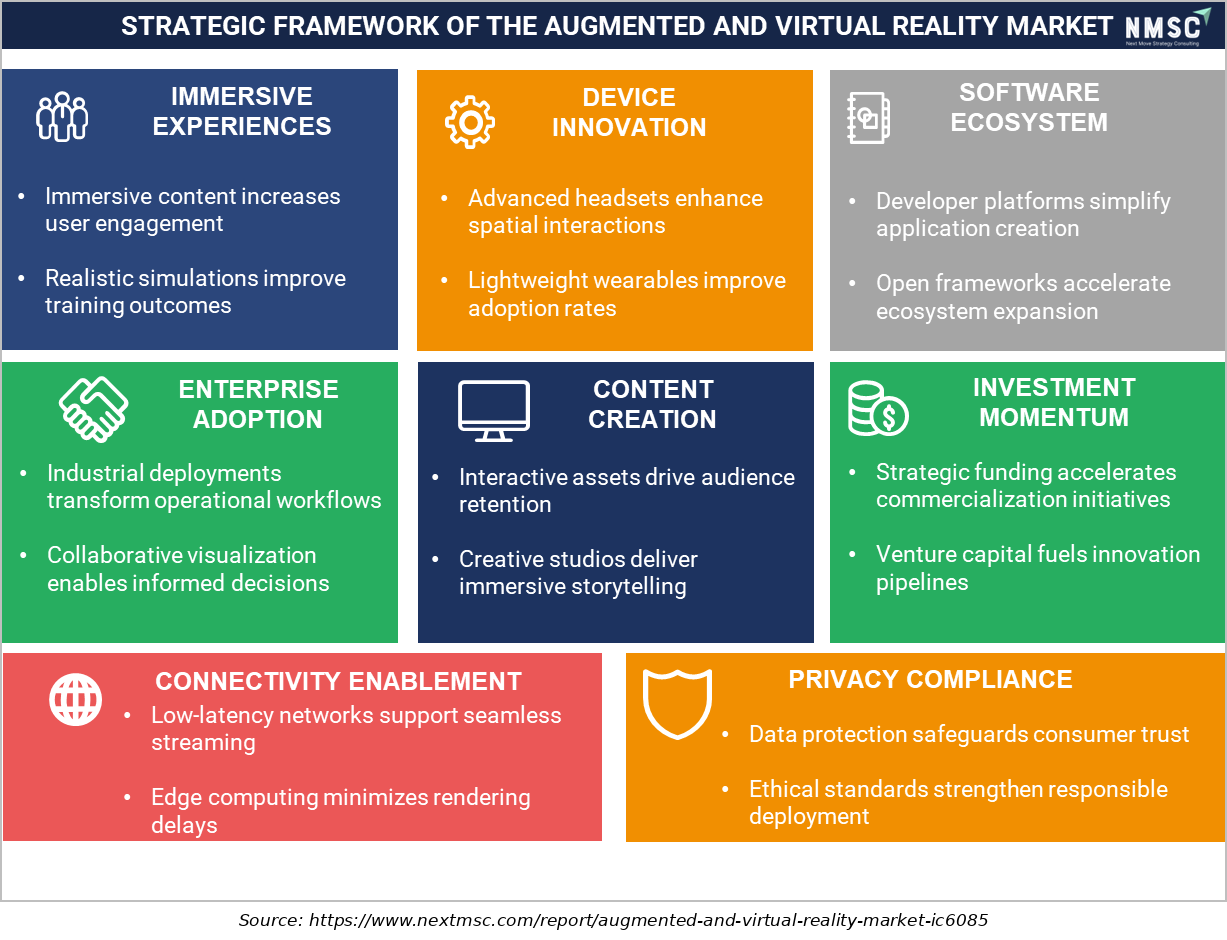
The strategic framework of the Augmented and Virtual Reality (AR/VR) market highlights the key pillars driving industry growth and commercialization. Advancements in immersive experiences, next-generation devices, and robust software ecosystems are accelerating technology adoption across consumer and enterprise applications. Increased enterprise deployment, innovative content creation, and strategic investments are expanding market opportunities, while high-speed connectivity and edge computing enhance user experiences. Furthermore, strong privacy and data protection practices are fostering consumer trust and supporting the responsible, scalable adoption of AR and VR technologies across diverse industries.

Regional Outlook

2025 (USD Billion)
2035 (USD Billion)
North Americ
Europe
Asia-Pacific
Middle East
Latin Americ
Region 2025 (USD Billion) 2035 (USD Billion) CAGR (%)
North America $10.0 USD Billion $40.0 USD Billion 9.0%
Europe $17.1 USD Billion $51.1 USD Billion 27.0%
Asia-Pacific $24.2 USD Billion $62.2 USD Billion 25.0%
Middle East & Africa $31.3 USD Billion $73.3 USD Billion 23.0%
Latin America $38.4 USD Billion $84.4 USD Billion 12.0%

Regional data is locked

Unlock complete regional numbers for this market.

Unlock Full Data

Competitive Landscape

We observed that the augmented and virtual reality market features a moderately consolidated competitive landscape, with diversified consumer technology platform owners competing alongside specialized enterprise and optics-focused developers on ecosystem breadth, AI integration, and form factor innovation.

Dimension Description
Market Structure Moderately consolidated; a small number of platform-owning technology companies account for a significant share of global augmented and virtual reality market revenue, while enterprise-focused and optics specialists serve targeted deployment niches.
Innovation Focus AI-native multimodal interaction, display-equipped smart glasses, and enterprise device management dominate current innovation pipelines across leading suppliers.
M&A Activity Platform partnerships and ecosystem co-development rather than large-scale mergers, exemplified by Samsung, Google, and Qualcomm's joint development of the Android XR platform and Galaxy XR device.

How Do Companies Compete in the Augmented and Virtual Reality Market?

Companies compete primarily on ecosystem breadth, AI integration, and form factor innovation across the industry. Global players such as Meta Platforms and Samsung Electronics leverage broad consumer distribution and platform partnerships to reach mainstream users, while specialized enterprise developers compete on device management, security certification, and vertical-specific content for training and industrial deployment.

Which Competitive Archetypes Dominate the Augmented and Virtual Reality Market?

Two archetypes dominate the market: diversified consumer technology platform owners offering integrated hardware-software-AI ecosystems, and specialized enterprise or optics-focused developers serving vertical deployment needs. Meta Platforms and Samsung Electronics exemplify the platform-owner archetype through vertically integrated device and AI ecosystems, while RealWear and Vuzix Corporation exemplify the enterprise-specialist archetype serving industrial and field-service end users.

How Are Companies Differentiating Through Innovation in Augmented and Virtual Reality?

Innovation and differentiation strategy increasingly center on AI-native interaction and lightweight form factors. Samsung's Galaxy XR multimodal AI platform and Meta's Ray-Ban Display glasses with Neural Band wristband both extend AI-driven interaction into mainstream wearable computing. Our analysis shows that suppliers unable to demonstrate credible AI integration and comfortable form factors risk exclusion from consumer and enterprise procurement shortlists as the category matures.

What M&A and Expansion Activity Is Shaping the Augmented and Virtual Reality Market?

Platform partnerships and international expansion continue to shape the competitive landscape within the industry. Samsung's joint development of Android XR with Google and Qualcomm, alongside Meta's planned early 2026 smart glasses expansion into Canada, France, Italy, and the UK, illustrates how platform owners pursue geographic expansion and cross-company ecosystem alliances across consumer and enterprise end markets.

Key Market Players

Our assessment indicates that the following 20 companies are actively shaping device innovation, platform development, and ecosystem strategy within the global augmented and virtual reality market.

Meta Platforms, Inc. Apple Inc. Sony Group Corporation [Samsung Electronics Co., Ltd.](file:///C:\Users\Mayurima%20Roy\Downloads\samsung.com\global\galaxy\galaxy-xr) HTC Corporation ByteDance Ltd. (PICO) Alphabet Inc. Microsoft Corporation Qualcomm Incorporated Valve Corporation Magic Leap, Inc. Varjo Technologies Oy Lenovo Group Limited XREAL Inc. RealWear, Inc. Vuzix Corporation Rokid Corporation Ltd Snap Inc. Niantic Spatial, Inc. Unity Software Inc.

Latest Developments

We found that recent product launches within the augmented and virtual reality market are concentrated on AI-native platforms and display-equipped smart glasses, reflecting the industry's broader shift toward everyday wearable computing.

Date Event
January 2024 Apple announced that its Apple Vision Pro spatial computer would become available in the U.S. beginning February 2, 2024, marking the commercial availability of Apple's first spatial computer powered by visionOS. Apple had originally unveiled Vision Pro in June 2023.

Investment Opportunities

What Capital Inflows Are Targeting the Augmented and Virtual Reality Market?

Capital inflows into the augmented and virtual reality market are increasingly directed toward AI-native platform development and smart glasses component supply chains. Strategic investors continue to fund ecosystem expansion, as seen in Samsung, Google, and Qualcomm's joint development of the Android XR platform. We observed that investors favor companies demonstrating validated multimodal AI integration, viewing platform partnerships as a proxy for long-term consumer and enterprise ecosystem retention.

How Is Infrastructure Investment Supporting Augmented and Virtual Reality Manufacturing?

Infrastructure investment is expanding display, optics, and sensor production capacity across Asia-Pacific and North America to serve rising headset and smart glasses demand. Manufacturers are scaling micro-OLED display and video game-content production to support both consumer and enterprise device architectures. Our findings suggest that regional developers are investing in automated assembly lines to improve consistency for products ranging from entry-level smart glasses to premium AI-native headsets.

What ESG Considerations Are Shaping Augmented and Virtual Reality Investment Decisions?

Environmental, social, and governance considerations are increasingly relevant to investment decisions across the industry, with data privacy safeguards for spatial and biometric sensor capture as a leading criterion. Meta has stated that on-device AI processing and end-to-end encryption protect certain user interactions on its smart glasses platform. We found that investors increasingly favor companies with transparent data-handling disclosures, treating it as a governance indicator alongside device safety compliance.

Key Benefits for Stakeholders

How Does This Report Benefit Enterprise and Industry Leaders?

Enterprise and industry leaders gain access to validated segmentation, competitive benchmarking, and regional demand forecasts that support product-portfolio decisions across the augmented and virtual reality industry. Our analysis shows that detailed component, application, and end-user breakdowns help procurement and product teams align specifications with AI integration and device-management requirements while identifying underserved segments for portfolio expansion.

How Does This Report Benefit Investors and Financial Analysts?

Investors and financial analysts benefit from consistent, single-point market size and CAGR estimates that support valuation and capital-allocation decisions across the augmented and virtual reality supply chain. We observed that the report's regional and segment-level growth differentials help identify which platform owners and component suppliers are best positioned to capture above-market growth in software and enterprise categories through 2035.

How Does This Report Benefit Technology Vendors and Product Teams?

Technology vendors and product teams gain insight into emerging design requirements, including multimodal AI interaction, lightweight smart glasses form factors, and open standards support, that are reshaping the industry. Our findings suggest that this analysis helps R&D teams prioritize development roadmaps around ecosystem interoperability and enterprise device management increasingly required by consumer and enterprise procurement processes.

Key Market Segments Evaluated

By Component

  • Hardware
  • Software
  • Services

By Application

  • Gaming and Entertainment
  • Enterprise Training and Industrial
  • Healthcare
  • Retail and E-Commerce
  • Education
  • Aerospace and Defense
  • Media and Live Events

By End User

  • Consumer
  • Enterprise
  • Government and Defense
  • Education Institutions
  • Healthcare Providers

Conclusion & Recommendations

The long-term outlook for the market remains positive, with global revenue projected to expand from USD 92.4 billion in 2025 to USD 610.5 billion by 2035 at a 20.9% CAGR. We observed that AI-native platform adoption, smart glasses commercialization, and enterprise training deployment will continue underpinning demand across consumer, enterprise, and government applications through the forecast period.

What Strategic Positioning Should Augmented and Virtual Reality Suppliers Pursue?

Suppliers should prioritize AI-native multimodal interaction while pursuing lightweight smart glasses form factors to secure long-term consumer and enterprise adoption. Our assessment indicates that companies investing early in open standards support and enterprise device management will be best positioned to capture premium pricing within the augmented and virtual reality market.

How Attractive Is the Augmented and Virtual Reality Market for New Investment?

The augmented and virtual reality industry presents an attractive investment case, supported by a USD 499.7 billion absolute dollar opportunity between 2026 and 2035 and above-average growth in Asia-Pacific and Software categories. We found that investment attractiveness is highest for companies combining AI-native platform ownership with scaled device manufacturing, positioning them to serve both consumer and enterprise buyer segments simultaneously.

What Market Shifts and Key Risks Should Stakeholders Monitor?

Stakeholders should monitor high device costs, motion sickness and comfort limitations, and data privacy scrutiny over spatial and biometric sensor capture as key risks to the augmented and virtual reality market. Our analysis shows that suppliers unable to reduce device costs and expand content libraries risk losing consumer attention to competing computing platforms, particularly as smartphones remain the default everyday device for most users.

What Are the Key Growth Pathways for the Augmented and Virtual Reality Market?

Key growth pathways include scaling AI-native smart glasses production, expanding enterprise device management capability, and deepening penetration into retail and healthcare application channels. Next Move Strategy Consulting's analysis indicates that suppliers pursuing these pathways while maintaining cost competitiveness in hardware will be best positioned to capture the augmented and virtual reality market's projected growth through 2035.

FAQs

About the Author

Liza Phukan

Liza Phukan

Liza Phukan is Research Associate at Next Move Strategy Consulting, where she has covered emerging industries and market research across sectors for 3.5 years. Her work includes analyzing industry developments, validating market data, and developing structured business content from research findings. She uses secondary research and data-validation practices to turn complex market information into clear decision-useful market analysis for business audiences and support report development and B2B.

About the Reviewer

Supradip Baul

Supradip Baul

Supradip Baul is an accomplished business consultant and strategist with over a decade of rich experience in market intelligence, strategy, technology, and business transformation. His work has included rigorous qualitative and quantitative analysis across multiple industries, helping clients shape investment decisions and long-term roadmaps. Earlier in his career, he was associated with Gartner, where he contributed to industry-leading reports and market share analyses. He has worked with leading global companies and holds an MBA with a dual specialization in Marketing and Finance.

Download Free Sample

Henri Knyphausen

HENRI KNYPHAUSEN

Partner at Singulier [Ex-BCG]

Singulier

I recently engaged NEXTMSC.com for a commercial due diligence project within the intralogistics sector, and I am pleased to provide a reference based on my experience. In utilizing NEXTMSC.com's services, I found their report to offer valuable insights into market dynamics and key industry players. The initial report provided a solid foundation for our analysis. However, as we were investigating a smaller target in the market, and I had specific customization requests requiring additional research. These requests included detailed information on product portfolios of various players and sub-market sizes, both inclusive and exclusive of certain product categories. NEXTMSC.com demonstrated commendable responsiveness and agility in accommodating these customization requests. Within a timeframe of 1-2 weeks, they delivered a revised report that met our specific needs. Furthermore, they were receptive to my follow-up inquiries, ensuring clarity and understanding of the data provided. The final deliverable significantly contributed to our due diligence efforts. One of NEXTMSC.com's notable strengths lies in their qualitative research capabilities. However, for future engagements, I would recommend the inclusion of a quantified market model in Excel format. Such a model would offer the ability to conduct in-depth analyses and explore various market segments, including country-specific data and subcomponent breakdowns. Based on my positive experience, I would not hesitate to work with NEXTMSC.com again. Their responsiveness, willingness to accommodate customization requests, and commitment to delivering actionable insights make them a reliable partner for commercial research projects.


Mohit Agarwal

MOHIT AGARWAL

Chief Manager

DryChem India Pvt. Ltd.

Next Move Strategy Consulting is an amazing team of consultants. We required a market study report for our investors on top priority and the team went above and beyond our expectations to deliver the same with ample supporting data within a short time span enabling us to secure the investments and keep our project timeline maintained. Their professionalism, attention to detail, and timely delivery of actionable recommendations have left a lasting impression on our organization.

Kevin Coker

KEVIN COKER

Founder, CEO and Board Diector

Proxima Clinical Research

I have been using Next MSC reports for product positioning in a new geography for a long time. They have by far the best reports I have found and the price is reasonable too!

Ross J Mckenzie

ROSS J MCKENZIE

Business Insight Manager

Staysure Group

“Next MSC have been incredibly helpful in providing detailed & robust information on our market, alongside quantifying growth by different segments. The process to procure was simple and easy, with sample reports and regular contact to ensure we had what we needed. Succinct detail on their sources & methodologies is also greatly received, allowing transparency in this respect helps build trust in the detail you pay for. Joseph in particular was fantastic, and helped ensure efficient provision of the insight pack – thank you NMSC!”.

Amos Chang

AMOS CHANG

Strategy Consultant

Kardex Group

I have bought the intralogistics market reports from NMSC two times so far. Joseph and his team are always very helpful and flexible in responding to any customization requirements on the report. Their expertise in market reports really helps us steer the day-to-day business. I will definitely recommend and come back myself whenever there is a need.

Custom Market Research Services

We will customize the research for you if the listed report does not fully match your requirements.

Get 30% Free Customization

Select License

This website uses cookies to ensure you get the best experience on our website. Learn more

✖