E-Sports and Gaming Tourism Market Global Industry Analysis and Forecast (2026-2035)

E-Sports and Gaming Tourism Market size was USD 10.5 billion in 2026, projected to reach USD 37.4 billion by 2035, growing at a CAGR of 15.2% from 2026 to 2035. Key drivers include expanding dedicated esports arena construction, rising publisher-led fan event programming, and growing integrated resort and esports organizer partnerships, with Asia-Pacific leading the market.

Download Free Sample PDF
Base Year (2025)
$9.10 Billion
Forecast (2035)
$37.40 Billion
CAGR (2026-2035)
15.2%
Top Region
Asia-Pacific

What Is the E-Sports and Gaming Tourism Market Size?

The global e-sports and gaming tourism market size was valued at USD 9.1 billion in 2025 and is estimated at USD 10.5 billion in 2026, forecast to reach USD 37.4 billion by 2035, expanding at a 15.2% CAGR between 2026 and 2035. Asia-Pacific leads with approximately 38% share, while integrated gaming resort tourism dominates all other offering types with approximately 34% share.

We observed that growth is broad-based across every segmentation axis, with dedicated esports arena development and publisher-led fan event expansion driving the dominant structural shifts through 2035.

E-Sports and Gaming Tourism Market Global Industry Analysis and Forecast (2026-2035) Revenue Forecast

Values in USD Billion

2025 $9.10 Billion
2025
2026 $10.48 Billion
2026
2027 $12.08 Billion
2027
2028 $13.91 Billion
2028
2029 $16.03 Billion
2029
2030 $18.46 Billion
2030
2031 $21.27 Billion
2031
2032 $24.50 Billion
2032
2033 $28.23 Billion
2033
2034 $32.52 Billion
2034
2035 $37.40 Billion
2035

Key Takeaways

By Offering Type: Integrated Gaming Resort Tourism held the largest share of approximately 34% (USD 3.09 billion) in 2025; Gaming Cruise Experiences is the fastest-growing sub-segment at 22.8% CAGR from 2026–2035.

By Event Type: International Championships held the largest share of approximately 32% (USD 2.91 billion) in 2025; Publisher Fan Events is the fastest-growing sub-segment at 19.9% CAGR from 2026–2035.

By Traveler Type: Spectators held the largest share of approximately 46% (USD 4.19 billion) in 2025; Content Creators is the fastest-growing sub-segment at 19.0% CAGR from 2026–2035.

By Customer Type: Individual held the largest share of approximately 52% (USD 4.73 billion) in 2025; Educational Institution is the fastest-growing sub-segment at 19.0% CAGR from 2026–2035.

By Booking Channel: Online Travel Agency held the largest share of approximately 30% (USD 2.73 billion) in 2025; Direct Organizer Website is the fastest-growing sub-segment at 17.8% CAGR from 2026–2035.

By Destination Type: Integrated Resort held the largest share of approximately 30% (USD 2.73 billion) in 2025; Esports Arena is the fastest-growing sub-segment at 18.1% CAGR from 2026–2035.

By Trip Duration: Short Stay held the largest share of approximately 52% (USD 4.73 billion) in 2025; Extended Stay is the fastest-growing sub-segment at 17.0% CAGR from 2026–2035.

By Price Tier: Midscale held the largest share of approximately 38% (USD 3.46 billion) in 2025; Premium is the fastest-growing sub-segment at 17.0% CAGR from 2026–2035.

Dominant Region: Asia-Pacific dominated with approximately 38% revenue share (USD 3.46 billion) in 2025.

Fastest-Growing Region: Latin America is expected to register the highest CAGR of 17.2% during 2026–2035.

Dominant Country: U.S. led with approximately USD 2.29 billion in 2025.

Fastest-Growing Country: China is the fastest-growing country at approximately 19.2% CAGR from 2026–2035.

Market Opportunity: The e-sports and gaming tourism market is expected to create an absolute dollar opportunity of USD 26.9 billion between 2026 and 2035, presenting significant investment potential across the dedicated esports arena and publisher fan event value chain.

According to Next Move Strategy Consulting analysis, integrated resort operators and esports organizers are increasingly co-developing destination packages that combine championship attendance with resort accommodation and entertainment programming, a shift that favors companies with proven cross-industry partnership capability over single-purpose venue operators as fan travel spending extends beyond event admission into multi-day destination experiences through 2035.

What Does the E-Sports and Gaming Tourism Market Encompass?

The e-sports and gaming tourism market encompasses integrated gaming resort tourism, event admission, event travel packages, gaming venue experiences, gaming camps, gaming cruises, and ancillary tourism purchases tied to competitive gaming and casino resort travel. Our assessment indicates that the scope spans international championships, professional league events, gaming festivals, and conventions attended by spectators, competitive players, professional teams, and content creators, booked through online travel agencies, direct organizer websites, and tour operators across integrated resorts, esports arenas, and convention centers worldwide.
Regulatory frameworks such as regional gaming and casino licensing authorities and event visa facilitation programs increasingly shape destination competitiveness and event hosting eligibility across the industry. We observed that technology adoption is shifting from traditional convention center bookings toward purpose-built esports arenas designed specifically for spectator experience and broadcast production. Next Move Strategy Consulting's analysis indicates that this structural shift, combined with expanding publisher-led fan event programming, is redefining destination development priorities across the e-sports and gaming tourism market.

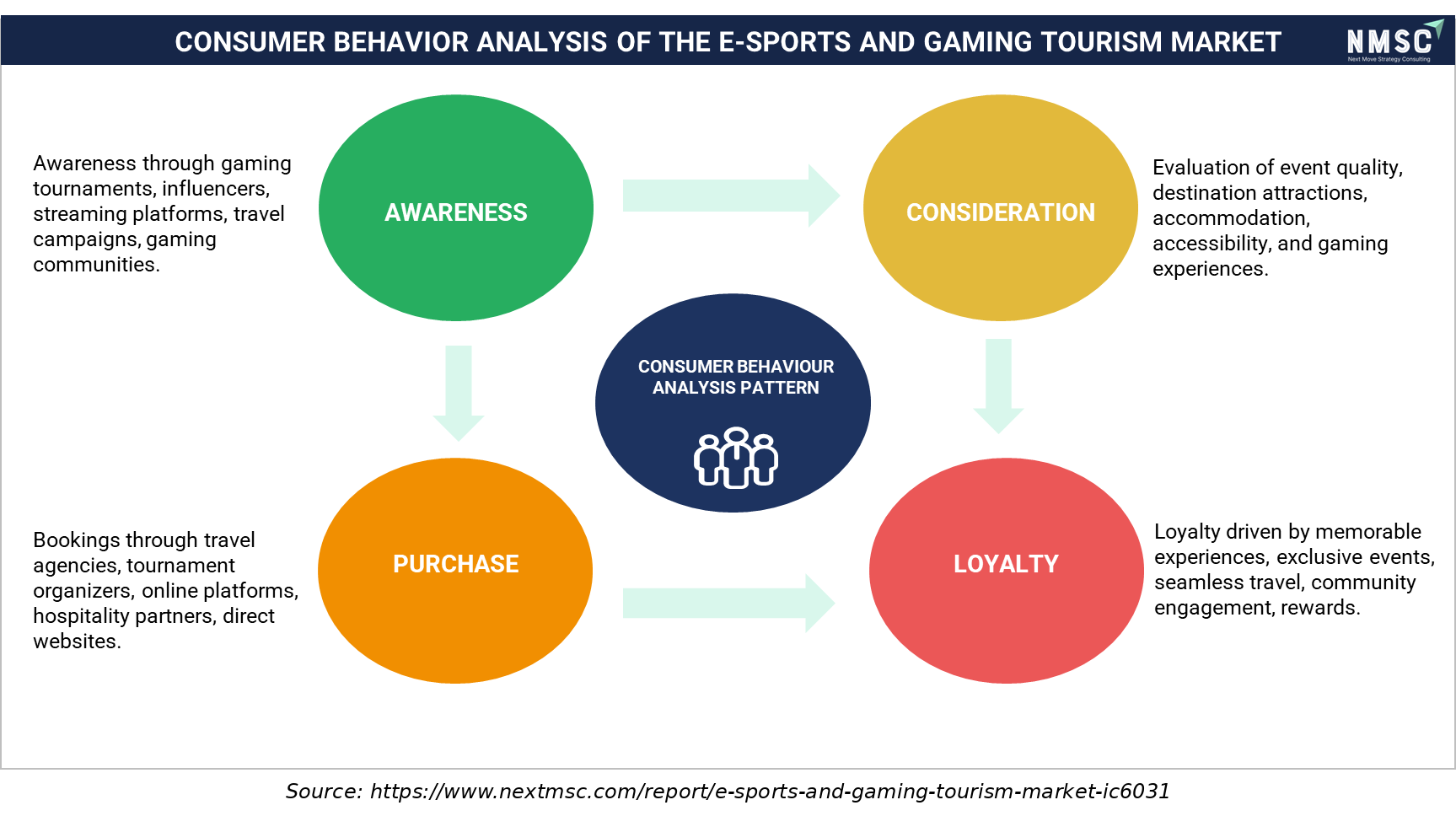
CONSUMER BEHAVIOR ANALYSIS OF THE E-SPORTS AND GAMING TOURISM MARKET

CONSUMER BEHAVIOR ANALYSIS OF THE E-SPORTS AND GAMING TOURISM MARKET

The figure illustrates the consumer behavior journey in the e-sports and gaming tourism market. Consumers first develop awareness through gaming tournaments, influencers, streaming platforms, travel campaigns, and gaming communities. During the consideration stage, they evaluate event quality, destination appeal, accommodation, accessibility, and gaming experiences. They then purchase travel packages through organizers or online platforms. Positive event experiences foster loyalty, encouraging repeat visits, community engagement, exclusive event participation, and long-term brand advocacy.

Market Drivers & Dynamics

Interactive Dataset
Expanding dedicated esports arena construction across major cities driver +2.6% Asia-Pacific, North America 2026-2035
Rising publisher-led fan event and festival programming driver +2.2% Global 2026-2035
Growing integrated resort and esports organizer cross-industry partnerships driver +1.8% Asia-Pacific, North America 2026-2035
Expanding content creator and influencer-driven event attendance driver +1.4% Global 2026-2035
Rising regional tournament circuit expansion into underserved markets driver +1.0% Latin America, Middle East & Africa 2026-2032
Growing corporate and educational institution esports engagement driver +0.7% North America, Europe 2026-2032
High venue construction and event hosting infrastructure costs restraint -1.4% Global 2026-2035
Visa and travel restriction complexity limiting international attendance restraint -0.9% Asia-Pacific, Middle East & Africa 2026-2032
Intensifying competition among destinations for recurring tournament hosting rights restraint -0.6% Global 2028-2035
Source: Next Move Strategy Consulting

Growth Drivers

What Is the Primary Growth Driver of the E-Sports and Gaming Tourism Market?

Expanding dedicated esports arena construction across major cities is the primary driver of the market. Multiple U.S. state and municipal economic development authorities continue to support convention and tourism infrastructure investment tied to major event hosting. We observed that this infrastructure-driven demand, reinforced by Allied Gaming & Entertainment Inc.'s continued operation of dedicated esports arena venues, continues to anchor baseline consumption of gaming venue experiences across developed and emerging tourism markets alike.

How Is Publisher-Led Fan Event Expansion Driving E-Sports and Gaming Tourism Market Growth?

Rising publisher-led fan event and festival programming is accelerating demand for integrated travel packages combining competition attendance with broader entertainment experiences. Next Move Strategy Consulting's analysis indicates that this programming-driven demand, combined with Riot Games, Inc.'s continued expansion of World Championship fan festival activities, is compressing adoption timelines for event travel packages among fans pursuing multi-day destination experiences beyond single-event admission.

Growth Inhibitors

What Is Restraining E-Sports and Gaming Tourism Market Expansion?

High venue construction and event hosting infrastructure costs restrain adoption speed across the industry, particularly for destinations without established convention or resort infrastructure. We found that cities pursuing recurring tournament hosting commitments face particular investment exposure, as dedicated esports arena construction requires substantial upfront capital compared with repurposing existing convention center or arena facilities for occasional gaming events.

Segmentation Analysis

2025 (USD Billion)
2035 (USD Billion)
Integrated Gaming Resort Tourism 2025: $3.09 Billion | 2035: $10.79 Billion
Integrated G
Event Travel Packages 2025: $1.64 Billion | 2035: $7.07 Billion
Event Travel
Event Admission 2025: $1.46 Billion | 2035: $5.95 Billion
Event Admiss
Gaming Venue Experiences 2025: $0.91 Billion | 2035: $4.15 Billion
Gaming Venue
Ancillary Tourism Purchases 2025: $0.73 Billion | 2035: $2.84 Billion
Ancillary To
Gaming Camp and Training Services 2025: $0.55 Billion | 2035: $2.61 Billion
Gaming Camp
Gaming Cruise Experiences 2025: $0.36 Billion | 2035: $2.67 Billion
Gaming Cruis
General Gaming Tourism Services 2025: $0.36 Billion | 2035: $1.34 Billion
General Gami
Integrated Gaming Resort Tourism $3.09 Billion $10.79 Billion 13.1%
Event Travel Packages $1.64 Billion $7.07 Billion 15.8%
Event Admission $1.46 Billion $5.95 Billion 15.1%
Gaming Venue Experiences $0.91 Billion $4.15 Billion 16.5%
Ancillary Tourism Purchases $0.73 Billion $2.84 Billion 14.5%
Gaming Camp and Training Services $0.55 Billion $2.61 Billion 17.1%
Gaming Cruise Experiences $0.36 Billion $2.67 Billion 22.8%
General Gaming Tourism Services $0.36 Billion $1.34 Billion 13.8%

Which Offering Type Dominates the E-Sports and Gaming Tourism Market?

Integrated Gaming Resort Tourism led the market with USD 3.09 billion in 2025, supported by the established scale of casino resort accommodation, entertainment, and gaming floor packages offered by major integrated resort operators. We observed that Gaming Cruise Experiences is the fastest-growing offering type, expanding at a 22.8% CAGR from 2026 to 2035, as cruise operators increasingly introduce dedicated gaming-themed voyages targeting competitive and casual gaming enthusiasts.

2025 (USD Billion)
2035 (USD Billion)
Internationa
Professional
Gaming Festi
Gaming Conve
Publisher Fa
Segment Item 2025 (USD Billion) 2035 (USD Billion) CAGR
International Championships $10.0 USD Billion $40.0 USD Billion 16.0%
Professional League Events $17.1 USD Billion $51.1 USD Billion 10.0%
Gaming Festivals $24.2 USD Billion $62.2 USD Billion 24.0%
Gaming Conventions $31.3 USD Billion $73.3 USD Billion 18.0%
Publisher Fan Events $38.4 USD Billion $84.4 USD Billion 25.0%

Segment-wise data is locked

Unlock complete segment-wise numbers for By Event Type.

Unlock Full Data
2025 (USD Billion)
2035 (USD Billion)
Spectators
Competitive
Professional
Content Crea
Media
Segment Item 2025 (USD Billion) 2035 (USD Billion) CAGR
Spectators $10.0 USD Billion $40.0 USD Billion 13.0%
Competitive Players $17.1 USD Billion $51.1 USD Billion 19.0%
Professional Teams $24.2 USD Billion $62.2 USD Billion 25.0%
Content Creators $31.3 USD Billion $73.3 USD Billion 15.0%
Media $38.4 USD Billion $84.4 USD Billion 24.0%

Segment-wise data is locked

Unlock complete segment-wise numbers for By Traveler Type.

Unlock Full Data

Which Traveler Type Leads E-Sports and Gaming Tourism Market Demand?

Spectators remained the dominant traveler type within the market, valued at USD 4.19 billion in 2025 on the broad global fan base traveling to attend live championship and league events. Our findings suggest that Content Creators is the fastest-growing traveler type, registering a 19.0% CAGR from 2026 to 2035, as streaming and social media personalities increasingly travel to events for content production, drawing dedicated hospitality and access packages from organizers.

2025 (USD Billion)
2035 (USD Billion)
Individual
Group
Corporate
Government
Educational
Segment Item 2025 (USD Billion) 2035 (USD Billion) CAGR
Individual $10.0 USD Billion $40.0 USD Billion 12.0%
Group $17.1 USD Billion $51.1 USD Billion 18.0%
Corporate $24.2 USD Billion $62.2 USD Billion 16.0%
Government $31.3 USD Billion $73.3 USD Billion 14.0%
Educational Institution $38.4 USD Billion $84.4 USD Billion 9.0%

Segment-wise data is locked

Unlock complete segment-wise numbers for By Customer Type.

Unlock Full Data
2025 (USD Billion)
2035 (USD Billion)
Direct Organ
Event Organi
Online Trave
Travel Agenc
Corporate Sa
Segment Item 2025 (USD Billion) 2035 (USD Billion) CAGR
Direct Organizer Website $10.0 USD Billion $40.0 USD Billion 24.0%
Event Organizer Sales $17.1 USD Billion $51.1 USD Billion 26.0%
Online Travel Agency $24.2 USD Billion $62.2 USD Billion 16.0%
Travel Agency and Tour Operator $31.3 USD Billion $73.3 USD Billion 10.0%
Corporate Sales $38.4 USD Billion $84.4 USD Billion 9.0%

Segment-wise data is locked

Unlock complete segment-wise numbers for By Booking Channel.

Unlock Full Data
2025 (USD Billion)
2035 (USD Billion)
Integrated R
Esports Aren
Convention C
Exhibition V
Gaming Cente
Segment Item 2025 (USD Billion) 2035 (USD Billion) CAGR
Integrated Resort $10.0 USD Billion $40.0 USD Billion 27.0%
Esports Arena $17.1 USD Billion $51.1 USD Billion 9.0%
Convention Center $24.2 USD Billion $62.2 USD Billion 19.0%
Exhibition Venue $31.3 USD Billion $73.3 USD Billion 21.0%
Gaming Center $38.4 USD Billion $84.4 USD Billion 18.0%

Segment-wise data is locked

Unlock complete segment-wise numbers for By Destination Type.

Unlock Full Data

Which Destination Type Is Most Widely Visited for E-Sports and Gaming Tourism?

Integrated Resort remained the dominant destination type, reaching USD 2.73 billion in 2025 due to the established scale and global distribution of major casino resort properties combining accommodation, entertainment, and gaming floor access. Based on research conducted by Next Move Strategy Consulting, we found that Esports Arena is the fastest-growing destination type at an 18.1% CAGR from 2026 to 2035, reflecting expanding dedicated venue construction purpose-built for competitive gaming spectatorship.

2025 (USD Billion)
2035 (USD Billion)
Day Trip
Short Stay
Extended Sta
Segment Item 2025 (USD Billion) 2035 (USD Billion) CAGR
Day Trip $10.0 USD Billion $40.0 USD Billion 8.0%
Short Stay $17.1 USD Billion $51.1 USD Billion 14.0%
Extended Stay $24.2 USD Billion $62.2 USD Billion 20.0%

Segment-wise data is locked

Unlock complete segment-wise numbers for By Trip Duration.

Unlock Full Data
2025 (USD Billion)
2035 (USD Billion)
Economy
Midscale
Premium
Luxury
Segment Item 2025 (USD Billion) 2035 (USD Billion) CAGR
Economy $10.0 USD Billion $40.0 USD Billion 26.0%
Midscale $17.1 USD Billion $51.1 USD Billion 24.0%
Premium $24.2 USD Billion $62.2 USD Billion 14.0%
Luxury $31.3 USD Billion $73.3 USD Billion 12.0%

Segment-wise data is locked

Unlock complete segment-wise numbers for By Price Tier.

Unlock Full Data

Growth Opportunities

Our analysis shows that three forward-looking opportunities stand out for stakeholders positioning within the e-sports and gaming tourism market over the 2026-2035 forecast period.

How Can Combined Resort-Arena Packages Unlock Value for Integrated Resort Operators?

Combined resort-arena packages present a whitespace opportunity for integrated resort operators positioning ahead of accelerating dedicated esports venue construction. Operators that commercialize bundled accommodation and championship admission packages stand to capture premium spending as traveling fans increasingly prefer single-destination experiences over separately booked lodging and event tickets.

Where Do Content Creator Hospitality Programs Create New Demand?

Content creators traveling for event coverage represent an underpenetrated opportunity for organizers offering dedicated production-ready hospitality packages. Organizers that develop validated creator access tiers with broadcast-quality amenities can secure new sponsorship and content partnership revenue, benefiting from expanded event visibility as creators amplify attendance to their own audiences.

How Can Regional Circuit Development Benefit Underserved Market Organizers?

Organizers operating in underserved regional markets create an opportunity for establishing recurring tournament circuits that reduce international travel costs for competitors and fans. Early movers that validate sustainable regional event calendars can differentiate with local sponsors and government tourism boards, benefiting from expanding demand as regional competitive scenes mature toward international standards.

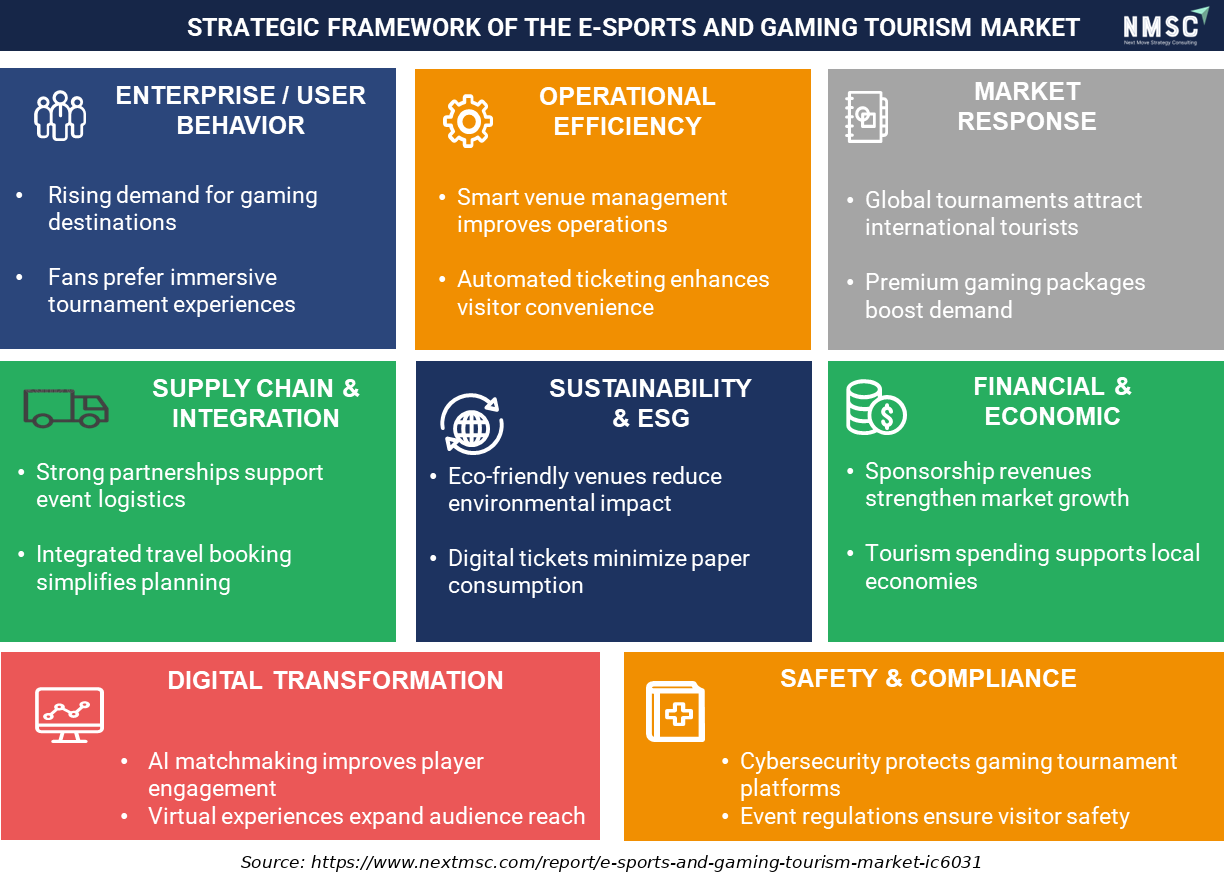
STRATEGIC FRAMEWORK OF THE E-SPORTS AND GAMING TOURISM MARKET

STRATEGIC FRAMEWORK OF THE E-SPORTS AND GAMING TOURISM MARKET
The figure presents the strategic framework of the e-sports and gaming tourism market, highlighting the key factors driving industry growth. Rising demand for immersive gaming destinations, smart venue management, and digital transformation enhance visitor experiences and operational efficiency. Strong partnerships, sustainable event practices, and cybersecurity measures support reliable event execution, while international tournaments, sponsorship revenues, and tourism spending stimulate economic development, positioning esports tourism as a rapidly expanding global travel and entertainment segment.

Regional Outlook

2025 (USD Billion)
2035 (USD Billion)
Asia-Pacific
North Americ
Europe
Middle East
Latin Americ
Region 2025 (USD Billion) 2035 (USD Billion) CAGR (%)
Asia-Pacific $10.0 USD Billion $40.0 USD Billion 9.0%
North America $17.1 USD Billion $51.1 USD Billion 27.0%
Europe $24.2 USD Billion $62.2 USD Billion 25.0%
Middle East & Africa $31.3 USD Billion $73.3 USD Billion 23.0%
Latin America $38.4 USD Billion $84.4 USD Billion 12.0%

Regional data is locked

Unlock complete regional numbers for this market.

Unlock Full Data

Competitive Landscape

We observed that the e-sports and gaming tourism market features a moderately fragmented competitive landscape, with integrated resort operators competing alongside specialized esports tournament organizers and convention operators.

Dimension Description
Market Structure Moderately fragmented; large integrated resort operators compete alongside specialized esports tournament organizers, convention operators, and regional gaming venue companies serving distinct destination and event segments.
Innovation Focus Dedicated esports arena development, publisher-led fan festival programming, and combined resort-arena destination packages dominate current innovation pipelines across leading operators.
M&A Activity Active cross-industry venue partnership exemplified by continued resort-arena co-development arrangements between integrated resort operators and esports venue specialists, reflecting industry-wide movement toward combined accommodation and competitive gaming destination offerings.

How Do Companies Compete in the E-Sports and Gaming Tourism Market?

Companies compete primarily on destination scale, tournament hosting track record, and cross-industry partnership capability across the industry. Large integrated resort operators such as Las Vegas Sands Corp. and MGM Resorts International leverage extensive accommodation and entertainment infrastructure to serve spectator and corporate guest customers, while specialized organizers such as ESL FACEIT Group and PGL Esports S.R.L. compete on tournament production expertise and competitive circuit reach supplied to spectators and competitive players.

Which Competitive Archetypes Dominate the E-Sports and Gaming Tourism Market?

Two archetypes dominate the market: large integrated resort operators offering combined accommodation, entertainment, and gaming floor packages, and specialized esports tournament organizers focused on competitive event production and fan engagement. MGM Resorts International and Genting Singapore Limited exemplify the integrated resort archetype, while ESL FACEIT Group and Riot Games, Inc. exemplify the specialized organizer archetype through dedicated tournament production and publisher-led event expertise.

How Are Companies Differentiating Through Innovation in E-Sports and Gaming Tourism?

Innovation and differentiation strategy increasingly center on dedicated venue infrastructure and cross-city tournament rotation. Riot Games, Inc.'s hosting of the League of Legends World Championship across three Chinese cities in 2025, followed by its planned 2026 rotation to three U.S. cities including the first international League of Legends competition in Texas, illustrates how publishers are strategically distributing hosting rights to expand fan travel demand across new destinations. Our analysis shows that organizers unable to demonstrate credible multi-city hosting capability risk losing premium event rights to competitors with proven production track records.

What M&A and Expansion Activity Is Shaping the E-Sports and Gaming Tourism Market?

Cross-industry venue partnerships and destination rotation strategy continue to shape competitive dynamics within the industry. Riot Games, Inc.'s rotation of its World Championship hosting rights between China and the United States illustrates how publishers leverage tournament placement to expand fan travel demand across new geographies, while integrated resort operators continue exploring dedicated gaming venue partnerships to capture younger demographic visitor segments beyond traditional casino floor revenue.

Key Market Players

Our assessment indicates that the following 20 companies are actively shaping destination development, tournament production, and cross-industry partnership strategy within the global e-sports and gaming tourism market.

Las Vegas Sands Corp. MGM Resorts International Caesars Entertainment, Inc. Galaxy Entertainment Group Limited Wynn Resorts, Limited Melco Resorts & Entertainment Limited Genting Singapore Limited Riot Games, Inc. ESL FACEIT Group BLAST ApS Koelnmesse GmbH (Gamescom) PGL Esports S.R.L. NODWIN Gaming Private Limited Wanyoo Esports Group Allied Gaming & Entertainment Inc. True Gamers Holding Team Liquid B.V. Gfinity PLC Super League Enterprise, Inc. OverActive Media Corp.

Latest Developments

We found that recent tournament hosting announcements within the e-sports and gaming tourism market are concentrated on multi-city destination rotation strategy.

Date Event
August 2025 BLAST signed a multi-year partnership with the Singapore Tourism Board (STB) to host four world-class arena esports events in Singapore. The partnership is designed to attract international esports fans, talent, media and commercial partners and strengthen Singapore's position as a leading global esports destination. The agreement is expected to support Singapore's tourism ecosystem and generate economic impact through visitor spending and related activity.
April 2025 BLAST and RISE Worldwide, a wholly owned subsidiary of Reliance Industries, formed a joint venture to expand esports operations in India. The partnership will bring BLAST's global esports properties to India and co-create new tournament IPs, supporting the growth of India's esports ecosystem through tournament management, marketing, production and broadcasting.

Expert Insights

Danny Tang

Co-Founder & CEO | Hero Esports

"The gaming industry has become one of the pillar markets in the internet industry and, in doing so, has become quite lucrative. The business model is also one of the best when it comes to monetization. Free-to-play models with in-game purchases drive long-term engagement, pushing developers to create compelling stories and experiences that retain their communities. This, in turn, fosters an environment where young talent is eager to enter the industry, making gaming and esports a key sector for future employment and innovation."

Analyst Interpretation

The statement highlights that gaming and esports have evolved into significant economic sectors that generate employment, technological innovation, and sustained consumer engagement. As governments and private stakeholders invest in esports arenas, global tournaments, gaming festivals, and destination-based entertainment, esports is increasingly becoming a catalyst for tourism growth. International competitions attract spectators, professional players, and gaming enthusiasts from across the world, creating demand for hotels, transportation, hospitality, retail, and local attractions. Consequently, the expansion of esports ecosystems is strengthening the e-sports and gaming tourism market by positioning host cities as global destinations for live gaming experiences and esports events.

Investment Opportunities

What Capital Inflows Are Targeting the E-Sports and Gaming Tourism Market?

Capital inflows into the e-sports and gaming tourism market are increasingly directed toward dedicated esports venue construction and multi-city tournament infrastructure. Integrated resort operators and publishers continue to fund venue development, as seen in continued dedicated esports arena investment across major tourism destinations. We observed that investors favor operators demonstrating credible multi-city hosting capability, viewing tournament rotation track record as a proxy for long-term destination competitiveness.

How Is Infrastructure Investment Supporting E-Sports and Gaming Tourism Deployment?

Infrastructure investment is expanding dedicated esports arena and convention capacity across destinations to support rising tournament hosting demand. Our findings suggest that municipal tourism authorities and integrated resort operators are investing in purpose-built venues combining broadcast production capability with spectator seating, supporting the production quality increasingly demanded by publishers selecting host cities for major championship events.

What ESG Considerations Are Shaping E-Sports and Gaming Tourism Investment Decisions?

Environmental, social, and governance considerations are increasingly relevant to investment decisions across the industry, with community economic impact and accessible event design as key criteria. Municipal tourism boards continue to evaluate event hosting bids based on local economic development impact alongside venue sustainability practices. We found that investors increasingly favor organizers demonstrating credible community engagement and accessible venue design, treating inclusive event access as a governance indicator alongside destination economic contribution.

Key Benefits for Stakeholders

How Does This Report Benefit Enterprise and Industry Leaders?

Enterprise and industry leaders gain access to validated segmentation, competitive benchmarking, and regional demand forecasts that support destination-development and partnership decisions across the e-sports and gaming tourism industry. Our analysis shows that detailed offering type, traveler type, and destination type breakdowns help venue and event teams align infrastructure investment with spectator and competitive player requirements while identifying underserved traveler segments for portfolio expansion.

How Does This Report Benefit Investors and Financial Analysts?

Investors and financial analysts benefit from consistent, single-point market size and CAGR estimates that support valuation and capital-allocation decisions across the e-sports and gaming tourism market supply chain. We observed that the report's regional and segment-level growth differentials help identify which operators and destination categories are best positioned to capture above-market growth in Esports Arena and Content Creator categories through 2035.

How Does This Report Benefit Technology Vendors and Product Teams?

Technology vendors and product teams gain insight into emerging design requirements, including broadcast-ready arena infrastructure, combined resort-arena packaging, and creator hospitality programs, that are reshaping the industry. Our findings suggest that this analysis helps venue development and event production teams prioritize roadmaps around multi-city hosting capability and cross-industry partnership increasingly required by publisher and organizer procurement processes.

Key Market Segments Evaluated

By Offering Type

  • Integrated Gaming Resort Tourism
  • Event Travel Packages
  • Event Admission
  • Gaming Venue Experiences
  • Ancillary Tourism Purchases
  • Gaming Camp and Training Services
  • Gaming Cruise Experiences
  • General Gaming Tourism Services

By Event Type

  • International Championships
  • Professional League Events
  • Gaming Festivals
  • Gaming Conventions
  • Publisher Fan Events
  • Non-Event Gaming Tourism

By Traveler Type

  • Spectators
  • Competitive Players
  • Content Creators
  • Corporate Guests
  • Professional Teams
  • Media

By Customer Type

  • Individual
  • Group
  • Corporate
  • Government
  • Educational Institution

By Booking Channel

  • Direct Organizer Website
  • Event Organizer Sales
  • Online Travel Agency
  • Travel Agency and Tour Operator
  • Corporate Sales
  • On-Site Sales

By Destination Type

  • Integrated Resort
  • Esports Arena
  • Convention Center
  • Mixed-Use Entertainment District
  • Exhibition Venue
  • Gaming Center
  • Gaming Attraction

By Trip Duration

  • Day Trip
  • Short Stay
  • Extended Stay

By Price Tier

  • Economy
  • Midscale
  • Premium
  • Luxury

Conclusion & Recommendations

The long-term outlook for the market remains strongly positive, with global revenue projected to expand more than fourfold from USD 9.1 billion in 2025 to USD 37.4 billion by 2035 at a 15.2% CAGR. We observed that sustained dedicated esports arena development, publisher-led fan event expansion, and growing content creator travel will continue underpinning demand across integrated resort and esports arena destinations through the forecast period.

What Strategic Positioning Should E-Sports and Gaming Tourism Operators Pursue?

Operators should prioritize dedicated venue infrastructure and cross-industry partnership capability while pursuing multi-city hosting track records to secure long-term publisher and organizer contracts. Next Move Strategy Consulting's assessment indicates that companies investing early in combined resort-arena packages and creator hospitality programs will be best positioned to capture premium positioning within the e-sports and gaming tourism market.

How Attractive Is the E-Sports and Gaming Tourism Market for New Investment?

The e-sports and gaming tourism industry presents a highly attractive investment case, supported by a USD 26.9 billion absolute dollar opportunity between 2026 and 2035 and above-average growth in Latin America and Gaming Cruise Experiences categories. We found that investment attractiveness is highest for operators combining established resort infrastructure with proven tournament hosting capability, positioning them to serve both established spectator and emerging content creator traveler segments simultaneously.

What Market Shifts and Key Risks Should Stakeholders Monitor?

Stakeholders should monitor high venue construction and hosting infrastructure costs, visa and travel restriction complexity, and intensifying destination competition as key risks to the e-sports and gaming tourism market. Our analysis shows that destinations unable to secure recurring tournament hosting commitments risk losing investment momentum to competitors with proven multi-city rotation track records and established publisher relationships.

What Are the Key Growth Pathways for the E-Sports and Gaming Tourism Market?

Key growth pathways include expanding dedicated esports arena construction, scaling publisher-led fan festival programming, and deepening penetration into Latin American and Asia-Pacific regional tournament circuits. Next Move Strategy Consulting's analysis indicates that operators pursuing these pathways while maintaining cross-industry partnership discipline will be best positioned to capture the e-sports and gaming tourism market's projected growth through 2035.

FAQs

About the Author

Liza Phukan

Liza Phukan

Liza Phukan is Research Associate at Next Move Strategy Consulting, where she has covered emerging industries and market research across sectors for 3.5 years. Her work includes analyzing industry developments, validating market data, and developing structured business content from research findings. She uses secondary research and data-validation practices to turn complex market information into clear decision-useful market analysis for business audiences and support report development and B2B.

About the Reviewer

Supradip Baul

Supradip Baul

Supradip Baul is an accomplished business consultant and strategist with over a decade of rich experience in market intelligence, strategy, technology, and business transformation. His work has included rigorous qualitative and quantitative analysis across multiple industries, helping clients shape investment decisions and long-term roadmaps. Earlier in his career, he was associated with Gartner, where he contributed to industry-leading reports and market share analyses. He has worked with leading global companies and holds an MBA with a dual specialization in Marketing and Finance.

Download Free Sample

Diana Trejo

DIANA TREJO

Assistant Manager

Sumitomo Corporation de Mexico, S.A. de C.V.

Recently, we purchased a report on the Mexico Data Center Market from Next Move Strategy Consulting. The service has been excellent, with support that is always timely and thoroughly professional. The information provided is interesting, highly useful, and delivered with clarity. I would highly recommend NextMSC for anyone seeking insightful and dependable analysis.

Nishant Awate

NISHANT AWATE

Business Development Global Sales

Zehnder Group Deutschland GmbH

Our experience working with Next Move Strategy Consulting was positive. The team was responsive, professional, and open to incorporating our specific requirements throughout the project. The India AHU market study was comprehensive and well structured, covering market value and volume forecasts, product and application segments, and key industry trends. The inclusion of both AHU and residential MVHR market insights made the study particularly relevant for our strategic market assessment. Overall, the report provides a solid foundation for evaluating market potential, identifying priority segments, and supporting business-development decisions in India.

Rishabh Jogani

RISHABH JOGANI

Strategy Analyst

Accenture Japan

We are incredibly impressed with the market report on the real estate market in India provided by Next Move Strategy Consulting. The report was thorough, insightful, and well-structured, offering deep analysis and actionable recommendations. It not only captured the current trends and dynamics but also provided a forward-looking perspective that has been invaluable for our strategic planning. Their team demonstrated exceptional professionalism, attention to detail, and a profound understanding of the industry. The data-driven insights and clarity of presentation exceeded our expectations, making complex market trends easy to understand. We highly recommend Next Move Strategy Consulting to anyone looking for reliable and comprehensive market research services. Their expertise has given us the confidence to navigate the complexities of the Indian real estate market with clarity and foresight.

Semih Kavaklioglu

SEMIH KAVAKLIOGLU

Co-Founder & Sales Manager

Decortie

I work a lot in the marketing industry and I know that research is an essential part of any campaign. I have used Market research reports for my own products and I found them to be very informative and well-researched. The team here produces insightful reports for a good price

Gustaf Hummel Burstrom

GUSTAF HUMMEL BURSTROM

Founder

Revline Tools AB

Joseph and the team at Next Move Strategy Consulting have been excellent to work with, in supplying us with relevant market data and forecasts for our specific category. We had some special requirements and they were able to do a custom package to suit our needs. We would definitely recommend them to any other company needing market data and forecasts

Custom Market Research Services

We will customize the research for you if the listed report does not fully match your requirements.

Get 30% Free Customization

Select License

This website uses cookies to ensure you get the best experience on our website. Learn more

✖